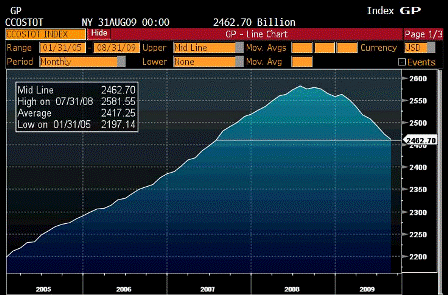
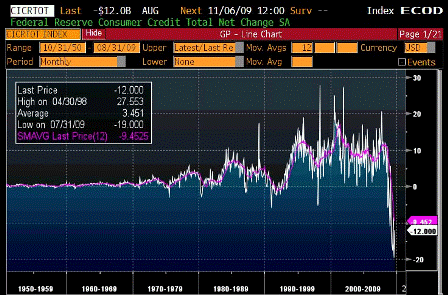
Total Credit decline from $2,475 billion to $2,463


[Skip to the end]

Two things:

1. Sales remain soft.
2. The federal deficit spending facilitates the same amount of sales with less credit.

>   
>   (email exchange)
>   
>   On Sun, Jul 12, 2009 at 9:20 AM, Dave wrote:
>   
>   Yet another month where the decline in consumer credit comes in worse than
>   expected: Total Credit decline from $2,475 billion to $2,463, with the bulk
>   of the $12 billion decline consisting of Revolving Credit reduction, or $10
>   billion, to $900 billion. Total consumer credit is now back to July 2007
>   levels… and the decline has yet to decelerate. This is the seventh straight
>   month of consumer credit declines.
>   


[top]

German Industrial Output Increased in August After July Decline


[Skip to the end]

This seems to be the current pattern of many stats.

Up a little from the last report, about as expected, but still way down vs last year as the output gap continues neat the wides.


German Industrial Output Increased in August After July Decline

Oct. 8 (Bloomberg) — German industrial output rose in August as domestic stimulus measures and improved global trade lifted demand.

Production rose 1.7 percent from July, when it fell a revised 1.1 percent, the Economy Ministry in Berlin said today.

Economists had forecast an increase of 1.8 percent, according to the median of 36 forecasts in a Bloomberg survey. From a year earlier, production declined 16.8 percent when adjusted for the number of work days.


[top]

Blanchflower


[Skip to the end]

>   
>   (email exchange)
>   
>   On Thu, Oct 8, 2009 at 7:55 AM, wrote:
>   
>   Check Blanchflower comments … he’s pretty good on the deficit and QE as well.
>   

Yes, refreshing!


Blanchflower Says Now Is Not the Time to Cut Government Deficit

Oct. 8 (Bloomberg) — Former Bank of England policy maker David Blanchflower said it was too soon to cut Britain’s deficit and its debt. “Clearly you need to control the debt, but now?,” he said in an interview with Bloomberg Television today. “I don’t really think so.”

Blanchflower also said the aim of quantitative easing was to raise some asset prices and to restore confidence.


[top]

Ritzholtz Blog


[Skip to the end]


Mosler: PAYROLL TAX HOLIDAY

Warren Mosler, economist, perturbed by the misunderstanding of monetary policy by the current and past administrations, is running for President in 2012. He has been speaking at the Tea Parties, explaining to taxpayers that Washington is either at best ignorant of economic policy or at worst deceptive.

~~~~

Federal Reserve Chairman, Ben Bernanke, has indicated that the economy is improving and the recession is ending. The media informs us that the stock market has added $2 trillion to national wealth since the market lows in March 2009. However, the stock market is still more than $2 trillion from its previous high in 2008 and real estate values are down $6 trillion and still declining. Not only has nominal wealth evaporated, but incomes are also treading heavy water. The Government informs us that unemployment is up to 9.8% with the only ‘good news’ being that the rate of job loss has declined. In July, there were only 2.6 million jobs available for 14.5 unemployed.

Also many are working part time when they want full time jobs. Americans are taking lower paying jobs and incomes are on the decline, especially when adjusted for the massive bonuses paid to bank employees and CEOs. The Department of Labor reported that young Americans (16 to 24 years old) have the highest unemployment rate ever (25.5%, although the New York Post has it at 53.4%). Regardless, America has a large and growing under utilization of labor among all age demographics.

At the same time, state tax collections have been declining and budgetary constraints (balanced budget requirements) are placing enormous pressures on state finances, especially California. In response, states and local municipalities are cutting jobs (teachers, policeman etc.), services, university, and infrastructure funding. Additionally, the states and municipalities are increasing taxes to gain the additional revenues.

The Administration and Congress are informing the public that everything is beginning to look good because of the trillions of dollars that they provided to repair the banks. The problem is that they have it backwards; the economy is best fixed from the bottom up rather than the top down.

In June 2008, Warren Mosler proposed three ‘bottom up’ policies to fix the economy. The first proposal is for a full Payroll Tax Holiday for both employees and employers. This stops the government from taking approximately $20 billion a week from people working for a living (a total of $600 per month for someone making $50,000 per year) rather than using that $20 billion to keep some bank limping along. The Government would still continue to credit the social security and the Medicare accounts, so employees and employers will never have to pay back the monies they received. The Payroll Tax Holiday would restore income to American workers (and businesses) to help make their loan payments, rents, pay bills, and sustain their households. The real economy would benefit as Americans both reduce debt and resume consumption. Banks will benefit because there will be fewer delinquencies and foreclosures in non fraudulent mortgages, which will also help limit home price declines. The Payroll Tax Holiday would also reduce corporate cost structures and help contain prices and inflation. The payroll tax is regressive (it is not graduated based on income like the income tax), so the Payroll Tax Holiday will benefit those in the lower income levels the most. This “People Power” solution will be far more effective than the Bush and Obama trickle down solution. And the Government can decide to end the Payroll Tax Holiday should the economy become too strong and inflation become a concern.

The second part of the proposal would to assist the states by providing them with $150 billion in revenue sharing on a per capita basis with no strings attached. This will help the states to fund operations, keep workers employed, provide necessary services and fund infrastructure projects.

The third part of the proposal would be to fund an $8/hr National Service job for anyone willing and able to work that includes full federal health care coverage. This, like the Payroll Tax Holiday, addresses unemployment from the ‘bottom up’ rather than the ‘top down’. A determination can be made as to what the jobs will be, but the goal is to improve America by providing useful output. It will also provide for a far superior price anchor, as it has been well documented that private employers more readily hire those already working over anyone who is unemployed. In 2001, Argentina introduced its Jefes de Jugar version of the Mosler Plan that employed nearly 2 million people that had never worked in the private sector, and within two years 750,000 moved up to private sector jobs.

If any of these proposals strikes a personal chord regarding how we can rebuild our economy, please forward them to your elected representatives in Washington. These are not proposals for out of control, top down, trickle down, Government spending on corporate welfare that insults the majority of Americans working for a living, but fundamental, proven, bottom up solutions that reward that vast majority of Americans that work for a living and struggling to make ends meet.


[top]

Krugman on monetary creation


[Skip to the end]


Still chasing shadows?

>   
>   (email exchange)
>   
>   On Wed, Oct 7, 2009 at 4:39 PM, Eric wrote:
>   
>   It’s hard to get it more backward than this:
>   

Yes, this is telling:

“The banks don’t need to sell securitized debt to make loans — they could start lending out of all those excess reserves they currently hold. ”

>   
>   He is asking good questions but with all the wrong reasoning.
>   

Agreed, thanks — waiting for the first Nobel prize that’s given to someone who actually understands basic monetary operations!


[top]

UN calling trade deficit a privilege


[Skip to the end]

Interesting! At least a small sign of the world beginning to figure it all out.

>   
>   The United Nations called on Tuesday for a new global reserve currency to end dollar
>   supremacy which has allowed the United States the “privilege” of building a huge trade
>   deficit.
>   


UN calls for new reserve currency

Oct. 6 (Breitbart) — The United Nations called on Tuesday for a new global reserve currency to end dollar supremacy which has allowed the United States the “privilege” of building a huge trade deficit.

“Important progress in managing imbalances can be made by reducing the reserve currency country?s ‘privilege’ to run external deficits in order to provide international liquidity,” UN undersecretary-general for economic and social affairs, Sha Zukang, said.

Speaking at the annual meetings of the International Monetary Fund and World Bank in Istanbul, he said: “It is timely to emphasise that such a system also creates a more equitable method of sharing the seigniorage derived from providing global liquidity.”

He said: “Greater use of a truly global reserve currency, such as the IMF?s special drawing rights (SDRs), enables the seigniorage gained to be deployed for development purposes,” he said.

The SDRs are the asset used in IMF transactions and are based on a basket of four currencies — the dollar, euro, yen and pound — which is calculated daily.

China had called in March for a new dominant world reserve currency instead of the dollar, in a system within the framework of the Washington-based IMF.


[top]

Geithner- more innocent subversion


[Skip to the end]

This is the party line and both sides agree.

We are our own worst enemy of our standard of living

As our real terms of trade continue to deteriorate.

How hard is it to understand that exports are real costs and imports real benefits???


Geithner Says Americans Will Have to Save More

Oct. 1 (Reuters) — Americans will have to save more in the future, transforming the global economy, and Europeans and Japanese must work to boost domestic demand, U.S. Treasury Secretary Timothy Geithner was quoted as saying on Wednesday.

“Everyone is going to have to come to terms with the fact that we are going to save more in the United States,” Geithner said in an interview with German weekly Die Zeit, conducted on Sunday in Istanbul, and due to appear on Oct. 8.

“If the U.S. starts saving more, that changes the whole world’s economic reality,” he said, according to the German text of the interview.

Geithner said China was already doing a lot to consider how to put growth on a more sustainable path.

“In China, the government is at the forefront of thinking about new ways to reduce the dependence of the economy on export and investments,” he said.

“But it is not just about the U.S. and China. Europe and Japan make up 40 percent of the global economy.”

Geithner said the U.S. could not force Europe to boost domestic demand to adapt to the new economic reality, but he saw it as the only viable strategy to guarantee lasting growth.

“They have to decide themselves how to adapt. I am not aware of any other strategy that promises success.”

He also said that the recovery was in a very early phase, and there were many risks ahead.

“If you look at past crises, politicians mostly made the mistake of tightening the purse strings too early,” he said.

“The private sector needs to start growing on its own for a sustainable recovery to take place.”


[top]

Investors Plan to Go Overweight Commodities, Credit Suisse Says


[Skip to the end]

Turning into a stampede?

People want it.

They are scared of the fed ‘printing money’ even in the face of obvious excess capacity?

Watch for storage costs to go up/contangos where there is not a monopolist setting price?

Good market for producers who sell forward, getting paid by investors paying up for forwards/storage?

Investors Plan to Go Overweight Commodities, Credit Suisse Says

By Chanyaporn Chanjaroen

Oct. 7 (Bloomberg) — More than half of investors surveyed
by Credit Suisse Group AG said they plan to hold an overweight
position in commodities in the next 12 months, double the
proportion with such a weighting now.

Of the 180 investors surveyed last month, 51 percent said
they expected to hold an overweight position in the next year,
34 percent a neutral weighting and 13 percent underweight. That
compares with 25 percent overweight now, 38 percent neutral and
30 percent underweight.

The most popular route for commodity investment will likely
be active indexes or funds, followed by exchange-traded funds,
according to the survey, e-mailed by the bank yesterday. Of
those surveyed, 44 percent were from hedge funds and 22 percent
from institutional funds.

The Reuters/Jefferies CRB Index of 19 commodities posted a
record 36 percent decline last year and rebounded 13 percent
this year. Assets under management at commodity hedge funds
increased 6 percent this year to $60.61 billion as of the end of
August, according to Hedgefund.net.

Expectations that inflation will accelerate and the dollar
weaken contributed to investor demand for commodities this year,
Kamal Naqvi, head of global commodity investor sales at Credit
Suisse in London, said by phone today.

Thirty-nine percent said natural gas would be the best
performer among energy products over the following 12 months,
with 32 percent picking crude oil.

Among industrial metals, 59 percent expected aluminum to be
the worst performer over the period, while 51 percent thought
copper would advance the most.


[top]

Fate of the US Dollar?


[Skip to the end]

I think they want to accumulate financial assets and would like to get a currency they could feel good about to do that.

And at the same time they want to net export.

The only way they could do that is to somehow ‘force’ us to borrow their new currency in order for us to net import from them.

It would be easier for them to instead come up with an inflation index and only sell their exports in exchange for financial assets linked to their new inflation index. As long as the financial assets are linked to their index the currency of denomination isn’t critical. But credit worthiness would be critical.

>   
>   (email exchange)
>   
>>   The following was printed in the Independent in the UK. Doesn’t this move
>>   threaten the US Dollar as the world’s reserve currency?
>   

Doesn’t matter what anything is ‘priced in’ as that is just a numeraire. What matters is what the ‘save in’ which determines trade flows.

>   
>   Interesting. A political move.
>   Seems a clumsy project though: they need to find a name for this ‘basket
>   currency’ (petrodollar?) and then accept payments in any ‘real’ currency
>   equivalent to the value of the ‘petrodollar’ at the time of payment.
>   Possible that all will continue to use dollars for payment.
>   Economic consequences will depend on whether this has any effect on the
>   willingness of foreigners to hold the given amount of dollars they own.
>   

>>   
>>   â€œIn the most profound financial change in recent Middle East history, Gulf
>>   Arabs are planning – along with China, Russia, Japan and France to end
>>   dollar dealings for oil, moving instead to a basket of currencies including
>>   the Japanese yen and Chinese yuan, the euro, gold and a new, unified
>>   currency planned for nations in the Gulf Co-operation Council, including
>>   Saudi Arabia, Abu Dhabi, Kuwait and Qatar. Secret meetings have already
>>   beenheld by finance ministers and central bank governors in Russia, China,
>>   Japan and Brazil to work on the scheme, which will mean that oil will no
>>   longer be priced in dollars.”
>>   


[top]