REINHART: Regarding Hilsenrath//+ Retail Sales

A number of people have inquired about this morning’s front page article in the WSJ by Jon Hilsenrath, “Fed Maps Exit from Stimulus.”

This seems constructed by Jon in a way that is very much reminiscent of the three-day inflation scare and talk of early exit he created last year. Note four points:

1. Jon does not have access to policy makers in the way the WSJ beat reporter once had. The days of Wessel and Ip are over. Bernanke was very reluctant to provide informal guidance to begin with, and the practice virtually ceased with the report of the Subcommittee on Communications at the beginning of last year. Essentially, they decided to speak authoritatively in FOMC statements and everyone was free to offer their own view in the public record after that, but not off camera.

2. The first two paragraphs are an extended, bloated, version of the single sentence in the statement that said “The Committee is prepared to increase or reduce the pace of its purchases to maintain appropriate policy accommodation as the outlook for the labor market or inflation changes.” Those paragraphs don’t say anything more than the Fed has a plan to do its job. This reminds me of the CNBC banner yesterday morning while Bernanke was giving his speech on financial stability. It said “BREAKING NEWS: THE FED IS MONITORING FINANCIAL STABILITY.” It would have been just as informative to run the banner “BREAKING NEWS: THE FED IS STILL IN BUSINESS.”

3. Note that the only two on-the-record, active voices are Charlie Plosser and Richard Fisher. Those two are probably last on the list of reliable co-conspirators for the core of the Committee that makes policy. But those quotes, plus the older Williams’ one, allows Jon to write “Fed officials” to make it sound like he has access to the second floor of the Board. It also lets him bring out the stale dealers survey.

4. Note the inconsistencies in the story. Fed officials want to put more volatility in the market by conveying that QE is a flexible, smoothly adjusting instrument. The problem is that this makes more sense if the effect of QE was on flows, not stocks, which they have studiously denied for four years. By the way, if those conspiring officials want to make clear it won’t be a slow, steady retreat of accommodation, than they better tell Janet Yellen to stop showing the optimal policy path. Good luck to that.

I believe the central message, which is what I have described in earlier notes: Fed officials want to put as much volatility as possible back into the market before starting to raise rates, provided financial conditions otherwise remain supportive to sustained expansion. They’ll take opportunities to do so on the back of an equity market rally. But Jon Hilsenrath is not the means they will do so.

Vincent


Karim writes:
RETAIL SALES

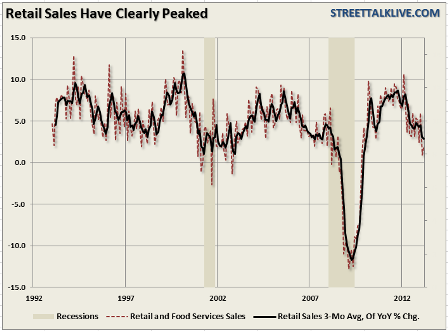
  • April retail Sales were strong both in terms of the actual advance and composition. Moreover upward revisions to the control group for Feb and March imply an upward revision to Q1 GDP from 2.5% to 2.8%.
  • The 0.5% advance in the control group for April was more impressive due to the breadth and composition of the gains. In particular, all the major discretionary spending categories were quite strong: electronics 0.8%, clothing/accessories 1.2%, sporting goods 0.5% and restaurants 0.8%.
  • As the chief economist of the ISCS commented the other day on chain store sales for April: It is most likely being boosted by a stronger household wealth effect from higher home and stock market prices. Although it was an improvement of recent months, the pace was still dampened by adverse seasonal weather,
  • With fiscal drag peaking this quarter, and private sector growth maintaining the momentum it has shown since Q4 of last year, its making 3-3.5% growth more plausible in the second half. Most dealer forecasts are still in the 2-2.25% area.

HILSENRATH

  • Technically, Reinhart is correct: Hilsenrath is not the mouthpiece for the Fed and this is not all new news.
  • But, he is piecing together a story that the Fed wants out there. That the last hiking cycle was too predictable in terms of both pace and size (25bps/meeting). So, the idea that they can taper a bit and skip a meeting; or taper a bit and taper at a greater pace at the next meeting, are ideas they probably want out there.
  • My guess is Bernanke outlines these concepts in greater detail next week at his JEC testimony (May 22) and that if we get another 175k or greater in private payroll growth plus another strong month in retail sales for May, we could see some tapering at the June meeting.
  • Also notable was Bernanke’s comment on Friday that the Fed is ‘looking closely for signs of excessive risk taking”.
Thaler’s Corner 04-22-2013 2013: And now?

Again, very well stated!

Thaler’s Corner

I must admit that I am at a loss for words these days. The analytical items at our disposal describe a situation so complex, given a myriad of contradictory influences, that I find it impossible to develop any sort of reasonable scenario.


I have spent a lot of time in recent weeks exchanging ideas and perceptions with academics, political officials and others in an effort to develop a coherent explanation of the events unfolding before us (Cyprus, wealth tax, etc.), but the conclusions are anything but conclusive!

Changes in financial securities will no longer be determined by purely economic factors but more and more by political decisions, such as whether or not to establish a real European banking union with all that implies in terms of cross-border budget transfer risks.

Whatever, lets take a look at the state of the real economy in the United Sates and Europe, given that it is still a bit early to draw any sort of conclusions about a third economic motor, Japan.

By the way, I strongly recommend that people check out the links in todays Macro Geeks Corner toward the end of the newsletter. It is interesting to see how two fairly divergent schools of thinking (the two first texts) end up with rather similar conclusions.

United States

In the United States, the economy is (logically) slowing as the effects of the Sequester slowly make themselves felt. Only the (increasingly discredited) partisans of Reinhold & Rogoffs constructive austerity thought it would not affect household consumption.

We had to wait for the hike in payroll taxes for the effect to be seen in retail sales figures, down 0.4% in March. Similarly, all the latest leading economic (PMI) and confidence indicators came in below expectations, which augurs for a soft patch in the US.

Moreover, the yens decline can only have a negative impact on America trade balance with Japan as it puts US exporters at a disadvantage, in particular, as they compete with their Japanese rivals on Asian markets. And the pitiful state of the European economy is not going to help this sector of the US economy either.

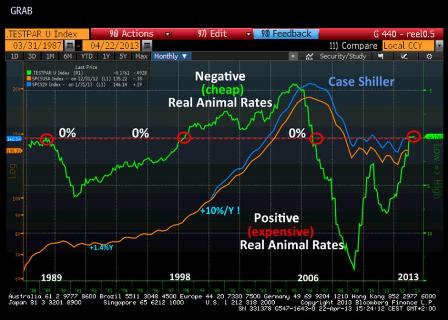
But there remains one bright spot, namely the residential real estate market, which should remain a powerful support in the quarters ahead. Check out one of my favorite graphs real animal rates.

Real animal rates in the US:


Full size image

These rates are calculated using a proprietary equation I developed, which includes, in addition to terms like mortgage interest rates, recent home price trends, the difference between the reported unemployment rate and that during periods of full employment, and the difference between the average length of unemployment and that existing in times of full employment.

With the Animal Spirits so dear to Keynes and behavioral science in mind, the goal was to factor in items more subjective than simple economic criteria (nominal borrowing rates) in the home purchase decision-making process of a household.

If experience has taught us anything, it is that the factors which most influence a potential homebuyers decision is his degree of job security and the feeling that prices can only rise.

The first point is that the only time these real animal rates dipped into negative territory (in the upper part of graph, transcribed in inverted scale) corresponds perfectly with the great real estate bubble of 1998 to 2006.

This big trend reversal occurred in 2006 when rates resurfaced above zero and thus below the graphs red line.

The only other time real animal rates became negative was in 1989, but that was abruptly reversed by the sharp hike in nominal interest rates.

In the current context, nominal interest rates are unlikely to undergo any such sharp hike in the quarters ahead, and this dip of real animal rates into negative territory should enable the real estate market to continue to recover. This all the more true, given that the yens decline will only strengthen disinflationary trends in North America, which ensure accommodative monetary policies for some time to come!

All you need to do is look at the steep decline in inflationary expectations, as expressed by the TIPS market in the US, to understand that investors seem to have finally realized that QE policies have nothing to do with the so-called dollar printing press. Notwithstanding the ZeroHedge paranoids!

That said, existing home sales in the US, out just a few minutes ago, came in weak, at -0.6% m-o-m (vs expected +0.4%, i.e. 4.92M vs 5M), which explains this afternoon shiver on stockmarket indices.

Now, as the IMF has said in recent days, the main brake on a worldwide recovery is the Eurozone, which remains paralyzed by the obsession of its northern member states on austerity and by the ECBs total and unforgivable incapacity to comply with its own mandate! In todays Macro Geeks Corner, you will find two instructive links on this matter.

Eurozone

Instead of harping on the endless stream of errors made by our beloved European monetary and governmental leaders, I prefer to comment on some far more instructive graphs.

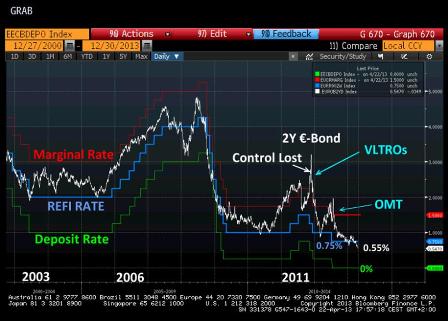
Lets start with our graph on aggregate 2-year Eurozone government bond rates, which have proven to be so useful in recent years for evaluating the ECBs reaction function.

This rate, currently at a record low 0.55%, is now well below the 0.75% set for the refi. This stems from two factors.

First, in view of the state of the economy and the latest comments by certain ECB board members, investors expect that the refi rate will very soon (May or June) be cut to 0.50%.

Second, certainty that short-term interest rates, like the Eonia, which have been stuck between 5 bps and 12 bps for the past 9 months, are not going to rise anytime soon is pushing investors to seek yields wherever they can still find them, like in Spain and Italy where 2-year bonds still fetch between 1.95% and 1.25%, now that they are assured that, henceforth, in case of insolvency, bank depositors will be forced to pay the bill without pushing sovereign issuers into default, as happened in Greece!

Aggregated Eurozone government 2-year rate:

Full size image

However, we have reason to be concerned that the ECB, if it does lower the refi to 0.50%, will be satisfied with what it already deems a low rate and highly accommodative monetary policy. Such is far from being the case, even if we go by the ECBs own obsolete aggregates, like M3, as money velocity continues to skid to a halt, following Cyprus.

And all this has an impact on the real economy, as you can see in the following graphs.

Eurozone Industrial Production

Full size image

The least we can say is that this graph is particularly distressing. Of course, it does not account for the economys industrial aspect, which some call the old economy. But it provides a whole lot of jobs and no economic area can afford to neglect it.

And the impact of Mr Sarkozys renowned Walk of Canossa, following his summons by Ms Merkel in July 2011 to Berlin where the unfortunate decision to create the first sovereign default of a developed country was endorsed (Greek PSI), is very clear on this graph. Together with a hardening of austerity policies and the nefarious consequences of the ECBs hikes of benchmark interest rates in the spring of 2011, this decision torpedoed already distressed economies, with the consequences we all know today.


But if there is one depressing economic indicator, which reflects even more cruelly how austerity affected the Eurozone, it is surely the unemployment curve.

Eurozone Unemployment

Full size image

Here again, no comment is needed. I included earlier in this newsletter the graph comparing the US and Eurozone curves, but even that is no longer all that relevant. If people are happy to underperform the United States, who cares? If the Eurozone wants to try liquidationist economic policies to help drive home the morality message, it has every right to do so, just as its citizens merit the leadership they elect.

But to go from there to creating a situation of hysteria, leading to an increasingly large segment of the active population being ejected from the labor market, is a big step that must never be taken.

In some countries, the figures are just horrifying, with nearly 30% general unemployment and over 50% for those under 25 years of age. It is incredible that some continue to boast the merits of such policies for countries like Ireland while ignoring the daily siphoning of the population due to massive immigration to seek jobs elsewhere!!

I wonder if those responsible for such policies have forgotten the consequences of such an approach in Europe and the breakdown in the social fabric during the Great Depression, especially now, with so many leaders spicing their speeches with anti-German references?

This pathetic situation, reflecting month after month of economic policies based on no worthwhile or credible foundations, be it on a theoretical or empirical basis, explains why I am having a hard time re-establishing a decent pace of publication.

This is especially so in that the conflict between this depressive macro situation and the strong efforts undertaken by the Fed and the BoJ (among others) to reignite economic activity leave no space for laying out clear asset allocation biases.

We continue to enable our clients to take advantage of opportunities on option markets which make it possible during these troubled times to make bets on the cheap but without any real conviction.

Has our asset allocation strategy, dating from 2007 (a bit early, I know), of favoring government debt came to maturity with German 10-year rates at 1.23%, i.e. more than 30 bps below those of the United States?

Will European stock markets continue to suffer from our big fear, the Japanese syndrome? Or will popular pressure push the ECB and the Austrian School proponents to realize that they have a modern currency at their disposal and that reversing their entire intellectual edifice is possible?


Despite all my efforts, studies, reading and discussion, I am totally incapable of responding to these questions, which a great lesson in humility. Sorry for the consequences in terms of this newsletters clarity and frequency of publication, but if anyone has any ideas, I am all ears!

The Macro Geeks Corner:

Dear Northern Europeans Monetary easing is not a bailout

A factual rebuttal of remarks of ECB chief Jrg Asmussen, made at the Bank of America/Merrill Lynch Investor conference

Breaking bad inflation expectations

Retail Sales in U.S. Dropped in March by Most in Nine Months

So maybe the year end FICA hike was more effective than markets have been discounting?

And this was before the sequester:

Retail Sales in U.S. Dropped in March by Most in Nine Months

By Alex Kowalski

April 12 (Bloomberg) — Retail sales in the U.S. unexpectedly fell in March by the most in nine months as employment slowed, showing households ended the first quarter on softer footing.

The 0.4 percent decrease, the biggest since June, followed a 1 percent gain in February, Commerce Department figures showed today in Washington. The median forecast of 85 economists surveyed by Bloomberg called for an unchanged reading in March. Department stores and electronics dealers were among the weakest showings.

The figures may prompt economists, who are projecting consumer spending climbed in the first quarter at the fastest pace in two years, to reduce growth estimates. A pickup in hiring and bigger increases in wages will be needed to ensure any slowdown proves temporary as federal budget cuts and an increase in the payroll tax restrain the expansion.

Households are now making those difficult choices on how to adjust spending, said Ellen Zentner, a senior economist at Nomura Securities International Inc. in New York, who projected sales would drop. We have no steam going into the second quarter.

Retail sales

Retail Sales Rise 1.1%, Much Higher Than Expected; Imports Prices Up 1.1%, Export Prices Up 0.8%

Looks to me like Americans paid more $ for the same or fewer goods and services?
That is, cutting back on purchases but not able to save $ due to higher prices?
Should show up as an increase in consumer debt/drop in savings rate?

Standing by for details.

China’s Economic Data Show Weakest Start Since 2009

China’s Economic Data Show Weakest Start Since 2009

March 10 (Bloomberg) — China’s industrial output had the weakest start to a year since 2009 and lending and retail sales growth slowed, toughening challenges for a new leadership that wants to narrow the gap between rich and poor.

Production increased 9.9 percent in the first two months and retail sales rose 12.3 percent, government data showed March 9, trailing economists’ estimates. New local-currency loans in February fell to 620 billion yuan ($99.6 billion), the People’s Bank of China said yesterday, lower than the estimates of 27 out of 28 analysts in a Bloomberg News survey.

Strengthening U.S. demand after the unemployment rate fell to a four-year low may help incoming Premier Li Keqiang achieve the 7.5 percent expansion in gross domestic product sought by policy makers entering the final week of their meeting at the National People’s Congress in Beijing. China’s exports jumped 23.6 percent in the first two months of the year, the most for a January-February period since 2010.

“Exports are still an important growth driver for China so the pickup should make policy makers less concerned about the disappointment in some of the other indicators,” said Louis Kuijs, chief China economist at Royal Bank of Scotland Plc in Hong Kong. “When push comes to shove, they know the recipe to kick-start growth, so if things do slow down to a rate they aren’t comfortable with, they can encourage investment.”

At the same time, February credit data indicate the central bank may be working to contain the expansion in lending and aggregate financing that started last year, said Kuijs, who previously worked as an economist for the World Bank in Beijing.

Increasing Optimism

New local-currency loans in February trailed the 700 billion yuan median estimate in a Bloomberg survey and were lower than the 710.7 billion yuan in the same month last year and the 1.07 trillion yuan figure in January. Aggregate financing, a broader measure of credit, fell to 1.07 trillion yuan last month from a record 2.54 trillion yuan the previous month, PBOC data showed.

U.S. stocks have risen 8.8 percent this year, compared with a 2.2 percent gain in the Chinese benchmark index, as optimism increases that the world’s biggest economy is responding to an unprecedented monetary stimulus. In China, the decline in four February purchasing managers’ indexes, and official data released over the past week, are raising concerns that a recovery that started in the fourth quarter may be peaking even as house-price gains accelerate and inflation risks increase.

Spending Crackdown

The growth in January-February retail sales was below the lowest economist projection of 13.8 percent and was the smallest for that period since 2004. The moderation follows a crackdown by new Communist Party chief Xi Jinping on lavish spending by government officials and state-owned companies, part of efforts to curb corruption and waste.

Shares of Kweichow Moutai Co. (600519), maker of the eponymous high- end white spirit, have dropped 19 percent since Xi took power on Nov. 15, compared with a 14 percent gain in the Shanghai Composite Index.

The increase in factory output compared with the 10.6 percent median estimate in a Bloomberg survey. The statistics bureau doesn’t break out figures for January and February retail sales and industrial output in an attempt to smooth distortions caused by the timing of the Lunar New Year holiday.

Fixed-asset investment excluding rural areas in the first two months of the year rose 21.2 percent, against a median economist estimate of 20.7 percent and a 20.6 percent pace for the whole of 2012.

Inflation Worry

Consumer prices climbed a more-than-estimated 3.2 percent in February from a year earlier. Standard Chartered Plc estimates inflation will average 4 percent this year, compared with the government’s target of 3.5 percent.

“From a monetary policy perspective, by mid-2013, the inflation issue should begin to move up policy makers’ list of things to worry about,” Li Wei, a Shanghai-based economist with Standard Chartered, said in March 9 note. Li forecasts the central bank will raise benchmark interest rates once in the fourth quarter by 25 basis points as the CPI rises above 5 percent.

China’s economic growth slowed for seven quarters before recovering to 7.9 percent in the final three months of 2012, led by government-directed spending on infrastructure. The central bank also allowed expansion in credit in the less-regulated shadow banking sector.

The rebound may accelerate to 8.2 percent in the first quarter before slowing to 8 percent in the last three months of the year, according to median estimates in Bloomberg surveys last month.

Policy Dilemma

At the same time, the PBOC has flagged growing inflation and financial risks since December and the government stepped up efforts to curb resurgent home prices on March 1, ordering higher down payments and interest rates for some mortgages and implementation of a 20 percent capital gains tax.

“Policy makers face a dilemma as growth is weakening yet inflationary pressure keeps building,” said Zhang Zhiwei, chief China economist at Nomura Holdings Inc. in Hong Kong. “The government will eventually have to tighten policy to contain inflation but in the short term, the next several months, the government may put policy on hold to observe how growth and inflation move and fine-tune accordingly.”

Euro-Area Unemployment Climbs to Record as Recession Deepens

EU Headlines:
Euro-Area Inflation Slowed More Than Estimated in February

With catastrophic unemployment prices are still rising. Seems a rethink of their model assumptions are in order.

ECB’s Constancio Says Barnier Plan Not Enough for Bank Failures

Right, the ECB must insure deposits and ensure liquidity and therefore do the regulation.

Europe Relying too Much on ECB, Fuest Tells Handelsblatt

No, not enough. The ECB, like all CB’s, directly or indirectly, ultimately/necessarily provides unlimited bank liquidity and supports member nation debt.

Euro-Area Unemployment Climbs to Record as Recession Deepens

And they all believe in deficit reduction, including Italy’s ‘anti establishment’ Grillo who’s merely proposed default (aka psi, bond tax) rather than other tax hikes and spending cuts.

German Retail Sales Post Biggest Monthly Jump in Six Years

From low levels for a nation presumably doing ‘very well’. It also highlights fact that any currency union requires some form of ‘fiscal transfers’ to sustain full employment. And unfortunately they don’t understand fiscal transfers for the production of public goods and services in fact imposes a real cost on the region with the high unemployment, and therefore hold back on doing it.

Italy Unemployment Rate Rises to Highest Since at Least 1992

The entire culture is being destroyed. It’s a slow motion train wreck. And all the proposals, including default, only add to the deflationary pressures, making it even worse. Call it a self inflicted crime against humanity.

Lombard says unemployment could go over 8%

If I recall correctly this was/is a ‘monetarist’ shop? Nice to see them recognizing the role of fiscal policy to this extent.

Why Over 8% Unemployment Could Lie Ahead

By Matt Clinch

Feb 18 (CNBC) — Severe fiscal tightening in the U.S. will lead to no growth or a contraction in the first two quarters of 2013 and will push unemployment over the 8 percent level, according to Lombard Street Research.

The knock-on effect will mean pain for the business sector, with corporate profits falling after a hit to consumer spending power, the firm said.

“Our view that unemployment could rise above 8 percent and that profits will be squeezed reflects a forecast of nil to negative 2013 (first quarter) growth, and further stagnation in (the second quarter),” a Lombard Street report released on Friday said.

The view contrasts sharply with that of other analysts who are considerably more bullish on the U.S. economy.

Keith McCullough, CEO of Hedgeye Risk Management told CNBC last week that he thinks employment could actually improve below 7 percent by the fourth quarter, adding that from a housing and employment perspective U.S growth is “pretty solid”.

Lombard Street does not agree.

At the start of the year, the payroll tax that funds Social Security was raised two percentage points to its 2010 level of 6.2 percent. This was the largest component of tax increases approved by Congress in the resolution to the “fiscal cliff”.

Retail sales rose 0.1 percent in January, data released by the Commerce Department showed on Wednesday. These two events together should set alarms bells ringing as tax increases suggest a slowdown in the pace of consumer spending, Lombard Street said.

“Retail sales data encouraged the idea that the payroll tax hike from 4.2 percent to 6.2 percent, worth 1 percent of personal disposable incomes, would pass off with little impact. But the effect of the payroll tax was only partly in January,” it said, indicating that only a modest impact would have been expected for January.

Monetary easing by the Federal Reserve provides few offsets to this drop in demand outside of the housing sector, according to Lombard Street.

“The contribution of housing growth to GDP (gross domestic product) has been about 0.4 percent and promises to continue; that of government spending has averaged -0.4 percent for the past three years, and could easily exceed this in (the first and second quarter),” it said.

This -0.4 percent contribution that the research firm cite is set to be complicated further with extra spending cuts after the “fiscal cliff” resolution and the sequestration – a deadline for automatic government spending cuts – due to kick in on March 1.

“Our assumption is that the sequestration is canceled in favor of further cuts in a new provision. But this means the contribution from public spending to GDP growth could well be more negative than the past -0.4 percent,” Lombard said.

“In February the full effect of the payroll tax hike will be reflected in disposable income, and the initial savings “cushion” is likely to give way, so real consumer spending could be down.”

This real consumer spending could be down by more than 2 percent (annualized), it said, with little recovery in March. Thus for the first quarter a dip of 1.5 percent on an annual rate should be expected, contributing -0.1 to GDP growth.

Inventory building and capital expenditure could prove positive factors on that figure, hence its forecasts that GDP could be flat to slightly down for the first quarter and remain stagnant for the second quarter. Along with the last quarter being negative, three straight quarters of zero growth will lead to a rise in the unemployment rate, the firm said.

“Given underlying labor force growth of about 1 percent, this would add 0.7-0.8 percent to the unemployment rate, which was 7.9 percent in January. Even a less pessimistic view of (first quarter) and (second quarter) would send unemployment over 8 percent,” it said.

The chief risk to the stock market is that a reduction of the budget deficit is likely to be offset largely by cuts in the business sector’s surplus, Lombard said, meaning a hit to corporate profits.

However, this might be considered to be a contrarian view with some seeing U.S. growth stabilizing in 2013.

Fed chief Bernanke has previously said that interest rates will be kept low until the unemployment rate reaches 6.5 percent. At the current rate of 150,000 jobs created every month, and 110,000 new entrants to the labor force, that will be around January 2017.