Redbook retail sales, Greece comment

Hopefully it bounces back:

Redbook
redbook-4-18-table
Highlights
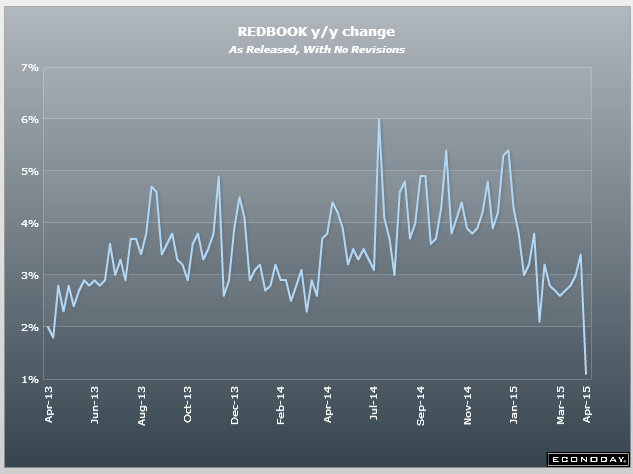
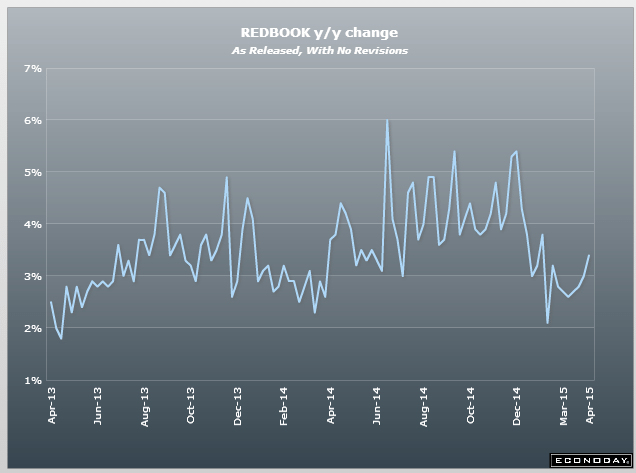
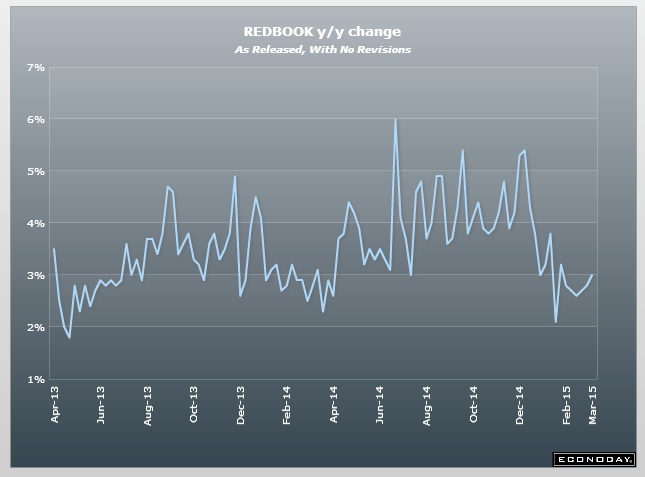
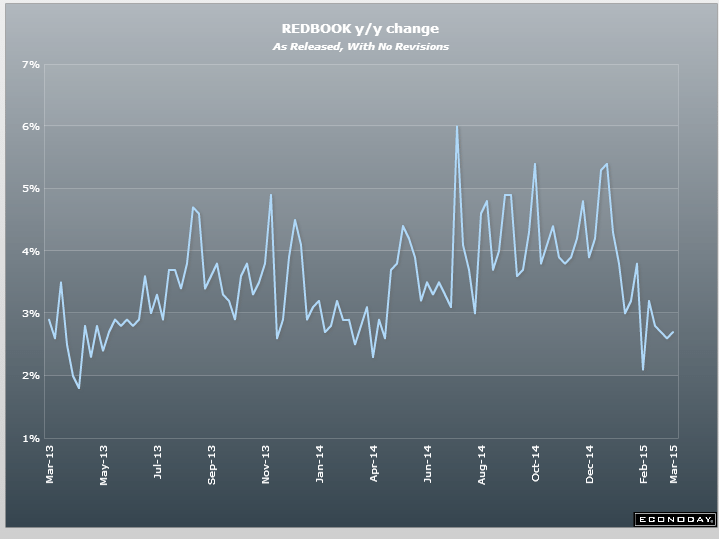
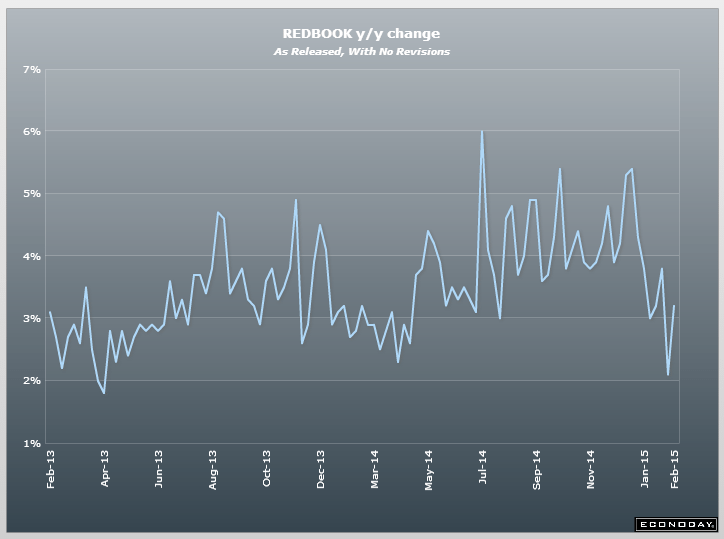
This year’s Easter shift, from late in April last year to early in April this year, is greatly distorting store sale comparisons. Redbook’s same-store year-on-year tally is up only 0.8 percent in the April 18 week following the prior week’s 1.1 percent rate which was also distorted by the calendar effect. When these distortions pass, store sales will likely return to their 3.0 to 3.5 percent pace.

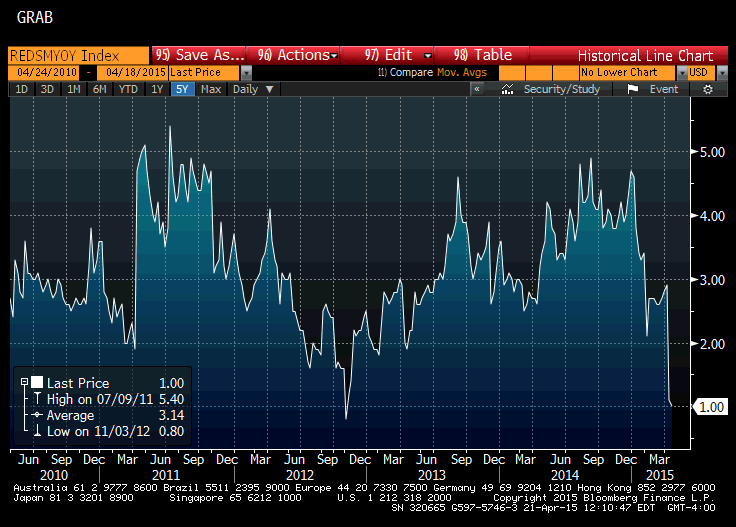
This chart is for a full month last year vs this year. Remember, lower gas prices are supposed to increase sales:
redbook-monthly-yoy

ECB’s Constancio: default no reason to quit euro as Greece cash pinch worsens

By John O’Donnell and Jonathan Gould

April 19 (Reuters) — “If a default will happen … the legislation does not allow that a country that has a default … can be expelled from the euro,” ECB VP Vitor Constancio told the European Parliament, saying that Greek banks had been told not to increase their exposure to the state to avoid “a possible credit event regarding the state”. “Capital controls can only be introduced if the Greek government requests,” he said, adding that they should be temporary and exceptional. “As you saw in the case of Cyprus, capital controls did not imply getting out of the euro.”

Atlanta Fed, Retail Sales, Redbook retail sales, small business optimism index, business inventories

Another string of lower than expected releases

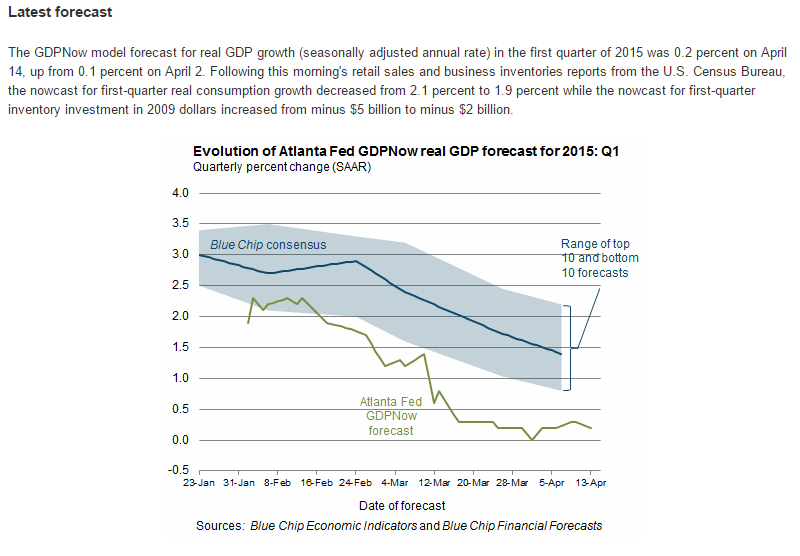
And 2nd quarter nowcasts are showing about the same as Q1 no bounce yet.
nowcast-4-14
Auto sales have a high import component. Note that reports of domestic wholesale auto output and sales have been lower than expected. And note year over year growth decline, though some of that is lower fuel prices. But of course the lower fuel prices were presumed to translate into higher sales elsewhere…

Retail Sales
er-4-14-1
Highlights
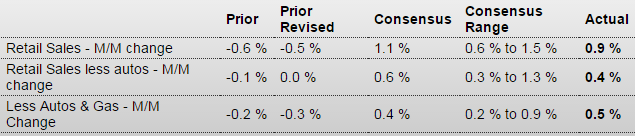
Weather effects may be fading with healthy sales numbers in March. Retail sales in March rebounded 0.9 percent after dropping 0.5 percent in February. The market consensus for March was for a 1.1 percent boost. Excluding autos, sales gained 0.4 percent, following no change in February. Expectations were for a 0.6 percent increase. Gasoline sales dipped 0.6 percent after 2.3 percent increase in February. Excluding both autos and gasoline sales rebounded 0.5 percent after declining 0.3 percent in February. Expectations were for a 0.4 percent increase.

By components, strength was seen in motor vehicles (up 2.7 percent), furniture, clothing, department stores, and miscellaneous store retailers.

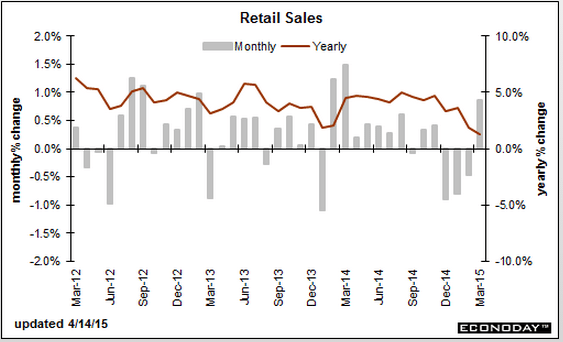
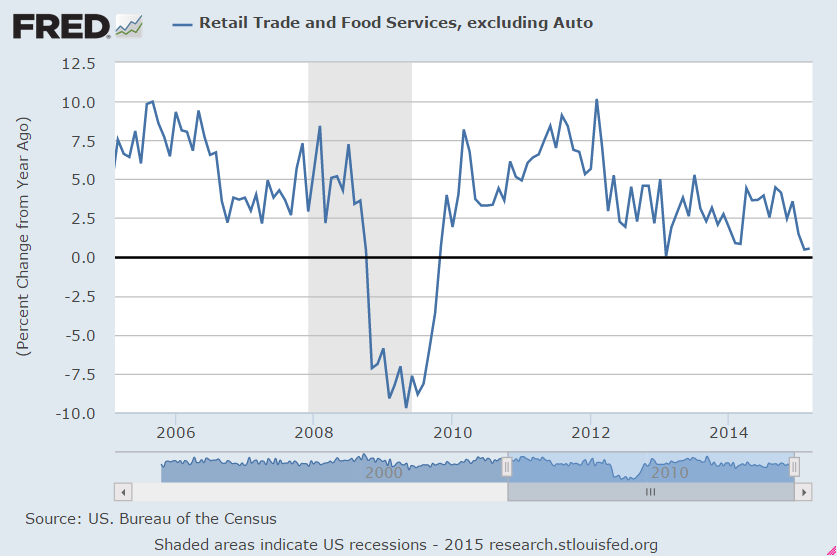
On a year-ago basis, retail trade and food service were up 1.3 percent in March, compared to 1.9 percent in February.

er-4-14-2
er-4-14-3
Redbook retail sales chart speaks for itself:
er-4-14-4
Another series in decline:
er-4-14-5
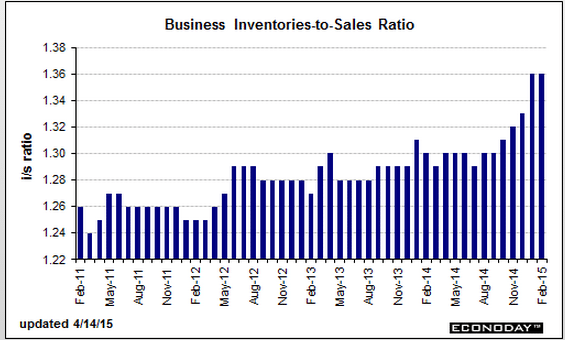
Business inventories remain way high:
er-4-14-6

Balanced budget amendment getting closer, consumer credit, Redbook retail sales, JOLTS

the BIG stupid…

Conservative lawmakers weigh bid to call for constitutional convention

Consumer Credit
consumer-credit-feb-table
Highlights
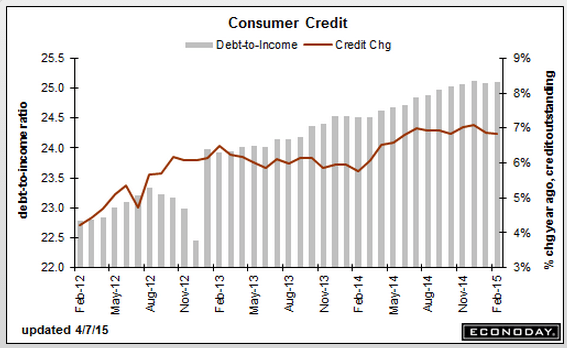
Consumer credit rose a solid looking $15.5 billion in February but a closer look shows an unwanted $3.7 billion decline in revolving credit. This is the 4th decline in 5 months for the revolving component which reflects consumer reluctance to finance purchases with credit-card debt. This reluctance may be a plus for consumer wealth, given the extremely high rates of interest credit-card companies often charge, but it is a definite negative for consumer spending which has been very soft in recent months.

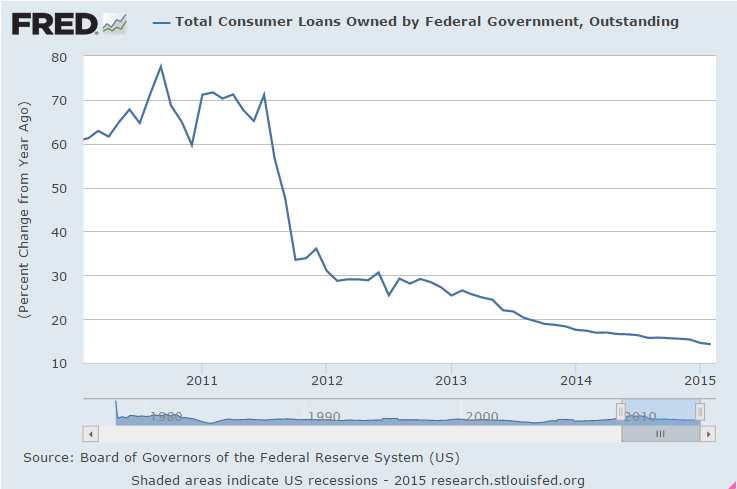
In contrast to revolving credit, non-revolving credit rose $19.2 billion which is the strongest gain since July 2011. The gain does reflect financing for autos but also an item not associated with consumer spending, and that’s the government’s ongoing and heavy acquisition of student loans.

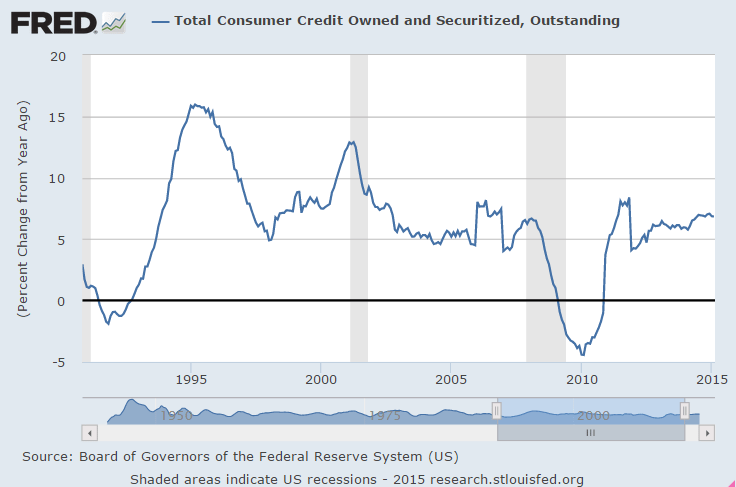
Year over year showing a (modest) decline in growth:

consumer-credit-feb-graph
consumer-credit-feb-graph-2

This is mainly student loans and the growth rate continues to decline:

consumer-credit-feb-graph-3

Not much of an Easter boost in retail showing in this chart:

redbook-4-2

This was for Feb and inline with Feb payrolls:

JOLTS
jolts-feb

Redbook retail sales, Case-Shiller HPI, Chicago PMI, Consumer Confidence, small business borrowing

Growth still depressed, even vs last year’s winter weakness:

redbook-3-31

Same here:

S&P Case-Shiller HPI
sp-jan-table
Highlights
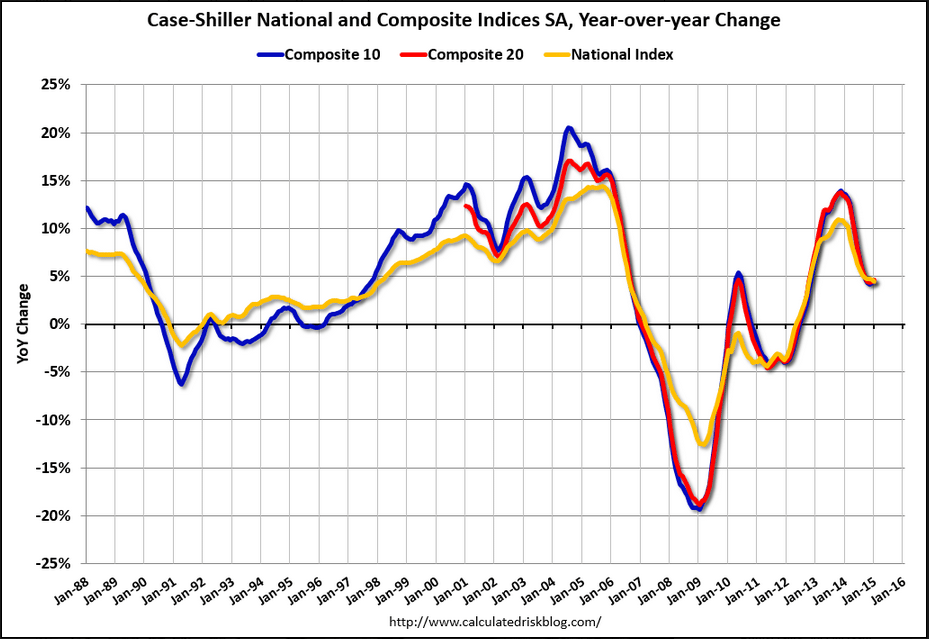
Home prices are firming as the Case-Shiller composite-20 index rose 0.9 percent in January following a 0.9 percent gain in December and a 0.8 percent rise in November. This is the strongest streak for this report since late 2013. Year-on-year, however, prices are still on the soft side, up only 4.6 in January and only fractionally higher than the prior two months.
sp-jan-graph

Bad here too:

Chicago PMI
chicago-pmi-mar
Highlights
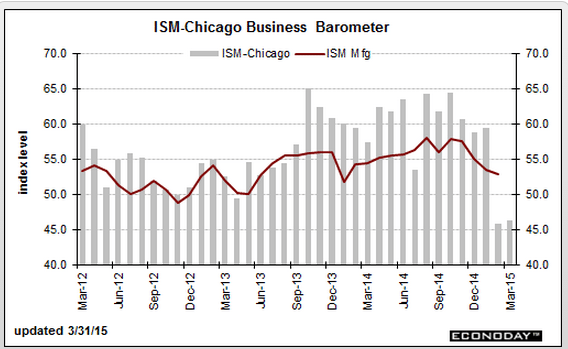
Companies sampled in the Chicago PMI report continue to report a lull in activity, at a sub-50 March index of 46.3 following 45.8 in February. On a quarterly basis, the index averaged only 50.5 in the first quarter, down steeply from 61.3 in the fourth quarter for the weakest reading since the third quarter of 2009. Respondents are citing bad weather and fallout from the West Coast port slowdown as temporary negatives, and they see orders picking up during the second quarter. Though the Chicago report, which covers both the manufacturing and non-manufacturing sectors, is often volatile, the last two months of sub-50 readings do confirm other indications of first-quarter weakness for the nation’s economy as a whole. The Dow is moving to opening lows following today’s report.
ism-chicago-graph

Consumer confidence is up even as retail sales growth plummets:

consumer-conf-mar

U.S. small-business borrowing slips in February, up on year: PayNet

By Elvina Nawaguna

March 31 (Reuters) — The Thomson Reuters/PayNet Small Business Lending Index fell to 119.2 last month from 122.4 in January. Still, the index was up 7 percent from February 2014. The index gauges borrowing by firms with $1 million or less in outstanding debt. An increase of 1 percent to 2 percent indicates businesses are borrowing to replace worn out assets, PayNet founder and President Bill Phelan said. Higher readings signal that firms are investing more to increase their production of goods and services. Small businesses account for nearly half of US GDP.

CAI, Housing starts, Redbook retail sales

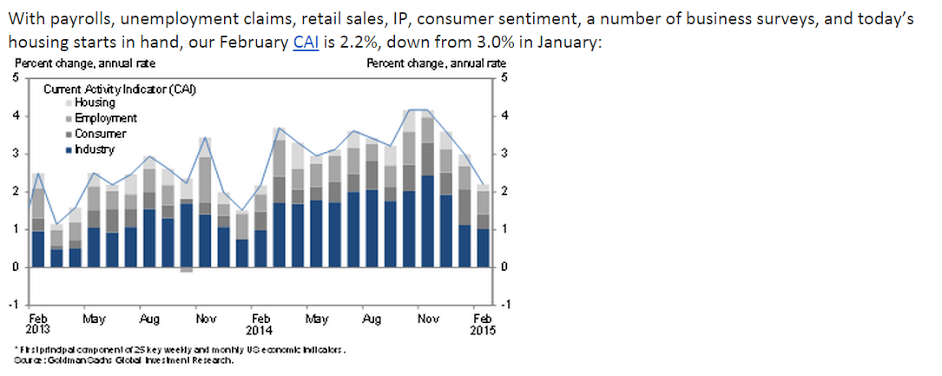
Remember all the economists pointing to this when this was going up?

Now they don’t mention it…
cai

Not good, and last winter was even colder:

Housing Starts
hs-feb-table

Highlights
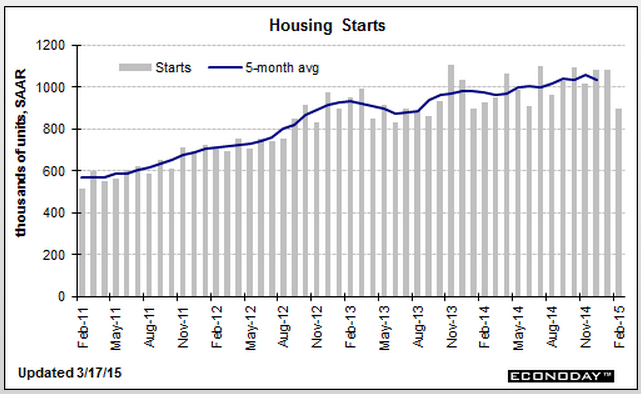
Housing starts unexpectedly fell sharply in February. Starts fell a monthly 17.0 percent, following no change in January. Expectations were for a 1.048 million pace for January. The 0.897 million unit pace was down 3.3 percent on a year-ago basis. This was the lowest starts level since January 2014 with a 0.897 million unit annualized pace.

Single-family units dipped 14.9 percent in February, following a 3.9 percent decrease the month before. Multifamily units dropped 20.8 percent after rising 7.9 percent in January.

By region, the Northeast Census region fell a whopping 56.6 percent (likely weather related). Declines were also seen in other regions: the Midwest down 37.0 percent; the West down 18.2 percent; and the South down 2.5 percent.

Housing permits, however, were more positive, gaining 3.0 percent after no change in January. The 1.092 million unit pace was up 7.7 percent on a year-ago basis. Analysts called for a 1.058 million unit pace.

The housing sector is hard to read due to severe winter weather. The outlook is not as bad as current activity. But this sector is still sluggish looking forward and this is another indicator that likely will keep the Fed dovish at this week’s FOMC meeting. Also, expect analysts to nudge down first quarter GDP forecasts.
hs-feb-1

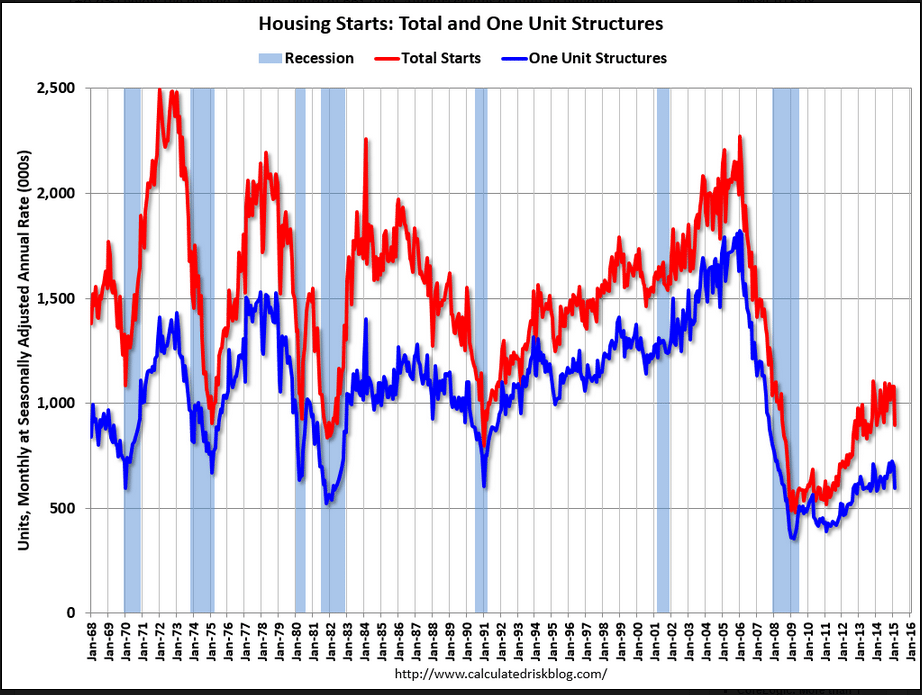
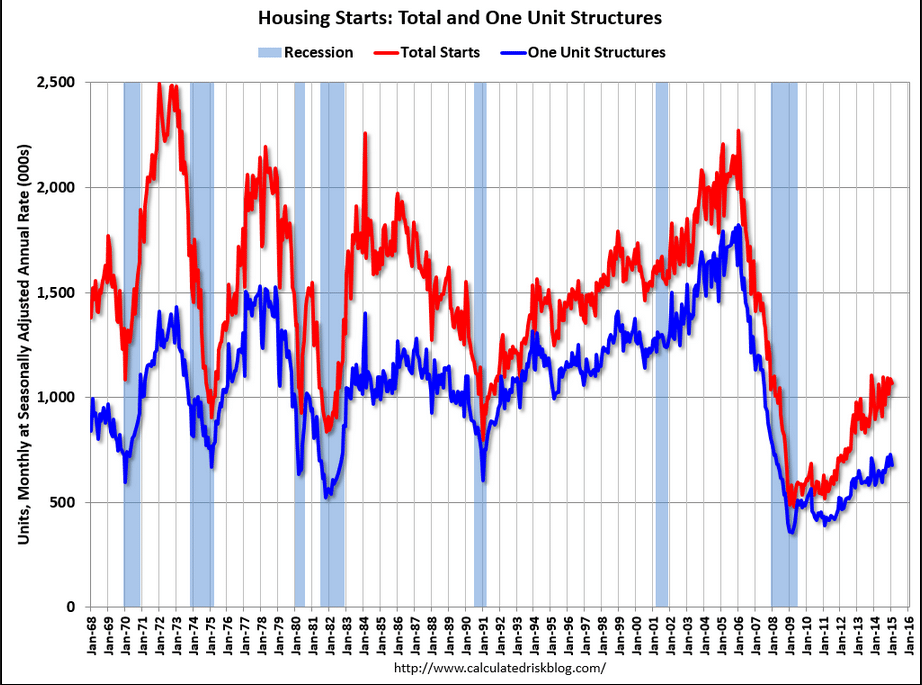
And back down to the bottom of prior cycle lows, and the population is larger now:

hs-feb-2

Not good here either- no sign of retail pickup from lower oil…

redbook-3-yoy

mtg prch apps, housing starts, Producer prices, Redbook retail sales

More bad housing news:

MBA Purchase Applications
mba-2-13
Highlights
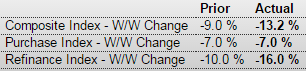
The purchase index is down for a 5th straight week, 7.0 percent lower for the 2nd consecutive week. Rates have been rising in recent weeks including the latest week which is especially depressing refinancing activity where the index fell a very sharp 16.0 percent following the prior week’s 10 percent fall. The report notes that demand for larger refinancing loans is especially down.

The average mortgage for conforming loans ($417,000 or less) rose 9 basis points in the week to 3.93 percent. The decline in the purchase index is a negative signal for underlying home sales.

More bad housing news:

Housing Starts
housing-starts-jan
Highlights
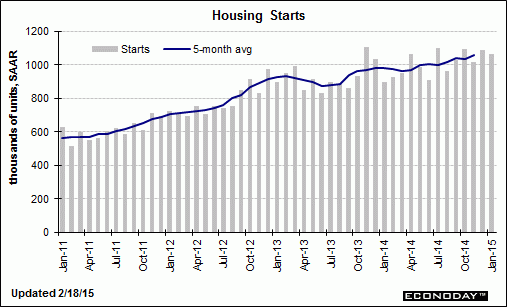
Housing is not adding to economic momentum. Housing starts slipped in January on weakness in single-family starts. Housing starts declined 2.0 percent in January after a 7.1 percent jump the month before. The 1.065 million unit pace was up 18.7 percent on a year-ago basis. Expectations were for a 1.070 million pace for January.

Single-family permits dropped 6.7 percent after a 7.9 percent boost in December. Multifamily starts gained 7.5 percent, following a 5.6 percent rise in December.

Again, permits suggest that housing activity is muted. Housing permits dipped 0.7 percent, following no change in December. The 1.053 million unit pace was up 8.1 percent on a year-ago basis. The market consensus was for a 1.070 million unit pace.

The bottom line is that housing is not adding to economic activity. This means the Fed likely will continue to reinvest mortgage-backed securities to keep rates low. But the long-term trend appears to be that single-family housing is not viewed as strong an investment as in the past.
housing-starts-jan-graph

housing-starts-jan-graph-2

PPI-FD
ppi-jan
Highlights
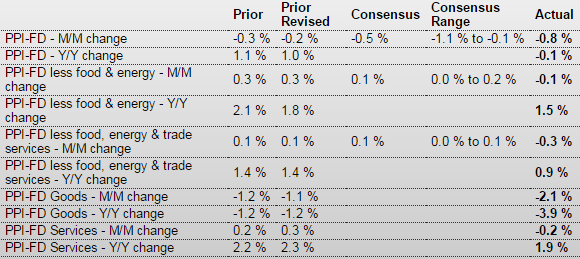
The PPI for total final demand decreased 0.8 percent after falling 0.2 percent in December. The consensus forecast a 0.5 percent drop. A sharp drop in energy pulled the headline number down. Excluding food and energy, producer price inflation slipped 0.1 percent after firming 0.3 percent the month before. Expectations were for a 0.1 percent rise.

The index for final demand goods fell 2.1 percent after dropping 1.1 percent in December. The January decrease was led by prices for final demand energy, which fell a monthly 10.3 percent. The decline in prices for final demand goods was led by the index for gasoline, which dropped 24.0 percent. Prices for diesel fuel, jet fuel, basic organic chemicals, dairy products, and home heating oil also moved lower. Conversely, the index for residential electric power moved up 1.2 percent. Prices for pharmaceutical preparations and for fresh and dry vegetables also advanced. Prices for final demand foods decreased 1.1 percent after slipping 0.1 percent in December.

The index for final demand services eased 0.2 percent after advancing 0.3 percent in December. In January, prices for final demand services less trade declined 0.3 percent after rising 0.1 percent the month before. This was the first decline since falling 0.3 percent in September 2014. In January, a major contributor to the decline in the index for final demand services was prices for outpatient care (partial), which fell 0.7 percent.

On a seasonally adjusted year-ago basis, PPI final demand was down 0.1 percent, compared to up 1.0 percent in December. Excluding food & energy, PPI final demand was up 1.5 percent versus 1.8 percent the month before.

Overall, inflation at the manufacturers’ level is muted even after discounting energy declines. The Fed is likely to see the numbers as allowing delayed rate increases.
redbook-2-15

And yet another disappointing report:

Industrial Production
ip-jan

Highlights
The industrial sector turned modestly positive in January-including for the manufacturing component. Industrial production for January rebounded 0.2 percent after a December decrease of 0.3 percent. Market expectations were for a 0.4 percent boost for January.

Manufacturing rose 0.2 percent in January after no change the month before. But the negative is that December manufacturing was revised down from a 0.3 percent gain. The manufacturing increase fell short of the 0.4 percent market forecast.

Manufacturing output rose 0.2 percent in January, as the production of durable goods advanced 0.4 percent and the production of nondurable goods was unchanged. Gains were posted by all major durable goods industries except motor vehicles and parts, aerospace and miscellaneous transportation equipment, and furniture and related products. Increases of more than 1.0 percent were recorded in the production of primary metals and of computer and electronic products. Among the major nondurable goods industries, gains in the indexes for apparel and leather, for chemicals, and for plastics and rubber products offset losses elsewhere. The production of other manufacturing industries (publishing and logging) moved down 0.4 percent.

Mining dropped 1.0 percent in January after a 2.1 percent jump the prior month. Utilities made a partial rebound of 2.3 percent after plunging 6.9 percent in December.

Overall capacity utilization was unchanged at 79.4 percent.

The biggest news from this report was the downward revision to December. Manufacturing is still sluggish although on a barely positive uptrend.

Empire survey, MS on consumer spending, Housing index, e commerce

All these surveys are now declining:

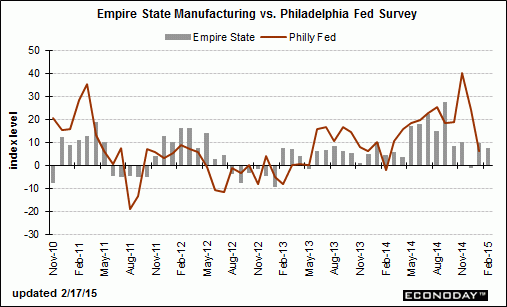
From the NY Fed: Empire State Manufacturing Survey

empire-v-philly-fed-feb

The February 2015 Empire State Manufacturing Survey indicates that business activity continued to expand at a modest pace for New York manufacturers. The headline general business conditions index edged down two points to 7.8. The new orders index fell five points to 1.2—evidence that orders were flat—while the shipments index climbed to 14.1. Employment indexes pointed to an increase in employment levels and little change in the average workweek.

Indexes assessing the six-month outlook, though generally positive, conveyed considerably less optimism about future business activity than in recent months. The index for future general business conditions plunged twenty-three points to 25.6, its lowest level in more than two years.
emphasis added

Maybe it’s because lower oil prices merely shift income from sellers of oil to buyers of oil? Leaving falling capital expenditures as the net effect? Along with the negative effect of falling net worth as the value of energy holdings declines?

MORGAN STANLEY: US consumers just aren’t spending their gas savings like we thought they would

By Akin Oyedele

Feb 16 (BI) — US consumers are getting more cautious about how they spend their savings from low gas prices.

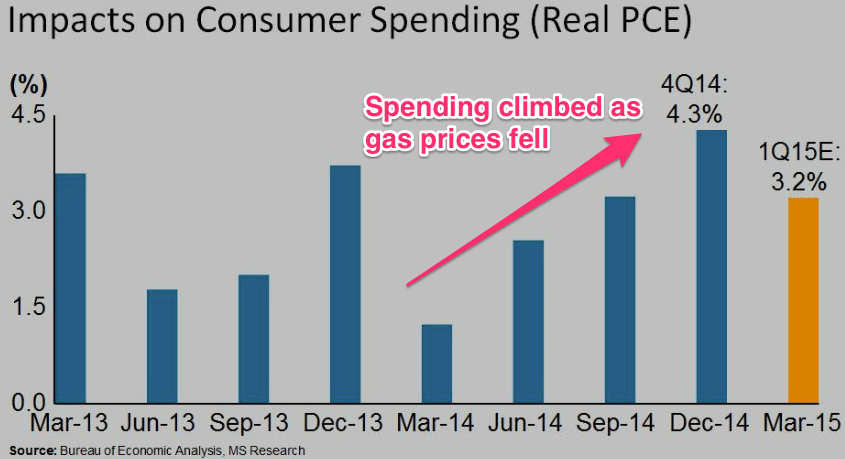
Gas prices have fallen 40% since September, giving consumers a ‘tax break’ of more than $60 billion, according to Morgan Stanley chief US economist Ellen Zentner.

As gas prices fell, the pace of real Personal Consumption Expenditures (PCE) growth accelerated above the 2% average of the last four years, Zentner said in a video Friday. It reached 4.3% for the fourth quarter of 2014.

Yet, that was less than what it could have been.

“What we found is some lingering caution, that sales could actually be stronger,” Zentner said. “So some of the discretionary categories have shown some weakening of late. Households simply aren’t spending as much out of the gas savings as we thought they would.”

“That lingering caution we think continues in the first quarter,” she added, showing that real PCE growth is estimated to fall to 3.2% for the first quarter. The benefit of the slowdown in spending is that people are using the extra money to pay off debt, or are stashing it away as savings, Zentner said. This ultimately improves households’ finances.
consumer-spending-impact

Housing Market Index
nahb-feb
Recent History Of This Indicator
The NAHB housing market index continued to report solid conditions with the housing market index at 57 in January versus an upwardly revised 58 in December. January was the 7th plus-50 score in a row. January’s strength was led by the most heavily weighted component, present sales, which held steady at 62. But the second most heavily weighted component, traffic, remained weak, down 2 points to 44 and reflecting a significant lack of first-time buyers in the new home market. The final component, future sales, did fall 4 points but remained very solid at 60.

E-Commerce Retail Sales
e-commerce-table

e-commerce

RT interview, UK inflation, retail sales mystery, Greece, Italian trade surplus

Greece must threaten Grexit to get best outcome from Troika

Edward talks to Warren Mosler, chairman of Consulier Engineering on why the EU’s approach to the Greek debt crisis has failed to lift the Greek …

So for decades the BOJ has tried to create inflation and failed, for 7 years the Fed has tried and failed, the ECB has tried and failed, etc. etc. etc. Maybe it’s not so easy for a CB to create inflation? Or impossible…;)

UK inflation hits lowest level since records began

Abe hopes BOJ keeps stimulus to meet inflation goal, upbeat on economy

Feb 16 (Reuters) — Abe hopes BOJ keeps stimulus to meet inflation goal, upbeat on economy (Reuters) Japanese Prime Minister Shinzo Abe said on Monday praised the BOJ’s aggressive stimulus program for helping revive the economy and wipe out the public’s “sticky deflationary mindset.” “I hope the BOJ continues to steadily proceed with bold monetary easing to achieve 2 percent inflation,”

No consideration that the lower prices in the first instance only shift income from sellers of oil to buyers of oil:

Even excluding gas, retail spending was flat last month after ticking down 0.2% in December. The retail restraint is somewhat surprising given that the average household is expected to save hundreds of dollars this year on gas that averaged $2.23 a gallonon Thursday, down from $3.32 a year ago, according to the AAA.

Greece demands a credible growth package:

“No more loans — not until we have a credible plan for growing the economy in order to repay those loans, help the middle class get back on its feet and address the hideous humanitarian crisis.” YV

Italy : Merchandise Trade

it-trade
Highlights
The seasonally adjusted trade balance returned a sizeable E5.1 billion surplus in December following a slightly larger revised E3.8 billion excess in November.

December’s sharp improvement was mainly attributable to a 2.6 percent monthly bounce in exports, their fourth increase in the last five months, which easily more than reversed a 1.1 percent mid-quarter drop. Outside of durable consumer goods all of the major sectors saw solid monthly gains and total exports were up 6.3 percent from their level in December 2013.

However, weak domestic demand and lower oil costs were also once again a factor in the expansion of the black ink. Hence, imports were down 1.6 percent versus December (minus 0.5 percent ex-energy), their third straight month of decline. Compared with a year ago, purchases from overseas were off 1.3 percent.

Having hit a low of E-4.1 billion in March 2011 the turnaround in the Italian trade balance has been sharp and quite steady. Net exports probably provided a useful boost to economic growth last quarter and look likely to play a key role in any sustained upswing in 2015.


Consumer comfort, business inventories

Bloomberg Consumer Comfort Index
inventories-dec
Highlights
According to Bloomberg, consumer confidence declined for a second straight week, interrupting a four-month surge as Americans’ perceptions of their finances and the economy waned.
Business Inventories
bberg-consumer-comfort
Highlights
A mismatch between inventories and sales is appearing in what could be a negative for production and employment. Business inventories rose only 0.1 percent in December but business sales fell a very sharp 0.9 percent for a 3rd straight decline. The inventory-to-sales ratio jumped 2 notches to 1.33 which is the heaviest reading since July 2009.

All 3 components show builds relative to sales especially retailers where inventories of apparel and building materials look heavy. Inventories of autos also look heavy — especially given this morning’s contraction in the auto component of the January retail sales report.

Jobless claims, Retail sales

claims-2-12

Maybe it’s because lower oil prices merely shift income from sellers to buyers, with capex reductions a net loss to all etc. as previously discussed?

Retail Sales
retail-sales-jan-table
Highlights
Lower gasoline prices continue to tug down on retail sales. And consumers are not yet putting higher discretionary income into spending on non-gasoline categories of retail sales even as confidence has improved. Retail sales in January fell 0.8 percent after declining an unrevised 0.9 percent in December. Excluding autos, sales decreased 0.9 percent-the same pace of decline as in December. Analysts expected a 0.5 percent decrease. Excluding both autos and gasoline sales rose 0.2 percent after no change in December. Expectations were for a 0.4 percent increase.

The latest retail sales numbers are not consistent with increased discretionary income and higher confidence. One explanation may be that consumers are spending more on services than on “hard” items found in the retail sales report.
retail-sales-jan