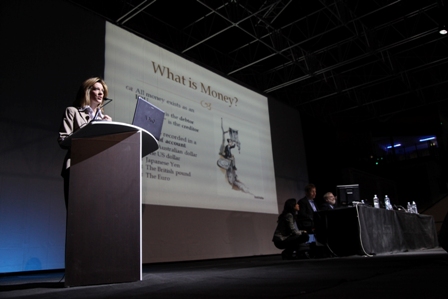
Video from Venice presentation

Venice video link here.

Also, Trichet Friday, the German elections, and G8 reports seem to be setting the tone for the euro zone to do something about the solvency issue. This is very good for equities and the rest of the credit stack.

At the same time it does not seem likely that any growth proposals will include fiscal relaxation, so the euro zone will have to get by the best it can with the deficits it has, which I’d guess should mean flat GDP, +/- 1% or so.

The US should also continue to muddle through with modest top line growth, and inflation low enough and the output gap wide enough to keep this Fed from hiking any time soon.

EU’s Response to Crisis Will ‘Convince People,’ Van Rompuy Says

See below, seems 75% still support the euro vs trusting their own leaders with their own currency.

Also, unfortunately, the non MMT world pretty much still fails to grasp that mass unemployment is a macro problem and a manifestation of unspent income. That the only way the output gap gets filled is by some sector spending more than its income; and that the issuer of the currency is the only entity that isn’t inherently revenue constrained when it spends.

EU’s Response to Crisis Will ‘Convince People,’ Van Rompuy Says

May 9 (Bloomberg) — European Union President Herman Van Rompuy said the EU’s response to the sovereign-debt crisis will “convince people” of the value of being in the 27-nation bloc.

“We will convince people of the sense and the meaning of EU membership by results,” Van Rompuy said in a question-and- answer session posted on the Euronews website today. “That’s why we have to stabilize the euro zone and that’s why we have to increase economic growth and create jobs.”

“There is still a huge majority in most of the countries for membership of the European Union and the euro zone,” Van Rompuy said. “Even in Greece, I saw an opinion poll just before the election which said that 75 percent of people don’t want to leave the euro zone.”

People who reject free lunches are fools: Liquidity trap – part II

Fiscal and monetary policy in a liquidity trap – part II

By Martin Wolf

Output is produced by work.
Work is a cost, not a benefit.
It is in that sense that there is no free lunch.

Might fiscal expansion be a free lunch? This is the question addressed in a thought-provoking paper “Fiscal Policy in a Depressed Economy”, March 2012, by Brad DeLong and Larry Summers, the most important conclusion of which is obvious, but largely ignored: the impact of fiscal expansion depends on the context. *

In normal times, with resources close to being fully utilised, the multiplier will end up very close to zero; in unusual times, such as the present, it could be large enough and the economic benefits of such expansion significant enough to pay for itself.

‘Paying for itself’ implies there is some real benefit to a lower deficit outcome vs a higher deficit outcome. With the govt deficit equal to the net financial assets of the non govt sectors, ‘Paying for itself’ implies there is a real benefit to the non govt sectors have fewer net financial assets.

In a liquidity trap fiscal retrenchment is penny wise, pound foolish.

I would say it’s penny foolish as well, as it directly reduces net financial assets of the non govt sectors with no economic or financial benefit to either the govt sector or the non govt sectors.

Indeed, relying on monetary policy alone is the foolish policy: if it worked, which it probably will not, it does so largely by expanding stretched private balance sheets even further.

Agreed.

As the authors note: “This paper examines the impact of fiscal policy in the context of a protracted period of high unemployment and output short of potential like that suffered by the United States and many other countries in recent years. We argue that, while the conventional wisdom rejecting discretionary fiscal policy is appropriate in normal times, discretionary fiscal policy where there is room to pursue it has a major role.”

There are three reasons for this.

1. First, the absence of supply constraints means that the multiplier is likely to be large.

Why is a large multiplier beneficial?

A smaller multiplier means the fiscal adjustment can be that much larger.

That is, the tax cuts and/or spending increases (depending on political preference) can be that much larger with smaller multipliers.

It is likely to be made even bigger by the fact that fiscal expansion may well raise expected inflation and so lower the real rate of interest, when the nominal rate is close to zero.

However the ‘real rate of interest’ is defined. Most would think CPI, which means the likes of tobacco taxes move the needle quite a bit.

And with the MMT understanding that the currency itself is in fact a simple public monopoly, and that any monopolist is necessarily ‘price setter’, the ‘real rate of interest’ concept doesn’t have a lot of relevance.

2. Second, even moderate hysteresis effects of such fiscal expansion, via increases in the likely level of future output, have big effects on the future debt burden.

Back to the errant notion of a public sector debt in its currency of issue being a ‘burden’.

3. Finally, today’s ultra-low real interest rates at both the short and long end of the curve, suggest that monetary policy is relatively ineffective, on its own.

Most central bank studies show monetary policy is always relatively ineffective.

The argument is set out in a simple example. “Imagine a demand-constrained economy where the fiscal multiplier is 1.5, and the real interest rate on long-term government debt is 1 per cent. Finally, assume that a $1 increase in GDP increased tax revenues and reduces spending by $0.33. Assume that the government is able to undertake a transitory increase in government spending, and then service the resulting debt in perpetuity, without any impact on risk-premia.

“Then the impact effect of an incremental $1.00 of spending is to raise the debt stock by $0.50. The annual debt service needed on this $0.50 to keep the real debt constant is $0.005. If reducing the size of the current downturn in production by $1.50 avoids a 1 per cent as large fall in future potential output – avoids a fall in future potential output of $0.0015 – then the incremental $1.00 of spending now augments future tax-period revenues by $0.005. And the fiscal expansion is self-financing.”

This is a very powerful result.

Yes, it tells you that the ‘automatic fiscal stabilizers’ must be minded lest the expansion reduce the govt deficit and, by identity, reduce the net financial assets of the non govt sectors to the point of aborting the economic recovery. Which, in fact, is how most expansion cycles end.

For the non govt sectors, net financial assets are the equity that supports the credit structure.

So when a recovery driven by a private sector credit expansion (which is how most are driven), causes tax liabilities to increase and transfer payments to decrease (aka automatic fiscal stabilizers)- reducing the govt deficit and by identity reducing the growth of private sector net financial assets- private sector/non govt leverage increases to the point where it’s unsustainable and it all goes bad again.

It rests on the three features of the present situation: high multipliers; low real interest rates; and the plausibility of hysteresis effects.

A table in the paper (Table 2.2) shows that at anything close to current real interest rates fiscal expansion is certain to pay for itself even with zero multiplier and hysteresis effects: it is a “no-brainer”.

And, if allowed to play out as I just described, the falling govt deficit will also abort the expansion.

Why is this? It is because the long-term real interest rate paid by the government is below even the most pessimistic view of the future growth rate of the economy. As I have argued on previous occasions, the US (and UK) bond markets are screaming: borrow.

The bond markets are screaming ‘the govt. Will never get its act together and cause the conditions for the central bank to raise rates.’

Of course, that is not an argument for infinite borrowing, since that would certainly raise the real interest rate substantially!

Infinite borrowing implies infinite govt spending.

Govt spending is a political decision involving the political choice of the ‘right amount’ of real goods and services to be moved from private to public domain.

Yet, more surprisingly, the expansion would continue to pay for itself even if the real interest rate were to rise far above the prospective growth rate, provided there were significantly positive multiplier and hysteresis effects.

I’d say it this way:
Providing increasing private sector leverage and credit expansion continues to offset declines in govt deficit spending.

Let us take an example: suppose the multiplier were one and the hysteresis effect were 0.1 – that is to say, the permanent loss of output were to be one tenth of the loss of output today. Then the real interest rate at which the government could obtain positive effects on its finances from additional stimulus would be as high as 7.4 per cent.

Thus, state the authors, “in a depressed economy with a moderate multiplier, small hysteresis effects, and interest rates in the historical range, temporary fiscal expansion does not materially affect the overall long-run budget picture.” Investors should not worry about it. Indeed, they should worry far more about the fiscal impact of prolonged recessions.

They shouldn’t worry about the fiscal impact in any case. The public sector deficit/debt is nothing more than the net financial assets of the non govt sectors. And these net financial assets necessarily sit as balances in the central bank, as either clearing balances (reserves) or as balances in securities accounts (treasury securities). And ‘debt management’ is nothing more than the shifting of balances between these accounts.

(and there are no grandchildren involved!)
(and all assuming floating exchange rate policy)

Are such numbers implausible? The answer is: not at all.

Multipliers above one are quite plausible in a depressed economy, though not in normal circumstances. This is particularly true when real interest rates are more likely to fall, than rise, as a result of expansion.

The ‘multipliers’ are nothing more than the flip side of the aggregate ‘savings desires’ of the non govt sectors. And the largest determinant of these savings desires is the degree of credit expansion/leverage.

Similarly, we know that recessions cause long-term economic costs. They lower investment dramatically: in the US, the investment rate fell by about 4 per cent of gross domestic product in the wake of the crisis. Businesses are unwilling to invest, not because of some mystical loss of confidence, but because there is no demand.

Again, we know that high unemployment has a permanent impact on workers, both young and old. The US, in particular, seems to have slipped into European levels of separation from the labour force: that is to say, the unemployment rate is quite low, given the sharp fall in the rate of employment. Workers have given up. This is a social catastrophe in a country in which work is effectively the only form of welfare for people of working age.

Not to mention the lost real output which over the last decade has to be far higher than the total combined real losses from all the wars in history.

Indeed, we can see hysteresis effects at work in the way in which forecasters, including official forecasters, mark down potential output in line with actual output: a self-fulfilling prophecy if ever there was one. This procedure has been particularly marked in the UK, where the Office for Budget Responsibility has more or less eliminated the notion that the UK is in a recession. Yet such effects are not God-given; they are man-chosen. They are the product of fundamentally misguided policies.

This is an important paper. It challenges complacent “do-nothingism” of policymakers, let alone the “austerians” who dominate policy almost everywhere. Policy-makers have allowed a huge financial crisis to impose a permanent blight on economies, with devastating social effects. It makes one wonder why the Obama administration, in which prof Summers was an influential adviser, did not do more, or at least argue for more, as many outsiders argued.

The private sector needs to deleverage.

It’s no coincidence that with a relatively constant trade deficit, private sector net savings, as measured by net financial $ assets, has increased by about the amount of the US budget deficit.

In other words, the $trillion+ federal deficits have added that much to domestic income and savings, thereby reducing private sector leverage.

However, as evidenced by the gaping output gap, for today’s credit conditions, it’s been not nearly enough.

The government can help by holding up the economy. It should do so. People who reject free lunches are fools.

Fiscal and monetary policy in a liquidity trap

Not bad, but let’s take it up to the next level.

Comments below:

Fiscal and monetary policy in a liquidity trap

By Martin Wolf

With floating fx, it’s always a ‘liquidity trap’ in that adding liquidity to a system necessarily not liquidity constrained is moot.

Part 1

What is the correct approach to fiscal and monetary policy when an economy is depressed and the central bank’s rate of interest is close to zero? Does the independence of the central bank make it more difficult to reach the right decisions? These are two enormously important questions raised by current circumstances in the US, the eurozone, Japan and the UK.

With floating fx, it’s always about a fiscal adjustment, directly or indirectly.

Broadly speaking, I can identify three macroeconomic viewpoints on these questions:
1. The first is the pre-1930 belief in balanced budgets and the gold standard (or some other form of a-political money).

Yes, actual fixed fx policy, where the monetary system is continuously liquidity constrained by design.

2. The second is the religion of balanced budgets and managed money, with Milton Friedman’s monetarism at the rules-governed end of the spectrum and independent inflation-targeting central banks at the discretionary end.

Yes, the application of fixed fx logic to a floating fx regime.

3. The third demands a return to Keynesian ways of thinking, with “modern monetary theory” (in which monetary policy and central banks are permanently subservient to fiscal policy) at one end of the policy spectrum, and temporary resort to active fiscal policy at the other.

MMT recognizes the difference in monetary dynamics between fixed and floating fx regimes.

In this note, I do not intend to address the first view, though I recognise that it has substantial influence, particularly in the Republican Party. I also do not intend to address Friedman’s monetarism, which has lost purchase on contemporary policy-makers, largely because of the views that the demand for money is unstable and the nature of money ill-defined. Finally, I intend to ignore “modern monetary theory” which would require a lengthy analysis of its own.

This leaves us with the respectable contemporary view that the best way to respond to contemporary conditions is via fiscal consolidation and aggressive monetary policy, and the somewhat less respectable view that aggressive fiscal policy is essential when official interest rates are close to zero.

Two new papers bring light from the second of these perspectives. One is co-authored by Paul McCulley, former managing director of Pimco and inventor of the terms “Minsky moment” and “shadow banking”, and Zoltan Pozsar, formerly at the Federal Reserve Bank of New York and now a visiting scholar at the International Monetary Fund.* The other is co-authored by J. Bradford DeLong of the university of California at Berkeley, and Lawrence Summers, former US treasury secretary and currently at Harvard university. **

Unfortunately, and fully understood, is the imperative for you to select from ‘celebrity’ writers regardless of the quality of the content.

The paper co-authored by Mr McCulley and Mr Pozsar puts the case for aggressive fiscal policy. The US, they argue, is in a “liquidity trap”: even with official interest rates near zero, the incentive for extra borrowing, lending and spending in the private sector is inadequate.

An output gap is the evidence that total spending- public plus private- is inadequate. And yes, that can be remedied by an increase in private sector borrowing to spend, and/or a fiscal adjustment by the public sector towards a larger deficit via either an increase in spending and/or tax cut, depending on one’s politics.

The explanation for this exceptional state of affairs is that during the credit boom and asset-price bubble that preceded the crisis, large swathes of the private sector became over-indebted. Once asset prices fell, erstwhile borrowers were forced to reduce their debts. Financial institutions were also unwilling to lend. They needed to strengthen their balance sheets. But they also confronted a shortage of willing and creditworthy borrowers.

Yes, for any reason if private sector spending falls short of full employment levels, a fiscal adjustment can do the trick.

This raises an interesting question:

Is it ‘better’, for example, to facilitate the increase in spending through a private sector credit expansion, or through a tax cut that allows private sector spending to increase via increased income, or through a government spending increase?

The answer is entirely political. The output gap can be closed with any/some/all of those options.

In such circumstances, negative real interest rates are necessary, but contractionary economic conditions rule that out.

I see negative nominal rates as a tax that will reduce income and net financial assets of the non govt sectors, even as it may increase some private sector credit expansion. And the reduction of income and net financial assets works to reduce the credit worthiness of the non govt sectors reducing their ability to borrow to spend.

Instead, there is a danger of what the great American economist, Irving Fisher called “debt deflation”: falling prices raise the real burden of debt, making the economic contraction worse.

Yes, though he wrote in the context of fixed fx policy, where that tends to happen as well, though under somewhat different circumstances and different sets of forces.

A less extreme (and so more general) version of the idea is “balance-sheet recession”, coined by Richard Koo of Nomura. That is what Japan had to manage in the 1990s.

With floating fx they are all balance sheet recessions. There is no other type of recession.

This is how the McCulley-Pozsar paper makes the point: “deleveraging is a beast of burden that capitalism cannot bear alone. At the macroeconomic level, deleveraging must be a managed process: for the private sector to deleverage without causing a depression, the public sector has to move in the opposite direction . . . by effectively viewing the balance sheets of the monetary and fiscal authorities as a consolidated whole.

Correct, in the context of today’s floating fx. With fixed fx that option carries the risk of rising rates for the govt and default/devaluation.

“Fiscal austerity does not work in a liquidity trap and makes as much sense as putting an anorexic on a diet. Yet ‘diets’ are the very prescriptions that fiscal ‘austerians’ have imposed (or plan to impose) in the US, UK and eurozone. Austerians fail to realise, however, that everyone cannot save at the same time and that, in liquidity traps, the paradox of thrift and depression are fellow travellers that are functionally intertwined.”

Agreed for floating fx. Fixed fx is another story, where forced deflation via austerity does make the maths work, though most often at an impossible social cost.

Confronted by this line of argument, austerians (a term coined by Rob Parenteau, a research associate at the Levy Economics Institute of Bard College), make three arguments:

1. additional borrowing will add heavily to future debt and so be an unreasonable burden on future generations;
2. increased borrowing will crowd out private borrowing;
3. bond investors will stop buying and push yields up.

Which does happen with fixed fx policy.

In a liquidity trap, none of these arguments hold.

With floating fx, none of these hold in any scenario.

Experience over the last four years (not to mention Japan’s experience over the past 20 years) has demonstrated that governments operating with a (floating) currency do not suffer a constraint on their borrowing. The reason is that the private sector does not wish to borrow, but wants to cut its debt, instead. There is no crowding out.

Right, because floating fx regimes are by design not liquidity constrained.

Moreover, adjustment falls on the currency, not on the long-term rate of interest.

Right, and again, unlike fixed fx.

In the case of the US, foreigners also want to lend, partly in support of their mercantilist economic policies.

Actually, they want to accumulate dollar denominated financial assets, which we call lending.

Note that both reserve balances at the Fed and securities account balances at the Fed (treasury securities) are simply dollar deposits at the Fed.

Alas, argue Mr McCulley and Mr Pozsar, “held back by concerns borne out of these orthodoxies, . . . governments are not spending with passionate purpose. They are victims of intellectual paralysis borne out of inertia of dogma . . . As a result, their acting responsibly, relative to orthodoxy, and going forth with austerity may drag economies down the vortex of deflation and depression.”

Right. Orthodoxy happens to be acting as if one was operating under a fixed fx regime even though it’s in fact a floating fx regime.

Finally, they note, “the importance of fiscal expansion and the impotence of conventional monetary policy measures in a liquidity trap have profound implications for the conduct of central banks. This is because in a liquidity trap, the fat-tail risk of inflation is replaced by the fat-tail risk of deflation.”

The risk of excess aggregate demand is replaced by the risk of inadequate aggregate demand.

And the case can be made that lower rates reduce aggregate demand via the interest income channels, as the govt is a net payer of interest.

In this situation, we do not need independent central banks that offset – and so punish – fiscally irresponsible governments. We need central banks that finance – and so encourage – economically responsible (though “fiscally irresponsible”) governments.

Not the way I would say it but understood.

When private sector credit growth is constrained, monetisation of public debt is not inflationary.

While I understand the point, note that ‘monetisation’ is a fixed fx term not directly applicable to floating fx in this context.

Indeed, it would be rather good if it were inflationary, since that would mean a stronger recovery, which would demand swift reversal of the unorthodox policy mix.

The conclusion of the McCulley-Pozsar paper is, in brief, that aggressive fiscal policy does work in the unusual circumstances of a liquidity trap, particularly if combined with monetisation. But conventional wisdom blocks full use of the unorthodox tool kit. Historically, political pressure has destroyed such resistance. Political pressure drove the UK off gold in 1931. But it also brought Hitler to power in Germany in 1933. The eurozone should take note.

Remarkably, in the circumstances of a liquidity trap, enlarged fiscal deficits are likely to reduce future levels of privately held public debt rather than raise them.

As if that aspect matters?

The view that fiscal deficits might provide such a free lunch is the core argument of the paper by DeLong and Summers, to which I will turn in a second post.

Free lunch entirely misses the point.

Why does the size the balances in Fed securities accounts matter as suggested, with floating fx policy?

The Challenge to Status Quo Economics Everybody is Talking About

The Challenge to Status Quo Economics Everybody is Talking About

By Lynn Parramore

February 22 — Over the last week, an important approach to economics that has spent years on the sidelines went mainstream: Modern Monetary Theory. This is good news for anyone who wants to see the neoliberal paradigm challenged, and a positive sign to heterodox economists who have difficulty getting a hearing in a field still gripped by outmoded models.

The theory, which provides unusual perspectives on issues including currency, debt, and government spending, kicked off in the mid-90s and has since grown into a movement. Its roster of proponents includes James K. Galbraith; Australian economist Bill Mitchel; Randall Wray and Stephanie Kelton of the University of Missouri-Kansas City; Rob Parenteau; Scott Fullwilier; Warren Mosler; and blogger Marshall Auerback. Their insights have been particularly valuable in countering the deficit hysteria which reached a fever pitch in the U.S. during the summer of 2011, and still darkens policy debates worldwide.

I worked with several MMTers after the financial crisis, especially Auerback, and met with plenty of scoffs, despite the fact that the renowned Galbraith was a key adherent. When I published a piece on the deficit in the Huffington Post which featured the insights of several MMTers, I received more mail than I’ve ever gotten on a single article — most of it hostile (See: The Deficit: Nine Myths We Can’t Afford). The majority of the liberals and ‘progressives’ I spoke to about MMT could not begin to consider an approach than upturned so much of what they knew to be "true" about the economy — despite the fact that much of that "truth" had been handed to them by neoliberals.

Establishment types told me the theory was "too out there" and "too controversial." But to me, "out there" and "controversial" was just what we needed to shake up a field that was mired in dangerous mythology and flawed thinking. Gradually, MMTers became part of a vibrant economic conversation on the websites bold enough to publish their work (New Deal 2.0, a blog I founded in 2009, was at one time such a venue). Recently, I’ve been proud to introduce Auerback to a new and receptive audience at AlterNet. Coming soon: economist Stephanie Kelton of UMKC will be explaining the theory in a feature article for AlterNet.

In the mean time, here’s a look at what people are saying.

From the Washington Post:

In contrast to “deficit hawks” who want spending cuts and revenue increases now in order to temper the deficit, and “deficit doves” who want to hold off on austerity measures until the economy has recovered, Galbraith is a deficit owl. Owls certainly don’t think we need to balance the budget soon. Indeed, they don’t concede we need to balance it at all. Owls see government spending that leads to deficits as integral to economic growth, even in good times.

The term isn’t Galbraith’s. It was coined by Stephanie Kelton, a professor at the University of Missouri at Kansas City, who with Galbraith is part of a small group of economists who have concluded that everyone — members of Congress, think tank denizens, the entire mainstream of the economics profession — has misunderstood how the government interacts with the economy. If their theory — dubbed “Modern Monetary Theory” or MMT — is right, then everything we thought we knew about the budget, taxes and the Federal Reserve is wrong.

From the Financial TimesAlphaville blog:

We’ve discussed MMT’s recent foray into the mainstream, and the confusion it has consequently courted.

But that’s the funny thing about the theory. It is naturally divisive because most of the time it fails to communicate its message succinctly. Which is weird, since the premise is actually fairly simple to understand. We’d say it’s akin to looking at an autostereogram. Once you get it, you never see things quite the same way again. But at the same time, try as they might, some people will never be able to see the image. Ever.

And it all rests on one key fact (at least as far as we can tell!) . Rather than treating money as an object of wealth or somebody else’s debt, a means to trade … MMT treats money as a claim on wealth, a product of trade.

From CNBC’s John Carney:

It was obvious to me way back before I had ever heard of MMT that government’s should probably never run a budget surplus—or should do so only in dire emergencies. When the government runs a surplus, that means it is taking more money out of the economy than it is spending back into the economy. It is making us poorer.

Anyone who worries about wasteful government spending should be all the more concerned about government surpluses. When corporations accumulate too much cash, investors rightly worry that management will lose discipline and engage in wasteful acquisitions or expansions. Better to pay it out in a dividend.

Stephanie Kelton’s response to WaPo MMT article

It was very nice to see Dylan Matthews, who is a young journalist and not an economist, recognize the growing influence of MMT. The piece does get a number of things wrong (perhaps inevitably, given the sheer volume of work we have produced over the last 10-15 years). We’ll be working to clear things up on our various websites (including: new economic perspectives and via our Twitter feed @deficitowl). We hope readers will not jump to erroneous conclusions about MMT. We have gotten a great deal right over the years (the S&P downgrade, the Eurozone debt crisis, QE, US interest rates, inflation, etc.). While the Austrians screamed, “Zimbabwe”, we explained that QE is nothing but an asset swap and that idle reserves — whatever their magnitude — will not “chase” any goods. And while “Keynesians” worried about the impact that large deficits would have on US interest rates, we calmly explained the flaws in the loanable funds framework and insisted that rates would remain low as long as the Fed was committed to low rates (as the Bank of Japan has shown for decades). And while Nobel laureates, like Robert Mundell, were espousing the virtues of a common currency in Europe, we warned that the new design would put bond markets in charge of government policies. At some point, being right should actually count for something.