eu credit growth slows

So much for the LTRO “bazooka”:

EMU Growth Watch: Credit Growth Slows

Frankfurt, Germany (AP) — The European Central Bank says the flow of credit available to businesses slowed down in February — a sign that the bank’s massive series of cheap loans to the financial system has yet to kickstart a lagging eurozone economy. Figures Wednesday showed loans to nonfinancial corporations — a key credit indicator — grew by only 0.4 percent on an annual basis, down from 0.7 percent in January. The ECB made two massive rounds of cheap loans to banks Dec. 21 and Feb. 29, adding about €500 billion ($666 billion) in net new credit to the financial system. The loans were introduced in the hope that the money would eventually find its way to businesses and consumers as loans and, in turn, promote growth. The loans are credited with easing the eurozone debt crisis by removing fears that one or more of Europe’s shaky banks might fail, and by making it easier for heavily indebted governments such as Italy to borrow on bond markets.

Our Take: LTRO’s do not mean banks will be lending.

Rest of Europe Shouldn’t Follow Greek Bailout: Dallara

In regard to the euro zone officials insisting there will be no further haircuts:

‘The lady doth protest too much, me thinks.’

Mr. Dallara and the rest of the euro mob have as yet not come up with any reason any one nation wouldn’t be better off, as evidenced by Greece, with a whopping big tax on bond holders vs the usual tax hikes and spending cuts otherwise demanded.

Rest of Europe Shouldn’t Follow Greek Bailout: Dallara

By Margo D. Beller

Mar 9 (CNBC) — Charles Dallara, who represented bond holders in the Greek debt talks, told CNBC Friday he doesn’t expect other troubled EU countries such as Italy, Portugal and Ireland to need a similar bond swap.

“I would strongly discourage other governments, other peoples of Europe from going this route,” he said, adding the Greek situation “cast a cloud over the entire euro zone.”

None of these other countries “have the same extraordinary high levels of debt and deficits and none of them have quite the same distortions in the economic system. They are on the right path and should maintain the path of reform.”

Greece’s problems were unique, he said, and the resulting financial crisis was “extremely painful for the citizens of Greece” and “prevented the building of confidence” throughout the euro zone.

Dallara, managing director of the U.S.-based Institute of International Finance, was the chief negotiator representing private-sector holders of Greek debt in the largest bond restructuring in history.

He said he was “quite pleased” that 83.5 percent of the bond holders voluntarily accepted losses of some 74 percent on the value of their investments in a deal that will cut more than 100 billion euros from Greece’s crippling public debt.

“To see so many bondholders voluntarily deliver their bonds into this exchange is remarkable” and speaks to the desire for Europe and investors to “turn the page” on the whole European sovereign debt problem, he added.

Athens had said it would enforce the deal on all its bondholders, activating collective action clauses on the 177 billion euros worth of bonds regulated under Greek law.

That would potentially trigger payouts on the credit default swaps that some investors held on the bonds, an event which would have unknown consequences for the market.

Dallara said activating the collective action clauses was “one of the unfortunate dimensions” of the debt swap, but stressed it shouldn’t stop foreign investment in European sovereign debt.

“The issue is not just one of legal risk in investing in sovereign debt, it’s better credit analysis,” he said. “You have to understand the underlying credit risks.”

Talk of other member nation haircuts slowly surfacing

Talk of widespread haircuts getting more serious. As previously discussed, this has the potential for catastrophic global financial meltdown.

Analysis: Greek default may be gift to other euro strugglers

By Mike Dolan

Mar 7 (Reuters) — Greece’s tortuous debt restructuring and threat of retroactive laws to compel reluctant creditors heaps regulatory risk onto investors but may make voluntary sovereign debt revamps more attractive and likely for other cash-strapped euro sovereigns and their creditors.

Thursday could mark a climax of the Greek debt workout with private creditors due to respond to an offer that would see them effectively write off more than 70 percent of the face value of their bonds in return for new debt with a series of sweeteners.

With Greek government bonds currently trading at less than 20 cents in the euro and the risk of a total wipeout if Greece decided to unilaterally refuse all payments, a majority will likely go for it. Legally-binding majorities are another matter.

Athens said this week it aims for 90 percent acceptance but if the takeup is at least 75 percent then it would consider triggering so-called “collective action clauses” retroactively inserted into the bonds issued under Greek law — about 85 percent of the 200 billion euros being restructured.

Those clauses in practice force all affected creditors to comply.

But it’s this distinction between debt issued under domestic laws and that sold under internationally-accepted English law that some say has consequences for other troubled euro nations eyeing Greece’s so-called Private Sector Involvement, or PSI.

A GIFT FROM GREECE

In essence, English-law Greek bonds, as is the case for many emerging market sovereigns, trade as if they were senior to local-law debt — at almost twice the price in fact right now. That’s because the terms of foreign-law bonds cannot be altered by an Athens parliament, and agreement for debt swaps is needed bond-by-bond, unlike local laws that aggregate majorities across all debtors and make blocking minorities more difficult to muster.

A paper released this week by Jeromin Zettelmeyer, deputy chief economist at the European Bank for Reconstruction and Development, and Duke University Professor Mitu Gulati reckons this legal gulf could well encourage other debt-hobbled euro zone countries and their creditors into mutually acceptable and beneficial debt restructurings.

This would involve an agreed switch in the legal status of the debt in return for relatively modest haircuts.

“Holders of local-law governed bonds in other euro zone countries that are perceived to be at risk might want to make a trade for English-law governed bonds,” the economists wrote. “Depending on how much these bondholders would be willing to pay to make this trade, it could serve the interest of the country as well to make it.”

The sovereign gets a chance to reduce a crippling debt burden while bondholders get greater contractual protection in any future restructuring.

Given that the Greek precedent of retroactive legislation vastly increases the allure of foreign-law bonds, which credit rating firm Moody’s says now make up less than 10 percent of all euro zone government bonds, a window of opportunity may open up.

“Effectively, this is a large gift from the Greeks to the parts of the euro zone that face debt crises. By conducting its debt exchange in the way it did, Greece has in effect resurrected the plausibility of purely voluntary debt-reduction operations in Europe.”

Although Berlin, Paris and Brussels insist the Greek case is a one-off and European Central Bank liquidity has insulated the wider banking system, Portugal’s 10-year bonds still trade as low as 50 cents in the euro and many creditors reckon it will be very difficult for the country to avoid some restructuring.

Even the 10-year debt of fellow bailout recipient Ireland, which many investors reckon has the underlying economic capacity to go back to the markets next year, is still trading at less than 90 cents in the euro and many doubt its imminent market return.

“We still expect a sizeable growth undershoot and deficit overshoot and expect that Ireland will need a second financing package (which may include PSI) beyond 2013,” economists at Citi said on Monday.

What’s more, if Europe’s new fiscal pact is rejected by voters in a planned referendum there in the coming months, Ireland would lose access to the financial backstop of the European Stability Mechanism and likely unnerve many investors.

Yet voluntary debt swaps with some debt relief stemming from more modest haircuts than Greece may well be the best way to ensure these two countries avoid outright default and return to private financing in a reasonable amount of time.

And if such exchanges were wholly voluntary, it would also mean credit default swap insurance would not pay out — a stated aim for many euro policymakers concerned about the speculative nature of a market where it’s possible to buy insurance on something you don’t own.

One danger is that the prospect of countries opting for such a swap may scare creditors in larger countries like Italy and Spain where currently no bond haircut is expected by the market, thanks in large part to the ECB’s liquidity injections.

And the upshot for many economists is that there will be a longer-term price to pay for governments for tinkering with the rules of the game, as many investors view it, via the likes of retroactive bond legislation and obfuscation of CDS markets.

“Investors will expect a premium for bearing this regulatory risk,” Morgan Stanley’s Manoj Pradhan told clients in a note, adding that only central bank liquidity floods were now obscuring the resultant higher financing costs and there would be a dangerous blurring of lines between macro and market risks.

But given that indiscriminate cheap lending was seen as at least partly responsible for the credit binge and bust of the past five years, maybe higher risk premia are not all bad.

EU headlines

Even as they work to fix the solvency issues, the austerity policies continue to work to weaken growth and increase the deficits they are trying to reduce, which sustains the solvency issues.

Euro-Region Manufacturing Output Contracts for Seventh Month

German Machine Orders Fell in January as Domestic Demand Waned

French Unemployment Rate Jumps as Economy Stalls on Euro Crisis

French Consumer Spending Drops as Job Losses, Budget Cuts Bite

Italy’s Jobless Rate Surged in January to Highest Since 2001

Monti Expects Firewall Deal This Month as Crisis Abates

MMT in Washington Post

Modern Monetary Theory, an unconventional take on economic strategy

By Dylan Matthews

February 18 (Bloomberg) — About 11 years ago, James K. “Jamie” Galbraith recalls, hundreds of his fellow economists laughed at him. To his face. In the White House.

It was April 2000, and Galbraith had been invited by President Bill Clinton to speak on a panel about the budget surplus. Galbraith was a logical choice. A public policy professor at the University of Texas and former head economist for the Joint Economic Committee, he wrote frequently for the press and testified before Congress.

What’s more, his father, John Kenneth Galbraith, was the most famous economist of his generation: a Harvard professor, best-selling author and confidante of the Kennedy family. Jamie has embraced a role as protector and promoter of the elder’s legacy.

But if Galbraith stood out on the panel, it was because of his offbeat message. Most viewed the budget surplus as opportune: a chance to pay down the national debt, cut taxes, shore up entitlements or pursue new spending programs.

He viewed it as a danger: If the government is running a surplus, money is accruing in government coffers rather than in the hands of ordinary people and companies, where it might be spent and help the economy.

“I said economists used to understand that the running of a surplus was fiscal (economic) drag,” he said, “and with 250 economists, they giggled.”

Galbraith says the 2001 recession — which followed a few years of surpluses — proves he was right.

A decade later, as the soaring federal budget deficit has sharpened political and economic differences in Washington, Galbraith is mostly concerned about the dangers of keeping it too small. He’s a key figure in a core debate among economists about whether deficits are important and in what way. The issue has divided the nation’s best-known economists and inspired pockets of passion in academic circles. Any embrace by policymakers of one view or the other could affect everything from employment to the price of goods to the tax code.

In contrast to “deficit hawks” who want spending cuts and revenue increases now in order to temper the deficit, and “deficit doves” who want to hold off on austerity measures until the economy has recovered, Galbraith is a deficit owl. Owls certainly don’t think we need to balance the budget soon. Indeed, they don’t concede we need to balance it at all. Owls see government spending that leads to deficits as integral to economic growth, even in good times.

The term isn’t Galbraith’s. It was coined by Stephanie Kelton, a professor at the University of Missouri at Kansas City, who with Galbraith is part of a small group of economists who have concluded that everyone — members of Congress, think tank denizens, the entire mainstream of the economics profession — has misunderstood how the government interacts with the economy. If their theory — dubbed “Modern Monetary Theory” or MMT — is right, then everything we thought we knew about the budget, taxes and the Federal Reserve is wrong.

Keynesian roots

“Modern Monetary Theory” was coined by Bill Mitchell, an Australian economist and prominent proponent, but its roots are much older. The term is a reference to John Maynard Keynes, the founder of modern macroeconomics. In “A Treatise on Money,” Keynes asserted that “all modern States” have had the ability to decide what is money and what is not for at least 4,000 years.

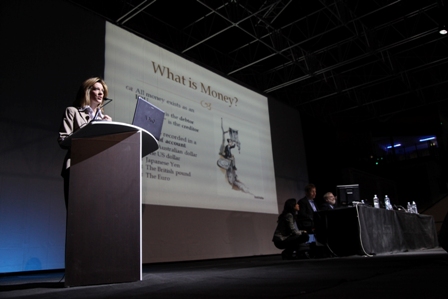
This claim, that money is a “creature of the state,” is central to the theory. In a “fiat money” system like the one in place in the United States, all money is ultimately created by the government, which prints it and puts it into circulation. Consequently, the thinking goes, the government can never run out of money. It can always make more.

This doesn’t mean that taxes are unnecessary. Taxes, in fact, are key to making the whole system work. The need to pay taxes compels people to use the currency printed by the government. Taxes are also sometimes necessary to prevent the economy from overheating. If consumer demand outpaces the supply of available goods, prices will jump, resulting in inflation (where prices rise even as buying power falls). In this case, taxes can tamp down spending and keep prices low.

But if the theory is correct, there is no reason the amount of money the government takes in needs to match up with the amount it spends. Indeed, its followers call for massive tax cuts and deficit spending during recessions.

Warren Mosler, a hedge fund manager who lives in Saint Croix in the U.S. Virgin Islands — in part because of the tax benefits — is one proponent. He’s perhaps better know for his sports car company and his frequent gadfly political campaigns (he earned a little less than one percent of the vote as an independent in Connecticut’s 2010 Senate race). He supports suspending the payroll tax that finances the Social Security trust fund and providing an $8 an hour government job to anyone who wants one to combat the current downturn.

The theory’s followers come mainly from a couple of institutions: the University of Missouri-Kansas City’s economics department and the Levy Economics Institute of Bard College, both of which have received money from Mosler. But the movement is gaining followers quickly, largely through an explosion of economics blogs. Naked Capitalism, an irreverent and passionately written blog on finance and economics with nearly a million monthly readers, features proponents such as Kelton, fellow Missouri professor L. Randall Wray and Wartberg College professor Scott Fullwiler. So does New Deal 2.0, a wonky economics blog based at the liberal Roosevelt Institute think tank.

Their followers have taken to the theory with great enthusiasm and pile into the comment sections of mainstream economics bloggers when they take on the theory. Wray’s work has been picked up by Firedoglake, a major liberal blog, and the New York Times op-ed page. “The crisis helped, but the thing that did it was the blogosphere,” Wray says. “Because, for one thing, we could get it published. It’s very hard to publish anything that sounds outside the mainstream in the journals.”

Most notably, Galbraith has spread the message everywhere from the Daily Beast to Congress. He advised lawmakers including then-House Speaker Nancy Pelosi (D-Calif.) when the financial crisis hit in 2008. Last summer he consulted with a group of House members on the debt ceiling negotiations. He was one of the handful of economists consulted by the Obama administration as it was designing the stimulus package. “I think Jamie has the most to lose by taking this position,” Kelton says. “It was, I think, a really brave thing to do, because he has such a big name, and he’s so well-respected.”

Wray and others say they, too, have consulted with policymakers, and there is a definite sense among the group that the theory’s time is now. “Our Web presence, every few months or so it goes up another notch,” Fullwiler says.

A divisive theory

The idea that deficit spending can help to bring an economy out of recession is an old one. It was a key point in Keynes’s “The General Theory of Employment, Interest and Money.” It was the chief rationale for the 2009 stimulus package, and many self-identified Keynesians, such as former White House adviser Christina Romer and economist Paul Krugman, have argued that more is in order. There are, of course, detractors.

A key split among Keynesians dates to the 1930s. One set of economists, including the Nobel laureates John Hicks and Paul Samuelson, sought to incorporate Keynes’s insights into classical economics. Hicks built a mathematical model summarizing Keynes’s theory, and Samuelson sought to wed Keynesian macroeconomics (which studies the behavior of the economy as a whole) to conventional microeconomics (which looks at how people and businesses allocate resources). This set the stage for most macroeconomic theory since. Even today, “New Keynesians,” such as Greg Mankiw, a Harvard economist who served as chief economic adviser to George W. Bush, and Romer’s husband, David, are seeking ways to ground Keynesian macroeconomic theory in the micro-level behavior of businesses and consumers.

Modern Monetary theorists hold fast to the tradition established by “post-Keynesians” such as Joan Robinson, Nicholas Kaldor and Hyman Minsky, who insisted Samuelson’s theory failed because its models acted as if, in Galbraith’s words, “the banking sector doesn’t exist.”

The connections are personal as well. Wray’s doctoral dissertation was advised by Minsky, and Galbraith studied with Robinson and Kaldor at the University of Cambridge. He argues that the theory is part of an “alternative tradition, which runs through Keynes and my father and Minsky.”

And while Modern Monetary Theory’s proponents take Keynes as their starting point and advocate aggressive deficit spending during recessions, they’re not that type of Keynesians. Even mainstream economists who argue for more deficit spending are reluctant to accept the central tenets of Modern Monetary Theory. Take Krugman, who regularly engages economists across the spectrum in spirited debate. He has argued that pursuing large budget deficits during boom times can lead to hyperinflation. Mankiw concedes the theory’s point that the government can never run out of money but doesn’t think this means what its proponents think it does.

Technically it’s true, he says, that the government could print streams of money and never default. The risk is that it could trigger a very high rate of inflation. This would “bankrupt much of the banking system,” he says. “Default, painful as it would be, might be a better option.”

Mankiw’s critique goes to the heart of the debate about Modern Monetary Theory —?and about how, when and even whether to eliminate our current deficits.

When the government deficit spends, it issues bonds to be bought on the open market. If its debt load grows too large, mainstream economists say, bond purchasers will demand higher interest rates, and the government will have to pay more in interest payments, which in turn adds to the debt load.

To get out of this cycle, the Fed?— which manages the nation’s money supply and credit and sits at the center of its financial system — could buy the bonds at lower rates, bypassing the private market. The Fed is prohibited from buying bonds directly from the Treasury — a legal rather than economic constraint. But the Fed would buy the bonds with money it prints, which means the money supply would increase. With it, inflation would rise, and so would the prospects of hyperinflation.

“You can’t just fund any level of government that you want from spending money, because you’ll get runaway inflation and eventually the rate of inflation will increase faster than the rate that you’re extracting resources from the economy,” says Karl Smith, an economist at the University of North Carolina. “This is the classic hyperinflation problem that happened in Zimbabwe and the Weimar Republic.”

The risk of inflation keeps most mainstream economists and policymakers on the same page about deficits: In the medium term — all else being equal — it’s critical to keep them small.

Economists in the Modern Monetary camp concede that deficits can sometimes lead to inflation. But they argue that this can only happen when the economy is at full employment — when all who are able and willing to work are employed and no resources (labor, capital, etc.) are idle. No modern example of this problem comes to mind, Galbraith says.

“The last time we had what could be plausibly called a demand-driven, serious inflation problem was probably World War I,” Galbraith says. “It’s been a long time since this hypothetical possibility has actually been observed, and it was observed only under conditions that will never be repeated.”

Critics’ rebuttals

According to Galbraith and the others, monetary policy as currently conducted by the Fed does not work. The Fed generally uses one of two levers to increase growth and employment. It can lower short-term interest rates by buying up short-term government bonds on the open market. If short-term rates are near-zero, as they are now, the Fed can try “quantitative easing,” or large-scale purchases of assets (such as bonds) from the private sector including longer-term Treasuries using money the Fed creates. This is what the Fed did in 2008 and 2010, in an emergency effort to boost the economy.

According to Modern Monetary Theory, the Fed buying up Treasuries is just, in Galbraith’s words, a “bookkeeping operation” that does not add income to American households and thus cannot be inflationary.

“It seemed clear to me that .?.?. flooding the economy with money by buying up government bonds .?.?. is not going to change anybody’s behavior,” Galbraith says. “They would just end up with cash reserves which would sit idle in the banking system, and that is exactly what in fact happened.”

The theorists just “have no idea how quantitative easing works,” says Joe Gagnon, an economist at the Peterson Institute who managed the Fed’s first round of quantitative easing in 2008. Even if the money the Fed uses to buy bonds stays in bank reserves — or money that’s held in reserve — increasing those reserves should still lead to increased borrowing and ripple throughout the system.

Mainstreamers are equally baffled by another claim of the theory: that budget surpluses in and of themselves are bad for the economy. According to Modern Monetary Theory, when the government runs a surplus, it is a net saver, which means that the private sector is a net debtor. The government is, in effect, “taking money from private pockets and forcing them to make that up by going deeper into debt,” Galbraith says, reiterating his White House comments.

The mainstream crowd finds this argument as funny now as they did when Galbraith presented it to Clinton. “I have two words to answer that: Australia and Canada,” Gagnon says. “If Jamie Galbraith would look them up, he would see immediate proof he’s wrong. Australia has had a long-running budget surplus now, they actually have no national debt whatsoever, they’re the fastest-growing, healthiest economy in the world.” Canada, similarly, has run consistent surpluses while achieving high growth.

To even care about such questions, Galbraith says, marked him as “a considerable eccentric” when he arrived from Cambridge to get a PhD at Yale, which had a more conventionally Keynesian economics department. Galbraith credits Samuelson and his allies’ success to a “mass-marketing of economic doctrine, of which Samuelson was the great master .?.?. which is something the Cambridge school could never have done.”

The mainstream economists are loath to give up any ground, even in cases such as the so-called “Cambridge capital controversy” of the 1960s. Samuelson debated post-Keynesians and, by his own admission, lost. Such matters have been, in Galbraith’s words, “airbrushed, like Trotsky” from the history of economics.

But MMT’s own relationship to real-world cases can be a little hit-or-miss. Mosler, the hedge fund manager, credits his role in the movement to an epiphany in the early 1990s, when markets grew concerned that Italy was about to default. Mosler figured that Italy, which at that time still issued its own currency, the lira, could not default as long as it had the ability to print more liras. He bet accordingly, and when Italy did not default, he made a tidy sum. “There was an enormous amount of money to be made if you could bring yourself around to the idea that they couldn’t default,” he says.

Later that decade, he learned there was also a lot of money to be lost. When similar fears surfaced about Russia, he again bet against default. Despite having its own currency, Russia defaulted, forcing Mosler to liquidate one of his funds and wiping out much of his $850 million in investments in the country. Mosler credits this to Russia’s fixed exchange rate policy of the time and insists that if it had only acted like a country with its own currency, default could have been avoided.

But the case could also prove what critics insist: Default, while technically always avoidable, is sometimes the best available option.

EU Leaders to Agree on Rescue Fund, Balanced Budget

No let up on the austerity demands, which are now to be legislated via balanced budget rules.

EU Leaders to Agree on Rescue Fund, Balanced Budget

Jan 29 (Reuters) — European Union leaders will sign off on a permanent rescue fund for the euro zone at a summit on Monday and are expected to agree on a balanced budget rule in national legislation, with unresolved problems in Greece casting a shadow on the discussions.

The summit – the 17th in two years as the EU battles to resolve its sovereign debt problems – is supposed to focus on creating jobs and growth, with leaders looking to shift the narrative away from politically unpopular budget austerity. The summit is expected to announce that up to 20 billion euros of unused funds from the EU’s 2007-2013 budget will be redirected towards job creation, especially among the young, and will commit to freeing up bank lending to small- and medium-sized companies.

But discussions over the permanent rescue fund, a new ‘fiscal treaty’ and Greece will dominate the talks.

Negotiations between the Greek government and private bondholders over the restructuring of 200 billion euros of Greek debt made progress over the weekend, but are not expected to conclude before the summit begins.

Until there is a deal between Greece and its private bondholders, EU leaders cannot move forward with a second, 130 billion euro rescue program for Athens, which they originally agreed to at a summit last October.

Instead, they will sign a treaty creating the European Stability Mechanism (ESM), a 500 billion-euro permanent bailout fund that is due to become operational in July, a year earlier than first planned. And they are likely to agree the terms of a ‘fiscal treaty’ tightening budget rules for those that sign up.

The ESM will replace the European Financial Stability Facility (EFSF), a temporary fund that has been used to bail out Ireland and Portugal and will help in the second Greek package.

Leaders hope the ESM will boost defenses against the debt crisis, but many – including Italian premier Mario Monti, IMF chief Christine Lagarde and U.S. Treasury Secretary Timothy Geithner – say it will only do so if its resources are combined with what remains in the EFSF, creating a super-fund of 750 billion euros ($1 trillion).

The International Monetary Fund says an agreement to increase the size of the euro zone ‘firewall’ will convince others to contribute more resources to the IMF, boosting its crisis-fighting abilities and improving market sentiment.

But Germany is opposed to such a step.

Chancellor Angela Merkel has said she will not discuss the issue of the ESM/EFSF’s ceiling until leaders meet for their next summit in March. In the meantime, financial markets will continue to fret that there may not be sufficient rescue funds available to help the likes of Italy and Spain if they run into renewed debt funding problems.

“There are certainly signals that Germany is willing to consider it and it is rather geared towards March from the German side,” a senior euro zone official said.

The sticking point is German public opinion which is tired of bailing out the euro zone’s financially less prudent. Instead, Merkel wants to see the EU – except Britain, which has rejected any such move – sign up to the fiscal treaty, including a balanced budget rule written into constitutions. Once that is done, the discussion about a bigger rescue fund can take place.

euro shares slipping on Greece

It wouldn’t be taking this long if there was a way to get’er done?

Not to mention that once haircuts are finalized the obvious political response from the opposition in Italy, for example, is “if Greece doesn’t have to pay why do we?’

Europe Shares Retreat From Highs as Greece Talks Stall

Jan 24 (Reuters) — European shares retreated from near six-month highs as concerns deepened that Greece might head towards a disorderly default and technical analysts said the recent rally could be coming to a close.

Italy Bond Auction Fails to Match Spain Success

The banking system can’t fund all the euro member nations under current regulatory restrictions, including capital requirements and diversification rules.

The 3 year variable rate funding from the ECB may have helped some banks with room on their balance sheets, but with general liquidity concerns, buy more national govt debt, but that would be a one time adjustment. Once the banking system is ‘topped off’ it only buys more national govt bonds to replace maturing issues, or to add to its balance sheet should its capital increase.

Italy Bond Auction Fails to Match Spain Success

By Valentina Za

Jan 25 (Reuters) — Italy’s three-year debt costs fell below 5 percent but its first bond sale of the year failed to match the success of a Spanish auction the previous day, reflecting the heavy refinancing load Rome faces over the next three months.

Italy raised the maximum planned amount of 4.75 billion euros at the auction but did not live up to market expectations raised by a Spanish tender on Thursday where Madrid raised 10 billion euros, twice the planned amount, at lower rates.

Both Italy and Spain are benefiting from half a trillion euros of cheap three-year funds the European Central Bank injected into the banking system in an unprecedented move last month. Investors, however, remain more cautious towards Rome in the light of its much larger refinancing needs.

“The auction metrics look robust on aggregate, although not as spectacular as yesterday’s Spanish supply,” said Michael Leister, a strategist at DZ Bank in Frankfurt.

Italian bonds rallied after domestic banks awash with ECB money snapped up Spain’s bonds on Thursday. The mixed results of the Italian sale tempered market enthusiasm and Italy’s 10-year yields rose back above 6.60 percent in the secondary market, after falling below 6.50 earlier in the session, to their lowest level in more than a month.

“This will serve to dampen some of the markets’ enthusiasm in the wake of yesterday’s Spanish auction … It doesn’t defeat the notion that the ECB extraordinary liquidity provisioning will support peripheral debt but it perhaps tempers expectations as to what degree these operations will support,” said Richard McGuire, a strategist at Rabobank in London.

LOWEST SINCE SEPTEMBER

Italy sold its November 2014 three-year benchmark bond at an average rate of 4.83 percent on Friday, down sharply from a yield of 5.62 yield at an auction just two weeks ago.

In a sign of improving funding conditions, this was the lowest yield at a three-year auction since September last year though fellow debt struggler Spain only had to pay 3.384 percent on three-year bonds on Thursday.

The bid-to-cover ratio fell to around 1.22, versus an already weak 1.36 ratio at the end-December sale, showing anemic demand for the paper. This time, however, Italy sold the top planned amount of its three-year benchmark.

Rome also sold debt due in July 2014 and August 2018.

The ECB’s liquidity boost, evident also at an Italian bill sale on Thursday where one-year yields more than halved, leaves Italy’s Treasury better placed to refinance some 90 billion euros of bonds maturing between February and April.

That is more than Spain aims to issue in medium and long-term maturities in the whole of 2012.

What analysts now describe as a challenging task may have been an impossible one at the end of November, when market fears of a financial collapse pushed Italy’s short-term debt costs towards 8 percent.

Under the leadership of a new technocrat government, Italy has embarked on a bold austerity push aimed at balancing the budget in 2013.

Analysts at Barclays Capital noted in a report that third-quarter budget data showed a decline in current expenditures for the first time ever, when excluding debt servicing costs.

But Prime Minister Mario Monti must now convince markets it can revive Italy’s ailing growth rate by overcoming entrenched resistance to its liberalization program.

Analysts warn that sentiment on the markets remains fragile with worries over a deal with private investors to voluntarily write down half of the value of their Greek debt lingering in the background.

“Looking beyond this one auction, the issuance challenge for Italy remains significant. Market pressures are most apparent in the 10-year sector of the curve which will face supply in two weeks time,” Citi analysts wrote in a research note.

Italy will sell five- and ten-year bonds at the end of January. On this longer maturities demand from foreign investors plays a bigger role but analysts say Italy would be able to shift only part of its funding burden to the short-term ahead of a second three-year liquidity tender at the end of February.

IMPORTANT SIDEBAR ABOUT CENTRAL BANKING

Email from JJ Lando, now at Nomura:

“THE LTRO DIDN’T DO ANYTHING. ALL THE MONEY WOUND UP AS DEPOSITS AT THE ECB” “QE DIDN’T DO ANYTHING. ALL THE MONEY BECAME EXCESS RESERVES BACK AT THE FED.”
(Apologies in advance to all who have heard me give this one ten times before)

1. Central Banks, whenever they buy any asset (eg lend eg grow balance sheet) create new reserves.

2. Commercial banks and people do NOT have the capacity to destroy those reserves. Once the Fed or ECB wires the money or creates that asset line item on its spreadsheet, there is an equal and offsetting liability on its spreadsheet called reserves. This spreadsheet cannot be broken.

3. All that commercial banks can do is lending, which moves some of those reserves from ‘excess’ to ‘required’ but they are still there.

4. Commercial Banks make this lending decision based upon regulatory capital and profit motives, not based upon reserves. They have a ‘captive audience’ in their Central Banks, who MUST create the necessary reserves (a floored amount) to prevent interest rates from going to infinity.

5. When a Central Bank does a lot of Balance Sheet expansion in a short time, it’s going to wind up as deposits/excess NO MATTER WHAT. If the Fed does 1T of QE, Banks don’t suddenly ‘find’ the regulatory capital to make 10T of loans. And even if they did, there would be the SAME AMOUNT OF TOTAL RESERVES.

6. Bank lending to a 0% risk weighted sovereign actually does NOTHING to diminish excess reserves.

7. Simplified Illustration: ECB does a very large unsterilized LTRO. They take a lot of sov paper on balance sheet (temporarily), and they wire NEW FUNDS to thie member banks. Those member banks take some of the money and buy paper from the ITalian government. That government spends the money by wiring it to its pensioners. Those pensioners take it to buy food from the local grocer. The local grocer DEPOSITS IT IN HIS BANK. SOMEWHERE DOWN THE CHAIN the money winds up on deposit in some member bank, be the chain long or short. WHATEVER MONEY THE ECB CREATES WINDS UP ON DEPOSIT IN ITS MEMBER BANKS, WHETHER OR NOT IT IS ‘USED’ TO BUY SOVEREIGN DEBT, ‘USED’ TO MAKE LOANS, OR NOT USED AT ALL.

8. Please. I never wish to read again that ‘Central Bank money went unused because it wound up as deposits.’ IT HAS NO WHERE ELSE TO GO. THE BANKING SYSTEM IS A CLOSED LOOP. With the possible exception of someone making a withdrawal, taking the paper, and making a bonfire (actually not feasible in the hundreds of billions anyway bec there are constraints)

9. And that is probably how Italy just managed to borrow at 1.64%
Good luck!