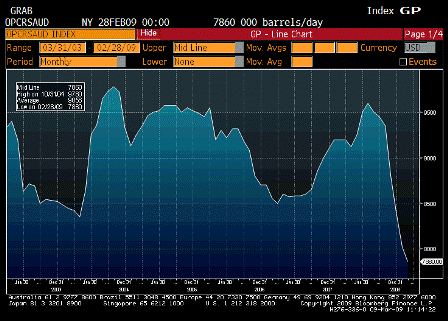
OPEC February Crude Output Down 770,000 Bbl/Day to 27.775 Million


[Skip to the end]

The Saudis are back to being swing producer as they set price and let output adjust.

World inventories are estimated to be falling by over 1.4 million barrels per day, as confirmed by the contango quickly fading to backwardation as we pass the ‘roll period’ for the passive funds.

With demand holding up better than markets anticipated and world non OPEC supply stagnant as well, I would expect demand for Saudi output to rise even as they keep prices firm.

I also expect the Fed to see this as a threat to growth rather than inflationary, and therefore continue to keep rates low.

OPEC February Crude Output down 770,000 Bdl/Day to 27.775 Mln

Mar 5 (Bloomberg) — Crude-oil production from the 12 OPEC members in February declined 770,000 barrels a day from January, the latest Bloomberg survey of producers, oil companies and industry analysts shows. Figures are in the thousands of barrels a day.

Opec Production
February 2009

Opec Country Feb Est. Jan Monthly Output Feb. 1 Change Est. vs. Target* Est. Target Est. Cap. (@)
Algeria 1,245 1,275 –30 1,203 42 1,450
Angola 1,670 1,740 -70 1,517 153 2,000
Ecuador 445 475 -30 434 11 500
Iran 3,690 3,780r -90 3,336 354 4,100
Iraq* 2,385 2,365 20 2,500
Kuwait# 2,140 2,280 -140 2,222 -82 2,650
Libya 1,605 1,630r -25 1,469 136 1,800
Nigeria 1,765 1,810 -45 1,673 92 2,500
Qatar 695 725 -30 731 -36 900
Saudi Arabia# 7,860 8,025 -165 8,051 -191 10,800
U.A.E 2,210 2,290 -80 2,223 79 2,800
Venezuela 2,065 2,150 -85 1,986 79 2,500
Total OPEC-12 27,775 28,545r -770 34,500
Total OPEC-11* 25,390 26,180r -790 24,845 545 32,000

*Quotas effective Jan. 1, 2009. OPEC agreed at its Dec. 17 meeting in Algeria to cut its quota target by 2.463 million barrels a day from the previous level, to 24.845 million barrels daily from Jan. 1. The quota target excludes Iraq, which has no formal quota. Indonesia left OPEC at end-2008.

Totals rounded.

r = revised @ = Capacity attainable within 30 days and sustainable for 90 days. # Includes Neutral Zone production shared equally between Saudi Arabia & Kuwait.


[top]

Valance Chart Book review Mar 7, 2009


[Skip to the end]

Valance Chartbook update Mar 7, 2009- The Automatic Stabilizers are Quietly doing their Job

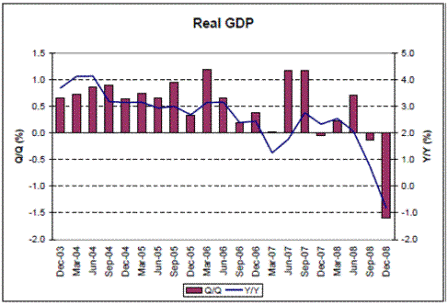
Q2 08 was the last up quarter (real growth up 2.8% annually), supported by the $170 billion fiscal adjustment.

Looks like all the last Congress had to do was keep doing a fiscal adjustment each quarter as needed to sustain positive output and employment growth.
Doesn’t seem like a lot to ask of them- spend more or cut taxes?

The subsequent declines could have easily been avoided.

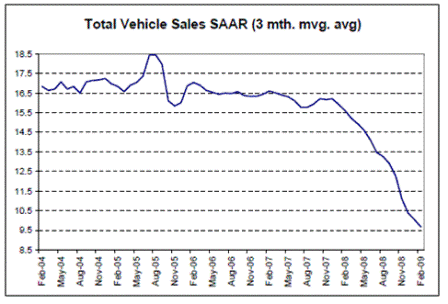
Interesting the auto execs didn’t blame Congress for the falling car sales and the financial crisis.

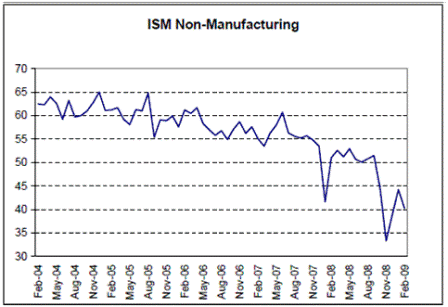
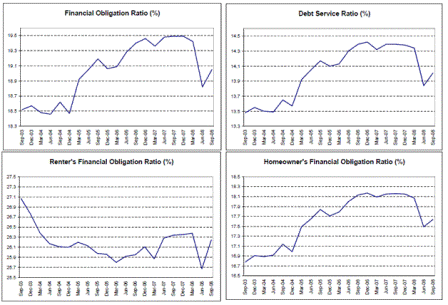
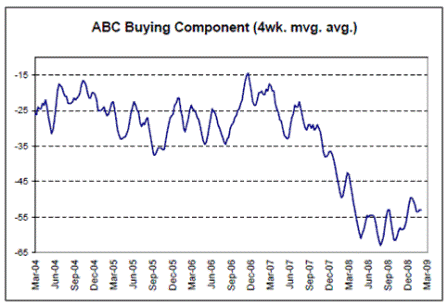
Almost all of the indicators look like this. Demand that had been slowly weakening for a long time fell apart sometime in July 2008.

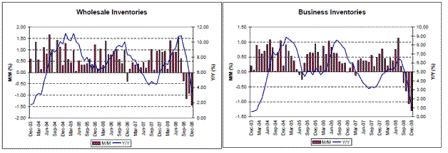
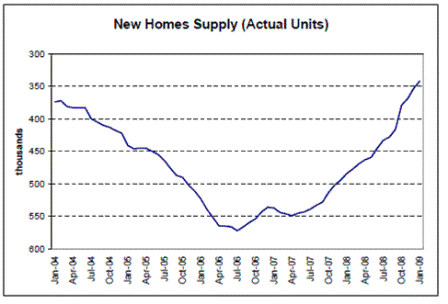
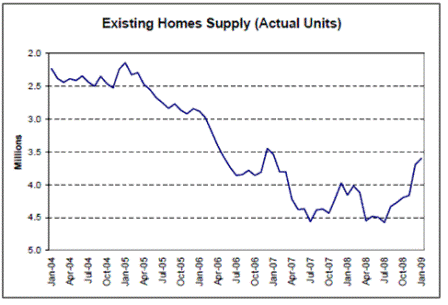
Like all recession’s I’ve seen, this one seems to have been characterized by inventory liquidation. Inventories now look to be very low.

The bulge in existing home sales was from the supply from foreclosures, which is also part of the inventory liquidation process.

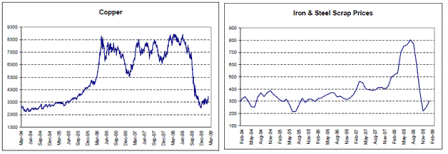
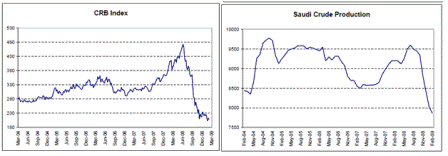
In addition to crude oil, the entire commodity basket was subject to the Great Mike Masters Inventory Liquidation. The charts seem to indicate that liquidation had run its course by late December 2008.

The Saudis and OPEC had to let the inventory liquidation run its course before regaining control of price late in Dec 08. Price is now going back to wherever they want it to be, as they set price to their liking and let output adjust. And with the latest data showing US gasoline consumption up 2% year over year it looks like demand for Saudi output may actually climb even as prices rise.

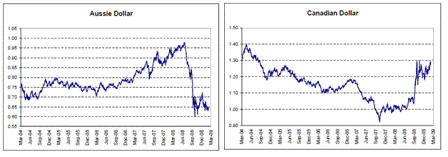
These commodity currencies have also gone sideways.

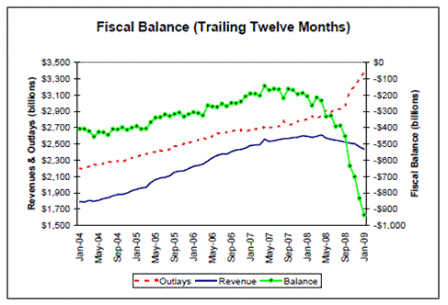
Coincident with the precipitous inventory liquidation and economic weakness, the automatic stabilizers kick in just as hard, increasing federal deficit spending via falling tax revenue and rising transfer payments.

This adds to private sector ‘savings’ of financial assets to the penny-

The accounting identity is government deficit = non-government ‘surplus’ of financial assets. (non-government includes residents and non-residents)

Less debt is mathematically the same as more savings.

Think of it this way. At the macro level, government deficit up= non-government net debt down.

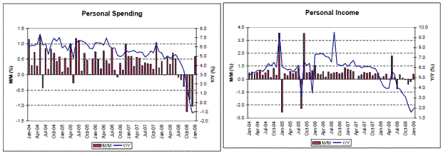
Meanwhile, the government deficit spending works to sustain personal income which works to support spending.

That’s how the automatic stabilizers work to keep recessions from turning into depressions.

There is some evidence beginning to surface, in addition to the above income and spending data, that maybe suggesting we are starting to move sideways rather than down.

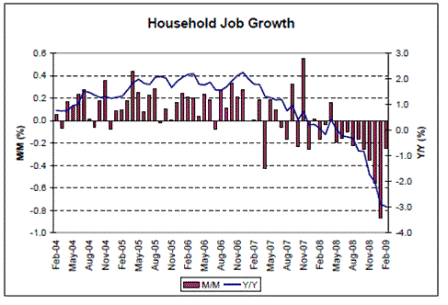
While unemployment will most likely continue to grow, as it takes at least maybe 2% real GDP growth for total hours worked to increase, there is some evidence at the margin that the rate of decline has peaked after a post year end spike from businesses that didn’t want to cut staff before the year-end holidays.

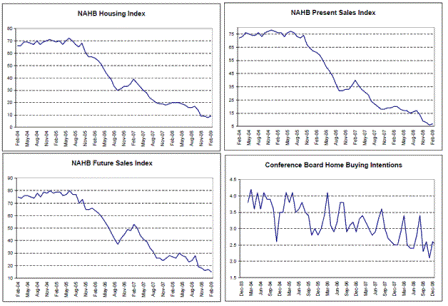
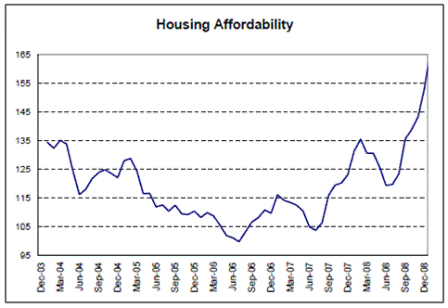
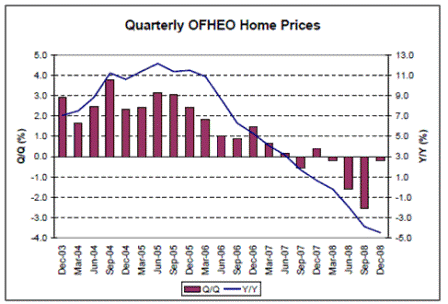
There is also some marginal evidence that the worst of the housing setback is behind us.

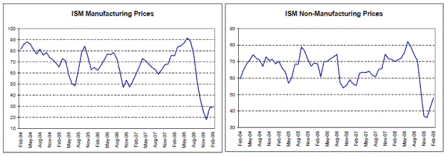
While the deflationary forces remain elevated by excess capacity in general, there is some evidence prices are selectively firming.

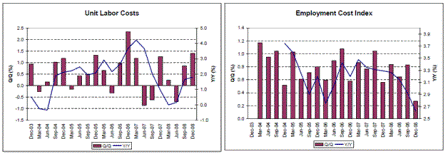
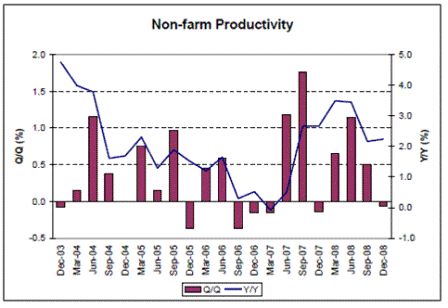
With low inventories prices get supported by replacement cost, which include costs of raw materials and unit labor costs, as well as productivity gains.

The new fiscal package isn’t my first choice, to be polite, but it isn’t ‘nothing’ either, and will further act to support demand and end this down cycle.

But it does nothing for near term energy consumption, and therefore risks rising commodity prices and rising CPI, even as unemployment remains unacceptably elevated.

This can put us back to where we started from- some growth but both weakness and inflation, this time with a backdrop of a much larger output gap, along with policy makers who don’t understand monetary operations and reserve accounting.


[top]

Re: “The 7 Deadly Innocent Frauds” DRAFT comments


[Skip to the end]

(email exchange)

>   
>   Here are some comments — this was interesting reading, and I do think it
>   makes sense on strictly a macro level (which is obviously what he’s going for).
>   

yes!

>   
>   #1 explanation is interesting, especially regarding the example of parents and
>   children with coupons. I do feel, however, that the author doesn’t give much
>   consideration to the inflationary results of the ‘govt check don’t bounce’ thesis
>   (I’m referencing the debate the author describes at the Australia conference).
>   While it’s probably true, I do think inflation has a material impact (at least at
>   the micro level, which I suppose isn’t really the point of this article).
>   

Right, the point is inflation is the issue, not solvency or sustainability. But critics of deficit spending never even attempt to quantify the inflationary aspect.

Instead, they seem to focus on ‘money supply’ for their inflation forecasting and ‘inflation expectation’ issues, both of which are not causal, but that’s another story.

>   
>   Under #2, I think the rhetoric about do we have to send goods and services back
>   in time to pay for historical debt is a red herring and not applicable (and I’m not
>   surprised the Senator couldn’t really say much about it off-hand while his wife ‘got
>   it’). It’s the debt servicing that people worry about, and that is in current terms
>   (no time machine required). However, the thesis of gov’t checks not bouncing
>   speaks to how the debt can be serviced.
>   

yes, and that distribution is entirely in the hands of the living who are in no case ruled from the grave.

>   
>   Paying off China — to book a Treasury Note sale, the gov’t on its own books would
>   debit cash (for the receipt)

yes, and the Tsy’s account at the Fed is debited. right now we have a self imposed constraint that says the tsy’s balance at the fed can’t be negative.

but that is not an operational constraint, just a self imposed constraint

>   and credit the liability (to book the obligation).

again, via the Fed.

>   The buyer’s accounts mentioned wouldn’t really be booked by the gov’t I don’t think,
>   but I get the point.

the buyer’s funds go to the fed where they are ‘accounted for’ as owning the securities.

>   
>   #3 and #7 go together in what is really being discussed is the use of leverage
>   (spending more than what you have). As long as the discussion stays at the macro
>   level, that’s fine as the gov’t can just keep printing money (again, ignoring any effects
>   of inflation).
>   

and by printing you mean simply ‘spending’ as that’s all there is- changing numbers on bank accounts. using the word ‘printing’ rather than ‘spending’ is used by the mainstream to color thinking in a fixed fx direction that no longer is applicable.

>   
>   But, it is quite a slippery slope to intertwine micro-level examples such as a hybrid car
>   factory and such as once you leave the gov’t level, leverage can have catastrophic
>   results (see the current deleveraging in the economy and how that’s affecting people on
>   a micro level). All this is fine as long as you have no monetary constraints, but for anyone
>   with no access to a US$ printing machine, it falls apart.
>   

Included with my 3 current proposals to reverse the current situation is the govt funding an $8 hr job for anyone willing able to work.

The other two are a full payroll tax holiday and $300 billion to the states on a per capita basis with no strings attached. Together they restore demand, output, and employment.


[top]

Bernanke Testimony March 3


[Skip to the end]

Let your Washington contacts know I’m available to help them formulate their questions!

SENATE COMMITTEE ON THE BUDGET HOLDS A HEARING ON ECONOMIC AND BUDGET CHALLENGES

MARCH 3, 2009

WITNESSES:
FEDERAL RESERVE SYSTEM BOARD OF GOVERNORS
CHAIRMAN BEN BERNANKE

GREGG: Thank you, Senator Wyden.

And thank you, Mr. Chairman, for attending this hearing today.

I think Senator Wyden, as acting chairman, has touched a core of one of the primary issues I’m interested in, which is the question of confidence. Whether or not the economy recovers depends in large part on the confidence of the American people in the value of their homes and in the fact that they’ll keep the job, confidence of those people
who buy our instruments that are debt is solid and sound, confidence that our currency is strong.

Wrong. It depends on having sufficient income to buy their own outputs and to net save as desired.

In the short run, one can accept the fact that debt is going to go up significantly because of the need to address this economy with the liquidity that only the government can put into it.

But in the long run, one has to ask how can this country sustain a debt to GDP ratio of 67 percent, deficits of over 3 percent, or as far as the eye can see, and expect to maintain the value of the dollar or the ability of people to come and buy our debt?

Like Japan? The yen seems strong enough to me with ratios twice that high.

There is a tsunami of debt headed at us — $66 trillion in unfunded liability. It will essentially overwhelm the capacity of our children to pay it and the ability of this nation to sustain it.

The usual mainstream nonsense.

BERNANKE: By December the Federal Open Market Committee had brought its target for the federal funds rate to an historically low range of zero to .25 percent, where it remains today.

(Which has removed maybe $200 billion annually in net interest income for the non government sectors)

Unfortunately,

Here we go. Deficits per se are bad.

the spending for financial stabilization, the increases in spending and reductions in taxes associated with the fiscal package, and the losses in revenues and increases in income- support payments associated with the weak economy will widen the federal budget deficit substantially this year. Taking into account these factors, the administration recently submitted a proposed budget that projects the federal deficit to increase to about $1.8 trillion this fiscal year and to remain around $1 trillion in 2010 and 2011.

As a consequence of this elevated level of borrowing, the ratio of federal debt held by the public to nominal GDP is likely to move up from about 40 percent before the onset of the financial crisis to more than 60 percent over the next several years, its highest level since the early 1950s, in the years following the massive debt buildup
during World War II.

Of course, all else equal, this is a development that all of us would have preferred to avoid.

He’s obviously in a fixed FX paradigm

We are better off moving aggressively today to solve our economic problems. The alternative could be a prolonged episode of economic stagnation that would not only contribute to further deterioration in the fiscal situation,

As if that’s the larger issue

but would also imply lower output, employment and incomes for an extended period.

Of secondary importance to the deficit issue.

With such large near-term deficits, it may seem too early to be contemplating the necessary return to fiscal sustainability. To the contrary, maintaining the confidence of the financial markets requires that we begin planning now for the restoration of fiscal balance.

Not true.

As the economy recovers and resources become more fully employed, we will need to withdraw the temporary components of the fiscal stimulus. Spending on financial stabilization also must wind down. If all goes well, the disposition of assets acquired by the Treasury in the process of stabilization will be a source of added revenue for the Treasury in the out years.

How about instead:

Whatever it takes to sustain output and employment is the right fiscal and policy.

Determining the pace of fiscal normalization will entail some difficult judgments. In particular, the Congress will need to weigh the costs of running large budget deficits for a time

What costs?

against the possibility of a premature removal of fiscal stimulus that could blunt the recovery.

That’s a real cost.

We at the Federal Reserve will face similar difficult judgment calls regarding monetary policy.

In particular, policy-makers must remain prepared to take the actions necessary in the near term to restore stability to the financial system and to put the economy on a sustainable path to recovery. But the near-term imperative of achieving economic recovery and the longer-run desire to achieve programmatic objectives should not be allowed to hinder timely consideration of the steps needed to address fiscal imbalances.

Why are they imbalances???

There are no gold reserves that can be depleted due to a convertible currency.

Without fiscal sustainability,

Fortunately, that isn’t an operational issue.

in the longer term we will have neither financial stability nor healthy economic growth.

Thank you for your attention. I’m happy to take your questions.

Senator Gregg?

GREGG: Thank you, Mr. Chairman.

And after that is all said and done, four years from now, when one certainly hopes, presumes and expects that we will be beyond these dire economic situations, we will be looking at a government which is taking up 22 percent of the gross national product,

(Probably the lowest in the world)

has a 67 percent ratio of publicly held debt to the GDP, and no end in sight and, in fact, it continues to work its way up, with deficits running at three to four percent, minimum, from 2013 to 2019, which is the end of the
window for this budget.

Reads like conditions for stability to me.

BERNANKE:GREGG: But your place is to protect the value of the dollar and protect the ability …

GREGG: … to sell the debt…

BERNANKE: … go on to say my concern here, as I expressed, was that there needs to be fiscal sustainability. If government spending is higher, it needs to be recognized that that will involve higher taxes in order to maintain a close reasonable balance between revenue and outlays.

So his target is a ‘close reasonable balance’.

That does have some implications for efficiency of the economy.

Does have some implications for efficiency? Is that all? Not that there is such a thing in the first place.

BERNANKE: Well, Senator, the CBO, for example, has done simulations which show that in 2030, under current laws, Medicare, Medicaid and Social Security would take up about, alone, would take up about 16 percent of GDP, which is pretty close to non-interest spending. It’s pretty close to the entire federal non-interest budget.

So it’s clear that in order to get control over the overall budget situation, we’re going to need to look at entitlements.

We don’t have the real resources to give the elderly a modest minimum standard of living and we don’t have the real resources to look after our health???

The current excess capacity alone is more than enough to do both.

If we don’t get a sustainable fiscal situation and deficits continue in large amounts for a long period, then it will become more difficult to sell our debt and interest rates will rise and it will be counterproductive.

Like Japan?

BERNANKE:Yes. So there’s been a lot of talk about banks and their ability to lend. In fact, for many types of credit, nonbank securitization markets are the main source of funding and those markets have largely closed down.

And so by restoring and re-stimulating activity in securitization markets, we hope to get credit flowing for a number of different critical areas.

We can’t ‘get credit going’ without securitization?

Of course we can!

The Fed could easily enable the banks, their legally designated agents, to do this with similar funding and guarantees.

Senator Cardin?

GRAHAM: Thank you, Mr. Chairman.

I’m trying to ask Senator Gregg’s question a little bit differently. Is there any outer limit on the federal government’s ability to borrow money?

BERNANKE: Certainly, there are outer limits.

Really??

GRAHAM: What are they and how close are we to them?

BERNANKE:Well, it’s — it’s hard — it’s hard to — to judge in any kind of explicit way, since we don’t — don’t know. I mean there are countries have clearly — for short periods of time has clearly had very high levels of debt.

Like Japan? For almost 20 years?

The United States had more than 100 percent debt to GDP ratio during World War II. The Japanese during their financial crisis raised the debt to GDP ratio above 100 percent.

Above 150% for considerable periods of time.

But clearly, that’s not a healthy situation.

Clearly?

It’s one in which interest payments can become a very important part of the — of the government’s outlays.

The Fed sets those interest rates. And Congress taxes interest income.

Nor operationally is the ability to make payments revenue constrained.

We had been — over years had been bringing our debt to GDP ratio down to about 40 percent. Now we’re going to see a jump to 60 or 65 percent.

We need to be I think looking for a — what’s called a primary deficit — that is, the deficit excluding interest payments, a somewhere close to balance. That would be sufficient to stabilize our debt to GDP ratio. I think that would be a good objective.

Interesting, more gold standard rhetoric.

How about an objective like optimal output and employment?

It’s very hard to know how much higher — how much higher the debt to GDP ratio could be before the international financial markets begin to — to balk. And so I think the prudent thing to do is to try and maintain stability of the debt to GDP ratio.

Like Japan, where 10 year JGB’s are under 1.5%, outstanding securities are over 150% of GDP, deficits range to over 8% of GDP, and they’ve been downgraded below Botswana???

Government rates go to where the CB sets them, end of story.

GRAHAM: Has there always been a buffer zone to — between reality and this magical place? And is there a buffer zone today?

BERNANKE: Well, as — as I think the recent experience is showing, confidence and expectations are critical.

Yes, he truly believes this.

And I think the markets will be quite able to absorb, for example, the large amount of issuance we’re seeing in the next couple of years, if there is a reasonable expectation and confidence in the same markets that the United States is serious about getting its budget position under control in the longer-term.

He truly believes that’s the case.

GRAHAM: There are some projections that exist that in 2050 the debt to GDP will be 300 percent. What kind of effect will that have, if that became a reality?

BERNANKE: Well, I don’t think that’s going to happen. It can’t happen, because things would break down before then.

GRAHAM: Something has to change first.

BERNANKE: Something…

GREGG: Happen, but not to change.

BERNANKE:That’s right.

GREGG: For it not to happen, right? Something has to change.

BERNANKE: Something would change, whether it was either change in policy or change in the willingness of the — of the lenders to finance the debt.

What generally changes is inflation keeps the nominal debt to GDP ratio down, but that’s another story that he knows well. And the reason he doesn’t want to go there is because that story says the risks are inflation and not solvency or the ability to sell securities.

GRAHAM: I’ve only got 15 seconds. My question, basically, is will we ever know in this country whether or not we’re repeating the Japanese mistake? Do you have any test out there to let us in Congress know that we’re throwing good money after bad, when it comes to certain institutions?

BERNANKE: The Japanese mistake was not acting quickly enough or aggressively enough, and I think that’s not our problem.

Yes, on fiscal policy.

SANDERS: Thank you, Mr. Chairman.

ALEXANDER: But — but they are (inaudible) to — to specify — the first risk is that you don’t get your money back. You think you will. The second risk would be that you’d — the more paper — the more money you print, the more likely we have inflation down the road…

(CROSSTALK)

BERNANKE: Senator, that’s aptly correct. So you’re absolutely right that in order for us to begin to raise interest rates and begin to stabilize the economy.

Now that they can pay interest on reserves they don’t have to ‘shrink the balance sheet’ to raise rates. Bernanke should know that.

At that time when the economy begins to grow again, we’re going to have to shrink the balance sheet and we are very comfortable — we’re watching that very, very carefully. It’s very important. We spend about half of our time at FOMC meetings, looking at the balance sheet and trying to make that evaluation.

Interesting use of FOMC time!

Worrying about something of no consequence whatsoever.


[top]

2009-02-27 USER


[Skip to the end]


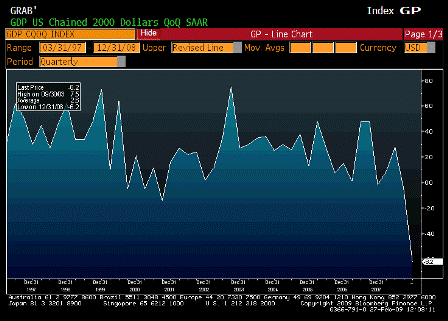
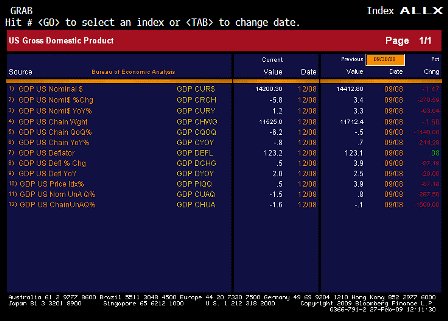
GDP QoQ Annualized (4Q P)

Survey -5.4%
Actual -6.2%
Prior -3.8%
Revised n/a

[top][end]

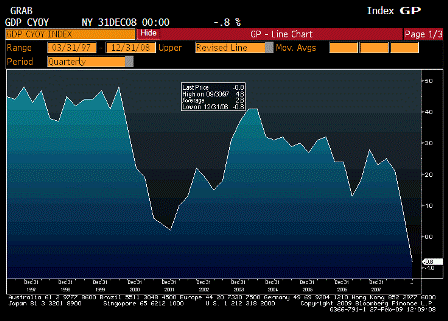
GDP YoY Annualized Real (4Q P)

Survey n/a
Actual -0.8%
Prior 0.7%
Revised n/a

[top][end]

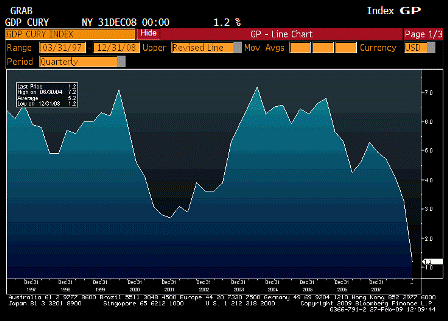
GDP YoY Annualized Nominal (4Q P)

Survey n/a
Actual 1.2%
Prior 3.3%
Revised n/a

[top][end]

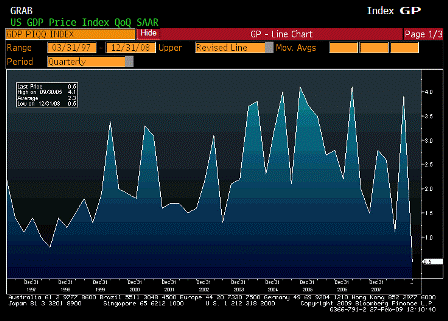
GDP Price Index (4Q)

Survey -0.1%
Actual 0.5%
Prior -0.1%
Revised n/a

[top][end]

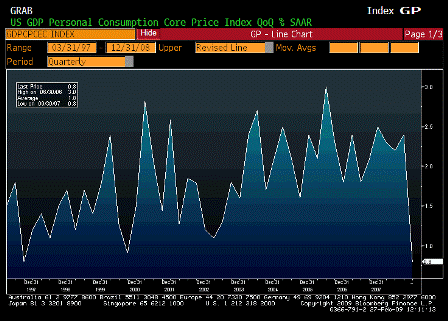
Core PCE QoQ (4Q)

Survey 0.6%
Actual 0.8%
Prior 0.6%
Revised n/a

[top][end]

GDP ALLX (4Q P)

[top][end]

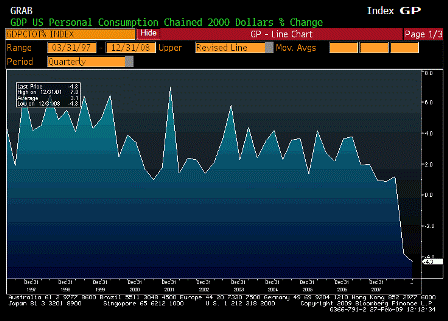
Personal Consumption (4Q)

Survey -3.7%
Actual -4.3%
Prior -3.5%
Revised n/a

[top][end]


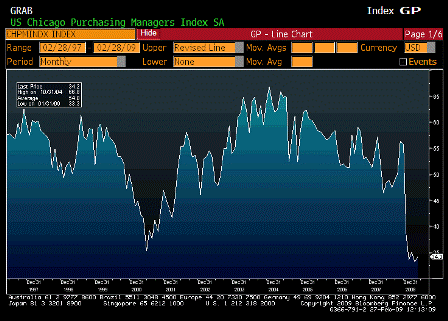
Chicago Purchasing Manager (Feb)

Survey 33.0
Actual 34.2
Prior 33.3
Revised n/a

[top][end]


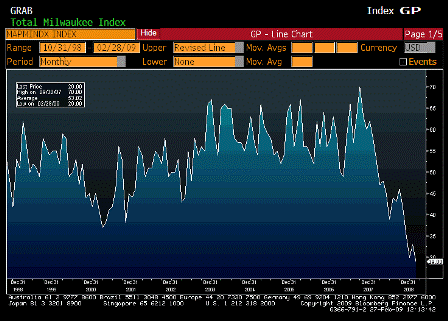
NAPM Milwaukee (Feb)

Survey 32.0
Actual 29.0
Prior 33.0
Revised n/a

[top][end]


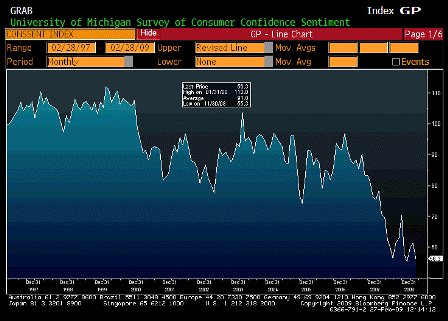
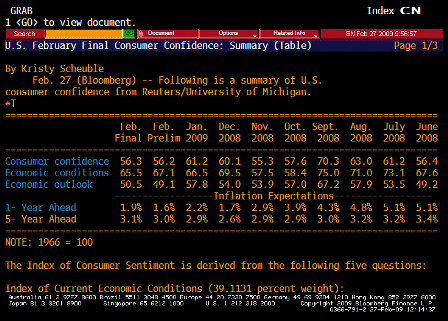
U of Michigan Confidence (Feb F)

Survey 56.0
Actual 56.3
Prior 56.2
Revised n/a

[top][end]

U of Michigan TABLE Inflation Expectations (Feb F)


[top]

Re: Tax cuts may heighten deflation risks – NY Fed study


[Skip to the end]

(email exchange)

It doesn’t make sense in any model this side of sanity. Comments below:

>   
>   On Sun, Feb 22, 2009 at 7:47 PM, Steve wrote:
>   
>   Does this make sense in your model of fiscal policy?….interesting
>   counter intuitive argument…
>   

Tax cuts may heighten deflation risks- NY Fed study

Feb 18 (Reuters) — Cutting taxes to try to stimulate the economy could do more harm than good in a zero interest rate environment as it can heighten the risk of deflation, according to a recent New York Federal Reserve study.

Policies that are aimed at increasing the supply of goods can be counterproductive when the main problem is insufficient demand, New York Fed economist Gauti Eggertsson said in a research paper entitled “Can tax cuts deepen the recession?”

Increasing the supply of public goods is never contractionary. Though wise investment can bring down real costs and prices and thereby increase productivity and our real standards of living.

“The emphasis should be on policies that stimulate spending,” Eggertsson said, adding that his research found the impact of tax cuts is “fundamentally different” with interest rates near zero.

“At zero short-term nominal interest rates, tax cuts reduce output in a standard New Keynesian (economic) model. They do so because they increase deflationary pressure,” he wrote. Eggertsson’s study focused primarily on labor taxes and some sales taxes.

There’s the problem- the standard ‘new Keynesian model’ is garbage.

Cutting payroll taxes, for example, would create an incentive for people to work more. But if there are not enough jobs, this could have a negative effect: creating more demand for work and thus driving down wages.

Huh? First of all, for me personally at least, when my income is cut I tend to work more to at least try to make the same income. And when taxes are cut I certainly don’t work more. But that’s just anecdotal.

The main point is there are already millions of unemployed so even if somehow cutting payroll taxes so people struggling to make ends meet can better do so causes a few more people to seek work the pressure on wages can hardly go up.

And maybe the strongest point, these new people supposedly seeking work due to a cut in payroll taxes will only work at the higher wage as a point of this (convoluted) logic which is far different from a market and wage level pressure point of view than the millions of others willing to work at current wages who can’t find work.

Last, the notion that changes in payroll tax could measurably alter wage seekers is extremely far fetched at best and not statistically significant in any case.

And with interest rates near zero, the Fed cannot cut rates further to fight deflation.

As if cutting rates does or ever has fought deflation.

If anything the causation is reversed. The new Keynesian model has this all wrong.

President Barack Obama on Tuesday signed into law a $787 billion package of measures to lift the recession-mired U.S. economy that included about $287 billion in tax cuts.

Eggertsson’s findings counter the argument that cutting taxes to put an extra buck in consumers’ pockets will boost their spending. Instead, given the current economic backdrop, it is likely people would save money from temporary tax cuts,

Yes, this is likely, and not a ‘bad thing’ as it means taxes can be cut at least that much further and/or spending increased further.

given the recession and expectations that tax increases are inevitable in the future.

This is the ‘Ricardian Equivalent’ argument put forth by some of the ‘new Keynesians’ and has largely been dismissed as nonsensical by most. The idea that tax cuts do nothing because people automatically expect higher taxes later as they ‘know’ the budget must eventually be balanced, taken to the extreme, means totally eliminating taxes does nothing for demand which of course is ridiculous.

He said that while a number of economists have argued that aggressive tax cuts are needed to revive the U.S. economy, policy-makers should “view with a great deal of skepticism” studies that use post World War Two data — a period characterized by positive interest rates.

Interest rates have nothing to do with the effect of tax cuts. And history (and all other theory) has shown that tax cuts add to demand, tax increases lower demand.

The best ways to stimulate spending, according to Eggertsson’s study, is through traditional government spending and a credible commitment to boosting inflation, creating an incentive to spend now before prices rise. (Reporting by Kristina Cooke; Editing by Diane Craft)

Good old ‘inflation expectations theory’ again from the new Keynesians, which is also nonsense. It’s a ‘plug’ due to no other theory of where the price level comes from, as they have yet to recognize the currency itself is a public monopoly, and monopolists are necessarily price setters.


[top]
Re: Martin Wolf spot on


[Skip to the end]

(email exchange)

Cliff,

Martin Wolf is spot on below. Our biggest risk is the reluctance of our leaders to implement the fiscal adjustments on an as needed, size no object, basis to reverse shortfalls in aggregate demand.

>   
>   On Fri, Feb 20, 2009 at 11:11 AM, Cliff wrote:
>   
>   Warren,
>   
>   Many people ask me why Japan did not have large
>   inflation with their large deficits,
>   

They weren’t even large enough to fully offset the deflationary forces.

>   
>   and they ask will the U.S. be like Japan or will
>   inflation recur in the next few years.
>   

Depends on crude prices. If they go up inflation as we know it comes back. This is very likely.

We need a hard policy to cut our imported fuel consumption to prevent ‘inflation’ and declining real terms of trade.

>   
>   Please see the article below, and can you
>   comment on the article and the related two
>   questions posed above.
>   
>   Thanks, Cliff
>   

Japan’s lessons for a world of balance-sheet deflation

by Martin Wolf

Feb 17 (Financial Times) — What has Japan’s “lost decade” to teach us? Even a year ago, this seemed an absurd question. The general consensus of informed opinion was that the U.S., the U.K. and other heavily indebted western economies could not suffer as Japan had done. Now the question is changing to whether these countries will manage as well as Japan did. Welcome to the world of balance-sheet deflation.

As I have noted before , the best analysis of what happened to Japan is by Richard Koo of the Nomura Research Institute.* His big point, though simple, is ignored by conventional economics: balance sheets matter. Threatened with bankruptcy, the overborrowed will struggle to pay down their debts. A collapse in asset prices purchased through debt will have a far more devastating impact than the same collapse accompanied by little debt.

Most of the decline in Japanese private spending and borrowing in the 1990s was, argues Mr Koo, due not to the state of the banks, but to that of their borrowers. This was a situation in which, in the words of John Maynard Keynes, low interest rates – and Japan’s were, for years, as low as could be – were “pushing on a string”. Debtors kept paying down their loans.

How far, then, does this viewpoint inform us of the plight we are now in? A great deal, is the answer.

First, comparisons between today and the deep recessions of the early 1980s are utterly misguided. In 1981, U.S. private debt was 123 per cent of gross domestic product; by the third quarter of 2008, it was 290 per cent. In 1981, household debt was 48 per cent of GDP; in 2007, it was 100 per cent. In 1980, the Federal Reserve’s intervention rate reached 19-20 per cent. Today, it is nearly zero.

When interest rates fell in the early 1980s, borrowing jumped. The chances of igniting a surge in borrowing now are close to zero. A recession caused by the central bank’s determination to squeeze out inflation is quite different from one caused by excessive debt and collapsing net worth. In the former case, the central bank causes the recession. In the latter, it is trying hard to prevent it.

Second, those who argue that the Japanese government’s fiscal expansion failed are, again, mistaken. When the private sector tries to repay debt over many years, a country has three options: let the government do the borrowing; expand net exports; or let the economy collapse in a downward spiral of mass bankruptcy.

Despite a loss in wealth of three times GDP and a shift of 20 per cent of GDP in the financial balance of the corporate sector, from deficits into surpluses, Japan did not suffer a depression. This was a triumph. The explanation was the big fiscal deficits. When, in 1997, the Hashimoto government tried to reduce the fiscal deficits, the economy collapsed and actual fiscal deficits rose.

Third, recognising losses and recapitalising the financial system are vital, even if, as Mr Koo argues, the unwillingness to borrow was even more important. The Japanese lived with zombie banks for nearly a decade. The explanation was a political stand-off: public hostility to bankers rendered it impossible to inject government money on a large scale, and the power of bankers made it impossible to nationalise insolvent institutions. For years, people pretended that the problem was downward overshooting of asset price. In the end, a financial implosion forced the Japanese government’s hand. The same was true in the U.S. last autumn, but the opportunity for a full restructuring and recapitalisation of the system was lost.

In the U.S., the state of the financial sector may well be far more important than it was in Japan. The big US debt accumulations were not by non-financial corporations but by households and the financial sector. The gross debt of the financial sector rose from 22 per cent of GDP in 1981 to 117 per cent in the third quarter of 2008, while the debt of non-financial corporations rose only from 53 per cent to 76 per cent of GDP. Thus, the desire of financial institutions to shrink balance sheets may be an even bigger cause of recession in the US.

How far, then, is Japan’s overall experience relevant to today?

The good news is that the asset price bubbles themselves were far smaller in the US than in Japan. Furthermore, the U.S. central bank has been swifter in recognising reality, cutting interest rates quickly to close to zero and moving towards “unconventional” monetary policy.

The bad news is that the debate over fiscal policy in the U.S. seems even more neanderthal than in Japan: it cannot be stressed too strongly that in a balance-sheet deflation, with zero official interest rates, fiscal policy is all we have. The big danger is that an attempt will be made to close the fiscal deficit prematurely, with dire results. Again, the U.S. administration’s proposals for a public/private partnership, to purchase toxic assets, look hopeless. Even if it can be made to work operationally, the prices are likely to be too low to encourage banks to sell or to represent a big taxpayer subsidy to buyers, sellers, or both. Far more important, it is unlikely that modestly raising prices of a range of bad assets will recapitalise damaged institutions. In the end, reality will come out. But that may follow a lengthy pretence.

Yet what is happening inside the US is far from the worst news. That is the global reach of the crisis. Japan was able to rely on exports to a buoyant world economy. This crisis is global: the bubbles and associated spending booms spread across much of the western world, as did the financial mania and purchases of bad assets. Economies directly affected account for close to half of the world economy. Economies indirectly affected, via falling external demand and collapsing finance, account for the rest. The US, it is clear, remains the core of the world economy.

As a result, we confront a balance-sheet deflation that, albeit far shallower than that in Japan in the 1990s, has a far wider reach. It is, for this reason, fanciful to imagine a swift and strong return to global growth. Where is the demand to come from? From over-indebted western consumers? Hardly. From emerging country consumers? Unlikely. From fiscal expansion? Up to a point. But this still looks too weak and too unbalanced, with much coming from the US. China is helping, but the eurozone and Japan seem paralysed, while most emerging economies cannot now risk aggressive action.

Last year marked the end of a hopeful era. Today, it is impossible to rule out a lost decade for the world economy. This has to be prevented. Posterity will not forgive leaders who fail to rise to this great challenge.


[top]
2009-02-20 USER


[Skip to the end]


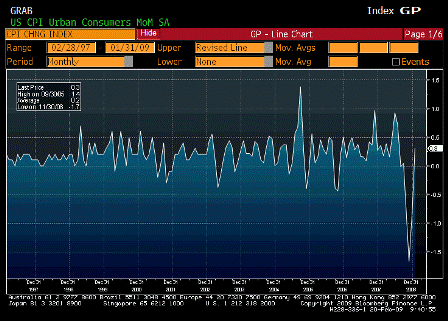
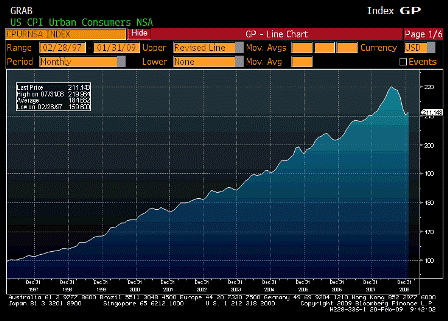
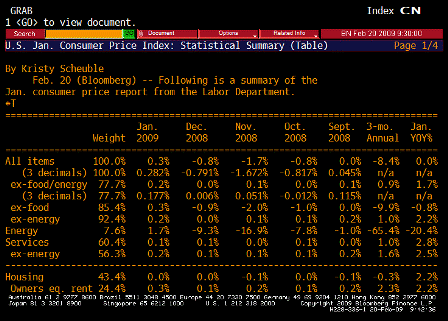
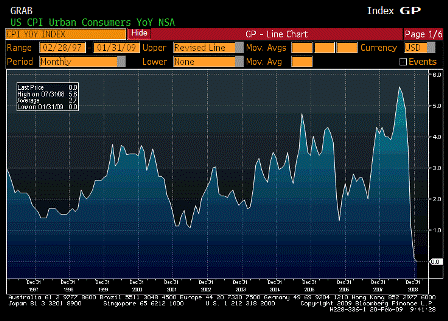
Consumer Price Index MoM (Jan)

Survey 0.3%
Actual 0.3%
Prior -0.7%
Revised -0.8%

 
Karim writes:

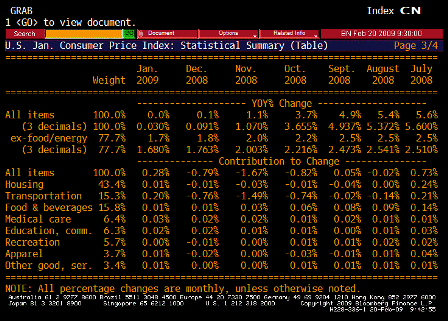
CPI boosted by OER and tobacco.

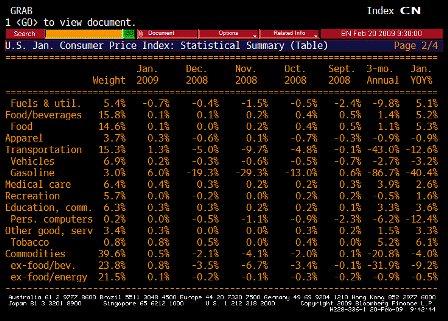
  • m/m .282% headline and .177% core; y/y 0.0% headline and 1.7% core
  • Mthly data boosted by OER (up 0.3%)-likely reflects decline in fuel/utility prices in recent months (which boosts ‘owners equivalent rent’)
  • Mirroring PPI yesterday, tobacco prices up 0.8%
  • Core PCE, which has less weight in housing, has been negative for 3mths in a row. On y/y basis, core inflation likely headed to 1% by mid-year (headline inflation may decline by -1% y/y by mid-year before converging to core in H2).

[top][end]

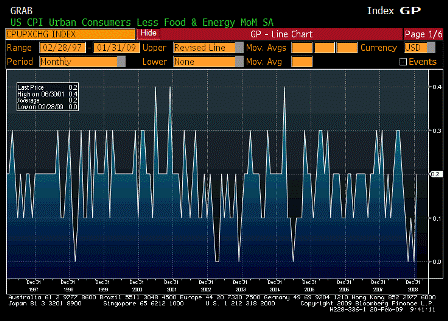
CPI Ex Food and Energy MoM (Jan)

Survey 0.1%
Actual 0.2%
Prior 0.0%
Revised n/a

[top][end]

Consumer Price Index YoY (Jan)

Survey -0.1%
Actual 0.0%
Prior 0.1%
Revised n/a

[top][end]

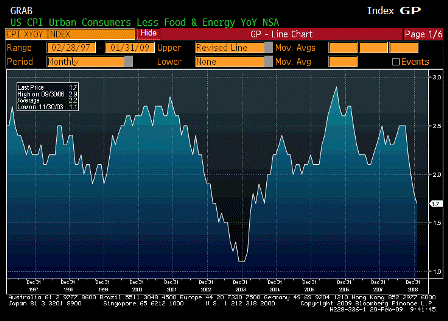
CPI Ex Food and Energy YoY (Jan)

Survey 1.5%
Actual 1.7%
Prior 1.8%
Revised n/a

[top][end]

Consumer Price Index NSA (Jan)

Survey 211.081
Actual 211.143
Prior 210.228
Revised n/a

[top][end]

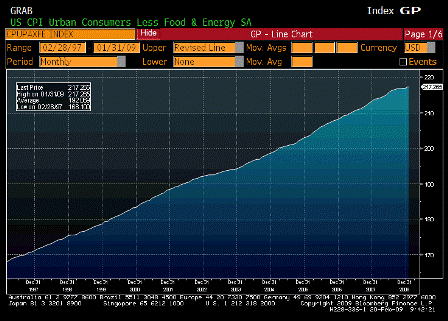
CPI Core Index SA (Jan)

Survey n/a
Actual 217.265
Prior 216.816
Revised 216.882

[top][end]

Consumer Price Index TABLE 1 (Jan)

[top][end]

Consumer Price Index TABLE 2 (Jan)

[top][end]

Consumer Price Index TABLE 3 (Jan)


[top]
The euro falls again


[Skip to the end]

Each time the euro falls like it has done over the last several days suspicions arise that ‘this is it’ and it’s on the way towards 0, with a wholesale exit by individuals and institutional investors afraid of everything from inflation to a total breakup of the currency union.

The cross currents are enormous, and the range of predicted outcomes wide.

What’s sure as always is in the end someone will have had the right forecast, but it will be because of ‘statistics’- the forecasts cover all possibilities- or maybe inside information, but not greater wisdom.

Partial list of cross currents:

Euro positive:

  • The eurozone has relatively tight fiscal policy, with no proactive fiscal package of consequence. This keeps the euro strong, and promotes deflationary domestic conditions as the economy tries to export to gain needed financial assets.
  • Fed swap lines tend to support the euro vs the dollar, as institutions that otherwise would need to sell euros and buy dollars to cover dollar losses can instead buy time and borrow them cheaply via the swap line arrangement. This kept the region from collapse in the fall.

Euro negative:

  • The dollar losses don’t go away with the swap lines, unless dollar asset prices and credit quality improve, which has not been the case. So any euro strength tends to see sellers of euro vs dollars to cover some of the losses.
  • In a breakup of the eurozone there is a risk euro securities get redenominated to the new national currencies which may be subject to high levels of deficit spending to support domestic demand and promote high inflation, high interest rates, and falling currencies as in the past.
  • Euro governments could default and payments be suspended indefinitely.
  • Bank deposits could be frozen indefinitely with major bank failures too large for any national govt. to politically or even operationally write the check.
  • The low price of crude supports the dollar by keeping dollars ‘hard to get’ for the foreign sector.

The exit from the euro includes those who buy gold, which has been driving gold to extremes vs other commodities even though you can’t eat it and it doesn’t pay interest, and it’s been a very long time since it was what you needed to pay taxes.

This is a major bubble in progress that ends in a very sharp collapse when the buying has run its course, and as those owning gold need it for payment purposes and begin to sell.

Along with the real buyers who are exiting the euro (and other currencies) are the usual specs and trend followers who exacerbate every trend on the way up and the way down.

And the fact remains that all the ‘money’ in the world is nothing more than spread sheet entries of what is needed to pay taxes.

And there aren’t a lot of practical alternatives to storing ‘wealth’ apart from inherently worthless gold, and various forms of ‘property’ that can all be taxed and therefore demands currency for payment.

Ironically, it is a spreadsheet crisis- there is no shortage of real resources- and therefore readily ‘fixed’ by the right data entry by governments on their own spreadsheets.

For the US that means something like:

  1. A full payroll tax holiday where the treasury makes all payments for employers and employees- why are we taking $1 trillion per year from workers and business struggling to make their payments?
  2. $300 billion to the states on a per capita basis with no strings attached- the per capita distribution concept removes the need for specific federal oversight.

Those two spreadsheet entries would end the ‘crisis’ in very short order.

And a government funded $8/hour job for anyone willing and able to work begins to replace the current unemployed labor buffer stock with an employed labor buffer stock, which is both a superior price anchor and potentially a source of increased useful output and reduction of the high real social costs of our current system.

But deficit myths are likely to remain the obstacle to making the spread sheet entries readily available to restore output and employment.

The latest ridiculous bit of non sense is that government borrowing takes ‘money’ from one place and puts it in another.

Government deficit spending adds exactly that many NEW ‘bank balances’ to non government financial assets, and government borrowing subsequently offers those NEW, ADDITIONAL bank balances CREATED BY DEFICIT SPENDING alternative financial assets called Treasury securities.

At the end of the day there are NEW financial assets called Treasury securities added to the existing stock of financial assets in the non govt sectors by federal deficit spending.

Spread the word!


[top]
3 blind mice- nonsense from the BOJ, MOF, and Prime Minister


[Skip to the end]
Running with tails cut off with a carving knife:

This is what you get when the head of the CB doesn’t understand monetary operations and reserves accounting:

Shirakawa Says BOJ to Limit Asset Buying to Save Balance Sheet

by Jason Clenfield and Toru Fujioka

Feb 5 (Bloomberg) — Bank of Japan Governor Masaaki Shirakawa said the central bank will limit its purchases of stocks and corporate debt to protect its balance sheet and the credibility of the yen.

“We are mindful of the need to eventually end the purchases” as they are “extraordinary measures,” Shirakawa told lawmakers in Tokyo today. Excessive buying would worsen the central bank’s balance sheet and “have a clear impact on the yen’s credibility,” he said.

This what you get when the Finance Minister, Deputy Party Chairman, and former Finance Minister don’t understand monetary operations and reserve accounting:

Nakagawa Says Japan Isn’t Considering Printing Money

by Keiko Ujikane

Feb 6 (Bloomberg) — Japan’s government isn’t considering printing new money, Finance Minister Shoichi Nakagawa said.

He was responding to a report in the Financial Times that ruling party lawmakers would today propose printing 50 trillion yen ($549 billion) of a new currency to be used to pay for stimulating the economy.

“The idea of the government printing money isn’t in my mind,” Nakagawa said at a press briefing in Tokyo today.

“Japan’s economy is worsening rapidly so some people are discussing various ways of financing business activities and daily life.”

Yoshihide Suga, deputy chairman of the ruling Liberal Democratic Party election strategy council, is among the group of politicians that will suggest using 30 trillion yen of the money on projects such as doubling the size of Tokyo’s Haneda airport, the Financial Times reported. The other 20 trillion yen would be for government purchases of stocks and real estate.

Bank of Japan Governor Masaaki Shirakawa said Feb. 3 such a plan would hurt the credibility of the yen and lead to an increase in long-term yields by raising concern about the government’s ability to pay back the debt.

Former Finance Minister Bunmei Ibuki, speaking at a meeting of ruling LDP factions, said currency printed by the government rather than the Bank of Japan would devalue the yen and invite inflation, according to the Yomiuri Newspaper.

Discussions about the printing the money weren’t in the public interest, Ibuki said.

This is what you get when the Prime Minister doesn’t understand monetary operations or reserve accounting:

Japan May Consider 50 Trillion Yen in Scrip, FT Says

by Dave McCombs

Feb 6 (Bloomberg) — An aide to Japan’s Prime Minister Taro Aso and some lawmakers will today propose printing 50 trillion yen ($549 billion) worth of a new currency to be used to pay for stimulating the economy, the Financial Times reported, citing Koutaro Tamura, an upper house Diet member.

Yoshihide Suga, deputy chairman of the ruling Liberal Democratic Party election strategy council, is among the group of politicians that will suggest 30 trillion yen of the scrip for programs for new industries and projects such as doubling the size of Tokyo’s Haneda airport, the report said. The other 20 trillion yen worth of the new currency would be allocated to government purchases of stocks and real estate.


[top]