
What Happens When the Government Tightens its Belt?

What Happens When the Government Tightens its Belt?

By Stephanie Kelton

May 27 — Imagine two people sitting on opposite ends of a 15-foot teeter-totter. The laws of physics dictate that the seesaw will balance if the product of the first mass (w1) and its distance (d1) from the fulcrum (i.e. the balancing point) is equal to the product of the other mass (w2) and its distance (d2) from the fulcrum. Thus, the physicist can show that the teeter-totter will be in balance when the fulcrum is placed 6 feet from the end holding a 150lb person and 9 feet from the end holding a 100lb person. Moreover, the laws of physics ensure that an imbalance will arise if the mass or the relative position of one of the people is changed.
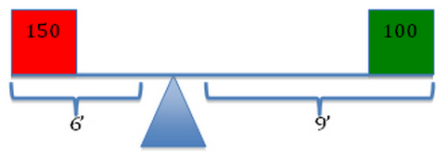

The laws of accounting allow us to demonstrate that similarly powerful concepts apply to the science of economics. Beginning with the simple identity for GDP in a closed economy, we have:

[1] Y = C + I + G, where:

   Y = GDP = National Income
   C = Aggregate Consumption Expenditure
   I = Aggregate Investment Expenditure
   G = Aggregate Government Expenditure

For economists, this is as obvious as stating that a linear foot is the sum of 12 sequential inches. It simply recognizes that the total amount of money spent buying newly produced goods and services will yield an equivalent income to the sellers of these products. Thus, it demonstrates that expenditures are a source of income.

Once earned, income can be allocated in one of three ways. At the end of the day, all income (Y) will be spent (C), saved (S) or used in payment of taxes (T):

[2] Y = C + S + T

Since they are equivalent expressions for Y, we can set equation [1] equal to equation [2], giving us:

C + I + G = C + S + T

Or, after canceling (C) from both sides and moving terms around:

[3] (S – I) = (G – T)

Equation [3] shows that there is a direct relationship between what’s happening in the private sector (S – I) and what’s happening in the public sector (G – T). But it is not the one that Pete Peterson, Erskin Bowles, or President Obama would have you believe. And I want you to understand why they are wrong.

To understand the argument, imagine that you and Uncle Sam are sitting on opposite ends of a teeter-totter. You represent the private sector, and your financial status is given by (S – I). Your budget can be in balance (S = I), in deficit (S < I) or in surplus (S > I). When your financial status is positive (S > I), you are net saving. When your financial status is negative (S < I), you are net borrowing. Uncle Sam’s financial status is equal to (G – T), and, like yours, his budget may be balanced (G = T), in deficit (G > T) or in surplus (G < T). When you interact, only three outcomes are possible.
First, it is conceivable that (S = I) and (G = T) so that (S – I) = 0 and (G – T) = 0. When this condition holds, the teeter-totter will level off with each of you experiencing a balanced budget.
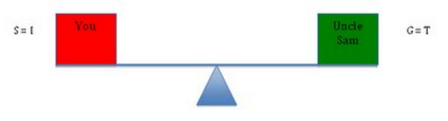
In the above scenario, the government is balancing its receipts (T) and expenditures (G), and you are balancing your savings and investment spending. There is no net gain/loss.

But suppose the government begins to spend more than it collects in taxes (i.e. G > T). How will Uncle Sam’s deficit affect your position on the teeter-totter? The answer is as straightforward as increasing the mass of the person on the right-hand side of the seesaw. As Uncle Sam’s financial position turns negative, your financial position turns positive.
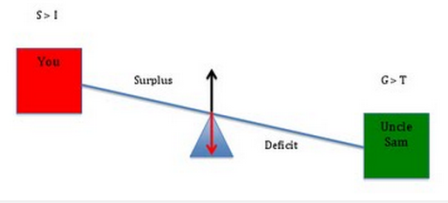
This should make intuitive as well as mathematical sense, because when Uncle Sam runs a deficit, you receive more financial assets than you lose through taxation. Put simply, Uncle Sam’s deficit lifts you into a surplus position. Moreover, bigger deficits mean bigger surpluses for you.

Finally, let’s see what happens when Uncle Sam tightens his belt. Suppose, for example, that we were able to duplicate the much-coveted surpluses of 1999-2001. What would (and did!) happen to the private sector’s financial position?
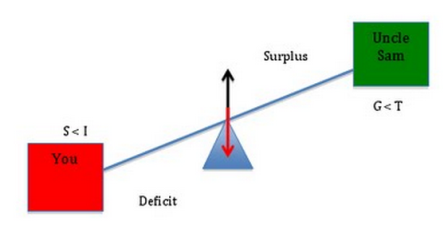
Because the economy’s financial flows are a closed system – every payment must come from somewhere and end up somewhere – one sector’s surplus is always the other sector’s deficit. As the government “tightens” its belt, it “lightens” its load on the teeter-totter, shifting the relative burden onto you.

This is not rocket science, but it appears to befuddle scores of educated people, including President Obama, who said, “small businesses and families are tightening their belts. Their government should, too.” This kind of rhetoric may temporarily boost his approval ratings, but the policy itself will undermine the efforts of the very families and small businesses that are trying to improve their financial positions.

* I’ll be back with a second installment that shows what happens when we ‘open’ the economy to take into account the foreign sector (and the relevant financial flows). Many of us have been working with financial balance equations for years (see herefor references), so the current effort is nothing new. I am merely trying to make the arguments more accessible by changing the way they are presented.

U.K. Daily – CIPS May Manufacturing Index Falls to 20-Month Low

My Q2 guestimate for the tipping point may not have been too far off

U.K. CIPS May Manufacturing Index Falls to 20-Month Low (Bloomberg)

A U.K. manufacturing index, based on a survey by Markit Economics and the Chartered Institute of Purchasing and Supply, declined to 52.1 in May from a downwardly revised 54.4 in April. “Domestic market weakness was the main drag on order books and output,” Rob Dobson, senior economist at Markit, said in the statement. “This was exacerbated by the additional bank holidays in late April, which fell during the early part of the latest survey period, and ongoing supply-chain disruption following the Japanese earthquake.” Producers of consumers goods and small-scale manufacturers were hit hardest last month as output and new orders fell for the first time since the middle of 2009, CIPS said.

U.K. April Mortgage Approvals Fall to Lowest in Four Months (Bloomberg)

Lenders granted 45,166 loans to buy homes, compared with a revised 47,145 the previous month, the Bank of England said. The April figure is the lowest since December. The Bank of England figures show net mortgage lending rose 739 million pounds ($1.22 billion) in April and gross lending amounted to 11.2 billion pounds. Consumer credit rose a net 504 million pounds in April. Credit-card lending increased 347 million pounds, the most since February 2010, while personal loans and overdrafts rose 157 million pounds. A measure of M4 money-supply growth that the central bank uses to assess the effectiveness of its asset purchases fell 2 percent in the three months through April on an annualized basis.

U.K. Inflation May Be Hurting Economic Growth, Sentance Says (Bloomberg)

Former Bank of England policy maker Andrew Sentance said U.K. inflation at more than twice the central bank’s 2 percent goal may be hurting economic expansion.
“The fact that inflation is high is not necessarily associated with strong growth,” he said in an interview with Sky News late yesterday, marking his final day as a member of the Monetary Policy Committee. “In some ways inflation is squeezing out the growth of the economy because it is squeezing people’s disposable incomes.”

Sentance, who will today be replaced by former Goldman Sachs Group Inc. economist Ben Broadbent, said interest rates need to start going up “gradually” now to curb consumer price growth and prevent “much sharper” rate increases in the future.

He also said the central bank’s view of inflation didn’t put enough weight on the influence of the international economy, commodity costs and the decline of the pound.

“I think we should revisit our thinking on the economy,” he said. “We went through a period where there seemed to be a very predictable relationship between growth and inflation. Now we’re in a much more complex situation.”

Sentance said it was difficult to judge how long the impact of the pound’s weakness on inflation would last, as it hadn’t been offset by the impact of the recession holding down prices and wages.

“The issue with the fall in the value of the pound is how big its effect will be and how long it will continue,” he said. “We’re an economy very open to international trade and the value of the pound affects the amount of competition on the markets, the way in which companies price in markets so I think we do have to take the value of the pound very seriously.”

U.K. Housing Transactions to Fall 5.2% This Year, CML Forecasts (Bloomberg)

U.K. housing transactions will probably fall 5.2 percent this year before rising in 2012 as the economy experiences a “weak and patchy recovery,” the Council of Mortgage Lenders said.

Transactions will fall to 840,000 this year from 886,000 in 2010, the London-based group said in a report on its website today. They will rise to 900,000 in 2012, matching the level in 2008. Gross mortgage advances will amount to 140 billion pounds this year and 150 billion pounds in 2012, which compares with
253 billion pounds in 2008.

The CML sees the Bank of England keeping its key interest rate at 0.5 percent for “most” of this year before starting a “modest” tightening cycle that will continue through 2012.

“The prospect of a gentler upward profile for interest rates significantly mitigates the adverse impact on household budgets of weak growth in incomes, and this will help borrowers keep up with their mortgage payments,” it said.

U.K. Consumer Spending Rebound Likely to Be Very Slow, FT Says (Bloomberg)

U.K. consumer spending is likely to recover more slowly than in any post-recession period since 1830, the Financial Times reported, citing its own analysis of forecasts from the Office for Budget Responsibility.

Households are forecast to spend 5.4 percent more in 2015 than they did before the 2008 financial crisis; at the equivalent stages of the 1980s and 1990s recessions, spending was 20 percent and 15 percent higher, respectively, the newspaper said.
In the 18 significant U.K. recessions that have occurred since records began in 1830, consumer spending rose 12 percent above its previous peak within seven years, the FT said, citing Bank of England figures.

Mortgage Applications Fell Last Week

Looks like those low rates aren’t all they’re cracked up to be.

Once again, we need:
a FICA suspension
$500 per capita fed distribution to the state govts
$8/hr federally funded transition job for anyone willing and able to work

And institutional structure that facilitates GDP growth with less energy consumption

Mortgage Applications Fell Last Week

May 25 (Reuters) — Applications for U.S. home mortgages fell last week, pulled lower by a decline in refinancing demand, an industry group said Wednesday.

The Mortgage Bankers Association said its seasonally adjusted index of mortgage application activity, which includes both refinancing and home purchase demand, fell nearly 4 percent in the week ended May 27.

The MBA’s seasonally adjusted index of refinancing applications lost 5.7 percent, even as interest rates tumbled.

“The last time mortgage rates were this low, refinance volume was more than twenty percent higher,” Mike Fratantoni, MBA’s vice president of research and economics, said in a statement. “It is likely that many borrowers still cannot qualify to refinance given the lack of equity in their homes.”

The refinance share of mortgage activity fell to 65.7 percent of total applications from 66.8 percent the week before. The gauge of loan requests for home purchases was essentially unchanged.

Fixed 30-year mortgage rates averaged 4.58 percent in the week, down from 4.69 percent the week before.

G8: Deficit Terrorism Leads Agenda

In the land of the blind, the one eyed man gets his good eye poked out.

While the statement regarding the US is perhaps a tad on the soft side, globally, political will and public support appears firmly in place for further stagnation and a too large output gap for the foreseeable future.

World Recovery Is Gaining Strength, Watch Debt: G8

May 27 (Reuters) — The Group of Eight leaders agreed on Friday that the global economy recovery was becoming more “self-sustained,” although higher commodity prices were hampering further growth.

In a communique to be issued at the end of a two-day summit in France, a copy of which was obtained by Reuters, European nations, the United States and Japan all agreed to ensure their public finances were sustainable.

“The global recovery is gaining strength and is becoming more self-sustained. However, downside risks remain, and internal and external imbalances are still a concern,” the communique said.

“The sharp increase in commodity prices and their excessive volatility pose a significant headwind to the recovery. In this context, we agreed to remain focused on the action required to enhance the sustainability of public finances, to strengthen the recovery and foster employment, to reduce risks and ensure strong, sustainable and balanced growth, including through structural reforms.

Europe has adopted a broad package of measures to deal with the sovereign debt crisis faced by a few countries, and it will continue to address the situation with determination and to pursue rigorous fiscal consolidation alongside structural reforms to support growth.

The United States will put in place a clear and credible medium-term fiscal consolidation framework, consistent with considerations of job creation and economic growth.

In Japan, while providing resources for the reconstruction after the disaster, the authorities will also address the issue of sustainability of public finances.”

Consumer Spending Cools More Than Estimated, Wages Gain Less, Profits and Manufacturing Decelerate

Not good for this part of the cycle, as we remain grossly overtaxed for the size govt we have

Consumer Spending Cools More Than Estimated

By Shobhana Chandra

May 26 (Bloomberg) — Consumer spending cooled in the first quarter more than previously estimated as the jump in food and fuel costs held back the biggest part of the U.S. economy.

Household purchases rose at a 2.2 percent annual pace from January through March, less than the 2.7 percent calculated last month and short of the 2.8 percent median forecast of economists surveyed by Bloomberg News, according to Commerce Department figures issued today in Washington. The economy grew at a 1.8 percent pace last quarter, the same as previously calculated.

The number of workers filing applications for unemployment insurance benefits increased by 10,000 to 424,000 in the week ended May 21, according to data from the Labor Department. The median forecast of economists surveyed by Bloomberg projected claims would decrease to 404,000.

A monthlong slide in consumer confidence ended last week as gasoline prices retreated, another report showed. The Bloomberg Consumer Comfort Index rose to minus 48.4 in the period to May 22 from a nine-month low of minus 49.4 the prior week. Readings of minus 40 or less are generally associated with recessions and their aftermaths, the report said.

The economy last quarter maintained the previously reported pace of growth as bigger gains in inventories and a smaller decline in commercial construction compensated for the slowdown in spending.

The gain in consumer purchases, which account for about 70 percent of the economy, followed a 4 percent increase in the fourth quarter was the biggest since the end of 2006. Cuts in spending on gasoline and utilities, combined with a smaller increase in demand for autos, contributed to the slowdown in the first three months of the year.

The price gauge tied to spending increased at a 3.8 percent pace in the first quarter, the biggest advance since the third quarter of 2008. Excluding food and fuel, the numbers tracked by Federal Reserve policy makers, prices climbed at a 1.4 percent rate.

Smaller Wage Gain

The GDP report also showed wages and salaries climbed by $27.9 billion from October through December, down from a prior estimate of $52.5 billion. Real disposable income, or after-tax earnings adjusted for inflation, climbed 1.1 percent in the fourth quarter, rather than the 1.9 percent gain previously estimated. They rose 0.8 percent in the first three months of the year, less than the 2.9 percent prior calculation.

The smaller gain in pay dwarfed the slowdown in spending, pushing the savings rate down to 5.1 percent in the first quarter from a prior estimate of 5.7 percent.

Today’s report also offered a first look at profits. Earnings before taxes were up 1.3 percent from the prior quarter, the smallest gain in more than two years, after rising 2.3 percent in the prior period. They climbed 8.5 percent from the same time last year.

Manufacturing, which accounts for 12 percent of the economy, is slowing this quarter as disruptions in the supply of components temporarily weigh on production until Japanese factories recover from the fallout of the March disaster.

Growth Forecasts

Economists at Goldman Sachs Group Inc. and JPMorgan Chase & Co. in New York each cut second-quarter growth forecasts by half a percentage point this week, citing setbacks in vehicle output caused by supply disruptions. Goldman trimmed its projection to 3 percent, while JPMorgan lowered it to 2.5 percent.

former President Clinton on the debt ceiling issue

Just in case you thought former President Clinton ever understood the monetary system:

Bill Clinton: Brief Debt Default ‘Might Not Be Calamitous’

“We regret if there has been a misinterpretation of a comment President Clinton made about raising the debt limit. President Clinton did not in any way mean to suggest that a default would not be highly damaging for the economy even for a very short period of time. He inadvertently misspoke. What he meant to say was that if a vote to extend the debt limit failed in advance of a default, that might not be harmful for a couple of days, but that if people thought that we might actually default, that in his words ‘we were literally not going to pay our bills anymore, then they would stop buying our debt.'”

China

RBS: China: Where is the slowdown?

Very good, tends to support some of my ongoing themes:

China will produce more of its own resources.

Higher rates don’t bring down demand, and probably increase it.
It’s the fiscal tightening, directly or indirectly, proactive or via auto stabilizers, that ultimately cause the tree to fall. (US budget went into small surplus in 1979, for example)

The inflation problem is severe enough for them to be using export unfriendly currency appreciation to fight it.

Hopefully it doesn’t all come apart in Q2!

GDP Gain Just 1.8%

No actual evidence, but my point remains that if the executive branch can cut spending they don’t like simply by not spending what’s authorized by Congress, they can take the pressure off demands for other spending cuts.

Also, again conjecture on my part, the QE and zero rate ‘tax’ (reduced interest income) may be what’s keeping a lid on growth here much like what’s happened to Japan for nearly 20 years.

As previously discussed, with 0 rates seems to me taxes can be quite a bit lower for any given size govt (larger deficit) without being ‘inflationary’. Unfortunately our fearless leaders are all going the other way.

Economic Growth Disappoints as GDP Gain Just 1.8%

May 26 (Reuters) — Surging gasoline prices and sharp cutbacks in government spending caused the economy to grow only weakly in the first three months of the year. Consumer spending slowed even more than previously estimated.

The Commerce Department says the overall economy grew at an annual rate of 1.8 percent in the January-March quarter.

That was the same as the government’s first estimate a month ago. Consumer spending grew at just half the rate of the previous quarter. And a surge in imports widened the U.S. trade deficit.

Many economists believe the economy is growing only slightly better in the current April-June quarter. Consumers remain squeezed by gas prices near $4 a gallon and renewed threats from Europe’s debt crisis.