Greek Parliament Approves Unpopular Property Tax

No compliance issues here- if the tax isn’t paid the property gets sold.

Don’t even have to know the owner.

Greek Parliament Approves Unpopular Property Tax

September 27 (Reuters) — Greek lawmakers approved an unpopular property tax law on Tuesday that is crucial to a new austerity campaign the government has proposed so it can meet the terms of its international bailout and continue receiving aid funds.

All 154 of the ruling Socialist PASOK party’s deputies voted in favor of the measure, winning a majority in the 300-seat parliament.

The vote is the first test of the government’s capacity to win backing for a new wave of belt-tightening measures announced last week to convince the International Monetary Fund and European Union that Greece is worthy of an 8-billion euro ($11 billion) loan that Athens needs to avoid bankruptcy next month.

Having grown increasingly impatient at the slow pace of reforms, an EU/IMF team abruptly quit Greece in early September following disagreements over what was needed for Athens to plug fiscal slippage this year and next.

Finance Minister Evangelos Venizelos met representatives from the lenders in Washington over the weekend and Greek officials said the inspectors had asked Athens for written assurances it will implement the measures announced before they return.

“We are at the moment of truth for Greece,” European Commission spokesman for economic affairs Amadeu Altafaj said on Monday. “This is the last chance to avoid the collapse of the Greek economy. The criteria must be fully met in order to allocate the funds.”

The IMF and EU team has rapped Athens for dragging its feet on cutting the size of the bloated public sector because it has made little progress on a pledge to cut the 730,000 public workforce by a fifth, eliminate dozens of inefficient state entities and sell off loss-making state firms.

The government has failed to end rampant tax evasion, while the third year of economic contraction has undermined budget revenues and put Greece off-track for its goal of cutting the budget deficit to 7.6 percent of annual output this year.

Analysts say the property tax is a short-term measure that will not forestall a default most economists see as inevitable.

Activists have pledged to step up demonstrations in Athens’ central Syntagma square, where Greek riot police clashed with anti-austerity protesters on Sunday, firing tear gas in the first such unrest after a summer lull.

When lawmakers voted on an earlier austerity package at the end of June, more than 100 people were injured in two days of clashes with police at the square in front of parliament.

Prime Minister George Papandreou was in Germany for a meeting with Chancellor Angela Merkel during the vote on the tax bill.

He will discuss reforms ahead of another key parliamentary vote in Germany on Thursday meant to give more powers to the EU’s EFSF bailout fund.

Some 92 percent of Greeks believe the austerity measures are unfair and 72 percent believe they will not work, according to a GPO poll published by Mega TV on Monday. But only 23 percent said they would not pay the new taxes.

The poll also showed 77.8 percent of Greeks think the country should stay in the single currency zone while 54.8 percent saw a risk that Greece would default on its 340 billion euro debt pile in the next couple of months.

Greece has vowed to do what it takes to get the next tranche and announced on Monday it may close concession deals as part of its 50-billion euro privatization plan, another key condition for bailout aid.

The property tax is meant to help plug a gap of about 2 billion euros in this year’s budget to try and meet EU/IMF fiscal targets.

Half of Germans oppose Greek bankruptcy

makes sense.

The ECB funds Greece which facilitates the purchase of German goods and services, including military,
at ‘no cost to the German taxpayer.’

Germany gets to control/impose austerity on Greece,
which keeps the euro strong, interest rates low, and punishes Greece for past sins.

Half of Germans oppose Greek bankruptcy (AP)

 
A poll finds that half of Germans oppose letting Greece go bust and a majority believe a Greek bankruptcy would be bad for their own economy. The ZDF television poll published Friday showed that 50 percent of respondents wouldn’t favor the European Union letting Greece go bankrupt, while 41 percent would. It says 68 percent believe such a bankruptcy would be economically bad for Germany and only 15 percent expect positive effects. Athens is working to persuade international debt inspectors to authorize the next batch of bailout cash. Without the euro8 billion, Greece has said it would run out of money next month. The poll of 1,229 people was conducted from Tuesday to Thursday and has a margin of error of plus or minus 3 points.

ECB allowing corporate accounts threatens Germany

First, I don’t have confirmation this is happening the way it’s being reported.

But if it is, it opens the door for German rates to rise with credit concerns.

Without direct ECB accounts, holders of euro balances have only credit sensitive options as depositories for their funds.
These include euro banks, where deposit insurance is only via their national govt., corporate liabilities including debt and equities, and national govt. debt.

With nowhere else to go, and Germany perceived as the safest of the lot, and therefore German yields have plunged relative to other debt instruments as risk perceptions have escalated.

However, if private companies can bank directly at the ECB, Germany can quickly lose it’s TINA (there is no alternative) status, and instead be valued as an alternative to an actual ‘risk free’ depository- the ECB itself- putting Germany in the same boat with the other member nations.

Additionally, the time seems right for a new (private sector) euro member bank to emerge that’s a pure ‘depository bank’ with its assets limited to deposits at the ECB, charging its depositors a fee for this service, much like a money market fund. This, too, would have the same effect on Germany.

So while Germany is the strongest of the euro member nations, it is none the less not the issuer of the euro, and has debt ratios that are far higher than what markets would ordinarily fund for non issuers of a currency. However, as long as it continues as the ‘investment of last resort’ for holders of euro rates can remain far lower than otherwise.

Siemens Shelters Up to $8 Billion at ECB
Published: Tuesday, 20 Sep 2011 | 12:46 AM ET

 
Siemens withdrew more than half-a-billion euros in cash deposits from a large French bank two weeks ago and transferred it to the European Central Bank, in a sign of how companies are seeking havens amid Europe’s sovereign debt crisis.

 
The German industrial group withdrew the money partly because of concerns about the future financial health of the bank and partly to benefit from higher interest rates paid by the ECB, a person with direct knowledge of the matter told the Financial Times.

 
In total, Siemens has parked between 4 billion euros ($5.4 billion) and 6 billion euros at the ECB’s facilities, mostly through one-week deposits, this person said. Only a handful of large companies have the banking licences that allow them to deposit cash directly with the ECB.

 
Siemens’ move demonstrates the impact of the eurozone’s deepening sovereign debt crisis on confidence in European banks.

 
It was not clear from which bank Siemens withdrew its deposits. A person familiar with BNP Paribas said, however, that it was not the bank involved.

 
Siemens and the ECB declined to comment.

 
The company’s move came almost a year after Europe’s largest engineering conglomerate prepared itself for a future financial crisis by launching its own bank, an unusual move for an industrial group outside the car sector, where companies run big car financing and leasing businesses.

 
In an interview last December, Roland Châlons-Browne, chief executive of Siemens’ financial services unit, said its banking business would enable the group to tap the central bank for liquidity and deposit cash at the ECB.

 
“In the case of another financial crisis, we will be able to broaden our flexibility and take out risk with our own bank,” Mr Châlons-Browne said at the time.

 
Siemens does not only use the ECB as a haven; it also gets paid a slightly higher interest rate than it would get from a commercial bank.

 
The ECB paid an average interest rate last week of 1.01 percent for its regular offers of one-week deposits, under which it withdraws from the financial system an amount of liquidity equivalent to the amount it has spent on eurozone government bonds.

 
That compares with an average overnight interest rate paid by eurozone banks of 0.95 percent.

Pilkington highlights Mosler’s ECB distribution proposal

thanks, well researched and much needed!!!

http://blogs.independent.ie/independent_blog/2011/09/economic-solutions-political-impediments-and-the-circus-that-we-call-europephilip-pilkington-conflicting-messages-coming-ou.html

FINANCIAL CRISIS: Deeper malaise at heart of the European project

 
PHILIP PILKINGTON

Conflicting messages coming out of euroland of late. On the one hand we have a German constitutional court ruling that any permanent action on behalf of the European authorities to stymie the current crisis and pose a risk to other countries are unconstitutional. Add to that Angela Merkel saying that eurobonds are ‘absolutely wrong’. Yet on the other hand, we have Jose Manuel Barroso, the president of the European Committee, coming out saying that a eurobond proposal is imminent. Clearly these two official statements conflict with one another.
Lying behind this latest conflict in euroland is a much deeper conflict: that between full fiscal union and breakup. Eurobonds are seen by many in the EU as the first step toward full federal integration. Sure, the proponents tell us that eurozone-wide bonds would only be issued to back the currently deteriorating position of the sovereign nations in fiscal difficulty, but it’s obvious to all that institutional reforms would have to follow.

 
Eurobonds would effectively centralise the burden of government expenditure in the eurozone. All states would back the eurobond and all states would, in turn, be backed by the eurobond. Sovereign government debt would gradually wane in importance as the European-wide bonds rose in prominence. With this would come the debate over how fiscal policy should be managed in the union. If states no longer bear the ultimate burden of financing themselves why should they be allowed to make their own taxing and spending decisions?

 
The trajectory then appears inevitable. Those in the eurozone who want to centralise fiscal policy would soon be front and center stage in the political debate. And those opposed to such centralisation would be equally to the fore. The former would argue that since member states were no longer financing themselves, fiscal responsibilities need to be given to a higher authority. While the latter would make the case that having some eurocrat in Frankfurt or Brussels involved in micromanaging the decisions of a nation state’s taxing and spending is a ghastly prospect — they might allege that it is reminiscent of the old Soviet centralised bureaucracy; now less a Politburo than a Politeuro.

 
Those opposed to centralisation would probably end up calling for the break up of the eurozone proper — that, after all, would be the logical end point of their argument.

 
So, what on earth should we do? The dangers of having a centralised fiscal authority are obvious; but the break up of the eurozone would prove remarkably unpleasant for all those involved.

 
The central question is what the eurocrats would do once they had control over fiscal policy. If they continued on as they are — as arch-conservatives geared only toward curbing inflation, even when such inflation simply doesn’t exist — they would destroy the eurozone. Simple as. Trade imbalances and an uneven economic landscape necessitate government surpluses to be run in some countries and deficits in others. To think otherwise is to think in moral terms rather than economic terms. But if the eurocrats did continue in their highly conservative — dare I say, unrealistic — tracks, we would have constant fiscal crises on our hands and eventually member states who were not allowed to run necessarily loose fiscal policies would drop out of the union.

 
What the eurozone needs is a central authority with an extremely flexible fiscal policy. Without this the project is doomed from the outset and we may as well just start looking for the cheapest way to get out now before further costs are incurred.

 
In fact, the eurozone already has an institution that can effectively allow such a flexible fiscal policy to be pursued: the ECB. The ECB, like it’s US cousin the Federal Reserve, has control over the issuance of currency and in that capacity it can effectively pay for anything it wants — provided, of course, that which it pays for is denominated in the currency it issues (Euros, in the case of the ECB). This simple fact comes as a shock to many, but consider what former Federal Reserve chairman Alan Greenspan recently said regarding the Fed:
“The United States can pay any debt it has because we can always print money to do that,” said Greenspan in an interview with Meet the Press recently.

 
Well, the same is true for the ECB. They have the legal mandate to create as much currency as they see fit and that currency can be effectively used to pay for anything that is denominated in said currency; that includes national government debt. It follows from this that the ECB can, in fact, create any amount of money that can then be used to retire the government debt of those sovereigns now facing default and crisis. This is a much simpler solution than eurobonds because it doesn’t pose any risk to other eurozone countries. And it can also be used in order to ensure fiscal flexibility in the future and ensure that the eurozone prospers rather than collapses.

 
This proposal was originally put together by economist and government bond expert Warren Mosler. Here’s how it would work:

 
The ECB would create €1trn on an annual basis and distribute it among the eurozone nations on a per capita basis. So, Germany, since it has a larger population, would get more than, say, Ireland. Each country would then use their newly acquired funds to begin paying down their stock of public sector debt. When they reached a reasonable level of debt — say 60% debt-to-GDP — the transfers would either discontinue or could be renegotiated to allow compliant countries to spend them (provided, of course, there are no major inflationary pressures in the eurozone at the time).

 
Since the payments take place on an annual basis the ECB and other European authorities could use them as leverage over the sovereign nations to ensure that they complied with responsible deficit targets. This would be far more effective than the current system — which effectively fines member-states for non-compliance — as the penalties for non-compliance would be immediately visible and would not require time-consuming legal and administrative action.

 
This all seems so simple, so what are the objections? Why won’t the ECB do this and solve the crisis?

 
Well, economically speaking the problems are basically non-existent. We’ve learned from the Quantitative Easing (QE) programs in the US and Britain (as well as in Japan some years ago) that so-called ‘debt monetisation’ is not inflationary. Buying up government debt certainly increases the amount of bank reserves in the private sector and according to the old economics textbooks this should lead to increased lending and thus inflation. But such inflation simply has not occurred in either country (yes, there is some inflation in Britain right now but this is largely due to oil/food price increases and VAT rises — it is NOT ‘demand-pull’).

 
This revelation is both surprising and important. Recent studies by economists working within central banks show that mainstream economists have basically been getting the whole thing wrong. In reality expanding bank reserves will not increase lending and so it is not inherently inflationary. Consider this paper by economists at the Bank of International Settlements (BIS) — known among economists as ‘the central bank’s central bank — published in late 2009. The authors write:

 
“The preceding discussion casts doubt on two oft-heard propositions concerning the implications of the specialness of bank reserves. [These are] first, [that] an expansion of bank reserves endows banks with additional resources to extend loans, adding power to balance sheet policy. Second, there is something uniquely inflationary about bank reserves financing.”

 
The authors continue:

“In fact, the level of reserves hardly figures in banks’ lending decisions. The amount of credit outstanding is determined by banks’ willingness to supply loans, based on perceived risk-return trade-offs, and by the demand for those loans. The aggregate availability of bank reserves does not constrain the expansion directly.”

 
So much for the inflation argument!

 
The other argument is that such debt monetisation might lead to a devaluation of the currency in question. If there are more Euros floating around the banking system, even if they aren’t spent into circulation, their value will decrease. In actual fact there is no evidence of any direct link between exchange-rate depreciation and the creation of money.

 
This doesn’t mean that depreciation may not occur due to monetisation but it does mean that we have to consider other variables. For example: what are the trade-off effects? If no action is taken and the eurozone crisis continues to spiral out of control will the currency depreciate anyway? You can bet your socks on that! So, exchange-rate issues are far more complex than simply ‘more money = devalued currency’.

 
In fact, the objections to this sort of plan are typically moral rather than economic in nature. Many commentators have begun to realise that a great deal of the discourse that has cropped up around the eurocrisis is not actually economic at all — it is moral. This is phenomenon about which economic commentators can say little, although it is a very real problem. However, if such moralising leads the eurocrats and the politicians to fiddle while Rome burns we may very well see the ECB creating bank reserves to backstop the banks anyway if a default occurs. Such will be messy. And we have seen it can be avoided. But what can one do? If nothing else necessity is certainly the mother of invention.

CH News – 09.13.11

Ok news so far for August, some slowing but no sign of a hard landing yet!

On Tue, Sep 13, 2011 at 8:03 AM, Evelyn Richards wrote:
 

HIGHLIGHTS
-China’s retail sales up 17% in Aug
-China’s fixed asset investment up 25% in Jan-Aug
-Yuan Forwards Decline Most in a Month on Greece Debt Concern
-China Aims to Play Role in Stabilizing Europe, Researcher Says
-China August Fiscal Revenue Rises 34.3% on Year, Ministry Says
-China Called on as Emergency Lender as Italy Faces Crisis
-China unlikely to loosen monetary policy
 

China’s retail sales up 17% in Aug
Sep. 13, 2011 (China Knowledge) – China’s retail sales reached RMB 1.47 trillion
in August this year, up 17% year-on-year, said the National Bureau of
Statistics.

Total retail sales in urban areas rose 17.1% year-on-year to RMB 1.28 trillion
last month, while retail sales in rural areas rose 16.4% to RMB 192.2 billion in
the same period.

Retail sales in the catering industry also grew and increased to 16.7%
year-on-year to RMB 171.7 billion in August, while retail sales of consumer
goods rose 17% to RMB 1.3 trillion.

Last month, the retails sales of automobiles continued to top the country’s
retails sales list, reaching RMB 174.6 billion, up 12.4% year-on-year, while
retail sales of oil and related products came in second, hitting RMB 126.7
billion, with a growth of 38.4%.

In the first eight months of this year, the country’s retail sales totaled RMB
11.49 trillion, 16.9% more than in the corresponding period of last year.
Retails sales of automobiles grew 14.9% to RMB 1.29 trillion during the period,
and retail sales of oil and related products amounted to RMB 928.2 billion,
39.5%.
 

China’s fixed asset investment up 25% in Jan-Aug
Sep. 13, 2011 (China Knowledge) – China’s total fixed asset investment surged
25% year on year to RMB 18.06 trillion in the first eight months of this year,
according to statistics released by the National Bureau of Statistics.

The growth rate was 0.4 percentage points lower than that in the first seven
months.

Last month, the country’s fixed asset investment climbed 1.16% from July.

Fixed asset investment in primary industry saw a 23% increase, hitting RMB 417.6
billion, while investment in secondary and investment in tertiary industry grew
27% and 23.6% year on year to RMB 7.92 trillion and RMB 9.73 trillion,
respectively, according to the latest statistics.

The country’s investment in the industrial sector jumped 26.6% year-on-year to
RMB 7.71 trillion, including RMB 638.9 billion in the mining sector and RMB 6.24
trillion in the manufacturing, up 15.9% and 32.2% year on year, respectively.
The power, gas and water producing and supplying industry saw its fixed-asset
investment climb 1.9% year on year to RMB 833.5 billion in the first eight
months.

In the first eight months, investment in real estate development surged up 33.2%
year on year to RMB 3.78 trillion.

Meanwhile, fixed asset investment in China’s eastern, central and western areas
booked notable year-on year increases of 22.6%, 30.1% and 29.4%, respectively.
 

Yuan Forwards Decline Most in a Month on Greece Debt Concern
Sept. 13 (Bloomberg) — China’s yuan forwards dropped the
most in a month amid speculation Greece is nearing default,
which may prompt policy makers to slow the currency’s
appreciation.
The People’s Bank of China set the daily reference rate
0.09 percent lower today, the most in almost four weeks, as
Asian currencies weakened. The chance of a default by Greece in
the next five years has soared to 98 percent as Prime Minister
George Papandreou fails to reassure investors that his country
can survive the euro-region crisis, credit-default swaps showed.
“What you may see actually is a weaker pace of
appreciation,” said Leong Sook Mei, regional head of global
currency research at Bank of Tokyo Mitsubishi UFJ Ltd. in
Singapore. “There was lots of risk aversion with regards to the
Greece issue. The overall trend of appreciation won’t stop as
yet until we see decisive signs of Chinese growth coming off and
inflation easing.”
Twelve-month non-deliverable forwards slid 0.33 percent to
6.3305 per dollar as of 4:58 p.m. in Hong Kong, according to
data compiled by Bloomberg. The premium to the onshore spot rate
was 1.1 percent, compared with 1.2 percent yesterday.
The yuan dropped 0.17 percent to 6.3991 per dollar in
Shanghai, according to the China Foreign Exchange Trade System.
In Hong Kong’s offshore market, the yuan declined 0.02 percent
to 6.3855.
A central bank statement yesterday that inflation is still
too high is “hawkish,” Tim Condon, head of Asia research at
ING Groep NV, said in an e-mailed note today.
Policy makers will want to see a second consecutive month
of lower headline inflation before declaring “victory,” Condon
wrote. He reiterated the bank’s call for one more 25-basis point
increase in benchmark interest rates by the end of the year.
China’s inflation eased in August, rising 6.2 percent from
a year earlier, compared with 6.5 percent in July, which was the
fastest since June 2008.
 

China Aims to Play Role in Stabilizing Europe, Researcher Says
Sept. 13 (Bloomberg) — China is playing its role as a
responsible major world economy and is trying to help stabilize
global confidence by supporting European governments, Zhang
Yansheng, a researcher affiliated with the nation’s top economic
planning agency, said today.
Chinese policy makers are thinking in a “global context”
and about the need to prevent a “domino effect” in the debt
crisis, Zhang said in Beijing today when asked to comment on
reports that China is in talks to make investments in Italy that
may include government bonds. If Italy “falls” it may drag
down Europe, the world and China’s economy, he said.
There is a limit to what China can do to help, Zhang said.
Zhang, who is a researcher at the Institute of Foreign
Economic Research affiliated to the National Development and
Reform Commission, said he was giving his own views on the
matter.
 

China August Fiscal Revenue Rises 34.3% on Year, Ministry Says
Sept. 13 (Bloomberg) — China’s August fiscal revenue rose
34.3 percent from a year earlier to 754.6 billion yuan and
fiscal expenditure rose 25.9 percent to 807.7 billion yuan,
according to a statement on the Ministry of Finance’s website
today.
Fiscal revenue for the first eight months this year rose
30.9 percent to 7.4 trillion yuan, the statement said.
 

China Called on as Emergency Lender as Italy Faces Crisis
Sept. 13 (Bloomberg Businessweek) — China’s status as the fastest- growing major economy and holder of the largest foreign-exchange reserves lured another bailout candidate as Italy struggles to avoid a collapse in investor confidence.

Italian officials held talks in the past few weeks with Chinese counterparts about potential investments in the country, an Italian government official said yesterday, adding that bonds weren’t the focus. Finance Minister Giulio Tremonti met with Chinese officials in Rome earlier this month, his spokesman Filippo Pepe said by phone today, declining to say exactly when the talks took place or what was discussed.

Foreign Ministry spokeswoman Jiang Yu, asked about buying Italian assets, said Europe is one of China’s main investment destinations, without specifically mentioning Italy.

Italy joins Spain, Greece, Portugal and investment bank Morgan Stanley among distressed borrowers that turned to China since the 2007 collapse in U.S. mortgage securities set off a crisis that widened to engulf euro-region sovereign debtors. Stocks rose on the potential Chinese investment in Italy even as previous commitments failed to have a lasting impact.

“It’s a clear pattern of China’s intention to help stabilize the euro area,” said Nicholas Zhu, head of macro- commodity research for Asia at Australia & New Zealand Banking Group in Shanghai and a former World Bank economist. “The benefit to China is that it will help in the perception of host countries if China is viewed as a responsible stakeholder in the global community.”

Bond Auction
Italy today is auctioning as much as 7 billion euros ($10 billion) of bonds to help pay for 14.5 billion euros of bonds maturing on Sept. 15. The euro region’s third-largest economy sold 11.5 billion euros of bills yesterday and priced its one- year notes to yield 4.153 percent, up from 2.959 percent at the previous auction last month.

The yield on Italy’s 10-year bond rose to 5.69 percent as of 10:01 a.m. in Rome, pushing the spread with the equivalent German securities up 13 basis points to 396 basis points. The MSCI Asia Pacific index of stocks advanced 0.3 percent as of 4:50 p.m. in Tokyo after the Standard & Poor’s 500 index gained 0.7 percent overnight.

Chinese Image
For China, any purchases of European debt may allow the world’s largest exporter to be seen as helpful as it rebuffs calls to allow its exchange rate to appreciate at a faster pace. The world’s second largest economy has amassed record currency reserves of $3.2 trillion by selling yuan to limit gains.

Chinese policy makers are thinking in a “global context” and about the need to prevent a “domino effect” in the European debt crisis, Zhang Yansheng, a researcher affiliated with the nation’s top economic planning agency, said today.

China’s central bank referred questions to the State Administration of Foreign Exchange, which didn’t respond to a request for comment. China Investment Corp., the nation’s sovereign-wealth fund, also didn’t respond.

Italy’s bond-yields rose to a euro-era record last month as the region’s sovereign debt crisis spread from Greece, the first to receive a European Union-led bailout. Prime Minister Silvio Berlusconi’s government rushed a 54 billion-euro austerity package to convince the European Central Bank to buy its debt.

Redemptions
Even so, the size of Italy’s debt — at 1.9 trillion euros more than Spain, Greece, Ireland and Portugal combined — leaves it vulnerable to any rise in borrowing costs as it refinances maturing securities. The country still needs to sell about 70 billion euros of debt this year to cover its deficit and finance redemptions.

“We have heard this story before with regard to the likes of Spanish and Portuguese bonds, and in the end it was ECB buying and EU bailouts that seemed to have taken place rather than anything with a Chinese influence,” Gary Jenkins, a strategist at Evolution Securities in London, wrote in a research note.

Any Chinese purchases of euro-region debt to date haven’t produced a lasting cut in yield premiums for Greece, Portugal or Spain.

The extra yield investors demand to buy Greek 10-year debt over German bunds is about 23 percentage points, up from 14 percentage points three months ago. The equivalent spread for Portugal over Germany is 9.5 percentage points, up from 7.7 points over that period. Spain’s gap rose to 3.6 points from 2.5 points.

Too Big
“The issue with Europe is bigger than China alone can help with,” said Ju Wang, a fixed-income strategist at Barclays Capital in Singapore, adding that Italy’s debt load alone is a sum exceeding half the Chinese foreign-exchange reserves. “China probably will continue to help to shore up the euro, but its involvement in direct purchases of troubled Europe debt is unlikely to be too aggressive.”

If Italy “falls” it may drag down Europe, the world and China’s economy, said Zhang, a researcher at the Institute of Foreign Economic Research affiliated to the National Development and Reform Commission.

Japanese Finance Minister Jun Azumi said today that European policy makers should decide themselves whether they need fiscal assistance from Japan. U.S. Treasury Secretary Timothy F. Geithner will travel to Poland on Sept. 16 to participate in a meeting of European government finance officials trying to contain the region’s debt crisis.

‘Helping Hand’
Premier Wen Jiabao said in June that China can offer “a helping hand” to Europe by buying a limited volume of sovereign bonds. The Asian nation pledged that month to buy Hungarian government bonds and agreed to extend a 1 billion euro loan for the financing of development projects in the European country that needed an International Monetary Fund-led bailout in 2008.

Spain’s prime minister secured a Chinese pledge to invest in his nation’s faltering savings banks and in government debt on an April visit to Beijing.

In October, Wen said China will buy Greek bonds to support Greece’s shipping industry, while Chinese state-run banks agreed to $267.8 million in loans to three Greek shippers. President Hu Jintao visited Portugal in November and said China is “available to support, through concrete measures, Portuguese efforts to face the impacts caused by the international financial crisis.”

Diversification
Any Chinese purchases of euro-denominated debt may help it diversify its reserves away from dollars. The biggest foreign owner of U.S. government debt has doubled its holdings of Treasuries in the three years through June to about $1.17 trillion.

China is playing a “white knight” role in assisting Europe and buying itself goodwill that will enable it to purchase more sensitive European assets such as technology companies, according to Stamford, Connecticut-based Faros Trading in a June report. The European Union still has an arms embargo on China, imposed after the Tiananmen Square massacre in 1989.

Some of China’s investments have returned losses. China Investment Corp. paid $3 billion for a 9.4 percent stake in private equity firm Blackstone in 2007 at a 4.5 percent discount to its initial public offering price of $31. The stock traded at $12.31 yesterday, which translates to a loss of more than $1.7 billion loss for China, according to data compiled by Bloomberg.

CIC, as the wealth fund is known, widened its investment horizon to 10 years from five years, the company said in July.

“They are trying to be helpful by diversifying a little within the euro zone community,” Michael Spence, a Nobel laureate in economics, said while attending a conference in Beijing today. “With relatively high yields, if there is a credible plan in Italy — Italy has very low private debt, its public debt is relatively stable if they adopt sensible policies — so could be quite a good investment as well.”
 

China unlikely to loosen monetary policy
Sept 13 (The Australian) – CHINA’s central bank says stabilising prices remains its priority, reinforcing signs that Beijing is unlikely to loosen the reins on the world’s No. 2 economy any time soon despite mounting global uncertainties.

In a statement last night, the People’s Bank of China also gave fresh acknowledgment that its traditional measuring tools have failed to keep up with recent changes in the Chinese financial system. The bank said it is considering issuing an adjusted version of its benchmark measure of the supply of money in the economy to help plug the resulting gaps.

The PBOC’s statement came after economic data over the previous three days showing growth and inflation both easing somewhat, but remaining strong.

The data reinforced a growing consensus among economists that Beijing has likely pressed pause on any big monetary policy moves — after a series of rate increases over the last year — as it balances concerns about the weakness in advanced economies like Europe and the US against ongoing wariness over consumer prices at home.

“There is some control over the causes of rising prices, but they haven’t been eliminated,” the PBOC said last night. “Inflation remains high and stabilising prices remains the top macro-control policy.” The bank said China needs to continue its “prudent” monetary policy and maintain steady and appropriate credit growth.

Data issued by the PBOC on Sunday showed that money-supply growth slowed further last month, which the central bank said was in line with its “prudent” monetary policy. China’s broadest measure of money supply, M2, was up 13.5 per cent at the end of August from a year earlier, slower than the 14.7 per cent rise at the end of July, and below economists’ expectations of 14.5 per cent.

But the PBOC’s statement last night also said it is researching the addition of an “M2-Plus” measure of money supply, because the current M2 measure — which gauges bank deposits and cash in circulation — doesn’t capture funds in wealth management products, which have expanded dramatically this year. That means the M2 readings have understated the total growth in money, which is a factor in inflation.

“The official M2 growth number has become a little less reliable than it once was,” said Standard Chartered economists Li Wei and Stephen Green in a research note last week.

The PBOC noted that growth in lending hasn’t been slow so far this year, pointing out that bank lending in August was up about 10 billion yuan ($1.5bn) from the same month last year, when monetary policy was still loose.

“Overall liquidity conditions are appropriate and banks’ provision levels are normal,” the PBOC said. China’s financial institutions issued 548.5bn yuan of new yuan loans in August, up from 493bn yuan in July and above economists’ expectations of 500bn yuan.

China’s consumer price index rose 6.2 per cent in August from a year earlier, slowing from July’s 6.5 per cent increase, which was the fastest rise in more than three years.

EU Daily | Eurozone PMI at two-year low as new orders fall in all countries

Weakness and continued austerity. My guess is it will take serious blood in the streets before policy changes

IMF and eurozone clash over estimates

(FT) International Monetary Fund work, contained in a draft version of its Global Financial Stability Report, uses credit default swap prices to estimate the market value of government bonds of the three eurozone countries receiving IMF bail-outs – Ireland, Greece and Portugal – together with those of Italy, Spain and Belgium. Although the IMF analysis may be revised, two officials said one estimate showed that marking sovereign bonds to market would reduce European banks’ tangible common equity by about €200bn ($287bn), a drop of 10-12 per cent. The impact could be increased substantially, perhaps doubled, by the knock-on effects of European banks holding assets in other banks. The ECB and eurozone governments have rejected such estimates.

ECB Lends Euro-Area Banks 49.4 Billion Euros for Three Months

(Bloomberg) The European Central Bank said it will lend euro-area banks 49.4 billion euros ($71.3 billion) in three-month cash. The ECB said 128 banks bid for the funds, which will be lent at the average of the benchmark rate over the period of the loan. The key rate is currently at 1.5 percent. Banks must repay 48.1 billion euros in previous three-month loans tomorrow. The ECB re-introduced an unlimited six-month loan this month and extended full allotment in its shorter-term operations through the end of the year as tensions on European money markets grew. ECB President Jean-Claude Trichet on Aug. 27 rejected the suggestion that there could be a liquidity crisis in Europe, citing the central bank’s non-standard measures.

Eurozone PMI at two-year low as new orders fall in all countries

(Markit) Manufacturing PMI fell from 50.4 in July to 49.0 in August, its lowest level since August 2009 and below the earlier flash estimate of 49.7. National PMIs held just above the 50.0 no-change mark in Germany, the Netherlands and Austria, but signalled contractions in Ireland, France, Italy, Spain and Greece. Only the Irish PMI rose compared to July, but still remained in contraction territory. The weakness highlighted by the headline PMI reflected falling volumes of both output and new business in August. The Eurozone new orders-to-finished goods inventory ratio, which tends to lead the trend in production, fell to its lowest for almost two-and-a-half years.

European Central Bank Said To Purchase Italian Government Bonds

Sept. 1 (Bloomberg) — The European Central Bank is buying Italian securities, according to two people with knowledge of the transactions. They declined to be identified because the transactions are confidential.

A spokesman for the ECB declined to comment.

Germans, Dutch, Finns to Meet on Crisis Amid Collateral Spat

Sept. 1 (Bloomberg) — The German, Dutch and Finnish finance ministers will meet on Sept. 6 in Berlin to discuss the euro-area debt crisis as a Finnish demand for collateral threatens to delay a second Greek bailout.

“We will discuss how to go forward with this crisis and the future,” Dutch Finance Minister Jan Kees de Jager told reporters in The Hague today. “It’s about fighting this fire, but more importantly, how do we prevent such a fire.”

Finland’s demand for collateral from Greece as a condition for contributing to a second rescue package has triggered calls for similar treatment from countries including Austria and the Netherlands. De Jager said an agreement on collateral shouldn’t take long to reach.

“I see room for a solution; there are proposals on the table to discuss,” De Jager said. “I think it will be possible to provide equal treatment for creditors without the disadvantage of the proposed deal between Finland and Greece, which is unthinkable because it uses extra money from the EFSF to provide collateral to Finland.”

The 440 billion-euro ($628 billion) European Financial Stability Facility is the euro region’s rescue fund.

Weidmann Says ECB Must Scale Back Crisis Measures to Reduce Risk

Sept. 1 (Bloomberg) — European Central Bank council member Jens Weidmann said the bank must scale back the additional risks it has shouldered to help counter the region’s debt crisis.

Measures taken by the ECB have “strained the existing framework of the currency union and blurred the boundaries between the responsibilities of monetary policy on one side and fiscal policy on the other,” Weidmann, who heads Germany’s Bundesbank, said at an event in Hanover today. Over time this can damage confidence in the central bank, he said. “It is therefore valid to scale back the extra risks monetary policy has taken on.”

The ECB is lending euro-area banks as much money as they need at its benchmark rate and has also re-started its bond purchase program — a step Weidmann opposed — in an attempt to stem the spreading debt crisis. While European leaders on July 21 re-tooled their 440-billion-euro ($629 billion) rescue fund, allowing it to buy government debt on the secondary market, national parliaments still need to ratify the changes.

“Decisions on taking further risks should be made by governments and parliaments, as only they are democratically legitimized,” Weidmann said.

He said one option for a long-term solution to Europe’s debt crisis could be “a real fiscal union.”

“Should one be unwilling or unable to take this path, then the existing no-bailout clause in the treaties, and the accompanying disciplining of fiscal policy, should be strengthened instead of being completely gutted,” he said.

Weidmann said his comments don’t relate to current economic developments or ECB policy, citing the one-week blackout prior to a rate decision. ECB officials will convene on Sept. 8 in Frankfurt.

German manufacturing PMI lowest since September 2009

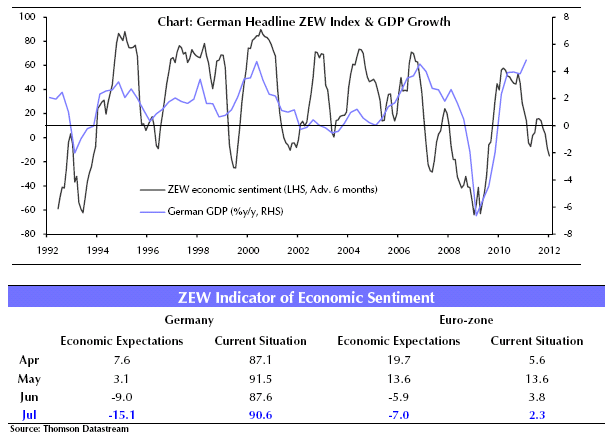
(Markit) At 50.9, down from 52.0 in July, the final seasonally adjusted Markit/BME Germany PMI was around one index point lower than the ‘flash’ figure of 52.0. Growth of German manufacturing output eased fractionally since the previous month and was the slowest since July 2009. Latest data pointed to a fall in intakes of new work for the second month running and the rate of contraction was the fastest since June 2009. The downturn in sales to export markets was highlighted by a further reduction in new business from abroad in August, with the rate of contraction also the sharpest for over two years. Meanwhile, stocks of finished goods at manufacturing firms accumulated at the steepest pace since the survey began in April 1996.


German Trade, Consumption Damped Second-Quarter GDP Growth

(Bloomberg) Private consumption contracted 0.7 percent in the second quarter. GDP increased 0.1 percent from the first quarter, when it gained 1.3 percent, the office said, confirming its initial Aug. 16 estimate. Exports rose 2.3 percent from the first quarter, when they gained 2.1 percent. Imports surged 3.2 percent in the second quarter after rising 1.7 percent in the first. That resulted in net trade reducing GDP growth by 0.3 percentage point. Companies stocked up inventories, which contributed 0.7 percentage point to GDP growth. Gross investment also added 0.7 percentage point to growth. Private consumption subtracted 0.4 percentage point and a 0.9 percent decline in construction spending cut 0.1 percentage point off GDP.

Carrefour posts net loss in 1st half

(AP) Europe’s largest retailer Carrefour SA posted an unexpected net loss in the first half and abandoned its growth target for the year amid the economic slowdown. The French retailer reported a net loss of euro249 million ($359 million) in the first six months of the year, compared with a profit of euro97 million a year earlier. Carrefour said it expects its operating profit to decline this year, reversing a target the retailer set in March when it said an ongoing and expensive “transformation plan” would raise profits this year. As it did last year, Carrefour booked what it calls “significant one-off charges” again in the first half. They amounted to euro884 million in the first half, over half of which went to writing down the value of Carrefour’s Italian assets.

Greece set to miss deficit target

(AP) Greece is likely to miss its budget targets in 2011 even if it fully implements painful reforms a parliamentary panel of financial experts said. “The increase in the primary deficit in combination with a further drop in economic activity strengthens significantly the dynamics of debt, offsetting the benefits from the decisions of the summit of July 21, and distancing the possibility of stabilization of the debt to GDP in 2012,” the panel, known as the State Budget Office, wrote in a report. Citing government figures, it said the 2011 January-July deficit stands at euro15.59 billion ($22.53 billion) with a primary deficit of 2.4 percent of gross domestic product, as opposed to a euro12.45 billion ($17.99 billion) shortfall and 1.5 percent primary deficit in that period last year.

Italy Drops Pension Changes, Will Announce Budget Amendments

(Bloomberg) The Italian government has dropped proposed changes to pension rules agreed to this week from a 45.5 billion-euro ($65.5 billion) austerity plan being discussed in parliament that aims to balance the budget by 2013. Giorgia Meloni, minister for youth and sport policy, told reporters that the government decided to withdraw the proposal agreed to by Prime Minister Silvio Berlusconi and Finance Minister Giulio Tremonti two days ago. On Aug. 29, Berlusconi’s office announced that the government had dropped a planned bonus tax on Italians earning more than 90,000 euros a year and reduced cuts in transfers to regional and local authorities. It did not provide details of how the lost deficit reduction of 4.5 billion euros from those changes would be compensated.

Crisis exposes weakness of Italian coalition

(FT) Giulio Tremonti, finance minister, was said to be in “damage limitation” mode on Wednesday, seeking to assure Italy’s partners that a budget could still get through parliament’s twin chambers by the end of next week, despite prime minister Silvio Berlusconi’s decision to jettison some key proposals, including a wealth tax. Three weeks after the centre-right cabinet agreed an austerity package – with €45.5bn ($65.4bn) of savings intended to balance the budget by 2013 – the government on Wednesday missed its self-imposed deadline to present legislation to the senate, the first step towards parliamentary approval. Insiders admit, however, that the budget could amount to a stopgap measure, the second since July, and might need to be reinforced at a later date.

Spanish PM: deficit cap amendment essential

(AP) “It is true that it is a reform done in a very short time span, because we need it,” Prime minister Jose Luis Rodriguez Zapatero said. The amendment of the 1978 constitution enshrines the principle of budgetary discipline into Spain’s constitution, but does not specify numbers. These will come in a separate law that is to be passed by June 2012. The Socialists and conservatives have agreed the law will stipulate that Spain’s deficit cannot exceed 0.4 percent of GDP, but that threshold will not take effect until 2020. Their support is enough for the bill to pass when it is voted on Friday in the lower house of Parliament and presumably next week in the Senate. Time is pressing because the legislature dissolves Sept. 27 in order to get ready for general elections Nov. 20.

Spain Expects ‘Chain’ of Market Turbulence, Valenciano Says

(Bloomberg) “We’re probably going to get back into a chain of financial turbulence in September and October,” Elena Valenciano, Socialist party campaign chief, said in an interview. Valenciano said the constitutional amendment is necessary as Spain must avoid following Greece, Ireland and Portugal into seeking a European bailout. “We have to say this because sometimes talking of a rescue seems almost something positive: any kind of intervention in Spain would be a great misfortune for the country,” she said. Valenciano said authorities “didn’t expect August to be as bad as it was” and that the gap may widen again in the next two months, “not so much because of our own debt, but because of Italy’s debt.”

Portugal Raises Taxes to Meet Deficit Targets in Rescue Plan

(Bloomberg) Portugal will raise capital gains tax and increase levies on corporate profit and high earners to reach the deficit-reduction goals in its 78 billion-euro ($112 billion) bailout. The government will impose a tax surcharge of 3 percent on companies with income above 1.5 million euros, add a bonus tax of 2.5 percent on the highest earners and raise the levy on capital gains by 1 percentage point to 21 percent, Finance Minister Vitor Gaspar said. The moves will help trim the budget deficit from 5.9 percent of gross domestic product this year to the European Union ceiling of 3 percent in 2013, he said. The shortfall will narrow to 0.5 percent in 2015. The government will reduce its deficit even as the economy contracts 2.2 percent this year and 1.8 percent next year, before expanding 1.2 percent in 2013, he said.

Ireland’s unemployment rate rises to 14.4 percent

(AP) Ireland’s unemployment rate has risen to 14.4 percent. Ireland has been trying to escape its 3-year recession through export growth led by its multinational companies. But the domestic economy remains dormant because of weak consumer demand, high household debts and a collapsed real-estate market. The Central Statistics Agency said Wednesday that unemployment rose from July’s rate of 14.3 percent, the fourth straight monthly increase. A record-high 470,000 people in Ireland, a country of 4.5 million, are claiming welfare payments for joblessness. About 17 percent are foreigners, chiefly Eastern Europeans who immigrated during the final years of Ireland’s 1994-2007 Celtic Tiger boom.

Swiss currency issues

Gnomes need MMT too, even thought they would undoubtedly try to punch holes in it…

Yes, currency intervention works. It’s what I call ‘off budget deficit spending’ and there are no nominal limits.

But seems they haven’t yet figured out that a tax cut and/or spending increase would do the trick all the better re: the currency, domestic demand, and employment.

Swiss Producer & Import Prices Drop Further In July

August 15 (RTTNews) — Switzerland’s producer and import prices decreased at a faster pace in July, data released by the statistical office showed Monday.

The producer and import price index dropped 0.6 percent year-on-year in July, faster than the 0.4 percent decrease recorded in June.

The producer price index decreased 0.8 percent annually during the month, while the import price index fell by 0.1 percent.

On a monthly basis, the producer and import price index decreased 0.7 percent during the month. There was a 0.4 percent monthly decline in producer prices, and a 1.1 percent decrease in import prices during the month.

Swiss Government, SNB in ‘Intense’ Talks, SonntagsZeitung Says

By Simone Meier and Matthias Wabl

August 15 (Bloomberg) — The Swiss government and the central bank are in “intense” talks about a possible franc target to stem currency gains, SonntagsZeitung newspaper reported, citing unidentified people close to the situation.

The plans are “ready” and the Swiss National Bank may set such a target in “coming days,” the newspaper reported yesterday. The discussions are focused on the government’s role and an “appropriate plan” may be adopted on Aug. 17, it said. Walter Meier, a spokesman for the SNB, declined to comment.

SNB policy makers, led by Philipp Hildebrand, have been seeking ways to deter investors from piling into the franc and stop the currency’s ascent to near parity with the euro. While the central bank boosted liquidity in money markets and cut borrowing costs to zero, lawmakers from the People’s Party to the Christian Democrats have signaled their support for tougher measures to protect the economy and avert job losses.

“The SNB is ‘leaning against the hurricane’ in a major way,” Stephen Gallo, head of market analysis at Schneider Foreign Exchange Ltd. in London, said in an e-mailed note today. While the central bank is probably “still looking for a better entry point to initiate a new round” of currency purchases, it “will have a very difficult time limiting the extent of the franc strength.”

The franc traded at 1.1404 versus the euro at 9:45 a.m. in Zurich, down 2.9 percent from Aug. 12. It reached a record of 1.0075 on Aug. 9. Against the dollar, the currency was at 79.74 centimes, down 2.5 percent.

October Vote

Lawmakers, facing elections in October, have become increasingly concerned that the franc’s strength will erode exports and hinder growth. Consumers became more pessimistic about the economic outlook and job prospects in July and investor confidence slumped. The government held an extraordinary meeting on the franc on Aug. 8 and forecast growth to weaken over the coming months.

Goldman Sachs Group Inc. said in an e-mailed note on Aug. 5 that cut its Swiss economic-growth forecasts for this year and next to 1.9 percent from 2.1 percent and to 0.6 percent from 2 percent, respectively.

Christophe Darbellay, head of the Christian Democrats, said in a telephone interview on Aug. 12 that the party supports the SNB and called for “extraordinary measures.” People’s Party Vice President Christoph Blocher, who previously objected to currency purchases, said policy makers need to use all tools to fight a “war.”

Secret Meeting

While the SNB is formally independent, the government may comment on a target to make such a step “as efficient as possible,” the newspaper said. The SNB may introduce an initial lower limit of slightly above 1.10 versus the euro before gradually increasing it, SonntagsZeitung reported, citing insiders.

Swiss Economy Minister Johann Schneider-Ammann led a secret meeting in Bern on Aug. 2 with leaders including Swatch Group AG Chief Executive Officer Nick Hayek and Credit Suisse Group AG Chairman Urs Rohner to discuss the franc, Neue Zuercher Zeitung am Sonntag reported yesterday, without saying where it got the information. The participants all agreed to support the SNB weakening the currency, it said.

Andre Simonazzi, a government spokesman, confirmed that the franc will be on the agenda when the Cabinet meets on Aug. 17 in Bern. The government is in close contact with the SNB and Hildebrand also attended the extraordinary session last week, he said. He wouldn’t comment on possible measures.

‘Several Hundred Billions’

SNB policy makers have been reluctant to start purchasing foreign currencies to weaken the franc after intervention attempts in the 15 months through mid-June 2010 sparked a record loss of $21 billion last year.

Lukas Gaehwiler, head of UBS AG’s Swiss operations, told SonntagsZeitung in an interview that the SNB has “better chances of success” with interventions, given the current exchange rate. Policy makers would have to be ready to spend “several hundred billions of francs or more,” he said.

“The SNB is wary of currency interventions given that they were not very successful the last time,” said Ursina Kubli, an economist at Bank Sarasin in Zurich. Still, “with the franc moving closer to parity, a lot of measures are becoming more realistic.”

Swiss Franc Slides Amid Speculation of Target-Setting; Yen Falls

By Keith Jenkins and Kristine Aquino

August 15 (Bloomberg) — The Swiss franc fell against the euro and headed for its biggest three-day decline since the European currency’s 1999 debut on speculation Switzerland will take further action to counter recent gains.

The franc slid for a fourth day versus the dollar after the SonntagsZeitung newspaper said the Swiss government and the central bank are in “intense” talks over setting a target for their currency. The yen dropped the most in a week against the euro after Japan’s Finance Minister Yoshihiko Noda indicated he’s ready to intervene in foreign-exchange markets again.

“The market is rightly nervous about what’s likely to come from the Swiss authorities as they have a track record of going down more unconventional policy steps,” said Lee Hardman, a currency strategist at Bank of Tokyo-Mitsubishi UFJ Ltd. in London. “If the steps will be enough to reverse the Swiss franc’s strengthening trend remains to be seen, but at these levels of overvaluation, which are very extreme, the risk-reward is more favorable in their way.”

The franc tumbled 1.6 percent to 1.12642 per euro at 7:12 a.m. in New York, from 1.10857 on Aug. 12, after rallying to a record 1.00749 on Aug. 9. The Swiss currency has slid 8.7 percent over the past three days, the most in 12 years. The franc declined 1.3 percent to 78.81 centimes per dollar after advancing to a record 70.71 centimes on Aug. 9.

Yen Versus Euro

The yen declined 0.4 percent to 109.78 per euro and depreciated 0.1 percent to 76.79 per dollar after climbing to 76.31 on Aug. 1, approaching its post-World War II record of 76.25 set on March 17. The 17-nation euro increased 0.3 percent to $1.4279.

The franc has soared 12 percent in the past three months and the yen added 3.5 percent, according to Bloomberg Correlation-Weighted Indexes. The currencies have gained as debt crises in Europe and the U.S. boosted demand for safety.

The Swiss National Bank may set a target for the currency in “coming days,” SonntagsZeitung reported. Talks are focusing on the role of the government and an “appropriate plan” may be adopted Aug. 17, the newspaper said.

SNB policy makers, led by Philipp Hildebrand, have been seeking ways to stop the franc’s ascent to almost parity with the euro. While the central bank boosted liquidity in money markets and cut borrowing costs to zero, lawmakers have signaled their support for tougher measures to protect the economy.

‘Shock-and-Awe’

“The market is paying much more respect towards the idea that there’s some sort of shock-and-awe tactic being put together in Switzerland,” said Robert Rennie, chief currency strategist in Sydney at Westpac Banking Corp., Australia’s second-largest lender. “It’s this fear of the unknown that has sparked a significant move” in the franc.

Gains have left the franc 41 percent too strong against the euro, according to an index developed by the Organization for Economic Cooperation and Development in Paris that uses relative costs of goods and services. It’s also the most overvalued currency against the dollar, at 49 percent.

The yen has risen beyond the level that prompted Japan to sell the currency on Aug. 4, its first intervention in foreign-exchange markets since March. A stronger yen reduces the value of overseas income at Japanese companies when converted into their home currency.

“An unstable situation is continuing,” Noda said yesterday during a television talk show on the public broadcaster NHK. “As foreign-exchange market matters are my prerogative, I will continue to closely watch the markets and take bold action if it becomes necessary.”

Japan’s Economy

Japan’s economy shrank at a 1.3 percent annual pace in the three months through June, the third quarter of contraction, government data showed today. The median forecast of economists surveyed by Bloomberg News was for a 2.5 percent drop.

The euro rose for a third day versus the dollar on speculation a meeting tomorrow between French President Nicolas Sarkozy and German Chancellor Angela Merkel in Paris may result in action to contain the region’s debt crisis.

The two leaders “will come out with something,” said Alex Sinton, senior dealer at ANZ National Bank Ltd. in Auckland. “It may even be long-term viable. I suspect there’ll be a range broken this week.” Investors will be looking to sell the euro on rallies toward $1.44, Sinton said.

Foreign-exchange traders reduced bets against the dollar by the most on record as demand for Treasuries soared amid global growth concerns. Aggregate bets the greenback will weaken against the euro, the yen, the Australian, Canadian and New Zealand dollars, the pound, the franc and the Mexican peso plunged by 154,105 contracts to 153,216 in the week ended Aug. 9, the biggest drop ever in Commodity Futures Trading Commission data compiled by Bloomberg beginning in November 2003.

Pound Outlook

Traders are betting on pound weakness even as the euro-area debt crisis deepens because of slumping consumer sentiment and a growth rate that may trail behind Germany’s by more than two percentage points in 2011, analysts in Bloomberg surveys said. Analysts cut forecasts for sterling versus the euro by 5.7 percent this year, the most of 17 developed-nation pairs tracked by Bloomberg.

The pound declined 0.2 percent to 87.66 pence versus the euro today and appreciated 0.2 percent to $1.6306.

France getting fried

As previously discussed,
back in the days before the euro, every few years the large French banks would take what were then massive write offs, with the French govt. writing the check and adding a bit to the French govt’s budget deficit, and life went on.

The idea that after switching to the euro French banks would suddenly upgrade their underwriting to the point where the periodic massive write offs would no longer take place seemed illogical to me.

So along those lines, after a dozen or so years with no major losses, it’s very possible some very large loan losses could be about to surface.

The way this hurts the US is through equity valuations for companies that trade with the euro zone, as well as currency translations of assets and earnings should the euro fall.

THE CATALYST FOR LOWER STOCK PRICES IS COMING OUT OF EUROPE..SPECIFICALLY FRANCE.. THE RUMORS OF FRANCE BEING DOWNGRADED SEEM TO BE UNFOUNDED, BUT CDS CONTINUES TO WIDEN.. THIS MORNING, SARKOZY CAME IN FROM HIS CHATEAU TO HEAD UP HIS WEEKLY WEDNESDAY MEETING. THE DIFFERENCE WAS THAT BANK OF FRANCES NOYER WAS IN ATTENDANCE, WHICH IS UNUSUAL…THE MARKET IS SPECULATING THAT A FRENCH BANK IS IN TROUBLE… SOCGEN STOCK IS DOWN OVER 20%….THE REAL BENEFICIARIES OF TRADING ARE THE UK AND GERMANY IN THAT ORDER…UK 10 YEARS ARE 23 BETTER, GERMANY 16 BETTER AND FRANCE 14 BETTER… THE EURO HAS GONE FROM 1.44 TO 1.418 TODAY.. AGAIN…SOCGEN IS THE RUMOR..WE SAW IT ON MONDAY IN A BB ARTICLE..WE HEAR IT AGAIN TODAY…