
quick macro update


[Skip to the end]

Market functioning has finally returned, helped by the Fed slowly getting around to where it should have been even before all this started- lending unsecured to its banks, setting its target rate and letting quantity adjust to demand. It’s not technically lending unsecured, but instead went through a process of accepting more and varied collateral from the banks until the result was much the same as lending unsecured.

A couple of years back (has it been that long?) when CPI and inflation expectations were rising, the Fed said it was going to restore market function first, and then work on inflation. It’s taken them this long to restore market functioning (eventually implementing in some form the proposals I put forth back then regarding market functioning) and with the inflation threat subdued by the wide output gap it looks like they are on hold for a while, though they would probably like to move to a ‘more normal’ stance when it feels safe to do so. That would mean a smaller portfolio (not that it actually matters) and a modest ‘real rate of interest’ as a fed funds target is also based on their notion of how things work.

It is more obvious now that the automatic fiscal stabilizers did turn the tide around year end, as the great Mike Masters inventory liquidation came to an end, and the Obamaboom began. The ‘stimulus package’ wasn’t much, and wasn’t optimal for public purpose, but it wasn’t ‘nothing,’ and has been helping aggregate demand some as well, and will continue to do so. It has restored non govt incomes and savings of financial assets to at least ‘muddle through’ levels of modest GDP growth, and we are now also in the early stages of a housing recovery, but not enough to keep productivity gains from continuing to keep unemployment and excess capacity at elevated levels.

This also happens to be a good equity environment- enough demand for some top line growth, bottom line growth helped by downward pressures on compensation, and interest rates helping valuations as well. There will probably be ups and downs from here, but not the downs of last year.

There also doesn’t seem to be much public outrage over the unemployment rate, with GDP heading into positive territory. Expectations of what government can do are apparently low enough such that jobs being lost at a slower rate has been sufficient to increase public support of government policies.

The largest macro risk remains a government that doesn’t understand the monetary system and is therefore unlikely to make the appropriate fiscal adjustments should aggregate demand suddenly head south for any reason.

And here’s a new one, just when I thought I’d heard it all:

‘Black Swan’ Author Taleb Wants His Vote for Barack Obama Back

By Joe Schneider

Sept. 16 (Bloomberg)— U.S. PresidentBarack Obama has failed to appoint advisers and regulators who understand the complexity of financial systems,Nassim Taleb, author of “The Black Swan,” told a group of business people in Toronto.

“I want my vote back,” Taleb, who said he voted for Obama, told the group.

The U.S. has three times the debt, relative to the country’s economic output, or gross domestic product, as it had in the 1980s, Taleb said. He blamed rising overconfidence around the world. U.S. Federal Reserve Chairman Ben Bernanke, who was appointed to a second term last month by Obama, contributed to that misperception, Taleb said.

“Bernanke thought the system was getting stable,” Taleb said, when it was on the verge of collapse last year.

Debt is a direct measure of overconfidence, he said. The national debt, according to the U.S. Debt Clock Web site, is at $11.8 trillion.

The nation must reduce its debt level and avoid “the moral sin” of converting private debt to public debt, he said.

“This is what I’m worried about,” Taleb said. “But no one has the guts to say let’s bite the bullet.”

As the founder of New York-based Empirica LLC, a hedge-fund firm he ran for six years before closing it in 2004, Taleb built a strategy based on options trading to protect investors from market declines while profiting from rallies. He now advises Universa Investments LP, a $6 billion fund that bets on extreme market moves.


[top]
NYC 2006 acquisition of Stuyvesant Town


[Skip to the end]

Thanks, looks like we could use a full payroll tax holiday and a lot of per capita revenue sharing ASAP.

Pretty much as expected, GDP muddling through around flat or modestly positive, supported by the automatic stabilizers and a bit of proactive fiscal support dribbling in, but not enough to keep unemployment from rising as GDP gains lag productivity gains.

This can be ok for financial markets and equities, which are now well off the bottom, but depressing for most of the voters.

NYC is dynamic and seems to adjust relatively quickly. Finances are getting reorganized, and prices are adjusting to current market conditions, as life there moves on and doesn’t look back.

Tishman Speyer’s 2006 acquisition of Stuyvesant Town for $5.4 billion apparently is about to turn terminally sour. The “biggest deal for a single American property in modern times” which never managed to be profitable from day one, is on the verge of completely exhausting reserve accounts tied to $3 billion of securitized accounts.The premise – take the 11,227 rent-stabilized u,nits apartment complex and convert them to market-rate. Alas, the timing could not have been worse due to an implosion in the NY rent market, coupled with legal difficulties – to date only 4,350 of the units have been converted to market rate, while the remaining rent-controlled units will likely increase in number due to a recent court ruling.

According to RealPoint the original reserve fund which had a balance of $650 million in 2007 when Stuy Town’s debt was first securitized is down to a meager $49.7 million. The origianal reserve fund set consisted of a $190 million general reserve as well as a $60 million replacement reserve, both of which have been depleted, as well as a $400 debt-shortfall service fund, which has now declined to just over 10% of its initial balance.

The reserve fund was drawn down by $7 million month to date, versus $13.3 million in July and $19.6 million in June, with an average decline in the reserve fund of $11.3 million per month. At this rate Stuy Town’s reserves will be completely wiped out in four months, sometime in December.

To demonstrate what a colossal failure Tishman and Blackrock’s assumptions have been from the very beginning, the property has a $23.8 million monthly debt service, while on the revenue side, according to first quarter data, the property generates $136.5 million in annual cash flow, or $11.4 million monthly, a $12.4 million monthly shortfall (a cap rate of about + infinity).

And to demonstrate just how bad (and getting progressively worse) real estate in New York is, midtown’s Dream Hotel, owners Hampshire Group have notified special servicer LNR Group, that it wold not make any more payments on the $100 million loan against the property. According to CREDirect, in 2008 the property’s cash flow dropped 11 percent to $7.8 million as occupancy fell 3% to 84%, with a DSCR drop from 1.41x in 2007 to 1.26x. Things have since deteriorated, not just for the now defaulted Dream, but for a vast majority of all other New York hotels who have been struggling with declining bookings and room rates.


[top]

China Money Rates Drop as Central Bank Stops Pushing Up Yields


[Skip to the end]

Check out the last ‘house hunting’ story.

Looks like they are on to that angle of attack, directing
that form of ‘investment’ as a matter of public purpose,
much like we have done with our public policies over the years.

Also looks like the cut back in lending was to try to moderate
what they deemed to be ‘overheating’ and should only be temporary.

Seems the rate hike was only 26 basis points (not that rates matter very much in any case).

Very interesting note here:

Chinese banks usually “frontload” lending in the first half of each year.

China Money Rates Drop as Central Bank Stops Pushing Up Yields

August 18 (Bloomberg) — China’s money-market rates dropped after the central bank stopped driving up the benchmark bill yield for the first time in six weeks, fanning speculation it will ease availability of funds to stem a slump in stocks.

The People’s Bank of China said it sold 45 billion yuan

($6.6 billion) of one-year bills at a yield of 1.7605 percent, unchanged from last week’s auction. The central bank has let the yield rise 26 basis points since resuming sales of one-year bills on July 9, following an eight-month suspension.

“The authorities may want to ease the market panic after a big slump in stocks,” said Zhang Lei, a fixed-income analyst at Shenyin Wanguo Research & Consulting Co. in Shanghai. “The unchanged yield is a signal that the central bank will stick to its loose monetary policy.”

The seven-day repurchase rate, which measures funding availability on the interbank market, declined 12 basis points, or 0.12 percentage point, to 1.30 percent as of 5:30 p.m. in Shanghai, according to the China Interbank Funding Center. A basis point is 0.01 percentage point.

A government report showed on Aug. 11 that industrial production gained 10.8 percent in July, less than the 12 percent median estimate in a Bloomberg survey of economists. Urban fixed-asset investment for the seven months to July 31 climbed

32.9 percent, which was also short of analyst forecasts.

China’s Investment-Grade Debt Ratings Affirmed by S&P

Aug. 18 (Bloomberg) — China’s investment grade credit rating was affirmed by Standard & Poor’s Ratings Services, which cited the country’s “exceptional” economic growth potential.

S&P maintained China’s A+ long-term sovereign credit rating and its A-1+ short-term rating, according to a statement issued today. The outlook on the long-term credit rating remains stable, S&P said.

“Fiscal flexibility remains significant,” S&P said in the statement. “The Chinese government faces moderate risks of balance sheet damage if there is a steeper and more prolonged economic slowdown than currently expected.”

Banks report fewer new loans

August 17 (China Daily) — China’s new lending in July fell to less than a quarter of June’s level, as banks sought to limit credit risks and the flow of money into stocks and property.

Banks extended 355.9 billion yuan in loans, down from 1.53 trillion yuan in June, the People’s Bank of China reported on its website last week. M2, the broadest measure of money supply, rose 28.4 percent.

China Construction Bank Corp, the nation’s second-largest lender, said recently that it will cut new lending by about 70 percent in the second half to avert a surge in bad debt.

The government wants to avert bubbles in stocks and property without choking off the recovery of the world’s third-biggest economy.

A smaller loan number “is probably a good thing – we’re coming off this ridiculously high level of lending in the first half,” said Paul Cavey, an economist with Macquarie Securities in Hong Kong.

Premier Wen Jiabao reiterated in a statement on Aug 9 that a “moderately loose” monetary policy and “proactive” fiscal policy will remain unchanged because the economy faces problems including sliding export demand and industrial overcapacity.

UBS AG stated in a July 31 note that the scale of China’s new lending in the first half was “neither sustainable nor necessary.” New loans of 300 billion yuan to 400 billion yuan a month in the second half would be “more than enough” to support the nation’s recovery, the report said.

Chinese banks usually “frontload” lending in the first half of each year.

The credit boom and a 4 trillion yuan stimulus package drove 7.9 percent economic growth in the second quarter from a year earlier and helped General Motors Co to report a 78 percent increase in vehicle sales in China in July.

A record $1 trillion yuan in loans through June has also helped to drive this year’s 79 percent gain in the Shanghai Composite Index.

Central bank and finance ministry officials said on Aug 7 that they will scrutinize gains in stock prices without capping new lending. The Financial Times reported the same day that the central bank had told the largest state-controlled lenders to slow growth in new loans, citing unidentified people familiar with the matter.

Credit exploded after the People’s Bank of China scrapped quotas limiting lending in November and told banks to back Wen’s 4 trillion yuan stimulus package.

Zhang Jianguo, the president of China Construction Bank, expressed concern about loan growth last week, saying some industries are growing too rapidly and some money isn’t flowing into the real economy.

Housing prices “are rising too fast and housing sales are growing too fast”, Zhang said.

Property sales climbed 60 percent in value in the first seven months from a year earlier, the statistics bureau said.

China’s banking regulator urged lenders on July 27 to ensure credit for investment projects flows into the real economy.

Three days later, the regulator announced plans to tighten rules on working capital loans.

Stephen Roach, chairman of Morgan Stanley Asia, said on July 29 that surging lending and infrastructure spending worsened imbalances in the Chinese economy and “could sow the seeds for a new wave of non-performing bank loans”.

Instead of pumping up growth, the government should do more to boost private consumption, he said.

China goes house hunting to rev up economy

August 18 (Reuters) — The Chinese government is attempting to pass the baton of growth from State-funded infrastructure investment to the private housing sector, a risky but necessary move to sustain the economic recovery.

Construction cranes sprouting in big cities, busy furniture shops and soaring property sales all show that the transition is going smoothly so far, though officials are wary that house prices may rise too high, too quickly.

China’s biggest listed property developer, Vanke, lifted its housing starts target for this year by 45 percent, while its rival Poly Real Estate said sales in Jan-July rose 143 percent from a year earlier.

On the ground, construction firms, big and small, are trying to meet the demand, last years’ downturn now a distant memory.

“It’s been a long time since we’ve had a day off. Several months, I think, though I can’t remember exactly,” said Zhang Minghui, owner of a small building company in Beijing.

“From late last year to early this year, we basically had nothing to do. Everybody was careful with their money because of the crisis and so projects got delayed.”

Zhang cut his staff to three in November but is now back up to a crew of 14.

The economic importance of the property sector in China is hard to overstate. Investment in residential housing accounted for about 10 percent of gross domestic product before a property boom turned to bust in 2008, roughly the same as the contribution from the country’s vaunted export factories.

The government’s first steps last year to revive the stalling Chinese economy were to offer tax cuts to encourage home purchases, followed by rules to ease access to mortgages.

These are bearing fruit.

With housing investment up an annual 11.6 percent in the first seven months, Chinese growth momentum is broadening out and the central government has been able to slow the pace of its stimulus spending on infrastructure.

Real economy

But Beijing must strike a fine balance in its bid to kick-start the housing market.

On the one hand, it wants rising prices to persuade house hunters to stop putting off purchases and to get developers to invest in new projects. On the other hand, it is wary of prices rising too quickly, luring speculators into the market and turning it into an asset bubble, not an economic driver.

“Because it is closely linked to so many industries, volatility in the real estate market will inevitably lead to macroeconomic volatility,” the government-run China Economic Times warned on Monday.


[top]

Social Security commentary published


[Skip to the end]

Social Security: Another Case of Innocent Fraud?

By Mathew Forstater and Warren Mosler

August 6th — In his recent book, The Economics of Innocent Fraud, John Kenneth Galbraith surveys a number of false beliefs that are being perpetuated among the American people about how our society operates: innocent (and sometimes not-so-innocent) frauds. There is perhaps no greater fraud being committed presently—and none in which the stakes are so high—as the fraud being perpetrated regarding government insolvency and Social Security. President Bush uses the word “bankruptcy” continuously. And the opposition agrees there is a solvency issue, questioning only what to do about it.
Fortunately, there is a powerful voice on our side that takes exception to the notion of government insolvency, and that is none other than the Chairman of the Federal Reserve. The following is from a transcript of a recent interview with Fed Chairman Alan Greenspan:

    RYAN… do you believe that personal retirement accounts can help us achieve solvency for the system and make those future retiree benefits more secure?

    GREENSPAN: Well, I wouldn’t say that the pay-as-you-go benefits are insecure, in the sense that there’s nothing to prevent the federal government from creating as much money as it wants and paying it to somebody. The question is, how do you set up a system which assures that the real assets are created
    which those benefits are employed to purchase. (emphasis added)

For a long time we have been saying there is no solvency issue (see C-FEPS Policy Note 99/02 and the other papers cited in the bibliography at the end of this report). Now with the support of the Fed Chairman, maybe we can gain some traction.

Let us briefly review, operationally, government spending and taxing. When government spends it credits member bank accounts. For example, imagine you turn on your computer, log in to your bank account, and see a balance of $1,000 while waiting for your $1,000 Social Security payment to hit. Suddenly the $1,000 changes to $2,000. What did the government do to make that payment? It did not hammer a gold coin into a wire connected to your account. It did not somehow take someone’s taxes and give them to you. All it did was change a number on a computer screen. This process is operationally independent of, and not operationally constrained by, tax collections or borrowing.

That is what Chairman Greenspan was telling us: constraints on government payment can only be self-imposed.

And what happens when government taxes? If your computer showed a $2,000 balance, and you sent a check for $1,000 to the government for your tax payment, your balance would soon change to $1,000. That is all—the government changed your number downward. It did not “get” anything from you. Nothing jumped out of the government computer into a box to be spent later. Yes, they “account” for it by putting information in an account they may call a “trust fund,” but this is “accounting”—after the fact record-keeping—and has no operational impact on government’s ability to later credit any account (i.e., spend!).

Ever wonder what happens if you pay your taxes in actual=2 0cash? The government shreds it. What if you lend to the government via buying its bonds with actual cash? Yes, the government shreds the cash. Obviously, the government doesn’t actually need your “funds” per se for further operational purpose.

Put another way, Congress ALWAYS can decide to make Social Security payments, previous taxing or spending not withstanding, and, operationally, the Fed can ALWAYS process whatever payments Congress makes. This process is not revenue constrained. Operationally, collecting taxes or borrowing has no operational connection to spending. Solvency is not an issue. Involuntary government bankruptcy has no application whatsoever! Yet “everyone” agrees—in all innocence—that there is a solvency problem, and that it is just a matter of when. Everyone, that is, except us and Chairman Greenspan, and hopefully now you, the reader, as well!

So if solvency is a non-issue, what are the issues? Inflation, for one. Perhaps future spending will drive up future prices. Fine! How much? What are the projections? No one has even attempted this exercise. Well, it is about time they did, so decisions can be made on the relevant facts.

The other issue is how much GDP we want seniors to consume. If we want them to consume more, we can award them larger checks, and vice versa. And we can do this in any year. Yes, it is that simple. It is purely a political question and not one of “finance.”

If we do want seniors to participate in the future profitability of corporate America, one option (currently not on the table) is to simply index their future Social Security checks to the stock market or any other indicator we select—such as worker productivity or inflation, whatever that might mean.

Remember, the government imposes a 30% corporate income tax, which is at least as good as owning 30% of all the equity, and has at least that same present value. If the government wants to take a larger or smaller bite from corporate profits, all it has to do is alter that tax—it has the direct pipe. After all, equity is nothing more than a share of corporate profits. Indexation would give the same results as private accounts, without all the transactional expense and disruption.

Now on to the alleged “deficit issue” of the private accounts plan. The answer first—it’s a non-issue. Note that the obligation to pay Social Security benefits is functionally very much the same as having a government bond outstanding—it is a government promise to make future payments. So when the plan is enacted the reduction of future government payments is substantially offset” by future government payments via the new bonds issued. And the funds to buy those new bonds come (indirectly) from the reductions in the Social Security tax payments—to the penny. The process is circular. Think of it this way. You get a $100 reduction of your Social Security tax payment. You buy $100 of equities. The person who sold the equities to you has your $100 and buys the new government bonds. The government has new bonds outstanding to him or her, but reduced Social Security obligations to you with a present value of about $100. Bottom line: not much has changed. One person has used his or her $100 Social Security tax savings to buy equities and has given up about $100 worth of future Social Security benefits (some might argue how much more or less than $100 is given up, but the point remains). The other person sold the equity and used that $100 to buy the new government bonds. Again, very little has changed at the macro level. Close analysis of the “pieces” reveals this program is nothing but a “wheel spin.”

Never has so much been said by so many about a non-issue. It is a clear case of “innocent fraud.” And what has been left out? Back to Chairman Greenspan’s interview—what are we doing about increasing future output? Certainly nothing in the proposed private account plan. So if we are going to take real action, that is the area of attack. Make s ure we do what we can to make the real investments necessary for tomorrow’s needs, and the first place to start for very long term real gains is education. Our kids will need the smarts when the time comes to deal with the problems at hand.

References

•Galbraith, John Kenneth, 2004, The Economics of Innocent Fraud: Truth for Our Time, Boston: Houghton Mifflin.

•Wray, L. Randall, 1999, “Subway Tokens and Social Security,” C-FEPS Policy Note 99/02, Kansas City, MO: Center for Full Employment and Price Stability, January, (http://www.cfeps.org/pubs/pn/pn9902.html).

•Wray, L. Randall, 2000, “Social Security: Long-Term Financing and Reform,” C-FEPS Working Paper No. 11, Kansas City, MO: Center for Full Employment and Price Stability, August, (http://www.cfeps.org/pubs/wp/wp11.html).

•Wray, L. Randall and Stephanie Bell, 2000, “Financial Aspects of the Social Security ‘Problem’,” C-FEPS Working Paper No. 5, Kansas City, MO: Center for Full Employment and Price Stability, January, (ht tp://www.cfeps.org/pubs/wp/wp5.html).


[top]

Bernanke Feared a Second Great Depression – WSJ.com


[Skip to the end]

The great depression was the last US gold standard depression.

A gold standard is fixed exchange rate policy characterized by a continuous constraint on the supply side of the currency.

Interest rates are endogenous, and even the treasury must first borrow before it can deficit spend, and in doing so compete with other borrowers for funds from potential lenders who have the option to convert their currency into gold. Therefore interest rates always represent indifference rates between holding securities and holding the gold.

With non convertible currency the central bank is left to set interest rates as holders of the currency no longer have the option to convert the currency into gold. Without conversion rights, there are no supply side constraints on credit expansion, and government can therefore offer the credible deposit insurance necessary to sustain the functioning of the payments system.
Bernanke failed to recognize this and therefore saw systemic risks that weren’t there, and also failed to act in line with the tools available to the Fed that would not have been available under the previous gold standard. The most obvious is unsecured lending to member banks, as I have been proposing for a number of years.

With today’s non convertible currency and floating exchange rate policy the fiscal ‘automatic stabilizers’ functioned as they always have during previous recessions, and as the deficit got above 5% of GDP at year end it was enough to reverse the downward spiral and turn things around.

This could not have happened under a gold standard. Before the deficit got anywhere near that large it would have driven up interest rates at an accelerating pace and the gold while the national gold reserves were being rapidly depleted.

We’ve seen this happen most recently with Argentina in 2001 and Russia in 1998 where similar fixed exchange rate regimes had similar outcomes.

We’ve also seen failures of logic regarding how the FDIC handled banking system stresses. The FDIC can simply ‘take over’ any bank it deems insolvent, and then decide whether to continue operations, sell off the assets, replace management, etc. This can be done and has been done in an orderly manner without ‘business interruption.’

The alternative in this cycle- having the treasury ‘add capital’- in my opinion was a major error for a variety of reasons.

When a bank loses capital, there is then less private capital left to lose before the FDIC starts taking losses. When the treasury buys capital in the banks, the amount of private capital remains the same. All that changes is that should subsequent losses exceed the remaining private capital, the treasury rather than the FDIC takes the loss. For all practical purposes both are government agencies, so for all practical purposes this changes nothing regarding risk to government. The FDIC could have just as easily accomplished the same thing by allowing the banks in question to continue to operate but under the same terms and conditions set by the treasury (not that those would have been my terms and conditions).

Instead, substantial political capital was burned and numerous accounting issues and interagency issues confused and distorted including ‘adding to the federal deficit’ when there was nothing that altered aggregate demand.

We have paid a high price for financial leaders being completely out of paradigm and in this way over their heads.

Bernanke Feared a Second Great Depression

By Sudeep Reddy

July 27 (WSJ) — Federal Reserve Chairman Ben Bernanke on Sunday said he engineered the central bank’s controversial actions over the past year because “I was not going to be the Federal Reserve chairman who presided over the second Great Depression.”

Speaking directly to Americans in a forum to be shown on public television this week, Mr. Bernanke pushed back against Kansas City area residents who suggested he and other government officials were too eager to help big financial institutions before small businesses and common Americans.

“Why don’t we just let the behemoths lay down and then make room for the small businesses?” asked Janelle Sjue, who identified herself as a Kansas City mother.

“It wasn’t to help the big firms that we intervened,” Mr. Bernanke said, diving into a discourse on the damage to the overall economy that can result when financial firms that are “too big to fail” collapse.

“When the elephant falls down, all the grass gets crushed as well,” Mr. Bernanke said. He described himself as “disgusted” with the circumstances that led him to rescue a couple of large firms, and called for new laws that would allow financial firms other than banks to fail without going into bankruptcy.

Mr. Bernanke appeared stoic at times as he sought to explain his actions during the financial crisis at the town-hall-style meeting with 190 people at the Federal Reserve Bank of Kansas City hosted by the NewsHour’s Jim Lehrer. But he also joked with the crowd, saying “economic forecasting makes weather forecasting look like physics.” He quipped that he could face malpractice charges if he offered investment advice — although he then recommended that a questioner practice diversification and avoid trying to time the stock market.

The hourlong session was the latest unusual forum where the Fed chairman has explained his actions in recent months, including bailouts and massive lending. Mr. Bernanke appeared before the National Press Club in February, agreed to an interview with CBS’s “60 Minutes” in March and took questions on camera from Morehouse College students in April.

Sunday’s setting offered the former Princeton economics professor a chance to speak outside of congressional testimony and speeches to economists, as his tenure leading the central bank faces increasing scrutiny. With just six months left in his term as chairman, Mr. Bernanke will learn in the coming months whether President Barack Obama will reappoint him to another four-year term or replace him.

Mr. Bernanke repeatedly used the frustrations voiced by people in the room to show his limited options during the crisis and reiterate the need for a regulatory overhaul.

David Huston, who called himself a third-generation small-business owner, said he was “very frustrated” to see “billions and billions of dollars” sent to large financial firms and called the government approach “too big to fail, too small to save.”

“Small businesses represent the lifeblood of small cities, large cities and our American economy,” he said, and they are “getting shortchanged by the Federal Reserve, the Treasury Department and Congress.”

Mr. Bernanke responded that “nothing made me more frustrated, more angry, than having to intervene” when firms were “taking wild bets that had forced these companies close to bankruptcy.”

More than 20 people asked questions of the Fed chairman, on topics ranging from bailouts to mortgage-regulation practices to the Fed’s independence, a topic that drew the most forceful tone from the Fed chairman. Mr. Bernanke suggested that a movement by lawmakers to open the Fed’s monetary-policy operations to audits by the Government Accountability Office is misunderstood by the public.

Congress already can look at the Fed’s books and loans that could be at risk for taxpayers, he said. Under the proposed law, the GAO would also be able to subpoena information from Fed officials and make judgments about interest-rate decisions based on requests from Congress.

“I don’t think that’s consistent with independence,” he said. “I don’t think people want Congress making monetary policy.”

After appearing before lawmakers three times last week, Mr. Bernanke broke little new ground in explaining the state of the economy. He said the Fed’s expected economic growth rate of 1% in the second half of the year would fall short of what is needed to bring down unemployment, which he sees peaking sometime next year.

“The Federal Reserve has been putting the pedal to the metal,” he says. “We hope that’s going to get us going next year sometime.”


[top]

Quantitative easing


[Skip to the end]

Monetary policy in a period of financial chaos:

The political economy of the Bank of Canada in extraordinary times

Presented at the Political Economy of Central Banking conference,

Toronto, May 2009

Marc Lavoie and Mario Seccareccia

Department of Economics

University of Ottawa

July 2009


“Although quantitative easing is now referred to as an unconventional monetary policy tool, the purchase of government securities is, in fact, the conventional textbook approach to monetary policy…. In practice, most central banks have chosen to conduct monetary policy by targeting the price of liquidity because the relationship between the amount of liquidity provided by the central bank and monetary aggregates on the one hand, and between monetary aggregates and aggregate demand and inflation on the other, are not very stable.” (Bank of Canada, 2009b, p. 26).

The Bank of Canada thus feels compelled to recall that monetary aggregates are very badly correlated with price inflation, and that base money is also very badly correlated with the money supply. To provide excess bank reserves, as recommended by Monetarists, central banks must decline to sterilize its liquidity creating financial operations or it must conduct open market operations by purchasing assets. As pointed out by Deputy Governor John Murray (2009), “All quantitative easing is, by definition, ‘unsterilized’. Although this is correctly viewed as unconventional, it closely resembles the way monetary policy is described in most undergraduate textbooks, and is broadly similar to how it was conducted in the heyday of monetarism”. Murray misleadingly insinuates that such a technique has been implemented before, namely during the 1975-1982 monetarist experiment in Canada. What can really be said is that quantitative easing is an attempt to put in practice what academics have been preaching in their textbooks for decades from their ivory towers. It is merely monetarism but in reverse gear. While monetarist policy of the 1970s was implemented to reduce the rate of inflation, current monetarist quantitative easing is being applied to generate an increase in the rate of inflation.

As a result, the claims of quantitative easing are just as misleading as the claims of monetarism of the 1970s and early 1980s. Bank of Canada officials claim that “The expansion of the amount of settlement balances available to [banks] would encourage them to acquire assets or increase the supply of credit to households and businesses. This would increase the supply of deposits” (Bank of Canada, 2009b, p. 26), adding that quantitative easing injects “additional central bank reserves into the financial system, which deposit-taking institutions can use to generate additional loans” (Murray, 2009). In our opinion, these statements are misleading and indeed completely wrong. They rely on the monetarist causation, endorsed in all neoclassical textbooks, which goes from reserves to credit and monetary aggregates. It implies that banks wait to get reserves before granting new loans. This has been demonstrated to be completely false in the world of no compulsory reserves in which we live since 1994. In any event, even before 1994, as argued by a former official at the Bank of Canada, the task of central banks is precisely to provide the amount of base money that banks require (Clinton, 1991). Banks do not wait for new reserves to grant credit. What they are looking for are creditworthy borrowers.

Quantitative easing is an essentially useless channel. It assumes that credit is supply-constrained. It assumes that banks will grant more loans because they have more settlement balances. Both of these assumptions are likely to be false, at least in Canada. With the possible exception of its impact on the term structure of interest rates, the only effect of quantitative easing might be to lower interest rates on some assets relative to the target overnight rate, as these assets are being purchased by the central bank through its open market operations. It is doubtful that the amplitude of these interest rate changes will have any impact on private borrowing or on the exchange rate. Indeed, in Japan, which has had experience with zero interest rates for many years, quantitative easing was pursued relentlessly between 2001 and 2004, but with no effect, as “the expansion of reserves has not been associated with an expansion of bank lending” (MacLean, 2006, p. 96). Indeed, officials at the Bank of Japan did not themselves believe that quantitative easing could on its own be of any help, but they tried it anyway as a result of the pressure and advice of international experts. As Ito (2004, p. 27) notes in relation to the Bank of Japan, “Given that the interest rate is zero, no policy measures are available to lift the inflation rate to positive territory… The Bank did not have the tools to achieve it”.


[top]

Progress!


[Skip to the end]

Deficits saved the world

By Paul Krugman

July 15 (NYT) — Jan Hatzius of Goldman Sachs has a new note (no link) responding to claims that government support for the economy is postponing the necessary adjustment. He doesn’t think much of that argument; neither do I. But one passage in particular caught my eye:

    The private sector financial balance—defined as the difference between private saving and private investment, or equivalently between private income and private spending—has risen from -3.6% of GDP in the 2006Q3 to +5.6% in 2009Q1. This 8.2% of GDP adjustment is already by far the biggest in postwar history and is in fact bigger than the increase seen in the early 1930s.


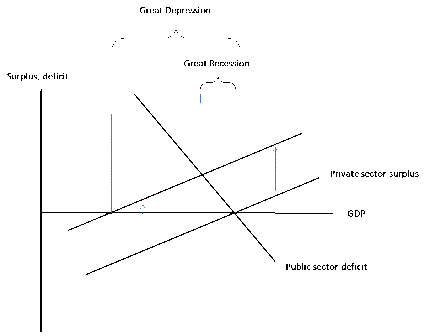
That’s an interesting way to think about what has happened — and it also suggests a startling conclusion: namely, government deficits, mainly the result of automatic stabilizers rather than discretionary policy, are the only thing that has saved us from a second Great Depression.

The following figure makes the argument:

Here I show the private sector surplus and the public sector deficit, both as functions of GDP; the private sector line is upward-sloping because higher GDP means higher income and more savings, the public-sector line is downward-sloping because higher GDP means higher revenues. In equilibrium the private surplus equals the government deficit (not strictly true for any one country if you add in international capital flows, but think of this as a picture for the world economy). To make the figure cleaner I’ve shown an initial position of balance in both sectors, but this isn’t important.

What we’ve had is a sharp increase in the desired private surplus at any given level of GDP, due to a combination of higher personal saving and reduced investment demand. This is shown as an upward shift in the private-surplus curve.

In the 1930s the public sector was very small. As a result, GDP basically had to shrink enough to keep the private-sector surplus equal to zero; hence the fall in GDP labeled “Great Depression”.

This time around, the fall in GDP didn’t have to be as large, because falling GDP led to rising deficits, which absorbed some of the rise in the private surplus. Hence the smaller fall in GDP labeled “Great Recession.”

What Hatzius is saying is that the initial shock — the surge in desired private surplus — was if anything larger this time than it was in the 1930s. This says that absent the absorbing role of budget deficits, we would have had a full Great Depression experience. What we’re actually having is awful, but not that awful — and it’s all because of the rise in deficits. Deficits, in other words, saved the world.


[top]

Daniel Berger piece


[Skip to the end]

>   
>   (email exchange)
>   
>   On Wed, Jul 8, 2009 at 7:24 PM, wrote:
>   
>   By the way, I forgot to mention it the other day, but I’m sure you all saw the front-page
>   report in Monday’s Financial Times. It seems that Goldman Sachs and Barclays are now
>   marketing “insurance” products that can help buyers dodge capital adequacy rules. You
>   can’t make this stuff up. The term that comes to mind is “impunity.”
>   
>   When are regulators in the US and EU going to put an end to this nonsense? Wasn’t the
>   collapse of AIG a sufficient example of the deliterious effects of using structured credit
>   to window dress corporate balance sheets?
>   

It is up to Congress to decide if ‘taxpayer money’ is adequately ‘protected’ by bank capital which takes the initial losses.

However, the public purpose of using the public private partnerships we call banks, rather than just have the government make the loans directly, is the notion that the private sector can better ‘price risk’ than the public sector.

Banks will price risk differently as a function of capital requirements.

With no capital required and all FDIC insured deposits they will take lots of risk! etc.

So I look at any new fangled notion of what constitutes capital from this perspective of public purpose and the pricing of risk.

>   >   
>   >   The film WALL STREET (in all its cheesy glory) happened to be on TV the other night,
>   >   and I was amazed to see how plainly some of the issues we now face are laid out.
>   >   
>   >   Dan Berger’s piece does a great job of illuminating this:
>   >   Link
>   >   


[top]

FT.com / Europe – Exporters warn of German credit squeeze


[Skip to the end]

Don’t think markets are ready for this:

Exporters warn of German credit squeeze

by Ralph Atkins

June 26th (Bloomberg) — Germany’s powerful export industry is warning of a credit squeeze in Europe’s largest economy even after the European Central Bank’s injection this week of one-year liquidity into the eurozone banking system.

The German BGA exporters’ association on Thursday forecast a “dramatic deterioration” in credit conditions in coming months, which would result in “massive financing squeeze”.


[top]

JPMorgan, Citigroup Expand in ‘Jumbo’ Home Mortgages


[Skip to the end]

Lending follows the markets.

As the economy improves banks and other lenders figure it out and jump in.

Also, today’s news on personal income is very bullish as well.

It shows fiscal policy ‘works’ as it did for q2 last year.

The concern is that the ‘savings rate’ is high which takes away from spending.

Not necessarily.

The ‘savings’ comes from federal deficit spending.

Net federal spending adds financial assets to someone’s account in the non government sector that can’t ‘go away.’

The federal spending can be spent many times over and savings will still go up by the same amount.

So to me it looks like the deficit spending is currently high enough to have sufficiently restored savings to levels that promote at least modest increases in consumption.

But not yet enough to bring unemployment down as the output gap continues to grow.

JPMorgan, Citigroup Expand in ‘Jumbo’ Home Mortgages

by Jody Shenn

June 26 (Bloomberg) —JPMorgan Chase & Co. and Citigroup Inc. are expanding in “jumbo” mortgages used to buy the most expensive homes, helping revive a market that shriveled amid a three-year jump in homeowner defaults.

JPMorgan resumed buying new jumbo loans made by other lenders this month, after halting purchases in March, spokesman Tom Kelly said. Borrowers must have checking accounts with the bank, he said. Citigroup is again offering the loans through independent mortgage brokers, spokesman Mark Rodgers said.


[top]