Fed throwing unsecured $ loans at the world to keep libor down.
They are all in this way over their heads.
On Sun, May 9, 2010 at 9:09 PM, wrote:
RTRS-BOJ SAYS AGREED WITH CANADA, UK, ECB, FED, SWISS CENTRAL CANKS ON TEMPORARY DOLLAR SWAP AGREEMENT

Fed throwing unsecured $ loans at the world to keep libor down.
They are all in this way over their heads.
On Sun, May 9, 2010 at 9:09 PM, wrote:
RTRS-BOJ SAYS AGREED WITH CANADA, UK, ECB, FED, SWISS CENTRAL CANKS ON TEMPORARY DOLLAR SWAP AGREEMENT
I now understand it this way:
The IMF creates and allocates new SDR’s to its members.
There is no other source of SDR’s.
SDR’s exist only in accounts on the IMF’s books.
SDR’s have value only because there is an informal agreement between members that they will use their own currency to lend against or buy SDR’s from members the IMF deems in need of funding who also accept IMF terms and conditions.
Originally, in the fixed exchange rate system of that time, this was to help members with balance of payments deficits obtain foreign exchange to buy their own currencies to keep them from devaluation.
The system failed and now the exchange rates are floating.
Currently SDR’s and the IMF are used by members needing help with foreign currency funding needs.
Looks to me like Greece will be borrowing euro from other euro nations using its SDR’s as collateral or selling them to other euro nations.
Either way it’s functionally getting funding from the other euro members.
Greece is also accepting IMF terms and conditions.
The only way the US is involved is if a member attempts to use its SDR’s to obtain $US.
The US is bound only by this informal agreement to accept SDR’s as collateral for $US loans, or to buy SDR for $US.
SDR’s have no intrinsic value and are not accepted for tax payments.
It’s a lot like the regional ‘currencies’ like ‘lets’ and ‘Ithaca dollars’ that are also purely voluntary and facilitate unsecured lending of goods and services with no enforcement in the case of default.
It’s a purely voluntary arrangement which renders all funding as functionally unsecured.
There is no IMF balance sheet involved.
While conceptually/descriptively different than what I erroneously described in my previous post, it is all functionally the same- unsecured lending to Greece by the other euro nations with IMF terms and conditions.
The actual flow of funds and inherent risk is as I previously described.
No dollars leave the Fed, euro are transferred from euro members to Greece.
I apologize for the prior incorrect descriptive information and appreciate any further information anyone might have regarding the actual current arrangements.
Prior post:
I understand it this way:
The US buys SDR’s in dollars.
those dollars exist as deposits in the IMF’s account at the Fed.
The euro members buy SDR’s in euro.
Those euro sit in the IMF’s account at the ECB
The IMF then lends those euro to Greece
They get transferred by the ECB to the Bank of Greece’s account at the ECB.
The IMF’s dollars stay in the IMF’s account at the Fed.
They can only be transferred to another account at the Fed by the Fed.
U.S. taxpayers are helping finance Greek bailout
By Senator Jim DeMint
May 6 — The International Monetary Fund board has approved a $40 billion bailout for Greece, almost one year after the Senate rejected my amendment to prohibit the IMF from using U.S. taxpayer money to bailout foreign countries.
Congress didn‚t learn their lesson after the $700 billion failed bank bailout and let world leaders shake down U.S taxpayers for international bailout money at the G-20 conference in April 2009. G-20 Finance Ministers and Central Bank Governors asked the United States, the IMF‚s largest contributor, for a whopping $108 billion to rescue bankers around the world and the Obama Administration quickly obliged.
Rather than pass it as stand-alone legislation, President Obama asked Congress to fold the $108 billion into a war-spending bill to send money to our troops.
It was clear such an approach would simply repeat the expensive mistake of the failed Wall Street bailouts with banks in other nations. Think of it as an international TARP plan, another massive rescue package rushed through with little planning or debate. That‚s why I objected and offered an amendment to take it out of the war bill. But the Democrat Senate voted to keep the IMF bailout in the war spending bill. 64 senators voted for the bailout, 30 senators voted against it.
Only one year later, the IMF is sending nearly $40 billion to bailout Greece, the biggest bailout the IMF has ever enacted.
Right now, 17 percent of the IMF funding pool that the $40 billion bailout is being drawn from comes from U.S. taxpayers. If that ratio holds true, that means American taxpayers are paying for $6.8 billion of the Greek bailout. Although the $108 billion extra that Congress approved for the IMF in 2009 hasn‚t yet gone into effect, you can bet that once it does Greek bankers will come to the IMF again with their hat in hand. And, if other European Union countries see free money up for grabs they could ask the IMF for bailouts when they get into trouble, too. If we‚ve learned anything from the Wall Street bailouts it‚s that just one bailout is never enough.
To hide the bailout from Americans already angry with the $700 billion bank bailout, Congress classified it as an „expanded credit line.‰ The Congressional Budget Office only scored it as $5 billion because IMF agreed to give the United States a promissory note for the rest of the bill.
As the Wall Street Journal wrote at the time, „If it costs so little, why not make it $200 billion. Or a trillion? It‚s free!‰
Of course, money isn‚t free and there are member nations of the IMF that won‚t be in a hurry to pay it back. Three state sponsors of terrorism, Iran, Syria and Sudan, are a part of the IMF. Iran participates in the IMF‚s day-to-day activities as a member of its executive board.
If the failed bank bailout and stimulus bill wasn‚t enough to prove to Americans the kind of misguided, destructive spending that goes on in Washington this will: The Democrat Congress, aided by a few Republicans, used a war spending bill to send bailout money to an international fund that‚s partially-controlled by our enemies.
America can‚t afford to bail out foreign countries with borrowed dollars from China and certainly shouldn‚t allow state sponsors of terror a hand in that process.
This has to stop if we are going to survive as a nation. Congress won‚t act stop such foolishness on its own. The only way Americans can stop this is by sending new people to Washington in November who will.
Sen. Jim DeMint is a Republican U.S. Senator from South Carolina.
Fed also re opening swap lines to ECB – looks ready to do more unsecured dollar lending to them and maybe others.
They look to be doing what they did last time around to keep libor down – lend unsecured to bad credits. High risk but it does get rates down.
On Fri, Apr 30, 2010 at 12:23 PM, Jason wrote:
Confluence of events..
Month end bid for treasuries
Goldman stock down 14 and financial CDS wider creating some fears for financial sector
Greece flight to quality concerns going into the weekend
Fed to begin expanding the Term deposit facility which will remove excess cash and remove downward pressure on term LIBOR
LIBOR quoted for Monday as 35.375 / 35.5 +1
1y OIS-LIBOR 5 day chart:
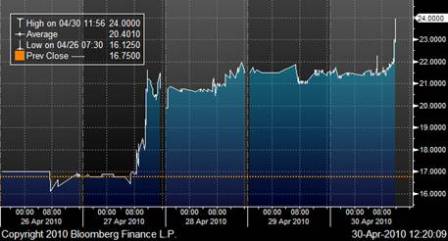
Result
2y spreads leading the way wider +5 to 23.5
Still cheap though
Press Release
Release Date: April 30, 2010
For immediate release
The Federal Reserve Board has approved amendments to Regulation D (Reserve Requirements of Depository Institutions) authorizing the Reserve Banks to offer term deposits to institutions that are eligible to receive earnings on their balances at Reserve Banks. These amendments incorporate public comments on the proposed amendments to Regulation D that were announced on December 28, 2009.
Term deposits, which are deposits with specified maturity dates that are held by eligible institutions at Reserve Banks, will be offered through a Term Deposit Facility (TDF). Term deposits will be one of several tools that the Federal Reserve could employ to drain reserves when policymakers judge that it is appropriate to begin moving to a less accommodative stance of monetary policy. The development of the TDF is a matter of prudent planning and has no implication for the near-term conduct of monetary policy.
The amendments approved by the Board are a necessary step in the implementation of the TDF. As noted in the attached Federal Register notice, the Federal Reserve anticipates that it will conduct small-value offerings of term deposits under the TDF in coming months to ensure the effective operation of the TDF and to help eligible institutions to become familiar with the term-deposit program. More detailed information about the structure and operation of the TDF, including information on the steps necessary for eligible institutions to participate in the program, will be provided later.
The amendments will be effective 30 days after publication in the Federal Register, which is expected shortly.
Yes, his causation is off on the less important point of the central bank eliminating opportunity costs when in fact market forces eliminate opportunity cost as they express indifference levels to central bank rate policies.
But apart from that it’s very well stated and what we’ve been saying all along, thanks!!! The highlighted part is especially on message and hopefully becomes common knowledge.
Jaime Caruana, General Manager of the BIS says ‘unconventional
measures’ do not increase lending, nor are inflationary:
In fact, bank lending is determined by banks’ willingness to grant
loans, based on perceived risk-return trade-offs, and by the demand
for those loans. An expansion of reserves over and above the level
demanded for precautionary purposes, and/or to satisfy any reserve
requirement, need not give banks more resources to expand lending.
Financing the change in the asset side of the central bank balance
sheet through reserves rather than some other short-term instrument
like central bank or Treasury bills only alters the composition of the
liquid assets of the banking system. As noted, the two are very close
substitutes. As a result, the impact of variations in this composition
on bank behaviour may not be substantial.
This can be seen another way. Recall that in order to finance balance
sheet policy through an expansion of reserves the central bank has to
eliminate the opportunity cost of holding them. In other words, it
must either pay interest on reserves at the positive overnight rate
that it wishes to target, or the overnight rate must fall to the
deposit facility floor (or zero). In effect, the central bank has to
make bank reserves sufficiently attractive compared with other liquid
assets. This makes them almost perfect substitutes, in particular for
other short-term government paper. Reserves become just another type
of liquid asset among many. And because they earn the market return,
reserves represent resources that are no more idle than holdings of
Treasury bills.
(…) What about the concern that large expansions in bank reserves
will lead to inflation – the second issue? No doubt more accommodative
financial conditions resulting from central bank lending and asset
purchases, insofar as they stimulate aggregate demand, can generate
inflationary pressures. But the point I would like to make here is
that there is no additional inflationary effect coming from an
increase in reserves per se. When bank reserves are expanded as part
of balance sheet policies, they should be viewed as simply another
form of liquid asset that is comparable to short-term government
paper. Thus funding balance sheet policies with reserves should be no
more inflationary than, for instance, the issuance of short-term
central bank bills.
(…) Ultimately, any inflationary concerns associated with
monetisation should be mainly attributed to the monetary authorities’
accommodating fiscal deficits by refraining from raising rates. In
other words, it is not so much the financing of government spending
per se – be it in the form of bank reserves or short-term sovereign
paper – that is inflationary, but its accommodation at inappropriately
low interest rates for too long a time. Critically, these two aspects
are generally lumped together in policy debates because the prevailing
paradigm has failed to distinguish changes in interest rate from
changes in the amount of bank reserves in the system. One is seen as
the dual of the other: more reserves imply lower interest rates. As I
explained earlier, this is not the case. While both the central bank’s
balance sheet size and the level of reserves will reflect an
accommodating policy, neither serves as a summary measure of the
stance of policy.
Excellent! About 6 months ago I handed out my ‘proposals,’ and we have made the below point on many occasions. Looks like real progress!
>
> (email exchange)
>
> On Sun, Apr 25, 2010 at 5:43 AM, Andrea wrote:
>
> It seems that Fed tries hard to see value in the interbank market but
> they are close to admit it has none?
>
FROM DIVORCING MONEY FROM MONETARY POLICY,
For example, market participants must monitor the
creditworthiness of borrowers. If the overnight market were
substantially less active, such monitoring may not take place on
a regular basis; this in turn could make borrowing even harder
for a bank that finds itself short of funds. Such monitoring may
also play a socially valuable role in exposing banks to market
discipline. It is important to bear in mind, however, that the
market for overnight loans of reserves differs from other
markets in fundamental ways. As we discussed, reserves are not
a commodity that is physically scarce; they can be costlessly
produced by the central bank from other risk-free assets.
Moreover, there is no role for socially useful price discovery
in this market, because the central bank’s objective is to set a
particular price. Weighing the costs and benefits of a reduction
in market activity is therefore a nontrivial task and an
important area for future research.
Sorry to see him leave.
He would have made a good Fed Chairman with his comprehensive understanding of monetary operations.
Hopefully he’s leaving to come back via an appointment that would put him on the FOMC.
Fed’s Madigan to Retire as Top Monetary Adviser
By Scott Lanman
April 12 (Bloomberg) — The Federal Reserve said Brian Madigan, the top staff adviser on interest-rate policy and an architect of the emergency-lending programs during the financial crisis, will retire later this year.
I guess he thinks the coming fiscal spending will close the output gap…
Cash Crunch Will Force Governments to Do Less
By Gerald F. Seib
April 9 (WSJ)
In a speech in Dallas, Mr. Bernanke bluntly noted that two giant fiscal waves were headed for the federal government, one atop the other. First comes the big deficit caused by the economic downturn. That will be followed immediately by ballooning costs for baby-boom retirees drawing Social Security and Medicare funds. “To avoid large and unsustainable budget deficits, the nation will ultimately have to choose among higher taxes, modifications to entitlement programs such as Social Security and Medicare, less spending on everything else from education to defense, or some combination of the above,” Mr. Bernanke
This from Q&A following Bernanke testimony:
Barney Frank: Do you think there is any realistic prospect of America’s defaulting on its debt in the near future?
Bernanke: Not unless Congress decides not to pay….
Latest tsy tips results indicate ‘contained inflation expectations’ as well.
I still have that nagging feeling that the 0 rate policy is highly deflationary and without some supply shock, like a spike in crude prices, prices in general will remain weak.
The weak core CPI and high unemployment rate continues to keep a lot of daylight between current conditions and the Fed’s dual mandate.
And the discount rate hike shows an ongoing lack of understanding of their own monetary arrangements.
Up until a few years ago the discount rate was kept a bit below the fed funds rate, which facilitated easier control of the fed funds rate.
This policy changed in a misguided effort to make the discount rate a ‘penalty’ rate which is a throwback to a fixed fx/gold standard paradigm and is entirely inapplicable with our current non convertible currency and floating fx.
All they’ve done by raising the discount rate is make it a bit more problematic to control the fed funds rate should technicals cause a system wide reserve deficiency.
Putting a penalty rate in for solvent banks (the FDIC is charged with removing insolvent banks) having funding difficulties is a throwback to the long discredited and illogical notion of using the liability side of banking for market discipline.
for more detail click here
Subject: Fed’s Lockhard on Reuters
Front end USTs getting very well bid on the back of these comments…
10:11 19Feb10 RTRS-FED’S LOCKHART –
FED PAYING CLOSE ATTENTION TO INFLATION EXPECATIONS
10:13 19Feb10 RTRS-
FED’S LOCKHART – MARKET BELIEF IN HIGH PROBABILITY OF RATE RISE THIS YEAR “OVERBLOWN”
10:14 19Feb10 RTRS-
FED’S LOCKHART – CURRENT POLICY STANCE MORE LIKELY TO EXTEND INTO NEXT YEAR
Maybe someday we will get an FOMC that actually understands reserve accounting and monetary operations, and maybe even recognizes the currency for the simple public monopoly that it is and moves away from ‘expectations theory’ as the reason for ‘inflation.’
But for now that seems to be only a very remote possibility.
“Why might households expect an increase in inflation? The amount of federal government debt held by the private sector has gone up by over 30 percent since the beginning of 2008. This debt can only be paid by tax collections or by the Federal Reserve’s debt monetization (that is, by printing dollars to pay off the obligations incurred by Congress). If households begin to expect that the latter will be true—even if it is not—their inflationary expectations will rise as well.”
