
*DJ Fed’s Fisher: All Programs Implemeted By Fed During Crisis Have Worked
*DJ Fed’s Fisher: There Is Plenty Of Liquidity To Drive Growth
*DJ Fed’s Fisher Sees Some Speculative Actions Driven By Too Much Liquidity
*DJ Fed’s Fisher: Congress Suffers From Addiction To Debt
Category Archives: Fed
Plosser on ‘removing accomodation’
Plosser Speach
Some comments below:
Let me begin by noting that the economy has gained significant strength and momentum since late last summer and seems to be on a much firmer foundation going forward. Consumer spending continues to expand at a reasonably robust pace, and business investment, particularly on equipment and software, continues to support overall growth. Labor market conditions are improving. Firms are adding to their payrolls, which will result in continued modest declines in the unemployment rate. The residential and commercial real estate sectors remain weak but appear to have stabilized. Nevertheless, I do not believe that weakness in these sectors will prevent a broader economic recovery. Indeed, the nonresidential real estate sector is likely to improve as the overall economy gains ground.
If this forecast is broadly accurate, then monetary policy will have to reverse course in the not-too-distant future and begin to remove the massive amount of accommodation it has supplied to the economy.
No it won’t. As the Fed’s own Kohn and Carpenter have stated, there is no ‘monetary channel’ from reserves to anything else.
Failure to do so in a timely manner could have serious consequences for inflation and economic stability in the future.
Not true.
But what matters is that pretty much the entire FOMC believes it to be true and will act accordingly.
Market participants also believe it to be true and shift portfolios accordingly.
To avoid this outcome, the Fed must confront at least two challenges. The first is selecting the appropriate time to begin unwinding the accommodation. The second is how to use the available tools to move monetary policy toward a more neutral stance over time.
Looks to me like the current situation- 2 years of very modest gdp growth, high unemployment that is forecast to fall only slowly, and very little signs of private credit expanding- is telling us policy is already relatively neutral, given the circumstances.
First, monetary policy should operate using the federal funds rate as its policy instrument. Because the Fed can now pay interest on reserves, monetary policy could use the interest rate on reserves (IOR) as its instrument, establishing a floor for rates and allow reserves to be supplied in an elastic manner.3 However, targeting the federal funds rate is more familiar to both the markets and policymakers than is an administered rate paid on reserves. To make the funds rate the primary policy instrument, the target federal funds rate would be set above the rate paid on reserves and below the discount or primary credit rate that banks pay when they borrow from the Fed.
This means the that at the margin the NY Fed has to keep the banks net borrowed to keep the fed funds rate above the floor, and net long to keep it below the ceiling.
Good luck and who cares if the rate paid on reserves equals the fund funds rate?
This operating framework is sometimes referred to as a corridor or channel system and is used by a number of other central banks around the world.4 I have argued elsewhere that our goal should be to operate with a corridor system instead of a floor system,
Yes, this greatly simplifies life for the NY Fed trading desk, especially if you allow fed funds to trade at the floor rate. The should have done it a long time ago, like most other CB’s in the world. And while they are at it, they should also drop reserve requirements, like Canada did a while back, and get rid of that anachronism. (I recall being at a monetary conference in Canada, where a senior monetary crank- sorry, I mean senior mainstream economist- was on a rant about how dropping reserve requirements to 0 was going to be hyper inflationary.)
in part because it constrains the size of the balance sheet while the floor system does not.
Like the salesman who went on after he made the sale and discredited himself. This last part again reveals is anachronistic, gold standard understanding of monetary operations.
The second element of the environment follows from the first. To ensure that the funds rate constitutes a viable policy instrument and thus is above the interest rate on reserves, the volume of reserves in the banking system must shrink to the point where the demand for reserves is consistent with the targeted funds rate. This will require a significant reduction in the size of the Fed’s balance sheet, with reserve balances falling by $1.4 trillion to $1.5 trillion to about $50 billion.
Yes, pretty much the problem I described above.
So why would the fed funds rate not be ‘a viable policy instrument’ if it equaled the rate of interest the Fed payed on reserves?
My proposed strategy involves raising rates and shrinking the balance sheet concurrently and tying the pace of asset sales to the pace and size of interest rate increases.8
The important thing here is not the wisdom of the policy, but that these statements are in fact what the FOMC is likely to be doing.
The first element of the plan to exit and normalize policy would be to move away from the zero bound and stop the reinvesting program and allow securities to run off as they mature. Thus, we would raise the interest paid on reserves from 25 basis points to 50 basis points and seek to achieve a funds rate of 50 basis points rather than the current range of 0 to 25 basis points.
This indicates the fed funds rate and the interest paid on reserves would be roughly equal, which makes sense operationally.
We would also announce that between each FOMC meeting, in addition to allowing assets to run off as they mature or are prepaid, we would sell an additional specified amount of assets. These “continuous sales,” plus the natural run-off, imply that the balance sheet, and thus reserves, would gradually shrink between each FOMC meeting on an ongoing basis.
Again, good to know what they plan on doing. And it seems this time around the all seem pretty much to be on the same page. At least so far.
Now the remaining question is whether the employment outlook will improve sufficiently and core inflation measures stabilize sufficiently in the FOMC’s comfort zone for them to begin ‘removing accommodation’ as they call it.
I’d suggest that could be by Q4 if not for the global bias towards ‘fiscal responsibility’ along with the inflation fighting going on in China which threatens to keep output gaps wide and employment low.
And at least so far price pressures are mainly from crude oil, which the Fed (rightly) considers a ‘relative value story’ and from food prices, which are closely related to fuel prices through various bio fuels and fertilizer inputs. Wages and unit labor costs remain subdued and with productivity relatively high there are, so far, no signs of ‘pass through’ from food and fuel prices to core measures.
The second element of the plan would be to announce that at each subsequent meeting the FOMC will, as usual, evaluate incoming data to determine if the interest rate on reserves and the funds rate should rise or not. Monetary policy should be conditional on the state of the economy and the outlook. If the funds rate and interest on excess reserves do not change, the balance sheet would continue to shrink slowly due to run-off and the continuous sales. On the other hand, if the FOMC decides to raise rates by 25 basis points, it would automatically trigger additional asset sales of a specified amount during the intermeeting period. This approach makes the pace of asset sales conditional on the state of the economy, just as the Fed’s interest rate decisions are. If it were necessary to raise the interest rate target more, say, by 50 basis points, because the economy was improving faster and inflation expectations were rising, then the pace of conditional sales would also be doubled during the intermeeting period.10
Dean Baker: Krugman Is Wrong: The United States Could Not End Up Like Greece
Krugman Is Wrong: The United States Could Not End Up Like Greece
By Dean Baker
March 25 — It does not happen often, but it does happen; I have to disagree with Paul Krugman this morning. In an otherwise excellent column criticizing the drive to austerity in the United States and elsewhere, Krugman comments:
“But couldn’t America still end up like Greece? Yes, of course. If investors decide that we’re a banana republic whose politicians can’t or won’t come to grips with long-term problems, they will indeed stop buying our debt.”
Actually this is not right for the simple reason that the United States has its own currency. This is important because even in the worst case scenario, where the deficit in United States spirals out of control, the crisis would not take the form of the crisis in Greece.
Yes, precisely!
Greece is like the state of Ohio. If Ohio has to borrow, it has no choice but to persuade investors to buy its debt. Unless Greece leaves the euro (an option that it probably should be considering, at least to improve its bargaining position), it must pay the rate of interest demanded by private investors or meet the conditions imposed by the European Union/IMF as part of a bailout.
However, because the United States has its own currency it would always have the option to buy its own debt. The Federal Reserve Board could in principle buy an unlimited amount of debt simply by printing more money. This could lead to a serious problem with inflation, but it would not put us in the Greek situation of having to go hat in hand before the bond vigilantes.
This is also true under current institutional arrangements.
However, with regards to inflation, for all practical purposes the fed purchasing us treasury securities vs selling them to the public is inconsequential.
This distinction is important for two reasons. First, the public should be aware that the Fed makes many of the most important political decisions affecting the economy. For example, if the Fed refused to buy the government’s debt even though interest rates had soared, this would be a very important political decision on the Fed’s part to deliberately leave the country at the mercy of the bond market vigilantes. This could be argued as good economic policy, but it is important that the public realize that such a decision would be deliberate policy, not an unalterable economic fact.
True! And, again, for all practical purposes the decision is inconsequential with regards to inflation.
The other reason why the specifics are important is because it provides a clearer framing of the nature of the potential problem created by the debt. The deficit hawks want us to believe that we could lose the confidence of private investors at any moment, therefore we cannot delay making the big cuts to Social Security and Medicare they are demanding. However if we have a clear view of the mechanisms involved, it is easy to see that there is zero truth to the deficit hawks’ story.
Agreed!
Suppose that the bond market vigilantes went wild tomorrow and demanded a 10 percent interest rate on 10-year Treasury bonds, even as there was no change in the fundamentals of the U.S. economy. In this situation, the Fed could simply step in and buy whatever bonds were needed to finance the budget deficit.
Correct.
And this would result in additional member bank reserve balances at the Fed, with the Fed voting on what interest is paid on those balances.
Does anyone believe that this would lead to inflation in the current economic situation? If so, then we should probably have the Fed step in and buy huge amounts of debt even if the bond market vigilantes don’t go on the warpath because the economy would benefit enormously from a somewhat higher rate of inflation. This would reduce the real interest rate that firms and individuals pay to borrow and also alleviate the debt burden faced by tens of millions of homeowners following the collapse of the housing bubble.
However not to forget that the Fed purchases also reduce interest income earned by the economy, as evidenced by the Fed’s ‘profits’ it turns over to the treasury.
The other part of the story is that the dollar would likely fall in this scenario. The deficit hawks warn us of a plunging dollar as part of their nightmare scenario. In fact, if we ever want to get more balanced trade and stop the borrowing from China that the deficit hawks complain about, then we need the dollar to fall. This is the mechanism for adjusting trade imbalances in a system of floating exchange rates. The United States borrows from China because of our trade deficit, not our budget deficit.
True, but with qualifications.
China didn’t start out with any dollars. They get their dollars by selling things to us. When they sell things to us and get paid they get a credit balance in what’s called their reserve account at the Fed.
What we then call borrowing from China- China buying US treasury securities- is nothing more than China shifting its dollar balances from its Fed reserve account to its Fed securities account.
And paying back China is nothing more than shifting balances from their securities account at the Fed to their reserve account at the Fed.
Which account China keeps its balances in is of no further economic consequence,
And poses no funding risk or debt burden to our grandchildren.
Nor does it follow that the US is in any way dependent on China for funding.
Nor is balanced per se trade desirable, as imports are real economic benefits and exports real economic costs.
This also puts the deficit hawks’ nightmare story in a clearer perspective. Ostensibly, the Obama administration has been pleading with China’s government to raise the value of its currency by 15 to 20 percent against the dollar. Can anyone believe that China would suddenly let the yuan rise by 40 percent, 50 percent, or even 60 percent against the dollar? Will the euro rise to be equal to 2 or even 3 dollars per euro?
And, with imports as real economic benefits and exports as real economic costs, in my humble opinion, the Obama administration is negotiating counter to our best interests.
Also, inflation is a continuous change in the value of the currency, and not a ‘one time’ shift which is generally what happens when currencies adjust.
This story is absurd on its face. The U.S. market for imports from these countries would vanish and our exports would suddenly be hyper-competitive in their home markets. As long as we maintain a reasonably healthy industrial base (yes, we still have one), our trading partners have more to fear from a free fall of the dollar than we do. In short, this another case of an empty water pistol pointed at our head.
The deficit hawks want to scare us with Greece in order to push their agenda of cutting Social Security, Medicare and other programs that benefit the poor and middle class. This is part of their larger agenda for upward redistribution of income.
We should be careful to not give their story one iota of credibility more than it deserves. By implying that the United States could ever be Greece, Krugman commits this sin.
Agreed!
Addendum: In response to the Krugman post, which I am not sure is intended as a response to me, I have no quarrel with the idea that large deficits could lead to a serious problem with inflation at a point where the economy is closer to full employment. My point is that the problem with the U.S. would be inflation, not high interest rates, unless the Fed were to decide to allow interest rates to rise as an alternative to higher inflation.
Agreed!
Nor would today’s size deficits necessarily mean inflation should we somehow get to full employment.
It all depends on the ‘demand leakages’ at the time.
This point is important because the deficit hawk story of the bond market vigilantes is irrelevant in either case. In the first case, where we have inflation because we are running large deficits when the economy is already at full employment, the problem is an economy that is running at above full employment levels of output. The bond market vigilantes are obviously irrelevant in this picture.
In the second case, where the Fed allows the bond market vigilantes to jack up interest rates even though the economy is below full employment, the problem is the Fed, not the bond market vigilantes.
We have to keep our eyes on the ball. The deficit hawks pushing the bond market vigilante story are making things up, as Sarah Pallin would say, their arguments do not deserve to be treated seriously.
Agreed.
They should be unceremoniously refutiated!
Reuters Insider Videos
UBS Says Faces LIBOR Manipulation Probe
As previously discussed, the US should outlaw the use of libor by its banking system.
It makes no sense to allow US dollar rate setting for our banks to be set overseas by the BBA.
Setting our banking system’s dollar rates is the Fed’s responsibility.
And, to further make the point, note the word ‘expect’ in this part from below:
“LIBOR is calculated daily by asking contributing banks the rate at which they expect term funding to be offered between prime banks at 11:00 am London time.”
See more of my proposals here.
UBS Says Faces LIBOR Manipulation Probe
March 16 (Reuters) — Swiss bank UBS said it had received subpoenas from U.S. and Japanese regulators regarding whether it made “improper attempts” to manipulate LIBOR rates, the benchmark price for interbank borrowing costs.
“UBS understands that the investigations focus on whether there were improper attempts by UBS, either acting on its own or together with others, to manipulate LIBOR rates at certain times,” the bank said in its annual report on Tuesday.
The Financial Times in its Wednesday edition said regulators, including Britain’s Financial Services Authority, are probing all 16 banks that help the British Bankers’ Association (BBA) set LIBOR rates.
In particular, they are investigating how LIBOR was set for U.S. dollars during 2006-2008, just before and after the financial crisis, the newspaper said, citing sources familiar with the probes.
UBS said it had received subpoenas from the U.S. SEC, Commodity Futures Trading Commission and Department of Justice regarding its submissions to the BBA. It has also been ordered to provide information to the Japan Financial Supervisory Agency concerning similar matters.
UBS said it was conducting an internal review and is cooperating with the investigations. It declined to provide any further details.
The SEC declined to comment.
BBA said LIBOR has a straightforward and transparent calculation method which excludes any rates that are significant outliers.
“We observe rigorous standards in our scrutiny and governance of the LIBOR mechanism, and work with the industry to ensure their continued full confidence in one of its most accurate and reliable benchmarks,” it said in a statement.
LIBOR is calculated daily by asking contributing banks the rate at which they expect term funding to be offered between prime banks at 11:00 am London time. A set number of the highest and lowest contributions are discarded and the remaining rates averaged.
QE and the term structure of rates
Background information first, answer later-
The Fed sets the fed funds target at their regular meetings, and lets the market then determine the term structure of rates.
That term structure of rates is therefore largely a function of anticipated future fed funds rate settings.
Then the Fed does QE- buys longer term securities at market prices- to try to bring longer term rates down, particularly mortgage rates.
But longer term rates don’t come down as much as hoped for.
Now to the point all this:
What the market place believes QE does, and not what QE actually does, is the same ‘force’ that largely determines the term structure of rates.
And so when the Fed does QE,
and the market place believes that QE will work to promote a strong economy and risk inflation,
the term structure of rates goes up in anticipation of higher fed funds rate settings by the Fed down the road.
And when the Fed ends QE,
that same market place then believes that support has been pulled from the economy,
the future is no longer as inflationary,
and the term structure of rates falls as fears of future fed funds hikes subside.
It doesn’t matter that the mainstream beliefs are wrong with regard to QE,
because the term structure of rates only reflects those same mainstream market place expectations, regardless of their actual validity.
And yes, this all highly problematic for a Fed trying to keep long rates down.
Employment/Population
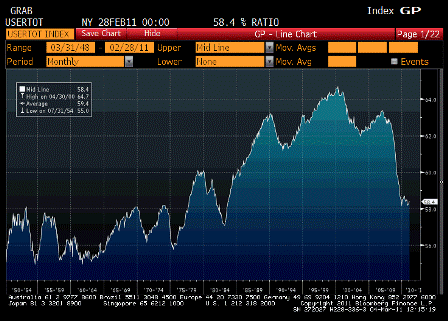
From Goldman: The household survey, however, was stronger than expected. In particular, the unemployment rate dropped another tenth (to 8.922%) due to a firm gain in employment (+250,000) and unchanged labor force participation (at 64.2%). The employment gain was also strong on a “payroll-adjusted” basis, up 342,000 on the month. The employment/population ratio remained unchanged at 58.4%. The decline in unemployment was broad based across different measures of unemployment; for example, the U6 unemployment rate, which counts marginally attached workers and those working part-time for economic reasons, declined by two tenths to 15.9%
With only 58.4% of the population employed it’s a stretch for the Fed or anyone else to declare victory.
Yes, there are some long term demographic changes.
Women entering the workforce probably drove this ratio higher,
and an aging population is probably going to drive it lower.
But we’re back to levels from before women entered the workforce.
Best I can tell, yes, there are signs of improvement, but overall it remains an economic disaster.

Karim writes:
- Data still weather impacted as 82k workers more than avg couldn’t work due to weather
- Unemployment rate falls to 8.92% from 9.05% as household survey employment rises 250k and labor force rises 60k
- Payrolls up 192k, with net revisions of +58k and private sector job gains of 222k (68k last month)
- Avg hourly earnings unch after 0.4% last month (and likely hard to read due to impact on hours worked from the weather)
- Index of aggregate hours up 0.2%
- Median duration of unemployment down from 21.8 to 21.2 weeks
- U6 measure down from 16.1% to 15.9%
- And the strongest indicator in this report was the Diffusion Index reaching its highest level since 1988, rising from 60.1 to 68.2 (this is like the ISM, measuring the breadth of industries adding jobs)
Bernanke/ISM
Bernanke qualifying a key phrase from 1mth ago.
Feb 3
Even so, with output growth likely to be moderate for awhile and with employers reportedly still reluctant to add to their payrolls, it will be several years before the unemployment rate has returned to a more normal level.
March 1
Even so, if the rate of economic growth remains moderate, as projected, it could be several years before the unemployment rate has returned to a more normal level. Indeed, FOMC participants generally see the unemployment rate still in the range of 7-1/2 to 8 percent at the end of 2012. Until we see a sustained period of stronger job creation, we cannot consider the recovery to be truly established.
Standard response on cmmdty prices: “the most likely outcome is that the recent rise in commodity prices will lead to, at most, a temporary and relatively modest increase in U.S. consumer price inflation–an outlook consistent with the projections of both FOMC participants and most private forecasters. That said, sustained rises in the prices of oil or other commodities would represent a threat both to economic growth and to overall price stability, particularly if they were to cause inflation expectations to become less well anchored.”
Karim writes:
ISM
- Encouraging news with index at its highest level since May 2004 and employment component highest since 1973
- Gap between orders and inventories remain wide
- Some strength in orders and shipments likely reflect inventory rebuild from huge Q4 drawdown vs entirely reflecting a change in demand
| ISM | Feb | Jan |
| Index | 61.4 | 60.8 |
| Prices paid | 82.0 | 81.5 |
| Production | 66.3 | 63.5 |
| New Orders | 68.0 | 67.8 |
| Backlog of orders | 59.0 | 58.0 |
| Supplier deliveries | 59.4 | 58.6 |
| Inventories | 48.8 | 52.4 |
| Customer inventories | 40.0 | 45.5 |
| Employment | 64.5 | 61.7 |
| Export Orders | 62.5 | 62.0 |
| Imports | 55.0 | 55.0 |
- “A continued weak dollar is increasing the cost of components purchased overseas. It is going to force us to increase our selling prices to our customers.” (Transportation Equipment)
- “We continue to see significant inflation across nearly every type of chemical raw material we purchase.” (Chemical Products)
- “Our plants are working 24/7 to meet production demands.” (Fabricated Metal Products)
- “Prices continue to rise, while business limps along at last year’s pace.” (Nonmetallic Mineral Products)
- “Overall demand is off 10 percent.” (Plastics & Rubber Products)
central bankers comment on QE
Recent statements regarding QE show at least some key Central Bankers have it right:
Don Kohn (Former FRB Vice Chair):”I know of no model that shows a transmission from bank reserves to inflation”.
Vitor Constancio (ECB Vice President): “The level of bank reserves hardly figures in banks lending decisions; the supply of credit outstanding is determined by banks’ perceptions of risk/reward trade-offs and demand for credit”.
Charlie Bean (Deputy Governor BOE): in response to a question about the famous Milton Friedman quote “Inflation is always and everywhere a monetary phenomenon”: “Inflation is not always and everywhere a monetary base phenomenon”:
Testimony from Chairman Bernanke
“If government debt and deficits were actually to grow at the pace envisioned, the economic and financial effects would be severe,” Federal Reserve Chairman Ben S. Bernanke told the House Budget Committee Feb. 9. “Sustained high rates of government borrowing would both drain funds away from private investment and increase our debt to foreigners, with adverse long-run effects on U.S. output, incomes, and standards of living.”