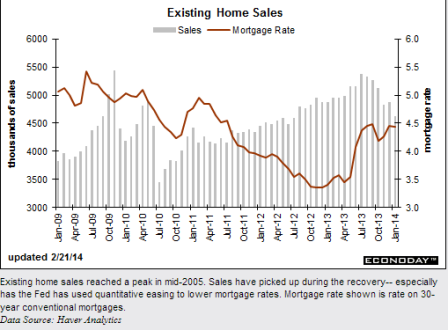
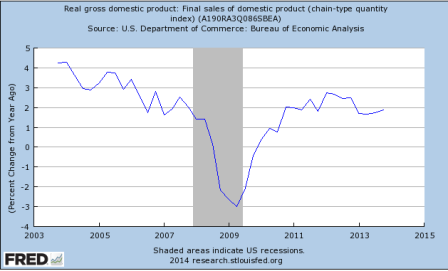
existing home sales chart, real final sales chart (pre weather)

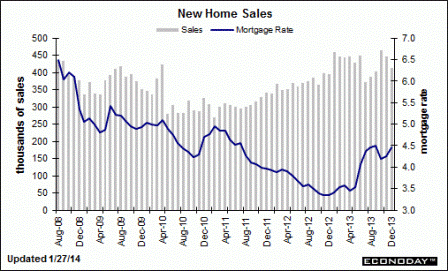
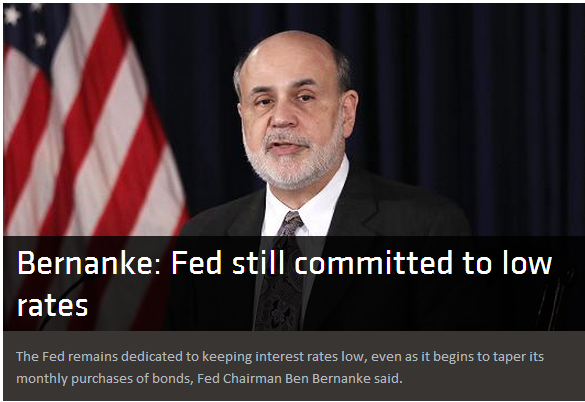
Yes, the Fed doesn’t like QE and wants to taper, but seems to me they don’t want mortgage rates this high either. They know the only way the market will ‘bring down rates’ is if the economic weakness persists. And they suspect it very well may persist unless rates come down.

Their remaining option is TIRT (term interest rate targeting) which has yet to be discussed.

Existing Home Sales

Highlights
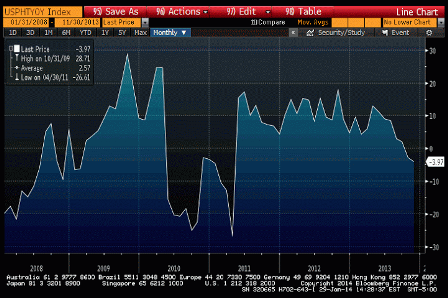
It’s more than just weather that’s clobbering the housing market. High prices and tight inventory aren’t helping either as existing home sales fell 5.1 percent in January to a 4.620 million annual rate. The year-on-year rate is also at minus 5.1 percent, a sharp contrast to the year-on-year median price which is up 10.7 percent.

Supply of homes relative to sales did rise to 4.9 months from 4.6 months but the improvement is tied mostly to the drop in sales. Prices did come down in the month but from already high levels with the median price down 4.5 percent to $188,900.

Weather was especially cold in January and no doubt contributed to the sales weakness, especially in the Midwest, where sales fell 7.1 percent in the month, and also the Northeast where the decline was 3.1 percent. But weather in California wasn’t a problem, yet sales in the West fell 7.3 percent which the National Association of Realtors points to as evidence of non-weather constraints.

Unattractive mortgage rates are another factor holding down sales. All cash buyers continue to hold up the market, accounting for 33 percent of all sales vs 32 percent in December. In contrast, first-time buyers, who are especially sensitive to the soft jobs market, continue to account for less sales, at 26 percent vs December’s 27 percent.

This is the 5th decline in the last 6 months for this series and lack of improvement in the jobs market, not to mention this month’s severe bout of heavy weather, point to more trouble for February. For the economy, the housing market needs to snap back sharply this spring. The Dow is showing little initial reaction to today’s report.

Full size image

Not exactly gang busters even before the weather reduced incomes.

And the bad weather it’s like hurricane sandy but without the insurance spending and federal relief spending.

Full size image
Fed Chair Yellen on fiscal

Good grief
:(

*YELLEN: IN 30 YEARS DEBT-TO-GDP RATIO WOULD BE UNSUSTAINABLE
*YELLEN: UNSUSTAINABLE DEFICITS HAVE NEGATIVE ECONOMIC IMPACT

From the speech:

“a long-term plan is needed to reduce deficits and slow the growth of federal debt”

And from 2010:

“In a nutshell, the problem is that, in the absence of significant policy changes, and under reasonable assumptions about economic growth, demographics, and medical costs, federal spending will rise significantly faster than federal tax revenues in coming years. As a result, if current policy settings are maintained, the budget will be on an unsustainable path, with the ratio of federal debt held by the public to national income rising rapidly.

A failure to address these fiscal challenges would expose the United States to serious economic costs and risks. A high and rising level of government debt relative to national income is likely to eventually put upward pressure on interest rates, thereby restraining capital formation, productivity, and economic growth. Indeed, once the economy has recovered from its downturn, fiscal deficits will crowd out private spending. Large fiscal deficits will also likely put upward pressure on our current account deficits with the rest of the world; the associated greater reliance on borrowing from abroad means that an increasing share of our future income will be required to make interest payments on federal debt held abroad, thereby reducing the amount of income available for domestic spending and investment. A large federal debt will also limit the ability and flexibility of policymakers to address future economic stresses and other emergencies, a risk that is underscored by the critical fiscal policy actions that were taken to buffer the effects of the recent recession and stabilize financial markets in the wake of the crisis. And a prolonged failure by policymakers to address America’s fiscal challenges could eventually undermine confidence in U.S. economic management.”

Posted in Fed

Fed is not swayed by any single number, Fisher tells CNBC

What about 2 consecutive numbers, like Dec and Jan jobs?
;)

Fed is not swayed by any single number, Fisher tells CNBC

February 7 (Reuters) — The U.S. central bank is unlikely to reverse its decision to wind down its bond-buying program in reaction to the weaker-than-expected January jobs report released on Friday. “I will say this about the rest of our committee, is they are not swayed by a single number. They are thoughtful people,” Dallas Federal Reserve Bank President Richard Fisher said on CNBC, referring to the Fed’s policy-setting Federal Open Market Committee.

The unconscious liberal

Macroeconomic Populism Returns

By Paul Krugman

February 1 (NYT) — Matthew Yglesias says what needs to be said about Argentina: theres no contradiction at all between saying that Argentina was right to follow heterodox policies in 2002, but it is wrong to be rejecting advice to curb deficits and control inflation now. I know some people find this hard to grasp, but the effects of economic policies, and the appropriate policies to follow, depend on circumstances.

Yes, unemployment- source of the greatest economic loss as well as a social tragedy and a crime against humanity, is always the evidence deficit spending is too low. There is no exception as a simple point of logic. The currency is a simple public monopoly, and the excess capacity we call unemployment- people looking to sell their labor in exchange for units of that currency- is necessarily a consequence of the monopolist restricting the supply of net financial assets.

I would add that we know what those circumstances are! Running deficits and printing lots of money are inflationary

Why the undefined ambiguous empty rhetoric?

and bad

What does ‘bad’ mean here? For example, there is no evidence that inflation rates at least up to 40% hurt real growth, and more likely help it. Politically, however, it may be ‘very bad’. But those are two different things.

in economies that are constrained by limited supply;

Limited supply of what? Labor? Hardly! In fact, full employment is even more critical, if that’s possible, when there are limited supplies of other resources. Wasn’t Rome built without electricity, oil, bulldozers, the IMF, etc. etc.? OK, it took more than a day, but it was built. There is always more to do than people to do it. Economically, unemployment is never appropriate policy.

they are good things when the problem is persistently inadequate demand.

Unemployment is the evidence of this ‘inadequate demand’ which is necessarily created by taxation, the ultimate source of all demand for a given currency. In fact, taxation functions first to create unemployment- people looking for work paid in that currency. That’s how govt provisions itself- it creates people looking for jobs with its taxation, then hires those unemployed its tax created. What sense does it make for govt to create more unemployed than it wants to hire??? Either hire the unemployed thus created, or lower the tax!!!!!!!!!!!!

Similarly, unemployment benefits probably lead to lower employment in a supply-constrained economy; they increase employment in a demand-constrained economy; and so on.

With more that needs to be done than there are people to do it, the economy isn’t supply constrained until full employment. And nominal unemployment benefits are about the level of prices, wages, and the distribution of income rather than the level of potential employment, etc.

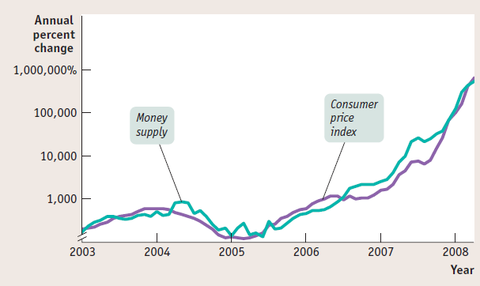
So sometimes the relationship and money looks like this, from the best economics principles textbook:

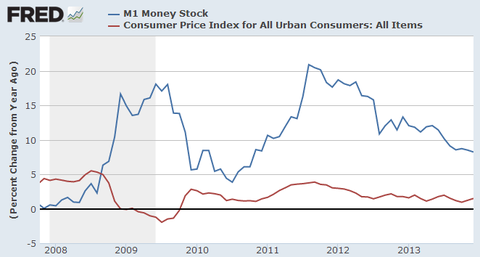
This is more about ‘inflation’ causing ‘money’ as defined.

But sometimes it looks like this:

This is more about partially defining ‘money’ as reserve account balances at the Fed but not securities account balances (tsy secs) at the Fed.

And just to repeat a point Ive made many times, those of us who understood IS-LM predicted in advance that the actions of the Bernanke Fed wouldnt be inflationary, while the other side of the debate was screaming debasement.

It’s not about ISLM, which is fixed fx analysis. It’s about recognizing that there is always precious little difference between balances in reserve accounts at the Fed and securities accounts at the Fed.

There’s something else to be said about Argentina and, it seems, Turkey namely, that were seeing a mini-revival of what Rudi Dornbusch and Sebastian Edwards long ago called macroeconomic populism. This involves, you might say, making the symmetrical error to that of people who think that running deficits and printing money always turns you into Zimbabwe; its the belief that the orthodox rules never apply. And its an equally severe mistake.

Unfortunately most of the ‘orthodox rules’ apply to the fixed fx policies in place when they were first stated, and not to today’s floating fx.

Its not a common mistake these days; a few years ago one would have said that only Venezuela was making the old mistakes, and even now its just a handful of countries. But it is a mistake, and we need to say so.

Yes, mistakes are being made by all of the headline economists and the global economy is paying the price.

Growing Pains

FLASH- Fed to taper another $10 billion

Maybe they are concerned about all the interest income they are removing from the economy?
;)

General comments:

For GDP to grow at 3% all the pieces have to ‘average’ 3% growth

And if anything is growing at a slower pace than last year, something else has to grow at a faster pace or GDP growth slows.

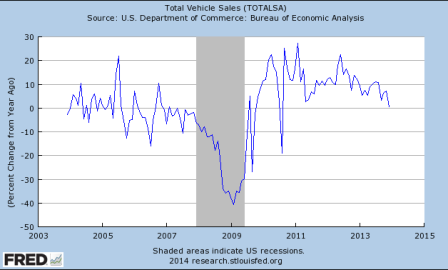
So the growth rate of car sales has slowed and is expected to slow further this year:

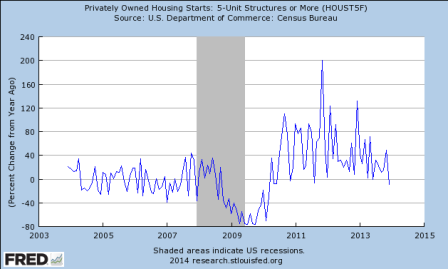
How about housing?

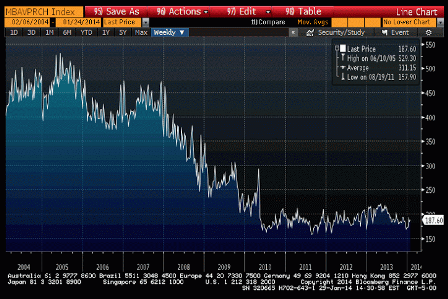
Pending home sales year over year change:

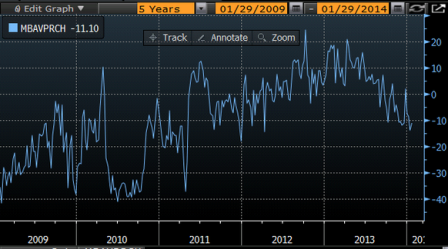
New mortgage applications to purchase homes:

Purchase apps year over year:

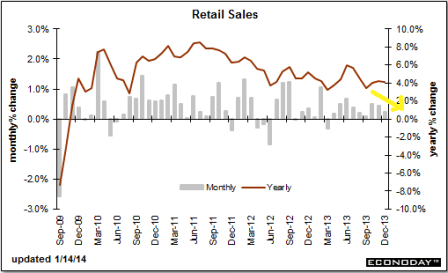
Retail sales growth has been generally slowing and has yet to show signs of increasing:

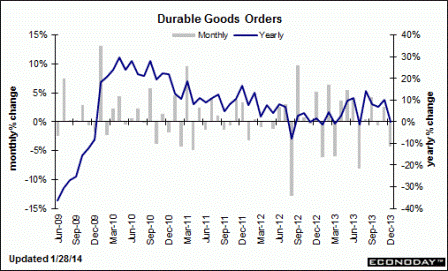
How about orders for durable goods?

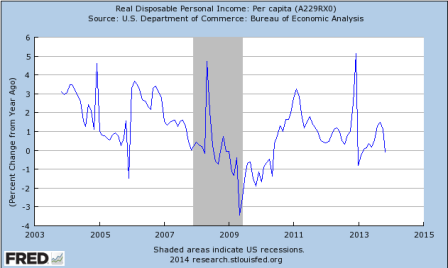
Is the income growth there to support higher levels of spending?

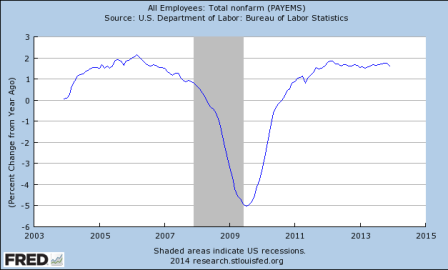
Is the growth rate of employment increasing?

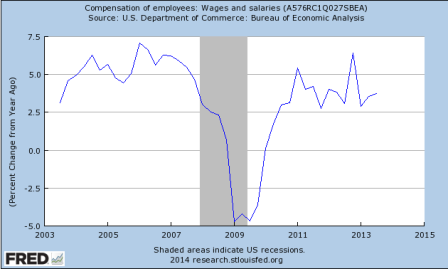
Compensation?

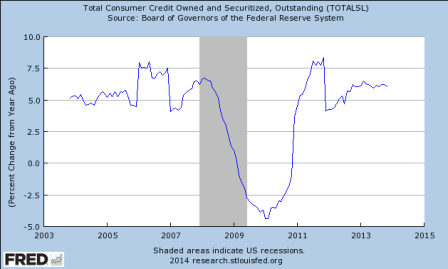
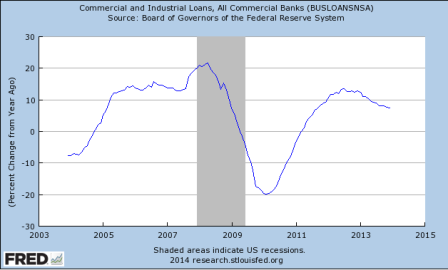
Maybe consumers are somehow borrowing to spend at a higher rate?

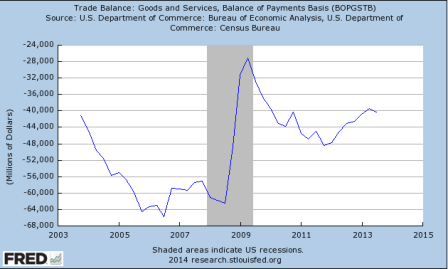
How about the foreign sector?

Well, it was helping, but we need the rate of change to increase to have more of an impact than last year. And with GDP around $17 trillion, last year’s rate of increase has to be exceed by about $7 billion/mo to add an additional .5 to GDP. And the substantial currency depreciation of the EM’s isn’t going to help any.

Just saying, something big needs to start growing a lot just to keep GDP growth positive?

So what happened to growth?
Private sector spending (including non residents) in excess of income may no longer be keeping up with the reduction in the federal govt’s spending in excess of its income (deficit spending spending)?

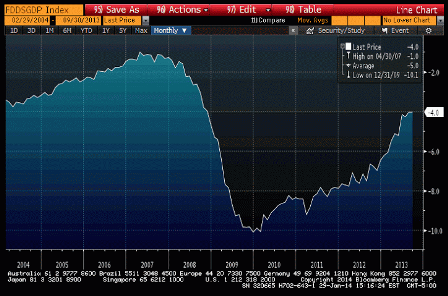
Maybe the federal deficit is too low for current credit and financial conditions?

Deficit as a % of GDP through Sept 13. It’s even lower currently:

Emerging market currencies

Seems no one is pointing out how this is all looking a lot like ‘catch up’ vs last year’s yen move?

As previously discussed, the proactive yen move from under 80 to over 100 vs the dollar- a 30% or so pay cut for domestic workers in terms of prices of imports- was an internationally deflationary impulse.

It’s called ‘currency wars’ with the exporters pushing hard on their govts to do whatever it takes to keep them ‘competitive’. And all, at least to me, shamelessly thinly disguised as anything but. And, in fact, it’s not ‘wrong’ to call it ‘dollar appreciation’ rather than EM currency depreciation given the deflationary bias of US (and EU) fiscal and monetary (rate cuts/QE reduce interest income for the economy) policy.

This is a highly deflationary force for the US (and EU) via import prices and lost export pricing power, also hurting earnings translations and, in general weakening US domestic demand, as increased domestic oil output doesn’t reduce net imports as much as would otherwise be the case.

And while I’m not saying energy independence is a ‘bad thing’ note that the UK has been largely ‘energy independent’ for quite a while, so there’s obviously more to it.

The optimal policy move for the US is fiscal relaxation- like my proposed FICA suspension- to get us back to full employment and optimize our real terms of trade. (and not to forget the federally funded transition job for anyone willing and able to work to facilitate the transition from unemployment to private sector employment as the economy booms).

But unfortunately Congress is going the other way and making it all that much worse.

Emerging market currencies take a battering

By Katrina Bishop

January 24 (CNBC) — Emerging market currencies continued to take a beating on Friday — with Turkey’s lira hitting a new record low against the dollar yet again — amid growing concerns about the U.S. Federal Reserve’s monetary guidance.

On Friday, the dollar strengthened to 2.3084 against Turkey’s currency. Investors also piled out of the South African rand and Argentina’s peso, and both the Indian rupee and the Indonesian rupiah fell to two-week lows against the dollar. Meanwhile, the Australian dollar fell to $0.8681 – its lowest level in three-and-a-half years.

“The market is in panic mode. We have huge psychological fear that is going to emerging markets, despite a global environment that hasn’t changed that much,” Benoit Anne, head of global emerging market strategy at Societe Generale, told CNBC.

“My bias at this stage — although it’s a bold one — is that this is all about the credibility of the Fed with respect to its forward guidance. This fear that the Fed is going to tighten quicker than expected is translating into emerging markets.”

The U.S. central bank has promised that it will not raise interest rates until unemployment hits 6.5 percent – but some analysts are concerned that rate hikes could come sooner than expected.

U.S. monetary policy has always had a significant on emerging markets, and the Fed’s bond-buying program boosted risk sentiment, causing investors to turn their back on so-called “safe havens” and pile into assets seen as riskier – such as emerging market currencies.

Speculation of Fed tapering in 2013 hit emerging markets hard, with currencies including India, Turkey, Russia and Brazil coming under intense pressure in 2013.
But Anne added these recent moves were likely to be more temporary.

“It’s a matter of weeks rather than the whole year 2014 as a total write off for emerging markets,” he said. “Although it will take the Fed re-establishing its credibility towards forward guidance before we see respite in emerging markets.”

Full Interview, Econ Focus, John Cochrane – Federal Reserve Bank of Richmond

University of Chicago going MMT?

If you know him, point out that the micro foundation is the currency itself is a public monopoly, and all the implications thereof, particularly the idea that monopolists are inherently ‘price setters’ rather than ‘price takers’, and that unemployment as defined is necessarily the evidence that Federal spending isn’t sufficient to cover the need to pay taxes and desires to net save, etc. etc.

And direct him to my book and website, thanks!
;)

Econ Focus