markets looking grim

>   
>   (email exchange)
>   
>   On Tue, Aug 24, 2010 at 8:32 AM, Seth wrote:
>   
>   stocks look bad
>   looks like another panic
>   

It doesn’t look good technically.

Must be coming out of europe with gold up/euro down dynamic, etc.

Insiders there must be bailing.

Maybe they know something we don’t, or maybe they are wrong.

History is no help as in the past it’s been both.

Austerity is trimming growth there a bit around the edges, but deficits remain reasonably high, so GDP’s are probably at least muddling through, with overall growth probably positive.

The ECB keeps the short term funding channels open for the member nations, but that may not be fully appreciated yet.

On a mark to market basis bank capital is probably below requirements, and they may not realize that doesn’t have to matter to the real economy for as long as the ECB continues to fund them.

Lower crude oil prices support consumption of other things. With US crude oil product consumption up and Saudi output rising, demand must be ok. Maybe Saudis are worried and want lower prices to help world growth as well. Hard to ever say what they are actually up to. They may see the Iraqi production coming on stream and are trying to engineer an increase in demand. Again, no way to tell what they are up to.

The lower 10 year rates reflects expectations of ‘low for longer’ from the Fed due to high unemployment and falling rates of inflation as measured by the Fed. And the possibility of more QE that could flatten the curve further.

There is also the notion that there’s nothing left that the Fed can do of any consequence regarding aggregate demand, and Congress thinks it’s run out of money, which means flying without a net. That increases the weight of the downside in the balance of risks.

If markets and Congress knew that fiscal policy had no nominal limit and deficit spending was not dependent on being able to borrow from the likes of China to be paid by our grandchildren, the balance of risks would be viewed very differently. But they don’t know that.

With the elections coming and California reverting to vouchers again, the time is right for my per capita revenue sharing. But it’s not even a consideration.

Q3 and Q4 GDP estimates are looking more like 1.5%, and Q2 looks to be revised down toward 1% Friday. Not a double dip but no drop in unemployment either as productivity might be at least that high. That’s worse politically than it is for equities, and adds support for a ‘second stimulus’ type of reaction. But that’s way down the road. More likely it causes most of the expiring tax cuts to be extended.

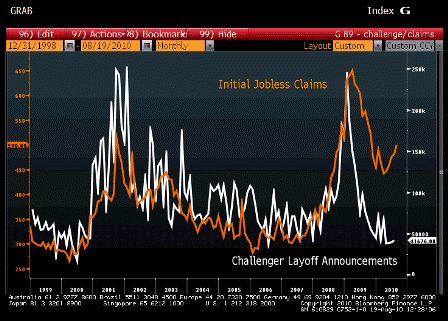
Thursday’s claims can make a big difference as well. The jump to 500,000 last week added an element of fear internationally.

Also, in thin summer markets technicals often cause exaggerated moves. Volume is very low, and a given size buying or selling causes larger moves to find someone willing to take the other side, and momentum type traders can easily overwhelm investors.

Robert Reich’s article

Forget a Double Dip. We’re Still in One Long Big Dipper.

By Robert Reich

August 14 — It’s nonsense to think of the economy heading downward again into a double dip when most Americans never emerged from the first dip. We’re still in one long Big Dipper.

More people are out of work today than they were last year, counting everyone too discouraged even to look for work. The number of workers filing new claims for jobless benefits rose last week to highest level since February. Not counting temporary census workers, a total of only 12,000 net new private and public jobs were created in July — when 125,000 are needed each month just to keep up with growth in the population of people who want and need to work.

Not since the government began to measure the ups and downs of the busines cycle has such a deep recession been followed by such anemic job growth. Jobs came back at a faster pace even in March 1933 after the economy started to “recover” from the depths of the Great Depression. Of course, that job growth didn’t last long. That recovery wasn’t really a recovery at all. The Great Depression continued. And that’s exactly my point. The Great Recession continues.

Even investors are beginning to see reality. Starting in February the stock market rallied because corporate profits were rising briskly. Investors didn’t mind that profits were coming from payroll cuts, foreign sales, and gimmicks like share buy-backs — none of which could be sustained over the long term. But the rally died in April when investors began to see how paper-thin these profits actually were. And now the stock market is back to where it was at the start of the year.

What to do? First, don’t listen to Wall Street and the right.

Forget the Neo-Hoover deficit hawks who day we have to cut government spending and trim upcoming deficits. We didn’t get into this mess and aren’t remaining in it because of budget deficits. In fact, the only way to reduce long-term deficits is to restore jobs and growth so government revenues rise and expenses like unemployment insurance drop.

There you go, Bob, reinforcing the myth that getting long term deficits down has value.
That makes you part of the problem, and not part of the answer.

Ignore the government haters who say we have to void or delay upcoming regulations of Wall Street and big business. We got here because Wall Street went bonkers, the housing bubble burst, and the middle class couldn’t continue to spend becuase their health-care bills were soaring and their pay was stagnating. New regulations of Wall Street and big business are necessary to avoid a repeat.

And don’t believe the supply-siders who say we have to extend the Bush tax cuts for the wealthy. Because the wealthy save rather than spend most of their incomes,

If you believe this, and understand taxing functions to regulate aggregate demand, why would you care if their taxes went up or not? Just like getting them angry?

extending their tax cut won’t do squat. And restoring their marginal tax rate to what it was under Bill Clinton won’t harm the economy. The Clinton years had the best sustained economy in American history.

The central problem is lack of demand — and that’s what has to be tackled.

Right! Which will eventually come back. The deficits are high enough for that. But there’s nothing to be gained by waiting around with maybe 20% real unemployment for private credit expansion to kick in like it did in the 90’s.

Three of the four sources of demand have stopped working. (1) Consumers can’t and won’t buy because they’re still under a huge debt load, can’t get more credit, are afraid of losing their jobs (or already have), depend on two wage earners at least one of whom is working part-time and pulling in less, or have to save. (2) Businesses won’t invest and spend on creating more jobs if they don’t see consumers willing to buy more.

Agreed on those two!

(3) Exports are stalled because the dollar is so high they cost too much, much of the rest of the world is still struggling with recession, and American firms can make things for sale abroad more cheaply abroad.

That’s a good thing- means we can have even lower taxes to sustain domestic demand and be able to buy all we can produce at full employment plus whatever the world wants to net sell to us.

That leaves only one remaining source of demand — government. We need a giant jobs program to hire people and put money in their pockets that they’ll spend and thereby create more jobs. Put ideology aside and recognize this fact. If it makes you more comfortable call it the National Defense Jobs Act. Call it the WPA. Call it Chopped Liver. Whatever, we have to get the great army of the unemployed and underemployed working again.

How about my $8/hr transition job proposal?

Also: Put more money in consumer’s wallets by eliminating payroll taxes on the first $20K of income (and make it up by applying payroll taxes to incomes over $250K.)

Why not just suspend FICA taxes entirely?

What are you afraid of?

The federal deficit?

Also: Get more hiring by giving the states and locales interest-free loans — so they can rehire all the teachers, fire fighters, police officers, and sanitation workers they’ve fired — to be repaid when their state employment rates hit 5 percent or below.

Why not simple federal revenue distributions on a per capita basis to make it fair?

What are you afraid of?

The federal deficit?

Also: Get more credit by having the Fed return to “quantitative easing” — expanding the money supply by purchasing mortgage-backed and other types of securities.

And you don’t have a clue on how monetary operations and reserve accounting work.
Otherwise you’d know this does nothing of macro consequence except take more interest income out of the private sector and shift a bit of interest from savers to borrowers.

If we let the deficit hawks and government haters dominate this debate, as they have, the Big Dipper will continue for years. The Great Depression lasted twelve.

If you’d get up to speed on monetary operations and stop supporting the deficit hawks, the true doves might have a fighting chance.

If any of you have Bob’s email address please forward this to him, thanks!

Lowe’s misses, but sales and earnings rise

Negative headline for a slight miss, and 3.8% top line growth and double digit earnings growth year over year.

And that is in Q2 where GDP growth was probably only 1% or so, and still looking a bit higher for Q3, supported by ongoing 8%+ federal budget deficits.

Not a good economy for sure, as shockingly high unemployment continues and the federal govt does nothing to further support aggregate demand, because they all believe the myth that the federal govt has run out of money and in order to spend have to borrow from the likes of China and leave the debts for our children to pay back.

Lowe’s results miss estimates

August 16th (Reuters) — Home improvement chain Lowe’s Cos missed quarterly profit and sales estimates as benefits from the homebuyer tax credit and cash for appliances programs waned.

Net income rose to $832 million, or 58 cents a share, in the second quarter ended July 30 from $759 million, or 51 cents a share, a year earlier.

Analysts on average were expecting 59 cents a share, according to Thomson Reuters I/B/E/S.

Sales rose 3.8 percent to $14.36 billion, but missed the average estimate of $14.52 billion.

Trade-Q2 GDP


Karim writes:

  • Real trade balance widens from -46bn in May to -54bn in June
  • Exports down 1.3% but imports up 3%
  • Even though civilian aircraft imports up 53% (after -49% prior month), imports up across the board
  • Consumer goods imports up 7.8% and capital goods up 1.2%
  • Even though the import data suggests final demand is holding up well, the final Q2 GDP print wont be pretty
  • Wholesale inventory data yesterday and trade data today were worse than initial BEA estimates for Q2 GDP
  • Headline GDP likely to be revised from initial estimate of 2.4% to somewhere in 1-1.5%. But final private demand may actually be revised up.

Yes, Q2 GDP to be revised down, but it’s been down. Q2 is history. Corporate earnings were based on the actual numbers- sales, costs, profits.

In other words, we know what the S&P were able to earn even with very modest headline GDP growth.

The higher final demand is also at least sustainable.
The relatively large and ongoing fiscal deficit that added that much income and savings to the non govt sectors allowed for the higher final demand AND higher savings.

While the QE from the Fed does nothing beyond causing term rates to be marginally lower than other wise, it does add some support for asset prices via implied discount rates.

As discussed earlier this year, markets are figuring out that the economy is flying without a net. All the Fed can do is alter interest rates which, with each passing day since the recession began, has been shown to not be able to support output and employment, or even prices and lending. (Just like Japan has shown for going on 20 years.)

And a Congress and Administration that thinks it’s run out of money and is dependent on borrowing and leaving the bill to our grand children to be able to spend is unlikely to provide meaningful fiscal adjustments to support aggregate demand.

So we muddle through with unthinkably high levels of unemployment and modest GDP growth waiting for an increase in private sector demand to kick in via credit expansion from the usual channels- cars and housing.

The risk to growth is now primarily proactive fiscal consolidation- spending cuts and/or tax hikes- in advance of private sector credit expansion. So far I haven’t seen anything meaningful enough to be of consequence. But the anti deficit rhetoric is certainly there, counterbalanced to some degree by the call for jobs.

So it remains a pretty good equity environment but a very ugly political environment.

Payrolls


Karim writes:

Not a game changer in my view and doesn’t compel the Fed to change course next week.

Private sector gradually churning out jobs; hours, wages, and diffusion index ok.

  • Private payrolls up 71k after avg of 41k of prior 2mths but well off highs of 200k avg of Feb and Mar
  • UE rate stays at 9.5%
  • Hours up 0.3% and wages up 0.2%
  • Diffusion index up to 55.6 from 55.2
  • Median duration of unemployment down from 25.5 to 22.2
  • U6 measure unch at 16.5%
  • Job growth accelerates in manufacturing and retail; weakens in temp services and leisure/hospitality

Yes, which means it remains a good market for stocks.

High unemployment is good for cost control and helps keep the Fed on hold. And 0 rates remain a deflationary influence as well.

Top line growth is modestly positive growing by productivity increases plus some hours and employment gains.

Earnings trend remains positive with productivity gains, some top line growth, and a loose labor market.

All supported by a federal deficit that still exceeds 8% of gdp.

Tough political environment with most of the real wealth going to the top as unemployment remains near the highs.

Stockman’s ‘Four Deformations of the Apocalypse’

Four Deformations of the Apocalypse

By David Stockman

July 31 (NYT) — If there were such a thing as Chapter 11 for politicians, the Republican push to extend the unaffordable Bush tax cuts would amount to a bankruptcy filing. The nation’s public debt — if honestly reckoned to include municipal bonds and the $7 trillion of new deficits baked into the cake through 2015 — will soon reach $18 trillion. That’s a Greece-scale 120 percent of gross domestic product, and fairly screams out for austerity and sacrifice. It is therefore unseemly for the Senate minority leader, Mitch McConnell, to insist that the nation’s wealthiest taxpayers be spared even a three-percentage-point rate increase.

Yet another ‘expert’ with fear mongering with ‘the US is the next Greece’ nonsense. So much for whatever positives may be left of his legacy.

More fundamentally, Mr. McConnell’s stand puts the lie to the Republican pretense that its new monetarist and supply-side doctrines are rooted in its traditional financial philosophy. Republicans used to believe that prosperity depended upon the regular balancing of accounts — in government, in international trade, on the ledgers of central banks and in the financial affairs of private households and businesses, too. But the new catechism, as practiced by Republican policymakers for decades now, has amounted to little more than money printing and deficit finance — vulgar Keynesianism robed in the ideological vestments of the prosperous classes.

At least they are practical enough to add to aggregate demand when needed.
Does anyone think there is an excess of demand that calls for a tax hike?
Any call for a tax hike on ‘fairness’ should be ‘paid for’ with at least an offsetting tax cut somewhere.

This approach has not simply made a mockery of traditional party ideals. It has also led to the serial financial bubbles and Wall Street depredations that have crippled our economy. More specifically, the new policy doctrines have caused four great deformations of the national economy, and modern Republicans have turned a blind eye to each one. The first of these started when the Nixon administration defaulted on American obligations under the 1944 Bretton Woods agreement to balance our accounts with the world. Now, since we have lived beyond our means as a nation for nearly 40 years, our cumulative current-account deficit — the combined shortfall on our trade in goods, services and income — has reached nearly $8 trillion. That’s borrowed prosperity on an epic scale.

That’s been adding to our real terms of trade and standard of living on an epic scale, and, ironically, the rest of the world is fighting to continue it while we are pressing to end it. Go figure!

It is also an outcome that Milton Friedman said could never happen when, in 1971, he persuaded President Nixon to unleash on the world paper dollars no longer redeemable in gold or other fixed monetary reserves. Just let the free market set currency exchange rates, he said, and trade deficits will self-correct.

He was right. It continuously self corrects to reflect rest of world savings desires of $US financial assets.

It may be true that governments, because they intervene in foreign exchange markets, have never completely allowed their currencies to float freely. But that does not absolve Friedman’s $8 trillion error. Once relieved of the discipline of defending a fixed value for their currencies, politicians the world over were free to cheapen their money and disregard their neighbors.

Yes, to our advantage!

In fact, since chronic current-account deficits result from a nation spending more than it earns, stringent domestic belt-tightening is the only cure.

Leave it to Dave to promote a cure for prosperity.

When the dollar was tied to fixed exchange rates, politicians were willing to administer the needed castor oil, because the alternative was to make up for the trade shortfall by paying out reserves, and this would cause immediate economic pain — from high interest rates, for example. But now there is no discipline, only global monetary chaos as foreign central banks run their own printing presses at ever faster speeds to sop up the tidal wave of dollars coming from the Federal Reserve.

It’s not from the Fed, Dave, it’s from the Treasury deficit spending and private deficit spending.

The second unhappy change in the American economy has been the extraordinary growth of our public debt. In 1970 it was just 40 percent of gross domestic product, or about $425 billion. When it reaches $18 trillion, it will be 40 times greater than in 1970. This debt explosion has resulted not from big spending by the Democrats, but instead the Republican Party’s embrace, about three decades ago, of the insidious doctrine that deficits don’t matter if they result from tax cuts.

Public sector deficits = non govt savings of those financial assets. And the unemployment rate and inflation rate are telling us federal deficits are too small to provide the savings demanded by the rest of us.

In 1981, traditional Republicans supported tax cuts, matched by spending cuts, to offset the way inflation was pushing many taxpayers into higher brackets and to spur investment. The Reagan administration’s hastily prepared fiscal blueprint, however, was no match for the primordial forces — the welfare state and the warfare state — that drive the federal spending machine. Soon, the neocons were pushing the military budget skyward. And the Republicans on Capitol Hill who were supposed to cut spending exempted from the knife most of the domestic budget — entitlements, farm subsidies, education, water projects. But in the end it was a new cadre of ideological tax-cutters who killed the Republicans’ fiscal religion.

And over the next 10 years inflation came down from over 12% to 3%, even with all the deficit spending because savings desires were even higher, and continue to grow geometrically due to tax advantaged pension contributions, etc.

Through the 1984 election, the old guard earnestly tried to control the deficit, rolling back about 40 percent of the original Reagan tax cuts. But when, in the following years, the Federal Reserve chairman, Paul Volcker, finally crushed inflation,

Volcker did not crush inflation. If anything, his high rates added to business costs and unearned income long after inflation turned down due to positive supply shocks in the energy markets, helped by the dereg of natural gas in 1978 that did the lion’s share of cutting the demand for crude for electricity generation.

enabling a solid economic rebound, the new tax-cutters not only claimed victory for their supply-side strategy but hooked Republicans for good on the delusion that the economy will outgrow the deficit if plied with enough tax cuts. By fiscal year 2009, the tax-cutters had reduced federal revenues to 15 percent of gross domestic product, lower than they had been since the 1940s. Then, after rarely vetoing a budget bill and engaging in two unfinanced foreign military adventures, George W. Bush surrendered on domestic spending cuts, too — signing into law $420 billion in non-defense appropriations, a 65 percent gain from the $260 billion he had inherited eight years earlier. Republicans thus joined the Democrats in a shameless embrace of a free-lunch fiscal policy.

Not my first choice for Federal spending, but certainly did the trick of turning the economy in 2003.

The third ominous change in the American economy has been the vast, unproductive expansion of our financial sector. Here, Republicans have been oblivious to the grave danger of flooding financial markets with freely printed money and, at the same time, removing traditional restrictions on leverage and speculation. As a result, the combined assets of conventional banks and the so-called shadow banking system (including investment banks and finance companies) grew from a mere $500 billion in 1970 to $30 trillion by September 2008.

The real problem with the financial sector is that it preys on the real economy with both a massive brain drain and a drain of other real resources as well.

But the trillion-dollar conglomerates that inhabit this new financial world are not free enterprises. They are rather wards of the state, extracting billions from the economy with a lot of pointless speculation in stocks, bonds, commodities and derivatives. They could never have survived, much less thrived, if their deposits had not been government-guaranteed and if they hadn’t been able to obtain virtually free money from the Fed’s discount window to cover their bad bets.

They didn’t get free money to cover their bad debts. All losses were deducted from shareholder value. Some banks lost all shareholder funds and were liquidated or sold (with the FDIC realizing losses after the shareholders were wiped out)
Functionally, tarp was regulatory forbearance, not a federal expenditure.

The fourth destructive change has been the hollowing out of the larger American economy. Having lived beyond our means for decades by borrowing heavily from abroad, we have steadily sent jobs and production offshore. In the past decade, the number of high-value jobs in goods production and in service categories like trade, transportation, information technology and the professions has shrunk by 12 percent, to 68 million from 77 million. The only reason we have not experienced a severe reduction in nonfarm payrolls since 2000 is that there has been a gain in low-paying, often part-time positions in places like bars, hotels and nursing homes.

Not true. The trade deficit is an enormous benefit. For a given size govt, it allows for lower taxes/higher deficits so Americans can have enough spending power to buy both all we can produce at full employment plus whatever the rest of the world wants to sell us. In 1999/2000, unemployment fell below 3.8%, even as the trade deficit soared to $380 billion.

It is not surprising, then, that during the last bubble (from 2002 to 2006) the top 1 percent of Americans — paid mainly from the Wall Street casino — received two-thirds of the gain in national income, while the bottom 90 percent — mainly dependent on Main Street’s shrinking economy — got only 12 percent. This growing wealth gap is not the market’s fault. It’s the decaying fruit of bad economic policy.

Agreed!!! However this has nothing to do with the rest of what he’s been droning on about. In fact, higher deficits are usually result in stronger economies which are associated with lower income inequality.

The day of national reckoning has arrived. We will not have a conventional business recovery now, but rather a long hangover of debt liquidation and downsizing — as suggested by last week’s news that the national economy grew at an anemic annual rate of 2.4 percent in the second quarter. Under these circumstances, it’s a pity that the modern Republican Party offers the American people an irrelevant platform of recycled Keynesianism when the old approach — balanced budgets, sound money and financial discipline — is needed more than ever.

No, we need a full payroll tax holiday, $500 per capita revenue sharing for the states, and an $8 transition job for anyone willing and able to work.

David Stockman, a director of the Office of Management and Budget under President Ronald Reagan, is working on a book about the financial crisis.

Latest Press Release

Warren Mosler Applauds the Senate for Passing Urgently Needed State
Funding and Urges the House to do Same


Independent candidate for Christopher Dodd’s CT Senate seat and economist specializing in monetary operations urges swift passage of aid to avoid job losses and fiscal distress


Waterbury, CT – August 5, 2010 – Warren Mosler, Independent candidate for Christopher Dodd’s Connecticut Senate seat and economist specializing in monetary operations today applauded members of the U.S. Senate for moving critical State Funding forward and urges members of the House to support this effort to alleviate the strain on state budgets when they reconvene next week. The Senate’s plan would allocate $16.1 billion for Medicaid and an additional $10 billion to help avert teacher layoffs. One of Mosler’s proposals to fix the economy is an unrestricted Federal distribution of $500 per capita to each state government to help them cope with the shortfalls created by the recession. “While this bill falls substantially short of my proposal, it is a step forward. That the U.S. Senate had previously failed to pass such a critical bill because it would add to the deficit only makes it clear that many lawmakers do not know how the U.S. monetary system works,” Mosler asserted. “Destroying even more jobs by forcing states to lay off teachers and raise taxes is the last thing they should be doing in this economy. Unfortunately, Congress acts as if we were still hamstrung by the gold standard.”

Warren Mosler, based upon his 37 years of successful banking and finance experience and with the support of many highly regarded economists, states that it is an operational fact (not theory) that today’s Federal spending is not constrained by revenue and, therefore, “pay as you go” is unnecessary and completely misses the point. Any government with its own non-convertible currency with a floating exchange rate that spends and borrows strictly in its own currency cannot become insolvent. “Everyone in Fed operations knows that Congress and the administration have it wrong. As Chairman Bernanke publicly stated, all Federal spending is done simply by marking up numbers in bank accounts with its computer” As Mosler explains, “The government can’t run out of money. It doesn’t get anything real when it taxes and doesn’t give anything real when it spends. There is no gold coin that goes into a bucket at the Fed when you are taxed and the government doesn’t hammer a gold coin into its computer when it spends. The US can’t possibly be the next Greece, because that nation no longer issues its own currency while the U.S. still does.” The people of Connecticut and the people of the United States deserve to have a voice of true knowledge and experience shaping the debate about our economic future, not the ill-informed voices of partisan, ideological bickering that have gotten us to where we are today. Warren’s in-depth knowledge of even the most minute aspects of the economy and monetary system make him uniquely qualified to provide the guidance and leadership needed to fix the economy so that it again creates well paid private sector jobs for anyone willing and able to work.

About Warren Mosler
Warren is running as an Independent. His populist economic message calls for a full payroll tax (FICA) holiday so that people working for a living can afford to buy the goods and services they produce, limiting government to the provision of public infrastructure, utilizing competitive market forces to achieve economic objectives, and restoring constitutional government and personal responsibility. He has also pledged never to vote for cuts in Social Security payments or benefits. Warren was born and raised in Manchester, Conn., where his father worked in a small insurance office and his mother as a night-shift nurse. He graduated from the University of Connecticut in 1971 with a degree in economics and, after years of hard work, started his own investment firm in 1982. For the last twenty years, Warren has also been deeply involved in the academic community, publishing numerous articles in economic journals, newspapers and periodicals, and giving presentations at conferences around the globe. Mosler’s new book “The 7 Deadly Innocent Frauds of Economic Policy” lays out a clear guide in, layman’s terms, to how the monetary system really works and exposes some of the most commonly held misconceptions. He is also the founder of Mosler Automotive, which builds the Mosler MT900, the world’s top performance car that also gets 30 mpg at legal highway speeds.

Learn more at www.moslerforsenate.com.


National Media Contact:
Will Thompson
(267) 221-6056
will@hedgefundpr.net

Connecticut Media Contact:
Erin Bronner
(818) 992-4353
ebronner@jmprpublicrelations.com

Non-Mfg ISM

With modest GDP growth and a 1.4 trillion deficit downside to equities can only come from an external shock.

High unemployment keeps the Fed on hold and the 0 rate policy keeps costs of production down and keeps personal income gains modest.

At least for now, the combo of 0 rates and an 8%+ budget deficit continues to be supportive of only modest aggregate demand growth and only very modest employment growth.

Again, good for stocks, where a bit of top line growth and productivity gains keep earnings growth positive.


Karim writes:

  • Strong service sector report with particular strength in key components (orders and employment)
  • Employment index crosses 50 and at highest since 2008
  • Service sector picking up growth mantle from manufacturing
  • ADP gain plus upward revision to prior month suggest about 125-150k in private sector job growth


July June
Composite 54.3 53.8
Activity 57.4 58.1
Prices Paid 52.7 53.8
New Orders 56.7 54.4
Employment 50.9 49.7
Export orders 52.0 48.0
Imports 48.0 48.0