
Non-Farm Payroll Employment – Sizable Downshift; CAI 1.0% for May

It’s a social disaster.

We are over 2 years past the trough

Monetary policy at best maybe kept it from being worse but most likely is a net drag due to the various income interest channels

And all the talk is about tightening fiscal

And no energy policy

:(

Goldman on NFP

Actual: +54,000 mom
Previous: +232,000 mom
Consensus: +165,000
Released: 03 June 2011 at 08:30 (New York time)

Sizable Downshift; CAI 1.0% for May
BOTTOM LINE: Employment Report broadly worse than expected, and weakness not obviously related to supply chain problems in auto sector. Income related news (weekly hours and earnings) most positive aspect of report. Our Current Activity Indicator shows preliminary growth of 1.0% for May.

US-MAP
Nonfarm payrolls -10 (5, -2)
Unemployment rate -10 (5, -2)

KEY NUMBERS:
Nonfarm payrolls 54k in May (mom), vs. GS +100k, median forecast +165k.
Unemployment rate 9.1% in May, vs. GS 8.9%, median forecast 8.9%.
Average hourly earnings +0.3% in May (mom), vs. GS +0.2%, median forecast +0.2%.

MAIN POINTS:
1. Nonfarm payroll employment increased by just 54k in May, significantly less than expected (although the surprise was smaller relative to forecasts which were recently updated; the post-ADP median was +130k). Weakness was concentrated in manufacturing (-5k vs. +24k in April), retail trade (-9k vs. +64k) and leisure/hospitality (-6k vs. +32k). In our view, only about 15-20k of the downshift in employment growth is attributable to supply-chain problems in the auto sector (adding together changes in job growth for manufacturing firms and vehicle dealers). Government employment fell by 29k, reflect another month of losses for state and local government workers. Total private employment gained by 83k after increasing by 251k in April. Job growth over the previous month was revised down a net 39k.

2. Secondary indicators in the establishment survey were more favorable. First, the average workweek was 34.4 in May, one tenth higher than expected, reflecting upward revisions to previous months. The three-month annualized growth in aggregate hours worked-total labor input into the economy-was a healthy 3.9%. Second, average hourly earnings increased by 0.3% mom in May, more than expected (although downward revisions meant the year-on-year rate was weaker). Together these variables imply that nominal household income growth has been reasonably good of late, although the increase in energy prices has hurt income in real terms.

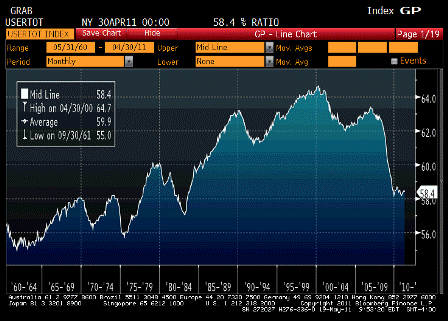
3. The unemployment rate rose by one tenth to 9.1% in May, and is now up three tenths from its recovery low in March. Household employment increased by 105k in May (after falling by 190k in April), but labor force growth was stronger. The employment-to-population ratio held at 58.4%. The U-6 measure-which captures other types of labor underutilization-fell by one tenth to 15.8%.

4. After the recent run of weaker-than-expected data, our Current Activity Indicator (CAI) now stands at just 1.0% for May, down from 1.6% in April and 4.2% in March.
Consumer Spending Cools More Than Estimated, Wages Gain Less, Profits and Manufacturing Decelerate

Not good for this part of the cycle, as we remain grossly overtaxed for the size govt we have

Consumer Spending Cools More Than Estimated

By Shobhana Chandra

May 26 (Bloomberg) — Consumer spending cooled in the first quarter more than previously estimated as the jump in food and fuel costs held back the biggest part of the U.S. economy.

Household purchases rose at a 2.2 percent annual pace from January through March, less than the 2.7 percent calculated last month and short of the 2.8 percent median forecast of economists surveyed by Bloomberg News, according to Commerce Department figures issued today in Washington. The economy grew at a 1.8 percent pace last quarter, the same as previously calculated.

The number of workers filing applications for unemployment insurance benefits increased by 10,000 to 424,000 in the week ended May 21, according to data from the Labor Department. The median forecast of economists surveyed by Bloomberg projected claims would decrease to 404,000.

A monthlong slide in consumer confidence ended last week as gasoline prices retreated, another report showed. The Bloomberg Consumer Comfort Index rose to minus 48.4 in the period to May 22 from a nine-month low of minus 49.4 the prior week. Readings of minus 40 or less are generally associated with recessions and their aftermaths, the report said.

The economy last quarter maintained the previously reported pace of growth as bigger gains in inventories and a smaller decline in commercial construction compensated for the slowdown in spending.

The gain in consumer purchases, which account for about 70 percent of the economy, followed a 4 percent increase in the fourth quarter was the biggest since the end of 2006. Cuts in spending on gasoline and utilities, combined with a smaller increase in demand for autos, contributed to the slowdown in the first three months of the year.

The price gauge tied to spending increased at a 3.8 percent pace in the first quarter, the biggest advance since the third quarter of 2008. Excluding food and fuel, the numbers tracked by Federal Reserve policy makers, prices climbed at a 1.4 percent rate.

Smaller Wage Gain

The GDP report also showed wages and salaries climbed by $27.9 billion from October through December, down from a prior estimate of $52.5 billion. Real disposable income, or after-tax earnings adjusted for inflation, climbed 1.1 percent in the fourth quarter, rather than the 1.9 percent gain previously estimated. They rose 0.8 percent in the first three months of the year, less than the 2.9 percent prior calculation.

The smaller gain in pay dwarfed the slowdown in spending, pushing the savings rate down to 5.1 percent in the first quarter from a prior estimate of 5.7 percent.

Today’s report also offered a first look at profits. Earnings before taxes were up 1.3 percent from the prior quarter, the smallest gain in more than two years, after rising 2.3 percent in the prior period. They climbed 8.5 percent from the same time last year.

Manufacturing, which accounts for 12 percent of the economy, is slowing this quarter as disruptions in the supply of components temporarily weigh on production until Japanese factories recover from the fallout of the March disaster.

Growth Forecasts

Economists at Goldman Sachs Group Inc. and JPMorgan Chase & Co. in New York each cut second-quarter growth forecasts by half a percentage point this week, citing setbacks in vehicle output caused by supply disruptions. Goldman trimmed its projection to 3 percent, while JPMorgan lowered it to 2.5 percent.

Philadelphia Fed survey, existing home sales, leading indicators all disappoint

Typical street review of today’s numbers from Goldman.

As suspected, look for continued downward revisions to initial 4% Q2 estimates.

And note the graph below showing employment as a % of the population.
The economy continues to be demand constrained at very low levels.
(That is, for the size govt we have, we are grossly over taxed.)

There could be as many as 30 million additional people gainfully employed in a good economy.
And a general prosperity far beyond what anyone might imagine.

But not to be with Congress, mistakenly fearful of the US facing a financial crisis like Greece,
moving forward with their death by 1000 cuts agenda.

USA: Philadelphia Fed Survey – Another Decline

Actual: 3.9
Previous: 18.5
Consensus: 20.0
Released: 19 May 2011 at 10:00 (New York time)

Another Decline
BOTTOM LINE: More signs of slower growth from the Philly Fed index and existing home sales.

US-MAP
Existing home sales -2 (2, -1)
Philadelphia Fed index -12 (4, -3)

KEY NUMBERS:
Existing home sales -0.8% in Apr (mom) vs. GS +2.0%, median forecast +2.0%.
Philadelphia Fed index +3.9 in May vs. GS +22.0, median forecast +20.0.
Leading indicators -0.3% in Apr (mom) vs. median forecast +0.1%.

MAIN POINTS:
1. The Philadelphia Fed’s monthly manufacturing survey weakened sharply for the second month in a row. The headline index of “general business activity” fell to 3.9, from 18.5 in April and 43.4 in March. This still suggests factory sector growth, but only barely. Most of the detailed activity indexes also weakened – the new orders index fell to 5.4 from 18.8, the shipments index to 6.5 from 29.1, and the unfilled orders index to -7.8 from 12.9 – with the exception of employment, which rose to 22.1 from 12.3 in April. (We have no information on how much of the drop in the Philly survey over the past two months could have been related to supply chain issues associated with the Japanese earthquake, but this is not a region with an especially high concentration of vehicle manufacturing.) Price pressures eased a little but remain high in historical terms.

2. Existing home sales declined by 0.8% mom in April to an annualized rate of 5.05 million units. Consensus forecasts had expected a moderate increase. Home sales dropped in three of the four Census regions during the month, with the largest declines in the Northeast. The number of homes currently offered for sales was about unchanged after seasonal adjustment, at about 3.7 million units (the months supply of homes increased, but this was likely due to seasonal variation). The median sales price of existing homes increased by about 0.5% mom on a seasonally-adjusted basis-an encouraging turn after several months of weakness. Existing home sales prices are down 5% year-over-year.

3. Rounding out the weaker-than-expected data, the index of leading economic indicators fell by 0.3% mom in April. The consensus had expected a 0.1% increase.

BoC/BoE/RBA Comments

Even with headline ‘inflation’ above comfort levels and recognizing the need to ‘manage inflation expectations’ under ‘expectations theory’ they all religiously believe, they seem to be sufficiently concerned about aggregate demand to make these kinds of dovish comments.

Conclusion: they’re understating the general weakness they’re sensing.

From Karim, my partner at Valance:


Karim writes:

Some important official comments from these 3 in last 24hrs:

Bank of Canada-Still dovish-Highlighting competitiveness issues due to stronger currency, under-representation in emerging markets, and commodity price gains acting as a brake on U.S. growth. No move in policy rate until Q4 at earliest and only to coincide with signal from Fed for higher rates. Excerpts from Carney speech yesterday:

  • Since only 10 per cent of Canada’s exports go to emerging economies and our non-commodity export market share in the BRICS has been almost halved over the past decade, activity in Canada does not benefit to the same extent as in past commodity booms driven by U.S. growth. The current situation is more akin to a supply shock for our dominant trading partner, with higher commodity prices acting as a net brake on growth. With oil prices up 50 per cent since last summer, the effect is material.
  • Investors looking to rebalance portfolios towards emerging markets could lead them to invest in proxies such as Australia and Canada.

Bank of England-Still dovish-Mervyn King shows no worry from inflation data today (higher than expected but virtually all due to airfares due to timing of late Easter-similar to Eur data) and new MPC Member Broadbent (replacing the uber-hawk Sentence) emphasizing downside risks to growth (higher savings rate, weak credit, Euro stresses). Base case is on hold through year-end.

  • King: As set out in my previous letter, the current high level of inflation reflects three main influences: the increase in the standard rate of VAT in January to 20%, higher energy prices and increases in import prices. Although the impact on inflation of these factors is difficult to quantify with precision, it is likely that had they not occurred, inflation would have been substantially lower and probably below the target…..Unemployment is high and wage growth is weak at around 2% a year. Money and credit growth are both very low. It is therefore possible that, as the temporary influence of the factors currently pushing up on inflation wanes, these downward pressures on inflation could drag inflation below the target.

RBA Minutes-Hawkish-Even though 2-speed economy (strong exports/trade; weak consumer), inflation forecast heading higher. Rate hike likely at June or July meeting. The sentence below didn’t appear at the prior RBA meeting in April.

  • …members judged that if economic conditions continued to evolve as expected, higher interest rates were likely to be required at some point if inflation was to remain consistent with the medium-term target.

Obama Tells Companies to ‘Step Up’ and Hire Workers

The rhetoric continues to deteriorate.
Labor is fundamentally a scarce resource.
Policy should encourage business to use as few workers as possible.
And, of course for any given size govt taxes can always be adjusted to sustain aggregate demand for optimal employment/output.

Obama Tells Companies to ‘Step Up’ and Hire Workers

May 12 (Reuters) — President Obama urged businesses to “step up” and hire workers, pressing banks and other corporations to do more to help an economy that he said would take “several years” to recover fully.

In a town-hall style meeting conducted by CBS News on Wednesday, Obama said the weak housing market and high gasoline prices were the biggest “headwinds” dragging on the economy.

“We’ve got a lot more work to do to get businesses to invest and to hire,” he told the audience in remarks broadcast on Thursday.

“It’s going to take us several years for us to get back where we need to be.”

The strength of the U.S. economy is likely to be the main factor that determines whether Obama will succeed in holding on to the White House next year.

He said businesses and banks that reaped the rewards of extraordinary measures to pull the country out of a deep recession had a responsibility now to invest hordes of cash into U.S. jobs.

“It is time for companies to step up,” Obama said.

“American taxpayers contributed to that process of stabilizing the economy. Companies havebenefited from that, and they’re making a lot of money, and now’s the time for them to start betting on American workers and American products.”

U.S. companies created jobs at the fastest pace in five years in April, according to the Labor Department, pointing to underlying strength in the economy even as the jobless rate hit 9.0 percent.

Goldman excerpts from employment report

The positives have been well publicized, so I’m just forwarding the negatives, particularly the downward revisions to Q2 I’ve been concerned about:

2. Results from the household survey were disappointing. Total household employment fell by 190k, and the unemployment rate rose to 9.0% (8.96% unrounded) from 8.8% previously. . Results were somewhat better after adjusting for methodological consistency with the nonfarm payroll data; on this basis the household survey measure of employment would have increased by 50k. However, the labor force participation rate was unchanged during the month, indicating that the rise in the unemployment rate reflected job losses rather than an influx of persons into the labor force. While the news was discouraging, it follows four months of declining unemployment, and the level of the unemployment rate remains down 1.1 percentage points from its peak. The employment-to-population ratio fell slightly to 58.4% from 58.5% previously.

4. After the Employment Report, our Current Activity Indicator (CAI) showed growth of 2.3% in April, down from 4.0% in March. The deceleration mostly reflects weaker survey-based data (e.g. the non-manufacturing ISM and Philly reports), and indicates a cooling in overall growth early in Q2.

Galbraith on federal debt sustainability

Is The Federal Debt Unsustainable?

By Professor James K. Galbraith

Excerpt

A more prosaic problem with the runaway-inflation scenario is that the “nonpartisan, professional” economic forecasters of the Congressional Budget Office (CBO), whose work is often cited as the benchmark proof of an “unsustainable path,” do not expect it to happen. The CBO baseline resolutely asserts that inflation will stay where it is now: around 2 percent. So one can’t logically cite the inflation threat and the CBO baseline at the same time. So far as I know, the CBO does not trouble itself to model the exchange value of the dollar.

What the CBO does warn is that, under their assumptions, the ratio of US federal debt (held by the public) to GDP will rise relentlessly, passing 200 percent by 2035 and 300 percent by midcentury. Correspondingly, net interest payments on that debt would rise to exceed 20 percent of GDP. This certainly seems worrisome, and the CBO warns about “investor confidence” and “crowding out” without actually building these things into their model. Indeed, in their model this remarkable and unprecedented ratio of debt to GDP goes right along with steady growth, full employment, and low inflation, world without end! Why one should care about mere financial ratios if they produce such good—and, according to the CBO model— “sustainable” results is another mystery the CBO does not explain.

Japan’s new vehicle sales mark largest fall in April

All looking very weak, probably weaker than expectations, and the (modest) new spending appears to be paid for by reductions in other spending, so no fiscal response yet.

Headlines:

Japan’s new vehicle sales mark largest fall in April
Japan’s Wages Fall, Highlighting Risks to Economic Recovery
Japan Passes Y4tln Emergency Budget, But Political Standoff Not Over
Domestic Auto Sales Fall 51% In April

Japan’s new vehicle sales mark largest fall in April

Workers give the final checkup on the cars of Honda Accord Tourer at Honda Motor Co.’s Saitama Factory in Sayama, north of Tokyo, Monday, April 18, 2011.(AP Photo/Shizuo Kambayashi)TOKYO (Kyodo) — Sales of new vehicles including minivehicles in Japan marked the largest fall of 47.3 percent in April from a year earlier to 185,673 units in the wake of the devastating March 11 earthquake and tsunami in the country’s northeastern region, industry bodies said Monday.

The sales volume was also the record monthly low, which was smaller than the previous low of 198,693 units marked in January 1968, according to the Japan Automobile Dealers Association and the Japan Mini Vehicles Association.

The rate of decline beat the previous record fall of 40.7 percent in May 1974 as disruptions in supply chains triggered by the disaster forced automakers to significantly curtail output.

Sales of vehicles, excluding minivehicles with engines of up to 660 cc, plunged 51.0 percent to a record low of 108,824 units, falling for the eighth straight month and registering the sharpest percentage fall.

Minivehicle sales dropped 41.1 percent to 76,849 units, also marking the largest percentage fall.

Japan’s Wages Fall, Highlighting Risks to Economic Recovery

May 2 (Bloomberg) — Japan’s wages slid for the first time in 13 months in March, underscoring the risk that slumping consumer spending may undermine the recovery from an earthquake that left more than 25,000 people dead or missing.

Monthly pay including overtime and bonuses dropped 0.4 percent from a year earlier to 274,886 yen ($3,383), the Labor Ministry said today in Tokyo. Overtime work hours fell 2 percent to 10.1 hours, the data showed.

The wage data highlight the economic damage from the March 11 disaster, which caused a record decline in factory output and decreases in retail sales, household spending and consumer confidence. Japan’s parliament passed today a 4 trillion yen ($49 billion) extra budget put together by Prime Minister Naoto Kan to pay for reconstruction in the northeast area.

“The impact of the earthquake on wages will materialize in coming months,” said Azusa Kato, an economist at BNP Paribas in Tokyo. “Corporate earnings are worsening, which could prompt companies to start cutting salaries,” and that “will likely weigh on personal consumption.”

The Nikkei 225 Stock Average rose 1.6 percent to close at 10004.20 today after U.S. companies reported better-than- expected earnings and President Barack Obama said al-Qaeda leader Osama bin Laden was killed. The yen weakened 0.3 percent to 81.47 against the dollar at 4:16 p.m. in Tokyo.

Nomura’s Income

Nomura Holdings Inc., Japan’s largest brokerage, said last week its net income fell 35 percent to 11.9 billion yen in the three months ended March 11, as income from investment banking and trading declined.

Toyota Motor Corp., Honda Motor Co. and Nissan Motor Co., Japan’s three biggest carmakers, say domestic output plunged in March. Toyota may lose output of 300,000 vehicles in Japan and 100,000 overseas through the end of April due to quake-related shutdowns, Executive Vice President Atsushi Niimi said last month.

Sales of cars, trucks and buses, excluding minicars, fell 51 percent in Japan from a year earlier to a record-low 108,824 vehicles in April, the Japan Automobile Dealers Association said in a statement today.

Japan’s industrial production plunged 15.3 percent in March from February, the largest drop since data began in 1953, government data showed last week. Household spending slid 8.5 percent from a year earlier in March, while consumer confidence fell the most on record, data last month showed.

‘Severe’ Outlook

The Bank of Japan last week cut its growth estimate for the nation for the year ending March 2012 to 0.6 percent from a January prediction of 1.6 percent, with Governor Masaaki Shirakawa saying the economic outlook is “severe.”

Consumer spending may decrease in both the first and second quarters and rebound in the third quarter at the earliest, BNP Paribas’ Kato said. Such outlays make up about 60 percent of Japan’s gross domestic product.

Kan’s extra budget, which the prime minister says will be one of several financing packages for rebuilding, may create around 200,000 jobs and support some 1.5 million workers, the government estimated last week.

The government projected in March that damage from the disaster may reach 25 trillion yen.

Seven & I Holdings Co., the owner of the 7-Eleven convenience-store brand, said last month its full-year profit may decline 22 percent. Aeon Co., which may surpass Seven & I to become the country’s biggest retailer in terms of revenue this fiscal year, said net income may decline 33 percent.

Japan Passes Y4tln Emergency Budget, But Political Standoff Not Over

(Dow Jones) Japan’s parliament passed a Y4 trillion disaster relief budget on Monday. The extra budget, which totals Y4.015 trillion and is the first of a planned series of spending packages to deal with the aftermath of the disaster, does not involve additional government borrowing as it will be financed by funds previously earmarked for other spending. The government will now shift its focus to drafting a broad after-quake reconstruction plan as well as a long-term blueprint to overhaul Japan’s tax and social security systems by the end of June. The government will then compile a second extra budget to fund other quake-related measures, Prime Minister Kan and Finance Minister Yoshihiko Noda have indicated.

Domestic Auto Sales Fall 51% In April

(Dow Jones) Japan’s domestic sales of new cars, trucks and buses dropped 51.0% from a year earlier in April, as supply chain problems after the massive earthquake and tsunami on March 11 reduced supplies of new vehicles to customers. Sales totaled 108,824 vehicles in April. The sales drop in April came after a 37% on-year decline in March. Sales of Toyota Motor Corp. vehicles dropped 68.7% to 35,557 vehicles in April, with those of its luxury brand Lexus down 44.7% at 1,656. Nissan Motor Co. vehicle sales tumbled 37.2% to 17,413 in the month, while Honda Motor Co.’s sales sagged 48.5% to 18,923. Auto sales are the first consumer spending numbers released each month. The figures don’t include sales of mini cars and trucks.

from Press Conference

I thought he did a AAA job within his paradigm.

The answers on the dollar were spot on- ultimately the dollar is worth what it can buy, so ‘low inflation’ is a strong dollar policy in the long term. It’s pretty much the purchasing power parity argument. Additionally, he said a strong economy helps the dollar, citing the capital inflow channel, probably a reference to China and other emerging market nations. And I might have added the fiscal tightening channel, as strong economies tend to cause federal deficits to fall via automatic fiscal stabilizers.

Interestingly, he did not mention specifically how higher oil prices, set by a foreign monopolist, continue to work against the dollar.

Nor how highly deflationary policies in other currencies tend to strengthen those currencies relative to the dollar.

And there was no mention of how portfolio shifting alters the dollar, which may be the largest driver currently.

Let me suggest, however, it would have been more nearly correct for him to have said the policy of low inflation and strong growth also happens to support the dollar, rather than imply a strong dollar was the policy variable.

He remains out of paradigm on the QE issue, still not realizing it’s entirely about price and not quantity, but that was to be expected.

The more dovish tone from the FOMC indicates some fundamental insecurity about the economy. Yes, they remain moderately optimistic, but probably continue to worry disproportionately about the downside risks. They see downside risks to demand everywhere from the euro zone and the UK, to Japan and China, and, though recognizing nothing of consequence has happened yet, they hear the fiscal sabre rattling from both the left and the right. And they see it’s unlikely for the housing channel to provide much support in the near future as it’s done in previous cycle.

Also, second chance to buy my 100oz gold bar at the current spot price of gold!
When I offered it for sale when gold was $1,200, no one wanted it so I still have it.

:)


Karim writes:

1) Extended period means a ‘couple of meetings’.
2) Q1 GDP weakness transitory (i.e., they didn’t alter the outlook for rest of f/cast period) due to
   a. timing of defense outlays
   b. timing of export shipments
   c. weather
3) No fiscal measures that have been announced so far have altered their near-term outlook
4) Impact of Japan supply disruptions ‘moderate and temporary’
5) Strong and stable dollar in U.S. best interest