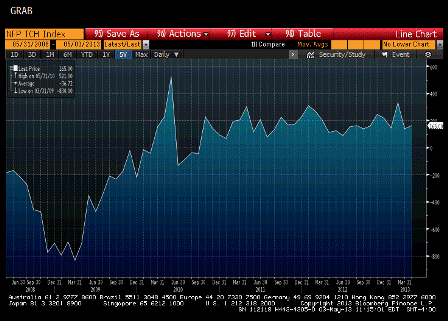
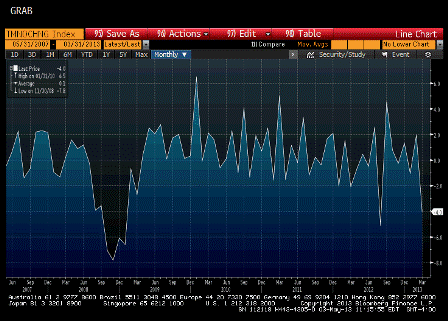
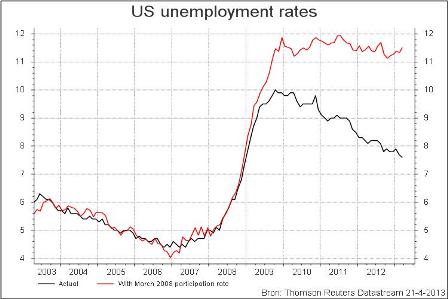
Obama double talk on jobs

Note the flip flop.

Obama Says Job Market May ‘Stall’ as Result of Budget Cuts

By Hans Nichols

May 19 (Bloomberg) — President Barack Obama told a group of Democratic donors in Atlanta that the economy and job market could falter as a result of the automatic spending cuts that went into effect March 1.

“Because of some policies in Washington, like the sequester, growth may end up slowing,” Obama said at a luncheon for the Democratic Senatorial Campaign Committee. “We may see once again the job market stall.”

The president was in Atlanta to give the commencement address at Morehouse College and he told the donors that while he was energized by the spirit of the graduates “they are entering into a job market that is still challenging.”

Earlier, at the commencement ceremony, Obama gave the labor market a more positive rendering. He told the graduates “you’re graduating into a job market that’s improving.”

American employers added more workers than forecast in April, sending the unemployment rate down to a four-year low of 7.5 percent. More Americans than projected filed claims for jobless benefits last week and manufacturing in the Philadelphia region unexpectedly shrank in May, signs that a slowdown in growth is rippling through the U.S. economy.

Sydney Morning Herald

Mosler lays down tablets on the economy, stupid

By Peter McAllister

May 11 (Sydney Morning Herald) — Ask US economist Warren Mosler whether the national disability insurance scheme should be paid for by a new levy or by spending cuts, and you’ll get a jarring answer – neither.

He’ll also tell you the question shows both the government and the opposition don’t really understand how public services are funded in a modern economy.

”Julia Gillard’s DisabilityCare does not require a tax at all,” Mosler says. ”Despite what most of us think, no modern capitalist government ever taxes to raise money to spend. Their real motive, even if they don’t know it, is to reduce aggregate demand and slow the economy.”

That means Tony Abbott’s insistence on spending cuts to return the budget to surplus is wrong too. ”When the economy is at less than full employment, spending cuts can only make matters worse.”

What’s really needed, Mosler adds, is both a simultaneous cut in taxes and an increase in spending to cover NDIS costs. That will restore what ought to be an essential fixture of Australian, and world, economies: good, healthy, productivity-enhancing deficits.

Welcome to the strange world of Warren Mosler, creator of Modern Monetary Theory.

The fact that Mosler – a tall, spare and super-rich Connecticut Yankee – dresses in nondescript slacks and T-shirts, and speaks in soft, matter-of-fact tones, only adds to the mind trip. He was recently in Australia to lay that trip on Northern Territory Treasury officials at a seminar organised by Charles Darwin University’s Centre for Full Employment and Equity, COFFEE for short. What they made of his message that deficits, like their $867 million budget hole, should be bigger, not smaller, is anybody’s guess.

”Budget deficit” is still the phrase that dare not speak its name in Australian politics. Mosler, however, says this will change. The world economic crisis, which is highlighting the bankruptcy of austerity economics and our obsession with surpluses, will force a rethink on deficit financing in Australia too. ”Current economic thought has it exactly backwards,” he explains. ”Government surpluses are not an economic plus – they’re a drag on performance because they always represent monetary savings withdrawn from the economy.” Mosler claims that, in fact, most financial crises in the modern era were caused by a preceding run of surpluses.

If that seems hard to absorb, you’re not alone. The longer Mosler talks, the longer the list of big-name economists and public officials who he says are wallowing in similar economic confusion. The chairman of the US Federal Reserve, Ben Bernanke, for example ”didn’t understand how the Fed worked in the US economic crisis; he disrupted recovery for six months by failing to realise he could lend freely to US banks on an unsecured basis”. Similarly, Paul Krugman, Nobel prizewinning economist, ”still hasn’t realised that regulating the economy through interest rates doesn’t work because cheaper credit is inevitably cancelled out by lower interest income”.

Their real error, however – and one shared by RBA governor Glenn Stevens – is the exaggerated importance they place on government debt.

”They don’t fully understand that where a government issues its own currency it doesn’t matter how large its debt grows, it can always pay it.” By extension, Mosler says, that guarantees future generations can pay it too, meaning our fears of passing a debt burden to our children are misplaced.

”We’re all still behaving as if our currency were linked to the gold standard, as it was before 1971,” Mosler complains. ”We’ve yet to adjust to the government’s new role as the economy’s scorekeeper, with money as nothing more than the points.”

Yet the game, he points out, really has changed. ”Not only can the government no longer run out of money, it also can’t drive up interest rates through higher levels of debt because its own central bank necessarily sets those rates, not market forces,” he says.

Likewise, Mosler adds, there is nothing to fear from the legendary ”bond vigilantes”, who supposedly police rising government debt through refusal to buy it. ”Since the government doesn’t, in reality, ever borrow to obtain funds, but rather to support interest rates, private refusal to buy securities actually results in a benefit to the treasury.” No issuer of currency, Mosler insists, is ever at risk from bond vigilantes; only users of currency, such as state governments, are.

These are certainly radical views – the question is should the world accept them? What separates Mosler from the myriad crackpot bloggers filling the digital airwaves with wacked-out and ruinous economics prescriptions?

Well, the evidence, possibly.

Some empirical support for Mosler’s radical views is surfacing. The controversy over the Reinhart-Rogoff analysis of growth rates in high debt-to-GDP ratio countries, for example, has established that there is, apparently, no growth penalty for high government debt. (Where there is, says Mosler, it is not from the debt itself but from the misguided contractionary measures governments take to reduce it). Then there is Mosler’s 2006 prediction that the current euro crisis would be the certain result of the PIGS countries’ surrender of their ability to issue currency and finance through government deficit.

There is also the small matter of the multibillion-dollar Bush tax cuts and spending increases, the second tranche of which, Mosler casually reveals, were inspired by his 2003 meeting with Andy Card, White House chief of staff to then president George W. Bush.

Most persuasive, however, is the man himself. If only three people actually understand global finance, Mosler might well be the only one to also understand international bond markets. He has, after all, traded in them for more than 40 years, managing billions in funds and making millions in profit. It was during his most profitable trades – on Italian government bonds in the 1990s – Mosler says, that he had his epiphany.

”We made a lot of money by betting the Italian government wouldn’t default even though their debt-to GDP ratio had exceeded 110 per cent,” Mosler recalls. ”I knew no country that issued its own currency ever had defaulted, nor had they ever had to ‘print money’ to pay, but I didn’t know why. Eventually it hit me: buying securities from a country’s central bank or its treasury are both functionally the same.”

They’re supposed to be different, Mosler points out: central banks sell securities in order to drain reserves, while treasuries supposedly do it to raise expenditure. ”But the end result is exactly the same – a pile of money sitting in securities accounts at the country’s central bank,” he says. ”The inescapable conclusion is that treasury sales of government debt don’t actually raise funds: they too simply drain reserves. That means that it is government spending and taxing that actually impacts the economy, not managing the debt.”

To paraphrase Dick Cheney, deficits do matter, says Mosler. ”And your persistent unemployment in Australia is telling you yours are far too small and need to be much larger.”

Large enough, perchance, for the NDIS, Gonski and Abbott’s parental leave scheme combined? Now that would be the end of politics as we know it.

Dr Peter McAllister is a journalism lecturer on the Gold Coast campus of Griffith University.

A word on jobless claims

For example, unemployment could be 10% with no employees being dismissed and filing for new claims, and 150,000 new hire just in line with workforce growth so as to keep unemployment at 10%, and Thursday’s claims number would be 0.

Point is a falling claims number can refect ‘quietness’ and ‘stability’ and not ‘improvement’ and therefore not be forecasting increased growth and employment. Once ‘quiet times’ are achieved, it’s just a measure of turnover.

However/likewise, rising claims indicate ‘less quiet times’ with active dismissals on the rise. With a lag, a breakdown in the private sector credit accelerator due to the proactive austerity measures
should be evidenced (again with a lag) by a slowdown in the growth of credit/slowdown in sales/output/employment. This generally gets reversed by the automatic fiscal stabilizers of rising unemployment comp and falling tax revenues that increase the federal deficit to the point where the demand leakages are sufficiently offset.

Support could also come from a reduction of the demand leakages, including a reduction in net imports, but in the case of the US those are highly unlikely to change anything near term.

Rogoff & Reinhart answering my call in FT – Austerity is not the only answer to a debt problem

Good to see Ken, who I’ve never met, and Carmen who I do know, no doubt assisted by her husband Vince, beginning to come clean with this response. While not complete, it’s the beginning of an encouraging, epic reversal and a first step in the right direction!

My comments added below:

Austerity is not the only answer to a debt problem

By Kenneth Rogoff and Carmen Reinhart

May 1 (FT) — The recent debate about the global economy has taken a distressingly simplistic turn. Some now argue that just because one cannot definitely prove very high debt is bad for growth (though the weight of the results still say it is),

They could add here ‘though likely via the reaction functions of govts and not the high debt per se.’

then high debt is not a problem. Looking beyond the recent public debate about the literature on debt we have already discussed our results on debt and growth in that context the debate needs to be reconnected to the facts.

Let us start with one: the ratios of debt to gross domestic product are at historically high levels in many countries, many rising above previous wartime peaks. This is before adding in concerns over contingent liabilities on private sector balance sheets and underfunded old-age security and pension programmes. In the case of Germany, there is also the likely need to further cushion the debt loads of eurozone partners.

Adding here ‘as they are ‘users’ of the euro the way US states are ‘users’ of the dollar, and not the actual issuer of the currency like the ECB, the Fed, the BOE, the BOJ, and the rest of the world’s central banks.’

Some say not to worry, pointing to bursts of growth after the world wars. But todays debts,

Add ‘while they pose no solvency risk for the issuer of the currency.’

will not be dealt with by boosts to supply from postwar demobilisation and to demand from the lifting of wartime controls.

To be clear, no one should be arguing to stabilise debt, much less bring it down, until growth is more solidly entrenched if there remains a choice, that is.

BRAVO!!!! And add ‘as is always the case for the issuer of the currency.’

Faced with, at best, haphazard access to international capital markets and high borrowing costs, periphery countries in Europe face more limited alternatives.

Add ‘as is the case for ‘users’ of a currency in general, including the US states, for example’.

Nevertheless, given current debt levels, enhanced stimulus should only be taken selectively and with due caution. A higher borrowing trajectory is warranted, given weak demand

BRAVO!

and low interest rates,

Add ‘which are confirmation by the CB policy makers who set the rates low that they too believe demand is weak’.

where governments can identify high-return infrastructure projects. Borrowing to finance productive infrastructure raises long-run potential growth, ultimately pulling debt ratios lower. We have argued this consistently since the outset of the crisis.

BRAVO! And add ‘additionally, weak demand can be addressed by tax reductions, recognizing that counter cyclical fiscal policy of currency users, like the euro zone members, requires funding support from the issuer of the currency, which in this case is the ECB.’

Ultra-Keynesians would go further and abandon any pretense of concern about longer-term debt reduction.

Add ‘without a credible long term inflation concern, as for the issuer of the currency inflation is the only risk from excess demand.’

This position has been in the rhetorical ascendancy in recent months, with new signs of weaker growth. It throws caution to the wind on debt

Add ‘with regards to solvency, as is necessarily the case for the issuer of the currency.’

and, to quote Star Trek, pushes governments to go where no man has gone before

Add ‘apart from war time, when the importance of maximum output and employment takes center stage.’

The basic rationale

Add ‘of the mainstream deficit doves (not the ultra Keynesian MMT school of thought)’

is that low interest rates make borrowing a free lunch.

Unfortunately,

Add ‘the mainstream believes’

ultra-Keynesians are too dismissive of the risk of a rise in real interest rates. No one fully understands why rates have fallen so far so fast,

Add ‘apart from the Central Bankers who voted to lower them this far and this fast, and in some cases provide guarantees to other borrowers.’

and therefore no one can be sure for how long their current low level will be sustained.

Add ‘as it’s a matter of second guessing those central bankers.’

John Maynard Keynes himself wrote How to Pay for the War in 1940 precisely because he was not blas about large deficits even in support of a cause as noble as a war of survival. Debt is a slow-moving variable that cannot and in general should not be brought down too quickly. But interest rates can change rapidly.

Add ‘all it takes is a vote by central bankers.’

True, research has identified factors that might combine to explain the sharp decline in rates.

Add ‘in fact, all you have to do is research the votes at the central bank meetings.’

Greater concern

Add ‘by central bankers’

over potentially devastating future events such as fresh financial meltdowns may be depressing rates. Similarly, the negative correlation between returns on stocks and long-term bonds, while admittedly quite unstable, also makes bonds a better hedge. Emerging Asias central banks have been great customers for advanced economy debt, and now perhaps the Japanese will be once more. But can these same factors be relied on to keep yields low indefinitely?

Add ‘In the end, it’s all a matter of the central bank’s reaction function.’

Economists simply have little idea how long it will be until rates begin to rise. If one accepts that maybe, just maybe, a significant rise in interest rates in the next decade

Add ‘due to inflation concerns’

might be a possibility, then plans for an unlimited open-ended surge in debt should give one pause.

Add ‘if he does not see the merits of leaving risk free rates near 0 in any case, as there is no convincing central bank research that shows rate hikes reduce inflation rates, and even credible theory and evidence to be concerned that rate hikes instead exacerbate inflation.’

What, then, can be done? We must remember that the choice is not simply between tight-fisted austerity and freewheeling spending. Governments have used a wide range of options over the ages. It is time to return to the toolkit.

First and foremost,

Add ‘only’

governments

Add ‘who fail to recognize that these are merely matters of accounting that don’t themselves alter output and employment’

must be prepared to write down debts rather than continuing to absorb them. This principle applies to the senior debt of insolvent financial institutions, to peripheral eurozone debt and to mortgage debt in the US.

Add ‘Additionally’

For Europe, in particular, any reasonable endgame will require a large transfer

Add ‘of public goods production’

from Germany to the periphery.

Add ‘which in fact would be a real economic benefit for Germany.’

The sooner this implicit transfer becomes explicit, the sooner Europe will be able to find its way towards a stable growth path.

There are other tools. So-called financial repression, a non-transparent form of tax (primarily on savers), may be coming to an institution near you. In its simplest form, governments cram debt into domestic pension funds, insurance companies and banks

By removing governmental support of higher rates from their net issuance of debt instruments, particularly treasury securities.

Europe is there already and it has been there before, several times. How to Pay for the War was, in part, about creating captive audiences for government debt. Read the real Keynes, not rote Keynes, to understand our future.

One of us attracted considerable fire for suggesting moderately elevated inflation (say, 4-6 per cent for a few years) at the outset of the crisis. However, a once-in-75-year crisis is precisely the time when central banks should expend some credibility to take the edge off public and private debts, and to accelerate the process bringing down the real price of housing and real estate.

It is therefore imperative for the central bankers to make it clear to the politicians that there is no solvency risk, and that central bankers, and not markets, are necessarily in control of the entire term structure of risk free rates, and that their research shows that rate hikes are not the appropriate way to bring down inflation, should the question arise’

Structural reform always has to be part of the mix. In the US, for example, the bipartisan blueprint of the Simpson-Bowles commission had some very promising ideas for simplifying the tax codes.

There is a scholarly debate about the risks of high debt. We remain confident in the prevailing view in this field that high debt is associated with lower growth

Add ‘but must add that the risk is that of misguided policy response, and not the level of debt per se.’

Certainly, lets not fall into the trap of concluding that todays high debts are a non-issue.

Add ‘as we must be ever mindful of the possibility of excess demand using up our productive capacity’

Keynes was not dismissive of debt. Why should we be?

The writers are professors at Harvard University. They have written further on carmenreinhart.com

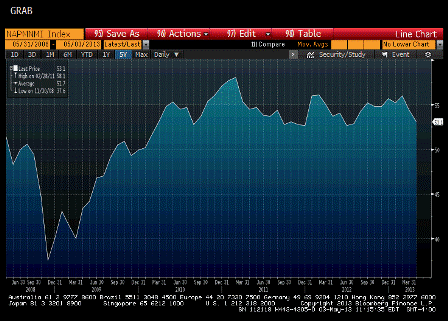
US consumers keep spending despite reduced pay

This is the current thinking, but the pieces don’t add up?
Hoping I’m being too negative here…

Comments below:

US consumers keep spending despite reduced pay

By Christopher S. Rugaber

April 29 (AP) — This year got off to a sour start for U.S. workers: Their pay, already gasping to keep pace with inflation, was suddenly shrunk by a Social Security tax increase.

Which raised a worrisome question: Would consumers stop spending and further slow the economy? Nope. Not yet, anyway.

On Friday, the government said consumers spent 3.2 percent more on an annual basis in the January-March quarter than in the previous quarter the biggest jump in two years. It highlighted a broader improvement in Americans’ financial health that is blunting the impact of the tax increase and raising hopes for more sustainable growth.

Yes, but the ‘slope’ has been negative, with March way down.

Consumers have shed debt. Gasoline has gotten cheaper. Rising home values and record stock prices have restored household wealth to its pre-recession high. And employers are steadily adding jobs, which means more people have money to spend.

Sort of. There have been new jobs, but often at lower pay, and the participation rate has continued to fall. Rising home values are from very low, foreclosure depressed levels, and reports show substantial negative equity remains. And it seems that while total household wealth may be back to the highs, the ‘1%’ has benefited disproportionately.

“No one should write off the consumer simply because of the 2 percentage-point increase in payroll taxes,” says Bernard Baumohl, chief economist at the Economic Outlook Group. “Overall household finances are in the best shape in more than five years.”

Yes, better than 08 after the crash, but still marginal. Debt is down, but take home pay vs the cost of living isn’t doing all that well.

Certainly, spending weakened toward the end of the January-March quarter. Spending at retailers fell in March by 0.4 percent, the worst showing in nine months. And more spending on utilities accounted for up to one-fourth of the increase in consumer spending in the January-March quarter, according to JPMorgan Chase economist Michael Feroli, because of colder weather.

Higher spending on utilities isn’t a barometer of consumer confidence the way spending on household goods, such as new appliances or furniture, would be.

Right. Not good and the slope is negative.

Americans also saved less in the first quarter, lowering the savings rate to 2.6 percent from 3.9 percent in 2012. Economists say that was likely a temporary response to the higher Social Security tax, and most expect the savings rate to rise back to last year’s level. That could limit spending.

‘Saving less’ generally takes the form of ‘borrowing more’, in this case to pay utility bills and make up for the income lost to the tax hike, which is not sustainable.

But several longer-term trends are likely to push in the other direction, economists say, and help sustain consumer spending. Among those trends:

Wealth is up

Home prices rose more than 10 percent in the 12 months that ended in February. And both the Dow Jones industrial average and Standard & Poor’s 500 stock indexes reached record highs in the first quarter. As a result, Americans have recovered the $16 trillion in wealth that was wiped out by the Great Recession.

Again, skewed to the higher income groups who’s ‘consumer spending’ wasn’t all that sensitive to income in any case.

Economists estimate that each dollar of additional wealth adds roughly 3 cents to spending.

Or is it every 3 cents in spending adds a dollar of additional wealth?

That means last year’s $5.5 trillion run-up in wealth could spur about $165 billion in additional consumer spending this year. That’s much more than the $120 billion cost of the higher Social Security taxes.

Or the 120 billion tax hike will reduce wealth by $5.5 trillion from where it would have been otherwise?

‘The wealth’ has to ‘come from’ somewhere. In this case, so sustain spending, non govt debt would have to climb that much more just to make up for the tax hike. It’s possible, but working against that happening is the lower after tax income makes it harder to qualify for new debt, even if you wanted to.

Debt is down

Household debt now equals 102 percent of after-tax income, down from a peak of 126 percent in 2007. That’s almost back to its long-term trend, according to economists at Deutsche Bank.

And so why should it grow faster than the long term trend? The burst last time around was from the sub prime fraud. Before that the .com nonsense and the Y2K scare. Before that the expansion phase of the S&L fraud. And it won’t happen this time if we’re careful to not allow a credit expansion we’ll later regret…

And households are paying less interest on their debts, largely because of the Federal Reserve’s efforts to keep borrowing rates at record lows.

And earning less on their savings. Households are net savers.

The percentage of after-tax income that Americans spent on interest and debt payments dropped to 10.4 percent in the October-December quarter last year. That’s the lowest such figure in the 32 years that the Federal Reserve has tracked the data.

And personal income from interest has likewise dropped, and probably more so.

Jobs are up

Employers have added an average of 188,000 jobs a month in the past six months, up from 130,000 in the previous six. Job gains slowed in March to only 88,000.

Yes, negative slope again. And not even beginning to close the output gap.

But most economists expect at least a modest rebound in coming months. And layoffs sank to a record low in January. Fewer layoffs tend to make people feel more secure in their jobs and more willing to spend.

Gas prices are down

Gasoline prices have fallen in the past year and are likely to stay low. Nationwide, the average price of a gallon of gas has dropped 28 cents since this year’s peak of $3.79 on Feb. 27. Analysts expect gas to drop an additional 20 cents over the next two months. Each 10 cent drop over a full year translates into roughly $13 billion in savings for consumers.

Yes, that helps, except gas prices have been going back up most recently.

Loan costs are down

Lower interest rates have enabled millions of Americans to save money by refinancing their mortgages. Mortgage giant Freddie Mac estimates that in the fourth quarter of 2012, homeowners who refinanced cut their interest rate by one-third, the biggest reduction in 27 years the agency has tracked the data. On a $200,000 loan, that means $3,600 in savings over the next 12 months.

And savers are losing that much.

Some economists note that the Social Security tax cut didn’t spur much more spending when it first took effect at the start of 2011. The tax cut gave someone earning $50,000 about $1,000 more to spend each year. A household with two high-paid workers had up to $4,500 more.

Despite the tax cut, Baumohl notes that consumer spending rose only 2.5 percent in 2011 and 1.9 percent in 2012. In the 10 years before the recession began in December 2007, the average annual spending increase was 3.4 percent.

And a study by the Federal Reserve Bank of New York found that consumers spent only 36 percent of the increased income that resulted from the tax cut. The rest went to paying down debt or to savings.

Ok, so the question is whether with the tax hike they will cut spending or consume from borrowing and dipping into savings. Initially that’s what happened, but seems by March the increasing consumption had started to fade?

And the sequesters hadn’t even begun.

Since the tax cut didn’t boost spending that much, its expiration may not drag it down much, either. Economists say temporary tax cuts are often ineffective because many consumers assume that the tax breaks will eventually disappear. So they don’t ramp up spending in response.

As just discussed. It’s not necessarily symmetrical.

Scott Loehrke, 25, hasn’t cut back spending this year. Loehrke went ahead in March with some car repairs that could have been delayed. And he still plans to vacation in May in Mexico with his wife, Jackie.

The couple, who live just outside Cleveland, feel secure in their jobs. Loehrke is a salesman for a company that makes T-shirts, cups, key chains and other promotional products. Business has picked up in the past year as the economy has improved. His wife is a pharmacist.

“Everything that we’ve planned to do we’re still doing,” Loehrke says.

That proves their case!!!
:(

The Loehrkes both have heavy student debt and so are focused on keeping their expenses in check. They both drive used cars. That’s enabled them to build up some savings and made it easier to absorb the tax increase.

New threats have emerged. Across-the-board government spending cuts kicked in March 1. The spending cuts have triggered government furloughs and could lead private companies that do business with the government to cut staff. And the cuts are expected to shave a half-point from economic growth this year.

And that’s just the first order effect.

Even so, most economists are relieved that consumers have proved so resilient so far.

“It’s very encouraging that consumers and thus the broader economy have been able to weather that storm as well as they have,” says Mark Zandi, an economist at Moody’s Analytics.

‘The beatings will continue until morale improves’

Overall view of the economy

This is my overall view of the economy.

The US was on the move by Q4 last year. A housing and cars (and student loans) driven expansion was happening, with slowing transfer payments and rising tax revenues bringing the deficit down as the automatic stabilizers were doing their countercyclical thing that would eventually reverse the growth. But that could take years. Look at it this way. Someone making 50,000 per year borrowed 150,000 to buy a house. The loan created the deposit that paid for the house. The seller of the house got that much new income, with a bit going to pay taxes and the rest there to be spent. Maybe a bit of furniture etc. was bought on credit as well, again adding income and (gross) financial assets to the recipients of the borrowers spending. And increasing sales added employment as well as output, albeit not enough to keep up with population growth etc.

I was very hopeful. Back in November, after the ‘Obama is a socialist’ sell off, I wrote that it was time to buy stocks and go play golf for three years, as, left alone, the credit accelerator in progress could go on for a long time.

But it wasn’t left along. Only a few weeks later the cliff drama began to intensify, with lots of fear of going over the ‘full cliff’. While that didn’t happen, we did go over about 1/3 cliff when both sides let the FICA reduction expire, thus removing some $170 billion from 2013, along with strong prospects of an $85 billion (annualized) sequester at quarter end. This moved me ‘to the sidelines’. Seemed to me taking that many dollars out of the economy was a serious enough negative for me to get out of the way.

But the Jan and then Feb numbers showed I was wrong, and that the consumer had continued to grow his spending as before via housing and cars, etc. Even the cliff constrained -.1 GDP of Q4 was soon revised up to .4. Stocks kept moving up and bonds moved higher in yield, even as the sequester kicked in, with the market view being the FICA hike fears were bogus and same for the sequester fears. Balancing the budget and getting the govt out of the way does indeed work to support the private sector. The UK, Eurozone, and Japan were exceptions. Austerity inherently does work. And markets were discounting all that, as it’s what market participants believed and the data supported.

Then, it all changed. April releases of March numbers showed not only suddenly weak March numbers, but Jan and Feb numbers revised lower as well. The slope of things post FICA hike went from positive to negative all at once. The FICA hike did seem to have an effect after all. And with the sequesters kicking in April 1, the prospects for Q2 were/are looking worse by the day.

My fear is that the FICA hikes and sequesters didn’t just take 1.5% of GDP ‘off the top’ as forecasters suggest, leaving future gains from the domestic credit expansion there to add to GDP as they had been. That is, the mainstream forecasts are saying when someone’s paycheck goes down by $100 per month from the FICA hike, or loses his job from the sequester, he slows his spending, but he still borrows to buy a car and/or a house as if nothing bad had happened, and so GDP is reduced by approximately the amount of the tax hikes and spending cuts, with a bit of adjustment for the ‘savings multipliers’. I say he may not borrow to buy the house or the car. Which both removes general spending and also slows the credit accelerator, shifting the always pro cyclical private sector from forward to reverse. And the ‘new’ negative data slopes have me concerned it’s already happening. Before the sequesters kicked in.

Looking at Japan, theory and evidence tells me the lesson is that lower interest rates require higher govt deficits for the same level of output and employment. More specifically, it looks to me like 0 rates may require 7-8% or even higher deficits for desired levels of output and employment vs maybe 3-4% deficits when the central bank sets rates at maybe 5% or so, etc. And US history could now be telling much the same.

And another lesson from Japan we should have learned long ago is that QE is a tax that does nothing good for output or employment and is, if anything, ‘deflationary’ via the same interest income channels we have here. Note that the $90 billion of profits the Fed turned over to the tsy would have been earned in the economy if the Fed hadn’t purchased any securities. So, as always in the past, watch for Japan’s QE to again ‘fail’ to add to output, employment, or inflation. However, their increased deficit spending, if and when it materialize, will support output, employment, and prices as it’s done in the past.

Oil and gasoline prices are down some, which is dollar friendly and consumer friendly, but only back to sort of ‘neutral’ levels from elevated ‘problematic’ levels And there is risk that the Saudis decide to cut price for long enough to put the kibosh on the likes of North Dakota’s and other higher priced crude, wiping out the value of that investment and ending the output and employment and currency support from those sources. No way to tell what they may be up to.

So my overall view is negative, with serious deflationary risks looming.

And the solution is still fiscal- a tax cut and/or spending increase.
However, that seems further away then ever, as the President is now moving towards an additional 1.8 trillion of deficit reduction.

:(

Low FF rate and down shift of Labor Particpation

Maybe they are beginning to confirm my ‘suspicion’ the mainstream has the rate thing backwards? Not that I agree with all their reasons, of course!

Subject: For The Economist in Us – Low FF rate and down shift of Labor Particpation

A short and interesting piece can be found on the St Louis Fed web site (and attached). Good chart on the second page showing the Federal Funds Rate and the Employment-to-Population Ratio. Towards the end of the report there is an interesting point about the current near zero rate and how it lifted, it could have have people re-enter the work force because it would increase the return to saving(s). I guess the labor force drop-outs view they’re not “leaving much on the table” . -Peter
—————————————————————————–
It is titled “Low Interest Rates Have Yet to Spur Job Growth”.

The study says that “low interest rates , of late, do not seem to be having much of the intended effect either on spending or on job growth.”

A serious concern in labor market has been the down shift of the labor participation rate which may be hiding the true level of unemployment as people drop out of the labor force.

The paper states “”Interest rates represent the return we get for waiting to consume. Low interest rates encourage more spending today, which the Fed intends, and more leisure today, which the Fed does not intend. Labor participation rates decline for many reasons, but low interest rates work in the direction of discouraging labor market participation.”

Apparently, the Fed has been chasing its own tail and the more it has lowered rates in order to produce higher demand for labor, it has generated lower participation rates.

The paper concludes, with great understatement, “After four years of low interest rates and stagnating growth around the world, a better understanding of low interest rate policies is needed.”

Maybe Chair Bernanke agrees and this explains his announced absence from Jackson Hole.