Time for England to complete the conquest of Ireland

The UK conquest of Ireland began in 1169.

It’s time to finish the job.

All they have to do is offer the following:

Ireland converts all its public debt to sterling.

The UK Treasury takes over the responsibility for all of Ireland’s existing public debt.

(Ireland gets a clean start with no Irish govt. debt and not interest payments)

Ireland taxes and spends in sterling only and has a balanced budget requirement.

Ireland can borrow only for capital expenditures.

The UK Treasury guarantees all existing insured euro bank deposits in Irish banks.

Only sterling deposits are insured for new deposits.

Ireland runs a mirror tax code to the UK and keeps all of its tax revenues.

The UK agrees to fund Ireland’s with a pro rata/per capita share of any UK deficit spending.

St. Patrick’s Day is declared a UK national holiday and everyone over 21 gets a beer voucher.

European Debt/GDP ratios – the core issue

Review:

Financially, the euro zone member nations have put themselves in the position of the US States.

Their spending is revenue constrained. They must tax or borrow to fund their spending.

The ECB is in the position of the Fed. They are not revenue constrained. Operationally, they spend by changing numbers on their own spread sheet.

Applicable history:

The US economy’s annual federal deficits of over 8% of gdp, Japan’s somewhere near there, and the euro zone is right up there as well.

And they are still far too restrictive as evidenced by the unemployment rates and excess capacity in general.

So why does the world require high levels of deficit spending to achieve fiscal neutrality?

It’s the deadly innocent fraud, ‘We need savings to have money for investment’ as outlined in non technical language in my book.

The problem is that no one of political consequence understands that monetary savings is nothing more than the accounting record of investment.

And, therefore, it’s investment that ’causes’ savings.

Not only don’t we need savings to fund investment, there is no such thing.

But all believe we do. And they also believe we need more investment to drive the economy (another misconception of causations, but that’s another story for another post).

So the US, Japan, and the euro zone has set up extensive savings incentives, which, for all practical purposes, function as taxes, serving to remove aggregate demand (spending power). These include tax advantaged pension funds, insurance and other corporate reserves, etc.

This means someone has to spend more than their income or the output doesn’t get sold, and it’s business that goes into debt funding unsold inventory. Unsold inventory kicks in a downward spiral, with business cutting back, jobs and incomes lost, lower sales, etc. until there is sufficient spending in excess of incomes to stabilize things.

This spending more than income has inevitably comes from automatic fiscal stabilizers- falling revenues and increased transfer payments due to the slowdown- that automatically cause govt to spend more than its income.

And so here we are:

The stabilization at the current output gap has largely come from the govt deficit going up due to the automatic stabilizers, though with a bit of help from proactive govt fiscal adjustments.

Note that low interest rates, both near 0 short term rates and lower long rates helped down a bit by QE, have not done much to cause consumers and businesses to spend more than their incomes- borrow to spend- and support GDP through the credit expansion channel.

I’ve always explained why that always happened by pointing to the interest income channels. Lower rates shift income from savers to borrowers, and the economy is a net saver. So, overall, lower rates reduce interest income for the economy. The lower rates also tend to shift interest income from savers to banks, as net interest margins for lenders seem to widen as rates fall. Think of the economy as going to the bank for a loan. Interest rates are a bit lower which helps, but the economy’s income is down. Which is more important? All the bankers I’ve ever met will tell you the lower income is the more powerful influence.

Additionally, banks and other lenders are necessarily pro cyclical. During a slowdown with falling collateral values and falling incomes it’s only prudent to be more cautious. Banks do strive to make loans only to those who can pay them back, and investors do strive to make investments that will provide positive returns.

The only sector that can act counter cyclically without regard to its own ability to fund expenditures is the govt that issues the currency.

So what’s been happening over the last few decades?

The need for govt to tax less than it spends (spend more than its income) has been growing as income going to the likes of pension funds and corporate reserves has been growing beyond the ability of the private sector to expand its credit driven spending.

And most recently it’s taken extraordinary circumstances to drive private credit expansion sufficiently for full employment conditions.

For example, In the late 90’s it took the dot com boom with the funding of impossible business plans to bring unemployment briefly below 4%, until that credit expansion became unsustainable and collapsed, with a major assist from the automatic fiscal stabilizers acting to increase govt revenues and cut spending to the point of a large, financial equity draining budget surplus.

And then, after rate cuts did nothing, and the slowdown had caused the automatic fiscal stabilizers had driven the federal budget into deficit, the large Bush proactive fiscal adjustment in 2003 further increased the federal deficit and the economy began to modestly improve. Again, this got a big assist from an ill fated private sector credit expansion- the sub prime fraud- which again resulted in sufficient spending beyond incomes to bring unemployment down to more acceptable levels, though again all to briefly.

My point is that the ‘demand leakages’ from tax advantaged savings incentives have grown to the point where taxes need to be lot lower relative to govt spending than anyone seems to understand.

And so the only way we get anywhere near a good economy is with a dot com boom or a sub prime fraud boom.

Never with sound, proactive policy.

Especially now.

For the US and Japan, the door is open for taxes to be that much lower for a given size govt. Unfortunately, however, the politicians and mainstream economists believe otherwise.

They believe the federal deficits are too large, posing risks they can’t specifically articulate when pressed, though they are rarely pressed by the media who believe same.

The euro zone, however has that and much larger issues as well.

The problem is the deficits from the automatic stabilizers are at the member nation level, and therefore they do result in member nation insolvency.

In other words, the demand leakages (pension fund contributions, etc.) require offsetting deficit spending that’s beyond the capabilities of the national govts to deficit spend.

The only possible answer (as I’ve discussed in previous writings, and gotten ridiculed for on CNBC) is for the ECB to directly or indirectly ‘write the check’ as has been happening with the ECB buying of member nation debt in the secondary markets.

But this is done only ‘kicking and screaming’ and not as a matter of understanding that this is a matter of sound fiscal policy.

So while the ECB’s buying is ongoing, so are the noises to somehow ‘exit’ this policy.

I don’t think there is an exit to this policy without replacing it with some other avenue for the required ECB check writing, including my continuing alternative proposals for ECB distributions, etc.

The other, non ECB funding proposals could buy some time but ultimately don’t work. Bringing in the IMF is particularly curious, as the IMF’s euros come from the euro members themselves, as do the euro from the other funding schemes. All that the core member nations funding the periphery does is amplify the solvency issues of the core, which are just as much in ponzi (dependent on further borrowing to pay off debt) as all the rest.

So what we are seeing in the euro zone is a continued muddling through with banks and govts in trouble, deposit insurance and member govts kept credible only by the ECB continuing to support funding of both banks and the national govts, and a highly deflationary policy of ECB imposed ‘fiscal responsibility’ that’s keeping a lid on real economic growth.

The system will not collapse as long as the ECB keeps supporting it, and as they have taken control of national govt finances with their imposed ‘terms and conditions’ they are also responsible for the outcomes.

This means the ECB is unlikely to pull support because doing so would be punishing itself for the outcomes of its own imposed policies.

Is the euro going up or down?

Many cross currents, as is often the case. My conviction is low at the moment, but that could change with events.

The euro policies continue to be deflationary, as ECB purchases are not yet funding expanded member nation spending. But this will happen when the austerity measures cause deficits to rise rather than fall. But for now the ECB imposed terms and conditions are keeping a lid on national govt spending.

The US is going through its own deflationary process, as fiscal is tightening slowly with the modest GDP growth. Also the mistaken presumption that QE is somehow inflationary and weakens the currency has resulted in selling of the dollar for the wrong reasons, which seems to be reversing.

China is dealing with its internal inflation which can reverse capital flows and result in a reduction of buying both dollars and euro. It can also lead to lower demand for commodities and lower prices, which probably helps the dollar more than the euro. And a slowing China can mean reduced imports from Germany which would hurt the euro some.

Japan is the only nation looking at fiscal expansion, however modest. It’s also sold yen to buy dollars, which helps the dollar more than the euro.

The UK seems to be tightening fiscal more rapidly than even the euro zone or the US, helping sterling to over perform medium term.

All considered, looks to me like dollar strength vs most currencies, perhaps less so vs the euro than vs the yen or commodity currencies. But again, not much conviction at the moment, beyond liking short UK cds vs long Germany cds….

Happy turkey!

(Next year in Istanbul, to see where it all started…)

Canadian success story…

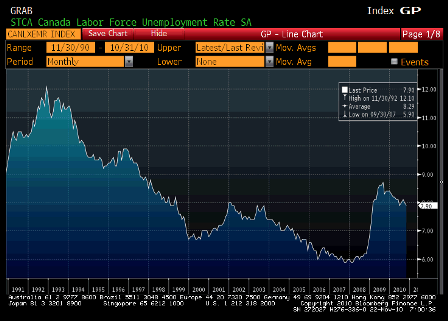
Doesn’t look like Canada was all that immune from the crisis to me?

Ok, their banks didn’t fail or need data transfered from one account at the Bank of Canada to another to keep them open for business.

So what? Look what happened to unemployment- real life for real people.

And it’s still a good 2% higher than it was only a couple of years or so ago.

And we are in a resource boom.

Yes, unemployment benefits are said to be generous, so out of work people maybe don’t suffer as much financially as in other places. But taking them at their word, and if history is any guide, they would take a job at reasonable pay and produce useful output if there were jobs available.

Yes, their federal budget deficit remains too small/ unemployment too high.
And they aspire to sustaining a federal budget surplus and high net export revenues, which, if successful, means reduced real terms of trade and a standard of living lower than otherwise.

My proposal- offer a national service job to anyone willing and able to work that pays a bit more than unemployment, and then cut taxes or increase public spending (depending on politics/needs) until that pool of labor in that national service job gets down to maybe 3% of the labor force, which will also coincide with a pretty good measure of what the current full employment deficit is.

Barrons Cover Story Spending

>   
>   (email exchange)
>   
>   On Sun, Nov 21, 2010 at 11:50 PM, Bob wrote:
>   
>   Don’t underestimate the amount people will possibly spend this holiday season.
>   
>   90 Percent have jobs, and they are NOT as worried as they were in 2008 and 2009
>   about Losing their jobs. This can create a good environment for stocks going
>   forward.
>   
>   There is a lot of corporate and consumer cash on the sidelines and they could
>   be feeling a bit better about spending it now and going forward.
>   

Moreover, household financial obligations—defined as debt and lease payments, rent, home insurance and property taxes—have fallen to 17% of disposable income, down from an all-time high of 18.9% in the third quarter of 2007 and below the 30-year average of 17.2%, notes James Paulsen, chief investment strategist at Wells Capital Management.

Yes, this is the direct result of the large federal budger deficit.

Reflected in those numbers is a sharp increase in the personal savings rate, which rose to a peak of 8.2% in May 2009 from as little as 0.8% in April 2005. The savings rate—the percentage of personal income that isn’t consumed—since has fallen back to 5.3%.

Yes, this is the direct result of the large federal budger deficit.

The savings rate typically rises during recessions and falls amid recoveries, as the public grows more confident about the future. Economists such as Paulsen expect that the savings rate will plateau around current levels.

Yes, this is the direct result of the large federal budger deficit.

A Better Balance Sheet

Household debt has fallen by about $1 trillion, to $11.5 trillion, since the fourth quarter of 2008…

Yes, this is the direct result of the large federal budger deficit.

If the Bush tax cuts aren’t extended for those making at least $250,000 a year, some $65 billion will start coming out of their paychecks and pockets starting Jan. 1. The potential hit to consumer spending could be significant, because although this group represents only 18% of U.S. taxpayers, they account for 35% of spending, notes ConsumerEdge Research.

Yes, reducing the federal deficit is contractionary.

MANY AMERICAN CONSUMERS still have too much debt, and potential threats such as renewed inflation, rising interest rates and higher taxes could prove formidable obstacles to a recovery in spending. But John Q. Wal-Mart and Jane Q. Saks have worked hard in the past two years—certainly harder than their Uncle Sam—to mend their financial health. They could be in much better shape than you think.

Yes, this is the direct result of the large federal budger deficit.

Comments on BS2 (Bernanke speech #2)

Rebalancing the Global Recovery

Chairman Ben S. Bernanke

November 19, 2010

The global economy is now well into its second year of recovery from the deep recession triggered by the most devastating financial crisis since the Great Depression. In the most intense phase of the crisis, as a financial conflagration threatened to engulf the global economy, policymakers in both advanced and emerging market economies found themselves confronting common challenges. Amid this shared sense of urgency, national policy responses were forceful, timely, and mutually reinforcing. This policy collaboration was essential in averting a much deeper global economic contraction and providing a foundation for renewed stability and growth.

The main policy response as the automatic fiscal stabilizers that, fortunately were in place to cut govt revenues and increase transfer payments, automatically raising the federal deficit to levels where it added sufficient income and savings of financial assets to support aggregate demand at current levels. And while the contents selected weren’t my first choice, the fiscal stimulus package added some support as well.

In recent months, however, that sense of common purpose has waned. Tensions among nations over economic policies have emerged and intensified, potentially threatening our ability to find global solutions to global problems. One source of these tensions has been the bifurcated nature of the global economic recovery: Some economies have fully recouped their losses

Those who have sustained adequate domestic aggregate demand through appropriate fiscal policy.

while others have lagged behind.

Those who have not had adequate fiscal responses.

But at a deeper level, the tensions arise from the lack of an agreed-upon framework to ensure that national policies take appropriate account of interdependencies across countries and the interests of the international system as a whole. Accordingly, the essential challenge for policymakers around the world is to work together to achieve a mutually beneficial outcome–namely, a robust global economic expansion that is balanced, sustainable, and less prone to crises.

Unfortunately, that would require an understanding of monetary operations and that a currency is a (simple) public monopoly. And with that comes the understanding that the us, for example, is far better off going it alone.

The Two-Speed Global Recovery
International policy cooperation is especially difficult now because of the two-speed nature of the global recovery. Specifically, as shown in figure 1, since the recovery began, economic growth in the emerging market economies (the dashed blue line) has far outstripped growth in the advanced economies (the solid red line). These differences are partially attributable to longer-term differences in growth potential between the two groups of countries, but to a significant extent they also reflect the relatively weak pace of recovery thus far in the advanced economies. This point is illustrated by figure 2, which shows the levels, as opposed to the growth rates, of real gross domestic product (GDP) for the two groups of countries. As you can see, generally speaking, output in the advanced economies has not returned to the levels prevailing before the crisis, and real GDP in these economies remains far below the levels implied by pre-crisis trends. In contrast, economic activity in the emerging market economies has not only fully made up the losses induced by the global recession, but is also rapidly approaching its pre-crisis trend. To cite some illustrative numbers, if we were to extend forward from the end of 2007 the 10-year trends in output for the two groups of countries, we would find that the level of output in the advanced economies is currently about 8 percent below its longer-term trend, whereas economic activity in the emerging markets is only about 1-1/2 percent below the corresponding (but much steeper) trend line for that group of countries. Indeed, for some emerging market economies, the crisis appears to have left little lasting imprint on growth. Notably, since the beginning of 2005, real output has risen more than 70 percent in China and about 55 percent in India.

No mention of the size of the budget deficits in those nations, not forgetting to include lending by state owned institutions that is, functionally, deficit spending.

In the United States, the recession officially ended in mid-2009, and–as shown in figure 3–real GDP growth was reasonably strong in the fourth quarter of 2009 and the first quarter of this year.

Mainly a bounce from an oversold inventory position due to the prior fear mongering and real risks of systemic failure.

However, much of that growth appears to have stemmed from transitory factors, including inventory adjustments and fiscal stimulus. Since the second quarter of this year, GDP growth has moderated to around 2 percent at an annual rate, less than the Federal Reserve’s estimates of U.S. potential growth and insufficient to meaningfully reduce unemployment. And indeed, as figure 4 shows, the U.S. unemployment rate (the solid black line) has stagnated for about eighteen months near 10 percent of the labor force, up from about 5 percent before the crisis; the increase of 5 percentage points in the U.S. unemployment rate is roughly double that seen in the euro area, the United Kingdom, Japan, or Canada. Of some 8.4 million U.S. jobs lost between the peak of the expansion and the end of 2009, only about 900,000 have been restored thus far. Of course, the jobs gap is presumably even larger if one takes into account the natural increase in the size of the working age population over the past three years.

Of particular concern is the substantial increase in the share of unemployed workers who have been without work for six months or more (the dashed red line in figure 4). Long-term unemployment not only imposes extreme hardship on jobless people and their families, but, by eroding these workers’ skills and weakening their attachment to the labor force, it may also convert what might otherwise be temporary cyclical unemployment into much more intractable long-term structural unemployment. In addition, persistently high unemployment, through its adverse effects on household income and confidence, could threaten the strength and sustainability of the recovery.

Low rates of resource utilization in the United States are creating disinflationary pressures. As shown in figure 5, various measures of underlying inflation have been trending downward and are currently around 1 percent, which is below the rate of 2 percent or a bit less that most Federal Open Market Committee (FOMC) participants judge as being most consistent with the Federal Reserve’s policy objectives in the long run.1 With inflation expectations stable, and with levels of resource slack expected to remain high, inflation trends are expected to be quite subdued for some time.

Yes, the FOMC continues to fear deflation.

Monetary Policy in the United States
Because the genesis of the financial crisis was in the United States and other advanced economies, the much weaker recovery in those economies compared with that in the emerging markets may not be entirely unexpected (although, given their traditional vulnerability to crises, the resilience of the emerging market economies over the past few years is both notable and encouraging). What is clear is that the different cyclical positions of the advanced and emerging market economies call for different policy settings. Although the details of the outlook vary among jurisdictions, most advanced economies still need accommodative policies to continue to lay the groundwork for a strong, durable recovery. Insufficiently supportive policies in the advanced economies could undermine the recovery not only in those economies, but for the world as a whole. In contrast, emerging market economies increasingly face the challenge of maintaining robust growth while avoiding overheating, which may in some cases involve the measured withdrawal of policy stimulus.

Let me address the case of the United States specifically. As I described, the U.S. unemployment rate is high and, given the slow pace of economic growth, likely to remain so for some time. Indeed, although I expect that growth will pick up and unemployment will decline somewhat next year, we cannot rule out the possibility that unemployment might rise further in the near term, creating added risks for the recovery. Inflation has declined noticeably since the business cycle peak, and further disinflation could hinder the recovery. In particular, with shorter-term nominal interest rates close to zero, declines in actual and expected inflation imply both higher realized and expected real interest rates, creating further drags on growth.2 In light of the significant risks to the economic recovery, to the health of the labor market, and to price stability, the FOMC decided that additional policy support was warranted.

Again, fear of deflation, especially via expectations theory.

The Federal Reserve’s policy target for the federal funds rate has been near zero since December 2008,

And not done the trick. And no mention that the interest income channels might be the culprits.

so another means of providing monetary accommodation has been necessary since that time. Accordingly, the FOMC purchased Treasury and agency-backed securities on a large scale from December 2008 through March 2010,

Further reducing interest income earned by the private sector.

a policy that appears to have been quite successful in helping to stabilize the economy and support the recovery during that period.

I attribute the stabilization to the automatic fiscal stabilizers increasing federal deficit spending, adding that much income and savings to the economy.

Following up on this earlier success, the Committee announced this month that it would purchase additional Treasury securities. In taking that action, the Committee seeks to support the economic recovery, promote a faster pace of job creation, and reduce the risk of a further decline in inflation that would prove damaging to the recovery.

Although securities purchases are a different tool for conducting monetary policy than the more familiar approach of managing the overnight interest rate, the goals and transmission mechanisms are very similar. In particular, securities purchases by the central bank affect the economy primarily by lowering interest rates on securities of longer maturities,

Very good! Looks like the officials in monetary operations have finally gotten the point across. It’s been no small effort.

just as conventional monetary policy, by affecting the expected path of short-term rates, also influences longer-term rates. Lower longer-term rates in turn lead to more accommodative financial conditions, which support household and business spending. As I noted, the evidence suggests that asset purchases can be an effective tool; indeed, financial conditions eased notably in anticipation of the Federal Reserve’s policy announcement.

Incidentally, in my view, the use of the term “quantitative easing” to refer to the Federal Reserve’s policies is inappropriate. Quantitative easing typically refers to policies that seek to have effects by changing the quantity of bank reserves, a channel which seems relatively weak, at least in the U.S. context.

While the channel is more than weak- it doesn’t even exist- even here his story has improved.

In contrast, securities purchases work by affecting the yields on the acquired securities and, via substitution effects in investors’ portfolios, on a wider range of assets.

Leaving out that they remove interest income from the private sector.

This policy tool will be used in a manner that is measured and responsive to economic conditions. In particular, the Committee stated that it would review its asset-purchase program regularly in light of incoming information and would adjust the program as needed to meet its objectives. Importantly, the Committee remains unwaveringly committed to price stability and does not seek inflation above the level of 2 percent or a bit less that most FOMC participants see as consistent with the Federal Reserve’s mandate. In that regard, it bears emphasizing that the Federal Reserve has worked hard to ensure that it will not have any problems exiting from this program at the appropriate time. The Fed’s power to pay interest on banks’ reserves held at the Federal Reserve will allow it to manage short-term interest rates effectively and thus to tighten policy when needed, even if bank reserves remain high. Moreover, the Fed has invested considerable effort in developing tools that will allow it to drain or immobilize bank reserves as needed to facilitate the smooth withdrawal of policy accommodation when conditions warrant. If necessary, the Committee could also tighten policy by redeeming or selling securities.

Not bad!

The foreign exchange value of the dollar has fluctuated considerably during the course of the crisis, driven by a range of factors. A significant portion of these fluctuations has reflected changes in investor risk aversion, with the dollar tending to appreciate when risk aversion is high. In particular, much of the decline over the summer in the foreign exchange value of the dollar reflected an unwinding of the increase in the dollar’s value in the spring associated with the European sovereign debt crisis.

Agreed.

The dollar’s role as a safe haven during periods of market stress stems in no small part from the underlying strength and stability that the U.S. economy has exhibited over the years.

Further supported by the desire of foreign govts to support exports to the US, but that is a different matter.

Fully aware of the important role that the dollar plays in the international monetary and financial system, the Committee believes that the best way to continue to deliver the strong economic fundamentals that underpin the value of the dollar, as well as to support the global recovery, is through policies that lead to a resumption of robust growth in a context of price stability in the United States.

This is a bit defensive, as it implies he does believe QE itself weakens the dollar in the near term. If he knew that wasn’t the case he would have stated it all differently.

In sum, on its current economic trajectory the United States runs the risk of seeing millions of workers unemployed or underemployed for many years. As a society, we should find that outcome unacceptable. Monetary policy is working in support of both economic recovery and price stability, but there are limits to what can be achieved by the central bank alone. The Federal Reserve is nonpartisan and does not make recommendations regarding specific tax and spending programs. However, in general terms, a fiscal program that combines near-term measures to enhance growth with strong, confidence-inducing steps to reduce longer-term structural deficits would be an important complement to the policies of the Federal Reserve.

Ok, it’s something.

But how about repeating that operationally, govt spending is not constrained by revenues, and therefore there is no solvency problem? That’s not politics, just monetary operations.

He could also explain how tsy secs are functionally nothing more than time deposits at the Fed, while reserves are overnight deposits, and funding the deficit and paying it down are nothing more than shifting dollar balances from reserve accounts to securities accounts, and from securities accounts to reserve accounts.

And he could spell out the accounting identity that govt deficits add exactly that much to net financial assets of the non govt sectors.

In other words, he could easily dispel the deficit myths that are preventing the policy he is recommending.

So why not???

Global Policy Challenges and Tensions
The two-speed nature of the global recovery implies that different policy stances are appropriate for different groups of countries. As I have noted, advanced economies generally need accommodative policies to sustain economic growth. In the emerging market economies, by contrast, strong growth and incipient concerns about inflation have led to somewhat tighter policies.

Unfortunately, the differences in the cyclical positions and policy stances of the advanced and emerging market economies have intensified the challenges for policymakers around the globe. Notably, in recent months, some officials in emerging market economies and elsewhere have argued that accommodative monetary policies in the advanced economies, especially the United States, have been producing negative spillover effects on their economies. In particular, they are concerned that advanced economy policies are inducing excessive capital inflows to the emerging market economies, inflows that in turn put unwelcome upward pressure on emerging market currencies and threaten to create asset price bubbles. As is evident in figure 6, net private capital flows to a selection of emerging market economies (based on national balance of payments data) have rebounded from the large outflows experienced during the worst of the crisis. Overall, by this broad measure, such inflows through the second quarter of this year were not any larger than in the year before the crisis, but they were nonetheless substantial. A narrower but timelier measure of demand for emerging market assets–net inflows to equity and bond funds investing in emerging markets, shown in figure 7–suggests that inflows of capital to emerging market economies have indeed picked up in recent months.

To a large degree, these capital flows have been driven by perceived return differentials that favor emerging markets, resulting from factors such as stronger expected growth–both in the short term and in the longer run–and higher interest rates, which reflect differences in policy settings as well as other forces. As figures 6 and 7 show, even before the crisis, fast-growing emerging market economies were attractive destinations for cross-border investment. However, beyond these fundamental factors, an important driver of the rapid capital inflows to some emerging markets is incomplete adjustment of exchange rates in those economies, which leads investors to anticipate additional returns arising from expected exchange rate appreciation.

The exchange rate adjustment is incomplete, in part, because the authorities in some emerging market economies have intervened in foreign exchange markets to prevent or slow the appreciation of their currencies. The degree of intervention is illustrated for selected emerging market economies in figure 8. The vertical axis of this graph shows the percent change in the real effective exchange rate in the 12 months through September. The horizontal axis shows the accumulation of foreign exchange reserves as a share of GDP over the same period. The relationship evident in the graph suggests that the economies that have most heavily intervened in foreign exchange markets have succeeded in limiting the appreciation of their currencies. The graph also illustrates that some emerging market economies have intervened at very high levels and others relatively little. Judging from the changes in the real effective exchange rate, the emerging market economies that have largely let market forces determine their exchange rates have seen their competitiveness reduced relative to those emerging market economies that have intervened more aggressively.

It is striking that, amid all the concerns about renewed private capital inflows to the emerging market economies, total capital, on net, is still flowing from relatively labor-abundant emerging market economies to capital-abundant advanced economies. In particular, the current account deficit of the United States implies that it experienced net capital inflows exceeding 3 percent of GDP in the first half of this year. A key driver of this “uphill” flow of capital is official reserve accumulation in the emerging market economies that exceeds private capital inflows to these economies. The total holdings of foreign exchange reserves by selected major emerging market economies, shown in figure 9, have risen sharply since the crisis and now surpass $5 trillion–about six times their level a decade ago. China holds about half of the total reserves of these selected economies, slightly more than $2.6 trillion.

It is instructive to contrast this situation with what would happen in an international system in which exchange rates were allowed to fully reflect market fundamentals. In the current context, advanced economies would pursue accommodative monetary policies as needed to foster recovery and to guard against unwanted disinflation. At the same time, emerging market economies would tighten their own monetary policies to the degree needed to prevent overheating and inflation. The resulting increase in emerging market interest rates relative to those in the advanced economies would naturally lead to increased capital flows from advanced to emerging economies and, consequently, to currency appreciation in emerging market economies. This currency appreciation would in turn tend to reduce net exports and current account surpluses in the emerging markets, thus helping cool these rapidly growing economies while adding to demand in the advanced economies. Moreover, currency appreciation would help shift a greater proportion of domestic output toward satisfying domestic needs in emerging markets. The net result would be more balanced and sustainable global economic growth.

Given these advantages of a system of market-determined exchange rates, why have officials in many emerging markets leaned against appreciation of their currencies toward levels more consistent with market fundamentals? The principal answer is that currency undervaluation on the part of some countries has been part of a long-term export-led strategy for growth and development. This strategy, which allows a country’s producers to operate at a greater scale and to produce a more diverse set of products than domestic demand alone might sustain, has been viewed as promoting economic growth and, more broadly, as making an important contribution to the development of a number of countries. However, increasingly over time, the strategy of currency undervaluation has demonstrated important drawbacks, both for the world system and for the countries using that strategy.

First, as I have described, currency undervaluation inhibits necessary macroeconomic adjustments and creates challenges for policymakers in both advanced and emerging market economies. Globally, both growth and trade are unbalanced, as reflected in the two-speed recovery and in persistent current account surpluses and deficits. Neither situation is sustainable. Because a strong expansion in the emerging market economies will ultimately depend on a recovery in the more advanced economies, this pattern of two-speed growth might very well be resolved in favor of slow growth for everyone if the recovery in the advanced economies falls short. Likewise, large and persistent imbalances in current accounts represent a growing financial and economic risk.

Second, the current system leads to uneven burdens of adjustment among countries, with those countries that allow substantial flexibility in their exchange rates bearing the greatest burden (for example, in having to make potentially large and rapid adjustments in the scale of export-oriented industries) and those that resist appreciation bearing the least.

Third, countries that maintain undervalued currencies may themselves face important costs at the national level, including a reduced ability to use independent monetary policies to stabilize their economies and the risks associated with excessive or volatile capital inflows. The latter can be managed to some extent with a variety of tools, including various forms of capital controls, but such approaches can be difficult to implement or lead to microeconomic distortions. The high levels of reserves associated with currency undervaluation may also imply significant fiscal costs if the liabilities issued to sterilize reserves bear interest rates that exceed those on the reserve assets themselves. Perhaps most important, the ultimate purpose of economic growth is to deliver higher living standards at home; thus, eventually, the benefits of shifting productive resources to satisfying domestic needs must outweigh the development benefits of continued reliance on export-led growth.

Improving the International System
The current international monetary system is not working as well as it should. Currency undervaluation by surplus countries is inhibiting needed international adjustment and creating spillover effects that would not exist if exchange rates better reflected market fundamentals. In addition, differences in the degree of currency flexibility impose unequal burdens of adjustment, penalizing countries with relatively flexible exchange rates. What should be done?

The answers differ depending on whether one is talking about the long term or the short term. In the longer term, significantly greater flexibility in exchange rates to reflect market forces would be desirable and achievable. That flexibility would help facilitate global rebalancing and reduce the problems of policy spillovers that emerging market economies are confronting today. The further liberalization of exchange rate and capital account regimes would be most effective if it were accompanied by complementary financial and structural policies to help achieve better global balance in trade and capital flows. For example, surplus countries could speed adjustment with policies that boost domestic spending, such as strengthening the social safety net, improving retail credit markets to encourage domestic consumption, or other structural reforms. For their part, deficit countries need to do more over time to narrow the gap between investment and national saving. In the United States, putting fiscal policy on a sustainable path is a critical step toward increasing national saving in the longer term. Higher private saving would also help. And resources will need to shift into the production of export- and import-competing goods. Some of these shifts in spending and production are already occurring; for example, China is taking steps to boost domestic demand and the U.S. personal saving rate has risen sharply since 2007.

In the near term, a shift of the international regime toward one in which exchange rates respond flexibly to market forces is, unfortunately, probably not practical for all economies. Some emerging market economies do not have the infrastructure to support a fully convertible, internationally traded currency and to allow unrestricted capital flows. Moreover, the internal rebalancing associated with exchange rate appreciation–that is, the shifting of resources and productive capacity from production for external markets to production for the domestic market–takes time.

That said, in the short term, rebalancing economic growth between the advanced and emerging market economies should remain a common objective, as a two-speed global recovery may not be sustainable. Appropriately accommodative policies in the advanced economies help rather hinder this process. But the rebalancing of growth would also be facilitated if fast-growing countries, especially those with large current account surpluses, would take action to reduce their surpluses, while slow-growing countries, especially those with large current account deficits, take parallel actions to reduce those deficits. Some shift of demand from surplus to deficit countries, which could be compensated for if necessary by actions to strengthen domestic demand in the surplus countries, would accomplish two objectives. First, it would be a down payment toward global rebalancing of trade and current accounts, an essential outcome for long-run economic and financial stability. Second, improving the trade balances of slow-growing countries would help them grow more quickly, perhaps reducing the need for accommodative policies in those countries while enhancing the sustainability of the global recovery. Unfortunately, so long as exchange rate adjustment is incomplete and global growth prospects are markedly uneven, the problem of excessively strong capital inflows to emerging markets may persist.

Conclusion
As currently constituted, the international monetary system has a structural flaw: It lacks a mechanism, market based or otherwise, to induce needed adjustments by surplus countries, which can result in persistent imbalances. This problem is not new. For example, in the somewhat different context of the gold standard in the period prior to the Great Depression, the United States and France ran large current account surpluses, accompanied by large inflows of gold. However, in defiance of the so-called rules of the game of the international gold standard, neither country allowed the higher gold reserves to feed through to their domestic money supplies and price levels, with the result that the real exchange rate in each country remained persistently undervalued. These policies created deflationary pressures in deficit countries that were losing gold, which helped bring on the Great Depression.3 The gold standard was meant to ensure economic and financial stability, but failures of international coordination undermined these very goals. Although the parallels are certainly far from perfect, and I am certainly not predicting a new Depression, some of the lessons from that grim period are applicable today.4 In particular, for large, systemically important countries with persistent current account surpluses, the pursuit of export-led growth cannot ultimately succeed if the implications of that strategy for global growth and stability are not taken into account.

Thus, it would be desirable for the global community, over time, to devise an international monetary system that more consistently aligns the interests of individual countries with the interests of the global economy as a whole. In particular, such a system would provide more effective checks on the tendency for countries to run large and persistent external imbalances, whether surpluses or deficits. Changes to accomplish these goals will take considerable time, effort, and coordination to implement. In the meantime, without such a system in place, the countries of the world must recognize their collective responsibility for bringing about the rebalancing required to preserve global economic stability and prosperity. I hope that policymakers in all countries can work together cooperatively to achieve a stronger, more sustainable, and more balanced global economy.

And They’re Off!!!!!

:(

12 billion won’t break the economy but it’s a bad start for sure.

And they still have to act soon to stop the tax hikes coming at year end before withholding goes up.

Unemployment Aid Extension Blocked in House Over Cost Concerns

By Brian Faler

November 18 (Bloomberg) — A bill to extend jobless benefits for three months was defeated today in the U.S. House, increasing the odds that some of the nation’s long-term unemployed will start losing aid.
The measure fell short of the two-thirds majority needed for approval under an expedited process. The vote on the bill was 258 in favor, 154 opposed.

Republican lawmakers complained that the bill’s $12 billion cost would be added to the government’s budget deficit. They demanded offsetting savings elsewhere in the budget.

The vote was a replay of a partisan dispute earlier this year that led to benefits being cut off for some jobless people for more than a month. Aid again is set to expire Nov. 30 for some of the unemployed.

No firm number of those who would be affected was available, though Representative Sander Levin, a Michigan Democrat and chairman of the House Ways and Means committee, estimated almost 2 million Americans could see their aid cut off by the end of this year if Congress does not act.

The nation’s unemployment rate in October was 9.6 percent.

Congress will be out of session next week for the Thanksgiving holiday, which means lawmakers will have little time to find agreement by the end of this month.

“This bill is like déjà vu all over again, and not in a good way,” said Representative Charles Boustany, a Louisiana Republican. “We all want to help those in need but the American people also know someone has to pay when government spends money, and it shouldn’t be our children and grandchildren.”
Levin said, “I don’t see how we can go home for Thanksgiving when as a result of a failure of benefits, hundreds of thousands of people may not have a turkey on their table because they can’t afford it.”

Beyond risk off

So it was buy the rumor, buy the news, then watch it all fall apart a few days later.

QE was a major international event, with the word being that the ‘money printing’ would not only take down the dollar, but also spread ‘liquidity’ to the rest of the world through the US banking system, via some kind of ‘carry trades’ and who knows what else, or needed to know. It was just obvious…

So the entire world was front running QE in every currency, commodity, and equity market.

And the Fed announcement only brought in more international players, with money printing headlines screaming globally.

Then the ‘risk off’ unwinding phase started, reversing what had been driven by maybe three themes:

1. There were those who knew all along QE probably did not do anything of consequence, but went along for the ‘risk on’ ride believing others believed QE worked and would drive prices accordingly.

2. A group that thought originally QE might do something and piled in, but began having second thoughts about how effective QE might actually be after learning more about it, and decided to get out.

3. A third group who continue to believe QE does work, who got cold feed when they started doubting whether the Fed would actually follow through with enough QE, also for two reasons.
   a. the FOMC itself made it clear opinion was highly polarized, often for contradictory reasons
   b. the economy showed signs of modest growth that cast doubts on whether the Fed might
   think something as ‘powerful and risky’ as QE was still needed.

Reminds me some of the old quip- the food was terrible and the portions were small-
(QE is questionable policy and they aren’t going to do enough of it.)

So risk off continues in what have become fundamentally illiquid markets until some time after the speculative longs have been sold and the shorts covered.

Next question, what about after the smoke clears?

A. The dollar could remain strong even after the initial short covering ends- the modest GDP growth is slowly tightening fiscal, and crude oil prices are falling, both of which make dollars ‘harder to get’

It’s starting a kind of virtuous cycle where the stronger dollar moves crude lower which strengthens the dollar.
Also, the J curve works in reverse with other imports as well. As imports get cheaper, initially
the rest of world gets fewer dollars from exports to the US, until/unless volumes pick up.

The euro zone is again struggling with the idea of the ECB supporting the weaker members with secondary market bond purchases, as ECB imposed austerity measures are showing signs of decreasing revenues of the more troubled members. Seems taxpayers of the core members are resisting allowing the ECB to support the weaker members, and the core leaders are groping for something that works politically and financially. All this adds risk to holding euro financial assets, as even a small threat of a breakup jeopardizes the very existence of the euro.

Japan is on the way to fiscal easing while the US, UK, and euro zone are attempting to tighten fiscal.

Falling commodity prices hurt the commodity currencies.

B. Interest rates are moving higher as spec longs who bought the QE rumor and news are getting out.
But it looks to me like term rates could again move back down after this sell off has run its course.
The Fed still failing on both mandates- real growth is still modest at best, and the 0 rate policy is deflationary/contractionary enough for even a 9% budget deficit not to do much more than support gdp at muddling through levels, with a far too high output gap/unemployment rate.
And falling commodities, weak stocks, and a strong dollar give the Fed that much more reason not to hike.

C. A mixed bag for stocks.
Equity values have fallen after running up on the QE rumor/news, further supported by the dollar weakness that came with the QE rumor news, with the equity sell off now exacerbated by the dollar rally which hurts earnings translations and export prospects.

But a 9% federal deficit is still chugging away, adding to incomes and savings of financial assets, and providing for modest top line growth and ok earnings via cost cutting as well.

Fiscal risks include letting the tax cuts expire and proactive spending cuts by the new Congress which seems committed to austerity type measures.

Low interest rates help valuations but reduce the economy’s interest income.

China acting more like the inflation problem is serious. Hearing talk of price controls, as they struggle to sustain employment and keep a lid on prices, in a nation where inflation or unemployment have meant regime change. Looks to me like a slowdown can’t be avoided with the western educated kids now mostly in charge.

>   
>   (email exchange)
>   
>   On Wed, Nov 17, 2010 at 1:05 AM, Paul wrote:
>   
>   Very interesting — but I have a question:
>   
>   What if the deficit causes “saving” increase in financial assets held by
>   foreigners (via the trade imbalance) rather than US domestic households?
>   

Hi Paul!

That would mean we would get the additional benefit of enjoying a larger trade deficit, which means for a given size govt taxes can be that much lower.

Or, if we get sufficient domestic private sector deficit spending, govt deficit spending can remain the same and we benefit by the enhanced real terms of trade supported by the increased foreign savings desires.

Except of course policy makers don’t get it and squander the benefit of a larger trade deficit/better real terms of trade with a too low federal deficit (taxes too high for the given level of govt) that sadly results in domestic unemployment- currently a real cost beyond imagination.

Fundamentally, exports are real costs and imports real benefits, and net imports are a function of foreign savings desires.

So the higher the foreign savings desires the better the real terms of trade.

Also, with floating exchange rates, the way I see it, it’s always ‘in balance’ as the trade deficit = foreign savings desires.

Best!
Warren

Greenspan: High US Deficits Could Spark Bond Crisis

Something that’s never happened even once in the history of the world with fiat money and floating fx policy.

Greenspan: High US Deficits Could Spark Bond Crisis

November 14 (Reuters) — The United States must move to rein in its massive budget deficits or it faces the risk of a bond market crisis, former Federal Reserve Chairman Alan Greenspan said Sunday.

“We’ve got to resolve this issue,” Greenspan said of the ballooning U.S. debt levels.

He spoke about the issue as a panel, chaired by former White House chief of staff Erskine Bowles and former U.S. Senator Alan Simpson, is due to deliver a report on debt and deficits by Dec. 1.

A draft report made public last week offered a series of politically tough tax and spending choices that would seek to reduce the debt by $4 trillion by 2020.

The report received a lukewarm reception from some politicians and outright condemnation by others, including House of Representatives Speaker Nancy Pelosi, who pronounced the ideas “simply unacceptable.”

Greenspan, who spoke on NBC’s “Meet the Press,” said he believed “something equivalent to what Bowles and Simpson put out is going to be approved by Congress. But the only question
is whether it is before or after a crisis in the bond market.”

He said the risk is that the deficit, which hit $1.3 trillion this year, could spook the bond market. That would result in long-term interest rates moving up rapidly and could lead to a double-dip recession.

John Taylor (Mr Hedge Fubd FX — not Mr. Hoover Institute Economist :))

The highlighted part is what I was getting at previously.
The idea that QE does nothing is now reasonably well distributed.
Those holding positions include a lot of managers who highly suspect QE does nothing.
But they believe others who do believe QE is ‘inflationary money printing’ will keep driving prices.

Same with austerity. The idea that it makes things worse is taking hold, but those who believe it is a good thing- that govt borrowing takes away money from the private sector and all that nonsense- still have the upper hand.

But ‘reality’ is working against those out of paradigm, as the dollar is firming and the rest showing signs of coming apart as well.

As for Europe, it all holds as long as the ECB keeps buying bonds in the secondary market in sufficient size to keep shorter term yields reasonable. And comes apart when they don’t.

The problem is politically it isn’t ‘fair’ to spend euro resources on targeted nations, which carries with it the notion that all the others are ultimately paying for it, though they don’t know exactly how that will play out. So you see the core addressing that with loud noises of restructuring, etc. which may or may not happen. But the real possibility is there.

My proposal of the ECB making per capita distributions to all the member nations of, say 10% of GDP in the first round, would not carry that notion of ‘unfairness’

And as long as member nation spending was appropriately constrained politically there would be no inflation or monetary ramifications, apart from better credit ratings and the ability to fund existing deficits at lower risk premiums.

But it’s still not even a consideration, best I can tell.

Fasten Your Seatbelt
November 11, 2010
By John R. Taylor, Jr.
Chief Investment Officer, FX Concepts

‘… Although the world believes that QE2 is there to push the dollar sharply lower, Bernanke argued that his goal was something else. On the day after the Fed’s move, he wrote in a Washington Post editorial piece that QE2 would push up the equity market, bonds, and other risky securities thereby stimulating consumption and economic activity. Even Greenspan did not publicly proclaim his “put,” but now Bernanke has made it the centerpiece of US strategy. Equities are already overpriced, with profit margins at all-time highs and PE ratios far above average. Speculation is now more American than apple pie – but this is a very risky time to practice it. As one highly respected analyst noted about Bernanke’s article, “these are undoubtedly among the most ignorant remarks ever made by a central banker.” As we and many others have noted that QE has shown little or no positive impact on actual economic activity, so the Fed has taken a big gamble, and if it fails as we expect it will have nowhere else to go. With the Republican victory tainted by the Tea Party “starve the beast” mentality, austerity has come to Washington. This next year will be a terrible one for the world’s biggest economy, so we would go against Bernanke on the equity side, but buy government bonds along with him…’

from John Mauldin

>   
>   (email exchange)
>   
>   On Sat, Nov 6, 2010 at 7:10 AM, wrote:
>   
>   The yield spreads on Irish and Spanish bonds are blowing out even as we speak, as
>   well as those on the rest of the periphery. While all eyes are on the Fed, the real action
>   may be in Europe.
>   

Agreed! The question remains, is the ECB still there to backstop short term funding. So far seems yes.
It’s entirely a political decision. Think of the euro zone as an under water city, with the ECB controlling the air supply.

Also, I like the next chart. A 9% federal budget deficit is so far been enough to muddle through with very modest GDP growth and stabilize employment, albeit at very low levels. With a proactive fiscal adjustment, it doesn’t get much better until consumer credit expansion kicks in, which could be quite a while.

It also looks to me like a dollar rally that will revive deflation fears might still be in the cards, as it’s been sold mainly based on a misunderstanding of QE.

A Few Thoughts on the Employment Numbers

By Dr. Lacy Hunt, Hoisington Investment Mgt. Co.

The October employment situation was dramatically weaker than the headline 159k increase in the payroll employment measure. The broader household employment fell 330k. The only reason that the unemployment rate held steady is that 254k dropped out of the labor force. The civilian labor force participation rate fell to a new low of 64.5%, indicating that people do not believe that jobs are available, but this serves to hold the unemployment rate down. In addition, the employment-to-population ratio fell to 58.3%, the lowest level in nearly 30 years.

While not actually knowing what happened to the net job change in the non-surveyed small business sector, the Labor Department assumed that 61k jobs were created in that sector. This assumption is not supported by such important private surveys as those from the National Federation of Independent Business or by ADP. Just a month ago the Labor Department had to revise downward the job totals due to a serious overcount of their statistical artifact known as the Birth/Death Model.


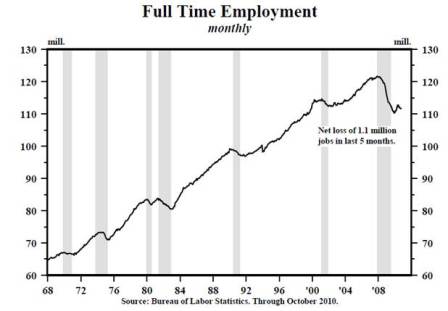
The most distressing aspect of this report is that the US economy lost another 124K full-time jobs, thus bringing the five-month loss to 1.1 million in this most critical of all employment categories. In an even more significant sign, the level of full-time employment in October was at the same level that was reached originally in December 1999, almost 11 years ago (see attached chart). An economy cannot generate income growth by continuing to substitute part-time work for full-time employment. This loss of full-time jobs goes a long way to explain why real personal income less transfer payments has been unchanged since May.

The weakness in real income is probably lost in an environment in which the Fed is touting the gain in stock prices and consumer wealth resulting from the latest quantitative easing (QE), but QE has unintended negative consequences for real household income. Due to higher prices of energy and food commodities, QE may result in less funds for discretionary spending for consumers whose incomes are stagnant. Also, with five-year yields falling below 1%, rates on CDs and other types of short-term bank deposits will decline, also cutting into household income. At the end of the day these effects will be more powerful than any stock-price boost in consumer spending, which, as always, will be very small and slow to materialize.

To have a broad-based recovery, the manufacturing sector must participate. Contrary to the ISM survey, manufacturing jobs fell 7k, the third consecutive drop, resulting in a net loss over the past three months of 35k.

In summary, the latest economic developments indicate a slight worsening of underlying fundamental conditions.