UBS: China’s energy imports soar by the back door!!!!


[Skip to the end]

Report by Andrew at UBS LIMITED

China – You will have seen in the FT that China plans to encourage its agricultural industry to start buying up land in Africa and Latin America to grow crops on for the Chinese market.

Last year the Chinese National Development & Reform Commission said that China will import the equivalent of 6% of the U.S. corn harvest by 2010. That works out at 38% of U.S. exports or 25% of world exports. A week or two back the Chinese Academy of Social Sciences said that China now has a shortfall of agricultural land equivalent to 17% of what it needs to support its population. Yesterday the Ministry of Agriculture said it is becoming increasingly difficult to sustain self-sufficiency.

This is why global grain prices are soaring, and are going to continue soaring. It is due to top soil mining and water depletion in China, and they are now clearly starting to call on the rest of the world to do the same.

Putting aside the strain this will have on the rest of the world’s land, it also does two other things. Grains have 2 real inputs. Energy (fertilizers) and water. So by importing grains, it is importing embedded energy and embedded water, and on a HUGE scale.

China is running out of water and is going through peak coal production, but rather than buying the energy on the open market and then desalinating the water it needs – (it would require 3% of world oil production to desalinate the scale of water needed just to stand still) – it is going to buy this in an embedded form. It does make some sense in that China has depleted its land so aggressively – (it has lost about 75% of its top soil in the last 30 years, and is consuming way beyond sustainable levels of water) that it will take less energy to produce grains in other parts of the world than in China, BUT that means paying world prices for the energy rather than with Chinese subsidized fertilizer and water prices. Food prices are going to soar. The terms of trade are going to continue to move against China.

You will have seen today that Thailand is warning that its rice yield could fall by 75% by year end. To meet global needs, it is doing a 3 crop harvest this year. That means the land is getting no respite, and the paddy fields are exhausting its water resources. The head of the government’s rice department has warned that this could seriously damage yields for many years, losing it the position as the world’s largest rice exporter. Rice is a very nitrogen dependent crop. That is why it is grown in paddy fields as the water stops nitrogen loss from the soil, and nitrogen rich algae grow on the stagnant water to form a living fertilizer. With the water depleting, Thailand is having to turn to buying nitrogen based fertilizers (natural gas is the cheapest way of making this), adding to the global call on energy.

Quite frankly, food and energy prices are only going one way until Chinese demand is priced out of the market. The problem is that China’s lands and water are so destroyed now, that it is going to become increasingly impossible for it to maintain existing production. Talk of bringing more land in the old Soviet Union or Africa under production seems wishful thinking. If you recall the Soviet Union destroyed its own land in the 1960’s under the various 5 year plans which caused it to import 25% of the U.S. grain harvest in the 1970’s causing the food price rises then. African land quality is also generally poor – (Northern African soils destroyed by the Roman Empire’s over exploitation, and then in recent years the use of fertilizers managed to lift agricultural yields heavily, but the land has deteriorated at the same time), and Africa, like Eastern Europe (and in fact every continent other than North America is a net grain importer. Food and energy price inflation is not a temporary issue, prices are going higher.

Dave from AVM comments on the article:

Good piece, highlights a few more things we have been talking about for a few months:

  1. Farming inputs ARE energy and water, energy for fertilizer (NG) and also diesel/kero for farm equipment (together something like 50+% of US farmer’s COGS)
  2. Diesel also a call on NG, as “cleaning” fuel (lowering sulfur content) requires hydrogen which is usually a byproduct of active gasoline refining (not this year, yet). In the absence of an increase in refinery utilization rates, hydrogen will be increasingly cracked with natural gas (which is still cheap fuel versus petroleum on a molecular basis)
  3. China also importing more LNG on long term contract basis, putting pressure on domestic US natural gas prices (we have to compete for LNG cargos (spot) when there are domestic NG shortages [we have a 300bcf deficit today to last year’s levels, before summer cooling demand begins in earnest])
  4. Coal issues mentioned are true, but coal still difficult to trade effectively. Better expressed in regional power markets.
  5. Abandoning ethanol mandates now (as opposed to Nov EPA vote) to have little impact on ethanol/implied corn demand with crude 120+

We think grains and natural gas prices to rise jointly over next 6 months by 20%+. Power to follow but with extremely high volatility in the summer months, and large positive skew in the shoulders (june and sep).

If food’s as tight as indicated below, world tensions will get a lot worse than anyone currently imagines, including large regional wars.

Eliminating biofuels could buy a few years, cutting national speed limits a few more and perhaps even stabilize things for the next 25 years.


[top]

2008-05-07 US Economic Releases


[Skip to the end]


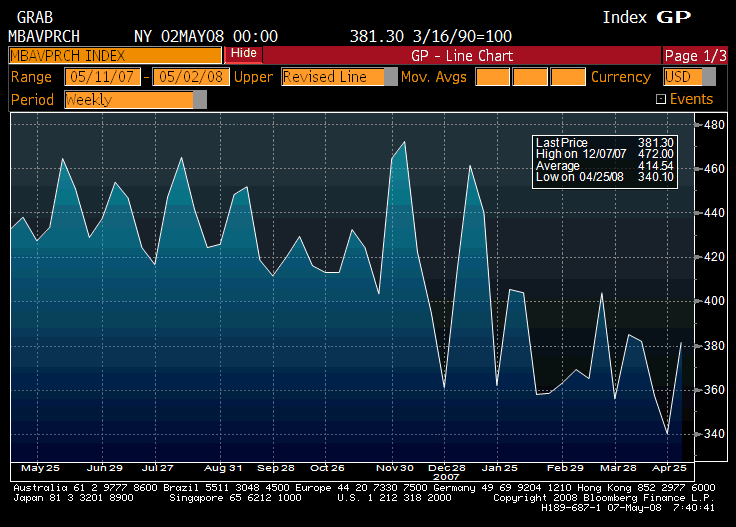
2008-05-07 MBAVPRCH Index

MBAVPRCH Index (May 2)

Survey n/a
Actual 381.3
Prior 340.1
Revised n/a

Seems to have at least stabilized.

[top] [end]


2008-05-07 MBAVREFI Index

MBAVREFI Index (May 2)

Survey n/a
Actual 2773.8
Prior 1905.2
Revised n/a

Doing okay.

[top][end]


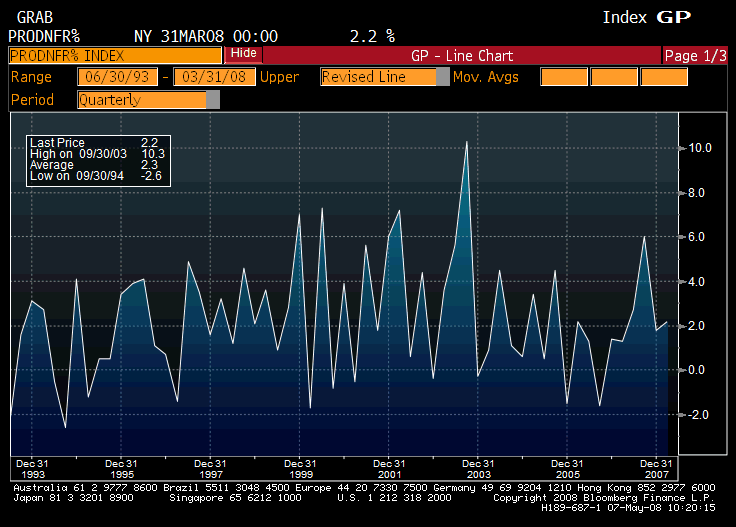
2008-05-07 Nonfarm Productivity

Nonfarm Productivity (1Q P)

Survey 1.5%
Actual 2.2%
Prior 1.9%
Revised 1.8%

Better than expected. Usually rises with output.

[top][end]


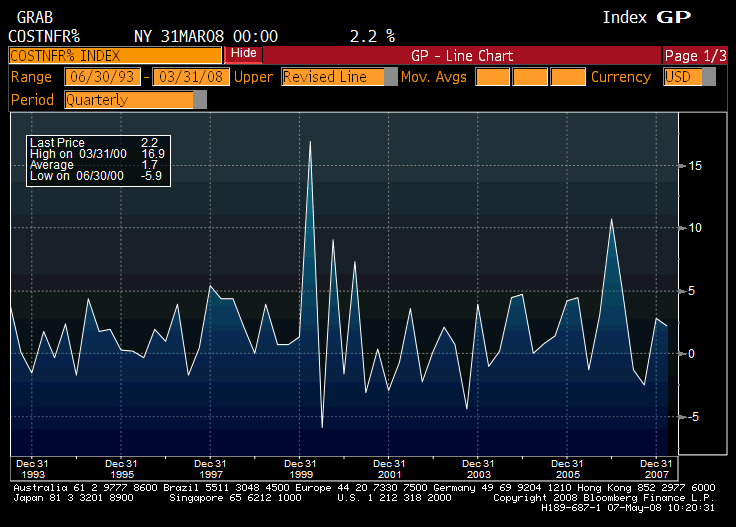
2008-05-07 Unit Labor Costs

Unit Labor Costs (1Q P)

Survey 2.6%
Actual 2.2%
Prior 2.6%
Revised 2.8%

Better then expected, prior revised up. This series isn’t doing much.

Look to imports from China for a handle on unit labor costs as well.

[top][end]


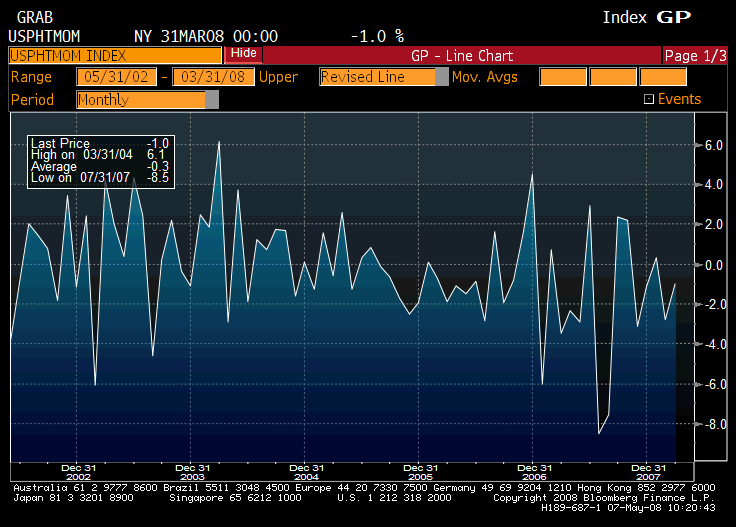
2008-05-07 Pending Home Sales MoM

Pending Home Sales MoM (Mar)

Survey -1.0%
Actual -1.0%
Prior -1.9%
Revised -2.8%

Still falling some, seasonally adjusted, and with actual inventory going down there is less to buy.

[top][end]


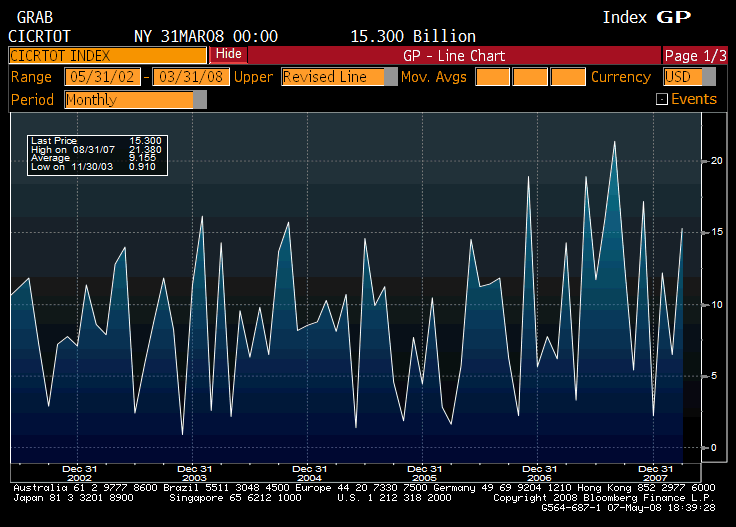
2008-05-07 Consumer Credit

Consumer Credit (Mar)

Survey $6.0B
Actual $15.3B
Prior $5.2B
Revised $6.5B

Volatile series.
Seems to be holding up as incomes hold up.

[top]

2008-05-03 Weekend update (in brief)


[Skip to the end]

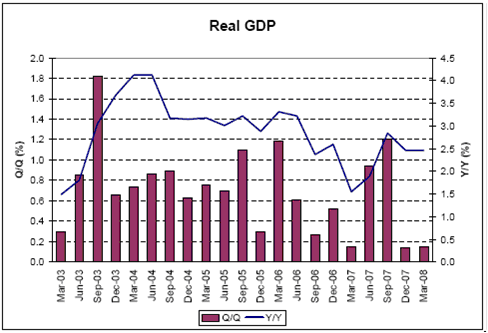
2008-05-03 Real GDP

No recession here, and Q1 likely to be revised higher when March trade numbers come out.

Q3 could be 2% depending on the multiplier from the fiscal package, and by Q3 other government spending will be kicking in for the elections and housing is unlikely to be subtracting from GDP. It could even be adding by then.

As suspected, the current weak housing market has been offset by strong exports.

Financial sector losses have nothing to do with GDP unless they somehow reduce aggregate demand.

The prime suspect was the credit channel, but so far the evidence shows only limited damage due to tighter credit conditions, and not the downward spiral feared by the Fed and many other private economists.

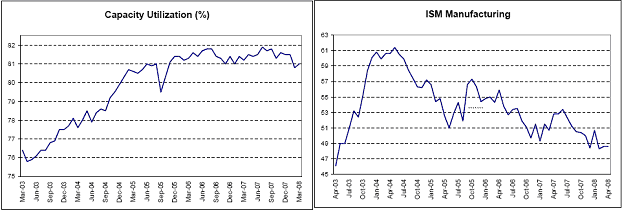
2008-05-03 Capacity Utilization, ISM Manufacturing

On the soft side, but no recession.

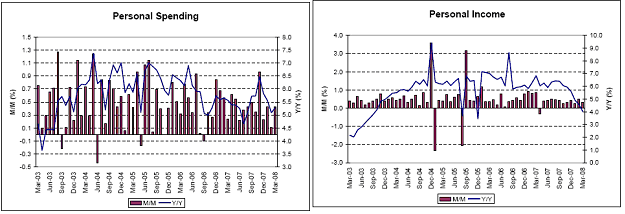
2008-05-03 Personal Spending, Personal Income

The consumer is muddling through as best as can be expected in an export economy.

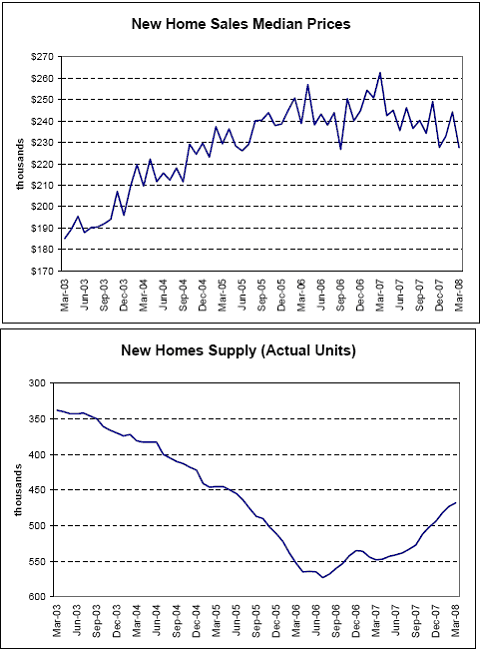
2008-05-03 New Home Sales Median Prices, New Home Suppy (Actual Units)

Median prices are soft and may or may not have bottomed, as actual inventories have worked their way down to relatively normal levels for a relatively normal sales pace (which we don’t have yet).

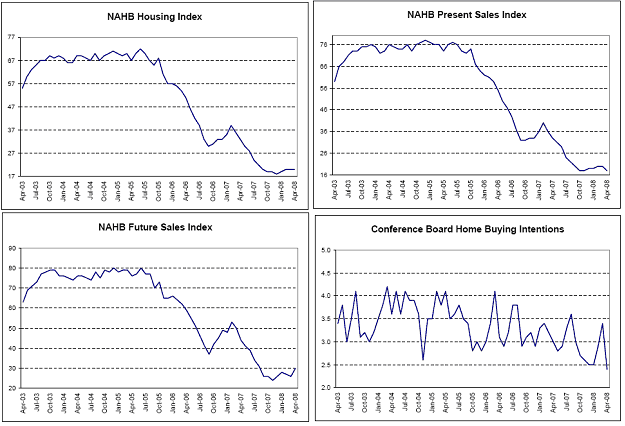
2008-05-03 NAHB Housing Index, NAHB Present Sales Index, NAHB Future Sales Index, Conference Board Home Buying Intentions

The bulk of the adjustment may have been bottoming around October/November.

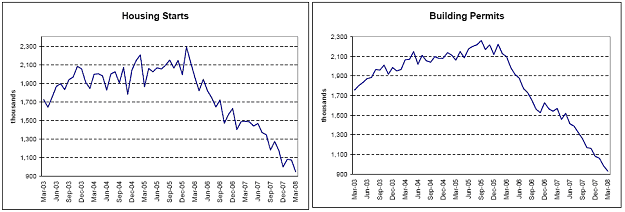
2008-05-03 Housing Starts, Building Permits

Low starts have reduced supply as builders and buyers remain cautious.

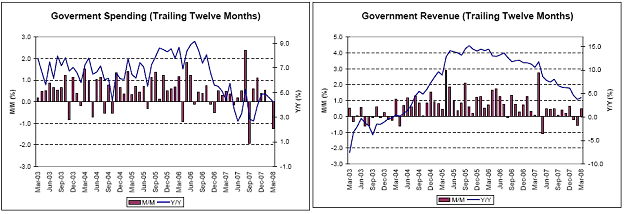
2008-05-03 Government Spending, Government Revenue

Government spending is roaring back and added nicely to Q1 GDP (March print above has timing issues and wasn’t functionally as low as indicated).

Revenue also holding up, indicating no recession yet.

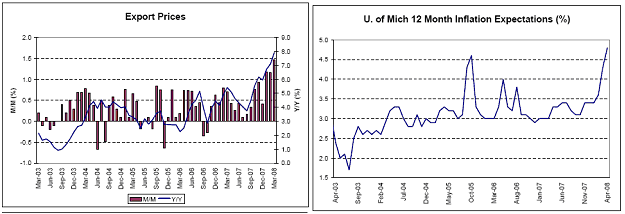
2008-05-03 Export Prices, U. of Michigan 12 Month Inflation Expectations

Every price chart is looking higher, and expectations have elevated, and the Fed keeps cutting rates. Who would’ve thought?

Fisher and Plosser make the mainstream case and are outvoted.

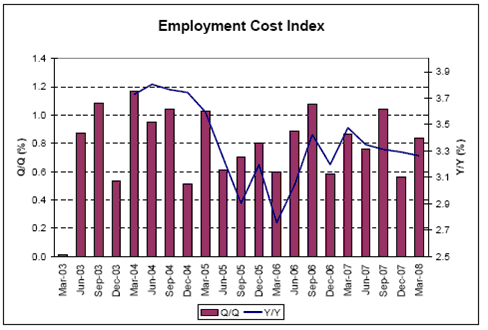
2008-05-03 Employment Cost Index

Wages remain ‘well contained’.

(If you don’t count import prices from China..)

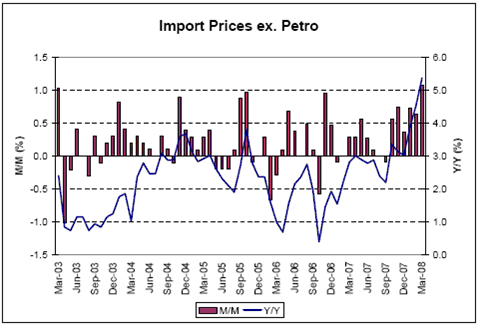
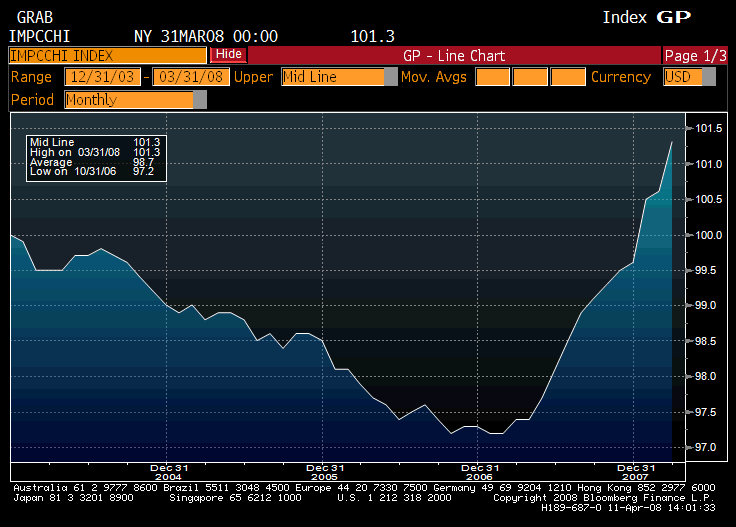
2008-05-03 Import Prices ex. Petro

Globalization is now inflationary.

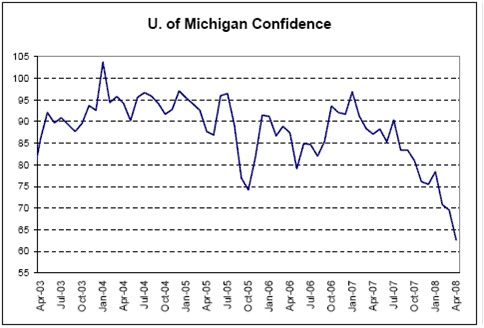
2008-05-03 U. of Michigan Confidence

All the confidence surveys look about this weak, and at recession type levels, and about 90% of voters think we are in a recession.

American’s aren’t used to an export economy with declining real terms of trade – a mercantilist concept publicly supported by Bernanke and Paulson.

And they don’t seem to like it.


[top]

2008-04-24 China News Highlights

Interesting statements here. China can’t afford politically to allow growth to slow sufficiently to cut employment growth, inflation not withstanding. This stance ultimately weakens the currency, one way or another:

(Bloomberg) China should stick with its tight monetary policy unless the economy’s expansion slows to below 9 percent, a National Bureau of Statistics official said. “Below 9 percent, it means the tightening is overdone and needs to be loosened,” Zheng Jingping, the bureau’s chief engineer, said at a seminar in Beijing today. The economy expanded by 10.6 percent in the first quarter. Premier Wen Jiabao is balancing the risk of a slump in the world’s fastest-growing major economy against the threat from inflation that is close to an 11-year high. A 1 percentage point slowdown in the U.S. economy will take 5 percentage points off China’s export growth, the Chinese Academy of Social Sciences said in a report today. “A reasonable combination for this year is 4.8 percent inflation and 9.7 percent GDP growth,” said Zheng. Inflation may be between 4.5 percent and 5.5 percent, he added. The government aims to cap price gains at 4.8 percent.

Highlights:

Shanghai Stock Index Surges 9.3%, Most in Six Years, After China Cuts Tax (Bloomberg)
China Economic Growth Must Stay Above 9 Percent, Statistics Official Says (Bloomberg)
Yuan Declines as Chinese Export Growth May Slow Further, Dollar Rebounding (Bloomberg)
China to Expand Oil Refining Capacity by 24% by 2010, Sinopec Group Says (Bloomberg)

NYT: Let them eat corn

Says it all about politics:

Fuel Choices, Food Crises and Finger-Pointing

by Andrew Martin

Senator Charles E. Grassley, Republican of Iowa, called the recent criticism of ethanol by foreign officials “a big joke.” He questioned why they were not also blaming a drought in Australia that reduced the wheat crop and the growing demand for meat in China and India.

“You make ethanol out of corn,” he said. “I bet if I set a bushel of corn in front of any of those delegates, not one of them would eat it.”

Delta Farm Press: aggregate demand

Looks like inflation as measured keeps ripping.True, there isn’t a shortage of available crude. the issue is that at the margin the available crude is sold by a ‘swing producer’ /monopolist who can hike prices indefinitely until there is a supply response as in the 1980’s when OPEC production dropped by 15 million bpd as they attempted to hold up prices.

I don’t see that kind of supply response this time around any time soon.

Markets volatile with index funds influence, bio-fuel requirements

by David Bennett
Farm Press Editorial Staff

The grain and livestock industries have experienced a certain change in attitude since USDA’s late January crop report.

RICHARD BROCK, right, author of the Brock Report, and Carl Brothers, vice president at Riceland Foods, both spoke at the recent 2008 ASU Agribusiness Conference in Jonesboro, Ark.

Several weeks ago, agriculture economist Richard Brock was at a conference with a professor from Kansas State University who “… indicated that currently in Kansas there’s such a quick liquidation that there’s a three-year wait to get slaughter space for sows.

“There is a wait list, but I don’t think it’s three years. In Illinois, we’re seeing a lot of 1,000- to 1,300-sow units being liquidated,” said Brock, author of the Brock Report and contributor to Delta Farm Press, at Arkansas State University’s Agribusiness Conference in Jonesboro, Ark., on Feb. 13.

Regardless, if the corn market isn’t corrected soon, “frankly there will be irreparable damage in the pork industry. Pork prices will be absolutely through the roof in 12 to 18 months.”

As for problems the poultry industry is having, it was announced in early February prices for chicken breasts are set to rise 7 to 10 percent. “We’re seeing probably a cutback in poultry for the first time since I’ve been in business over 30 years. So there are repercussions from this strong grain market and changing world.”

In the grain elevator business, “the last three weeks have been the most chaotic I’ve ever seen. A week ago, I was speaking at the Minnesota Feed and Grain Convention. I had dinner with a banker from a large, national bank the night before. Just (days) before they’d notified some of their clients, independent grain elevator operators, not to come back for additional lines of credit.”

There are “huge problems” in the grain elevator business. “If they can’t increase a line of credit, they must liquidate their position. That means an increasingly wide basis.”

Further, a large, regional Midwest elevator company announced two weeks it wouldn’t even make bids for new-crop soybeans, wheat or corn. A farmer in that region “can’t even get a price, right now. These are some of the issues the industry as a whole will be facing.”

Economic rules
While studying agriculture economics at Purdue University, one of Brock’s professors said, “the laws of economics have never been repealed and probably never will be. If you keep the price of any commodity too high, too long, someone will find a way to produce more of it, use less of it or use something else.”

Brock finds that “particularly true of the energy market, right now. We’ve kept prices much too high for way too long. We don’t have a shortage of energy, of crude oil. We have a perceived shortage of crude oil.

“The only time we’ve had a real energy shortage was in 1973. That’s the only time I can remember lines at gas stations because of shortages.”

What is happening now is a huge change in technology. For example, China has eight nuclear plants under construction with 45 others on the drawing board.

Few are aware that within the next 18 months, six nuclear plants will start up in the United States, the first built in the country since the frightening Three-Mile Island incident in 1979.

Meanwhile, “if you drive through the Midwest, you can’t go 10 miles without seeing windmill farms. They’re going up everywhere.”

Regarding the value of the U.S. dollar, Brock takes a position contrary to many agriculture economists. “I don’t understand why a lot of the press and ag economists have convinced producers that a cheap dollar is good for us. I think — particularly if you’re a corn or soybean farmer — a cheap dollar hurts more than helps.”

The value of the dollar is a relative issue. “We don’t compete against anyone in the corn market so what difference does the value of the dollar make? We’re the majority of the world’s corn export market. We have no significant competition.”

Last year, the United States exported more corn at $4.50 than it did two years ago at $2. Is there any correlation between the value of the dollar and price of corn? “Countries buy corn based on need not price.”

What about soybeans U.S. farmers are competing against in South America? “Again, show me a correlation between the value of our currency and Brazil’s and soybean exports. My guess is you’d find a much stronger correlation between ocean freight rates and soybean exports.”

Fifty percent of the nitrogen used in U.S. agriculture is now imported along with 80 percent of the potash. What has really happened “is the value of the dollar has substantially increased the price of our inputs. And I’d argue it has helped the selling price not at all. Yet, for some reason, we’re led to believe the (lower) value of the dollar is good for us.”

Funds
Very few are aware one of the biggest issues impacting U.S. agriculture are index funds.

“There are two commodity funds. Regular funds can be both long and short. In 2002, those had about $51 billion in. By last September, the most recent data, that number had risen to about $185 billion.”

The real issue, though, is with index funds. “The granddaddy of them is the Goldman and Sachs Index Fund. Our last estimate was it had $103 billion.”

Three or four years ago, any fund that traded commodities was subject to position limits. Suppose the position limit on corn was around 18 million bushels. “If you’re a manager of a Goldman Sachs fund and the market moves $1, that’s (potentially) $18 million dollars. That’s a lot of money to us but if you’re working with $103 billion, it’s a pimple on an elephant’s back.”

So the index funds petitioned the Commodity Futures Trading Commission (CFTC) to be classified as commercial companies. The limits on a commercial company like ADM or Cargill are only the amounts of grain being sold or bought.

Meanwhile, the index fund companies don’t have any grain, only cash. Their only limit is the amount of money on hand. This allows them to go long on as much corn, beans, wheat and crude oil as they have cash.

There are smaller index funds “and they all have perspectives and must maintain balances at the end of each month. For the Goldman Sachs fund, 74 percent of its money must be invested in the energy market. In other words, the fund has $75 billion to be used in crude oil and gas futures. Further, 8.2 percent of its money must be traded in grain markets.

“Think about this, the fund has $8.5 billion for corn, soybeans and wheat and $74 billion for crude oil and heating oil. I never thought I’d be considering a conspiracy theory. But I can see a novel being written in about five years as to where the money was coming from for these funds. Wouldn’t it be ironic if we discovered that of that $103 billion, a lot is oil money from the Middle East. And the fund is self-perpetuating: put the money in the fund, they have unlimited access to buying oil futures to keep the price of oil up and keep the flow of money going. I’m not saying that’s happening, but I’ve seen stranger things.”

What does worry Brock is that, as of a month ago, the index funds position in Chicago on soft red winter wheat represented 270 percent of the crop.

“That was the position! People wonder why the wheat market is so volatile — because the funds are buying more wheat than we produce. In the corn market, (the funds) represent only about 15 percent of the crop. They actually have a current position in cotton of over 50 percent of the crop.”

The largest long position is held by the index funds — currently long on about 400,000 corn contracts. “That’s 2 billion bushels of corn. The regular funds are long on another 100,000 contracts. So, between the two types of funds, they’re long on over 3 billion bushels of corn.”

Brock is unsure of a solution. However, the livestock and poultry industries are “all over” the CFTC to get regulations changed.

The index funds distort the market, insists Brock. With such a high futures market, “the cash can’t keep up. There are basis swings like we’ve never seen before because the grain elevators can’t meet margin calls.

“The one thing that could happen is — and let’s use the Goldman Sachs fund as an example — if, hypothetically, crude oil dropped $15 a barrel. At the end of the month, the fund must adjust assets.” If all other commodities stay the same and no other cash flow is coming into the fund, “they’ll have to sell corn, soybeans, wheat and cotton in order to bring their percentages back in line.

“If they have more money coming into their fund, though, instead of selling corn, beans, wheat and cotton they could buy more energy to maintain the monthly balances.”

Fuel
Currently, there are 127 U.S. ethanol plants with an average capacity of 59 million gallons. There are 68 facilities under construction with an average capacity of 84 million gallons. Another 88 facilities are on the drawing board with over 89 million gallons of capacity.

“If you take a look at the mandate in the energy bill that just passed, 36 billion gallons of ethanol (are required) by 2015 and 15 billion of that is to come from corn.… In 12 to 18 months, we’ll already be producing enough ethanol with what’s already under construction to reach the 2015 mandate.”

If the plants proposed are built, by 2015 the United States will produce about 22 billion ethanol. “But I don’t think we’ll get there because of what’s happened in the last month. By year’s end, in Illinois 22 percent of the corn crop will be used for ethanol. In Indiana 41 percent, Iowa 53 percent, Kansas 38 percent, Kentucky 8 percent, Nebraska 40 percent, North Dakota 45 percent, South Dakota 58 percent.

Ohio — which a year ago was at zero — will be at 35 percent. Ohio has always been a corn-deficit state because it ships corn east and southeast to pork and poultry industries. Here they are, already in a corn deficit, and now 35 percent of their crop will be in an ethanol plant. That doesn’t make a lot of sense, but it’s being done.”

With current corn prices, some ethanol plants are losing money. “I received an e-mail last night from the president of a feed company in California. He named three (plants) that are under construction and have stopped building and six plants that were on the drawing board and (have been dropped).

“I think what the industry will find is if the corn market stays high much longer, a lot of the plants being planned will disappear. We won’t reach the big (predictions) made.

“This industry has changed enormously in just the last six weeks. The economics have changed because of the price of corn.”

Another issue in California is almost all of the corn used for ethanol is coming from Nebraska, South Dakota and Minnesota.

This year, there’s plenty of corn. However, next year is a concern.

“Corn can be found, but as anyone in the railroad industry knows, the problem is there aren’t enough railcars to get it from the western Corn Belt to California. And even if you could get the railcars, there isn’t enough track. It isn’t like building a new track through Arkansas — there are these things called the Rocky Mountains that aren’t flat. Getting new track built won’t happen.”

Ethanol is about $2.20 per gallon. That means using a break-even formula, $6 corn is required. In California, by the time “they pay about $1.40 per bushel to get the corn from the western Corn Belt the price (is too high). That’s why some plants are shutting down.”

Brock estimates that about 3.2 billion corn bushels from this year’s crop will go to ethanol. Next year, he says, the number will be between 3.8 billion and 4 billion.

A possible bearish factor to add to the mix: the 54-cent tariff on imported ethanol expires in 11 months.

“If you’d asked me three months ago about the chances of that being renewed, I’d have said 95 percent. But with political pressure in Washington, D.C., right now, I’m not so sure it’ll be renewed. It’s up in the air and might depend on who the next president is.”

Genetics and enzymes
The next thing that could change things around is genetic improvements. “Talk to executives at Pioneer and Monsanto and they’ll say a 10-bushel-per-acre increase in the next two years is inevitable. Most are more optimistic than that. Add 10 bushels to the corn yield and it would solve a lot of problems. We’d have corn running out of our ears.”

Two weeks ago, Brock made a mistake while giving a speech. “I said someone would be coming along with an enzyme that would allow poultry and pork to digest more than the 10 percent of DDG (Dry Distillers Grain) equivalent in their rations.”

As soon as the speech was over, “some executives (approached me and explained) they’d released a product called Allzyme SSF about a month ago. This is being commercially marketed to the poultry and pork companies. If (it works), this would change the demand for corn quite a bit. DDG could be fed more aggressively to poultry.”

Bernanke House Committee Transcript

From the first day:

(EDITED)

BERNANKE:

Well, mortgage rates are down some from before this whole thing began.

But we have a problem, which is that the spreads between, say, treasury rates and lending rates are widening, and our policy is essentially, in some cases, just offsetting the widening of the spreads, which are associated with various kinds of illiquidity or credit issues.

So in that particular area, you’re right that it’s been more difficult to lower long-term mortgage rates through Fed action.

Seems he isn’t aware the tools he has to peg the entire term structure of rates as desired.

G. MILLER (?):

On January 17th, you presented your near-term economic outlook to the House Budget Committee. In that outlook, you indicated the future market suggests (inaudible) prices will decelerate over the coming year. However, since then, oil prices have reached record highs in nominal terms.

Questioning the Fed’s ability to forecast oil prices and the use of futures markets for forecasting.

If oil continues to remain at its current levels, thereby adding further pressure on the overall inflation, it may be more difficult for the Fed to cut interest rates. And if that were the case, what option do you have, beyond cutting interest rates, are you considering to help spur the economic growth?

BERNANKE:

Oil prices don’t have to come down to reduce inflation pressure. They just have to flatten out. And if they —

I would suggest that even if they flattened out, it will be years before all the cost push aspects of the current price filters through.

G. MILLER (?):

But if they don’t flatten out?

BERNANKE:

Well, if they continue to rise at this pace, it’s going to be a — create a very difficult problem for our economy. Because, on the one hand, it’s going to generate more inflation, as you described. But it’s also going to, you know, create more weakness because it’s going to be like a tax that’s extracting income from American consumers.

BERNANKE:

Well, we don’t know what oil prices are going to do. It depends a lot on global conditions, on demand around the world. It also depends on suppliers, many of which are politically unstable or politically unstable regions or have other factors that affect their willingness and ability to supply oil. So, there’s a lot of uncertainty about it.

But our analysis, combined with what we can learn from the futures market, suggests that we should certainly have much more moderate behavior this year than we have. But, again, there’s a lot of uncertainty around that estimate.

Still using futures markets for forecasting.

And he is also forecasting growth to pick up in Q3 and Q4 and inflation to moderate. Seems contradictory?

BERNANKE:

Our easing is intended to, in some sense, you know, respond to this tightening in credit conditions, and I believe we’ve succeeded in doing that, but there certainly is some offset that comes from widening spreads, and this is what’s happening in the mortgage market.

Has to be frustrating – they cut rates to hopefully cut rates to domestic borrowers, but those rates don’t go down, only the $ goes down and imported prices rise further.

FRANK:

The gentleman from Texas, Mr. Neugebauer?

RANDY NEUGEBAUER, U.S. REPRESENTATIVE (R-TX):

Thank you.

Mr. Chairman, I want to turn my attention a little bit.

You mentioned in your testimony a little bit about the dollar and the fact that it has increased our exports — because American goods are more competitive. But at the same time, it’s created — it swings the other way and the fact that it raises price — it has an inflationary impact on the American consumer.

I believe one of the reasons that oil is $100 a barrel today is because of our declining dollar. People settle oil in dollars, and I think a lot of them have, obviously, just increased the price of the commodity.

And so I really have two questions.

One is, what do you believe the continuing decline of the dollar is — what kind of inflationary impact do you think that is going to have?

And then, secondly, as this dollar declines, one of the things that I begin to get concerned with is all of these people that have all of these dollars have taken a pretty big hickey over the last year or so and continue to do that.

At what point in time do people say, you know, “We want to stop trading in dollars and trade in other currencies”? And what implication do you think then that has on the capital markets in U.S.?

BERNANKE:

Well, Congressman, I always need to start this off by saying that treasury is the spokesman for the dollar. So let me just make that disclaimer.

We, obviously, watch the dollar very carefully. It’s a very important economic variable.

As you point out, it does increase U.S. export competitiveness, and in that respect it’s expansionary but it also has inflationary consequences. And I agree with you that it does affect the price of oil. It has probably less effect on the price of consumer goods or finished goods that come in from out of the country, but it does have an inflationary effect.

Our mandate, of course, is to try to achieve full employment and price stability here in the United States, and so we look at what the dollar’s doing. And we think about that in the context of all the forces that are affecting the economy, and we try to set monetary policy appropriately.

So we don’t try to — we don’t have a target for the dollar or anything like that. What we’re trying to do is, given what the dollar’s doing, we try to figure out where we need to be to keep the economy on a stable path.

Sidestepped the heart of the question.

With respect to your other question, there is not much evidence that investors or holders of foreign reserves have
shifted in any serious way out of the dollar to this point.

The drop in the trade deficit = The change in non-resident desires to hold $US financial assets.

And, indeed, we’ve seen a lot of flows into U.S. treasuries,

Those are not evidenced of increased foreign holding of $US financial assets

which is one of the reasons why the rates of short-term U.S. treasuries are so low, reflecting their safety, liquidity and general attractiveness to international investors.

Who are scared of other $US financial assets.

In fact, the low treasury rates are probably partially responsible for the rush to get out of $US financial assets.

So we’ve not yet seen the issue that you’re raising.

And he is sincere in that answer.

NEUGEBAUER:

One of the other questions that I have — and just your thoughts — is the U.S. economy is based on encouraging the consumer to consume as much as he possibly can. And, in fact, the stimulus package that we just passed the other day, $160 billion, was really, by and large, saying to the American people, “Go out and spend.”

And this consumption mentality away from any kind of a savings mentality concerns me that makes the economy always going to be a lot more volatile because there’s not much margin.

And now — a year ago, people were testifying before this — “Don’t worry about the low savings rates,” because people had these huge equities in their homes, and so that was compensating for the lack of savings in the U.S.

That now, we see, as some reports, devaluation of real estate, 10, 12, 15 percent, and the savings rates at zero and negative rate.

Does that concern you long term that we’re trying to build an economy on people to use up every resource that they have?

BERNANKE:

Yes, Congressman.

Wonder if he is aware the only source of net financial assets for the non-government sectors is government deficit spending, by identity?

I think we — in the long term, we need to have higher saving, and we need to devote our economy more toward investment and more to foreign exports than to domestic consumption.

This is a troubling long-term view and reflects his mercantilist tendencies reviewed in earlier posts.

And that’s a transition we’re going to have to make in order to get our current account deficit down, in order to have enough capital in

(I think it should be ‘and’ – transcript error?)

foreign income to support an aging population as we go forward the next few decades.

This is a very peculiar position to be taking, not to mention formulating policy on this notion.

The stimulus package, which is going to support consumption in the very near term, there’s a difference between the very short run and the long run.

In the very short run, if we could substitute more investment, more exports, that would be great.

Exports better than consumption? He’s calling for a reduced standard of living -lower real wages- just like what has been happening.

But if we — since we can’t in the short run, a decline in total demand will just mean that less of our capacity’s being utilized, we’ll just have a weaker economy.

So that’s the rationale for the short-term measure. But I agree with you that over the medium and long term we should be taking measures to try to move our economy away from consumption dependence, more toward investment, more toward net exports.

Restating the same mercantilist view that’s non-applicable with non-convertible, floating fx $US as in my previous posts.

GREGORY MEEKS, U.S. REPRESENTATIVE (D-NY):

Thank you, Madam Chair.

Good to be with you, Mr. Chairman.

You know, you get some of these conditions, and you do one thing and it helps or you do something else and it hurts. And such is the situation that I think that we’re currently in.

It seems to me that if you move aggressively to cut interest rates and stimulate the economy, then you risk fueling inflation, on top of the fact that we’ve got a weak dollar and a trade deficit. You know, you’ve got to go into one direction or another.

Which direction do you think — are you looking at focusing on first?

BERNANKE:

Congressman, I think I’ll let my testimony speak for itself in terms of the monetary policy.

I just would say that, you know, we do face a difficult situation. We have — inflation has been high. And oil prices and food prices have been rising rapidly.

We also have a weakening economy, as I discussed. And we have difficulties in the financial market and the credit markets.

So that’s three different areas where the Fed has to, you know, worry about — three different fronts, so to speak. So the challenge for us, as I mentioned in my testimony, is for us to try to balance those risks and decide at a given point in time which is more serious, which has to be addressed first, which has to be addressed later.

That’s the kind of balancing that we just have to do going forward.

MEEKS:

So you just move back and forth as you see and try to see if you can just have a level —

BERNANKE:

Well, the policy is forward looking. We have to deal with what our forecast is. So we have to ask the question where will the economy be six months or a year down the road? And that’s part of our process for thinking about where monetary policy should be.

And that forecast is for growth to increase and prices to moderate.

Seems contradictory.

MEEKS:

Well, let me also ask you this: The United States has been heavily financed by foreign purchasers of our debt, including China, and there has been a concern that they will begin to sell our debt to other nations because of the falling dollar and the concerns about our growing budget deficits.

Will the decrease in short-term interest rates counterbalance other reasons for the weakening dollar enough to maintain demand for our debt? And, if that happens, what kind of damage does it do to our exports?

MEEKS:

And I’d throw into that, because of this whole debate currently going on about sovereign wealth funds, and some say that these sovereign wealth funds are bailing out a lot of our American companies. So, is the use of sovereign wealth funds good or bad?

BERNANKE:

Well, to address the question on sovereign wealth funds, as you know, a good bit of money has come in from them recently to invest in some of our major financial institutions.

I think, on the whole, that it’s been quite constructive. The capitalization — extra capital in the banks is helpful because it makes them more able to lend and to extend credit to the U.S. economy.

The money that’s flowed in has been a relatively small share of the ownership or equity in these individual institutions and, in general, has not involved significant ownership or control rights.

So, I think that’s been actually quite constructive. And, again, I urge banks and financial institutions to look wherever they may find additional capitalization that allow them to continue normal business.

More broadly, we have a process in place called the CFIUS process, as you know, where we can address any potential risks to our national security created by foreign investment. And that process is — I think is a good process.

Otherwise, to the extent that we are confident that sovereign wealth funds are making investments on economic basis for returns, as opposed to for some other political or other purpose, I think that’s — it’s quite constructive and we should be open to allowing that kind of investment.

Bernanke doesn’t realize there is no need for investment $ per se from sovereign wealth funds.

Part of the reciprocity of that is to allow American firms to invest abroad, as well. And so, there’s a quid pro quo for that, as well.

MEEKS:

What about the first part of my question?

BERNANKE:

I don’t see any evidence at this point that there’s been any major shift in the portfolios of foreign holders of dollars. So, I — you know, we do monitor that to the extent we can, and so far, I have not seen any significant shift in those portfolios.

Sad, but true.

SPENCER BACHUS, U.S. REPRESENTATIVE (R-AL):

Thank you.

Chairman Bernanke, have the markets repriced risk? Where do we stand there?

You know, we talked about the complex financial instruments, and…

BERNANKE:

That’s an excellent question.

Part of what’s been happening, Congressman, is that risk perhaps got underpriced over the last few years. And we’ve seen a reaction, where, you know, risk is being, now, priced at a high price.

It’s hard to say, you know, whether the change is fully appropriated or not. Certainly, part of it, at least — certainly, part of the recent change we’ve seen is a movement toward a more appropriate, more sustainable pricing of risk.

But in addition, we are now also seeing additional concerns about liquidity, about valuation, about the state of the economy, which are raising credit spreads above, sort of, the normal longer-term level. And those increased spreads and the potential restraint on credit is a concern for economic growth. And we’re looking at that very carefully.

But he does recognize they, too, are market pricing of risk.

This implies that markets are ‘functioning’.

BACHUS:

I see.

One thing you didn’t mention in your testimony is the municipal bond market and the problems with the bond insurers. Would you comment on its affect on the economy and where you see the situation?

BERNANKE:

Yes, Congressman.

The problems — the concerns about the insurers led to the breakdown of these auction-rate securities mechanisms which were a way of using short-term financing to finance longer-term municipal securities.

And a lot of those auctions have failed, and some municipal borrowers have been forced into, at least for a short period, have been forced to pay the penalty rates.

So there may be some restructuring that’s going to have to take place to get the financing for those municipal borrowers.

But as a general matter, municipal borrowers are very good credit quality. And so my expectation is that within a relatively short period of time we’ll see adjustments in the market to allow municipal borrowers to finance reasonable interest rates.

Agreed!

BACHUS:

Let me ask one final question.

You’re a former professor, and I think the word is “financial accelerator process.” What we mean there is problems in the economy cause sentiment problems; a lack of confidence.

Where do you see — is negative sentiment a part of what we’re seeing now?

I know I was in New York, and bankers there said there were a lot of industries making a lot of money who were just waiting, because of what they were reading in the papers as much as anything else, to invest.

BERNANKE:

Well, there’s an interaction between the economy and the financial system, and perhaps even more enhanced now than usual, in that the credit conditions in the financial market are creating some restraint on growth.

So far, the pass-through to the real economy has been modest, which means he’s saying that in normal times it’s even less.

I agree with that.

And slower growth, in turn, is concerning the financial markets because it may mean that credit quality is declining.

And so that’s part of this financial accelerator or adverse feedback loop is one of the concerns that we have, and one of the reasons why we have been trying to address those issues.

Never mentions in countercyclical tax structure – the automatic stabilizers that Fed research has shown to be highly effective in dampening cycles since WWII.

RON PAUL, U.S. REPRESENTATIVE (R-TX):

Thank you, Mr. Chairman.

(rant snipped)

And when you look at it — and I mentioned in my opening statement that M3, now, measured by private sources, is growing by leaps and bounds. In the last two years, it increased by 40, 42 percent. Currently, it’s rising at a rate of 16 percent.

It’s all in the definition of that aggregate.

The Fed dropped it for a good reason.

(more rant snipped)

So if we want stable prices, we have to have stable money. But I cannot see how we can continue to accept the policy of deliberately destroying the value of money as an economic value. It destroys — it’s so immoral in the sense that, what about somebody who’s saved for their retirement and they have CDs and we’re inflating the money at a 10 percent rate? Their standard of living is going down.

And that’s what’s happening today. The middle class is being wiped out and nobody is understanding that it has to do with the value of money. Prices are going up.

So, how are you able to defend this policy of deliberate depreciation of our money?

BERNANKE:

Congressman, the Federal Reserve Act tells me that I have to look to price stability — price stability, which I believe is defined as the domestic prices — the consumer price index, for example — and that’s what we aim to do. We look for low domestic inflation.

CPI and core is way above Fed comfort zones and rising.

Now, you’re correct that there are relationships, obviously, between the dollar and domestic inflation and the relationships between the money supply and domestic inflation. But those are not perfect relationships. They’re not exact relationships.

And, given a choice, we have to look at the inflation rate — the domestic inflation rate.

Now, I understand that you would like to see a gold standard, for example, but that it is really something for Congress. That’s not my decision.

PAUL:

But your achievement — we have now PPI going up at a 12 percent rate. I would say that doesn’t get a very good grade for price stability, wouldn’t you agree?

BERNANKE:

No, I agree. It’s not — the more relevant one, I think, is the consumer price index, which measures the price consumers have to pay, and that was, last year, between 3.5 and 4 percent.

It finished the year North of 4%.

And I agree, that’s not a good record.

PAUL:

And the PPI is going to move over into the consumer index, as well.

BERNANKE:

We’re looking forward this year and we’re trying to estimate what’s going to happen this year. And a lot of it depends on what happens to the price of oil.

And if oil flattens out, we’ll do better. But if it continues at the rate in 2007, it’ll be hard to maintain low inflation. I agree.

PAUL:

Thank you.

Expected more from Mr. Paul.

Central bank debate: Is it inflation or deflation?

Here’s how the inflation can persist indefinitely:

  1. In addition to the India/China type story for resource demand, this time around nominal demand for commodities is also coming from our own pension funds who are shifting more of their financial assets to passive commodity strategies.

    Pension funds contributions have traditionally been invested primarily in financial assets, making them ‘unspent income’ and therefore ‘demand leakages.’ Other demand leakages include IRAs (individual retirement accounts), corporate reserve funds, and other income that goes ‘unspent’ on goods and services.

    Supporting these demand leakages are all kinds of institutional structure, but primarily tax incentives designed to increase ‘savings’.

    These come about due to the ‘innocent fraud’ that savings is necessary for investment, a throwback to the gold standard days of loanable funds and the like.

    A total of perhaps $20 trillion of this ‘unspent income’ has accumulated in the various US retirement funds and reserves of all sorts.

    This has ‘made room’ for the government deficit spending we’ve done to not be particularly inflationary. In general terms, the goods and services that would have gone unsold each year due to our unspent income have instead been purchased by government deficit spending.

    But now that is changing, as a portion of that $20 trillion is being directed towards passive commodity strategies. While the nature of these allocations varies, a substantial portion is adding back the aggregate demand that would have otherwise stayed on the sidelines.

    That means a lot less government deficit spending might be needed to sustain high levels of demand than history indicates.

    And, of course, the allocations directly support commodity prices.
  1. We are faced with the same monopoly supplier/swing producer of crude oil as in the 1970’s.

    Back then the oil producers simply accumulated $ financial assets and were the source of a massive demand leakage that caused widespread recession in much of the world. And didn’t end until there was a supply response large enough to end the monopoly pricing power.

    But it did persist long enough for the ‘relative value story’ of rising crude prices to ‘turn into an inflation story’ as costs were passed through the various channels.

    And a general inflation combined with the supply response served to return the real terms of trade/real price of crude pretty much back to where they had been in the early 1970’s.
  1. This time around rather than ‘hoard’ excess oil revenues the producers seem to be spending the funds, as evidence by both the trillions being spent on public infrastructure as well as the A380’s being built for private use, and the boom in US exports- 13% increase last month.

    This results in increased exports from both the US and the Eurozone to the oil producing regions (including Texas) that supports US and Eurozone GDP/aggregate demand.

    At the macro level, it’s the reduced desire to accumulate $US financial assets that is manifested by increasing US exports.

    (This reduced desire comes from perceptions of monetary policy toward inflation, pension fund allocations away from $US financial assets, Paulson calling CBs who buy $US currency manipulators and outlaws, and ideological confrontation that keeps some oil producers from accumulating $US, etc. This all has weakened the $ to levels where it makes sense to buy US goods and services – the only way foreigners can reduce accumulations of $US is to spend them on US goods and services.)

    The channels are as follows:

    1. The price of crude is hiked continuously and the revenues are spent on imports of goods and services.
    2. This is further supported by an international desire to reduce accumulation of $US financial assets that lowers the $ to the point where accumulated $ are then spent on US goods and services.

    For the US this means the export channel is a source of inflation. Hence, the rapid rise in both exports and export prices along with a $ low enough for US goods and services (and real assets) to represent good value to to foreigners.

  1. This is not a pretty sight for the US. (Exports are a real cost to the US standard of living, imports a real benefit.)

    Real terms of trade are continually under negative pressure.

    The oil producers will always outbid domestic workers for their output as a point of logic.

    Real wages fall as consumers can find jobs but can’t earn enough to buy their own output which gets exported.

    Foreigners are also outbidding domestics for domestic assets including real estate and equity investments.
  1. The US lost a lot off aggregate demand when potential buyers with subprime credit no longer qualified for mortgages.

    Exports picked up the slack and GDP has muddled through.

    The Fed and Treasury have moved in an attempt to restore domestic demand. Interest rate cuts aren’t effective but the fiscal package will add to aggregate demand beginning in May.

    US export revenues will increasingly find their way to domestic aggregate demand, and housing will begin to add to GDP rather than subtract from it.

    Credit channels will adjust (bank lending gaining market share, municipalities returning to uninsured bond issuance, sellers ‘holding paper,’ etc.) and domestic income will continue to be leveraged though to a lesser degree than with the fraudulent subprime lending.

    Pension funds will continue to support demand with their allocations to passive commodity strategies and also directly support prices of commodities.
  1. Don’t know how the Fed responds – my guess is rate cuts turn to rate hikes as inflation rises, even with weak GDP.
  1. We may be in the first inning of this inflation story.

    Could be a strategy by the Saudis/Russians to permanently disable the west’s monetary system, shift real terms of trade, and shift world power.