China hopes U.S. keeps deficit to appropriate size


[Skip to the end]

Translation:  China threatens to liquidate it’s dollars to keep the dollar weak so China can peg to it and increase global exports??? 

China hopes U.S. keeps deficit to appropriate size

(Reuters) – China hopes that the United States will keep its deficit to an appropriate size to ensure basic stability in the U.S. dollar exchange rate, Chinese Premier Wen Jiabao said on Sunday.

“We have seen some signs of recovery in the U.S. economy … I hope that as the largest economy in the world and an issuing country of a major reserve currency, the United States will effectively discharge its responsibilities,” Wen told a news conference in Egypt.

“Most importantly, we hope the United States will keep an appropriate size to its deficit so that there will be basic stability in the exchange rate, and that is conducive to stability and the recovery of the global economy,” he added.

The premier had expressed concern in March that massive U.S. deficit spending and near-zero interest rates would erode the value of China’s huge U.S. bond holdings.

China is the biggest holder of U.S. government debt and has invested an estimated 70 percent of its more than $2 trillion stockpile of foreign exchange reserves, the world’s largest, in dollar assets.

“I follow very closely Chinese holdings of U.S. assets because that constitutes a very important part of our national wealth. Our consistent principle when it comes to foreign exchange reserves is to ensure the safety, liquidity and good value of the reserves,” Wen said.


[top]

Short-Rate Thoughts: DEFLATION – Radical Thesis Turnaround


[Skip to the end]

Well stated!

*Not house view.

Since March I have been arguing that the world was a better place than people thought. I am now shifting my core view, which still might take several months to develop in the marketplace.

Skipping to the Conclusions

1. Deflation will be the surprise theme of 2010, when Congress will go into a pre-election deadlock; elections have only underscored this is the public direction

2. Excess Reserves will neither generate new lending nor generate inflation; actually, the quantity of reserves (M0) basically has no real economic effect

3. ZIRP and QE actually CONTRIBUTE to the deflation mostly by depriving the spending public of much-needed coupon income

4. When Federal Tax Rates increase in 2011 this problem will become even more severe

5. The overall level of public indebtedness (vs GDP) will not put upward pressure on yields in this backdrop and there will be a reckoning in the high-rates/deficit hawk community

6. Strong possibility that QE will actually be upsized next year rather than ended when the Fed observes these effects (and this might actually make things WORSE)

The Explanation (a Journey)

It seemed fairly intuitive and obvious for thousands of years that the Earth was at rest and the Sun moving around it. Likewise, it has seemed that the Fed controls the money supply, balances the economy by setting interest rates and fixing reserves which power bank lending, that more Fed money means less buying power per dollar (inflation), that the federal government needs to borrow this same money from The People in order to be able to spend, and that it needs to grow its way out of its debt burden or risks fiscal insolvency. I have, in just a fortnight, been COMPLETELY disabused of all these well-entrenched notions. Starting from the beginning, here is how I now think it works:

1. The first dollar is created when Treasury gives it to someone in exchange for something ammo, a bridge, labor. It is a coupon. In exchange for your bridge, here is something you or anyone you trade it with can give me back to cover your taxes. In the mean time, it goes from person A to person B, gets deposited in a bank, which then deposits it at the Fed, which then records the whole thing in a giant spreadsheet. Liability: One overnight reserve/demand deposit/tax coupon. Asset: IOU from Treasury general account. Tax day comes, Person A pulls his deposit, cashes in the coupon, the Treasury scraps it, and POOF, everything is back to even.

2. For various reasons (either a gold-standard relic or a conscious power restraint, depending who you ask), we make the Treasury cover its shortfall at the Fed and SWAP one type of tax-coupon (a deposit or reserve) for another by selling a Treasury note. Either the Fed (in the absence of enough reserves well get to this) or a Bank (to earn risk-free interest) or Person A (who sets a price for his need to save) is forced out his demand deposit dollar and into a treasury note at the auction clearing price. What about the fact that treasuries aren’t fungible like currency? On an overnight basis, that doesn’t really constrain anyones behavior. A reserve or a deposit means you get your money back the next day. Same thing with a treasury. Functionally its cash and wont influence your decision to buy a car. Likewise for the bank. In the overnight duration example, it does NOT affect their term lending decisions if they have more reserves and few overnight bills, or more bills and fewer reserves. Its even possible to imagine a world (W. J.Bryans dream) where the Fed, with its scorekeeping spreadsheet, combines the line-items we call treasuries and reserves.

3. Total public sector dissavings is equal to private sector savings (plus overseas holdings) as a matter of accounting identity. This really means that the only money available to buy treasuries came from government itself (here I am being a bit loose combining Tres+Fed), from its own tax coupons. If there arent enough ready coupons at settlement time for those Treasuries, the Fed MUST supply them by doing a repo (trading deposits/coupons for a treasury by purchasing one themselves at least temporarily). They dont really have a choice in the matter, however, because if the reserves in the banking system didnt cover it, overnight rates would go to the moon. So in setting interest rates they MUST do a recording on their spreadsheet and the Fedwire and shift around some reserve-coupons (usable as cash) for treasury-coupons (usable for savings but functionally identical).

4. Thus monetizing the deficit is actually just the Feds daily recordkeeping combined with its interest rate targetting, just keeping the score in balance. However, duration is real, as only overnight bills are usable as currency, and because people (and pensions!) need savings, they need to be able to pay taxes or trade tax-coupons for goods when they retire, and so there is a price for long-term money known as interest rates. The Fed CAN affect this by settings rates and by shifting between overnight reserves, longer-term treasuries, and cash in circulation. When the Fed does a term repo or a coupon sale, they shift around the banking and private sectors duration, trading overnight coupons for longer-term ones as needed to keep the balance in order.

5. But all this activity doesnt influence the real economy or even the amount of money out there. The amount of money out there dictates the recordkeeping that the Fed must do.

6. This is where QE comes in to play. In QE, aside from its usual recordkeeping activities, the Fed converts overnight reserves into treasuries, forcing the private sector out of its savings and into cash. This is just a large-scale version of the coupon-passes it needed to do all along. Again, they force people out of treasuries and into cash and reserves.

7. The private sector is net saving, by definition. It has saved everything the Treasury ever spent, in cash and in treasuries and in deposits. In fact, Treasuries outstanding plus cash in circulation plus reserves are just the tangible record of the cumulative deficit spending, also by IDENTITY.

8. So when QE is going on, there is some combination of savers getting fewer coupons which constrains their aggregate demand just like a lower social security check would, and banks being forced out of duration instruments and into cash reserves. I do not think this makes them lend more their lending decision was not a function of their cashflow but rather a function of their capital and the opportunities out there (even when you judge a banks asset/equity capital ratio, there is no duration in accounting, so a reserve asset and a treasury asset both cost the same). If they had the capital and the opportunities, they would keep lending and force the Fed to give them the cash (via coupon passes and repos, which we then wouldnt call QE but rather preventing overnight rates from going to infinity). As far as I can tell, excess reserves is a meaningless operational overhang that has no impact on the economy or prices. The Fed is actually powering rates (cost of money) not supply (amount of money) which is coming from everyone else in the economy (Tres spending and private loan demand).

9. Ill grant there is a psychological component to inflation phenomenon, as well as a preponderance of ignorance about what reserves are, and that might result in some type of inflationary event in another universe, but not in the one we are in where interest rates are low and taxes are going up and the demand for savings is therefore rising rather than falling.

10. One can now retell history through this better lens. Big surpluses in 97-01, then a big tax cut in 03. Big surpluses in 27-30, then a huge deficit in 40-41. Was an aging Japanese public shocked into its savings rate or is that savings just the record of the recessionary deficit spending that came after 97? It will be interesting to watch what happens there as the demographic story forces households to live moreso off JGB income will this force the BOJ to push rates higher or will they never get it and force the deflation deeper?

11. There are, as always mitigating factors. Unlike in the Japan example, a huge chunk of US fixed income is held abroad, so lower rates are depriving less exported coupon income which is actually a benefit. There is of course some benefit from lower private sector borrowing rates as well MEW, lower startup costs for new capital investment, etc. Also, even if one denies that higher debt/gdp ratios are what weakened it (rather than Chinas decisions again something unavailable to Japan), the dollar IS weaker now which is inflationary. But this is all more than offset, I think, by ppls expectation that higher taxes are coming, and thats hugely deflationary and curbs aggregate demand via multiple channels.

12. Additionally, there seems to be a finite amount of political capital that can be spent via the deficit, and that amount seems to be rapidly running out. See https://portal.gs.com/gs/portal/home/fdh/?st=1&d=8055164. The period of deficit stimulus is mostly behind us. Instead, people are depending upon ZIRP and the Fed to stimulate the economy, and in fact there is marginal, and possible negative, stimulation coming from that channel. The Fed is taking away the social security checks knowns as coupon interest.

13. Finally, there is a huge caveat that I cant get around, which is whether we are measuring inflation correctly. It happens that I don’t think we are strange effects like declining inventory will provide upward pressure and lagged-accounting for rents providing downward pressure in the CPI. This is an unfortunate, untradeable fact about the universe that I think will be offset by other indicators (Core PCE) sending a better signal. But this is part of the reason this whole story will take time to develop in the marketplace. As a massive importer of goods and exporter of debts we are not quite Japan, but the path of misunderstanding is remarkably similar.

* Credit due Warren Mosler and moslereconomics.com for guiding my logic.

J. J. Lando


[top]

Carry trade


[Skip to the end]

The article completely misses the point.

There is no ‘cash pouring into’ anything.

Nor is there a constraint on lending/deposits in any non convertible currency.

It is not a matter of taking funds from one currency and giving them to another.

There is no such thing.

Yes, the interest rate differential may be driving one currency high in the near term (not the long term) due to these portfolio shifts.

But the nation with the currency seeing the appreciation has the advantage, not the other way around.

Imports are the real benefits, exports the real costs, which the author of this piece has backwards.

The nation with the stronger currency is experiencing improving real terms of trade- more imports in exchange for fewer exports.

The most common way to realize this benefit is for the government to use the currency strength to accumulate foreign currency reserves by ‘pegging’ its currency to sustain it’s exports. This results in the same real terms of trade plus foreign exchange accumulation which can be of some undetermined future real benefit.

Better still, however, is cut taxes (or increase govt. spending, depending on your desired outcome) and sustain domestic demand, employment, and output, so now the domestic population has sufficient spending power to buy all that can be produced domestically at full employment, plus anything the rest of the world wants to net export to you.

Unfortunately those pesky deficit myths always seem to get in the way of anyone implementing that policy, as evidenced by this
article below and all of the others along the same lines. Comments in below:

>   
>   Steve Keen pointed me to it. Talks about the carry trade in US$ over to AUD$.
>   There are not Federal unsecured swap lines, would be interested in your take.
>   

Foreign speculation on our currency is a bubble set to burst

By Kenneth Davidson

Oct. 26 (National Times) — The pooh-bahs running US and British hedge funds and the banks supporting them are more than capable of reading the minutes of the Reserve Bank of Australia board meetings and coming to the conclusion that RBA Governor Glenn Stevens is committed to pushing up the cash rate from the present 3.25 per cent to 4 to 5 per cent if necessary.

And they are already betting tens of billions of dollars on what has so far been a sure bet.

But is always high risk, and not permitted for US banks by our regulators, though no doubt some gets by.

These foreign financial institutions are up to their old tricks. After getting trillions of dollars out of their respective governments to avoid GFC-induced bankruptcy – which was largely engineered by their criminal greed – because they are ”too big to fail”, they are already using their influence to maintain ”business as usual”.
Why funnel the money gouged out of American and British taxpayers into lending to their national economies to maintain employment when there are richer pickings elsewhere?

As above, these transactions directly risk shareholder equity. The govt. is not at risk until after private capital has been completely eliminated.

Two of those destinations are Brazil and Australia. Their resource-rich economies are still doing well compared with most other countries because they are riding in the slipstream of the strong demand for commodities from China and India.

Cash is pouring into these economies, not for development, but to speculate on the local currency and the sharemarket. The rising value of the Brazilian real and the Australian dollar against the US dollar has had a disastrous impact on both countries’ non-commodity export and import competing industries.

Yes, except to be able to export less and import more is a positive shift in real terms of trade, and a benefit to the real standard of living.

Brazil’s popular and largely economically successful left-wing Government led by President Lula da Silva is meeting the problem head on. It has decided to impose a 2 per cent tax on all capital inflows to stop the real appreciating further.

Instead, it could cut taxes to sustain full employment if that’s the risk they are worried about.

Arguably, the monetary strategy adopted by Stevens has compounded Australia’s lack of international competitiveness for our manufacturing and service industries, especially tourism. Since the end of 2008 our dollar has appreciated 27 per cent (as of last week). This means that financial institutions that invested money at the beginning of January are enjoying an annual rate of return on their investments of 35 per cent.

Tourism is an export industry. Instead of working caring for tourists a nation is better served taking care of its people’s needs.
And those profits are from foreign capital paying ever higher prices for the currency.

US and British commercial banks can borrow from their central banks at a rate less than 1 per cent. The equivalent RBA rate is 3.25 per cent and many pundits are forecasting the rate could go to 3.75 per cent before the end of 2009. This will increase the differential between Australian and British and US interest rates and make the scope for speculative profits even higher.

They are risking their shareholder’s capital if they do that, not their govt’s money, at least not until all the private equity is lost.
And the regulators are supposed to be on top of that.

Since the beginning of the year, $64 billion has poured into Australia in the form of direct and portfolio (share) investment and foreign lenders have switched $80 billion of foreign debt payable in foreign currencies to Australian currency. Most of the portfolio investment ($41 billion) has gone into bank shares. Banks now represent 40 per cent of the value of shares traded on the stock exchange, and while shares in the big four bank shares have increased by about 80 per cent (as measured by CBA shares), the Australian Stock Exchange Index has risen by only 30 per cent.

When anyone buys shares someone sells them. There are no net funds ‘going into’ anything.

Also, portfolio mangers do diversify globally, and I’d guess a lot of managers went to higher levels of cash last year, and much of this is the reversal. And it’s also likely, for example, that Australian managers have increased their holdings of foreign securities as well.

Foreigners have shifted out of Australian fixed interest debt and into equities because as interest rates go up, the capital value of fixed debt declines. By driving up interest rates to curb inflationary expectations and the prospect of a housing price bubble the RBA is in far greater danger of creating a stock exchange asset price bubble as well as an Australian dollar bubble. Once foreigners believe interest rates have peaked, the bubbles are likely to be pricked as financial speculators attempt to realise their gains. This could lead to a stampede out of Australian denominated securities.

Markets do fluctuate for all kinds of reasons, both short term and long term. The Australian dollar has probably reacted more to resource prices than anything else. But again, the issue is real terms of trade, and domestic output and employment.

With unemployment expected to continue to rise, and the level of unemployment disguised by growing numbers of workers being forced to work part-time, there is little chance of the underlying inflation rate, already below 2 per cent, increasing as a result of a wages break-out. The last wages breakout (leaving aside the explosive growth in executive salaries in the past three decades) occurred in 1979.

This gives the govt. cause to increase domestic demand with fiscal adjustments, including Professor Bill Mitchell’s ‘Job Guarantee’ proposal which is much like my federally funded $8/hr job for anyone willing and able to work proposal.

The world has moved on but the obsessive debate about wage inflation and union powers hasn’t. Since the beginning of the ’80s, the problem has been periodic bouts of asset price inflation. It is the biggest danger now.

Instead of controlling the unions, there should be control of financial institutions. The Australian dollar bubble and the incipient housing bubble should be micro-managed. Capital inflow could be dampened by a compulsory deposit of 1 to 2 per cent to be redeemed after a year to stop speculative inflow. Home ownership has become a tax shelter. The steam could be taken out of the rise in house prices if negative gearing was limited to new housing. This would obviate the need for higher interest rates that affect everyone.

The Job Guarantee offers a far superior price anchor vs our current use of unemployment as a price anchor. Also, I strongly suspect that the mainstream has it wrong, and that it is lower rates that are deflationary.


[top]

Baker Critique


[Skip to the end]

CENTER FOR ECONOMIC AND POLICY RESEARCH
________________________________________

Does Citigroup Need China?

By Dean Baker

Most of the economists and pundits who could not see an $8 trillion housing bubble are telling us that the United States desperately needs for the Chinese government to keep buying its debt. This crew of failed analysts argues that without the support of the Chinese government, interest rates in the United States will rise, choking off the recovery. In reality, the decision by China to stop buying U.S. government debt may not harm the economy’s recovery, but it could be devastating to the recovery efforts at Citigroup and other basket case banks.

The basic logic is simple. China’s central bank has been buying up huge amounts of dollar-based assets for the last decade. Their purchases include short and long-term government debt, mortgage backed securities, and, to a lesser extent, private assets.

The Chinese central bank’s purchases have two effects. First, they help to keep interest rates low. This supports economic growth by keeping down the interest rate on mortgages, car loans, and other borrowing that boosts demand.

Interest rates are lower than otherwise only if China’s maturity preference is longer than that of who would otherwise have the excess balances and buy treasury securities. And most of what they buy is probably short term and therefore has little influence on rates.

The other effect of China’s purchase of dollar-based assets is that it keeps down the value of its currency against the dollar. This is the famed currency “manipulation,” that draws frequent complaints from politicians. Of course, it is not exactly manipulation. China has an explicit policy of keeping down the value of its currency against the dollar. It is not buying up hundreds of billions of dollars of U.S. assets in the dark of night. It does it in broad daylight in order to keep its currency at the targeted rate.

Right. They keep their currency down to keep their domestic real wages low enough to be ‘competitive.’

Suppose China stopped buying up U.S. government debt. Interest rates in the U.S. would rise,

Very little, if any.

which would have some negative impact on growth.

Very small impact, if any.

Of course, the Fed could try to offset this rise in rates by simply buying more debt itself. It has already been buying debt and it could simply buy enough to replace the lost demand from China. This would leave interest rates largely unchanged.

Yes, any time the Fed wants tsy rates lower it can simply buy them in sufficient quantities to keep rates at their desired target rate.

Suppose that the Fed doesn’t intervene and lets interest rates rise.

A few basis points.

This will have some negative impact on growth,

Tiny

but there will also be a very positive side effect from China’s decision to stop buying dollars. The dollar would fall in value against China’s currency. This would make Chinese goods more expensive in the United States, leading U.S. consumers to purchases fewer imports from China and more domestically produced goods.

Yes, which reduces our standard of living.
Imports are real benefits, exports real costs.

A lower-valued dollar would also make our exports cheaper in China. That would allow us to export more to China.

Right, we work and produce goods and services but instead of consuming them domestically we send them to china for them to consume. We become the world’s slaves instead of China.

The net effect would be an improvement in our trade balance,

The number goes towards positive, but that’s not ‘improvement’ from a US standard of living point of view.

bringing back some of the 5.5 million jobs that we’ve lost in manufacturing over the last decade.

We can sustain domestic demand at full employment levels with fiscal policy, such that there is sufficient demand for us to buy all we produce plus whatever the rest of world wants to send us.

And fewer manufacturing jobs means people in the us are free to produce other real goods and services for domestic consumption. It’s all a matter of sustaining domestic demand with the right fiscal adjustments.

In fact, since nearly all economists agree that the current trade deficit can’t persist for long, China would be helping the country bring about a necessary adjustment if it stopped buying up dollars.

Its their loss and our gain. Why should we work to kill the goose that’s laying the golden eggs for us?

Even the rise in interest rates would have a positive effect since it would allow for the completion of the deflation of the housing bubble, with house prices finally settling back to their trend levels. This drop in house prices will be a painful adjustment, but there is no way to avoid it.

How about supporting incomes through a full payroll tax holiday, and a $500 per capita revenue distribution to the states, and a federally funded $8/hr job for anyone willing and able to work
To use an employed labor buffer stock rather than an unemployed labor buffer stock as a price anchor.

Bubbles cannot be sustained indefinitely and we are better off allowing the housing market to return to normal so we can get back to a path of sustainable growth.

Sustaining incomes on a moderate 3% growth path rather than the current -3% path personal income is now on will work wonders for stabilizing the housing markets, and fixing the banks as well from the bottom up, as the bad loan problem improves due to falling delinquencies. Instead, the govt has been using top down funding of the banks that has resulted in delinquencies continuing to rise.

While the decision of the Chinese to stop buying dollars might be good for the economy,

Only because we do not understand the monetary system sufficiently to know how to sustain domestic demand.

it is likely to be disastrous for Citigroup and the rest of the basket case banks. If interest rates rose, then the value of the government bonds they hold would plummet. If the interest rate on 10-year Treasury bonds goes from the current 3.5 percent to a still-low 4.5 percent, then the banks will have lost 8 percent on their holdings. At a 5.5 percent interest rate, a rate that would still be far below the average for the 90s, the loss would be 15 percent. Citi and the other basket cases could not endure these losses in their current financial state.

Only if they currently have a maturity mismatch, which is not permitted by regulation. Bank regulators and supervisors get ‘gap’ reports for the banks to make sure they aren’t taking that kind of interest rate risk. If they are it’s a violation that the regulators need to put an end to.

This could be why we see shrill pronouncements from the likes of the Washington Post editors, and other “experts” who couldn’t see an $8 trillion housing bubble, that we need the Chinese government to keep buying up our debt.

Not likely the reason they think we need China to buy our debt.

We absolutely do not need the Chinese government to keep buying U.S. debt and would almost certainly be better off if it stopped tomorrow. Citigroup and the other big banks do need the Chinese government to keep the money flowing if they are to have a chance of getting back on their feet.

‘Money flowing’ has nothing to do with interest rates. The fed can set the risk free rate at whatever level it wants to.

And we know where the sympathies of the Washington Post’s editors and other “experts” lie.

— This article was published on October 19, 2009 by the Guardian Unlimited [http://www.guardian.co.uk/commentisfree/cifamerica/2009/oct/19/china-us-economy-debt].

________________________________________

Dean Baker is the co-director of the Center for Economic and Policy Research (CEPR). He is the author of Plunder and Blunder: The Rise and Fall of the Bubble Economy. He also has a blog on the American Prospect, “Beat the Press”, where he discusses the media’s coverage of economic issues.

The Center for Economic and Policy Research is an independent, nonpartisan think tank that was established to promote democratic debate on the most important economic and social issues that affect people’s lives. CEPR’s Advisory Board includes Nobel Laureate economists Robert Solow and Joseph Stiglitz; Janet Gornick, Professor at the CUNY Graduate Center and Director of the Luxembourg Income Study; Richard Freeman, Professor of Economics at Harvard University; and Eileen Appelbaum, Professor and Director of the Center for Women and Work at Rutgers University.


[top]

China and the $US


[Skip to the end]

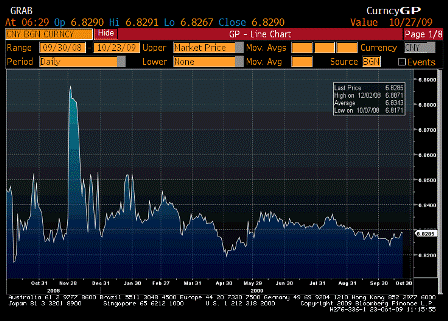
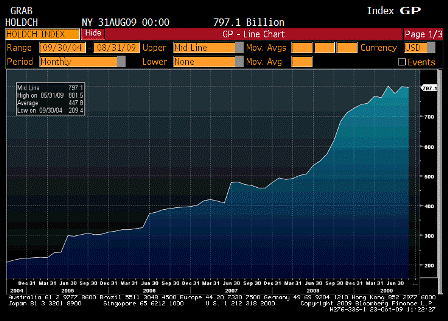
Looks like China is pretty much keeping its currency stable vs the dollar and depreciating against the rest of the world, probably to support it’s exporters.

(Note the recent rise in exports and rhetoric regarding the importance of exports.)

This means if the currency is ‘naturally’ strong China is buying $US financial assets to keep it fixed to the $US. The second chart shows holding of tsy secs but China could also be adding agencies and other $US financial assets now that ‘agency credibility’ has been restored.

Seems they are quietly testing the waters to see if Geithner will come down on them as Paulson did.

If we had an administration that understood the monetary system we’d encourage them to do this and export without limit, while sustaining domestic demand with fiscal adjustments (lower taxes and/or higher spending, depending on your politics) which obviously ‘good things’ (again, if you understand the monetary system).

In fact, with the entire world seeming desirous of exporting to the US if only we would let them, a serious level of prosperity is there to be had.


[top]

Yuan Peg Spurs Exports


[Skip to the end]

If the yuan is ‘naturally’ stronger than that it means they are accumulating dollar reserves without the wrath of the US administration.
This will encourage other potential exporters to do the same and help the dollar find a bottom.

The Eurozone, however, remains ideologically inhibited from buying dollars yet is also determined to support demand through exports.

Crude oil remains key. Higher prices make dollars ‘easier to get’ overseas, lower prices make the dollar ‘harder to get.’

Yuan Peg Spurs Exports, Luring Pimco as Dollar Sinks

By Bloomberg News

Oct. 13 (Bloomberg) — Investors are the most bullish on the yuan in 14 months as China’s exporters say the currency’s link to the slumping dollar is helping revive sales.

Contracts based on expectations for the currency’s value a year from now show the yuan will appreciate 3 percent, compared with estimates for 0.5 percent two months ago, data compiled by Bloomberg show. Twelve-month non-deliverable forwards touched 6.5440 per dollar on Oct. 20, the strongest level since August 2008. They rose 0.3 percent to 6.6265 today, compared with a spot exchange rate of 6.8275.

The dollar’s decline against all 16 of the most-active currencies in the past six months has made Chinese exports more competitive because the government has pegged the yuan to the greenback since July 2008. Union Investment and Martin Currie Investment Management Ltd., which oversee a total of $250 billion, are buying contracts that will profit from an end to the peg, predicting the yuan will gain 5 percent a year.

“Exports are beginning to pick up,” said Douglas Hodge, the chief operating officer of Pacific Investment Management Co., which runs the world’s largest bond fund. “The fact that the dollar has fallen makes the yuan cheaper relative to the euro and the yen, so it does begin to improve their export picture.”


[top]

US Treasury reiterates a weak dollar policy towards China


[Skip to the end]

U.S. Criticizes China for Lack of Exchange-Rate ‘Flexibility’

By Rebecca Christie

Oct. 16 (Bloomberg) — The U.S. Treasury Department criticized China for the “lack of flexibility” of the yuan and a buildup of foreign-exchange reserves while stopping short of branding the nation a manipulator of its currency.

“The recent lack of flexibility of the renminbi exchange rate and China’s renewed accumulation of foreign-exchange reserves risk unwinding some of the progress made in reducing imbalances,” the Treasury said in its semiannual report to Congress on the currency policies, using another name for the yuan.

The report released yesterday, which found that no major U.S. trading partner illegally manipulated its currency in the first half of 2009, comes after Group of 20 leaders adopted a “framework” for sustaining global growth and reducing lopsided flows of trade and investment. The framework could see China boosting domestic demand, the U.S. saving more and Europe increasing investment.

“Both the rigidity of the renminbi and the reacceleration of reserve accumulation are serious concerns which should be corrected to help ensure a stronger, more balanced global economy consistent with the G-20 framework,” the report said. “The Treasury remains of the view that the renminbi is undervalued.”


[top]

China Big 4 Banks’ New Loans Drop to Year’s Low, Caijing Says


[Skip to the end]

China Big 4 Banks’ New Loans Drop to Year’s Low, Caijing Says

Oct. 12 (Bloomberg) — China’s four biggest commercial banks
extended new yuan-denominated loans of about 110 billion yuan ($16
billion) in September, the lowest monthly figure in 2009, Caijing
magazine reported, citing industry data.

China Construction Bank Corp. had the highest new loans, totalling
44 billion yuan, Industrial & Commercial Bank of China Ltd. and
Agricultural Bank of China each lent about 30 billion yuan while Bank of
China Ltd.’s new yuan loans totalled around 3 billion yuan, the magazine
said, without giving a total figure for overall new lending for the month.


[top]

UN calling trade deficit a privilege


[Skip to the end]

Interesting! At least a small sign of the world beginning to figure it all out.

>   
>   The United Nations called on Tuesday for a new global reserve currency to end dollar
>   supremacy which has allowed the United States the “privilege” of building a huge trade
>   deficit.
>   


UN calls for new reserve currency

Oct. 6 (Breitbart) — The United Nations called on Tuesday for a new global reserve currency to end dollar supremacy which has allowed the United States the “privilege” of building a huge trade deficit.

“Important progress in managing imbalances can be made by reducing the reserve currency country?s ‘privilege’ to run external deficits in order to provide international liquidity,” UN undersecretary-general for economic and social affairs, Sha Zukang, said.

Speaking at the annual meetings of the International Monetary Fund and World Bank in Istanbul, he said: “It is timely to emphasise that such a system also creates a more equitable method of sharing the seigniorage derived from providing global liquidity.”

He said: “Greater use of a truly global reserve currency, such as the IMF?s special drawing rights (SDRs), enables the seigniorage gained to be deployed for development purposes,” he said.

The SDRs are the asset used in IMF transactions and are based on a basket of four currencies — the dollar, euro, yen and pound — which is calculated daily.

China had called in March for a new dominant world reserve currency instead of the dollar, in a system within the framework of the Washington-based IMF.


[top]

Geithner- more innocent subversion


[Skip to the end]

This is the party line and both sides agree.

We are our own worst enemy of our standard of living

As our real terms of trade continue to deteriorate.

How hard is it to understand that exports are real costs and imports real benefits???


Geithner Says Americans Will Have to Save More

Oct. 1 (Reuters) — Americans will have to save more in the future, transforming the global economy, and Europeans and Japanese must work to boost domestic demand, U.S. Treasury Secretary Timothy Geithner was quoted as saying on Wednesday.

“Everyone is going to have to come to terms with the fact that we are going to save more in the United States,” Geithner said in an interview with German weekly Die Zeit, conducted on Sunday in Istanbul, and due to appear on Oct. 8.

“If the U.S. starts saving more, that changes the whole world’s economic reality,” he said, according to the German text of the interview.

Geithner said China was already doing a lot to consider how to put growth on a more sustainable path.

“In China, the government is at the forefront of thinking about new ways to reduce the dependence of the economy on export and investments,” he said.

“But it is not just about the U.S. and China. Europe and Japan make up 40 percent of the global economy.”

Geithner said the U.S. could not force Europe to boost domestic demand to adapt to the new economic reality, but he saw it as the only viable strategy to guarantee lasting growth.

“They have to decide themselves how to adapt. I am not aware of any other strategy that promises success.”

He also said that the recovery was in a very early phase, and there were many risks ahead.

“If you look at past crises, politicians mostly made the mistake of tightening the purse strings too early,” he said.

“The private sector needs to start growing on its own for a sustainable recovery to take place.”


[top]