Bank lending accelerating

From DB:

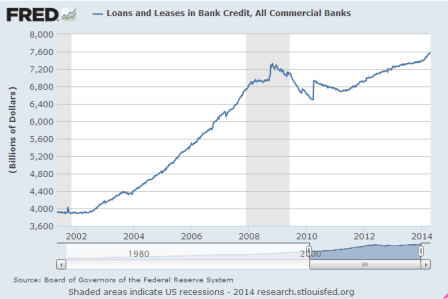
The weekly bank lending data just came out and we continue to see an acceleration in credit growth, see also the chart below. The latest observation in the chart is April 23 2014.


Full size image

Yes, lending has picked up some.

Here’s some longer term perspective and note how said lending is a seriously lagging indicator, which makes sense.

We could be seeing borrowing to pay utility bills, fund unsold inventories, etc. etc. All of which is followed by less spending.

Or it could be proactive borrowing to spend due to ‘feeling good about things’ that leads to a ‘virtuous’ up cycle.

Problem is, IMHO, the federal deficit is too small and the auto stabilizers too aggressive for the ‘borrowing to spend’ to get ahead of it, which is why I’ve been writing about the downside risk for the last few quarters, with that narrative still intact and, to me, supported by the data. (yes, others see it differently)

Note real GDP % change from a year ago below. Still looks to me like it’s working its way lower as the shrinking federal deficit provides less and less help overcoming the demand leakages.


Full size image


Full size image


Full size image


Full size image


Full size image

QE is a Tax

QE is a Tax

By Chris Mayer

May 2 — QE is a tax.

That’s an odd thing to say about the Fed’s bond-buying stimulus program, known as quantitative easing, or QE. But the reality of QE is different than what most people think…

To talk about this, I sought out Warren Mosler, a former hedge fund manager and now trailblazing economist. (I first introduced Mosler to you in your February letter, No. 120. See “How Fiat Money Works.”) So on one Sunday afternoon, with Mosler in Italy and me in Gaithersburg, Md., we chatted on Skype about the Fed and its doings.

Mosler was also a successful banker, and he talks about this stuff with the ease that comes from deep familiarity with the plumbing of the system. The U.S. system, importantly, is one of floating exchange rates and a nonconvertible currency. Meaning the government does not fix the price of the dollar against anything (contra what is done in Hong Kong, where they peg their currency to the dollar). And it is not convertible into anything except itself. (You can’t present your dollars to the Fed and demand gold, for instance.)

With those parameters, we started with a simple question: What would the natural rate of interest be if the government didn’t try to interfere in the interest rate market? (“Natural rate” in this context means the risk-free, nominal rate of interest.)

“In some sense, QE is undoing what the Treasury has done.”

Well, before we can answer that, think about the ways the government interferes in the interest rate market. There are two ways, Mosler points out. The first is that the government pays interest on bank reserves, which are essentially checking accounts held at the Fed. Currently, that rate is 25 basis points, or 0.25%.

The second is to offer “alternative accounts at the Fed called Treasury securities.” These are essentially savings accounts and pay higher interest than the checking accounts (or reserve accounts).

“If we eliminated these things, there would no interest paid on reserves, and there would be no securities,” Mosler says. “So the natural rate of interest would be zero.” Like in Japan for 20 years.

Note this doesn’t mean there would be no interest rates. It means absent these interventions, the market would determine interest rates based on credit risk, etc. But there would be no floor — no risk-free rate, no natural rate — put in place by the government.

“Not that you should do it that way,” Mosler says, “but that’s the way to look at it. The base case is zero. Then the Treasury comes in and offers $17 trillion in securities. And that’s a distortion, to some degree. If the Fed did QE and bought them all back, it would put you back to where you started. In some sense, QE is undoing what the Treasury has done.” When the Fed buys securities, it is as if the Treasury never issued them in the first place.

Or as Mosler puts it in a tidy, eight-page paper (more on that in a bit):

It can be argued that asset pricing under a zero interest rate policy is the “base case” and that any move away from a zero interest rate policy constitutes a (politically implemented) shift from this “base case.”

In other words, the government doesn’t have to pay 3% on a 10-year note, as it does today. It doesn’t have to issue bonds at all. It creates dollar deposits (money) in member bank reserve accounts when it spends. By issuing securities/offering alternative interest-bearing accounts, the government pays a lot of interest to the economy.

“So in that sense,” Mosler says, “issuing securities means paying higher rates than the overnight rate. It is a spending increase and has an inflationary bias by adding net financial assets to the system.”

The mainstream view says that when the government sells Treasury securities, it is taking money out of the system, that it’s a deflationary thing to do and it offsets the inflationary effect of deficit spending. “Not true at all,” Mosler says. “Selling Treasuries does not take money out.” What’s happening is akin to a shuffle between checking accounts and savings accounts.

Let’s turn back to the case of QE, where the Fed buys securities. In this case, the economy loses the interest income from those securities.

“QE takes money out of the economy,” Mosler says, “which is what a tax does.” Hence, as noted above, QE is a tax.

“The whole point of QE is to bring rates down,” Mosler says. “If it does bring rates down, that means the rest of the securities the Treasury sells pay less interest too. So it lowers government interest expense even more. Because the government is a net payer of interest, lower rates mean it pays less interest.”

But does it help the economy? Hard to see how it does. Mosler has an interesting take here. I’ll paraphrase as best I can.

Let’s say people ask why the Fed is buying securities. Well, to help the economy. So now people have to think about whether that policy will work or not. If it’s going to work, that means the Fed’s going to be raising rates, because the economy will be getting stronger. The only time QE will bring rates down is if investors think the policy won’t work. It’s a policy that works through expectations, and it works only if investors think it won’t work.

“It’s a disgrace,” he says.

“On top of that, most investors don’t understand it,” Mosler says. “You’ve got the Chinese reading about how the Fed is printing money. And they go and buy gold. There are knock-on effects all over the world, and portfolios are shifting based on perceptions.”

QE, then, because it costs the private sector interest income and doesn’t add money to the economy, is not inflationary. “The evidence is that it is not inflationary,” Mosler says.

Let’s look at it another way. The bank of Japan has been trying to create inflation for 20 years. The Fed’s been trying to create inflation as hard as it can. The European Central Bank too. “It is not so easy for a central bank to create inflation,” he says, “or you’d think one of these guys would’ve succeeded.

“People act like you have to be careful because one false move on inflation expectations and, bang, you have hyperinflation,” Mosler chuckles. “If you know what that false move is, tell Janet Yellen [the current Fed chief], because she’s trying to find it.”

Though he no longer runs a hedge fund, Mosler is still involved in financial markets. He has a portfolio he runs for himself and for other people. I asked him if he fears interest rates going up.

“It could happen,” he says. “It’s a political decision where rates go.”

And that’s a good place to leave it. Because it brings us back to the beginning. Without the government wading into the interest rate market, the base rate would be zero. And everybody would be working off that. But instead, we have the Fed trying to find monetary nirvana.

As Mosler says, it’s a disgrace.

These are challenging ideas, I know. If you want to read more, look up “The Natural Rate of Interest is Zero,” a tightly reasoned, accessible eight-page paper by Mathew Forstater and Warren Mosler. You can find it free online.

Diase Coffelt Release: Gubernatorial Candidate Announces Warren Mosler as Running Mate

Donations appreciated! Please visit our website.

FOR IMMEDIATE RELEASE
April 29, 2014

CONTACT: Maggie Harrell
(340)776-7772


GUBERNATORIAL CANDIDATE SORAYA DIASE COFFELT ANNOUNCES WARREN MOSLER AS RUNNING MATE

St. Thomas, Virgin Islands – Today, U.S. Virgin Islands Gubernatorial candidate Soraya Diase Coffelt announced that she has selected Warren Mosler as her running mate for the position of Lieutenant Governor. Mosler, a renowned financial professional and 11 year resident of St. Croix, is also an independent and has previously run for Delegate to Congress.

Diase Coffelt made the following statement regarding her selection:

“My vision for the Virgin Islands is to develop it into the economic powerhouse of the Caribbean. In order to bring about this economic growth and prosperity, I am seeking qualified and experienced people to join me. I am proud to announce that Warren Mosler has agreed to do so as my running mate. The Office of the Lieutenant Governor is responsible for very important financial issues, including banking, insurance, corporations and trademarks, and property taxes. Mosler is well qualified to execute these duties and help me create a more prosperous future for all of us,” said Diase Coffelt.

“His 40 years of high level experience in financial markets and exemplary management of his investment fund, along with his global achievements in promoting progressive economic policies, have more than demonstrated his capabilities and qualifications for the office. Moreover, he is dedicated to the people of the Virgin Islands and is committed to working with me as a team to fight on behalf of the people, for a better Virgin Islands,” Diase Coffelt concluded.


“This is both a great honor and opportunity,” said Mosler. “Soraya Diase Coffelt has all of the professional qualifications and experience to serve as the next governor. In addition, her integrity and honesty combine to make her – by any measure – the superior candidate for Governor of the U.S. Virgin Islands.”


Candidates Diase Coffelt and Mosler will be actively campaigning on all of the islands, reaching out to voters in each community to meet as many people as possible. They will also hold a variety of public events and meetings, as well as participate in forums and debates.

Existing home sales

This doesn’t add to GDP.

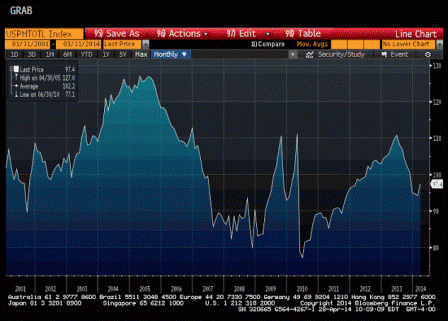
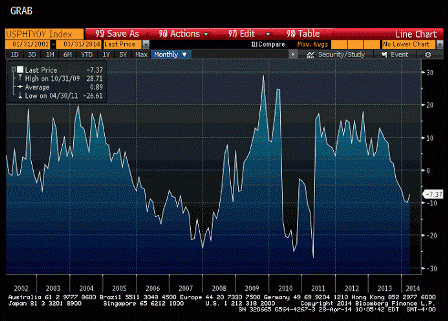
While a bit higher than expected, it’s yet another case of a ‘bounce’ that doesn’t even get up to where things were before the dip.

Furthermore, it seems that if it wasn’t for distressed sales, sales would have been substantially lower for the last several years. With distressed ‘bid hitting’ fading, prices are gravitating back to ‘non distressed’ offered prices, and price is high enough to be slowing things down while remaining below construction costs which is keeping a lid on new home building (which directly adds to gdp)

Home sales finally thaw, but just slightly

By Diana Olick

April 28 (CNBC) — U.S. home buyers signed more contracts to buy existing homes in March, as weather in much of the country warmed and as more listings came onto the market. An index of so-called “pending” home sales from the National Association of Realtors rose 3.4 percent from February, the first gain in nine months, but is still down 7.9 percent from March of 2013.

“After a dismal winter, more buyers got an opportunity to look at homes last month and are beginning to make contract offers,” Lawrence Yun, chief economist for the Realtors. “Sales activity is expected to steadily pick up as more inventory reaches the market, and from ongoing job creation in the economy.”

Regionally, sales in the Northeast increased 1.4 percent, but are 5.9 percent below a year ago. In the Midwest, sales slipped 0.8 percent and are 10.1 percent below March 2013. Pending home sales in the South rose 5.6 percent, but are 5.3 percent below a year ago. The index in the West increased 5.7 percent monthly, but is 11.1 percent below March, 2013. The Realtors still predict overall home sales for 2014 will come in lower than last year, at 4.9 million units sold.

Fast-rising home prices have caused at least some of the slowdown in sales during this spring season. In fact, prices in several major metropolitan markets hit new peaks in February. With median home values well above the national average, Denver, San Jose, Austin, Dallas and Houston hit new price highs, according to Black Knight Financial Services. Metropolitan markets in California made up eight of the top ten biggest price gains in February, with Portland, Ore., and Seattle, rounding out the list. Home prices fell in several Northeast and Midwest markets, like Cincinnati, Allentown, Pa. and Atlantic City, N.J. Nationally, home prices are still 13.5 percent below their June, 2006, peak, but that gap is closing fast.

Credit availability and cost are also keeping potential buyers on the sidelines. Despite anecdotal reports of a loosening in credit conditions, it is still far tougher to get a mortgage today than it was even prior to the housing boom.

Existing home sales:


Full size image

Existing home sales Y/Y:

Full size image

Comments on Martin Wolf’s banking article

Strip private banks of their power to create money

By: Martin Wolf
The giant hole at the heart of our market economies needs to be plugged

Printing counterfeit banknotes is illegal, but creating private money is not. The interdependence between the state and the businesses that can do this is the source of much of the instability of our economies. It could – and should – be terminated.

It is perfectly legal to create private liabilities. He has not yet defined ‘money’ for purposes of this analysis

I explained how this works two weeks ago. Banks create deposits as a byproduct of their lending.

Yes, the loan is the bank’s asset and the deposit the bank’s liability.

In the UK, such deposits make up about 97 per cent of the money supply.

Yes, with ‘money supply’ specifically defined largely as said bank deposits.

Some people object that deposits are not money but only transferable private debts.

Why does it matter how they are labeled? They remain bank deposits in any case.

Yet the public views the banks’ imitation money as electronic cash: a safe source of purchasing power.

OK, so?

Banking is therefore not a normal market activity, because it provides two linked public goods: money and the payments network.

This is highly confused. ‘Public goods’ in any case aren’t ‘normal market activity’. Nor is a ‘payments network’ per se ‘normal market activity’ unless it’s a matter of competing payments networks, etc. And all assets can and do ‘provide’ liabilities.

On one side of banks’ balance sheets lie risky assets; on the other lie liabilities the public thinks safe.

Largely because of federal deposit insurance in the case of the us, for example. Uninsured liabilities of all types carry ‘risk premiums’.

This is why central banks act as lenders of last resort and governments provide deposit insurance and equity injections.

All that matters for public safety of deposits is the deposit insurance. ‘Equity injections’ are for regulatory compliance, and ‘lender of last resort’ is an accounting matter.

It is also why banking is heavily regulated.

With deposit insurance the liability side of banking is not a source of ‘market discipline’ which compels regulation and supervision as a simple point of logic.

Yet credit cycles are still hugely destabilising.

Hugely destabilizing to the real economy only when the govt fails to adjust fiscal policy to sustain aggregate demand.

What is to be done?

How about aggressive fiscal adjustments to sustain aggregate demand as needed?

A minimum response would leave this industry largely as it is but both tighten regulation and insist that a bigger proportion of the balance sheet be financed with equity or credibly loss-absorbing debt. I discussed this approach last week. Higher capital is the recommendation made by Anat Admati of Stanford and Martin Hellwig of the Max Planck Institute in The Bankers’ New Clothes.

Yes, a 100% capital requirement, for example, would effectively limit lending. But, given the rest of today’s institutional structure, that would also dramatically reduce aggregate demand -spending/sales/output/employment, etc.- which is already far too low to sustain anywhere near full employment levels of output.

A maximum response would be to give the state a monopoly on money creation.

Again, ‘money’ as defined by implication above, I’ll presume. The state is already the single supplier/monopolist of that which it demands for payment of taxes.

One of the most important such proposals was in the Chicago Plan, advanced in the 1930s by, among others, a great economist, Irving Fisher.

Yes, a fixed fx/gold standard proposal.

Its core was the requirement for 100 per cent reserves against deposits.

Reserves back then were ‘real’ gold certificates.

The floating fx equiv would be 100% capital requirement.

Fisher argued that this would greatly reduce business cycles,

And greatly reduce aggregate demand with the idea of driving net exports to increase gold/fx reserves, or, alternatively, run larger fiscal deficit which, on the gold standard, put the nation’s gold supply at risk

end bank runs

Yes, banks would only be lending their equity, so there is nothing to ‘run’

and drastically reduce public debt.

If you wanted a vicious deflationary spiral to lower ‘real wages’ and drive net exports

A 2012 study by International Monetary Fund staff suggests this plan could work well.

No comment…

Similar ideas have come from Laurence Kotlikoff of Boston University in Jimmy Stewart is Dead, and Andrew Jackson and Ben Dyson in Modernising Money.

None of which have any kind of grasp on actual monetary operations.

Here is the outline of the latter system.

First, the state, not banks, would create all transactions money, just as it creates cash today.

Today, state spending is a matter of the CB crediting a member bank reserve account, generally for further credit to the person getting the corresponding bank deposit. The member bank has an asset, the funds credited by the CB in its reserve account, and a liability, the deposit of the person who ultimately got the funds.

If the bank depositor wants cash, his bank gets the cash from the CB, and the CB debits the bank’s reserve account. So the person who got paid holds the cash and his bank has no deposit at the CB and the person has no bank deposit.

So in this case the entire ‘money supply’ would consist of dollars spent by the govt. But not yet taxed. That’s called the deficit/national debt. That is, the govt’s deficit would = the (net) ‘money supply’ of the economy, which is exactly the way it is today.

Customers would own the money in transaction accounts,

They already do

and would pay the banks a fee for managing them.

:(

Second, banks could offer investment accounts, which would provide loans. But they could only loan money actually invested by customers.

So anyone who got paid by govt (directly or indirectly) could invest in an account so those same funds could be lent to someone else. Again, by design, this is to limit lending. And with ‘loanable funds’ limited in this way, the interest rate would reflect supply and demand for borrowing those funds, much like and fixed exchange rate regime.

So imagine a car company with a dip in sales and a bit of extra unsold inventory, that has to borrow to finance that inventory. It has to compete with the rest of the economy to borrow a limited amount of available funds (limited by the ‘national debt’). In a general slowdown it means rates will skyrocket to the point where companies are indifferent between paying the going interest rate and/or immediately liquidating inventory. This is called a fixed fx deflationary collapse.

They would be stopped from creating such accounts out of thin air and so would become the intermediaries that many wrongly believe they now are. Holdings in such accounts could not be reassigned as a means of payment. Holders of investment accounts would be vulnerable to losses. Regulators might impose equity requirements and other prudential rules against such accounts.

As above.

Third, the central bank would create new money as needed to promote non-inflationary growth. Decisions on money creation would, as now, be taken by a committee independent of government.

What does ‘create new money’ mean in this context? If they spend it, that’s fiscal. If they lend it, how would that work? In a deflationary collapse there are no ‘credit worthy borrowers’ as they system is in technical default due to ‘unspent income’ issues. Would they somehow simply lend to support a target rate of interest? Which brings us back to what we have today, apart from deciding who to lend to at that rate, the way today’s banks decide who to lend to? And it becomes a matter of ‘public bank’ vs ‘private bank’, but otherwise the same?

Finally, the new money would be injected into the economy in four possible ways: to finance government spending,

That’s deficit spending, as above, and no distinction regards to current policy

in place of taxes or borrowing;

Same as above. For all practical purposes, all govt spending is via crediting a member bank account.

to make direct payments to citizens;

Same thing- net fiscal expenditure

to redeem outstanding debts, public or private;

Same

or to make new loans through banks or other intermediaries.

As above, that’s just a shift from private banking to public banking, and nothing more.

All such mechanisms could (and should) be made as transparent as one might wish.

The transition to a system in which money creation is separated from financial intermediation would be feasible, albeit complex.

No, it’s quite simple actually, as above.

But it would bring huge advantages. It would be possible to increase the money supply without encouraging people to borrow to the hilt.

Deficit spending does that.

It would end “too big to fail” in banking.

That’s just a matter of shareholders losing when things go bad which is already the case.

It would also transfer seignorage – the benefits from creating money – to the public.

That’s just a bunch of inapplicable empty rhetoric with today’s floating fx regimes.

In 2013, for example, sterling M1 (transactions money) was 80 per cent of gross domestic product. If the central bank decided this could grow at 5 per cent a year, the government could run a fiscal deficit of 4 per cent of GDP without borrowing or taxing.

In any case spending in excess of taxing adds to bank reserve accounts, and if govt doesn’t pay interest on those accounts or offer interest bearing alternatives, generally called securities accounts, the consequence is a 0% rate policy. So seems this is a proposal for a permanent zero rate policy, which I support!!! But that doesn’t require any of the above institutional change, just an announcement by the cb that zero rates are permanent.

The right might decide to cut taxes, the left to raise spending. The choice would be political, as it should be.

And exactly as it is today in any case

Opponents will argue that the economy would die for lack of credit.

Not if the deficit spending is allowed to ‘shift’ from private to public.

I was once sympathetic to that argument. But only about 10 per cent of UK bank lending has financed business investment in sectors other than commercial property. We could find other ways of funding this.

Govt deficit spending or net exports are the only two alternatives.

Our financial system is so unstable because the state first allowed it to create almost all the money in the economy

The process is already strictly limited by regulation and supervision

and was then forced to insure it when performing that function.

The liability side of banking isn’t the place for market discipline, hence deposit insurance.

This is a giant hole at the heart of our market economies. It could be closed by separating the provision of money, rightly a function of the state, from the provision of finance, a function of the private sector.

The funds to pay taxes already come only from the state.

The problem is that leadership doesn’t understand monetary operations.

This will not happen now. But remember the possibility. When the next crisis comes – and it surely will – we need to be ready.

Agreed!!!!!

Thursday meeting with Soraya 7pm at her HQ, the Armrey Cabinets, Richmond, just west of the post office, across the street from WSTX

Thursday meeting with Soraya Diase Coffelt, 7pm at her HQ, the Armrey Cabinets, Jack Bishop’s shop, Richmond, just west of the post office, across the street from WSTX Christiansted

Good meeting last night at the Tamarind Reef conference center! About 35 of you turned out for a high level discussion of
the issues and challenges of moving forward.

Soraya and I will be there Thursday to meet with you all and as many of your friends as you can possibly bring with you!

I can only get the word out though this email list and Facebook, so I’m counting on all of you to each notify as many people as possible, thanks!

In my humble opinion, this is THE team for the ‘better Virgin Islands’ we’d all like to see, and the most important thing to do is simply get the word out!!!

thanks again!

Warren

mortgage purchase applications

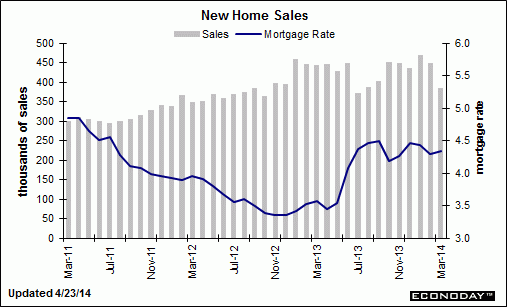
Seems the post weather bounce is over?
These are alarmingly low numbers:.

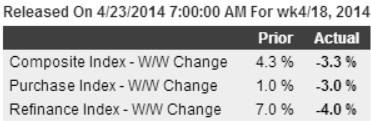
MBA Purchase Applications

Highlights

The purchase index, which had been inching higher in prior weeks, fell back 3.0 percent in the April 18 week. Year-on-year, the index remains in very negative ground at minus 18.0 percent. The refinancing index, which has been sliding, fell a further 4 percent in the week. Rates moved slightly higher in the week with the average rate for conforming 30-year mortgages up 2 basis points to 4.49 percent. Watch for new home sales later this morning at 10:00 a.m. ET.