Producer Prices, Retail sales, Business inventories, Atlanta Fed, Debt Ceiling Comment

Gives the Fed another dovish data point:

PPI-FD
er-10-14-4
Highlights
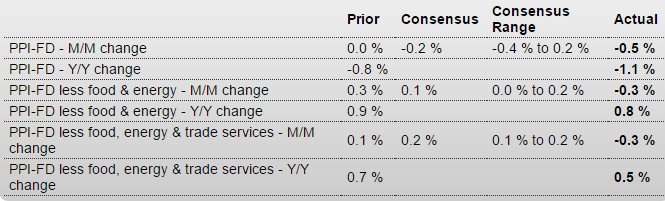
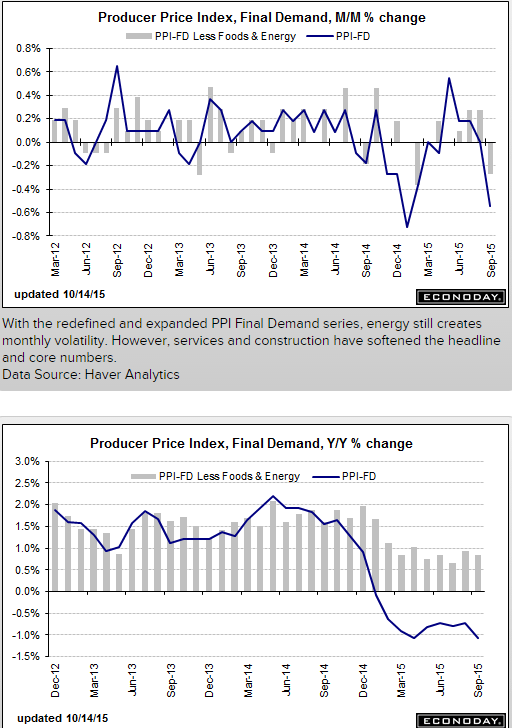
Producer prices show wide weakness and may raise talk that deflationary pressures are building, not easing. The PPI-FD fell 0.5 percent in September which is just below Econoday’s low estimate for minus 0.4. Year-on-year, producer prices are falling deeper into the negative column at minus 1.1 percent. And it’s not all due to energy excluding which and also excluding food, prices fell 0.3 percent though the year-on-year rate is still in the plus column, at plus 0.8 percent but down 1 tenth from August. Excluding food, energy and services, where the latter had been showing price traction, prices still fell 0.3 percent with the year-on-year rate at only plus 0.5 percent.

The services weakness, down 0.4 percent in the month, follows two prior gains of 0.4 percent that had been cited as evidence of resilience in domestic demand. Exports remain very weak at minus 0.8 percent in the month following August’s 0.4 percent decline. September energy prices fell 5.9 percent and are down 23.7 percent year-on-year. Gasoline fell a monthly 16.6 percent for a 42.8 percent year-on-year decline.

Other readings include a 1.3 percent decline for finished goods where the year-on-year rate, following a long string of monthly declines, is down 4.1 percent. This is an important reading that points to pass through of low raw material prices.

Hawks at the Fed are saying that the negative price effects from oil and low import prices will prove temporary. That may be, but the depth of ongoing price weakness continues to sink. Watch for the consumer price report on tomorrow’s calendar.
er-10-14-5

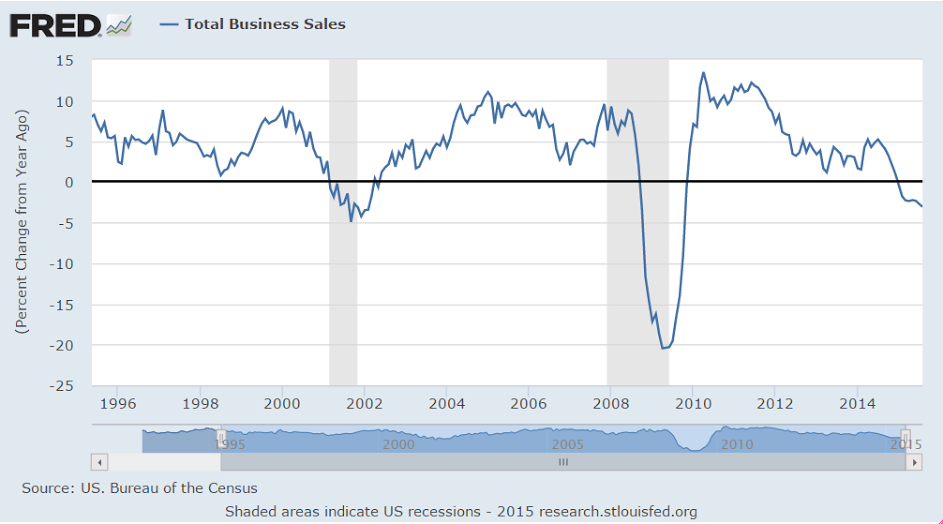
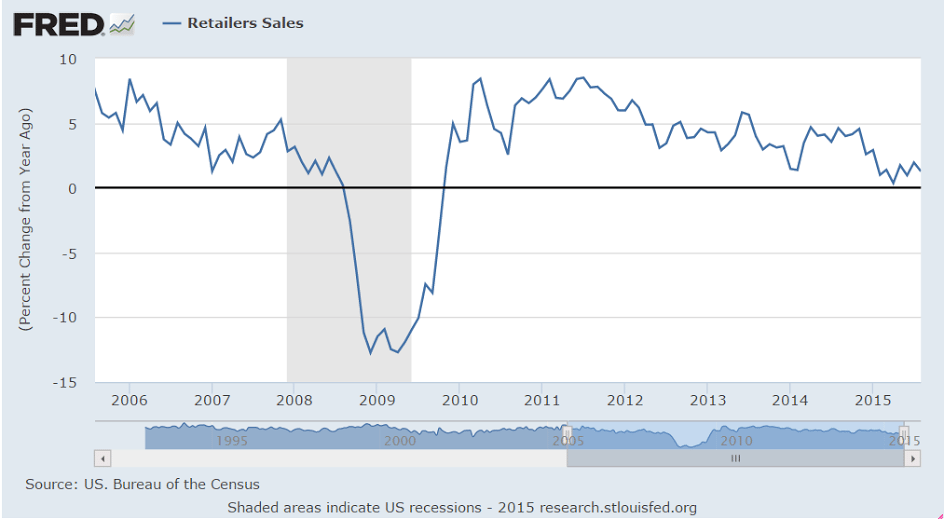
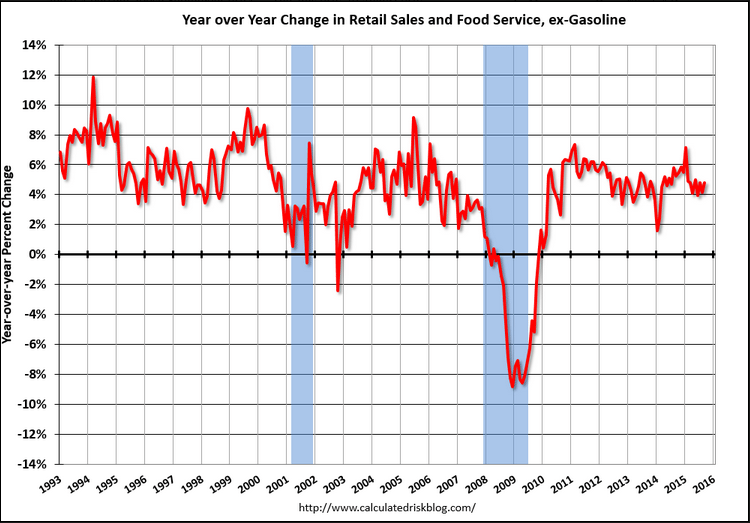
This continues to disappoint, no matter how they try to spin it. And total sales do count, as they are also the total income for the sellers, so that’s been slowing as well:

Retail Sales
er-10-14-6
Highlights
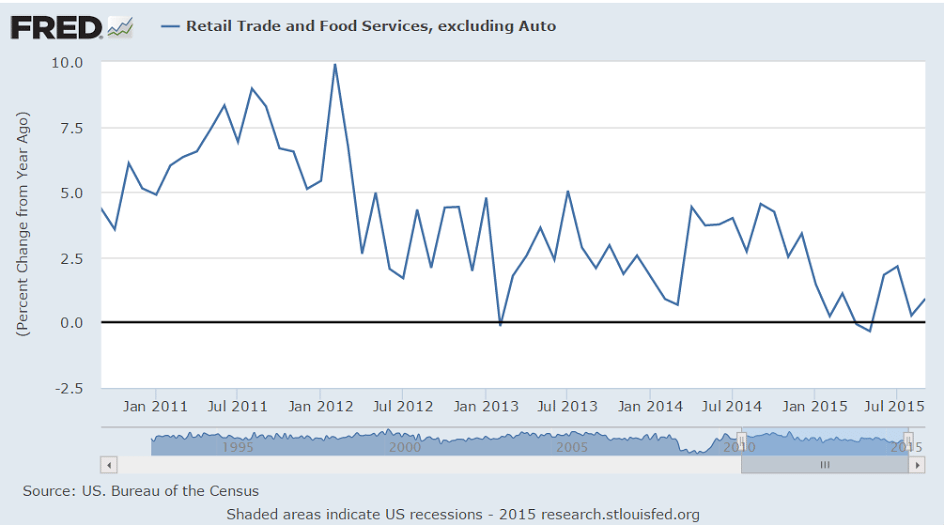
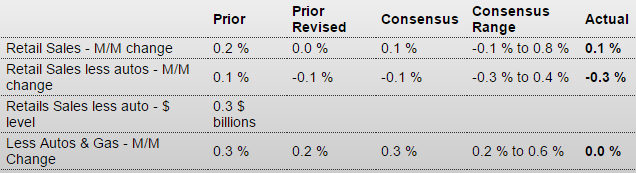
Weakness at gasoline stations, where low prices are depressing sales totals, continues to exaggerate weakness in retail sales where the headline inched only 0.1 percent higher in September. Gasoline sales fell 3.2 percent in the month, excluding which the headline looks far more respectable at plus 0.4 percent.

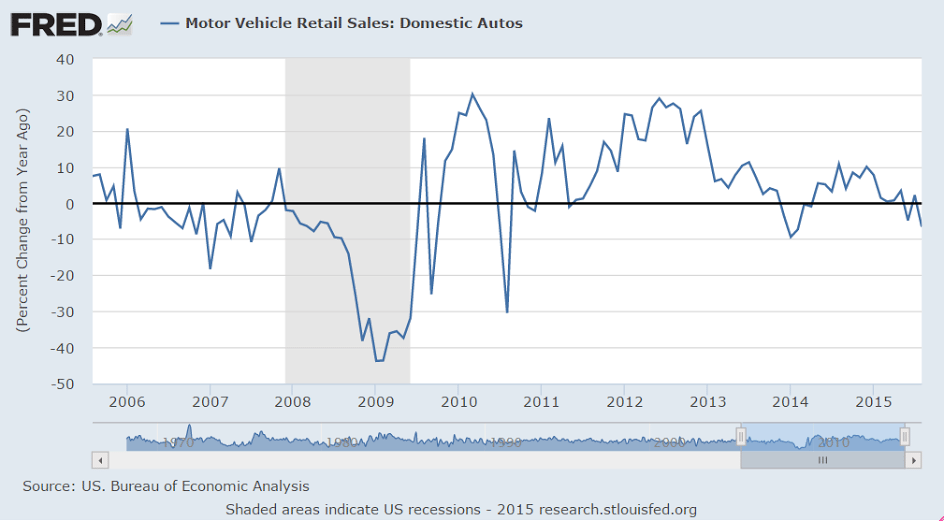
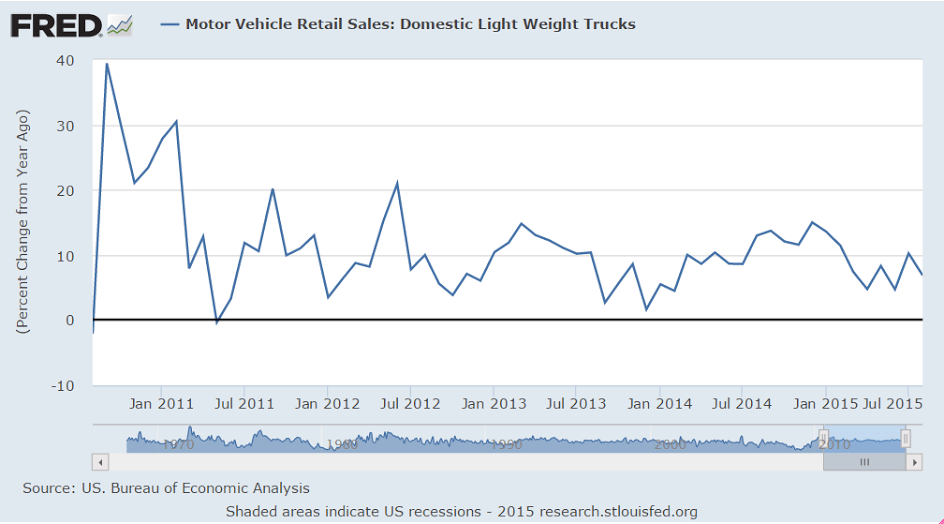
And there are plenty of tangible positives in the data including a third straight solid gain for motor vehicles, at plus 1.7 percent in September, and a second straight outsized gain of 0.9 percent for restaurants. Both of these are discretionary categories and point to underlying consumer strength. Clothing stores are also posting strong gains, up 0.9 percent despite negative price effects from lower import prices.

Price weakness is not only pulling down gasoline sales but also sales at food & beverage stores which fell 0.3 percent. But there are signs of consumer retracement in the September report with the general merchandise category, which is very large, down 0.1 percent, and with health & personal care stores unchanged. Building materials fell 0.3 percent with electronics & appliance stores down 0.2 percent.

Looking at adjusted year-on-year rates helps clarify the trends. Excluding gasoline stations, retail sales are up a very respectable 4.9 percent which is well above the less impressive 2.4 percent gain for total sales. Sales at gasoline stations are down a year-on-year 19.7 percent. Leading the positive side are motor vehicles, up 8.8 percent, and restaurants, up 7.9 percent — both robust gains. Core sales, that is ex-auto ex-gas, the year-on-year rate is a moderate plus 3.8 percent for a 1 tenth decline from August.

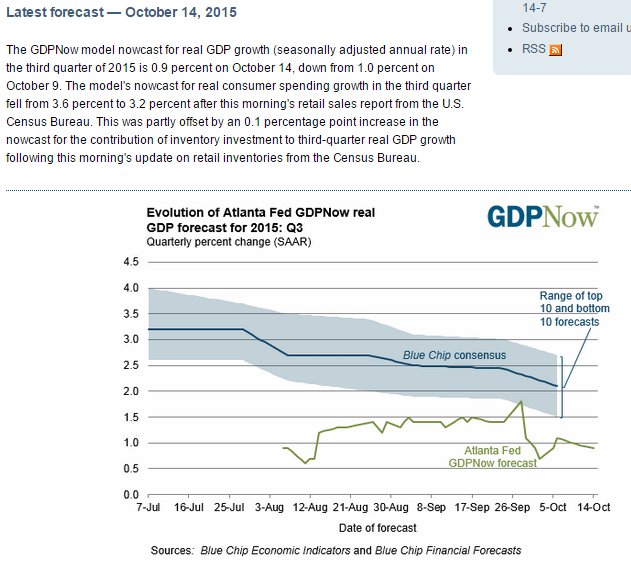
One of the very biggest positives for the consumer right now, aside from strength in labor demand, is the weakness in pump prices, which however in this report, where dollar totals are tracked and not sales volumes, turns into a negative. Still, the headline is weak and will likely lower third-quarter GDP estimates — but for Fed policy, because the weakness is skewed due to gas prices, the results are harder to assess and may prove neutral.
er-10-14-7
Imports have a much lesser effect on the economy:
er-10-14-8
This is where the domestic growth has been, which has been about the same growth rate for the last few years:
er-10-14-9
er-10-14-10

And even this is low vs prior cycles:
er-10-14-11
Yet another big negative here. Again, it’s the same unspent income story. If agents spent less than their incomes others must have spent more than their incomes or inventory went unsold, which is exactly what’s been happening. And unsold inventory = cuts in output and employment = less income = less spending etc. until some agent starts spending that much more than his income. Most often that’s govt, spending more than its income (deficit spending) on rising unemployment benefits, and experiencing reduced tax revenues in the slow down:

Business Inventories
er-10-14-12
Highlights
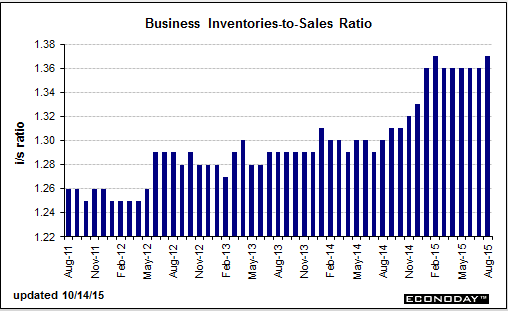
There’s evidence of economic weakness coming from inventory data where inventories are being kept down but are still building relative to sales. Business inventories were unchanged for a second month in August while sales fell a sizable 0.6 percent, driving up the inventory-to-sales ratio to 1.37 from 1.36.

Inventory downscaling is underway in manufacturing which is being hurt by weak exports. Manufacturing inventories fell 0.3 percent in both August and July against a major sales decline of 0.7 percent in August and a 0.2 percent dip in July. There’s less inventory downscaling, at least right now, among wholesalers where inventories rose 0.1 percent but sales at wholesalers are even weaker, down 1.0 percent in the month. Retail, the third component, is not immune with sales down 0.1 percent but inventories up 0.3 percent.

Inventories are looking heavy which could limit production and employment growth and could emerge as a new concern for the doves at the Fed.

er-10-14-13
er-10-14-14
Revised down again:
er-10-14-15
Applying leverage here is, functionally, subversive:

McConnell’s Last Stand: He Wants Medicare, Social Security Cuts to Raise Debt Limit

By Rob Garver

Oct 13 (Fiscal Times) — In case anyone thought things couldn’t get more chaotic on Capitol Hill, Senate Majority Mitch McConnell appears ready to set them straight. McConnell, according to a report first published by CNN, plans to make several major demands of the White House, including changes to Medicare, Social Security, and EPA regulations as his price for raising the nation’s debt limit.
Exports, Bank Revenues, Chips, Japan, Mtg Purchase Apps, Oil Comment

At U.S. Ports, Exports Are Coming Up Empty

Oct 13 (WSJ) — In September, the Port of Long Beach Calif. handled 197,076 outbound empty boxes. September was the eighth straight month in which empty containers leaving Long Beach outnumbered those loaded with exports. Last month, however, Long Beach and the Port of Oakland both reported double-digit gains in exports of empty containers. So far this year, empties at the two ports are up more than 20% from a year earlier. Long Beach’s containerized exports were down 8.2% this year through September, while Oakland’s volume of outbound loaded containers fell 12.7% from a year earlier in the January-September period.

J.P. Morgan’s Revenue Slides

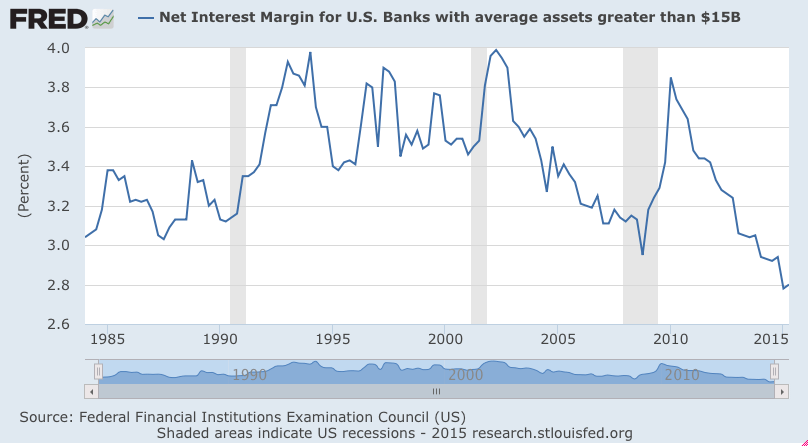
Oct 13 (WSJ) — J.P. Morgan Chase reported a profit of $6.8 billion, or $1.68 a share. That compares with a profit of $5.57 billion, or $1.35 a share, in the same period of 2014. Excluding $2.2 billion of tax benefits and other one-time items, earnings were $1.32 a share. Revenue fell 6.4% to $23.54 billion. Return on equity was 12% in the third quarter compared with 10% a year earlier. The bank continued to cut its workforce last quarter, shedding 1,781 people to 235,678. That includes reductions across its consumer & community banking and corporate divisions.
er-10-14-1

Intel Profits Slide Amid PC Slump

Oct 13 (WSJ) — Intel said its third-quarter profit fell 6.3% from the year-earlier period on a small revenue decline. Intel issued an outlook for the current quarter that was in line with Wall Street estimates. In all, the chip maker reported third-quarter net income of $3.11 billion, or 64 cents a share, down from profit in the year-earlier period of $3.32 billion, or 66 cents a share. Revenue for the period ended Sept. 30 declined to $14.47 billion from $14.55 billion. Intel’s gross profit margin declined to 63% from 65%. It said 2015 capital spending will be about $7.3 billion, down from a projected $7.7 billion.

Good time to hit the brakes:

Abe orders preparation of multiple rates for 2017 sales tax hike

Oct 1(Kyodo) — Prime Minister Shinzo Abe on Wednesday ordered preparations for the introduction of multiple tax rates under the planned consumption tax hike in April 2017. Abe gave the instruction to former industry minister Yoichi Miyazawa, who is to replace Takeshi Noda as chairman of the ruling Liberal Democratic Party’s tax panel. The prime minister believes it is necessary to consider measures to avoid unnecessarily burdening smaller businesses, Miyazawa said. To ease the impact the government is considering introducing reduced tax rates for some items such as daily necessities.

Slowdown in emerging economies weakens Japanese real GDP outlook

Oct 14 (Nikkei) — Japan’s real gross domestic product inched up an annualized 0.55% from the previous quarter during the July-September period, a new survey of professional forecasters showed Tuesday, a considerable retreat from the 1.67% growth predicted in September. The experts saw exports growing 0.62%, less than half the 1.39% outlook in September. The survey pegged real economic growth for fiscal 2015 at 0.97%, down from September’s outlook of 1.11%. Official government estimates from July see a 1.5% advance. The economists also cut real GDP growth for fiscal 2016 from 1.7% in September to 1.59%.

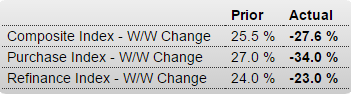
Giving back last week’s gains, and then some as housing remains depressed:

MBA Mortgage Applications

er-10-14-2
Mortgage applications decreased 27.6 percent from one week earlier, according to data from the Mortgage Bankers Association’s (MBA) Weekly Mortgage Applications Survey for the week ending October 9, 2015.

The Refinance Index decreased 23 percent from the previous week. The seasonally adjusted Purchase Index decreased 34 percent from one week earlier. The unadjusted Purchase Index decreased 34 percent compared with the previous week and was 1 percent lower than the same week one year ago.

Don’t forget, Saudis did cut price/increased discounts on October 5 for November deliveries:
er-10-14-3

China trade, WRKO interview

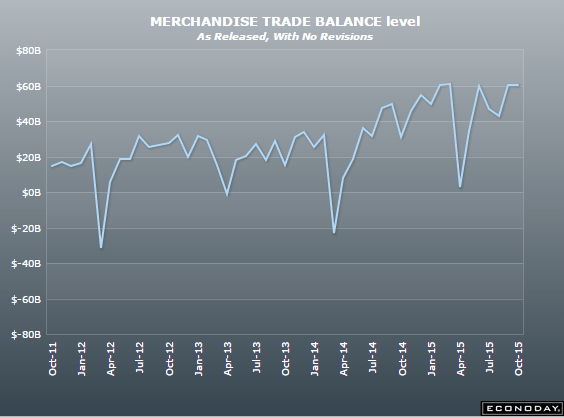
Total trade is down, but the surplus is still high and holding, which ultimately supports the currency:

China : Merchandise Trade Balance
er-10-13-5
Highlights
Every month China’s trade data are reported in both the renminbi and U.S. dollars by the National Bureau of Statistics. The renminbi report comes out first, followed about an hour later by the more closely-watched U.S. dollar report. Since the August 11 devaluation of the renminbi there is a wider discrepancy between the two sets of data and it has taken on added significance.

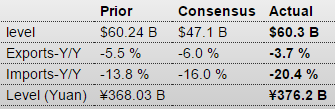
September imports, in renminbi terms, fell 17.7 percent from a year ago after dropping 14.3 percent in August. This is the 11th consecutive decline and the worst pace since May. But, exports fell just 1.1 percent, holding up much better than expected. This is third straight decline and points to some stabilization. As a result of weakening imports but improving exports, the trade surplus surged to a record high. The surplus was Rmb376 billion. That was almost 30 percent higher than the August surplus.

Low commodity prices, compounded by deteriorating domestic demand, are cutting the import bill. Exports have performed comparatively better but are also weak and are falling in year-on-year terms.

The trade surplus in U.S. dollar terms was $60.3 billion. On the year, exports were down a less than anticipated 3.7 percent while imports plunged 20.4 percent.
er-10-13-6

Short interview on recession possibility:

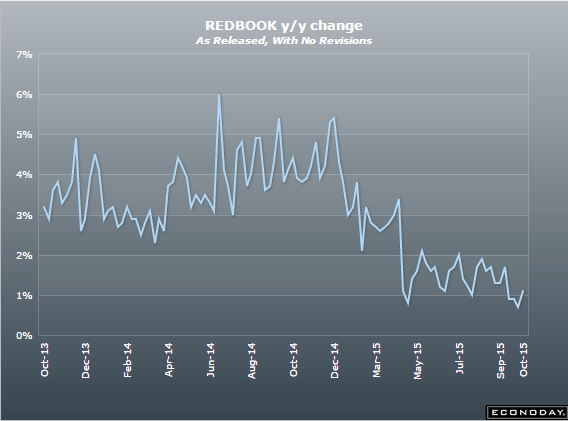
NFIB index, Redbook, German ZEW

NFIB Small Business Optimism Index
er-10-13-1
Highlights
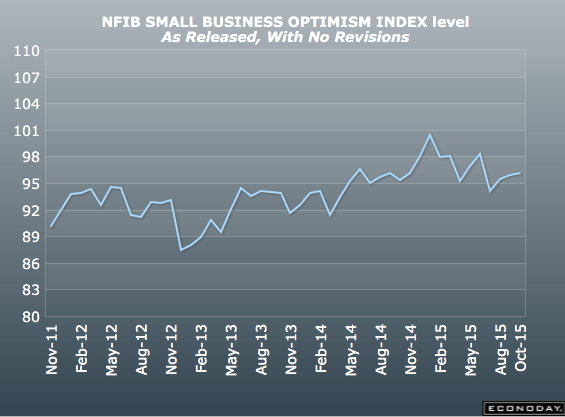
In a confirmation of strong levels of job openings in the JOLTS report, small businesses are reporting the most difficulty in finding qualified workers since 2007, pointing to the risk ahead of wage pressures. Boosted by employment, the small business optimism index inched 2 tenths higher in September to a slightly higher-than-expected 96.1. Plans to increase employment are also up, at their best level of the year, while capital outlay plans are also positive. Earnings trends are in the negative column as are expected credit conditions. Overall, this report is moderate though the strength in employment could raise talk of strength for the October employment report.

Still zig zagging it’s way lower:
er-10-13-2
Still depressed:
er-10-13-3
Bad:

Germany: ZEW Survey
er-10-13-4
Highlights
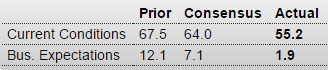
ZEW’s October survey was surprisingly weak with analysts’ assessment of both current and expected economic performance comfortably short of the market consensus.

Current conditions fell 12.3 points to 55.2, their sharpest decline since October 2014 and their lowest reading since March. Expectations were off an only slightly smaller 10.2 points at 1.9, their seventh consecutive decrease and their worst outturn in a year.

The findings provide one of the first real looks at how the impact of the VW emissions scandal has hit confidence and if anything, there may even be some relief that the report is not weaker still. Nonetheless, with worries about the slowdown in business activity in the emerging markets also a major feature, it was significant that ZEW felt obliged to talk down the likelihood of Germany sliding back into recession. Not so long ago the domestic economy was supposed to be leading the rest of the Eurozone on the path to solid economic recovery.

The correlation between the ZEW and PMI surveys is not especially high on a monthly basis but there is probably some extra downside risk to the latter in the wake of today’s news.

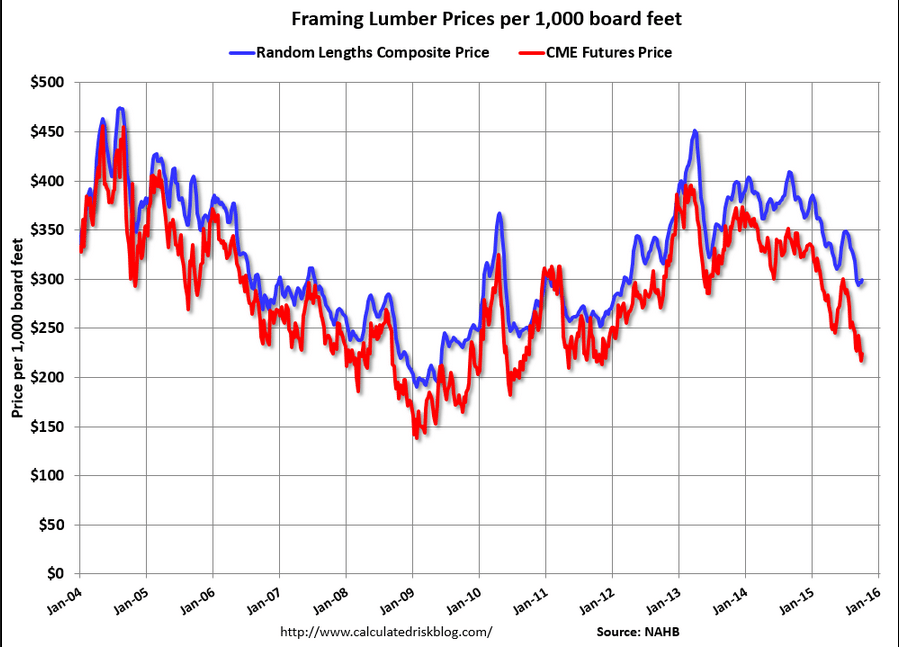
Lux GDP, Iowa, PC shipments, Lumber Prices, Oil Prices

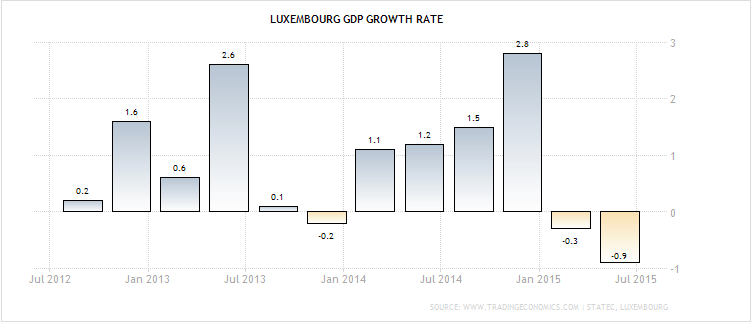
Even Luxembourg peaked after oil prices collapsed:
er-10-12-1

Ag slowdown imperils state revenue

By Donnelle Eller

Oct 12 (Des Moines Register) — Money coming into Iowa’s government coffers was flat the first quarter of this fiscal year, raising concern about how big an effect the slowing farm economy could have on the state budget.

State revenues — income tax paid by workers and corporations, along with sales tax paid at malls, restaurants and bars, among other sources — hit $1.77 billion since the start of the fiscal year July 1. It’s about even with revenue received this time last year.

But the state’s $7.17 billion budget is built around getting 6 percent more revenue this fiscal year than last year.

Gov. Terry Branstad and state budget and legislative leaders say they’re closely watching receipts but add that it is too soon to be alarmed.

PC Shipments Continue to Slump

By Anne Steele

Oct 8 (WSJ) — International Data Corp. said shipments fell a larger-than-anticipated 11% to 71 million units in the third quarter, while rival researcher Gartner Inc. said shipments totaled 73.7 million units, down 7.7% from a year ago. Both firms said Thursday that many users opted to upgrade existing PCs with the Windows launch rather than purchase new hardware. Gartner added that it expects the Windows 10 rollout to bolster holiday sales, while IDC said the new software and chips “may represent the most compelling reason we’ve had in years for consumers to upgrade their PCs.”

Remember when this was associated with housing?
;)
er-10-12-2
The Saudis did increase their discounts substantially for November delivery, which, all else equal, should bring price down fast until the change course. It took a few days for markets to react, but it may have started today:
er-10-12-3

Credit Check, Atlanta Fed, ECRI, Rail Traffic, Oil Comment

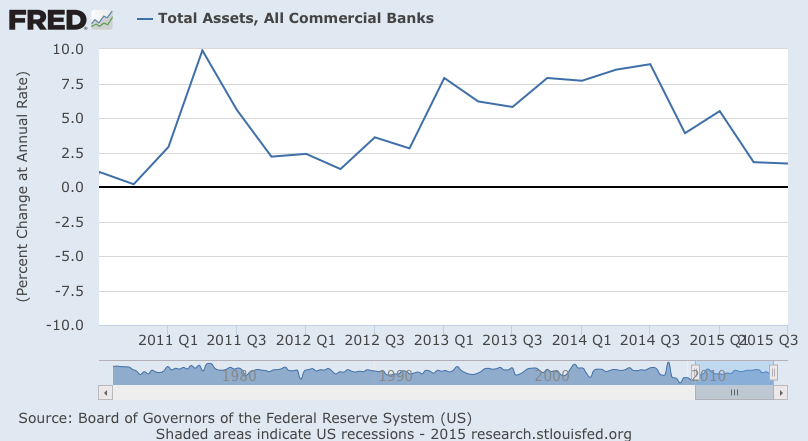
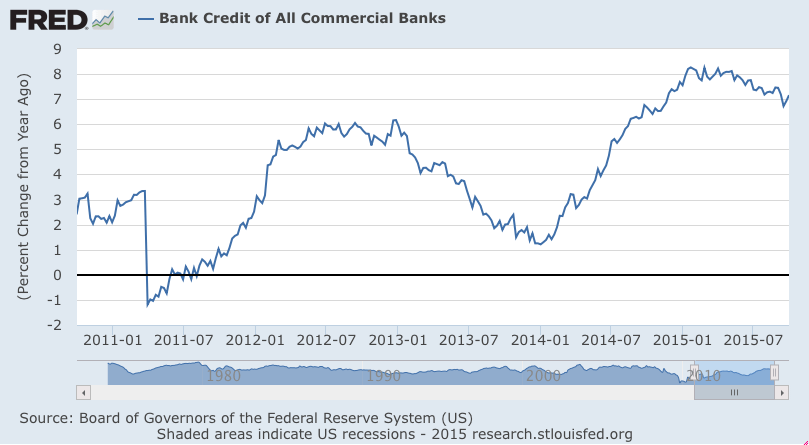
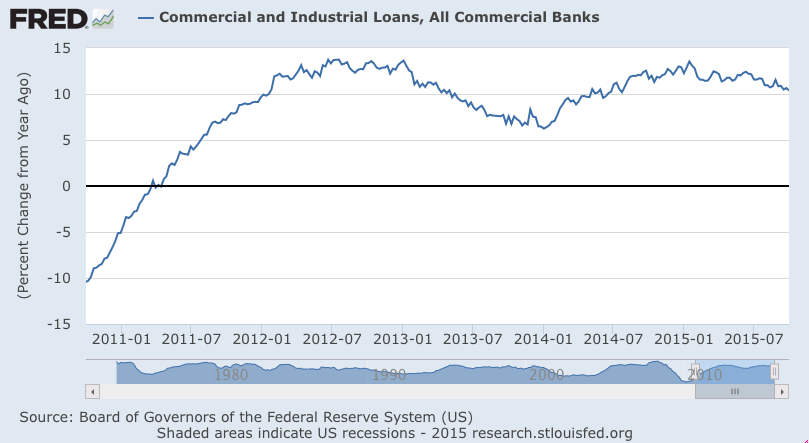
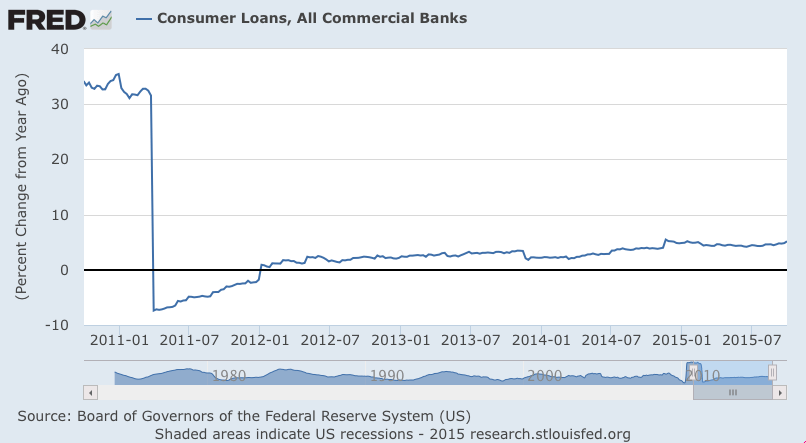
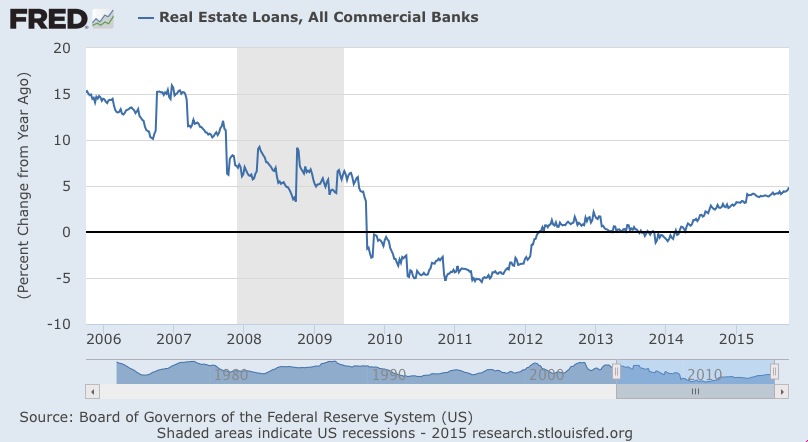
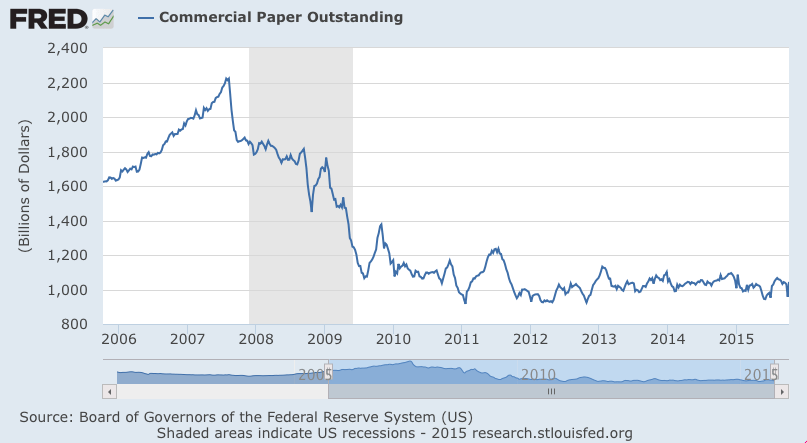
Growth rates still trending lower:

cc-10-10-1
cc-10-10-2
cc-10-10-3
cc-10-10-4
cc-10-10-5
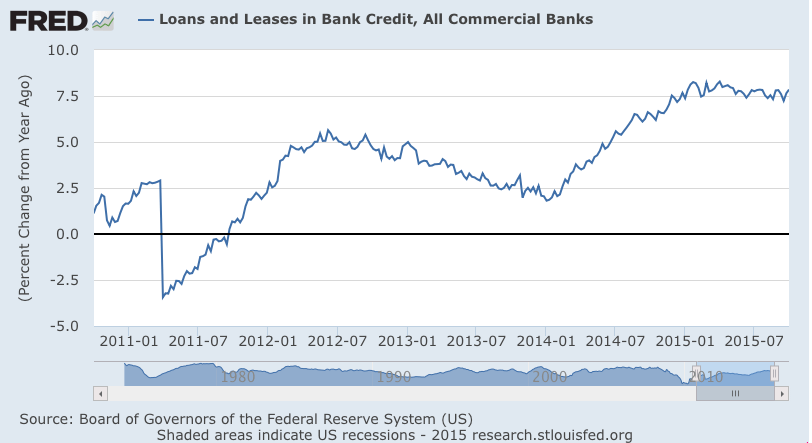
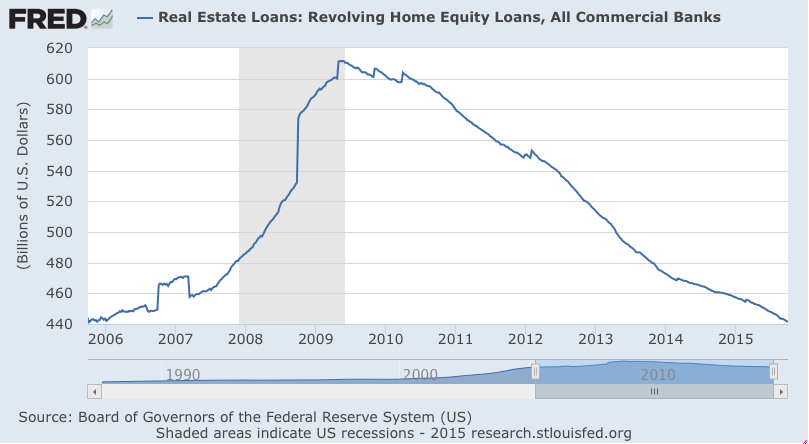
Growth rate edging higher from very low levels:
cc-10-10-6
cc-10-10-7
cc-10-10-8

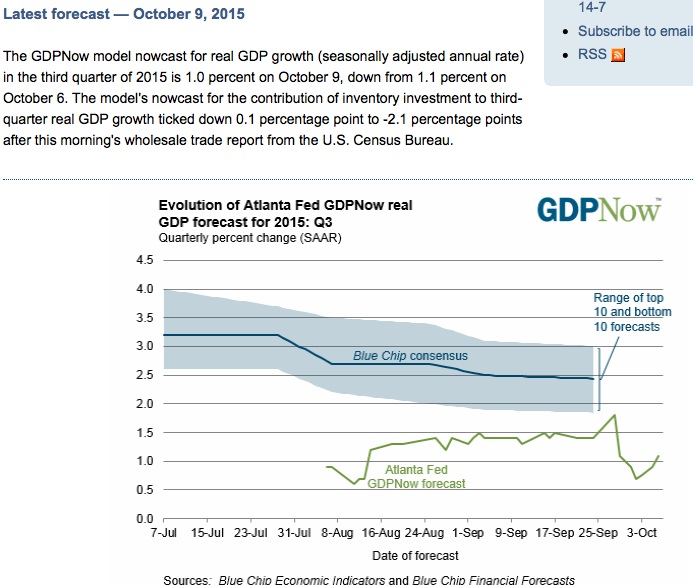
Back down to 1% for Q3:
cc-10-10-9
cc-10-10-10
cc-10-10-11

On October 5th Saudi price cuts were announced, as they increased discounts to various benchmark prices by substantial amounts. If the reports were accurate, the discount increases create a downward price spiral dynamic as previously described.

However, since that announcement oil prices have increased approximately 10% driven by buyers reacting to various news reports ranging from reduced US output to issues surrounding the mid east conflicts. And at the same time the rising oil prices led to a lower $US, higher prices for global equities, and term structures of interest rates moving higher in yield.

The risk here is that if the Saudi discounts are in fact in place, oil prices will reverse and head lower until the Saudis alter their pricing structure. And with traders and managers having previously gone ‘the wrong way’ the sell off in oil and equities will be all the more dramatic.

Wholesale Trade, UK Construction, Benefit Checks

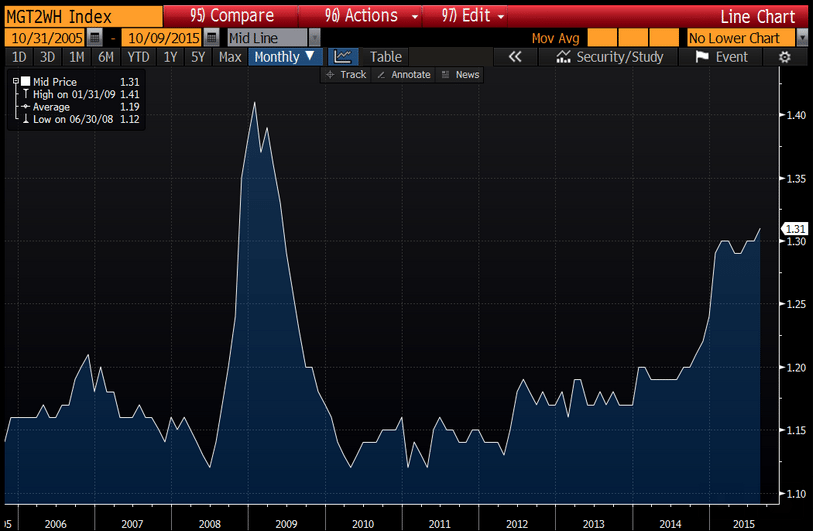
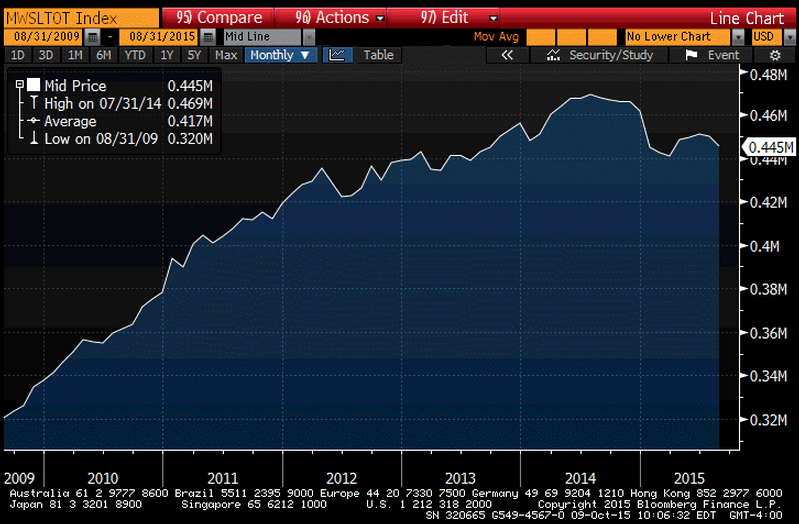
Sales to inventory ratios still looking way high to me, as happens entering a recession:

Wholesale Trade
er-10-9-1

Highlights
Wholesale inventories look to be pulling down on third-quarter GDP, up only 0.1 percent in August following a downwardly revised 0.3 percent decline in July. But relative to sales, which fell 1.0 percent in August and fell 0.3 percent in July, inventories are looking heavy. The stock-to-sales ratio rose to 1.31 in September from July’s 1.30.

Inventories relative to sales rose in autos which is a plus given how strong auto sales proved to be in September. Inventories of machinery also rose but here sales have been uneven and the build might be unwanted. Metals show a large draw on a bounce back for sales.

As far as GDP goes, inventories are looking to have a neutral effect. Businesses are keeping their inventories in check even as sales remain on the slow side. Watch for the business inventories report on Wednesday.

Wholesale Inventories +0.1% in August

U.S. wholesale inventories rose in August, boosted by larger stocks of computers and professional equipment used by businesses. Inventories are a key component of gross domestic product changes. The component of wholesale inventories that goes into the calculation of GDP – wholesale stocks excluding autos -rose 0.1 percent. Inventories for durable goods climbed 0.3 percent, with computers up 1.9 percent. At August’s sales pace it would take 1.31 months to clear shelves, up slightly from 1.30 months in July. An inventory-to-sales ratio that high usually means an unwanted inventory build-up, which would require businesses to liquidate stocks. That in turn could weigh on manufacturing and economic growth.
Inventory to sales ratio:
er-10-9-2
Total sales:
er-10-9-3
er-10-9-4
er-10-9-5

German Trade, Japan

Exports down but so are imports, indicating a weak global economy and continued euro support from trade net flows:

Germany : Merchandise Trade
er-10-8-1

German exports plunge at fastest pace since global financial crisis

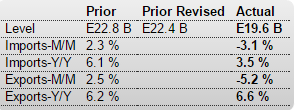
Oct 8 (Reuters) — German exports plunged in August. Data from the Federal Statistics Office showed seasonally-adjusted exports sliding by 5.2 percent to 97.7 billion euros month-on-month, the steepest drop since January 2009. Imports tumbled by 3.1 percent to 78.2 billion euros, the biggest one-month decline since November 2012. Germany’s trade surplus narrowed to 19.6 billion euros. Germany’s auto industry accounts for roughly one in five jobs. It accounted for 17.9 percent of Germany’s 1.1 trillion euros ($1.25 trillion) in exported goods last year.

Out of the frying pan and into the fire:

Japan : Machine Orders
er-10-8-2
Highlights
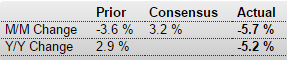
Core machine orders retreated for a third month in August. Core machine orders sank 5.7 percent on the month – expectations were for an increase of 3.2 percent. The monthly decline followed drops of 3.6 percent in July and 7.9 percent in June. On the year, orders were 5.2 percent lower. Total orders plunged 14.6 percent.

Manufacturing orders slid 3.2 percent while nonmanufacturing orders dropped 6.1 percent on the month. In an indication of weak international trade, overseas orders plummeted 26.1 percent on the month.

Needless to say, the government downgraded its view – said orders are marking time. Core machine orders are considered a proxy for private capital expenditures.

Japan out of deflation, Kuroda says

Oct 8 (Nikkei) — Japan has exited deflation and the overall inflation trend has risen steadily, Bank of Japan Gov. Haruhiko Kuroda said Wednesday. Kuroda emphasized price hikes, arguing that daily and weekly price indexes show a significant change from last year. Growth in the UTokyo Daily Price Index, which tracks changes in supermarket prices using data from Nikkei Inc., is hovering near 1.5%. Companies are passing higher labor and other costs on to customers, who are accepting the resulting price increases. Kuroda hinted that even a cut to inflation projections caused by the slump in crude oil would not be enough to merit more stimulus.

Japan’s August core machinery orders down 5.7% on month

Oct 8 (Kyodo) — Japan’s core private sector machinery orders fell a seasonally adjusted 5.7 percent in August from the previous month to 759.4 billion yen ($6.33 billion). The government cut its basic assessment, saying core machinery orders are “at a standstill.” Orders from the manufacturing sector dropped 3.2 percent to 347.9 billion yen in August, down for the third straight month, while those from the nonmanufacturing sector slid 6.1 percent to 422.1 billion yen for the second straight monthly fall. Overseas demand for Japanese machinery, an indicator of future exports, plunged 26.1 percent to 872.3 billion yen.

Japan service sector sentiment worsens in September

Oct 8 (Economic Times) — Japan’s service sector sentiment index fell to 47.5 in September, a Cabinet Office survey showed on Thursday. The survey of workers such as taxi drivers, hotel workers and restaurant staff – called “economy watchers” for their proximity to consumer and retail trends – showed their confidence about current economic conditions slipped from 49.3 in August. The outlook index, indicating the level of confidence in future conditions, rose to 49.1 in September from 48.2 the previous month. The Cabinet Office started compiling the data in comparative form in August 2001.

Consumer Credit

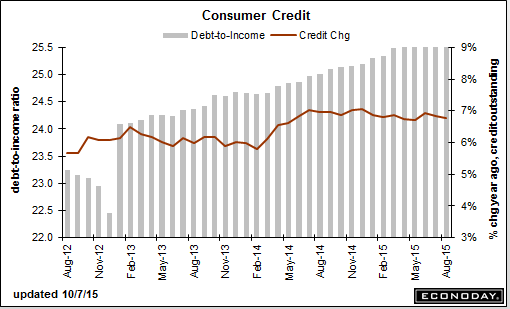
Now looking like this peaked as oil prices collapsed:

Consumer Credit
er-10-7-3

Highlights
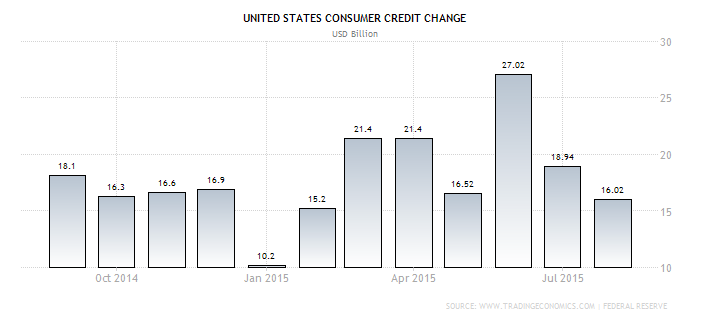
Revolving credit continues to show life, up a solid $4.0 billion in August for a sixth straight gain. Gains in this reading, which have been scarce this recovery, perhaps suggest that consumers are growing less reluctant to run up their credit cards, which would be good news for retailers going into the holidays. Non-revolving credit, driven by both vehicle financing and student financing which is tracked in this component, rose $12.0 billion to make for a headline increase of $16.0 billion.

United States Consumer Credit Change

Consumer Credit in the United States increased by 16.02 USD Billion in August of 2015, following a downwardly revised 18.94 USD Billion in the previous month and below market expectations. Consumer Credit in the United States averaged 4.38 USD Billion from 1950 until 2015, reaching an all time high of 115 USD Billion in December of 2010 and a record low of -18 USD Billion in June of 2009. Consumer Credit in the United States is reported by the Federal Reserve.
er-10-7-4

er-10-7-5