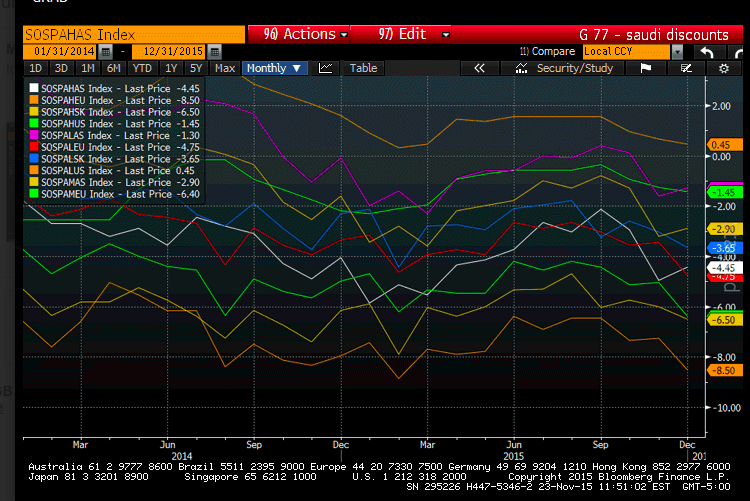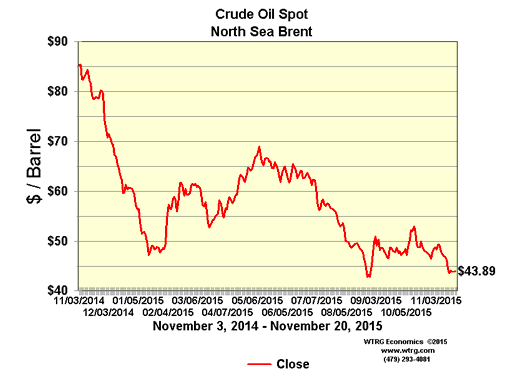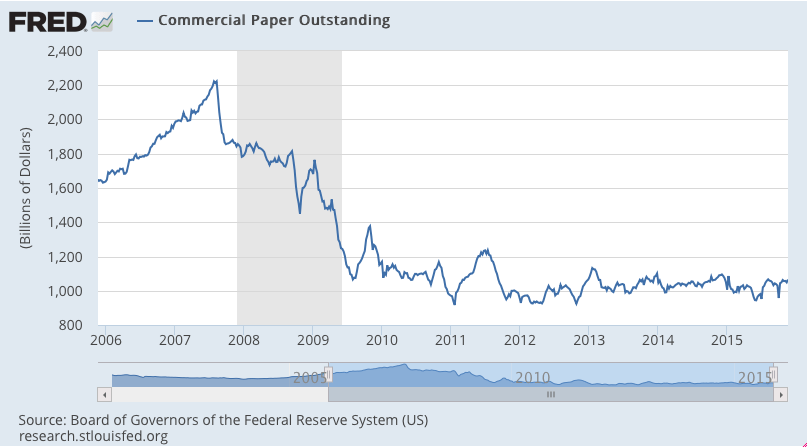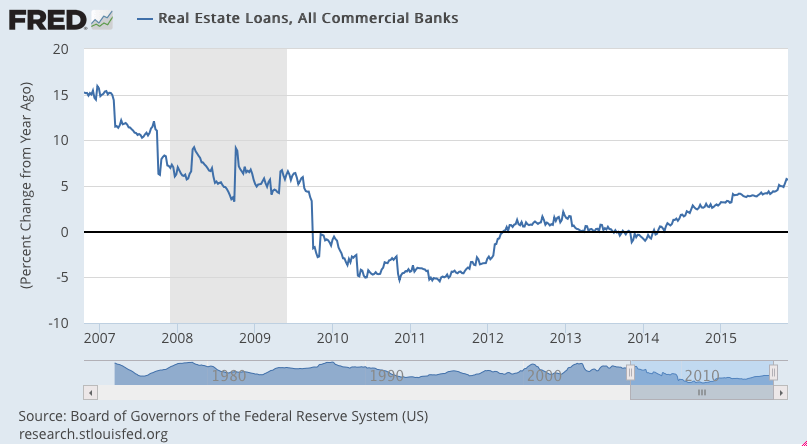
Discount rate, Profits, GDP commentary

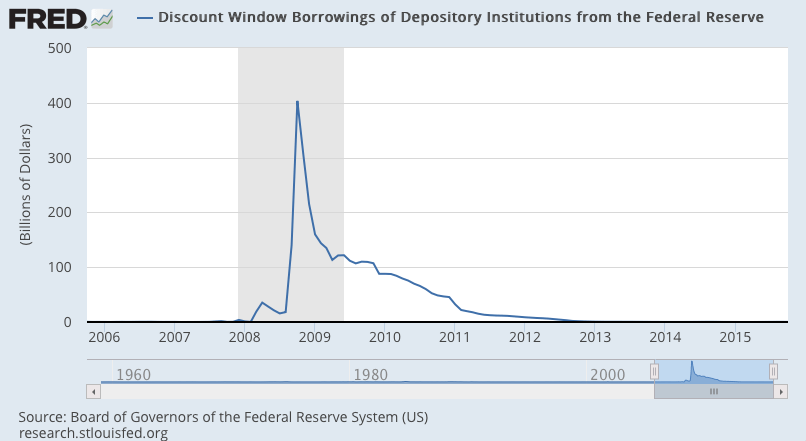
Interesting, with no discount borrowings, the regional Federal Reserve Bank presidents want a discount rate hike?

Nine Fed banks called for discount rate hike: minutes

Nov 24 (Reuters) — The number of regional Federal Reserve banks pushing for a hike in what commercial banks are charged for emergency loans rose to nine in October, minutes from its discount rate meeting showed. Eight Fed banks had voted to raise the discount rate at the prior meeting in September, a jump from five in July and August. The nine regional banks that requested a hike want to normalize the spread between the discount rate governing Fed lending to banks and the overnight federal funds rate, which is the central bank’s primary economic lever.
er-11-25-1

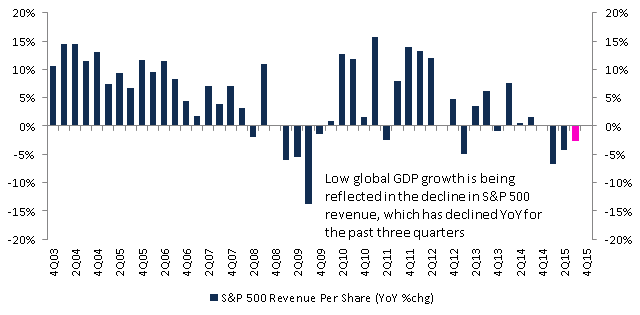
Falling Corporate Profits Blur U.S. Growth Outlook

Nov 24 (WSJ) — A comprehensive measure of companies’ profits across the U.S.—earnings adjusted for inventory and depreciation—dropped to $2.1 trillion in the third quarter, down 1.1% from the second quarter. Compared with a year earlier, profits fell 4.7%. Profits as a share of overall economic output have shrunk to 11.4% in the third quarter from a recent peak of 12.5% in 2012. Domestic profits rose $7.3 billion in the third quarter, or 0.4%. Domestic profits were down 2.8% from the third quarter of 2014. Meanwhile, foreign profits fell by $30 billion, a 7.4% decline from the second quarter and 12.2% drop from a year earlier.

As previously discussed, if agents spending more than their incomes weren’t sufficient to offset agents spending less than their incomes the output didn’t get sold, and inventories build. This leads to reduced production, reduced employment, and reduced income, in a downward spiral that only reverses via agents spending that much more than their incomes. With the private sector largely pro cyclical, the reversal most often requires govt spending that much more than its income, either by reducing taxes or increasing spending. This can be done proactively, or the ugly way- via reduced tax collection due to the slow down and rising unemployment benefits, as most often is the case, at least initially. With the currency itself a (simple) public monopoly, and in this case the currency monopolist is restricting the supply of net $US financial assets, and a necessarily pro cyclical private sector, the idea of markets clearing on their own to restore output and employment is entirely inapplicable once the down turn is in progress:

U.S. GDP growth raised for third quarter

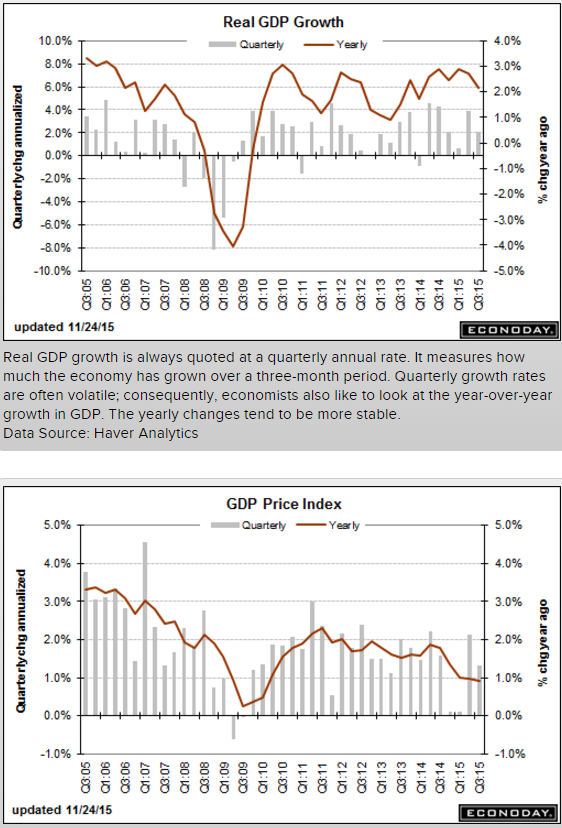
Nov 25 (Reuters) — US GDP grew at a 2.1 percent annual pace, not the 1.5 percent rate it reported last month. Wages and salaries increased $109.3 billion, $61.6 billion more than initially estimated. In the third quarter, businesses accumulated $90.2 billion worth of inventories, instead of the $56.8 billion reported last month. That followed more than $100 billion worth of inventories accumulated in each of the prior two quarters. Business spending on equipment was revised up to a 9.5 percent rate from a 5.3 percent pace.

Consumer Confidence Index Declines Again

Nov 24 (Conference Board) — The Consumer Confidence Index declined to 90.4 in November, down from 99.1 in October. The Present Situation Index decreased from 114.6 last month to 108.1 in November, while the Expectations Index declined to 78.6 from 88.7 in October. Those stating jobs are “plentiful” decreased from 22.7 percent to 19.9 percent, while those claiming jobs are “hard to get” increased to 26.2 percent from 24.6 percent. Those anticipating more jobs in the months ahead fell from 14.4 percent to 11.6 percent, while those anticipating fewer jobs increased from 16.6 percent to 18.7 percent.

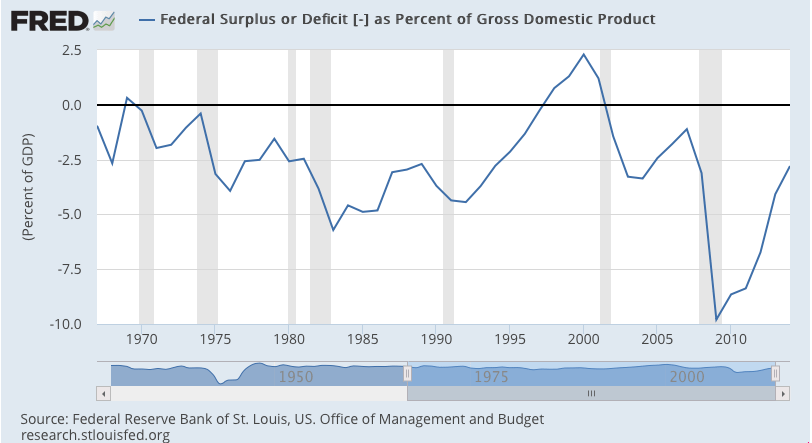
As recession hits, deficit spending is what always leads the subsequent recovery:
er-11-25-2

Posted in GDP

GDP, Consumer confidence, Corporate profits, Richmond Fed, Trade

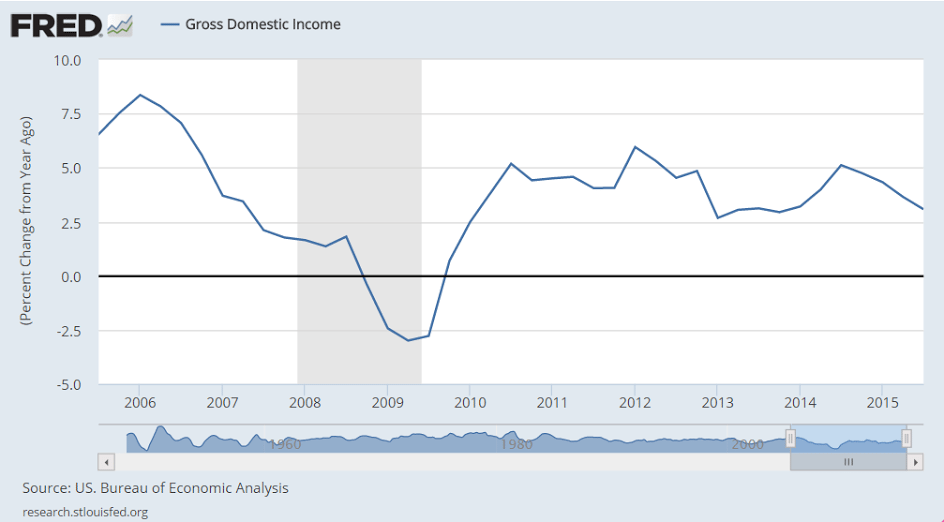
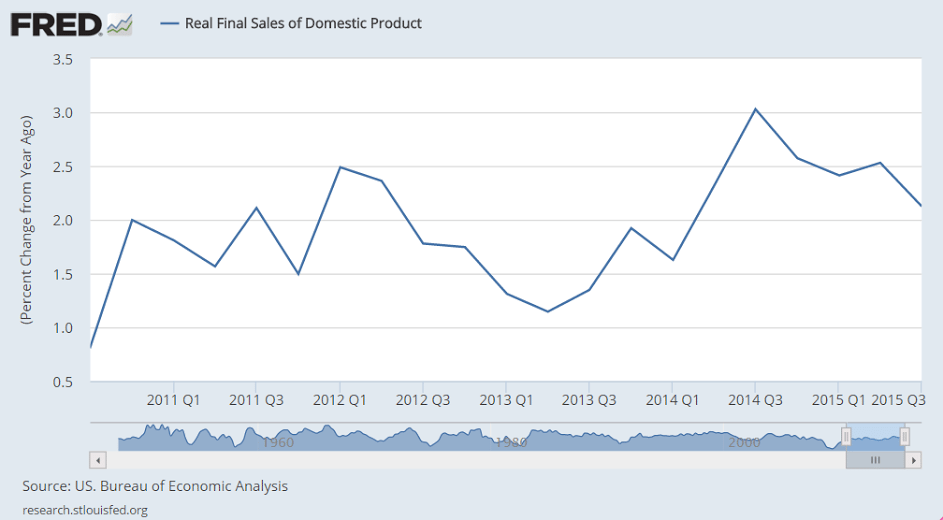
Output was revised up, but mainly due to growing unsold inventory, with other spending revised lower and showing more deceleration than the first release:

GDP
er-11-24-1
Highlights
Third-quarter GDP is revised to an annualized plus 2.1 percent, up 6 tenths from the initial estimate but showing less strength by the consumer with final sales now at plus 2.7 from plus 3.0 percent. Higher inventories are a big factor in the upward revision, subtracting 6 tenths from GDP vs an initial 1.4 percent subtraction.

Net exports pulled GDP down by 2 tenths vs only a small negative effect in the first estimate. Exports rose only 0.9 percent in the quarter, down 1 percentage point from the initial reading. Readings on residential investment, adding 2 tenths to GDP, and nonresidential fixed investment, adding 3 tenths, are little changed.

Turning back to the consumer, personal consumption expenditures are revised to plus 3.0 percent, down 2 tenths from the initial estimate and reflecting less strength for durable goods and also services on lower spending for communications and natural gas.

The gain in inventories is not a positive for the fourth quarter, posing headwinds for businesses which may limit production and employment to pull down their inventories. Still, the readings on the consumer are a positive and a reminder that the nation’s economy is being driven by domestic demand. Other details include a tame plus 1.3 percent rise in the GDP price index, up 1 tenth from the initial reading.

Note the decelration over the last year as oil prices and capital expenditure collapsed:
er-11-24-2
er-11-24-3
er-11-24-4

Collapsing?

Consumer Confidence
er-11-24-5
Highlights
Lack of confidence in the outlook for the jobs market sank the consumer confidence index in November, which fell to 90.4 vs a revised 99.1 in October. The November reading is far under expectations and is the lowest since September last year. Expectations, one of two main components in this report, fell more than 10 points to 78.6 which is the lowest reading since February last year. The employment subcomponent here shows fewer consumers seeing jobs opening up six months from now and more seeing fewer jobs ahead.

The present situation component shows less weakness, down 6.5 points to 108.1 which is the lowest reading since only July. Here the employment subcomponent also shows weakness but nothing dramatic, with 26.2 percent saying jobs are hard to get which is up from October’s 24.6 percent but still respectable. But those describing jobs as currently plentiful showed more noticeable deterioration, at 19.9 percent vs October’s 22.7 percent.

A plus in the report is a jump in buying plans for autos, at 12.4 percent vs October’s 9.8 percent in a reading that hints at renewed acceleration for the motor vehicle component of the government’s retail sales report. A negative is a dip in home buying plans, to 5.6 percent from 6.2 percent. Other readings include a 1 tenth dip in inflation expectations to 5.0 percent which, for this particular reading, is actually subdued but nothing dramatic.

But the decline in job expectations is dramatic and raises the question whether global effects, which have been negative for the U.S., are beginning to weigh on the American consumer — which would not be a positive for the holiday spending outlook.

Corporate Profits
er-11-24-6
Highlights
Corporate profits in the third quarter came in at a revised $1.786 trillion, up a year-on-year 1.4 percent. Profits are after tax without inventory valuation or capital consumption adjustments.

Richmond Fed Manufacturing Index
er-11-24-7
Highlights
Early indications for the November factory sector are soft right now after Richmond Fed reports a much lower-than-expected minus 3 headline for its manufacturing index. Order data are very negative with new orders at minus 6, down from zero in October, and backlog orders at minus 16 for a 9-point deterioration. Shipments are also in contraction, at minus 2, with the workweek at minus 3. Employment, at zero, shows no monthly change but the declines for backlog orders and the workweek don’t point to new demand for workers. Price data are subdued but do show some constructive upward pressure.

This report along with Empire State, as well as yesterday’s manufacturing PMI, are pointing to a downbeat month for the factory sector which is being held down by weak foreign demand, as evidenced in the decline for goods exports in this morning’s advance release of international trade data.

International trade in goods
er-11-24-8
Highlights
The nation’s trade gap in goods came in at a lower-than-expected deficit of $58.4 billion in October vs $59.2 billion in September. Though the month-to-month comparison points to improvement for the trade deficit, the details are not positive with exports down 2.6 percent and imports, in a sign perhaps of softening domestic demand, down 2.1 percent and following weakness also in September. Weak categories for imports include foods/feeds/beverages, industrial supplies and also capital goods as well as consumer goods with the latter hinting at weak business expectations for the holidays. Export categories showing weakness include foods/feeds/beverages and also industrial supplies.

Copper, Japan, Corp tax policy

They must have found a way for their workers to live on fewer calories…

Copper Miners’ Pain Doesn’t Stop Buildup

Nov 23 (WSJ) —Global copper production is on track to hit an all-time high of 18.7 million metric tons this year, according to BMO Capital Markets. The cost of producing a pound of copper at Freeport’s Grasberg mine in Indonesia will drop to 61 cents next year, from an estimated $1.05 cents in 2015, according to BMO. Next year, four new mines will increase the world’s copper production by 5.1%, says Barclays. This year, rains, drought, earthquakes and labor strikes cut 9% from planned global mine output, versus typical annual losses of 4% to 5%, said Citigroup.

Capital Expenditure is one of the channels whereby agents spend more than their incomes which offsets those spending less than their incomes:

Japan Inc. tightens purse strings at home

Nov 24 (Nikkei) — Capital spending in Japan shrank an annualized 4.8% from the previous quarter in the April-June period and fell an annualized 5% in the three months ended in September. Aggregate pretax profit of listed companies in Japan is seen climbing to a record for the second consecutive year in fiscal 2015. Japanese companies M&A spending overseas topped 10 trillion yen ($80.6 billion) for the first time this year, according to M&A advisory Recof. R&D spending will be included in GDP data from the end of next year, but at this point, its omission makes corporate spending look even smaller than the reality.

The progressive response is to eliminate all corporate taxes, as they merely get passed through to consumers. But don’t count on either side picking up on that. Or that in no case should health care be a marginal cost of production, unless the work itself causes health problems, etc. etc. etc.

phizer

Chicago index, PMI manufacturing index, Existing home sales, Saudi pricing

Still negative. This is just a composite of other indexes that have been released:

Chicago Fed National Activity Index
er-11-23-1
Highlights
October was a soft month for the economy but solidly improved from September, based on the national activity index which is at minus 0.04 vs September’s revised minus 0.29. October’s improvement is centered in the key component of employment, at plus 0.11 vs September’s minus 0.06. The gain reflects the month’s very strong 271,000 rise in nonfarm payrolls and the 1 tenth downtick in the unemployment rate to 5.0 percent.

Turning to the three other components, manufacturing was also a plus for October, from minus 0.17 in September to minus 0.05 and reflecting the related component gain in the industrial production report. The sales/orders/inventories component was little changed, at minus 0.01, as was personal consumption & housing at minus 0.09.

The improvement in October, however, did not lift the 3-month average, at minus 0.20 vs a revised minus 0.03 in September in a reminder that the nation’s economic growth remains, by historical standards, sub-par.

I don’t give much weight to the Markit reports as they have tended to overstate things, which makes this one somewhat interesting:

PMI Manufacturing Index Flash
er-11-23-2
Highlights
Markit’s U.S. manufacturing sample is finally reporting weakness, weakness long registered across the breadth of other manufacturing data. The manufacturing PMI, at 52.6 for the November flash, is still above 50 to indicate monthly growth but the rate of growth is the slowest for this sample in more than two years, since October 2013. Growth in new orders is also the slowest in just over two years with respondents citing special weakness in exports which, hit by the strong dollar and weak global demand, dipped back into the contraction column in the month. Markit’s sample still, however, reports a “robust” rate of production which is a positive indication for November industrial production.

Other readings include the first drop in a year for backlog orders and a fourth straight dip for finished goods inventories. Price data show contraction for inputs, one tied to lower transportation and commodity prices, and little change for finished goods prices. A sign of strength comes from another gain for employment, again in contrast to other data.

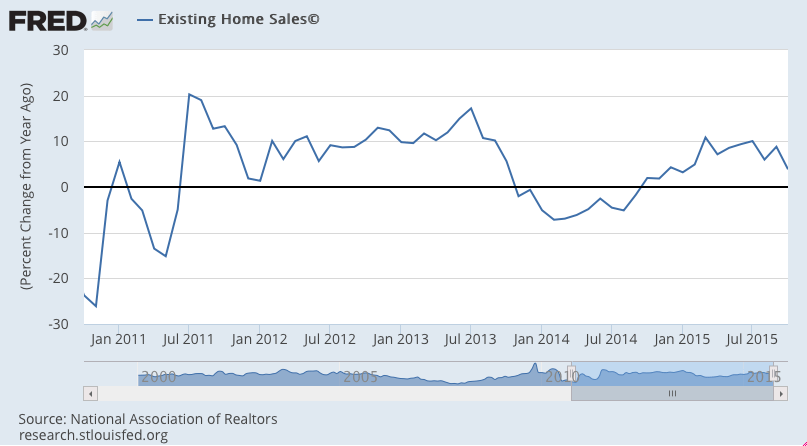
More evidence of a slowing housing market for all the reasons previously discussed:

Existing Home Sales
er-11-23-3

Highlights
Sales of existing homes are not a source of strength for the economy, down 3.4 percent in October to a slightly lower-than-expected annualized rate of 5.36 million. Year-on-year, sales are up only 3.9 percent which is the lowest for this reading since January. Weakness is split roughly even between single-family homes, down 3.7 percent in the month to a 4.75 million rate, and condos, down 1.6 percent to a 610,000 rate.

Lack of homes on the market, in a reflection of price weakness, remains a major factor holding down sales. Supply relative to sales is at 4.8 months, up slightly from the prior month but still below the 5.2 months of October last year. A reading of 6.0 months is considered a balanced market. The number of homes on the market, at 2.14 million, is actually below the 2.24 million this time last year, an unwanted surprise that the National Association of Realtors, which compiles the existing home sales report, calls “disturbing”.

Price data for October are once again weak, down 0.9 percent for both the median (at $219,600) and the average (at $262,800). Year-on-year, the median is up 5.8 percent with the average up 3.4 percent.

Regional sales data show a sharp decline in the West, down 8.7 percent in the month for a year-on-year gain of 2.7 percent. The South, which is the largest housing region, also shows weakness, down 3.2 percent for only a 0.5 percent year-on-year gain. The Northeast and Midwest were little changed in October with year-on-year appreciation very solid for both, in the high single digits.

But the weakness in the West and the weakness in the South are not positive indications for the housing sector where moderate strength on the new home side of the market is being offset by weakness on the existing side.

Familiar theme of deceleration after oil capital expenditures collapsed about a year ago:
er-11-23-4

Saudis in the news but doesn’t look like they’ve changed the pricing policy that brought prices down, as they work to let prices fall to the point they sell their entire output capacity, like all the rest do:

Oil gyrates after Saudi Arabia reiterates support for market

er-11-23-5
And it looks from this chart like spot prices remained subdued even during the days futures rose last week, and futures due ultimately converge to spot:
er-11-23-6

Rail traffic, credit check

Rail Week Ending 14 November 2015: Contraction Grows

Week 45 of 2015 shows same week total rail traffic (from same week one year ago) declined according to the Association of American Railroads (AAR) traffic data. Intermodal traffic contracted year-over-year, which accounts for approximately half of movements. and weekly railcar counts continued in contraction. The 52 week rolling average contraction grew.

Not much happening:

er-11-22-1

er-11-22-3

er-11-22-4

er-11-22-5

Atlanta Fed, Investor poll, Fed surveys

er-11-19-6

The crowd is not always wrong, but it’s not always right, either:

Fund managers polled at the start of November have significantly hiked their allocation to equities and cut cash holdings to levels not seen since July, according to research from Bank of America Merrill Lynch.

Of the 200 investors managing $576 billion of assets that were quizzed by the bank for its monthly fund manager survey, four-fifths now expect the U.S. Federal Reserve to raise rates this quarter.

Some 43 percent of managers are now “overweight” stocks, up 17 percentage points from the previous month.

Long dollar is the most crowded trade according to the survey, with 32 percent of the investors polled anticipating further strength in the greenback.

er-11-19-7

Housing starts, High end weakness

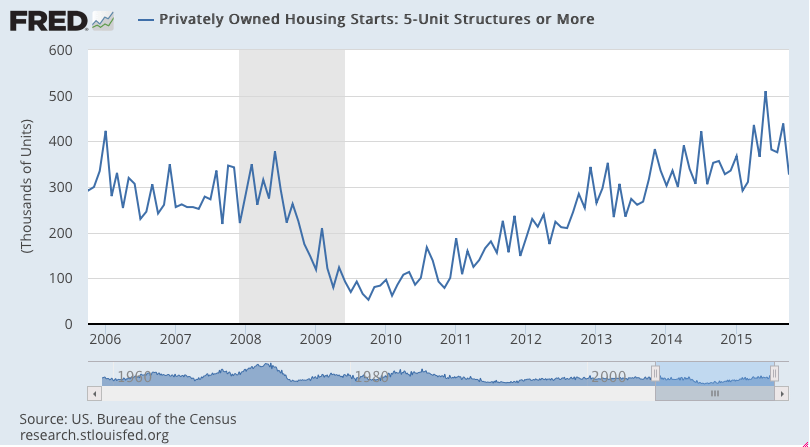
Falling off, as previously discussed, particularly multi family, which had been the driver:

Housing Starts
er-11-19-1
Highlights
Pulled down by a big drop in multi-family homes, housing starts fell a steep 11.0 percent in October to a 1.060 million annualized rate that is far below Econoday’s low estimate. Starts for multi-family homes, which spiked in September following a springtime jump in permits for this component, fell back 25 percent in the month to a 338,000 annualized rate. Single-family starts fell a much less severe 2.4 percent to 722,000.

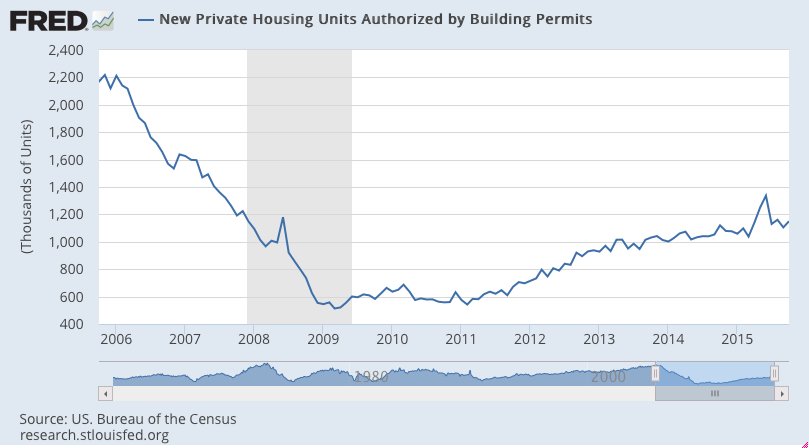
And there is important good news in this report. Permits are up, rising 4.1 percent to a 1.150 million rate that hits the Econoday consensus. Single-family permits are up 2.4 percent to a 711,000 rate with multi-family up 6.8 percent to 439,000.

Housing completions fell back in October, down 6 percent to a 965,000 rate that reflects lower work in the Northeast and Midwest. Homes under construction rose 0.9 percent to a recovery best 938,000 rate and are up a very strong 16.4 percent year-on-year, pointing, despite the slip in starts, to ongoing strength for construction spending, at least for October.

But the big drop in starts is definitely a negative for the near-term construction outlook, though the rise in permits points to subsequent strength.

er-11-19-2
er-11-19-3
er-11-19-4
er-11-19-5

Sotheby’s Offers Employees Voluntary Buyouts to Cut Costs

Nov 13 (Bloomberg) — Sotheby’s is offering employees voluntary buyouts to cut costs after a drop in third-quarter revenue grabbed more attention from the company’s investors than its largest ever semiannual auction season.

San Francisco in housing ‘correction’

Nov 5 (CNBC) — San Francisco homes are still some of the priciest in the nation, but sales of those houses are showing significant weakness. September sales were down 19.5 percent in the city from a year ago, according to the California Association of Realtors.

“We’re going through a kind of correction, as we have a lot of new developments being built right now. The supply is definitely on the rise,” said Justin Fichelson, an agent at Climb Real Estate Group in San Francisco. “The market is not going to continue going up like we’ve seen in the past two years, because prices are already high.”

London Mansion Prices Fall 11.5% as Home `Bubble’ May Have Burst

Nov 12 (Bloomberg) — Prices of homes valued at 5 million pounds ($7.6 million) or more fell 11.5 percent on a per square foot basis in the third quarter from a year earlier, according to Richard Barber, a director at broker W.A. Ellis LLP, a unit of Jones Lang LaSalle Inc. Sales volumes across all homes in the best parts of central London dropped 14 percent in the period, the realtor said on Thursday.

“The bubble may already have burst” for the most expensive homes, Barber said. Now, “36 percent of all properties currently on the market across prime central London are being marketed at a lower price than they were originally listed at, with the average reduction in price being 8.5 percent.”

Luxury-Jet Market Value Seen Slipping for First Time Since 2009

Nov 15 (Bloomberg) — Global long-term spending on private jets is starting to slow for the first time since 2009 as slumping commodity prices sap demand in emerging markets, according to an industry forecast.

Deliveries for the 11 years ending in 2025 will be valued at $270 billion, Honeywell International Inc. said Sunday in its annual survey of the luxury-aircraft market. That’s down 3.6 percent from last year’s comparable projection, and snapped a streak of gains since the last U.S. recession ended.

The decline reflects weakness in Brazil, Russia, India and China, the group known as the BRIC countries, and the impact of political conflicts in the Middle East and Africa, according to Brian Sill, chief of Honeywell’s business and general aviation unit. Delays in some new plane models are also pushing back demand, he said.

Jet shipments will drop 2.6 percent to 9,200 planes, according to Honeywell, whose forecast had predicted fluctuations in deliveries but no drop in the planes’ list value in the post-recession years. Large planes that had spearheaded the recovery are now seeing slower growth.

CPI, Redbook Retail Sales, Industrial Production, Housing Index, Containers, FHA Capital, EU Car Registrations, Japan

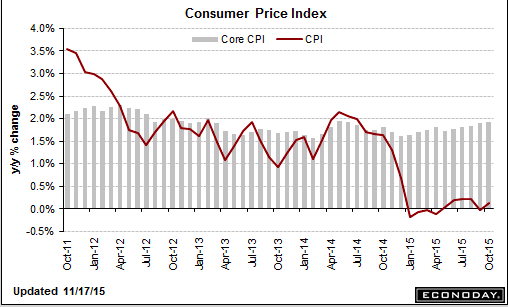
Part of the Fed’s mandate is to hit it’s 2% inflation target:
er-11-17-6
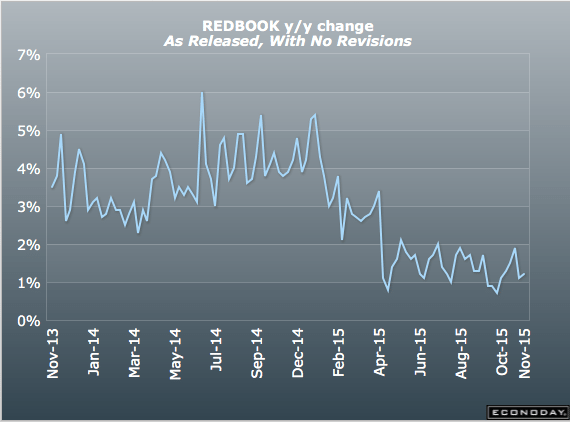
Still at recession type levels:
er-11-17-7
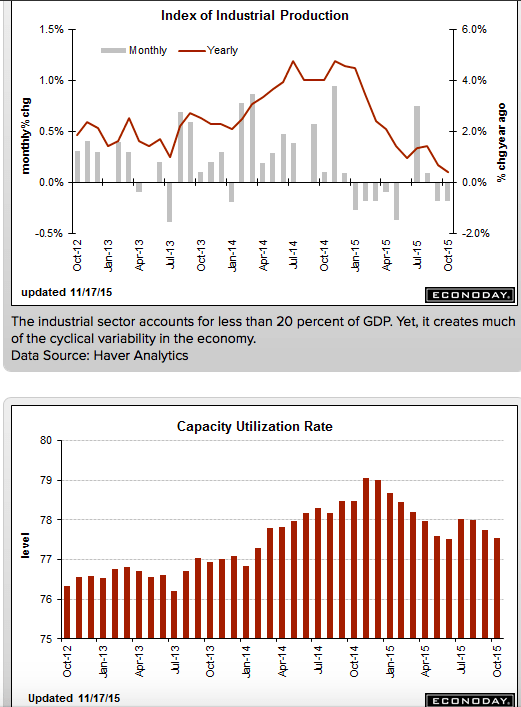
This is also what recession looks like:
er-11-17-8
The anointed ‘driver of the economy’ continues to falter as previously discussed:

Housing Market Index
er-11-17-9
Highlights
The housing market index from the nation’s home builders shows weakness, at 62 for November and missing the Econoday consensus by 2 points. And compared to a revised October, the index is down 3 points. Yet readings in the report, though slowing, remain solid and one important detail is favorable.

Of the report’s three components, future sales are down a sizable 5 points but the level is still in the seventies, exactly at 70. Present sales, which is the most heavily weighted component, fell 3 points to 67, also still a strong level.

The positive in the report is a 1 point rise in traffic, a component which, at 48 in the latest report, has been lagging badly but is getting closer to the breakeven 50 mark. Weakness in this reading has been reflecting lack of first-time buyers in the market.

Turning to regional data, the highest composite score goes to the West, at an enormously strong 77, followed by the South, at 62. Two less watched regions for new homes, the Midwest and North, trail at 59 and 52.

There are positives in this report but the decline in both future and present sales is a reminder that both starts and permits for single-family homes have been slowing. Despite the rise in traffic, this report probably pulls back the housing outlook by a degree.

October 2015 Sea Container Counts Continue to Show Trade Recession Continues

By Steven Hansen

The data for this series continues to be in contraction. The year-to-date volumes are contracting for both exports and imports. The trade sector remains in a recession.

Federal agencies don’t need ‘capital’ to function.

This is simply unspent income that reduces aggregate demand:

FHA Meets Minimum Reserve Requirement for First Time Since 2009

(WSJ) — The Federal Housing Administration, which backs low-down-payment mortgages popular with first-time home buyers, said its insurance fund’s net worth at the end of September was $23.8 billion, up from a year-earlier level of $4.8 billion. Its capital reserve ratio, which by law is required to stay above 2%, rose to 2.07%, the first time it met the threshold since the start of the agency’s 2009 fiscal year. With the private subprime-mortgage market largely gone, the agency offers some of the easiest terms available, letting borrowers with a credit score as low as 580 make a down payment of as little as 3.5%.

Passenger car registrations: +8.2% over ten months; +2.9% in October

(ACEA) — In October 2015, the EU passenger car market continued its upward trend, despite a slower rate of increase (+2.9%), marking the 26th consecutive month of growth. Demand for new passenger cars saw momentum slowing down in all major markets. Registrations in Italy (+8.6%), Spain (+5.2%), Germany (+1.1%) and France (+1.0%) kept growing, even though less strong than in past months, while the UK market declined in October (-1.1%). Across the region, new passenger car registrations totalled 1,104,868 units, also supported by growth in the EU’s new member states (EU-12).

Can’t admit fiscal works and monetary doesn’t:

Abe to call for supplementary budget topping 3tn yen

(Nikkei) — Prime Minister Shinzo Abe will direct the Japanese government to put together a supplementary budget totaling more than 3 trillion yen ($24.2 billion) next week to help shore up a flagging economy. The government is set to compile measures to cope with the Trans-Pacific Partnership trade pact on Nov. 25 and steps for promoting active civic engagement on Nov. 26, with both to be incorporated into the extra budget for fiscal 2015. The prime minister declined to characterize the supplementary budget as a stimulus measure, since doing so could be seen as admitting defeat on Abenomics.

Capital spending delays took toll on July-September GDP

(Nikkei) —Weak capital investment led Japan’s economy to shrink by an annualized 0.8% in the three months ended September. A 1.3% drop in capital investment was the main cause of the decline. Corporations had planned to invest a good deal this fiscal year, though the follow-through has been lacking. Machinery orders, which typically lead capital investment by three to six months, slipped 10% for the July-September quarter. But if the outlook for economic growth overseas remains hazy, more companies could put investment on hold.

Empire State Manufacturing, China Power Usage, Stock Buy Backs

The recession continues:

Empire State Mfg Survey
er-11-17-1
Highlights
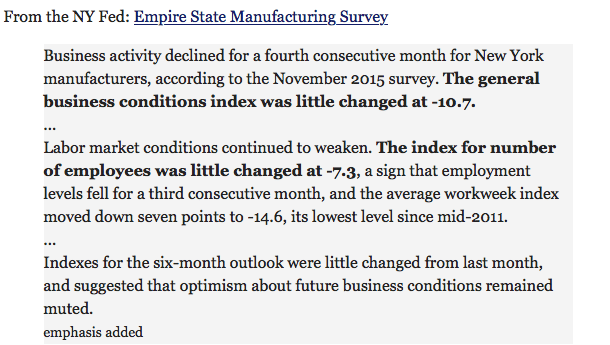
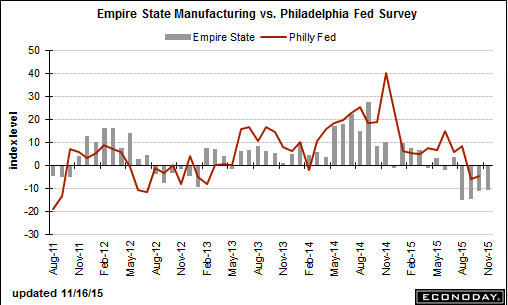
Negatives are beginning to run in Empire State with the index at minus 10.74 in November, right in line with the prior four readings and well below the Econoday consensus for minus 5.00. Several components are showing extended weakness including unfilled orders, at minus 18.18 for the lowest reading of the year, and also the workweek, at minus 14.55 for a fifth straight decline and the weakest run since mid 2013. With unfilled orders down and the workweek down, it’s no surprise that employment is down, at minus 7.27 for a third straight loss and the weakest streak since late 2009. And prices, even outside of energy and commodities, are not helped by weak demand with prices for final goods at minus 4.55 for a third straight decline and the longest run of contraction since early 2013.

Good news is hard to find but there is easing weakness in new orders, at minus 11.82 vs October’s minus 18.91, and in shipments as well, at minus 4.10 vs minus 13.61. Still, this is the sixth straight decline for new orders and the fourth straight for shipments. Manufacturers are keeping their inventories down while delivery times, reflecting the weakness in shipments, are speeding up.

This report is the first indication on November’s factory sector and it points to another run of weak regional reports, starting Thursday with the Philly Fed. The factory sector, hit by weak exports and in contraction for a full year, is becoming perhaps the economy’s Achilles heal — and also perhaps a dovish wildcard for the December FOMC.

er-11-17-2
er-11-17-3
Power usage has been a reasonable growth indicator:

China’s power use drops slightly in Oct.

Nov 16 (Xinhua) — China’s electricity consumption edged down 0.2 percent to 449.1 billion kilowatt hours (kwh) in October. In the first ten months, power use rose 0.7 percent from a year earlier to 4.58 trillion kwh. China’s value-added industrial output of the electricity, heating, gas and water sectors lost 0.3 percent in October, while September saw 0.7-percent growth. Electricity use in the service sector rose 7.1 percent in the first ten months, the agricultural sector posted a 3.0 percent increase, while use by the industrial sector dropped 1.1 percent from a year earlier, the NEA said.

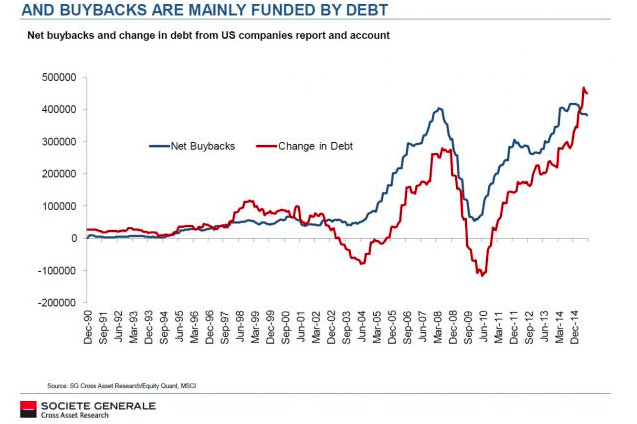
So seems the new corporate debt is largely going towards stock buy backs, substituting debt for equity on the balance sheets, leaving corps more leveraged than otherwise:
er-11-17-4
er-11-17-5