AFP: British finances


[Skip to the end]

The deficit will go higher. The only question is whether it will go higher the nice way (proactive spending or tax cut to restore demand and growth), or the ugly way (revenues fall and transfer payments go up until the deficit is large enough to restore financial equity and aggregate demand).
Solvency is not an issue. The choice is purely political.

British finance minister paints bleak picture of economy

Britain’s economic downturn is worse than previously thought and there is no extra money available for public spending, Chancellor of the Exchequer Alistair Darling said in an interview published Saturday.

There’s the problem. They’ve got it backwards – the money to pay taxes comes from government spending, not vice versa as they think.

Darling also told The Times newspaper that taxpayers were at the limit of what they were willing to pay, a day after official data showed a record deficit in Britain’s public finances, and reports that the government might bend its budget rules.

“At Christmas most people remained hopeful there would be an improvement by the autumn,” he said.

“Most people would now say it’s far more profound. It’s affecting every economy and everybody. I can’t say how long it will last.”

He added: “We are going through a very, very difficult time.”

Yes, and the government is making it worse.

Darling said that the economic picture was “at the bottom end of my range” set out in his annual budget in March.

On public spending, the finance minister said he has been “very clear with my colleagues that there is no point them writing in saying, ‘Can we have some more money?’ because the reply is already on its way and it’s a very short reply.”

“I told them at the last meeting of Cabinet they’ve got to manage within the money they’ve got.”

Again, they’ve got it backwards – the money to pay taxes comes from govt spending, not vice versa as they think.

The Office for National Statistics said on Friday that public sector debt at the end of June was at 38.3 percent of GDP, but increased to 44.2 percent when the impact of nationalised mortgage lender Northern Rock is included.

Japan’s been at 150%. Doesn’t matter. It’s all a function of private/non-government savings desires which are a function of institutional structure, including tax advantages for not spending income for the likes of pension fund contributions, ins reserves, etc.

Public finances were at a record deficit of 15.5 billion pounds in June compared with the same time last year, well over market expectations of a 12.3-billion-pound deficit.

So? If demand is deemed too low it’s not enough, whatever it is.

The Financial Times, meanwhile, reported that finance ministry officials were working on plans to revise the rules to allow for increased borrowing without raising taxes amid the current economic downturn.

In actual fact they spend first, then borrow, but they don’t know that either.

One of the fiscal rules sets a government borrowing limit of 40 percent of national income.

Yes, a self imposed constraint not inherent in the system.

In The Times interview, Darling played down the report and reiterated comments made Friday that the Treasury constantly reviews its fiscal rules.

He noted, however, that while voters will “pay their fair share … you can’t push that.”

“My judgment is that there are a lot of people in this country who feel they work hard, they make their contribution and they’re feeling squeezed.”

Yes they are, but the deficit isn’t the problem.


[top]
Bloomberg: Stern Says Fed Rate Rise `Can’t Wait’ for Markets to Stabilize


[Skip to the end]

A minority view but a growing one.

They are thinking the low rates are destabilizing the housing and financial markets via the weak USD channel.

Stern Says Fed Rate Rise `Can’t Wait’ for Markets to Stabilize

by Vivien Lou Chen
(Bloomberg) Federal Reserve Bank of Minneapolis President Gary Stern said the central bank shouldn’t wait for financial and housing markets to stabilize before raising interest rates.

“We can’t wait until we clearly observe the financial markets at normal, the economy growing robustly, and so on and so forth, before we reverse course” and begin raising rates, Stern said in an interview in Minneapolis today. “Our actions will affect the economy in the future, not at the moment. Forecasts play a critical role.”

The comments by Stern, a voter on the rate-setting Federal Open Market Committee this year, may reinforce traders’ forecasts for a rate increase by year-end. Stern indicated that Treasury Secretary Henry Paulson’s rescue plan for Fannie Mae and Freddie Mac will help prevent a deeper housing and economic slump.

“We’re pretty well-positioned for the downside risks we might encounter from here,” said Stern, 63, the Fed’s longest-serving policy maker. “I worry a little bit more about the prospects for inflation.”

The bank president compared the current credit crunch to the one in the early 1990s, which restrained economic growth for almost three years. That’s a more sanguine assessment than others have. The International Monetary Fund has said it’s the worst since the Great Depression and former Fed Chairman Alan Greenspan said it’s the most intense in more than half a century.

17-Year High
Stern spoke two days after government figures showed consumer prices surged 5 percent over the past year, the biggest jump since 1991. Excluding food and fuel, so-called core prices rose 2.4 percent, higher than the 2.1 percent average over the last five years.

“Headline inflation is clearly too high,” Stern said. He added that he’s concerned that will feed through to core prices and public expectations for inflation.

As long as energy and food costs level off, core inflation ought to slow over the next year, Stern said.

Crude oil has surged 73 percent in the past 12 months, and rose to a record of $147.27 a barrel on July 11. Worldwide, prices for food commodities such as wheat and rice were 43 percent higher in April than a year earlier, according to the United Nations Food and Agriculture Organization.

Stern declined to say when policy makers may shift toward raising rates. The FOMC halted its series of seven reductions last month, after reducing the benchmark rate to 2 percent, from 5.25 percent last September.

Rate Outlook
Traders estimate 58 percent odds that the Fed will boost its main rate at least a quarter point from 2 percent in October, after keeping borrowing costs unchanged in August and September. There’s a 73 percent probability of a move by year-end, futures prices show.

Minutes of the Fed’s June 24-25 gathering, released July 15, showed that some Fed officials favored an increase in rates “very soon.” Fed Chairman Ben S. Bernanke this week said there are risks to both inflation and growth, abandoning the FOMC’s June assessment that the threat of a “substantial” downturn had receded.

“This is a very challenging policy environment,” Stern said today. “I don’t think we ought to pretend that” an end to the credit crisis “won’t take some time,” he said.

The Fed on July 13 offered Fannie Mae and Freddie Mac access to direct loans from the central bank in case the firms needed the financing before Congress acts on Paulson’s rescue plan. The Treasury chief is seeking power to make unlimited loans to and purchase equity in the companies if needed.

Stern said the proposals are “clearly designed to bolster Fannie and Freddie.”

Stern is the only FOMC member who’s served with three chairmen: Paul Volcker, Greenspan and Bernanke. He became the bank’s president in 1985.


[top]

Crude sell off


[Skip to the end]

Seems like a sale ahead of possible Congressional action to limit ‘speculation’.

Not sure how big the dip might be, but yet another buying op as the choice remains – pay the Saudis their asking price or shut the lights off.

The price only goes down if the Saudis cut price, or if there is a supply response of more than 5 million bpd that dislodges them from being swing producer.


[top]

2008-07-17 US Economic Releases


[Skip to the end]


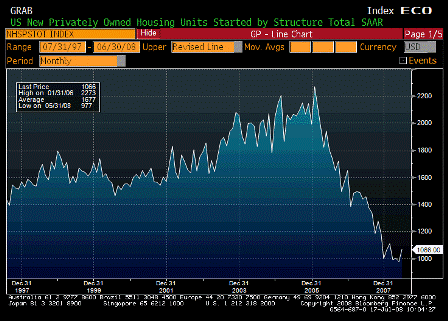
Housing Starts (Jun)

Survey 960K
Actual 1066K
Prior 975K
Revised 977K

Karim writes:

Starts up 9.1%, due to the following.

*New York City enacted a new set of construction codes

effective for permits authorized as of July 1, 2008. In June there

was a large increase in building permits issued for multifamily

residential buildings in New York City.

Multi-family starts in Northeast up 102.6%.

Single family starts down 9.2% in northeast, and down 5.3% nationally.

Same effect on permits (up 73% for mult-family in northeast).

Single family permits down 3.5% nationally.

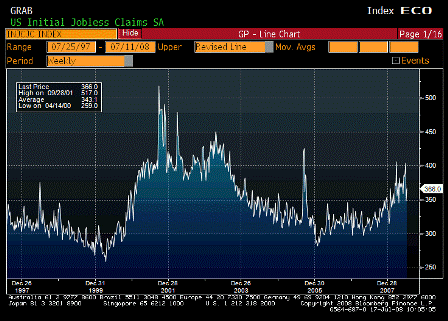
Initial claims rise from 348k to 366k.4wk average falls from 381k to 376k.

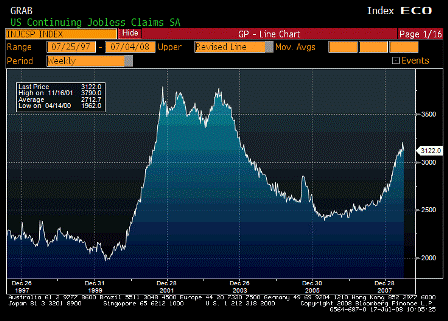
Continuing claims drop from 3203k to 3122k; 4wk average rises from 3126k to 3142k.

[top][end]

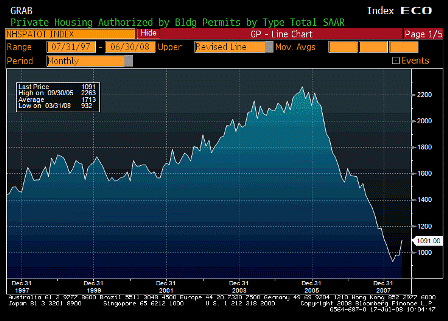
Building Permits (Jun)

Survey 965K
Actual 1091K
Prior 969K
Revised 978K

James writes:

Total starts were up 9.1% but single family was down -5.3% while multi-fam was up 42.5%. Then look at the regional break down. Multi-fams were up 102.6% m/m in the northeast which apparently has something to do w/ a tax abatement for rushing into some starts and permits in the NY area. Don’t know the details there but what matters to the broader market is that single family starts and permits declined. Less supply to compete w/ tons of inventory is what we want to see so the net/net = positive.

Right, thanks, either way housing starts are muddling around the 1 million mark, down from about 2 million not long ago.

Actual inventories of new homes are falling quickly; so seems to me a shortage is developing.

The weekly applications are steady at levels that used to be associated with maybe 1.5 million annual starts.

Starts peaked at 2.6 million units around 1972 with only about 215 million population.

They can return to 1.5 million pretty quickly, and I’d still consider that a depressed level.

4 week average jobless claims again moved down a bit, as did continuing claims.

Corporate earnings pretty good so far.

Q2 GDP looking like maybe 2% to be released July 31.

Government deficit spending moving up nicely -the tide that’s lifting all boats- and supporting prices/’inflation’ which turns the relative value story into an inflation story.

Dems ready with more fiscal packages to fire off as needed.

While shoes do keep falling, each one seems to do less damage and pass more quickly than the prior bumps. The agencies were the latest, the USD at stake were the largest, and the ‘crisis’ didn’t even last a week.

With stocks on the move there will be more talk within the FOMC of the low Fed Funds rate creating an asset bubble like they think it did in 1999 and 2003.

[top][end]


Initial Jobless Claims (Jul 12)

Survey 380K
Actual 366K
Prior 346K
Revised 348K

[top][end]


Continuing Jobless Claims (Jul 5)

Survey 3180K
Actual 3122K
Prior 3202K
Revised 3203K

[top][end]


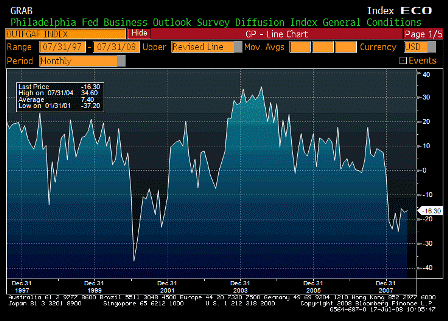
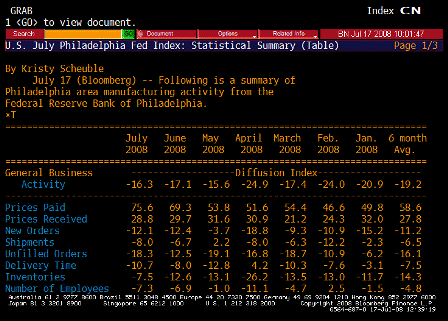
Philadelphia Fed (Jul)

Survey -15.0
Actual -16.3
Prior -17.1
Revised n/a

Hanging tough off the bottom, but still depressed.

[top][end]

Philadelphia Fed TABLE (Jul)

Prices paid jumped to 75.6 from numbers that were already way too high.


[top]

2008-07-16 US Economic Releases


[Skip to the end]


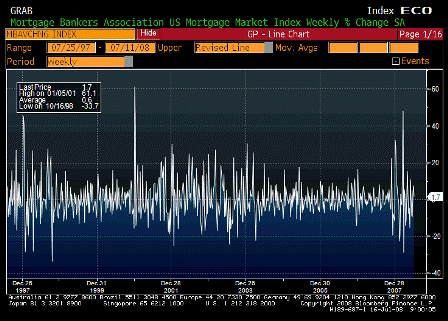
MBA Mortgage Applications (Jul 11)

Survey n/a
Actual 1.7%
Prior 7.5%
Revised n/a

[top][end]

MBA Purchasing Index (Jul 11)

Survey n/a
Actual 359.7
Prior 365.8
Revised n/a

Minor down tic, still in a range that used to be indicative of 1.5 million housing starts per year, vs today’s approx 1 million.

[top][end]

MBA Refinancing Index (Jul 11)

Survey n/a
Actual 1474.9
Prior 1379.3
Revised n/a

[top][end]


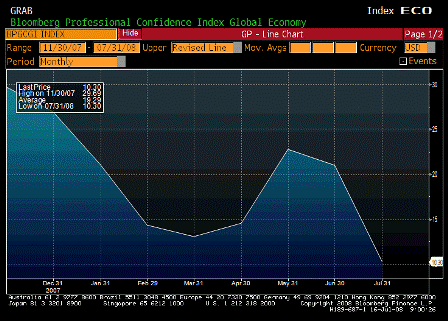
Bloomberg Global Confidence (Jul)

Survey n/a
Actual 10.30
Prior 21.01
Revised n/a

Inflation and falling equity markets are getting everyone down.

[top][end]


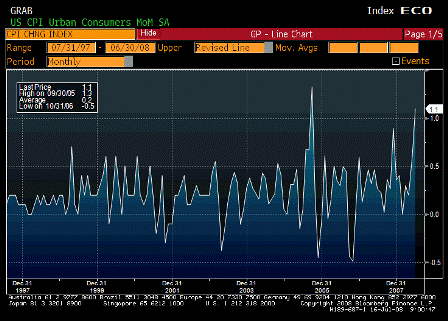
Consumer Price Index MoM (Jun)

Survey 0.7%
Actual 1.1%
Prior 0.6%
Revised n/a

Higher than expected.

[top][end]

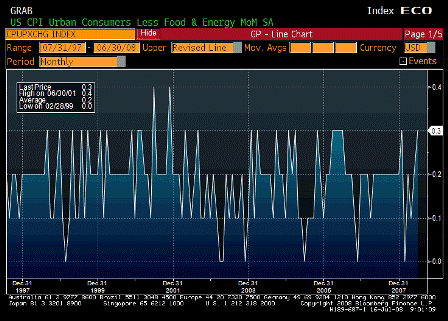
CPI Ex Food & Energy MoM (Jun)

Survey 0.2%
Actual 0.3%
Prior 0.2%
Revised n/a

Headline leaking into core.

[top][end]

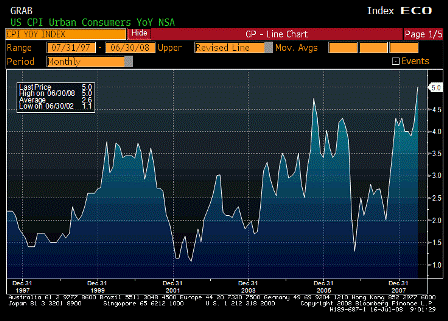
Consumer Price Index YoY (Jun)

Survey 4.5%
Actual 5.0%
Prior 4.2%
Revised n/a

Breakout!

[top][end]

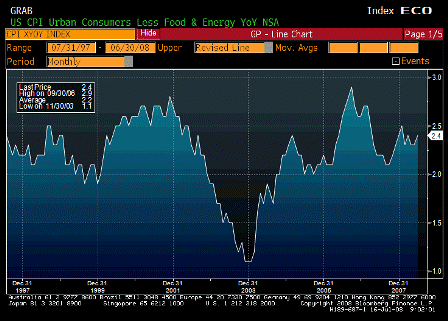
CPI Ex Food & Energy YoY (Jun)

Survey 2.3%
Actual 2.4%
Prior 2.3%
Revised n/a

If it was a relative value story, this would be a lot lower and going down.

[top][end]

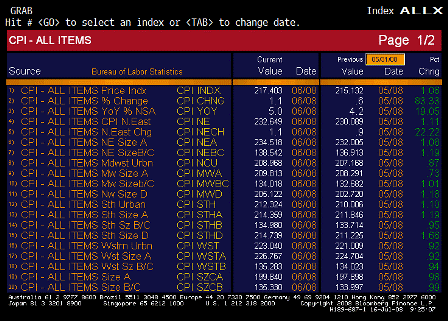
CPI ALLX (Jun)

[top][end]

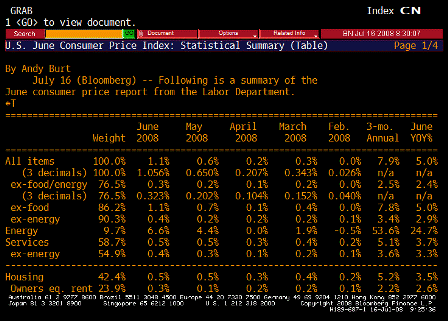
CPI TABLE (Jun)

[top][end]

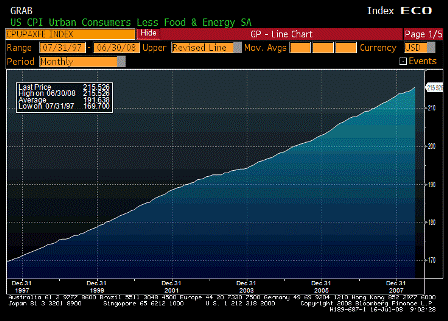
CPI Core Index SA (Jun)

Survey n/a
Actual 215.526
Prior 214.832
Revised n/a

[top][end]

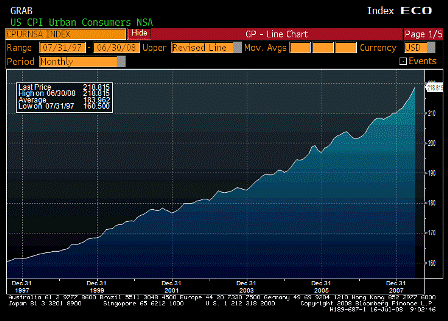
Consumer Price Index NSA (Jun)

Survey 217.903
Actual 218.815
Prior 216.632
Revised n/a

Karim writes:

  • Headline up 1.1% and 5.0% y/y

Above Fed’s comfort zones.

  • Core up 0.323% m/m and 2.4% y/y

In the 70’s I recall core passing 3% about the time headline passed 6%.

Click to see CPI Charts and CPI Table from the 1970s.

The difference there is no supply response for crude oil in sight this time.

  • Largest contributor to core was housing, where first 0.3% rise in oer this year was posted, and also a 1.8% rise in the fuel and utility component of housing.

Weak demand isn’t yet bringing CPI down as the Fed has been forecasting.

  • Lodging away from home (0.7%) had its second straight strong gain; this is usually +/- more than 1% each month, so likely to give back next month.

Weak occupancy hasn’t brought this measure down.

  • Tobacco up 1.5% due to tax hike in NY
  • Other items likely to reverse next month based on usual patterns are apparel (0.1%) and vehicle prices (0.1%)

Maybe, but lower car sales may not bring prices down over time due to cost issues.

  • Education (+0.5) also above trend

Costs rising here at well. And most employees probably get CPI increases.

  • Bernanke probably knew this number yesterday when he said inflation would be ‘temporarily higher’ in short-term.

Yes, and he and Vice Chair Kohn will have their hands full with the hawks at the August

  • Also, chain-weighted core CPI rose 0.1% and 2.1% y/y. This is a better proxy for core PCE (Fed’s preferred measure) as its not a fixed-weight time series and thus picks up substitution of one good versus another in consumer purchasing behavior.

Yes. Keeps this series lower than CPI until we’re down to eating bread and water, as deteriorating real terms of trade weigh on our standard of living.

[top][end]


Net Long-term TIC Flows (May)

Survey $70.0B
Actual $67.0B
Prior $115.1B
Revised n/a

[top][end]

Total Net TIC Flows (May)

Survey n/a
Actual -$2.5B
Prior $60.6B
Revised $61.6B

[top][end]


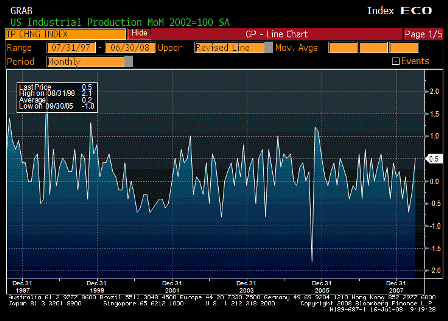
Industrial Production MoM (Jun)

Survey 0.1%
Actual 0.5%
Prior -0.2%
Revised n/a

Better then expected.

[top][end]

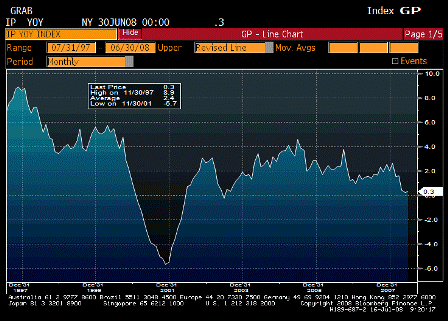
Industrial Production YoY (Jun)

Survey n/a
Actual 0.3%
Prior 0.1%
Revised 0.2%

Seems to be working its way lower over time. May be stabilizing with the weak USD.

[top][end]


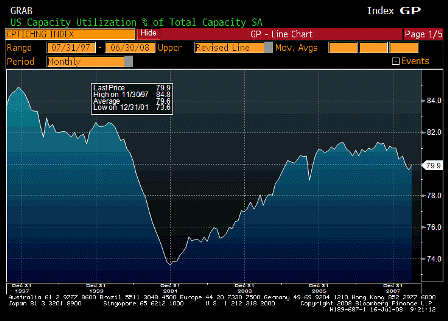
Capacity Utilization (Jun)

Survey 79.4%
Actual 79.9%
Prior 79.4%
Revised 79.6%

Higher than expected. The Fed is counting on slack to bring ‘inflation’ down.

[top][end]


NAHB Housing Market Index (Jul)

Survey 18
Actual
Prior 18
Revised


[top]

Bernanke testimony on inflation


[Skip to the end]

The last few Michigan surveys had one-year inflation expectations over 5%.

This is not lost on an FOMC that believes inflation expectations cause inflation.

Chairman Bernanke said this yesterday after outlining the inflation expectations/inflation process:

“A critical responsibility of monetary policy makers is to prevent that process from taking hold.”

‘Prevent’ implies action, not ‘monitoring’.

Might just be a poor choice of words.


[top]