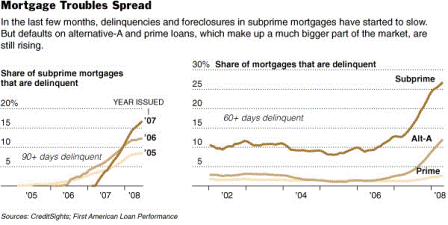
2008-08-07 US Economic Releases


[Skip to the end]


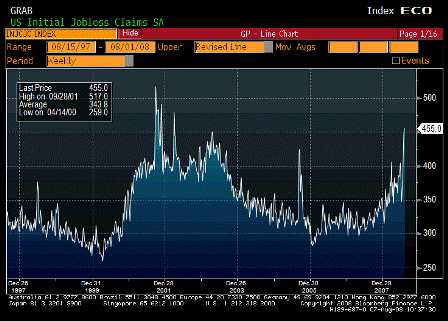
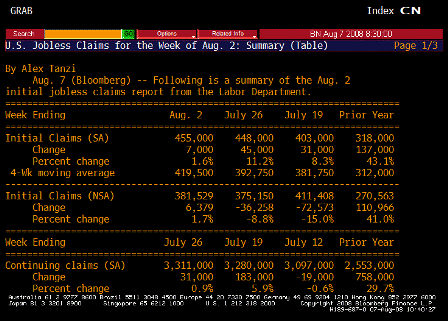
Initial Jobless Claims (Aug 2)

Survey 425K
Actual 455K
Prior 448K
Revised n/a

Karim writes:

  • Initial claims rise 7k to new cycle high of 455k with 4wk moving avg up from 393k to 420k
[top][end]

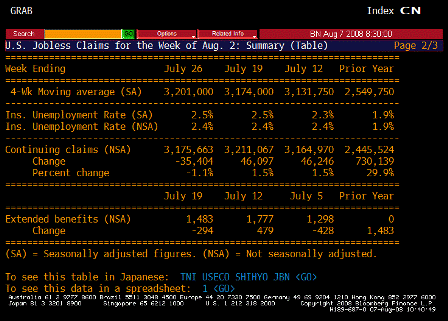
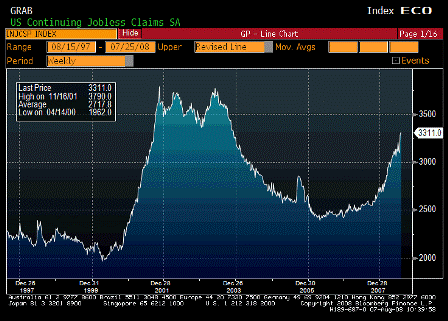
Continuing Jobless Claims (Jul 26)

Survey 3255K
Actual 3311K
Prior 3282K
Revised 3280K

Karim writes:

  • Continuing claims rise from 3280k to 3311k and 4wk moving avg up from 3174k to 3201k
[top][end]

Jobless Claims TABLE 1 (Jul 26)

[top][end]

Jobless Claims TABLE 2 (Jul 26)

Cesar writes:

A year ago we were at 4.7% unemployment rate (7,137 unemployed/ 153,182 labor force)

We are currently at 5.7% unemployment rate (8,784 unemployed/ 154,603 labor force)

Seems nearly the entire jump in unemployment is due to labor force increases.

Total employed is about flat.

In that case, GDP growth is about equal to productivity growth.

Karim writes:

  • Initial claims somewhat distorted by new program to extend benefits where those filing extensions are considered first time filers (double counted); this should have an effect for the first 2-3 weeks of the program before initial claims fall back to trend level (same happened back in 2001). Last week was first week of program, so numbers for next 2 weeks should reflect underlying trend (last number before extension program was 403k). Of concern would be if numbers don’t fall back much.
  • This program does not effect continuing claims, which reflects ability to find a job once laid off. This is at a new cycle high.
[top][end]


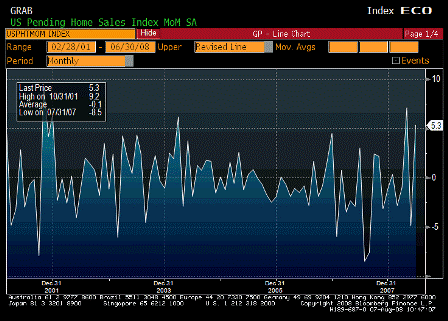
Pending Home Sales MoM (Jun)

Survey -1.0%
Actual 5.3%
Prior -4.7%
Revised -4.9%

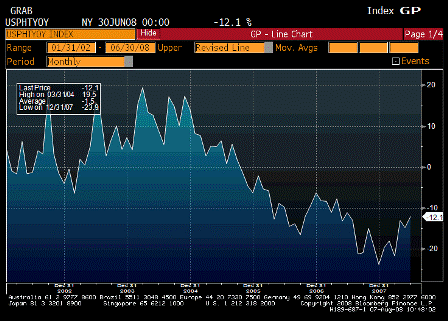
Karim writes:

  • Rise 5.3% m/m, continuing recent see-saw pattern (-4.9%, +7.1% prior 2mths).

Q2 GDP for Japan and Germany are out next week. A German newspaper yesterday leaked German GDP growth likely to be -1 to -1.5%. Much of this is a giveback for a strong Q1 of +1.5% but definitely weaker than expected. Of concern to the ECB is that Spain (industrial production now down 10% y/y) and Italy already written off, so much depends on Germany. Moreover, German PMIs have gotten off to a very weak start for Q3. I imagine that was at the root of Trichet’s more dovish tone today.

Estimates for Japanese Q2 GDP are in the -1% to -3.5% range. The July Tankan and the foreign orders component of last night’s machinery orders data also don’t bode too well for Q3.
[top][end]

Pending Home Sales YoY (Jun)

Survey n/a
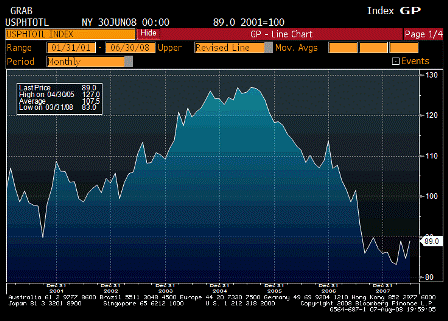
Actual -12.1%
Prior -14.8%
Revised n/a

Looks like it has bottomed and moving up as prices have adjusted and GDP has improved.

Housing my no longer be subtracting from GDP.
[top][end]

Pending Home Sales Total SA (Jun)

Survey n/a
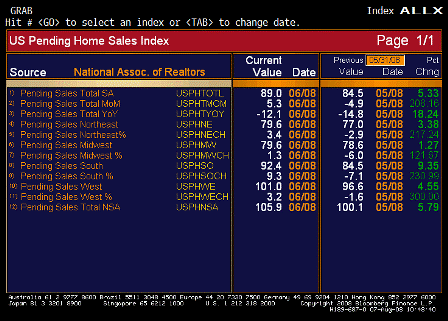
Actual 89.0
Prior 84.5
Revised n/a

Looks to have found support and probably bottomed albeit at very low levels.
[top][end]

Pending Home Sales ALLX (Jun)

[top][end]


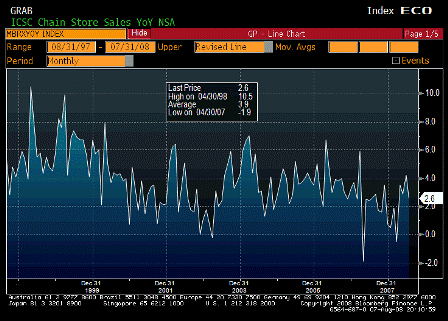
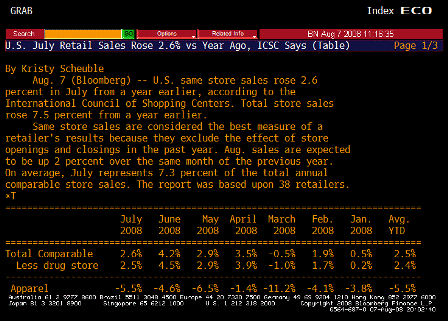
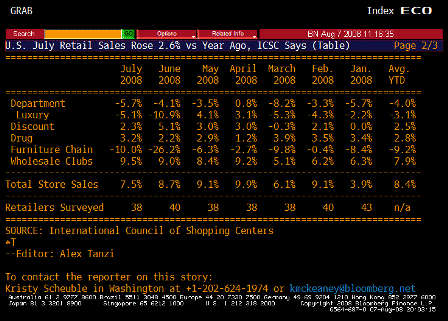
ICSC Chain Store Sales YoY (Jul)

Survey 3.4%
Actual 2.6%
Prior 4.3%
Revised 4.2%

Less then expected but not bad.

[top][end]

ICSC TABLE 1 (Jul)

[top][end]

ICSC TABLE 2 (Jul)

[top][end]


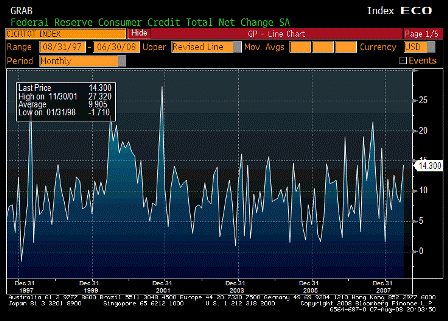
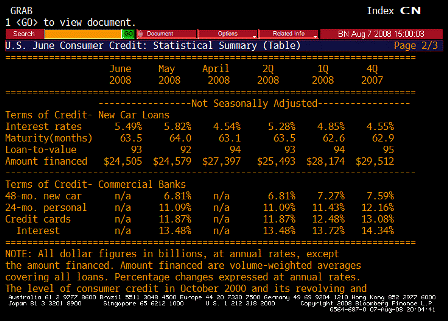
Consumer Credit (Jun)

Survey $6.3B
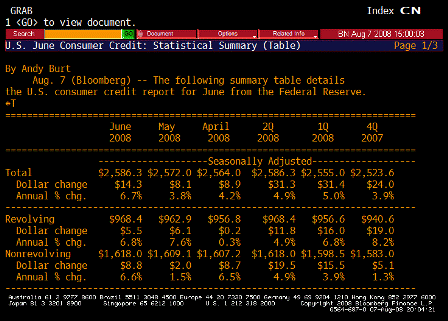
Actual $14.3B
Prior $7.8B
Revised $8.1B

Volatile series. Moving up some to support higher levels of spending.
[top][end]

Consumer Credit TABLE 1 (Jun)

[top][end]

Consumer Credit TABLE 2 (Jun)

Note from the graph the improving position of the domestic sector as the government deficit and net exports rise and support domestic ‘savings’ and spending. The US budget deficit is expected to exceed 3% this year and exports should remain firm even with slowing foreign economies. In fact, that’s one of the primary reasons those economies are slowing.

U.S. June Consumer Credit Up $14.3 Billion, More Than Forecast

by Shobhana Chandra

(Bloomberg) U.S. consumers borrowed more than twice as much as economists forecast in June as the slump in real-estate prices prevented American homeowners from tapping into home-equity lines of credit.

Consumer credit rose by $14.3 billion, the most since November, to $2.59 trillion, the Federal Reserve said today in Washington. In May, credit rose by $8.1 billion, previously reported as an increase of $7.8 billion. The Fed’s report doesn’t cover borrowing secured by real estate.

Consumers are using credit cards and loans to cover expenses as falling home values cause banks to restrict access to home- equity lines. The Bush administration sent out tax rebate checks in the past three months to help support spending, which accounts for more than two-thirds of the economy.

“Consumers are stressed, and some who are short of cash are relying more on credit cards,” Joseph Brusuelas, chief economist at Merk Investments LLC in Palo Alto, California, said before the report.


[top]
2008-08-07 UK News Highlights


[Skip to the end]

Highlights:

ECB Leaves Interest Rates at Seven-Year High to Fight Inflation
German industrial orders drop
Western European Car Sales Fall by 6.7% in July, JD Power Says
German June Exports Rise the Most in Nearly Two Years
German Economy Contracted as Much as 1.5% in 2Q
French Trade Deficit Expands to Record as Euro Curbs Exports
Italian June Production Stalls as Record Oil Prices Damp Growth
Fall in output fuels Spanish recession fears


Article snip:

ECB Leaves Interest Rates at Seven-Year High to Fight Inflation (Bloomberg) – The ECBkept interest rates at a seven-year high to fight inflation even as evidence of an economic slump mounts. ECB policy makers meeting in Frankfurt left the benchmark lending rate at 4.25 %, as predicted by all 60 economists in a Bloomberg News survey. The bank, which raised rates last month, will wait until the second quarter of next year to cut borrowing costs, a separate survey shows. The ECB is concerned that the fastest inflation in 16 years will help unions push through demands for higher wages and prompt companies to lift prices. At the same time, record energy costs and the stronger euro are strangling growth. Economic confidence dropped the most since the Sept. 11 terrorist attacks in July and Europe’s manufacturing and service industries contracted for a second month. ECB President Jean-Claude Trichet will hold a press conference 2:30 p.m. to explain today’s decision.

Same as UK, less costly to address inflation now rather than support growth and address inflation later if it gets worse.

It’s been said in the US that the Fed needs to firm up the economy first, and then address inflation. To most Central Bankers this makes no sense, as they use weakness to bring inflation down.

In their view that means the Fed wants to get the economy strong enough to then weaken it.

The Fed majority sees it differently.

They agree with the above.

However, for the last year they have been forecasting lower inflation and lower growth were willing to take the chance that supporting growth would not result in higher inflation.

Now, a year later, the FOMC is faced with higher inflation and more growth than the UK and Eurozone, and systemic ‘market functioning’ risk remains.

The FOMC continues to give the latter priority as they struggle with fundamental liquidity issues that stem from a continuing lack of understanding of monetary operations.


[top]

TimesOnline: Latest on BoE rate setting

The mainstream view remains the cost of a near term recession in order to bring prices under control now is far less than the cost of a recession later if you support growth now and let prices continue higher.

Bank of England holds interest rate at 5%

by Gary Duncan, Grainne Gilmore

The Bank of England rebuffed mounting concerns over the rapidly weakening economy today and held interest rates at 5 per cent as it pursued its drive to quell soaring inflation.

The tough verdict from the Bank’s rate-setting Monetary Policy Committee (MPC) brushed aside pleas from business leaders and trade unions for a cut in base rates to shore up Britain’s growth, amid growing fears that the country is on the brink of recession.

The Bank’s decision came after headline consumer price inflation leapt to a 10-year high of 3.8 per cent in June, well above the Bank’s 2 per cent target, and amid expectations that it could hit 5 per cent over the summer, following swingeing increases in household gas and electricity bills imposed by utility companies.

The MPC had been widely expected to spurn pressure for a rate cut today in a bid to make clear its determination to bring inflation back to the target set by the Chancellor. The committee will almost certainly have discussed raising rates this morning, as it did last month, when Professor Tim Besley, voted for an immediate increase. He is expected to have done so again today, and may have been joined by other hawkish MPC members.

The Bank will set out its thinking more clearly next week when it publishes its latest forecasts for the economy in its quarterly Inflation Report. That is expected to emphasise the dilemma that the MPC confronts, with inflation set to soar far above target in the next few months, even as the economy slides towards a severe downturn.

The quandary facing the Bank was underlined yesterday as the International Monetary Fund sharply cut its forecasts for Britain’s growth this year and next, while issuing a warning that it saw “little scope” for interest rates to fall, although it also saw no need for an immediate rate rise.

Today’s no-change verdict by the MPC came despite bleak economic news in recent days, which have produced danger signs of recession.

Concern that Britain’s growth had ground to a virtual halt last month, and could even be in the grip of recession, were inflamed this week after bleak figures revealed growing frailty in the most critical parts of the economy.

These included shrinking activity in the services sector, the economy’s engine room that account for three quarters of the UK’s output, as well as in manufacturing.

The services sector, spanning businesses from cafes and leisure centres to accountancy and law firms, shrank for a third month in succession last month, according to the latest purchasing managers’ survey, regarded by the Bank as a key gauge of economic conditions.

Although services activity edged up from a seven-year low that was plumbed in June, the survey pointed to an even sharper slowdown ahead, with levels of outstanding business for the sector’s companies falling for a tenth month in a row, and inflows of new business dropping to a record low.

At the same time, it emerged that manufacturing is suffering its first sustained run of decline since 2001, after its output fell in June for a fourth month in a row, dropping by 0.5 per cent.

The figures were among the latest data confirming the dire plight of the economy, and came after official confirmation that the pace of Britain’s overall growth slowed to just 0.2 per cent in the second quarter, its weakest rate of expansion for three years.

The falling housing market remains a key source of economic anxiety, with the Nationwide Building Society reporting that house prices tumbled by a further 1.7 per cent last month, leaving them down 8.1 per cent on last year – their sharpest annual pace of decline since 1991.

The high street is also being badly hit by the downturn, with official figures showing that retail sales plunged by 3.9 per cent in June – their biggest monthly drop for 22 years.

Yesterday, the International Monetary Fund added to the mood of pessimism as it cut its forecast for Britain’s growth this year and next to only 1.4 per cent, and 1.1 per cent, respectively. The prediction of the UK’s worst performance since the end of the last recession raised the spectre of two years of economic misery.

In May, Mervyn King, Governor of the Bank, was forced to write an explanatory letter to the Chancellor, required by law, explaining why inflation had risen more than 1 point above its 2 per cent target, after it climbed to its then-high of 3.3 per cent. Mr King has admitted that he expects to write more such letters this year.

The Bank’s inflation headache has been further aggravated by signs of further severe price pressures in the pipeline to the consumer, Manufacturers’ costs rose at a record 30 per cent annual rate in June, and prices for goods leaving factories rose by a record 10 per cent. Inflation is being stoked by a sharp slide in the pound, by about 12 per cent over the past year, which lifts Britain’s bills for imported products.

However, there has been some let up in international food and energy costs, with oil prices tumbling by 13 per cent in a month, and prices for food products are also on the slide.

2008-08-07 Weekly Credit Graph Packet


[Skip to the end]

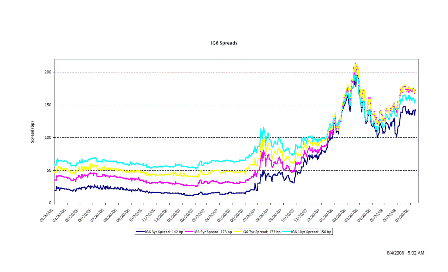
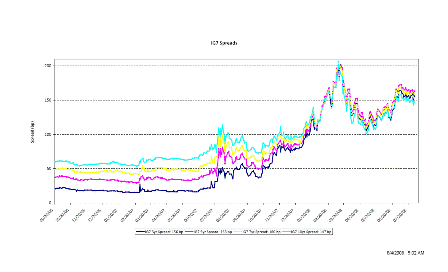
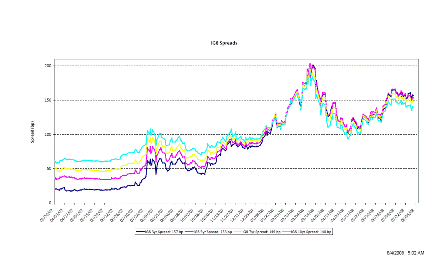
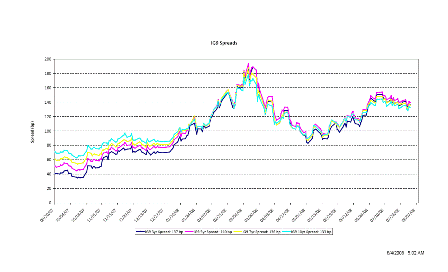
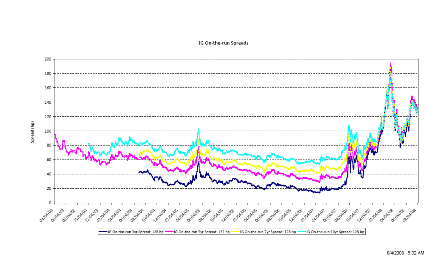
Generally up a touch but still looks to be slowly wiggling its way lower.

IG On-the-run Spreads (Aug 4)

[top][end]

IG6 Spreads (Aug 4)

[top][end]

IG7 Spreads (Aug 4)

[top][end]

IG8 Spreads (Aug 4)

[top][end]

IG9 Spreads (Aug 4)


[top]

Re: Oil prices


[Skip to the end]

(an email exchange)

>   
>   On Wed, Aug 6, 2008 at 4:45 PM, Craig wrote:
>   
>   It seems that the ‘right’ price for them to set oil at is not
>   necessarily the highest price possible.
>   

All the 911 passports were Saudi; so, they might have other agendas.

>   
>   If I were them it would seem like the best policy to maximize
>   the total value of their oil holdings over the life of those
>   holdings. By cranking the price up ‘too high’, they incent
>   substitution and potentially kill their sales in the long term.
>   

Right, classic monopoly analysis.

>   It would seem their goal would be to keep the price as high
>   as they could w/o setting off a chain of
>   substitution/invention/philosophy which would move the world
>   meaningfully away from oil (or towards increased oil exploration
>   or towards invading them). There is also the little matter of
>   how much money do they really need (a somewhat silly question
>   but this situation does create an embarrassment of riches/market
>   dislocations in excess of where a rational accumulation might lie).
>   

Yes, understood.

>   
>   It looks to me that on the highs they got everybody’s attention.
>   There may still be political responses towards
>   innovation/substitution/conservation at these levels, but it seems
>   likely that at or above the old highs, US folks will be making their
>   next car a hybrid, beating their government to get prices down
>   (including pluggables/nuclear – a long term threat to Saudi
>   dominance) and the like. Then there’s China’s slowdown and food
>   riots. I’d have thought quietly bleeding the world would be better
>   business than actually setting it on fire.
>   

Yes, but again, it’s their ‘political choice.’ There is no ‘market price’.

Also, with only 1.5 million bdp in total excess capacity, it might be too close to the line for them, and they might want to get prices high enough to build their excess capacity by a million or two bpd.

Otherwise they risk losing control of price on the upside, as happened a couple of years back when output briefly hit 10.5 million bpd when the funds were buying intensely enough to cause builds of physical inventory and a large contango as storage went to a premium.

>   
>   Of course, even if this is all true, they may be looking at it
>   differently.
>   

Worst case for us is they understand that they can hike all they want if they spend the extra revenues on imports of real goods and services. This keeps foreign GDPs muddling through in positive territory as they exact ever higher real terms of trade and they increasingly prosper at our expense.

And out leaders think more exports and less consumption is a good thing and are encouraging more of same.

Almost seems from the data this is exactly what they are up to?

Think they read my blog???

:)

warren

>   
>   Craig
>   


[top]

Q&A: Oil prices


[Skip to the end]

Russel asks:

Any reason why the Saudi’s are allowing the price of oil to slide?

Just a guess. The futures liquidations were large enough such that holding spot prices up and letting futures free fall would have made it obvious the Saudis are price setter.

There also could be some liquidation of physical inventory going on in which case they would have to let inventories fall before resuming control of prices, or else actually buy in the spot markets which is out of the question of course.

It’s like if some pension fund had a hoard of NYC subway tokens and decided to sell them ‘at the market’. The price would go down from the current $2 price until that selling pressure abated. Then the price would go back to whatever NYC was charging.

So most likely they just let this inventory liquidation run its course, and then work prices higher again.

Much like happened in Aug 2006 with the massive Goldman liquidation and again in a smaller way at year end back then.


[top]

Re: UK economy


[Skip to the end]

(an email exchange)

>   
>   
>   On Wed, Aug 6, 2008 at 12:25 AM, Prof. P. Arestis wrote:
>   
>   Dear Warren,
>   
>   Just received the piece below. The situation over here is getting
>   worse but pretty much as expected.
>   
>   Recession signalled by key indicators of British economy
>   
>   
>   Best wishes, Philip
>   

Dear Philip,

Yes, seems tight fiscal has finally taken its toll and is now reversing the ugly way – falling revenues and rising transfer payments.

Without support from government deficit spending, consumer debt increases sufficient to support modest growth are unsustainable.

And with a foreign monopolist setting crude oil prices ‘inflation’ will persist until there is a large enough supply response,

It’s the BoE’s choice which to respond to, though ironically changing interest rates is for the most part ceremonial.

All the best,
Warren


[top]

2008-08-06 US Economic Releases


[Skip to the end]


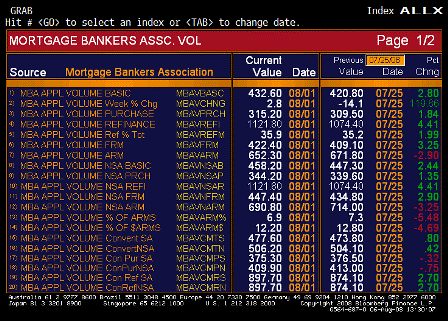
MBA Mortgage Applications (Aug 1)

Survey n/a
Actual 2.8%
Prior -14.1%
Revised n/a

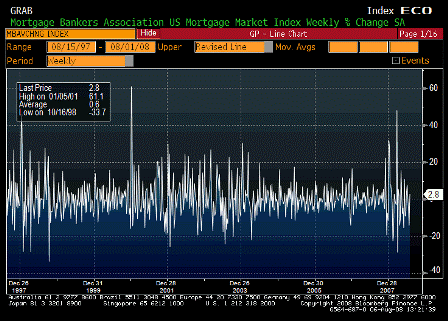
Nudging up a tad. Still looking soft. Mortgage bankers losing market share to banks. Even this low level equates historically to higher levels of sales and new starts.

[top][end]

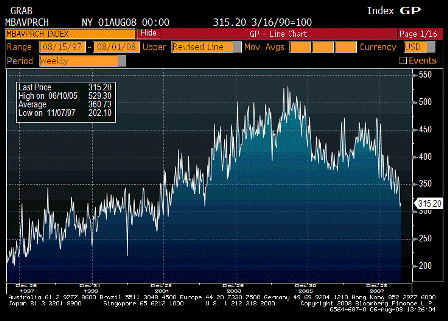
MBA Purchasing Index (Aug 1)

Survey n/a
Actual 315.2
Prior 309.5
Revised n/a

Up some, muddling along. Most of the resets are past.

[top][end]

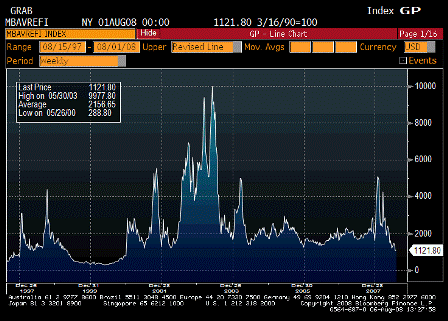
MBA Refinancing Index (Aug 1)

Survey n/a
Actual 1121.8
Prior 1074.4
Revised n/a

[top][end]

MBA ALLX 1 (Aug 1)

[top][end]

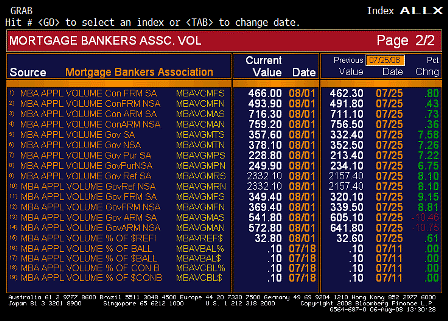
MBA ALLX 2 (Aug 1)

“The refinancing applications index climbed 4.4 percent to 1,121.8 last week, while the home purchase applications gauge rose 1.8 percent to 315.2 on a seasonally adjusted basis, the MBA said.”

Government spending will lift housing along with aggregate demand in general, as it always does, and there are numerous signs it’s already happening.

And history will probably see it as the Fed’s rate cuts of a year ago as it always does.

They say monetary policy ‘works’ with a lag, but seems to me the lag is always until fiscal spending kicks in.

It was the fiscal package of 2003 and not the low interest rates that got housing going the last time around.

(And history blames Greenspan for the housing ‘bubble’ rather than Bush.)

Now and then the private and foreign sector can provide the spending power by spending by ‘reducing its savings’/going into debt but that process is ultimately unsustainable without the support of government deficit spending.

The recession has again been pushed forward a quarter or two, with street firms now saying Q3 will be ok, but Q4/Q1 will be weak.

With the latest GDP revisions it’s looking more and more like Q4 2007 was the bottom, and the government deficit looking to move towards 4% of GDP should be sufficient for continued muddling through.

Demand isn’t high enough for ‘full employment’ so labor markets (whatever that actually means) should remain soft.

And more people previously not looking for work now looking for work (they now desire more income due to higher prices) will probably keep the unemployment rate elevated.


[top]

NYT: Mortgages


[Skip to the end]

(an email exchange)

>   
>   On Mon, Aug 4, 2008 at 7:50 AM, Russell wrote:
>   
>   I am more and more convinced housing is not near a bottom.
>   Granted, I have no idea what the recent Housing Bill will do. But I
>   think housing problems are going to cover the entire swath of
>   America – not only Subprime, but also Alt A and even Prime.
>   
>   

could be, but would be very unusual in an economy with a growing gdp supported by what may now be endless fiscal packages.

the actual housing slump could be mostly old news unless/until gdp softens again as most are forecasting in q4.


[top]