ECB 1 year term repo


[Skip to the end]

This should bring down the term structure of rates at least out to one year, especially if the program is ongoing at this fixed rate.

And, operationally, it’s a similarly simple matter to set ‘risk free’ rates out the entire curve.

So, for example, bringing down rates out to a year could steepen the entire curve, but a follow up program to do the same for longer term rates could then flatten the curve.

And ‘turning the program on and off’ can add volatility as well.

Asikainen : Long Term Repo Operation (LTRO)

Next Thursday, the ECB will offer the market a funding tender which will let members of the system borrow at 1.0% for up to a year. Yes – term funding, secured by the ECB, at bargain-low rates for a year. You can pledge anything that is BBB or higher, and the ECB will fill unlimited supply at 1.00%. If they get EUR100 billion pledged? Filled. If they get EUR 2 trillion pledged? Filled.


[top]

Fed Repo Facility


[Skip to the end]

It is something they want but seems there is no viable plan yet.

It is harder than it sounds and what they do come up with if short of a government guaranteed market will have similar risks.

The ‘answer’ is the repo markets add no value to the real economy and therefore there is no public purpose behind creating a ‘better one.’

I would just let the banks continue to price risk for secured lending as they are doing and let the interest spreads (and disintermediation when borrowers and lenders find each other directly) fall where they may due to competitive pressures.

Fed plans repo markets revamp

by Henny Sender and Michael Mackenzie

June 21 (FT) — The US Federal Reserve is considering dramatic changes to the giant repurchase – or repo – markets where banks around the world raise overnight dollar loans.

The plans include creating a utility to replace the Wall Street banks that handle transactions, people familiar with the matter say.

The Fed’s deliberations are partly motivated by concerns that the structure of the US overnight repurchase market may have exacerbated the financial turmoil that accompanied the failure of Lehman Brothers in September last year.

Fed officials plan to meet next month with market participants to discuss reforms.

People familiar with the Fed’s thinking say it is looking into the creation of a mechanism to replace the clearing banks – the biggest of which are JPMorgan Chase and Bank of New York Mellon – that serve as intermediaries between borrowers and lenders.

“The Fed is raising questions about whether the system really protects the interests of all participants,” says one person familiar with the Fed’s thinking.

In the repo markets, borrowers, such as banks, pledge collateral in return for overnight loans from lenders, such as money market funds.

The clearing banks stand between the parties, providing services such as valuing the collateral and advancing cash during the hours when trades are being made and unwound.

Fed officials fear this arrangement puts the clearing banks in a difficult position in a crisis. As the value of the securities falls, clearing banks have an obligation to demand more collateral to avoid losses. But in doing so, they could destabilise a rival.

“The clearing banks fear the positions of the investment banks are so large that a default would be difficult for them to manage,” the person familiar with the Fed’s thinking said.

“[Everyone] is thinking about how to remove conflicts of interest of the clearing banks and the investment banks so that the investment banks aren’t vulnerable to a sudden restriction of credit.”

The system’s complications were evident during Lehman’s collapse. JPMorgan, one of Lehman’s biggest trading partners, acted as its clearing bank in the repo market and – along with BoNY Mellon – served as the clearing bank for the New York Federal Reserve’s credit facility for securities ­companies.

Lawyers for the Lehman estate and for creditors have raised questions about whether JPMorgan acted too aggressively in seizing and marking down Lehman’s collateral.

Hedge funds have bought Lehman debt on the theory that the estate can claw back some of that collateral in court.

Citing confidentiality concerns, JPMorgan declined to comment.

The Fed hopes to have a new repo system in place by October, when its credit facility for securities companies is to close.


[top]

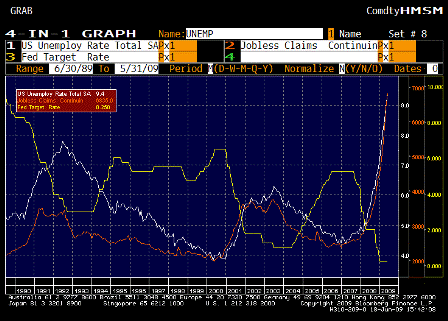
Continuing Claims->UE Rate->FF Rate


[Skip to the end]


Karim writes:

The chart attached shows the last 3 cycles in continuing claims, the unemployment rate and the FF rate.

Continuing claims is a coincident to leading indicator of the unemployment rate. Its interesting that in the last two cycles, continuing claims made what appears to be a double top before the unemployment rate peaked. In those cycles, the lag between the peak in the unemployment rate and the first Fed rate hike was 12mths (June 2003-June 2004) and 19mths (July 1992-Feb 2004).

While this cycle is notably different than the others in many respects (size and speed of economic deterioration as well as policy response), look for the Fed to make some reference (implicit or explicit) to the unemployment rate coming down in a sustainable fashion before tightening policy. Based on history, even if this month was the peak in the unemployment rate, the first hike seems unlikely until mid-2010. Based on likely further deterioration in the ue rate, first hike unlikely before 2011.


[top]

California


[Skip to the end]

Rather than let the states cut essential services and lay off employees with unemployment over 9%, I would give all the states an immediate $500 per capita distribution from the federal government.

It is the same voters and the same taxpayers, so per capita is the way to go.

This gives California most of what it needs and also gives the other states the same per capita distribution to use as desired.

That way it is equitable and helps support aggregate demand during this obvious shortfall.

Calif. Aid Request Spurned By U.S.

Officials Push State To Repair Budget

By David Cho, Brady Dennis and Karl Vick

June 16 (Washington Post)— The Obama administration has turned back pleas for emergency aid from one of the biggest remaining threats to the economy — the state of California.

Top state officials have gone hat in hand to the administration, armed with dire warnings of a fast-approaching “fiscal meltdown” caused by a budget shortfall. Concern has grown inside the White House in recent weeks as California’s fiscal condition has worsened, leading to high-level administration meetings. But federal officials are worried that a bailout of California would set off a cascade of demands from other states.

The administration is worried that California will enact massive cuts to close its deficit, estimated at $24 billion for the fiscal year that begins July 1, aggravating the state’s recession and further dragging down the national economy.

After a series of meetings, Treasury Secretary Timothy F. Geithner, top White House economists Lawrence Summers and Christina Romer, and other senior officials have decided that California could hold on a little longer and should get its budget in order rather than rely on a federal bailout.

“After June 15th, every day of inaction jeopardizes our state’s solvency and our ability to pay schools and teachers and to keep hospitals and ERs open,” Gov. Arnold Schwarzenegger (R) said Friday.

California’s budget is also heavily dependent on taxes paid on capital gains and stock options, which have been clobbered during the meltdown of financial markets. State budget analysts made their annual estimate of revenue a month before the crisis spiked in the fall and have been backpedaling ever since.

Consider capital gains — income from sales of stocks or other assets. In California, that income dropped to $52 billion in 2008 from $130 billion a year earlier. It is estimated to be $36 billion this year.

By February, the shortfall was projected at $42 billion over two years.

To close an annual gap now put at $24 billion, Schwarzenegger and leaders of the legislature’s Democratic majority have put aside talk of tax increases to concentrate on cuts.

“A lot of the burden,” Geithner said, “is going to be on them to lay out a path that gets their deficits down to the point where they’re going to be able to fund themselves comfortably.”


[top]

CPI


[Skip to the end]


Karim writes:

No outliers.

  • Headline CPI up 0.096% m/m and -1.3% y/y; lowest y/y rate since 1950 will fall further over next 2mths before rising again in August.
  • Wild swings in headline from 5.6% to -2% in a 12mth period reinforcing Fed focus on core
  • Core up .145% m/m and 1.8% y/y
  • OER up 0.1%, med and education up 0.3%, tobacco down 0.3% after 20% rise in prior 2mths
  • Core likely to drift down to 1% y/y by yr-end


[top]

Twin deficit terrorists Ferguson and Buiter


[Skip to the end]

This is the exact same line Niall Ferguson is spewing.
He also says the two choices are inflating or defaulting.

The inflation would be from too much aggregate demand and a too small output gap.

That would mean that fatefull day would be an economy with maybe 4% unemployment and 90%+ capacity utilization and an overheating economy in general.

Sounds like that’s the goal of deficit spending to me- so in faccct he’s saying deficit spending works with his rant on why it doesn’t.

And if we do need to raise taxes to cool things down some day, we can start with a tax on interest income if we want to cut payments to bond holders.

Regarding the supposed default alternative to inflation, in the full employment and high capacity utilization scenario that might call for a tax increase to cool it down, I don’t see how default fits in or why it would even be considered.

In fact, with our countercyclical tax structure, strong growth that follows deficits automatically drives down the deficit, and can even drive it into surplus, as happened in the 1990’s. In that case one must be quick to reverse the growth constraining surplus should the economy fall apart as happend shortly after y2k.

Feel free to pass this along to either.

The fiscal black hole in the US

June 12 (FT)—US budgetary prospects are dire, disastrous even. Without a major permanent fiscal tightening, starting as soon as cyclical considerations permit, and preferably sooner, the country is headed straight for a build up of public debt that will either have to be inflated away or that will be ‘resolved’ through sovereign default.


[top]

deficits and future taxes


[Skip to the end]

(email exchange)

The latest noise is that today’s deficits mean higher taxes later.

Answer:

1. Taxes function to reduce aggregate demand.

2. A tax hike is never in order with a weak economy, no matter how high the deficit or how high the interest payments may be.

3. Future tax increases would be a consideration should demand rise to the point where unemployment fell ‘too far’- maybe below 4%.

4. That is a scenario of prosperity and an economy growing so fast that it might be causing inflation which might need a tax hike or spending cut to cool it down.

So when someone states that today’s high deficit mean higher taxes later, he is in fact saying that today’s high deficits might cause the economy to grow so fast that it will require tax increases or spending cuts to slow it down.

Sounds like a good thing to me — who can be against that?

And, of course, the government always has the option to tax interest income if interest on the debt is deemed a problem at that time.

>    On Fri, Jun 12, 2009 at 8:46 AM, James Galbraith wrote:
>   
>   A comment in the National Journal, on the ever-green deficit alarmism that so preoccupies
>   people in Washington, to no good effect.
>   
>   Also, my June 5 lecture in Dublin, at the Institute for International and European Affairs, on the
>   crisis.
>   
>   With Q&A
>   
>   And a small postscript, reprising the old story of Eliza in Cuba, which I’ve promised her I
>   will now retire
>   
>   Jamie


[top]

National Journal Expert Blog debate on fiscal sustainability


[Skip to the end]

What Is Fiscally — And Politically — ‘Sustainable’?

By James K. Galbraith
Professor of Economics, University of Texas

June 11th —Chairman Bernanke may, if he likes, try to define “fiscal sustainability” as a stable ratio of public debt to GDP. But this is, of course, nonsense. It is Ben Bernanke as Humpty-Dumpty, straight from Lewis Carroll, announcing that words mean whatever he chooses them to mean.

Now, we may admit that the power of the Chairman of the Board of Governors of the Federal Reserve System is very great. But would someone please point out to me, the section of the Federal Reserve Act, wherein that functionary is empowered to define phrases just as he likes?

A stable ratio of federal debt to GDP may or may not be the right policy objective. But it is neither more nor less “sustainable,” under different economic conditions, than a rising or a falling ratio.

In World War II, from 1940 through 1945, the ratio of US federal debt to GDP rose to about 125 percent. Was this unsustainable? Evidently not. The country won the war, and went on to 30 years of prosperity, during which the debt/GDP ratio gradually fell. Then, beginning in the early 1980s, the ratio started rising again, peaked around 1993, and fell once more.

Thus, a stable ratio of debt to GDP is not a normal feature of modern history. Gradual drift in one direction or the other is normal. There seems no great reason to fear drift in one direction or the other, so long as it is appropriate to the underlying economic conditions.

History has a second lesson. In a crisis, the ratio of public debt to GDP must rise. Why? Because a crisis – and this really is by definition – is a national emergency, and national emergencies demand government action. That was true of the Great Depression, true of war, and true of the Great Crisis we’re now in. Moreover, we’ve designed the system to do much of this work automatically. As income falls and unemployment rises, we have an automatic system of progressive taxation and relief, which generates large budget deficits and rising deficits. Hooray! This is precisely what puts dollars in the pockets of households and private businesses, and stabilizes the economy. Then, when the private economy recovers, the same mechanisms go to work in the opposite direction.

For this reason, a sharp rise in the ratio of debt to GDP, reflecting the strong fiscal response to the crisis, was necessary, desirable, and a good thing. It is not a hidden evil. It is not a secret shame, or even an embarrassment. It does not need to be reversed in the near or even the medium term. If and as the private economy recovers, the ratio will begin again to drift down. And if the private economy does not recover, we will have much bigger problems to worry about, than the debt-to-GDP ratio.

It is therefore a big mistake to argue that the next thing the administration and Congress should do, is focus on stabilizing the debt-to- GDP ratio or bringing it back to some “desired” value. Instead, the ratio should go to whatever value is consistent with a policy of economic recovery and a return to high employment. The primary test of the policy is not what happens to the debt ratio, but what happens to the economy.

*****

Now, what about those frightening budget projections? My friend Bob Reischauer has a scary scenario, in which a very high public-debt-to-GDP ratio leaves the US vulnerable to “pressure from foreign creditors” – a euphemism, one presumes, for the very scary Chinese. Under that pressure, interest rates rise, and interest payments crowd out other spending, forcing draconian cuts down the line. To avert this, Bob has persuaded himself that cuts are required now, not less draconian but implemented gradually. Thus the frog should be cooked bit by bit, to avoid an unpleasant scene later on when the water is really boiling hot.

With due respect, Bob’s argument displays a very vague view of monetary operations and the determination of interest rates. The reality is in front of our noses: Ben Bernanke sets whatever short term interest rate he likes. And Treasury can and does issue whatever short-term securities it likes at a rate pretty close to Bernanke’s fed funds rate. If the Treasury doesn’t like the long term rate, it doesn’t need to issue long-term securities: it can always fund itself at very close to whatever short rate Ben Bernanke chooses to set.

The Chinese can do nothing about this. If they choose not to renew their T-bills as they mature, what does the Federal Reserve do? It debits the securities account, and credits the reserve account! This is like moving funds from a savings account to a checking account. Pretty soon, a Beijing bureaucrat will have to answer why he isn’t earning the tiny bit of extra interest available on the T-bills. End of story.

The only thing the scary foreign creditors can do, if they really do not like the returns available from the US, is sell their dollar assets for some other currency. This will cause a decline in the dollar, some rise in US inflation, and an improvement in our exports. (It will also cause shrieks of pain from European exporters, who will urge their central bank to buy the dollars that the foreigners choose to sell.) The rise in inflation will bring up nominal GDP relative to the debt, and lower the debt-to-GDP ratio. Thus, the crowding-out scenario Bob sketches will not occur.

I’m not particularly in favor of this outcome. But unlike Bob Reischauer’s scenario, this one could possibly occur. And if it did, it would lower real living standards across the board. This is unpleasant, but it would be much fairer than focusing preemptive cuts on the low-income and vulnerable elderly, as those who keep talking about Social Security and Medicare would do.

****

Now, it is true, of course, that you can run a model in which some part of the budget – say, health care – is projected to grow more rapidly than GDP for, say, 50 years, thus blowing itself up to some fantastic proportion of total income and blowing the public finances to smithereens. But this ignores Stein’s Law, which states that when a trend cannot continue it will stop, and Galbraith’s Corollary, which states that when something is impossible, it will not happen.

Why can’t health care rise to 50 percent of GDP? Because, obviously, such a cost inflation would show up in – the inflation statistics! – which are part of GDP. So the assumption of gross, uncontrolled inflation in health care costs contradicts the assumption of stable nominal GDP growth. Again, the consequence of uncontrolled inflation is… inflation! And this increases GDP relative to the debt, so that the ratio of debt to GDP does not, in fact, explode as predicted.

I do not know why the CBO and OMB continue to issue blatantly inconsistent forecasts, but someone should ask them.

Further confusion in this area stems from treating Social Security alongside Medicare as part of some common “entitlement problem.” In reality, health care costs and haphazard health insurance coverage are genuine problems, and should be dealt with. Social Security is just a transfer program. It merely rearranges income. For this reason it cannot be inflationary; the only issue posed is whether the elderly population as a whole deserves to kept out of poverty, or not.

Paying the expenses of the elderly through a public insurance program has the enormous advantage of spreading the burden over all other citizens, whether they have living parents or not, and of ensuring that all the elderly are covered, whether they have living children or not. A public system is also low-cost and efficient, and this too is a big advantage. Apart from that, whether the identical revenue streams are passed through public or private budgets obviously has no implications whatever for the fiscal sustainability of the country as a whole.

****

What is politically sustainable is nothing more than what the political community agrees to at any given time. I have been surprised, and pleased, by the political community’s acquiescence in the working of the automatic stabilizers and expansion program so far. The deficits are bigger, and therefore more effective, than many economists thought would be tolerated. That’s a good sign. But it would be a tragedy if alarmist arguments now prevailed, grossly undermining job prospects for millions of the unemployed.

Let me note, in passing, that Chairman Bernanke should please read the Federal Reserve Act, and focus on the objectives actually specified in it, including “maximum employment, stable prices and moderate long-term interest rates.” He does not have a remit to add stable debt-to-GDP ratios or other transient academic ideas to the list. One might think that the embarrassing experience with inflation targeting would be enough to warn the Chairman against bringing too much of his academic baggage to the day job.


[top]

Nonsense from Wells Fargo


[Skip to the end]

Please send this on to Eugenio Aleman at Wells Fargo

Thinking The Unthinkable: The Treasury Black Swan, And The LIBOR-UST Inversion

Posted by Tyler Durden

>   The below piece is a good analysis of a hypothetical Treasury/Dollar black swan
>   event, courtesy of Eugenio Aleman from, surprisngly, Wells Fargo. Eugenio does
>   the classic Taleb thought experiment: what happens if the unthinkable become
>    not just thinkable, but reality. Agree or disagree, now that we have gotten to
>   a point where 6 sigma events are a daily ocurrence, it might be prudent to
>   consider all the alternatives.

In previous reports, I have touched upon the concerns I have regarding the overstretching of the federal government as well as of monetary policy while the Federal Reserve tries to maintain its independence and its ability, or willingness, to dry the U.S. economy of the current excess liquidity.

Excess reserves are functionally one day Treasury securities.
It’s a non issue.

Furthermore, we heard this week the Fed Chairman’s congressional testimony on the perils of excessive fiscal deficits and the effects these deficits are having on interest rates at a time when the Federal Reserve is intervening in the economy to try to keep interest rates low.

His thinking is still on the gold standard in too many ways.

Now, what I call “thinking the unthinkable” is what if, because of all these issues, individuals across the world start dumping U.S. dollar notes, i.e., U.S. dollar bills?

The dollar would go down for a while.
Prices of imports would go up.
Exports would go up for a while

All assuming the other nations would let their currencies appreciate and let their exporters lose their hard won US market shares, which is certainly possible, though far from a sure thing.

Why? Because one of the advantages the U.S. Federal Reserve has over almost all of the rest of the world’s central banks is that there seems to be an almost infinite demand for U.S. dollars in the world, which has made the Federal Reserve’s job a lot easier than that of other central banks, even those from developed countries.

In what way? They set rates, that’s all. It’s no harder or easier for the Fed than any other central bank.

if there is a massive run against the U.S. dollar across the world then the Federal Reserve will have to sell U.S. Treasuries to exchange for those U.S. dollars being returned to the country, which means that the U.S. Federal debt and interest payments on that debt will increase further.

Not true. First, they have a zero rate policy anyway so they can just sit as excess reserves should anyone deposit them in a bank account, and earn 0. Or they can hold the cash and earn 0.

This means that we will go from paying nothing on our “currency” loans to having to pay interest on those U.S. Treasuries that will be used to sterilize the massive influx of U.S. dollar bills into the U.S. economy, putting further pressure on interest rates.

No treasuries have to sold to sterilize anything.
A little knowledge about monetary operations would go a long way towards not letting this nonsense be published in respectable forums.

If we add the nervousness from Chinese officials regarding U.S. debt issues, then we understand the reason why we had Treasury secretary Timothy Geithner in China last week “calming” Chinese officials concerned with the massive U.S. fiscal deficits. I remember similar trips from the Bush administration’s Treasury officials pleading with Chinese officials for them to continue to buy GSEs (Freddie Mac and Freddie Mae) paper just before the financial markets imploded.

Yes, they have it wrong, and it’s making the administration negotiate from a perceived position of weakness while the Chinese and others take us for fools.

But the situation today is even more delicate because of the impressive amounts of U.S. Treasuries s we will have to issue during the next several years in order to pay for all the programs we have put together to minimize the fallout from this crisis.

Issuing Treasuries does not pay for anything. Spending pays for things, and spending is not operationally constrained by revenues.

The Treasuries issued support interest rates. They don’t ‘provide’ funds.

Furthermore, if China and other countries do not keep buying U.S. Treasuries, then interest rates are going to skyrocket.

There’s some hard scientific analysis. They go to the next highest bidder. The funds to pay for the securities come from government spending/Fed lending, so by definition the funds are always there and the term structure of rates is a matter of indifference levels predicated on future fed rate decisions.

This is one of the reasons why Bernanke was so adamant against fiscal deficits in his latest congressional appearance.

And because on a gold standard deficits can be deadly and cause default. He’s still largely in that paradigm that’s long gone.

Of course, the U.S. government knows that the Chinese are in a very difficult position: if they don’t buy U.S. Treasuries, then the Chinese currency is going to appreciate against the U.S. dollar and thus Chinese exports to the U.S., and consequently, Chinese economic growth will falter.

Yes, as I indicated above.

The U.S. and China are like Siamese twins joined at the chest and sharing one heart. This is something that will probably keep Chinese demand for Treasuries elevated during the next several years. However, this is not a guarantee, especially if the Chinese recovery is temporary and they have to keep on spending resources on more fiscal stimulus rather than on buying U.S. Treasuries.

Again, this shows no understanding of monetary operations and reserve accounting. The last two are not operationally or logically connected.

Thus, my perspective for the U.S. dollar is not very good. And now comes the caveat. Having said this, what is the next best thing? Hugo Chavez’s Venezuelan peso? Putin’s Russian rubble? The Iranian rial? The Chinese renminbi? Kirchner’s Argentine peso? Lula da Silva’s Brazilian real? That is, the U.S. dollar is still second to none!


[top]