France Joins Germany Ganging Up on Bondholders

It does look like they are trying to cause markets to discount a very high probability of restructuring.

Any restructuring losses are reductions in financial assets and ultimately deflationary, as former bond holders
have less spending power. Unless the restructuring somehow results in more govt spending on goods and services, which, in this case, it clearly won’t. In fact, it will most likely be followed with additional austerity.

So looks like another whipsaw for the euro- down as people flee the currency over fears of losses due to restructuring
as well as fears of officials willing to restructure doing some other unknown thing that could cause losses, followed by a strong currency once it’s sorted out and considered ‘safe’ from default risk.

France Joins Germany Ganging Up on Bondholders to Share Pain

By Mark Deen and Francine Lacqua

November 11 (Bloomberg) — French Finance Minister Christine Lagarde said investors must share the cost of sovereign debt restructurings, backing a German call that helped send yields on Irish and Portuguese bonds to record highs.

“All stakeholders must participate in the gains and losses of any particular situation,” Lagarde said during an interview yesterday in Paris for Bloomberg Television’s “On the Move” with Francine Lacqua. “There are many, many ways to address this point of principle.”

Irish 10-year bonds dropped for a 13th day, driving the yield up 19 basis points to 8.95 percent and the risk premium over benchmark German 10-year bunds to a record 652 basis points. Ten-year Portuguese yields rose 9 basis points to 7.27 percent, while Greek and Spanish bond yields also climbed.

Lagarde’s comments mark France’s most explicit backing of German proposals to make bondholders contribute in bailouts, which deepened the slump in bonds of the so-called euro peripherals. Risk premiums that investors demand to buy their debt have risen since an Oct. 29 European Union summit when German Chancellor Angela Merkel sparred with European Central Bank President Jean-Claude Trichet over forcing bondholders to take losses in restructurings, so-called haircuts.

“We do have differing approaches,” Merkel told reporters after the summit.

The clash continued during the past two weeks, pummeling European bond markets.

‘Nail in the Coffin’

“Lagarde’s comments mentioned restructuring, and that’s another nail in the coffin” for peripheral debt, said Steven Major, global head of fixed-income research at HSBC Holdings Plc in London. “There’s still a big constituency of investors and traders who have not recognized until now that restructuring could happen.”

The spread between yields of Irish 10-year bonds and German bunds has widened more than 200 basis points since Merkel began her push for burden sharing.

German officials are sticking to their guns amid the bond market rout.

“We do also need creditors to be involved in the costs of restructuring,” Merkel said today in Seoul, where she’s attending a summit of the Group of 20 leaders. “There may be a conflict here between the interests of the financial world and the interests of politicians. We can’t constantly explain to our voters that taxpayers have to be on the hook for certain risks, rather than those who make a lot of money taking those risks. I ask the markets sometimes to bear politicians in mind, too.”

Trichet’s Stance

Trichet says such talk risks exacerbating the situation for indebted nations as they struggle to cut their budget deficits.

“The more you talk about restructuring debt, the harder it is to obtain debt,” Irish Finance Minister Brian Lenihan said Nov. 2. “That is the reality.”

“They are making it more likely that countries like Ireland and Portugal will be forced to restructure their debt,” said John Stopford, head of fixed income at London-based Investec Asset Management Ltd., which oversees $65 billion. “There should potentially be some conditionalities, otherwise it will become a self-fulfilling prophecy.”

The cost of insuring Irish debt gained 20 basis points to a record 617 basis points, according to data provider CMA. Credit default swaps for Portugal added 17 basis points to 494. Fallout from the slump in Ireland and Portugal pushed up the default risk on Spanish debt 12 basis points to 289.

Irish and Portuguese debt has suffered the biggest declines this month among the world’s government bonds. Ireland has dropped 8.6 percent since the Oct. 29 EU summit and Portuguese bonds have shed 5.9 percent.

Portugal Bid

Portuguese Finance Minister Fernando Teixeira dos Santos urged the EU yesterday to clarify how the so-called crisis mechanism will operate.

EU leaders plan to map out by December how a permanent bailout facility might work, and also study how to treat private bondholders and whether to involve the International Monetary Fund. The new system would kick in when temporary measures, set up this year to rescue Greece and protect the euro, expire in 2013.

“We have to make an appeal at the European level for the European institutions to rapidly, with the greatest possible urgency, clarify the terms in which this mechanism will function,” Teixeira dos Santos told reporters in Lisbon.

Lagarde cited several ways in which investors would share the losses in a bond scheduling with taxpayers.

“I’m not specially focused on haircuts,” she said. “We can insist on having in any issuance and in any agreements a collective action clause under which any lender agrees that if something goes wrong, the lender will actually participate in the plan that will solve the difficulty, in the same way that you can have rescheduling over time.”
QE question

>   
>   (email exchange)
>   
>   On Wed, Nov 10, 2010 at 10:29 PM, Mark wrote:
>   
>   One more thing I dont get. You say there isn’t more money
>   in the system, but there is more “cash”. For instance, If
>   I have $10 in t-bonds before QE and you have $10 in cash
>   and the government comes and buys my bond from me then we
>   both have $20 in cash combined.
>   

Right, because as an investor, yields are such where you now favor cash over t bonds.

>   
>   If we both want to buy a pair of socks the next day we will
>   bid up the price of those socks because now there is more
>   cash in the system, right? Before I couldn’t buy the socks
>   because I owned a bond. Is that wrong?
>   

Not wrong, but probably not realistic.

If you wanted socks you could have sold your t bonds the day before, just at a slightly higher yield/lower price.

QE is predominately about yields adjusting to levels where investors in aggregate make investment decisions decide to hold cash rather than longer term securities.

To your point, the question is whether lower rates in general cause what were investors to become consumers.

There isn’t much evidence of this happening anywhere, including Japan, so the next question is why not.

My guess is the interest income channel- lower rates mean less income for the economy in general because the govt sector is a net payer of interest. And QE directly reduces govt interest payments as the Fed earns the interest on the securities it buys, rather than the private sector.

So rates are lower, which might encourage consumption, and might encourage borrowing to consume, but income over all is lower as well.

And, of course, without real asset prices rising lenders are less inclined to lend as they don’t have rising collateral values to bail them out. A 70,000 mtg on a 100,000 condo or house can easily turn into a loss if the borrower defaults, for example, just from fees, commissions, closing costs, depreciation due to neglect.

Mortgage Applications in U.S. Increase for Third Week on Gain in Purchases

Still at extremely low levels, but moving up none the less, along with car sales, as happens at the early stages of a consumer credit expansion, supported by the trillions in financial equity from federal deficit spending that continues to add large quantities of income and savings to the economy.

Risks for equities remain the possibility of a near term dollar reversal, proactive fiscal tightening by Congress, and the ECB changing its mind with regards to supporting member funding needs.

Mortgage Applications in U.S. Increase for Third Week on Gain in Purchases

By Courtney Schlisserman

November 25 (Bloomberg) — The number of mortgage applications in the U.S. rose as purchases increased for a third straight week and refinancing picked up.

The Mortgage Bankers Association’s index increased 5.8 percent in the week ended Nov. 5, the Washington-based group said today. Refinancing rose 6 percent and purchase applications were up 5.5 percent, the most since Oct. 1.

Zoellick Sees ‘Elephant,’ Not Endorsing Gold Standard

Back pedaling from yesterday’s remarks, but just getting the fish hook in deeper.

Gold is a non financial asset,not an ‘alternative monetary asset’

Starting to look like the QE fairy dust is wearing off.
The dollar selling was the focus of the ‘risk on’ hysteria, and it looks like the dollar may have stopped going down.

From what I see, the risk positions mostly look like short dollar bets, including long gold, commodities, and commodity currencies, etc. And long equity trades have had support from weak dollar assumptions as well.

I’ve yet to see any fundamental reason for the dollar weakness apart from misunderstanding QE. In fact, the firming US economy continues to lower the US budget deficit modestly, which tightens things up a bit, and also attracts foreign direct investment and financial investment. (I recall in the late 90’s reading that US FDI was the highest in the world, and it sure wasn’t due to cheap labor.)

So I’m watching for what’s potentially a dramatic dollar reversal here and all the other reversals that will come with it.

Zoellick Sees ‘Elephant,’ Not Endorsing Gold Standard

By Robin Knight

November 10 (Bloomberg) — Gold is the “elephant in the room” that must be addressed by policymakers, as it’s being used as an alternative monetary asset because of unease about the strength of developed economies, Robert Zoellick, president of the World Bank, told CNBC Wednesday.

What “the price of gold has been telling people is that there is a lack of confidence in some of the fundamentals growth policies,” Zoellick said.

“The golden elephant in the room, whether people recognize it or not, is being used as an alternative monetary asset,” he said.

China Newspaper Warns of Disaster Over Fed Move

Actually, China’s exporters are quite happy when the dollar goes down.

All they do is keep the peg in place to gain market share in the rest of the world.

Or even let their currency appreciate some.
So the recent dollar weakness has probably helped their gdp probably more than it helped the US.
But it did aggravate their domestic inflation some which is problematic.

It’s when the dollar goes up that they get worried.
The dollar has been driven down by the ‘qe is inflationary money printing’ hysteria.
A ‘qe does nothing?!’ dollar reversal, if it happens,
should soften their equity markets along with the US equity markets if they hold the peg in place.

China newspaper warns of disaster over Fed move

November 7 (Reuters) — Washington’s latest move to print more money is a form of indirect currency manipulation that could lead to a new round of currency wars and even global economic collapse, a leading Chinese newspaper warned on Monday.

The United States last week announced it would inject an extra $600 billion into its banking system in its latest effort to boost a fragile economic recovery, prompting criticism from a number of countries, notably China and Germany.

The overseas edition of Communist Party mouthpiece the People’s Daily said in a front page commentary that this quantitative easing was bad for China and bad for the world.

“In essence this is an uncontrolled increase in money supply, equal to indirect exchange rate manipulation,” Shi Jianxun of Shanghai’s Tongji University wrote in the guest commentary.

The U.S. Federal Reserve’s actions will “touch off a global competition to devalue currencies … (leading to) a ‘currency war’ and trade protectionism, threatening the global economic recovery”, Shi wrote.

“Exchange rate wars are in fact trade wars, and if they set off a trade war it won’t only threaten the global economy, it will perhaps cause a collapse…and everyone’s interests will be harmed,” the academic added.

The comments were the latest in a string of strongly worded criticisms of U.S. economic policies by Chinese economists and government officials ahead of the G20 summit in Seoul this week.

On Friday, Vice Foreign Minister Cui Tiankai suggested the move by the Federal Reserve would add to financial instability in China and other countries.

For his part, Federal Reserve Chairman Ben Bernanke in recent days has been defending the bond-buying, saying the measures to help restore a strong U.S. economy were critical for global financial stability.

“We are committed to our price stability objective,” he said. “I have rejected any notion that we are going to raise inflation to a supra-normal level.”

However, the People’s Daily commentary asserted that the Fed’s actions will increase inflationary pressure on China and other holders of foreign debt and cause “huge losses” for China’s foreign exchange reserves, the world’s largest at $2.65 trillion as of the end of September.

Cash will flood into financial institutions and go overseas, creating new asset bubbles and “lie in ambush” for future inflation, Shi added.

“Given the present international financial situation, countries should join together to restrain America’s irresponsible behavior of issuing excessive amounts of money,” Shi wrote.

Consumer Borrowing Posts Rare Gain in September

This is how it all starts.
The $10.1 billion gain in non revolving is the key.
That, along with housing, is the borrowing to spend the drives consumer credit expansions.
And the ongoing federal deficit spending continues to add to savings via less credit card debt that’s generally used for current consumption.

It’s only one month, and the series has volatility, but it does fit with the financial burdens ratios.

Without the external risks, the Obama boom that began in Jan 09 (before he added a bit with his fiscal package) looks intact and ready to accelerate.

Unfortunately there are risks.

Taxes are scheduled to go up at year end if gridlock isn’t broken. And even if they do extend the current tax structure, it’s not a tax cut, just not an increase.
Congress is bent on ‘paying for’ everything and proactively reducing the federal deficit, one way or another, including paying for not letting taxes rise should that happen.
The sustainability report is due Dec 1 which could further scare everyone into more proactive deficit reduction.

This kind of stuff. There are probably enough votes for the balanced budget constitutional amendment to pass Congress:

Sen.-elect Paul: GOP must consider military cuts

November 7 (AP) — Republican Sen.-elect Rand Paul says GOP lawmakers must be open to cutting military spending as Congress tries to reduce government spending.

The tea party favorite from Kentucky says compromise with Democrats over where to cut spending must include the military as well as social programs. Paul says all government spending must be “on the table.”

Paul tells ABC’s “This Week” that he supports a constitutional amendment calling for a balanced budget.

The rising crude oil price is like a tax hike for us.

The $US could head north in a ‘hey, QE doesn’t in fact weaken the dollar and we’re all caught short with no newly printed money to take us out of our trade’ rally, further fueled by the automatic fiscal tightening that comes with the modest GDP growth reducing spending via transfer payments and increasing tax revenues, making dollars ‘harder to get.’

Also an even modestly growing US economy does attract foreign direct investment as well as equity investors in a big way.
And, real US labor costs are low enough for us to be exporting cars- who would have thought we would have sunk this low!
On the other hand, higher crude prices does make $US ‘easier to get’ overseas and tend to weaken it fundamentally.
The falling dollar was supporting a good part of the latest equity rally- better foreign earnings translations, more exports, etc.- so a dollar reversal could create a set back for the same reasons.

China is looking at maybe 10% inflation, and their currency fix seems to be closer to ‘neutral’ as their fx holdings seem to have stabilized.

It’s possible their currency adjustment has come via internal inflation, and now the question could be whether and how they ‘fight’ their inflation. In the past inflation has been a regime changer, so political pressures are probably intense.

Euro zone austerity is resulting in ‘political imbalances’ as Germany sort of booms and the periphery suffers.
It’s all muddling through with high and rising over all unemployment, modest growth, and the ECB dictating terms and conditions for its support.

Conclusion- clear sailing, Obama boom intact, unless the ‘external’ risks kick in. The most immediate risk is a dollar rally, closely followed by fiscal tightening

Consumer Borrowing Posts Rare Gain in September

November 5 (AP) — Consumer borrowing increased in September for the first time since January even though the category that includes credit cards dropped for a record 25th straight month.

The Federal Reserve said Friday that consumer credit increased at an annual rate of $2.1 billion in September after having fallen at a rate of $4.9 billion in August. It was only the second increase in the past 20 months.
Americans have been reducing their borrowing for nearly two years as they try to repair their balance sheets in the wake of a steep recession and high unemployment.

For September, revolving credit, the category that includes credit cards, fell for a record 25th consecutive month, dropping by an annual rate of $8.3 billion, or 12.1 percent.

The category that includes student loans and auto loans, rose by $10.4 billion, or an annual rate of 7.9 percent.

The $2.1 billion rise in overall borrowing pushed consumer debt to a seasonally adjusted $2.4 trillion in September, down 2.9 percent from where consumer credit stood a year ago.

Analysts said that consumer credit is continuing to be constrained by all the problems facing households, including high unemployment and tighter lending standards on the part of banks struggling with high loan losses.

Households are borrowing less and saving more and that has acted as a drag on the overall economy by lowering consumer spending, which accounts for 70 percent of total economic activity.

The economy, as measured by the gross domestic product, grew at a lackluster annual rate of 2 percent in the July-September quarter, up only slightly from 1.7 percent GDP growth in the April-June period.

Higher oil prices

The last I saw domestic gasoline consumption has been looking modestly higher, even as prices are up.
Here’s how I see how that works out:

Assumptions:

1. The US bill for imported crude goes up and consumption doesn’t fall.

2. US consumers have less to spend on other things.

two possibilities:

A) Iran and Saudia Arabia use their incremental winnings to buy US jets and nuclear reactors from US companies.
a) US jobs and paychecks in jets and nukes business increase by the same amount as the oil price hike, so
b) US domestic consumption remains constant.

Summary of results:

More US people working more hours and consuming the same in total.
As a whole that’s a negative outcome.

More exports for the same amount of imports.
Also a negative- declining real terms of trade.

It’s a case of ‘looks good’ (a few more jobs, exports up)
but feels bad (working harder for the same consumption).

Other possibility:

B) Iran and Saudi Arabia don’t spend the dollars
a) Domestic (non oil) consumption falls, so
b) Output and employment falls

This is a case of looks bad and feels even worse.

What actually happens seems to be somewhere in between?
Crude prices up, exports up, and jobs flat.

from John Mauldin

>   
>   (email exchange)
>   
>   On Sat, Nov 6, 2010 at 7:10 AM, wrote:
>   
>   The yield spreads on Irish and Spanish bonds are blowing out even as we speak, as
>   well as those on the rest of the periphery. While all eyes are on the Fed, the real action
>   may be in Europe.
>   

Agreed! The question remains, is the ECB still there to backstop short term funding. So far seems yes.
It’s entirely a political decision. Think of the euro zone as an under water city, with the ECB controlling the air supply.

Also, I like the next chart. A 9% federal budget deficit is so far been enough to muddle through with very modest GDP growth and stabilize employment, albeit at very low levels. With a proactive fiscal adjustment, it doesn’t get much better until consumer credit expansion kicks in, which could be quite a while.

It also looks to me like a dollar rally that will revive deflation fears might still be in the cards, as it’s been sold mainly based on a misunderstanding of QE.

A Few Thoughts on the Employment Numbers

By Dr. Lacy Hunt, Hoisington Investment Mgt. Co.

The October employment situation was dramatically weaker than the headline 159k increase in the payroll employment measure. The broader household employment fell 330k. The only reason that the unemployment rate held steady is that 254k dropped out of the labor force. The civilian labor force participation rate fell to a new low of 64.5%, indicating that people do not believe that jobs are available, but this serves to hold the unemployment rate down. In addition, the employment-to-population ratio fell to 58.3%, the lowest level in nearly 30 years.

While not actually knowing what happened to the net job change in the non-surveyed small business sector, the Labor Department assumed that 61k jobs were created in that sector. This assumption is not supported by such important private surveys as those from the National Federation of Independent Business or by ADP. Just a month ago the Labor Department had to revise downward the job totals due to a serious overcount of their statistical artifact known as the Birth/Death Model.


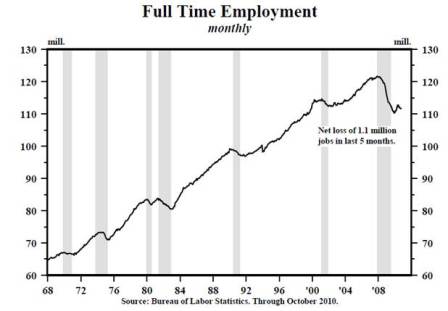
The most distressing aspect of this report is that the US economy lost another 124K full-time jobs, thus bringing the five-month loss to 1.1 million in this most critical of all employment categories. In an even more significant sign, the level of full-time employment in October was at the same level that was reached originally in December 1999, almost 11 years ago (see attached chart). An economy cannot generate income growth by continuing to substitute part-time work for full-time employment. This loss of full-time jobs goes a long way to explain why real personal income less transfer payments has been unchanged since May.

The weakness in real income is probably lost in an environment in which the Fed is touting the gain in stock prices and consumer wealth resulting from the latest quantitative easing (QE), but QE has unintended negative consequences for real household income. Due to higher prices of energy and food commodities, QE may result in less funds for discretionary spending for consumers whose incomes are stagnant. Also, with five-year yields falling below 1%, rates on CDs and other types of short-term bank deposits will decline, also cutting into household income. At the end of the day these effects will be more powerful than any stock-price boost in consumer spending, which, as always, will be very small and slow to materialize.

To have a broad-based recovery, the manufacturing sector must participate. Contrary to the ISM survey, manufacturing jobs fell 7k, the third consecutive drop, resulting in a net loss over the past three months of 35k.

In summary, the latest economic developments indicate a slight worsening of underlying fundamental conditions.

QE still driving portfolio shifting

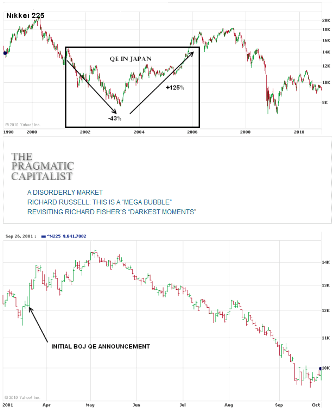
When Japan First Did QE, Stocks Shot Up And Then Quickly Cratered Massively

Pragmatic Capitalist

November 4 — There appears to be some confusion over the response of equity markets to quantitative easing. Of course, the Fed is hoping that they can ignite a “wealth effect” by driving stocks higher. But as we saw in Japan this failed to materialize. In fact, anyone buying in front of the QE announcement in Japan ultimately got crushed in the ensuing few months and years. When the BOJ initially announced the program in March 2001 the equity market rallied ~16%.

But the euphoria over the program didn’t last long. In fact, within 6 weeks of the announcement the Nikkei began to crater almost 30% over the course of several months. In the ensuing two years the Japanese stock market fell a staggering 43%! It wasn’t until the global economic recovery in 2003 that Japanese equities finally bottomed and went on a tear. Ultimately, the BOJ ended the program in March 2006 and deemed it a failure.