
Spreads sort of showing signs of starting to widen, maybe.
More indications Japan will ‘pay for’ the earthquake reconstruction
Seems to be the way of the world right now.
On Mon, Apr 25, 2011 at 12:26 AM, sean wrote:
looks like japan will raise tax to destroy the demand that the quake couldn’t
JAPAN RULING PARTY’S NAKAGAWA: THINK BEST TO SEEK PUBLIC UNDERSTANDING FOR SALES TAX HIKE TO FUND RECONSTRUCTION
JAPAN RULING PARTY’S NAKAGAWA: RECONSTRUCTION BILL WILL CALL FOR GOVT TO MAINTAIN FISCAL DISCIPLINE
Quick Bernanke video clip from 60 minutes on how the Fed spends/lends
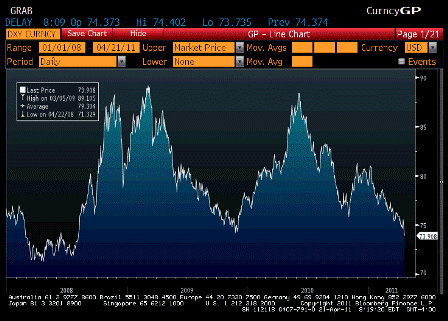
Dollar index remains in decline
With crude oil back up, the dollar has resumed it’s slide vs the other currencies. And odds are West Texas crude converges to Brent, which remains over $10 per barrel higher at about $124/barrel when/as the Cushing supply issues clear up.
However, with food and energy, at least for now, remaining a relative value story, this could largely be the other currencies deflating rather than the dollar inflating.
The US is a large importer of finished products and with relatively weak aggregate demand here this means downward price pressures on those who export to the US to sustain their export volumes and market share.
And with US unit labor costs not rising, US companies can price aggressively overseas and keep foreign margins under pressure as well.
So looks to me like the world shortage of aggregate demand/dangerously high unemployment will continue for a considerable period of time, now exacerbated by rising food and energy costs which takes purchasing power from high propensity to consume individuals and transfers it to low propensity to consume states, corporations, investment funds, etc.
While at the same time this (at least for the near future) relative value story gets treated like an inflation story by most of the world’s governments, who are consequently prone to take measures to further reduce aggregate demand.
No nation wins in this process, just some losing less than others.

Robert Reich’s no so innocent fraud
Obama’s Real Budget Plan (and Why It’s a Huge Gamble)
By Robert Reich
Here’s the part of interest to me:
Yet what are the chances of a booming recovery? The economy is now growing at an annualized rate of only 1.5 percent. That’s pitiful. It’s not nearly enough to bring down the rate of unemployment, or remove the danger of a double dip. Real wages continue to drop. Housing prices continue to drop. Food and gas prices are rising. Consumer confidence is still in the basement.
Fair enough, now on to the problem and the remedy:
By focusing the public’s attention on the budget deficit, the President is still playing on the Republican’s field. By advancing his own “twelve year plan” for reducing it – without talking about the economy’s underlying problem – he appears to validate their big lie that reducing the deficit is the key to future prosperity.
Promising rhetoric there- deficit reduction isn’t the answer!
The underlying problem isn’t the budget deficit.
Really getting my hopes up now!
It’s that so much income and wealth are going to the top that most Americans don’t have the purchasing power to sustain a strong recovery.
****sound of a balloon deflating****
Until steps are taken to alter this fundamental imbalance – for example, exempting the first $20K of income from payroll taxes while lifting the cap on income subject to payroll taxes, raising income and capital gains taxes on millionaires and using the revenues to expand the Earned Income Tax Credit up to incomes of $50,000, strengthening labor unions, and so on – a strong recovery may not be possible.
Message to Bob:
I suspect you understand taxes function to regulate aggregate demand, not to fund expenditures per se?
So please don’t blow smoke and instead just state that the tax cut part of your proposal is meant to add to aggregate demand,
And that the tax increase part is to achieve your vision of social equity without subtracting very much from aggregate demand.
Instead, by doing it the way you are doing it, you are implying that the deficit per se is of economic consequence.
This makes you part of the problem, rather than part of the answer, as you are supporting the deficit myths which are preventing any actual solution from being implemented.
Robert B. Reich has served in three national administrations, most recently as secretary of labor under President Bill Clinton. He also served on President Obama’s transition advisory board. His latest book is Supercapitalism.
The Sin of US ethanol subsidies
The reality if very simple, and there is no end in sight.
The US is a net exporter of food, and a net importer (directly and indirectly) of motor fuels.
So with current high gasoline prices we get a higher price for our food surplus by burning up part of it for fuel.
Even if the energy used in creating the ethanol is somewhat more than the energy produced, the energy used is generally coming from lower cost and domestically produced sources such as coal. And the fuel burned in our cars replaces gasoline- a much higher cost energy that we import.
So, bottom line, burning up part of our surplus crops as motor fuel, which drives up food prices world wide, we reduce imports of motor fuels and we get a higher price for the remaining foods we export.
That is, we benefit economically from the global chaos and the likelihood of mass starvation created by this policy.
:(
CNBC features Warren in contrast to Carmen Reinhart
Thoughts on S+P action re USA
>
> —– Original Message —–
> From: Hadden, Glenn (FID)
> Sent: Monday, April 18, 2011 04:45 PM
> Subject: IMPORTANT – thoughts on S+P action re USA
>
I would like to address the action taken today by S+P in revising the United
States credit outlook to negative.
Simply, I believe the argument behind S+P’s decision is flawed and displays
a misunderstanding of how the monetary system operates. My view is not
predicated on any political ideology. I am merely attempting to demonstrate
the incorrect logic regarding United States credit quality and solvency.
1. FINANCIAL BALANCE FRAMEWORK:
The first fundamental item that must be understood is how financial balances
relate to government indebtedness. In a closed economy (or an economy with a
perpetually balanced current account), government deficits must equal
private savings. If private savings desires increase, a government’s deficit
must increase by precisely the same amount all things equal. There is no
other way.
In the case of the United States, the budget deficit has grown to 10% of gdp
from approximately 4% of gdp because the savings rate has shifted from
approximately negative 2% to approximately positive 6%. Simply stated, the
federal budget isn’t a function of profligate government spending, its a
function of higher desired private savings causing a shortage of aggregate
demand. This shortage of aggregate demand is putting downward pressure on
tax revenues (lower nominal gdp implies lower tax revenues) and upward
pressures on expenditures owing to automatic stabilizers such as UI.
With this example, it is theoretically possible to have much larger
government deficit and debt levels if savings desires grow commensurately.
If private sector savings desires were to fall, which implies higher
aggregate demand (because the spending of a person in the private sector
simply creates another person’s income), the government deficit would fall
commensurately owing to higher tax revenues and possibly lower expenditures.
2. MYTHS REGARDING FOREIGN INVESTORS FUNDING THE UNITED STATES AND EXTERNAL LIABILITIES:
Firstly, the most important item to understand is the USA discharges its
debt in $US. So the entire argument of rating agencies behind ‘external
funding pressures’ is moot. Functionally there is no difference between a
holder of UST’s who is domiciled in USA or abroad, as they are both $US
dominated savers. The only difference is the foreign saver has no ‘need’ to
save in $US (where a USA investors needs $US as a means of exchange and to
pay his taxes).
So, what if foreign now dump their ust’s?
Foreign investors own ust’s and $us because they WANT to own them. By
engaging in fx driven trade policies, foreigners ‘pay up’ to get $US which
allows them greater sales into the USA market. If foreigners didn’t want to
save in $US, they would change their fx policy which would result in less
market share in USA economy. Foreigners can’t be both buyers and sellers
simultaneously. If foreigners wanted to own less $US, the result would be a
smaller current account deficit in USA, which again using a financial
balance framework would either result in more private savings, or a smaller
govt deficit. Bottom line – if foreigners want to have fewer savings in $US,
either private savers must increase savings, or the govt deficit must fall.
3. MYTHS REGARDING FOREIGN INVESTORS FUNDING THE UNITED STATES AND EXTERNAL LIABILITIES part II:
The same way banks offer savers demand deposits and term deposits (ie
chequing accounts versus savings accounts) the USA economy offers savers the
same in the form of $US (demand assets) or UST (term asset). Foreign savers
can therefore keep their $ at their Fed Reserve account and earn basically
zero (functionally a ‘chequing’ or demand account) or buy UST’s
(functionally a ‘savings’ or term account) and earn a coupon. There is no
other way to save in risk free space. As said above, foreigners who engage
in fx driven trade policies must accumulate $US demoninated assets. The only
choice they have is term vs demand assets. So indeed if foreigners declined
to own ust’s and alternatively kept their savings in $US at the Fed, the
result could be a higher and steeper term structure for USA rates. If the
Treasury decided to sell less ust’s and more tbills, this term structure
rise could be negated. Note foreigners actions are never about SOLVENCY, its
merely a function of liquidity preference.
4. THE DEFAULT BY THE SOVEREIGN OPERATING WITHIN A NON-CONVERTABLE EXCHANGE RATE REGIME IS A *FUNCTIONAL* IMPOSSIBILITY:
One must also understand the mechanics of government spending. A government
purchases goods and services from the private sector and then the Federal
Reserve credits the reserve accounts of the commercial banks whom the
sellers of such good and services bank. The Fed then debits the reserve
account of The US Treasury. The Treasury then sells ust’s, where the Fed
then credits the Treasury’s reserve account while debiting the reserve
accounts of the banking system.
So all that has happened is the government has created savings in the
economy by spending (from point 1 above: govt spending = private savings).
So as is illustrated, there is no issue of ‘solvency’ per se. The
government, by spending, is creating the savings to buy the ust’s. The only
issue here is the term gap. Specifically if savers only want demand assets
(ie $us), while the Treasury only wants to sell term assets (ie ust’s), the
resolution will be price and risk premium: ie how much interest rate spread
will a bank or arbitrageur need to intermediate this imbalance. This can all
be negated of course, if the Treasury only issued T-bills.
5. THE DEFAULT BY THE SOVEREIGN OPERATING WITHIN A NON-CONVERTABLE EXCHANGE RATE REGIME IS A *FUNCTIONAL* IMPOSSIBILITY part II:
This is the fundamental flaw of the S+P decision. The basis of their
sovereign rating criteria is as they describe it is: “The capacity and
willingness to pay its debts on time”. As mentioned above, there is
functionally no reason for the USA to ever not pay its debts – the USA’s
debts are and will always be equal to savings desires of the private and
foreign sectors. So ‘CAPACITY’ can never be an issue.
Hence the only reason the USA would ever default was because they ‘wanted’
to default, they never under any circumstance NEED to default so long as the
$US remains a non-convertable currency. The implications for a voluntary
default (again, this is the only kind of default possible by the USA) make
such a default an impossibility. The reason is because the 2nd largest
liability of the federal government is deposit insurance. If the USA decided
it wanted to default to escape its obligations, it would bankrupt its
banking system, who’s holdings of ust’s are greater than system-wide bank
capital of $1.4 Trillion. In fact the contingent liability put the
government has issue via deposit insurance is almost as large as USA debt
held by the public at $6.2 Trillion. So essentially a voluntary default
would actually INCREASE USA indebtedness by almost 100% while
simultaneouslybankrupting its banking system. So if ABILITY to pay is
assured, and a voluntary default actually raises indebtedness while
collapsing the banking system and economy, why would USA ever voluntarily
default? So S+P’s criteria of ‘WILLINGNESS’ to pay is also not applicable.
SUMMARY:
So as demonstrated, the bottom line is ABILITY to pay can never be an issue
in a non-convertable currency system. The only issue is WILLINGNESS to pay.
So if the argument by S+P relates to “the capacity and willingness to pay
its debts on time” as they described on Monday’s call, then their argument
simply isn’t cogent.
The last point I want to make is it would be incorrect to attempt to draw an
analogy to the placement of the UK on credit watch in mid May 2009 relating
to market performance. Yes indeed gilts sold off shortly after this
announcement. However this was more a function of the unhinging of the USA
MBS market. There existed a perception that the Fed via QE1 was attempting
to cap current coupon mortgage rates at 4%. Once this level was breached and
it became clear in mid/late May that this view was incorrect, a convexity
sell event hit the USA rates market which dragged all global bond yields
higher including Gilts.
To conclude – I view the decision today by S+P as having zero impact on
valuations of USA sovereign debt. We continue to engage in trades that
express the correct view that the solvency of the United States can never be
an issue in nominal terms; specifically we are buyers of 30yr assets swaps
at -25bps.
MMT’s Professor L. Randall Wray makes the NY Times!
Ignore the Raters
By L. Randall Wray
April 18 (NYT)
L. Randall Wray is a professor of economics at the University of Missouri-Kansas City and a senior scholar at the Levy Economics Institute of Bard College. He is the author of“Understanding Modern Money,” and blogs at New Economic Perspectives.
In what appears to be an attempt to influence the political debate in Washington over federal government deficits, Standards & Poor’s rating firm downgraded U.S. debt to negative from stable. Yes, the raters who blessed virtually every toxic waste subprime security they saw with AAA ratings now see problems with sovereign government debt.
The best thing to do is to ignore the raters — as markets usually do when sovereign debt gets downgraded — but this time stock indexes fell, probably because of the uncertain prospects concerning government budgeting. After all, we barely avoided a government shutdown earlier this month, and with S.&P. joining the fray who knows whether the government will continue to pay its bills?
Mind you, this has nothing to do with economics, government solvency or involuntary default. A sovereign government can always make payments as they come due by crediting bank accounts — something recognized by Chairman Ben Bernanke when he said the Fed spends by marking up the size of the reserve accounts of banks.
Similarly Chairman Alan Greenspan said that Social Security can never go broke because government can meet all its obligations by “creating money.”
Instead, sovereign government spending is constrained by budgeting procedure and by Congressionally imposed debt limits. In other words, by self-imposed constraints rather than by market constraints.
Government needs to be concerned about pressures on inflation and the exchange rate should its spending become excessive. And it should avoid “crowding out” private initiative by moving too many resources to our public sector. However, with high unemployment and idle plant and equipment, no one can reasonably argue that these dangers are imminent.
Strangely enough, the ratings agencies recognized long ago that sovereign currency-issuing governments do not really face solvency constraints. A decade ago Moody’s downgraded Japan to Aaa3, generating a sharp reaction from the government. The raters back-tracked and said they were not rating ability to pay, but rather the prospects for inflation and currency depreciation. After 10 more years of running deficits, Japan’s debt-to-gross-domestic-product ratio is 200 percent, it borrows at nearly zero interest rates, it makes every payment that comes due, its yen remains strong and deflation reigns.
While I certainly hope we do not repeat Japan’s economic experience of the past two decades, I think the impact of downgrades by raters of U.S. sovereign debt will have a similar impact here: zip.