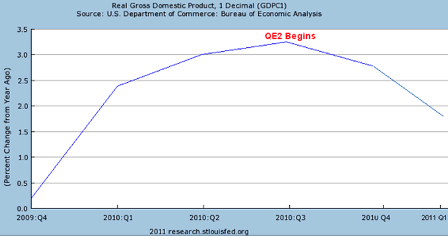
QE and Real GDP

To which they respond ‘monetary policy works with a lag’

And to which I add, yes, it lags until the next fiscal adjustment kicks in.

;)

>   
>   But equities continue to peform relatively well.
>   

Yes, they should be ok with any positive top line growth.

The risks that remain are a hard landing in China, a euro zone meltdown, and fiscal responsibility in the US and Japan.

Goldman on monetary policy in the BRICs

Excellent recap of what’s happening through the eyes of Wall St. in the BRICS.

To be noted:

The BRICS all seem to be fighting inflation, which means the problem is that bad.

Unfortunately, hiking rates via direct rate hikes, reserve requirement hikes, and the like, which they all are doing, add to aggregate demand through the interest income channels, making their inflations that much worse. (That’s the price of being out of paradigm, as reinforced by analysts who are also out of paradigm)

Some are using credit controls, which do slow demand, as does fiscal tightening which generally happens through automatic stabilizers that work through higher nominal growth, including reduced transfer payments and higher tax receipts.

In general, this type of thing tends to end with a very hard landing, which their equity markets may be starting to discount.

BRICs Monthly : 11/04 – Monetary Policy in the BRICs

Published April 28, 2011

The BRICs’ central banks rely on a variety of tools to adjust monetary policy. As output gaps have closed and inflation pressures have accelerated, policy stances in the BRICs have shifted meaningfully towards tightening. We expect policy to continue to tighten in the coming months via a combination of policy rate hikes, reserve ratio requirement hikes and other measures.

There is a large degree of variation in the stated goals of monetary policy and the tools used to achieve those goals, both among the BRICs and relative to the advanced economies. The BRICs (like many other emerging markets) rely more heavily on a broader set of tools than is typical in the developed world. These include several policy rates, reserve ratio requirements, open market operations and FX intervention. As a result, looking at the policy rate alone does not provide an accurate picture of the overall monetary policy stance.

Over the past year, BRICs’ policymakers have shifted from an accommodative policy stance (in response to the financial crisis) to tightening (in response to closing output gaps and rising inflation pressures). However, the unusual shape of the global recovery—in which most of the BRICs and other EMs have rebounded quickly, while the developed world has lagged behind—has brought about a shift in the way in which the BRICs have tightened monetary policy. This time around, most have relied less on policy rate hikes and more on alternative tools.

While the BRICs have tightened monetary policy meaningfully, we believe that more is on the way. We expect Brazil, India and Russia to hike their policy rate by another 125bp and China to hike by 25bp by end-2011. In addition, we expect further tightening through the exchange rate, the reserve requirement ratio and other measures.

Monetary Policy in the BRICs

There is a large degree of variation in the stated goals of monetary policy and the tools used to achieve those goals, both among the BRICs and relative to advanced countries. The BRICs (like many other EMs) rely more heavily on a broader set of tools than is typical in the developed world. Hence, looking at the policy rate alone does not provide an accurate picture of their monetary policy stance.

Brazil’s monetary policy framework has shifted dramatically over the past two decades. As it struggled against hyper- and high inflation in the early 1990s, the government first introduced a period of extremely high interest rates (over 50%) in 1994, and then transitioned in 1995 to a soft exchange rate peg accompanied by high and volatile interest rates. In 1999, Brazil shifted to its current inflation-targeting regime. The current inflation target is set at 4.5%, with a relatively wide band of +/- 2% and no repercussions if the target is missed (as it has been for the past three years). To this end, COPOM targets the SELIC interest rate (the overnight interbank rate).

China uses a more eclectic form of monetary policy that involves a range of players, objectives and instruments. The People’s Bank of China (PBoC) is the official implementer, but the central government often weighs heavily on the PBoC’s decisions. The Bank does not hold regular policy meetings and policy changes are typically released after the close of the local market without advance notice. The Monetary Policy Committee of the PBoC is an advisory body, which does not determine policy direction. Chinese monetary policy has an official quad mandate of growth, employment, inflation and a balanced external account. To achieve these goals, the PBoC uses a range of quantity- and price-based mechanisms, such that there is no single policy instrument that can be used as a main indicator of its monetary policy stance at any given time. Quantity-based tools include reserve requirement (RRR) changes and credit controls. Price-based tools include changes in the benchmark deposit and lending interest rates.

India’s monetary policy is conducted by the Reserve Bank of India (RBI), which has the dual mandate of price stability and the provision of credit to productive sectors to support growth. To this end, the RBI targets the interest rate corridor for overnight money market rates, with the reverse-repo rate as the floor and the repo rate as the ceiling. The RBI also utilises open market operations and two types of reserve ratio requirements (the cash reserve ratio and the statutory liquidity ratio).

In Russia, monetary policy is set by the Central Bank of Russia (CBR). Until recently, the CBR concentrated on exchange rate stability and allowed inflation to vary. Its main policy rates are the overnight deposit rate and the 1-week minimum repo rate, although these historically have played a subordinate role to FX intervention. The CBR also monitors liquidity through reserve requirements, FX interventions and open market operations.

Shift in BRICs’ Approach to Monetary Tightening

The unusual shape of the global recovery—in which most of the BRICs and other EMs have rebounded quickly, while the developed world has lagged—has brought about a shift in the way in which the BRICs have tightened monetary policy.

Policymakers in Brazil have been hesitant to raise rates as aggressively as they normally would in response to the current high-growth/high-inflation domestic cyclical picture, given their concern that this would attract greater capital inflows. Instead, they have increasingly relied on two alternative mechanisms to tighten the overall policy stance: (1) a gradual FX appreciation and (2) several ‘macro-prudential’ measures that slow the pace of new credit concessions, raise the cost and lengthen the maturity of new loans, and raise the tax on foreign fixed income inflows.

Over the recent cycle, Chinese policymakers have relied most heavily on explicit and implicit credit controls, including window guidance meetings and the Dynamic Differentiated RRR System (under which the PBoC imposes a differentiated RRR for some banks but removes it for others, if they have been following government lending controls). Frequent RRR hikes have generally not produced any net tightening, as they were counterbalanced by increased FX inflows and expiring central bank bills. Likewise, recent interest rate hikes have been an effective signalling device but have been too small in magnitude to have a large impact.

In India, the RBI has kept liquidity tight in order to pass policy rate hikes through to bank deposit and lending rates. However, excessively tight and volatile liquidity has caused overnight borrowing rates to fluctuate widely in recent months, such that market participants have focused more on liquidity than policy rate actions in determining the direction and magnitude of interest rates at the short end. In an effort to address this issue and increase transparency, the RBI has proposed shifting to a single policy rate target (the repo rate) while simultaneously improving its control over system-wide liquidity.

Russia has seen the largest change in its monetary policy framework since the onset of the financial crisis. The CBR has shifted towards more FX flexibility with a greater focus on inflation, with the goal of an eventual move towards an inflation targeting regime (although, as the CBR has highlighted, such a move would ultimately be a government decision, which is unlikely to be realised in the absence of a strong political will to make the change). To this end, the CBR has moved towards interest rates as its primary monetary policy tool, and has scaled down its presence in the FX markets. It now sterilizes most FX interventions so as not to impact money supply growth. It has also relied more heavily on reserve requirement changes in recent months, in an effort to signal tightening liquidity.

More Tightening to Come

While the BRICs have meaningfully tightened monetary policy via a variety of tools, we believe more is needed. Demand-driven inflationary pressures are picking up as output gaps close, contributing to an acceleration in core inflation. Moreover, the BRICs also face large food and energy price spikes, which are likely to continue to push up headline inflation at least through the summer. In addition, fiscal policy is not turning sufficiently contractionary, leaving the burden of tightening on monetary policymakers.

In Brazil, we expect five more SELIC hikes by 25bp per meeting and further macro-prudential measures. For China, we forecast at least one more rate hike (25bp in 2011Q2), further currency appreciation (6% annualised), liquidity absorption measures through RRR hikes and open market operations, and tight control over credit issuance. We have a much more hawkish view of India than consensus, where we now expect the RBI to hike policy rates by another 125bp in 2011. Russia’s CBR should hike deposit and repo rates by 150bp and 125bp respectively by end-2011.

Russia Continues To Buy Gold

Looks like QE scared Putin into buying gold:

Russia Continues To Buy Gold

By Rhiannon Hoyle

April 28 (Dow Jones) — Russia’s central bank is continuing to make steady gold purchases, while sales by signatories to the third Central Bank Gold Agreement meanwhile remain negligible, the World Gold Council said Thursday.

Russia added 8.2 metric tons of gold to its reserves between December and February–the most significant change in reserves reported by any country, the WGC said.

It appears to be continuing “its long-term program of gold accumulation,” with sustained buying primarily in the domestic market, the industry body added.

At the end of February the Russian central bank held 7.3% of its reserves in gold, at a total of 792.3 tons, according to data the WGC collected from the International Monetary Fund and other sources.

Sales of gold by CBGA signatories have meanwhile accounted for less than one ton so far during the second year of the agreement, which began in September, the WGC added. The agreement, which covers the gold sales of the Eurosystem central banks, Sweden and Switzerland from September 2009 to 2014, states that annual sales will not exceed 400 tons and total sales over the period will not exceed 2,000 tons.

Other substantial purchases between December and February included a reported 7-ton reserve increase in Bolivia, taking the country’s total holdings to 35.3 tons, or 15.1% of its overall reserves, the WGC said.

“While Bolivia has not made any public comment on this increase in gold holdings, it is very likely that the central bank has simply decided to restore its gold holdings relative to its growing foreign currency reserves, similar to other recent emerging market central bank purchases,” it noted.

The data was released in the council’s regular statistical update on gold reserves in the official sector.

China’s dollar reserves being used to fight inflation?

This may be some of the most recent data:

The SAFE Releases Data on Chinas External Debt at the End of September 2010

Excerpt: “At the end of September 2010, China’s outstanding external debt (excluding that of Hong Kong SAR, Macao SAR, and Taiwan Province) reached USD546.449 billion. Specifically, the outstanding registered external debt reached USD326.549 billion and the balance of trade credit totaled USD219.9 billion. ”

Then Mktwatch reported this end Dec 2010:

China’s external debt nears $550 billion: Safe

Escerpt: “HONG KONG (MarketWatch) — China’s external debt was $548.938 billion at the end of 2010, compared to $546 billion owed at the end of the third quarter, according to newswire reports Thursday that cited figures released by the State Administration of Foreign Exchange. Of that total, China’s short-term debt was $375.7 billion, or equivalent to 13.2% of China’s foreign exchange reserves, the agency said”

CAUTION,THIS IS ALL VERY PRELIMINARY AND COULD PROVE TO BE ENTIRELY WRONG

I got this response, and I’m looking further into it.

I don’t think this includes dollar debt of state banks and state owned enterprises.

What it means is that China’s net reserves aren’t as high as generally believed, and that they are being ‘spent/lent’ by borrowing dollars and then spending, leaving the gross, headline reserve number intact, rather than spending the reserves directly.

They could even be buying their own currency to drive it higher to fight inflation.

This would be an interesting, quasi desperation move, as it would mean they are willing to risk export markets to try to keep prices in check.

It would also help explain the downward drift in the dollar over the last 6 months or so.

And currency support under these circumstances is also, in general, unsustainable. If the trade flows have turned against them due to inflation, they will burn through all their reserves trying to support their currency without a lot more fiscal tightening at all levels, and a very hard landing as well. And even that might not be enough, depending on how institutionalized the inflation is.

All speculation on my part at this point.

from Press Conference

I thought he did a AAA job within his paradigm.

The answers on the dollar were spot on- ultimately the dollar is worth what it can buy, so ‘low inflation’ is a strong dollar policy in the long term. It’s pretty much the purchasing power parity argument. Additionally, he said a strong economy helps the dollar, citing the capital inflow channel, probably a reference to China and other emerging market nations. And I might have added the fiscal tightening channel, as strong economies tend to cause federal deficits to fall via automatic fiscal stabilizers.

Interestingly, he did not mention specifically how higher oil prices, set by a foreign monopolist, continue to work against the dollar.

Nor how highly deflationary policies in other currencies tend to strengthen those currencies relative to the dollar.

And there was no mention of how portfolio shifting alters the dollar, which may be the largest driver currently.

Let me suggest, however, it would have been more nearly correct for him to have said the policy of low inflation and strong growth also happens to support the dollar, rather than imply a strong dollar was the policy variable.

He remains out of paradigm on the QE issue, still not realizing it’s entirely about price and not quantity, but that was to be expected.

The more dovish tone from the FOMC indicates some fundamental insecurity about the economy. Yes, they remain moderately optimistic, but probably continue to worry disproportionately about the downside risks. They see downside risks to demand everywhere from the euro zone and the UK, to Japan and China, and, though recognizing nothing of consequence has happened yet, they hear the fiscal sabre rattling from both the left and the right. And they see it’s unlikely for the housing channel to provide much support in the near future as it’s done in previous cycle.

Also, second chance to buy my 100oz gold bar at the current spot price of gold!
When I offered it for sale when gold was $1,200, no one wanted it so I still have it.

:)


Karim writes:

1) Extended period means a ‘couple of meetings’.
2) Q1 GDP weakness transitory (i.e., they didn’t alter the outlook for rest of f/cast period) due to
   a. timing of defense outlays
   b. timing of export shipments
   c. weather
3) No fiscal measures that have been announced so far have altered their near-term outlook
4) Impact of Japan supply disruptions ‘moderate and temporary’
5) Strong and stable dollar in U.S. best interest

FOMC Statement

Also note that long term forecasts continue to assume ‘appropriate monetary policy’

This means the forecasts contain the assumption that the Fed can hit it’s long term goals for inflation and unemployment by adjusting ‘monetary policy’

In other words, the presumption of being able to hit their targets means the longer term forecasts are nothing more than the their targets.

This is in contrast with non Fed forecasters, who attempt to forecast actual results, which while they do incorporate assumptions about monetary policy, do not necessarily assume those Fed policy adjustments will be successful.


Karim writes:

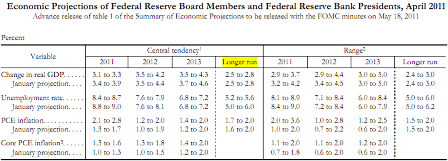
  • Mid-point of 2012 Core PCE forecast now 1.55%! Rates wont be 25bps in that event
  • 2011 GDP growth shaved lower by 0.3% (now 3.25%)
  • 2012 GDP growth lower by 0.1% (now 3.85%)
  • Unemployment rate lower by 0.35% in 2011 (now 8.55% by Q4) and lower by 0.1% next year (now 7.75%).

LAST STATEMENT (MARCH) AND FORECASTS (JANUARY)

Federal Reserve Press Release
Release Date: March 15, 2011
For immediate release

Information received since the Federal Open Market Committee met in January suggests that the economic recovery is on a firmer footing, and overall conditions in the labor market appear to be improving gradually. Household spending and business investment in equipment and software continue to expand. However, investment in nonresidential structures is still weak, and the housing sector continues to be depressed. Commodity prices have risen significantly since the summer, and concerns about global supplies of crude oil have contributed to a sharp run-up in oil prices in recent weeks. Nonetheless, longer-term inflation expectations have remained stable, and measures of underlying inflation have been subdued.

Consistent with its statutory mandate, the Committee seeks to foster maximum employment and price stability. Currently, the unemployment rate remains elevated, and measures of underlying inflation continue to be somewhat low, relative to levels that the Committee judges to be consistent, over the longer run, with its dual mandate. The recent increases in the prices of energy and other commodities are currently putting upward pressure on inflation. The Committee expects these effects to be transitory, but it will pay close attention to the evolution of inflation and inflation expectations. The Committee continues to anticipate a gradual return to higher levels of resource utilization in a context of price stability.

To promote a stronger pace of economic recovery and to help ensure that inflation, over time, is at levels consistent with its mandate, the Committee decided today to continue expanding its holdings of securities as announced in November. In particular, the Committee is maintaining its existing policy of reinvesting principal payments from its securities holdings and intends to purchase $600 billion of longer-term Treasury securities by the end of the second quarter of 2011. The Committee will regularly review the pace of its securities purchases and the overall size of the asset-purchase program in light of incoming information and will adjust the program as needed to best foster maximum employment and price stability.

The Committee will maintain the target range for the federal funds rate at 0 to 1/4 percent and continues to anticipate that economic conditions, including low rates of resource utilization, subdued inflation trends, and stable inflation expectations, are likely to warrant exceptionally low levels for the federal funds rate for an extended period.

The Committee will continue to monitor the economic outlook and financial developments and will employ its policy tools as necessary to support the economic recovery and to help ensure that inflation, over time, is at levels consistent with its mandate.

MBA’s index of loan requests for home purchases tumbled 13.6 percent

This is disturbing, along with still weak housing price indicators, and the ongoing downward revisions to GDP forecasts, as aggregate demand remains under international attack on all fronts.

On the govt side, China is cutting demand to fight inflation, with India and Brazil presumed to be doing same. Austerity measures continue to bite in the UK and the euro zone, and are looming in the US.

On the private credit expansion side, regulatory over reach continues to restrict lending by the US banking system, and particularly with the small banks. This limits both bank and non bank lending, as the non bank lending is most often at least indirectly dependent on bank lending.

Additionally, the rising costs of food and fuel are taking purchasing power from those with the higher propensities to consume and shifting it to those with far lower propensities to consume.

And, of course, ongoing QE continues to remove interest income from the economy, as does the shift of interest income from savers to bank and other lender net interest margins, in a process that has yet to reach the national debate as a point of discussion.

Other commodity prices also continue to rise as hoarding from pension funds and the like via passive commodity strategies continues to expand globally.

This sends price signals that increase supply, which means human beings are being mobilized to produce stockpiles of gold, silver, and other metals and commodities not to ever be used for real consumption, but to forever remain as ‘reserves’ to index financial performance as demanded by current institutional structures. This is a monumental waste of human endeavor as well as the real resources, including energy, that are committed to this process.

So at the macro level we are removing teachers from what have become over crowded classrooms, removing nurses from neglected patients, and removing workers from building, repairing, and maintaining our homes and other infrastructure, to send them to either the unemployment lines or the gold mines.

And because they think at any moment we can suddenly become the next Greece, both sides agree with the necessity and urgency of promoting this policy.

Mortgage Applications Fell Last Week: MBA

April 27 (Reuters) — Applications for U.S. home mortgages fell last week as higher insurance premiums for government-insured loans sapped demand, an industry group said Wednesday.

The Mortgage Bankers Association said its seasonally adjusted index of mortgage application activity, which includes both refinancing and home purchase demand, fell 5.6 percent in the week ended April 22.

“Purchase applications fell last week, driven primarily by a sharp decrease in government purchase applications as new, higher Federal Housing Administration premiums went into effect,” Michael Fratantoni, MBA’s vice president of research and economics, said in a statement.

The decline reverses a recent increase in government purchase applications, which was likely due to borrowers trying to beat the deadline, Fratantoni said.

The MBA’s seasonally adjusted index of loan requests for home purchases tumbled 13.6 percent, while the gauge of refinancing applications slipped 0.6 percent.

Fixed 30-year mortgage rates averaged 4.80 percent in the week, easing from 4.83 percent the week before.

More on the euro zone deficit report

Yes, the deficit went from 6.3% to 6% of GDP, but the question remains as to whether they are at the point where further slowing from austerity measures continue to reduce the overall deficit or, instead, an induced slowdown begins to increase it.

Euro Zone 2010 Deficit Shrinks, Debt Rises

April 26 (Reuters) — The euro zone’s aggregated budget deficit fell last year as most countries slashed government spending to restore market confidence in public finances, but the debt still grew, Eurostat data showed.

The European Union’s statistics office said on Tuesday the budget deficit in the euro zone in 2010 was 6.0 percent of gross domestic product, down from 6.3 percent in 2009. Public debt, however, rose to 85.1 percent from 79.3 percent in 2009.

All euro zone countries except Germany, Ireland, Luxembourg and Austria improved their budget balance last year, but debt rose in all euro zone countries except Estonia.

Eurostat said Greece, which was forced to seek emergency funding from the euro zone last year because it was effectively cut off from market borrowing due to its large debt, cut its budget gap to 10.5 percent of GDP from 15.4 percent in 2009.

This is well above the initial target of the Greek austerity programme of 8 percent and even above the latest estimate from the European Union and the International Monetary Fund of 9.6 percent.

Greek public debt rocketed to 142.8 percent of GDP from 127.1 percent in 2009.

Ireland saw its budget deficit more than double to 32.4 percent of GDP last year from 14.3 percent in 2009 and its debt jumped to 96.2 percent from 65.6 percent as the country had to borrow to bail out its banking sector.

Euro-Area Debt Reaches Record 85.1% of GDP as Crisis Festers

It’s hard to say from the headlines whether proactive deficit reduction measures are slowing the economies to the point where the slowing is causing their deficits to increase.

However, if that is the case, continuing their deficit reduction efforts will only make things worse, to the point of forcing social upheaval.

And the rising deficits will begin to weaken the euro, as the deficit reduction that initially worked to strengthen the euro reverse.

And higher rates from the ECB will only serve to further increase national government deficits via higher interest payments by those same governments.

This also makes euro ‘easier to get’ and thereby weakens the currency.

Yes, the euro zone is seeing ‘inflation’, as they define it, moving higher, but under current conditions I don’t see any channel from rate hikes to lower ‘inflation’, again as they define it. But I do see how higher rates can instead add to the general price level through income interest and cost channels. All of which would be exacerbated should this policy also cause the euro to depreciate.

With regards to funding, there is nothing operationally to stop the ECB from, for all practical purposes, funding/backstopping the entire banking system as well as the national governments.

The question is the political will, which is not quantifiable.

And the solution remains painfully simple- the ECB can simply announce an annual payment of 10% of the euro zone’s gdp to the national governments on a per capita basis.

This will have no effect on inflation as it won’t get spent. It will only serve to allow all of the national governments to borrow at the ECB’s target rate, which would lower funding costs for the nations currently paying premiums for funding.

This will also give the ECB a lever to control deficits- the threat of suspending a nation’s funding if it is not in compliance.

And by removing the threat of market discipline from funding, the region would be free to set their stability and growth pact deficit targets at levels designed to achieve their macro economic goals for employment, output, and price stability.

Euro-Area Debt Reaches Record 85.1% of GDP as Crisis Festers

(Bloomberg) Euro-area debt reached a record in 2010. Debt rose in all 16 countries that were using the euro last year, lifting the bloc’s average to 85.1 percent of gross domestic product from 79.3 percent in 2009, the European Union’s statistics office said. Greece’s deficit topped expectations and debt ballooned to 142.8 percent of GDP, the highest in the euro’s 12-year history. Ireland’s debt surged the most, by 30.6 percentage points to 96.2 percent of GDP. Contingent liabilities from guaranteeing the banking system after the 2008 financial panic now amount to 6.5 percent of GDP, down from 8.6 percent in 2009, Eurostat said.

Saudi Uneasy With High Oil Price, Worried About Economy

Could be just talk or a prelude to a price cut.
No way to tell in advance- it’s a political decision on their part.

And it’s not illegal for them to place their personal and state bets first, and then cut price.
And it’s not illegal for them to cut any kind of a deal with anyone, anywhere in the world with regard to price.

In fact, it would be foolish not to.

Saudi uneasy with high oil price, worried about economy

By Cho Mee-young and Miyoung Kim

April 26 (Reuters) — Top oil exporter Saudi Arabia is uneasy with high oil prices and concerned about their impact on the global economy, the chief executive of state oil firm Aramco said on Tuesday.

Oil prices recovered from early losses on Tuesday, with Brent crude LCOc1 trading up 16 cents at $123.82 a barrel at 1059 GMT. Aramco Chief Executive Khalid al-Falih’s comments at an industry event in South Korea had weighed on sentiment earlier, when prices fell amid a wider decline in commodities.

“We are not comfortable with oil prices where they are today…I am concerned about the impact it could have on the global economy,” Falih told an industry gathering in South Korea.

There was no tightness in global oil markets, Falih said. His comments echoed those of Saudi Oil Minister Ali al-Naimi, who said last week that the kingdom had cut oil output in March as the market was oversupplied.

Unrest in North Africa and the Middle East and strong demand growth in Asia have pushed oil prices to their highest levels since 2008, triggering concern among consumers costly oil would harm economic growth and crimp fuel demand. OPEC producers also warned last week of the strain of high energy prices on economies still fragile as they emerge from the global financial crisis.

The kingdom has enough capacity to meet any spike in demand and plug short-term outages in supply, Falih said, adding that without Saudi spare capacity, oil price volatility would have been a lot worse when Libyan supply was lost.

OPEC’s largest producer boosted supply in February to above 9 million bpd to plug the gap left by fellow OPEC member Libya, where civil war cut exports. Saudi Arabia is the only oil producer with significant spare capacity to meet large supply outages such as that experienced in Libya.

Riyadh boosted capacity to 12.5 million barrels per day (bpd) in 2009, just as the global economic downturn cut demand. This left it with a supply cushion of over 4 million bpd, more than twice the spare capacity it targets of 1.5 million bpd to 2 million bpd. Output stood at 8.292 million bpd in March, down from 9.125 million bpd in February.

“People need to know that there are millions of barrels per day of spare capacity available,” Falih said.