PM RTRS – GREEK POLITICAL LEADERS’ MEETING ON BAILOUT PACKAGE POSTPONED TO WEDNESDAY–GREEK GOVT OFFICIAL ….
Postponed again?
Who would’ve thought?

PM RTRS – GREEK POLITICAL LEADERS’ MEETING ON BAILOUT PACKAGE POSTPONED TO WEDNESDAY–GREEK GOVT OFFICIAL ….
Postponed again?
Who would’ve thought?
Japan traditionally bought $ and built it’s fx reserves to support its exporters.
It was finally Tsy Sec. Paulson who shamed them into suspending their $ purchases by calling Japan, China, and others ‘outlaws’ and ‘currency manipulators’ in what was then, functionally, an attempt at a ‘weak dollar’ policy.
The current administration, however, is on the defensive with regards to the dollar, under attack from political adversaries for allowing the Fed to ‘print money’ and ‘debase the currency’ even as the dollar has been reasonably strong.
So Japan has been testing the waters first with an announced ‘one time’ intervention in response to the earthquake, which didn’t attract the name calling of the prior US administration, and now with the announcement of ongoing intervention.
Seems to me its highly unlikely the US administration will respond negatively which would support their opposition’s ‘currency debasing’ labeling. So I expect Japan to continue to sell yen in an orderly fashion at least until they strike a US nerve.
Japan Adopts Stealth Intervention as Yen Gains Hurt Growth
By Monami Yui and Shigeki Nozawa
Feb 7 (Bloomberg) — Japan used so-called stealth intervention in November as the government sought to stem yen gains that hammered earnings at makers of exports ranging from cars to electronics.
Finance Ministry data released today showed Japan conducted 1.02 trillion yen ($13.3 billion) worth of unannounced intervention during the first four days of November, after selling a record 8.07 trillion yen on Oct. 31, when the yen climbed to a post World War II high of 75.35 against the dollar. The currency’s strength has eroded profits at exporters such as Sharp Corp. and Honda Motor Co., just as faltering global growth undermines demand.
“Japan has clearly shown its intention to stop a further appreciation of the yen, and there is a high chance” for more yen selling, said Hideki Shibata, a senior strategist for rates and foreign exchange at Tokai Tokyo Research Center Co. “Caution against intervention has increased in markets.”
November’s unannounced yen sales were the most effective strategy to weaken the currency, said a Japanese official who spoke to reporters in Tokyo today on condition of anonymity. Finance Minister Jun Azumi said he won’t rule out any options to curb the yen’s appreciation and that he will take action whenever necessary.
Exporting ‘Nearly Impossible’
His comment came a week after Sharp, Japan’s largest maker of LCD panels, forecast its worst annual loss since its founding a century ago, with its president saying exporting is “nearly impossible” with the strong yen. Panasonic Corp., Japan’s biggest appliance maker, forecast a 780 billion yen loss, the worst since the Osaka-based company was established in 1918.
Honda, the nation’s third-largest automobile maker, forecast on Jan. 31 net income for the 12 months ending March will decline to a three-year low of 215 billion yen. The company estimates its operating income is cut by 15 billion yen for every one yen gain against the dollar.
The Bank of Japan last month lowered its forecast for economic growth to 2 percent in the year starting in April from an October estimate of 2.2 percent, citing a slowdown overseas and the stronger yen.
The U.S. Treasury Department criticized Japan in a December report for unilaterally selling its currency in August and October, saying the Asian nation should focus on steps to “increase the dynamism of the domestic economy.” Intervention is an option if the yen moves excessively, Naoyuki Shinohara, a deputy managing director at the International Monetary Fund, said in an interview in Tokyo on Feb. 3.
U.S. Criticism
“Coming under growing criticism from overseas, Japan couldn’t openly intervene in the markets,” said Junichi Ishikawa, an analyst in Tokyo at IG Markets Securities Ltd. “Japan had to choose stealth intervention from the very few options to deal with increasing pressure within the country.”
Intervention is defined as “stealth” when it’s done without any finance ministry announcement, he said.
The yen sale in October was the biggest intervention on a monthly basis in data going back to 1991, while sales totaled 14.3 trillion yen in 2011, the third-largest annual amount, ministry data also showed.
No New Tactics
“We do not believe that the intervention over a period of several days by Japanese authorities signals a significant shift in tactics compared to previous interventions,” Osamu Takashima, Issei Suzuki and Todd Elmer, foreign-exchange strategists at Citibank Japan Ltd. in Tokyo, wrote in a note to clients today. “Investors may be inclined to sell into any renewed bout of intervention on USDJPY on a breakdown beneath recent range lows.”
The first intervention of 2011 was a 692.5 billion yen sale on March 18, when the Bank of Japan led a coordinated effort with Group of Seven nations to counter a jump in the yen after a record earthquake struck Japan a day earlier, stoking speculation companies would repatriate overseas assets to pay for rebuilding. Current Prime Minister Yoshihiko Noda, who was finance minister at the time, ordered the nation’s central bank to intervene again unilaterally on Aug. 4.
The yen reached 76.03 per dollar on Feb. 1, the strongest since Oct. 31. It traded at 76.72 as of 2:33 p.m. today in Tokyo.
This will work- can be used to pay local taxes:
‘Bristol Pound’ currency to boost independent traders
By Dave Harvey
Feb 5 (BBC) — The Euro is in trouble, the world’s financial system is in turmoil. Is this the perfect time for cities to go it alone, and print their own money?
A group of independent traders in Bristol are launching their own currency, with the backing of the council and a credit union.
The “Bristol Pound” will be printed in notes, and also traded electronically.
There are other local currencies in the UK, but this is the first which can be used to pay local business taxes.
Ciaran Mundy, the director of the Bristol Pound, explained the concept behind the currency.
“Big companies just hoover up money from a local area,” he told me.
“Money goes into their financial system and typically out into London and into the offshore sector.”
Corporate challenge
But by definition, Bristol pounds must stay in the city. Spend a tenner in a Bristol bakery, and they must use it to pay their suppliers or staff. In turn, those companies will have to use the money within the local economy.
“We’ll be driving more business to independent traders, and ensuring the diversity of our city, which is one of the things people love about Bristol,” Mr Mundy said.
Already more than 100 firms are signed up. A family bakery, the Tobacco Factory Theatre, the Ferry company, dozens of small cafes – even Thatcher’s Cider will accept Bristol pounds.
So how will it work?
They will print notes in £1, £5, £10 and £20 denominations. A Bristol pound will be worth exactly £1 sterling.
People will open an account with the Bristol Credit Union, which is administering the scheme, and for every pound sterling they deposit, they will be credited one Bristol pound.
This money can then either be cashed, or used electronically to pay bills online or even with a mobile phone.
Since the money is held by the credit union, which has FSA backing, it will have the same protection as any other deposit account. The standard government scheme guarantees up to £85,000 per person.
Bristolians are being challenged to help design the new notes. The organisers have already created a logo, and produced security features to counter forgery.
There is a silver hologram design, a gold foil strip with serial numbers embedded, and other features which are impossible to reproduce.
But whose face should be on the notes? That is down to Bristolians.
Small change?
“Bristol’s own currency should reflect the values and the lives of people who live here,” explained the designer, Adele Graham.
“We’re open to any suggestions. It could be famous people, but it can be any design at all which Bristolians feel represents their city.”
Local people can submit their ideas on the Bristol Pound’s website. The competition will run until the end of February, and the notes will be launched in May.
But will the Bristol Pound really take off?
Most local currencies have remained small. The Totnes Pound was the first to launch, in Devon in 2006, and has 70 traders involved.
Eighteen months ago Stroud, in Gloucestershire, starting printing its own currency, but to date no more than 30 firms are taking the money.
Bristol’s organisers point to two key differences: online banking, and council support.
Since the scheme is run by a bona fide financial institution, the Bristol Credit Union, traders can pay each other large amounts of money at the click of a button.
Also unique is the ability to pay local business rates in local currency. The council leader, Councillor Barbara Janke, is fully behind the scheme.
She told me: “This is a chance to demonstrate the economic resilience of the city.
“We want to make it as easy as possible for people to use the Bristol Pound.”
‘No real boost’
Paying business rates in Bristol pounds means firms need not worry about being stuck with thousands of pounds they can’t spend, if their own suppliers refuse them.
Naturally, there are sceptics. Will people find it inconvenient to carry two kinds of notes in their pockets? Will it be more than a gimmick?
Interestingly, it is the prospect of success that worries some the most.
Ben Yearsley understands money. Big money. He is an investment strategist at Hargreaves Lansdown, the Bristol finance house which looks after £22bn of people’s savings.
He points out that the scheme will do nothing to help Britain’s economic recovery.
“This won’t boost spending,” he explained. “It will merely move money from one sector to another, from national firms to local ones.”
And if the Bristol Pound really works, Mr Yearsley worries that big national firms may be put off.
“A lot of people work for the national companies, and you may actually cause an increase in unemployment. Worse, there may be a brake on investment in the city.”
But the organisers think he worries too much.
Stephen Clarke, a local lawyer who is working for the new currency for nothing, said: “This is not an attack on national chains.
“We just want to preserve our local independents, and you can see how hard it is for them at the moment.”
Whenever local shops close down, and supermarkets or chain stores open, there are complaints about “cloned high streets” and “chain store Britain”.
Well, now if people really want to support independents, they can quite literally put their money where their mouth is.
Out of the goodness of their hearts.
Not if, but Wen-
China’s Wen Suggests Euro Funding After Meeting With Merkel
Feb 6 (Bloomberg) — Chinese Premier Wen Jiabao raised the prospect of contributing to the euro-area’s bailout programs, telling Chancellor Angela Merkel that China may be prepared to assist in resolving its debt crisis.
The Chinese government is considering funding options for the temporary European Financial Stability Facility and its permanent successor, the European Stability Mechanism, through the International Monetary Fund to help stabilize the monetary union, Wen said yesterday after meeting Merkel in Beijing. China has previously said that it needs more detail on any plan to contribute funds to the euro area.
China is “investigating and evaluating ways, through the IMF, to be more deeply involved using the ESM and EFSF channels in solving the European debt issue,” Wen said at a briefing alongside Merkel, who arrived in China early yesterday on her fifth visit to the world’s most populous country as chancellor.
Trojan horse
They just want to support their exports.
Premier Wen says China needs to help Europe – report
Feb 5 (Reuters) — Chinese Premier Wen Jiabao said that China needs to help Europe stabilise its markets due to strategic considerations in its relations with the region, the official China Securities Journal reported on Monday.
China also needs to keep its policy on imports and exports stable via more encouragements rather than restrictions, the newspaper quoted Wen as saying during a visit to China’s southern province of Guangdong earlier this month.
“Europe is now in a debt crisis,” Wen was quoted as saying. “We must consider our relations with Europe from strategic needs, maintaining our nation’s own interest.
“On the other hand, Europe is our largest export market. Europe is our biggest source of technological imports. Helping Europe stabilise its markets is thus helping ourselves.”
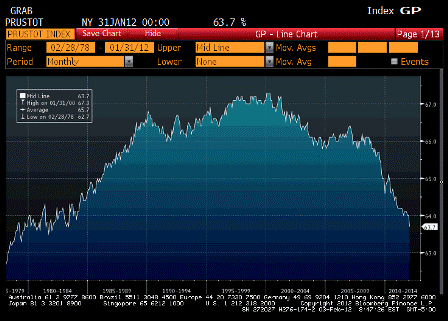
Payrolls up 243k, better than expected,
however the output gap continues to widen,
as we continue continue to go the way of Japan.
Labor force participation rate, 1978-now:
But their banking system is sound.
Like talking about how good the person looked at his funeral?
Karim writes:
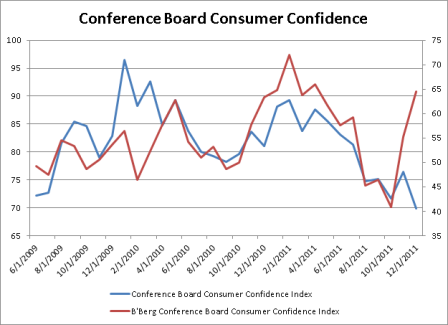
Another downbeat number with the unemployment rate rising to an 8mth high of 7.6% (from 7.5%).
Total employment up 2.3k, with full-time jobs -3.6k after -21.7k the prior month.
In the past 5mths the unemployment rate in Canada has risen by 0.4% while the U.S. has fallen 0.6% (subject to today’s #)-a large move in a short time.
Chart below shows the recent divergence in Conference Board confidence surveys for Canada (blue) and U.S. (red).
Not much progress here:
Rising Deficits Pose Major Threat to Economy: Bernanke
By Jeff Cox
Feb 2 (CNBC) — Rising federal budget deficits are posing a significant threat to the U.S. economy and are likely to cause a crisis if not brought under control, Federal Reserve Chairman Ben Bernanke told Congress Thursday.
Calling the situation “unsustainable,” the central bank leader pointed out that surging health-care costs, along with the high level of government spending used to pull the economy out of recession, are creating fiscal hazard.
“Having a large and increasing level of government debt relative to national income runs the risk of serious economic consequences,” Bernanke told the House Budget Committee. “Over the longer term, the current trajectory of federal debt threatens to crowd out private capital formation and thus reduce productivity growth.”
At the same time, he also warned Congress not to pull the reins too tightly so as to threaten growth.
Another Gross error.
Bank’s aren’t allowed to take what’s called ‘interest rate risk’ by borrowing short and lending long.
It’s the first thing the regulators and supervisors look for.
It’s the S in CAMELS ratings- Capital, Asset quality, Management, Earnings, Liquidity, and Sensitivity to interest rates.
Fed’s Low Rates Killing Credit, Slowing Recovery: Gross
By Jeff Cox
Feb 1 (CNBC) — The Federal Reserve’s zero-interest-rate policy is hampering economic recovery by discouraging bank lending, Pimco bond titan Bill Gross said in an analysis.
For banks, a healthy lending environment exists where they can borrow at low rates in the short term and lend at significantly higher rates over the long term, a situation that creates a profit through a positively sloped yield curve