
One reason rates are lower than otherwise could be, the idea that in a breakup, if Germany goes back to the mark, bond holders will experience currency gains on the presumed appreciation vs the other euro members.
Comment by the Fed Chairman
From a comment on Mike Norman’s blog.
This helps to ensure a wide output gap.
From Bernanke’s testimony from a couple of weeks ago:
“Having a large and increasing level of government debt relative to national income runs the risk of serious economic consequences. Over the longer term, the current trajectory of federal debt threatens to crowd out private capital formation and thus reduce productivity growth. To the extent that increasing debt is financed by borrowing from abroad, a growing share of our future income would be devoted to interest payments on foreign-held federal debt. High levels of debt also impair the ability of policymakers to respond effectively to future economic shocks and other adverse events.
Even the prospect of unsustainable deficits has costs, including an increased possibility of a sudden fiscal crisis. As we have seen in a number of countries recently, interest rates can soar quickly if investors lose confidence in the ability of a government to manage its fiscal policy. Although historical experience and economic theory do not indicate the exact threshold at which the perceived risks associated with the U.S. public debt would increase markedly, we can be sure that, without corrective action, our fiscal trajectory will move the nation ever closer to that point.”
Full prepared remarks
US crude rises on US pipeline reversal plan
This could be it- watch for WTI crude to converge to Brent.
My guess is that WTI rises to meet Brent at around 120+
The pipeline was scheduled to open June 1.
This moves it up to May 15th or so.
NYMEX-US crude rises on US pipeline reversal plan
By Randy Fabi
April 1 (Reuters) — U.S. crude oil prices rose above $103 a barrel on Tuesday in response to news that a plan to drain off a glut of oil from the Midwest could be implemented two weeks ahead of schedule.
FUNDAMENTALS
* NYMEX crude for May edged up 28 cents to $103.20 a barrel by 2306 GMT, adding to a 10 cent gain the previous session.
* Enterprise Product Partners and Enbridge plan to reverse the flow of the Seaway oil pipeline by mid-May pending regulatory approval, allowing the line to start draining the glut of crude from the U.S. Midwest two weeks ahead of schedule.
* Iran is ready to resolve all nuclear issues in the next round of talks with world powers if the West starts lifting sanctions, its foreign minister said on Monday.
* U.S. commercial crude stockpiles were forecast to have risen 1.6 million barrels last week after data showed the largest three-week build in more than three years due to higher imports, a preliminary Reuters poll showed on Monday. The American Petroleum Institute will release its report later on Tuesday.
Sheila Bair quote, former FDIC chief
You’d think the former chief bank regulator would know the banks they regulate and supervise aren’t allowed to do this, and that it’s up to the FDIC to see they don’t:
Sheila Bair:
“For several years now, the Fed has been making money available to the financial sector at near-zero interest rates. Big banks and hedge funds, among others, have taken this cheap money and invested it in securities with high yields. This type of profit-making, called the “carry trade,” has been enormously profitable for them.”
Pound Strength Is ‘Crippling’ Britain’s Recovery, Civitas Says
Actually just another symptom of overly tight fiscal policy:
Pound Strength Is ‘Crippling’ Britain’s Recovery, Civitas Says
By Svenja O’Donnell
April 12 (Bloomberg) — Britain’s exchange rate is “crippling” the economic recovery, and devaluing the pound by as much as 25 percent could push growth back to an annual 4 percent, research group Civitas said.
The pound’s “significant” drop since 2008 hasn’t been enough to make U.K. exports competitive on world markets, and a future decline in the currency is inevitable, according to John Mills, the author of the Civitas report published in London today. A devaluation of as much as 15 percent would balance the U.K.’s trade deficit, he said.
“The exchange-rate policy which we have pursued for decades has made it much more expensive to run most manufacturing operations here than in other parts of the world,” Mills said. “Getting the exchange rate down is a matter on which, in the end, we will have no choice.”
Data yesterday showed the U.K. trade deficit widened to the most in three months in February as exports of cars and heavy machinery fell, especially to the U.S., China and Russia. British manufacturing has become less competitive as some Asian countries devalued their currencies, boosting their competitiveness and hurting the U.K. economy, Mills said.
Spanish Law Aims To Rein in Budget
Institutionalizing death by 1000 cuts:
Spanish Law Aims To Rein in Budget
(FT) Spain’s plan to toughen the central government’s control of regional finances passed its first legislative hurdle in a parliamentary vote Thursday. “This is a law that will serve as the foundation for policies to make Spain’s budget deficit disappear, so that Spain goes back to being a reliable European Union partner,” Budget Minister Cristóbal Montoro said after the bill passed the lower house of Parliament. The law will now go to the Senate, where it also is expected to pass. The new law will require that all levels of Spanish government have balanced budgets by 2020 and that the government lower its debt-to-GDP ratio to 60% by that year as well. The government has forecast its debt-to-GDP ratio will rise to around 80% this year.
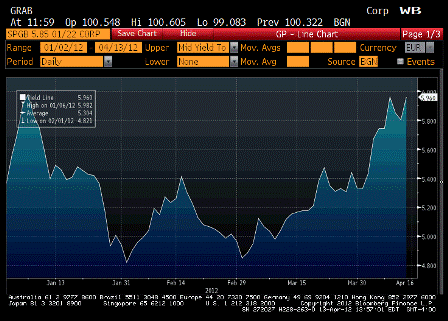
Spanish 10 year note
If the Spanish banking system is now capital constrained with regard to buying more Spanish govt debt, liquidity adjustments by the ECB won’t matter.
In my opinion, global markets are not even close to discounting the systemic risk, as they are over discounting the capability of central bankers to deal with what might happen.
Saudi’s Naimi says determined to bring down oil prices
He could start by lowering his posted prices…
Saudi’s Naimi says determined to bring down oil prices
By Meeyoung Cho
April 13 (Reuters) — Top oil exporter Saudi Arabia is determined to bring down high oil prices and is working with fellow OPEC members to accomplish that, Oil Minister Ali al-Naimi said on Friday.
Brent crude has risen about 13 percent this year, trading above $120 a barrel on Friday, threatening a nascent recovery of the global economy. Oil has traded above $100 for all but a couple of days in the past year.
“We are seeing a prolonged period of high oil prices,” Naimi said in a statement during a visit to Seoul. “We are not happy about it. (The Kingdom of Saudi Arabia) is determined to see a lower price and is working towards that goal.”
The influential Saudi oil minister earlier this year identified $100 a barrel as an ideal price for producers and consumers earlier this year.
Concern of a supply shortage due to production problems in some producing countries and as U.S. and European sanctions target exports from OPEC’s second-largest producer Iran have helped keep Brent crude well above that mark.
Naimi reiterated that there were no supply shortages in the global oil market and the kingdom stood ready to use its spare production capacity if necessary.
Saudi Arabia is pumping 10 million barrels per day, he said. Output at that level would be the highest since November, when the kingdom produced more oil than it had done for decades. Naimi reiterated that production capacity stands at 12.5 million bpd.
“The story is one of plenty,” he said. “Supply is not the problem.”
Fellow OPEC producers Libya, Iraq and Angola have increased output, Naimi said. Non-OPEC members including Canada, the United States and Russia had also boosted supplies, he added.
Saudi stockpiles at home and abroad were full, he added. Inventories in industrialized countries were also filling up, he said.
“Fundamentally the market remains balanced — there is no lack of supply,” he said.
The International Energy Agency said on Thursday that the oil market had broken a two-year cycle of tightening supply conditions as demand growth weakens and top exporter Saudi Arabia increases output.
The agency, which advises industrialized nations on their energy policies, said increased supply and slowing demand growth might already point to a significant rise in global oil stocks.
Stubbornly high oil prices could be expected to ease when markets woke up to the shift in trend, it added.
The President’s Fairness Fiction
President Obama’s ‘Fairness’ Vision Would Bankrupt Nation
April 11 (IBD) — Economy: In two recent high-profile policy speeches, President Obama has struggled to make a case for his big-government, high-tax vision for the economy. But his comments reveal just how bankrupt his vision is.
Last I read, he’s actually reduced govt head count for maybe the first time in history, and spending as a % of GDP is up only because of transfer payments due to the recession, with taxes as a % of GDP reaching extremely low levels as well.
It’s ironic that President Obama would make two speeches this week in Florida about “fairness,” sandwiched as they were between $10,000-a-plate fundraising dinners. But that’s the level of hypocrisy coming from the White House these days.
To be polite, most of the comments Obama makes these days about the economy, taxes and, especially, “fairness” stretch all credibility. Hearing the large number of outright falsehoods and partial truths he uses to support his argument, it’s impossible not to believe it’s simply a ploy to get votes from those who envy the rich and the successful.
A full unpacking of Obama’s whoppers would require a much larger space than we have here. Here are just a few examples:
“I believe the free market is the greatest force for economic progress in human history.”
If he believed that, he would not have signed the $787 billion stimulus bill.
That helped the private sector and ‘free markets’ even though I didn’t like the details.
He wouldn’t have imposed onerous new green regulations on businesses.
Without federal pollution regulation the states get into a race to the bottom where whoever allows the most pollution gets the most businesses.
He wouldn’t have taken over the auto and banking industries.
Banking with FDIC deposit insurance makes banking a 90/10 public private partnership. And he didn’t take over banking in any case.
Nor would he seek massive new tax hikes on businesses, or use the frightening power of government — including thousands of new IRS agents to enforce ObamaCare — to pursue his utopian vision of “fairness.”
First, I’m against corporate taxes in general. But even so, he cut payroll taxes for business and the proposed increases were about closing loopholes. And Obamacare took 500 billion out of medicare to give to insurance companies- hardly pro govt/anti business.
If Obama truly believed in the free market,
And remember, there is no ‘free market’ as by definitions markets operate only within institutional structure including contract law and enforcement.
he’d eliminate Fannie Mae, Freddie Mac, the EPA, the Energy Department and many other federal departments and agencies that distort free markets.
All govt and all taxation necessarily distorts markets. All govt works on coercion. Nor are there competitive markets when there is limited competition and monopoly power, which means some form of govt regulation is required.
He would roll back thousands of costly, ineffective regulations that estimates say cost the U.S. $1.8 trillion a year.
I’d have to see the specifics, which the rest of this article makes me doubtful of.
“The gap between those at the very, very top and everybody else keeps growing wider and wider and wider and wider.”
In fact, the top 1% have a lower share of total household income than they did in 1920 — just after World War I.
So maybe 1920 was a particularly high year because of the war? Don’t know his point, except pointing to 1920 is a smokescreen to disguise the fact that the share of income has been rising dramatically for a long time.
Though the top 1% have recently boosted their share, that’s largely due to the tech boom of the 1980s, 1990s and 2000s, which made all Americans richer.
I thought it was the financial sector??? But even so, a tech boom doesn’t necessarily do that to income distribution. It doesn’t explain why the football coach earns $10 million while the professor who cured cancer gets $100,000. It’s all about institutional structure.
Even so, the so-called Gini Coefficient — the federal government’s own measure of income inequality — is today lower than it was during the Clinton era.
“At the beginning of the last decade, the wealthiest Americans got two huge tax cuts, in 2001 and 2003.”
The rich, with everyone else, did get their top tax rates cut. But the actual taxes they paid rose sharply.
Right, because their incomes rose that much more. This is out of context writing throughout, laced with lies of omission.
Don’t believe it? Just before those tax cuts were passed, the top 1% earned 18% of all adjusted gross income and paid 34% of all federal taxes.
Only because they conveniently don’t include FICA when they talk about taxes like this. But they do include it when it’s going up or down- tax cut or tax hike. And it’s something approaching half of all federal income taxes.
By 2009, the last full year for which there are data, the top 1% share of AGI had fallen to 17%, according to IRS data. But they paid 37% of all taxes.
Not including FICA
As for the bottom 50% of income earners: In 2009 they took home 13% of income but paid less than 3% of federal income taxes. And today, nearly half of all Americans don’t pay taxes at all.
Not including FICA which is 7.6% of income from dollar one, with a cap at something like $105,000. Including FICA it could be something like 30% paid by lower income earners.
In short, during the 2000s, top earners took home a smaller share of the income pie but paid a larger share of the taxes. Is that what Obama means by “fairness?”
Does leaving out FICA count as fairness?
As for the so-called Buffett Rule that Obama wants, it would impose a minimum tax of 30% on millionaires to make them pay their “fair share.” It’s premised on investor Warren Buffett’s assertion that he pays a lower tax rate than his secretary.
Nonsense. Those with incomes over $1 million pay about 30% in taxes on average, about twice the average for those with middle incomes, like Buffett’s assistant.
Not counting FICA.
Simply put, this is class warfare. The tax would only raise $47 billion over the next decade — a drop in the bucket compared to the $45 trillion in spending and $9.6 trillion in deficits under Obama’s budget.
And just under $1 trillion per year of FICA taxes
Unfortunately, by raising the capital gains tax from 15% to over 30%, it would kill millions of American jobs and send small business creation into a tailspin.
Any tax hike can reduce aggregate demand. And not having income taxes and cap gains at the same rate merely causes income to shift to the lowest taxed category, and provide massive fees for the accounting firms and financial sector as well.
Who would that help?
“We tried (free market economics) for eight years before I took office. … We were told the same thing we’re being told now — this is going to lead to faster job growth, it’s going to lead to greater prosperity for everybody. Guess what? It didn’t.”
Obama has repeatedly suggested all the economy’s problems are due to President Bush.
But Bush, like Obama, entered office during a recession. Not only did he take over after the biggest stock market crash since the Depression, but the Fed had more than doubled interest rates, killing growth.
The Fed doubled rates from very low levels after the economy started growing from the combo Bush proactively expanding the deficit and from the up leg of the sub prime adventure. It ended with the shrinking of the deficit and the down leg of the sub prime adventure.
Worse, within eight months of entering office, the U.S. was hit with the 9/11 terrorist attacks — the first on the American homeland since World War II. Within the space of just 90 days, a million jobs were lost.
Jobs were lost because private sector credit expansion ended after being stretched past it’s limits during the late 90’s, with the govt budget surplus draining off hundreds of billions of dollars of net financial assets as well.
Obama’s right. President Bush did cut tax rates. What was the result? We had 52 straight months of job growth, with 8 million new jobs over six years.
Propelled by the larger deficit and the expansion phase of the sub prime adventure.
For Bush’s entire presidency, the unemployment rate averaged 5.3%. Under Obama, it’s not been below 8%.
Yes, because the deficit is too small, and both sides want to make it smaller. Good luck to us…
Real after-tax income per person rose more than 11% under Bush, while real GDP from 2000 to 2007 grew $2.1 trillion, or 17%. In 2007, the deficit fell to $162 billion — roughly 1% of GDP.
Yes, not large enough to support aggregate demand after support from the sub prime expansion phase ended.
Does Obama really want to compare himself to that? Since he’s entered office, we’ve lost 1.7 million jobs, and unemployment has averaged over 8%.
His deficits have averaged $1.4 trillion — about 8% of GDP, a record. On his watch, debt has soared from $10.7 trillion to $16 trillion. America now has more debt than the entire euro zone and Great Britain — combined.
And still not nearly enough to restore aggregate demand.
Under Obama spending has surged. The federal government now accounts for 25% of the economy, vs. the long-term average of 20%.
Due mainly to automatic counter cyclical transfer payments, not expanded regular spending.
Through his big-government policies, Obama took a bad recession and made sure our recovery would be the worst ever — and then blamed it on everyone but himself.
Meanwhile, get ready for “taxmageddon” — the $494 billion tax hike that hits in 2013 as the Bush tax cuts expire, something Obama is doing nothing about.
Wasn’t it the opposition trying to not allow the extension this year?
Our economy, in short, will never regain its old vitality until a new president is elected, and Obama’s top-down, government-centered policies are laid to rest.
I’ve been a harsh critic of Obama’s policies all along, but this is all a pile of intellectually dishonest propaganda.
Hoover statement from the comment section
Just because he got filthy rich inventing the vacuum cleaner doesn’t mean he knew macro.
Yes, they were on the gold standard, but the forces at work took us off it about a year and a half later.
Statement by President Herbert Hoover on March 8, 1932.
“Nothing is more important than balancing the budget with the least increase in taxes. The Federal Government should be in such position that it will need issue no securities which increase the public debt after the beginning of the next fiscal year, July 1. That is vital to the still further promotion of employment and agriculture. It gives positive assurance to business and industry that the Government will keep out of the money market and allow industry and agriculture to borrow the monies required for the conduct of business. I cannot overemphasize the importance of the able nonpartisan effort being made by the Ways and Means Committee and the Economy Committee of the House whose work are complementary to each other.