health care inflation slowing

I’m all for efficiency and cutting waste and fraud, but it does reduce aggregate demand, begging a tax cut or spending increase elsewhere to sustain output and employment.

Health Care Cost Inflation on Track to Slow in 2014: Report

By Dan Mangan

June 18 (CNBC) — Already sluggish health-care inflation is expected to slow down even more in 2014 as consumers, employers and the federal government continue looking to cut medical costs, a new report said Tuesday.

And the rate of health-care inflationas distinct from total medical spendingcould drop further in future years as Obamacare rolls out and employers and consumers pay greater attention to costs, suggests the report by the professional services firm PwC.

In 2014, the health-care inflation rate is projected to slow to 6.5 percent, according to the new Medical Cost Trend: Behind the Numbers report by PwC’s Health Research Institute.

That’s 1 percent less than the 7.5 percent inflation rate for 2013 that HRI projected last year.

After accounting for changes in health insurance benefit designs that drive down cost, the net growth rate of inflation next year is projected to be just 4.5 percent, according to HRI The report based those projections on analysis of the large-employer market that covers around 150 million Americans.
Fitch says China credit bubble unprecedented…

Nothing that fiscal adjustment can’t keep from spilling over into the real economy.

But that’s not how the western educated offspring now in charge learned it…

Fitch says China credit bubble unprecedented in modern world history

By Ambrose Evans-Pritchard

June 16 (Telegraph) — China’s shadow banking system is out of control and under mounting stress as borrowers struggle to roll over short-term debts, Fitch Ratings has warned.

The agency said the scale of credit was so extreme that the country would find it very hard to grow its way out of the excesses as in past episodes, implying tougher times ahead.

“The credit-driven growth model is clearly falling apart. This could feed into a massive over-capacity problem, and potentially into a Japanese-style deflation,” said Charlene Chu, the agency’s senior director in Beijing.

“There is no transparency in the shadow banking system, and systemic risk is rising. We have no idea who the borrowers are, who the lenders are, and what the quality of assets is, and this undermines signalling,” she told The Daily Telegraph.

While the non-performing loan rate of the banks may look benign at just 1pc, this has become irrelevant as trusts, wealth-management funds, offshore vehicles and other forms of irregular lending make up over half of all new credit. “It means nothing if you can off-load any bad asset you want. A lot of the banking exposure to property is not booked as property,” she said.

Concerns are rising after a string of upsets in Quingdao, Ordos, Jilin and elsewhere, in so-called trust products, a $1.4 trillion (0.9 trillion) segment of the shadow banking system.

Bank Everbright defaulted on an interbank loan 10 days ago amid wild spikes in short-term “Shibor” borrowing rates, a sign that liquidity has suddenly dried up. “Typically stress starts in the periphery and moves to the core, and that is what we are already seeing with defaults in trust products,” she said.

Fitch warned that wealth products worth $2 trillion of lending are in reality a “hidden second balance sheet” for banks, allowing them to circumvent loan curbs and dodge efforts by regulators to halt the excesses.

This niche is the epicentre of risk. Half the loans must be rolled over every three months, and another 25pc in less than six months. This has echoes of Northern Rock, Lehman Brothers and others that came to grief in the West on short-term liabilities when the wholesale capital markets froze.

Mrs Chu said the banks had been forced to park over $3 trillion in reserves at the central bank, giving them a “massive savings account that can be drawn down” in a crisis, but this may not be enough to avert trouble given the sheer scale of the lending boom.

Overall credit has jumped from $9 trillion to $23 trillion since the Lehman crisis. “They have replicated the entire US commercial banking system in five years,” she said.

The ratio of credit to GDP has jumped by 75 percentage points to 200pc of GDP, compared to roughly 40 points in the US over five years leading up to the subprime bubble, or in Japan before the Nikkei bubble burst in 1990. “This is beyond anything we have ever seen before in a large economy. We don’t know how this will play out. The next six months will be crucial,” she said.

The agency downgraded China’s long-term currency rating to AA- debt in April but still thinks the government can handle any banking crisis, however bad. “The Chinese state has a lot of firepower. It is very able and very willing to support the banking sector. The real question is what this means for growth, and therefore for social and political risk,” said Mrs Chu.

“There is no way they can grow out of their asset problems as they did in the past. We think this will be very different from the banking crisis in the late 1990s. With credit at 200pc of GDP, the numerator is growing twice as fast as the denominator. You can’t grow out of that.”

The authorities have been trying to manage a soft-landing, deploying loan curbs and a high reserve ratio requirement (RRR) for banks to halt property speculation. The home price to income ratio has reached 16 to 18 in many cities, shutting workers out of the market. Shadow banking has plugged the gap for much of the last two years.

However, a new problem has emerged as the economic efficiency of credit collapses. The extra GDP growth generated by each extra yuan of loans has dropped from 0.85 to 0.15 over the last four years, a sign of exhaustion.

Wei Yao from Societe Generale says the debt service ratio of Chinese companies has reached 30pc of GDP – the typical threshold for financial crises — and many will not be able to pay interest or repay principal. She warned that the country could be on the verge of a “Minsky Moment”, when the debt pyramid collapses under its own weight. “The debt snowball is getting bigger and bigger, without contributing to real activity,” she said.

The latest twist is sudden stress in the overnight lending markets. “We believe the series of policy tightening measures in the past three months have reached critical mass, such that deleveraging in the banking sector is happening. Liquidity tightening can be very damaging to a highly leveraged economy,” said Zhiwei Zhang from Nomura.

“There is room to cut interest rates and the reserve ratio in the second half,” wrote a front-page editorial today in China Securities Journal on Friday. The article is the first sign that the authorities are preparing to change tack, shifting to a looser stance after a drizzle of bad data over recent weeks.

The journal said total credit in China’s financial system may be as high as 221pc of GDP, jumping almost eightfold over the last decade, and warned that companies will have to fork out $1 trillion in interest payments alone this year. “Chinese corporate debt burdens are much higher than those of other economies. Much of the liquidity is being used to repay debt and not to finance output,” it said.

It also flagged worries over an exodus of hot money once the US Federal Reserve starts tightening. “China will face large-scale capital outflows if there is an exit from quantitative easing and the dollar strengthens,” it wrote.

The journal said foreign withdrawals from Chinese equity funds were the highest since early 2008 in the week up to June 5, and withdrawals from Hong Kong funds were the most in a decade.

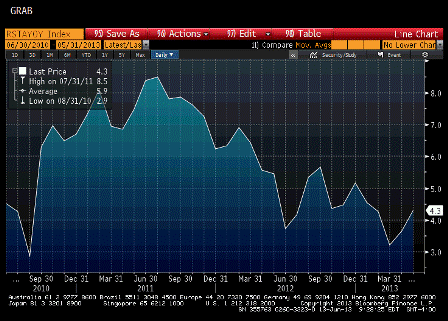
JOBS DECELERATING!

3 mo moving average decelerating and now back to levels about where they were when the Fed expanded QE.

As expected, QE has failed again, and seems there’s no understanding that QE is in fact a tax that removes interest income from the economy.

Furthermore, the deceleration in jobs is consistent with the narrative that the FICA hikes and sequesters function to reduce aggregate demand, which, for all practical purposes, can only be overcome by an increased rate of private sector credit expansion, which the data tells me isn’t happening.

So after a weak Q4 due to cliff fears, a weak Q1 rebound to only 2.4% due to the tax increases, and now a weak and decelerating Q3 with GDP of about 1.5%, the 3 month average decelerates to only about 1.5% with a non trivial chance of going down from there.

In fact, if the govt deficit is too small and private sector credit expansion too weak to close the ‘spending gap’ it all goes into reverse until the automatic fiscal stabilizers increase the govt. deficit sufficiently to stabilize aggregate demand.

Just like in the Euro zone. And Japan, And the UK.

:(

Graph

Japan CEFP headlines – nothing expansionary here

I see nothing ‘expansionary’ here:

JAPAN GOVT TOP PANEL: MUST AIM TO KEEP PRIMARY BUDGET BALANCE TARGETS TO FIX PUBLIC FINANCES

JAPAN GOVT PANEL: FISCAL REFORM IS VERY IMPORTANT FOR ‘ABENOMICS’ TO HAVE SUSTAINED EFFECTS

JAPAN GOVT PANEL: MONETARY EASING MUST BE BACKED BY GOVT’S FISCAL DISCIPLINE TO AVOID CONCERN ON MONETISATION

JAPAN GOVT PANEL: AIMS TO CREATE FAVOURABLE CYCLE OF ECONOMIC REVIVAL AND FISCAL REFORM

JAPAN GOVT PANEL: UPTREND IN CONSUMER PRICES WILL STRENGTHEN GRADUALLY FROM MIDDLE OF THIS YEAR

JAPAN GOVT PANEL: WILL KEEP CLOSE WATCH ON IMPACT FROM RISE IN IMPORT PRICES AND FINANCIAL MKT MOVEMENTS AND RESPOND APPROPRIATELY

JAPAN GOVT PANEL: MUST PAY ATTENTION TO GLOBAL ECONOMY, FINANCIAL MKT AND RESTRICTION ON POWER SUPPLY AS RISKS TO ECONOMY

JAPAN GOVT PANEL: WILL REVISE FISCAL SPENDING INCLUDING AREA OF SOCIAL SECURITY

TOKYO, June 6 (Reuters) – Japan aims to stick to its targets for fiscal consolidation to curb its massive public debt, the government’s top macroeconomic policy panel said on Thursday, despite concerns that Prime Minister Shinzo Abe might back pedal on the promises.

The previous Democratic Party-led government had set targets of halving its primary deficit – the budget excluding new bond sales and debt servicing – by March 2016 and returning to surplus by March 2021.

The Council on Economic and Fiscal Policy (CEFP) also said Japan aims to lower the country’s debt-to-GDP ratio in a stable manner after achieving the primary balance target.

Japan’s public debt is already more than twice the size of its 500 trillion yen ($5 trillion) economy and any sign that the government was backing off on the fiscal reform targets or on its plan to double the five percent sales tax by October 2015 could make the Japanese government bond market nervous.

Abe, who took office last December after his Liberal Democratic Party’s (LDP) big election win, has made his “Abenomics” prescription for rescuing the economy from deflation and engineering sustainable growth his top priority.

CEFP has legal authority to craft long-term fiscal and macroeconomic policies, and it issues policy guidelines around this time of the year, which will be reflected in an annual budget and other key policies.