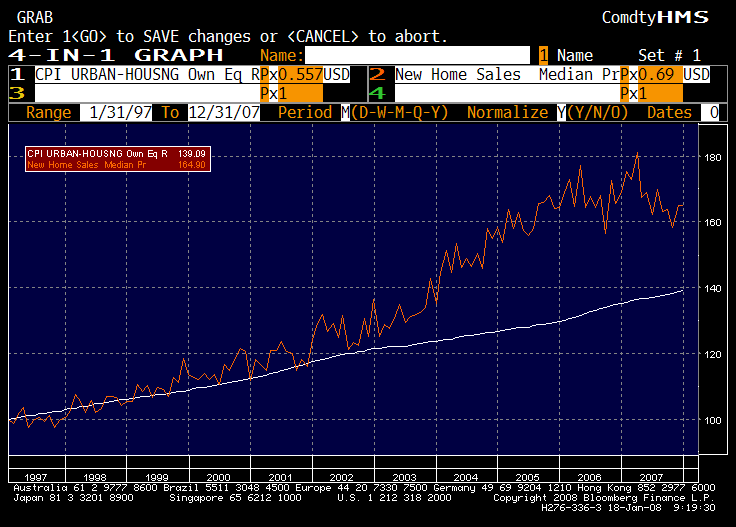
Looks like it will take a very large drop in home prices to slow the ‘pull’ on owner’s equivalent rent (the basis for the CPI housing component).
♥

Looks like it will take a very large drop in home prices to slow the ‘pull’ on owner’s equivalent rent (the basis for the CPI housing component).
♥
We have gone from the jobless recovery to the full employment recession.
Recap of prospects for strong GDP in 2008 – details/support covered in previous posts:
♥
Near triple digit gains for 2007 in food and fuel and rising export/import prices from the weak $ policy will keep core inflation on the high side for a long time.
And with the great pricing of risk ‘crisis’ no longer a forward looking phenomena, the beginnings of a housing recovery, financial downside surprises behind us, and exports continuing to boom, the Fed’s concern switches to the ‘monetary easing’ they believe kicks in with it’s macro effects later in the year.
Most at the Fed say you can’t wait for core to start going up – it’s too late when that happens. Some say you can wait for it to move a tiny bit. Either way both concerns are now elevated.
A 50bp ‘insurance’ cut is still likely if the meeting were today. The next key numbers are claims tomorrow and next Thursday, as well as housing data due out, but seems that data at best could mean this is the last cut rather than take the cut away.
Equities may may do better as well, as financial write-off uncertainty is largely behind us, and the companies doing well in this environment lead the way forward, and PEs are very low.
♥
The desire to accumulate $US financial assets has been diminished for at least the following reasons:
This all sets in motion a downward pricing of the $US as non residents sell them to each other at lower and lower prices in this effort to lower their rate of accumulation of $US financial assets. But these financial assets can only ‘go away’ when they get spent or invested in the US, when US prices are low enough to cause this to happen. The rapid rise in exports and accelerated non resident buying of US real estate and other assets is anecdotal evidence this is taking place as theory predicts.
This is a very large cyclical force that should continue to drive rapidly rising exports for perhaps a year or more. Weak foreign economies should have little effect on this process, as that weakness doesn’t reduce the desire of portfolio managers to shift out of $US financial assets.
This is also highly inflationary for the US. This buying by non residents both drives down the $US and drives up the prices of US exports, now rising at a 7% clip last I checked.
The desired shift is probably well over $1 trillion which means exports will increase by a good part of that to facilitate this transfer.
This can sustain US GDP in the face of falling domestic demand, which will stay relatively low until housing picks up. Employment will remain reasonably good, but standards of living fall as we produce as much, but export more and consume less. We get paid to work but can buy less due to high prices, with our remaining production exported to those wishing to reduce their accumulated $US financial assets.
We’ve been talking about this possibility about a long time, but seems our trade negotiators have finally got their wish.
Meanwhile, Saudis continue to act the swing producer. In fact, they told Bush today they have 2 million bpd capacity in reserve, and that markets are well supplied. At their price, of course.
Probably have been some year end allocations out of crude by pension funds as with the price hikes they would need to sell some to keep the same ‘weight’ in their portfolios. That should be ending soon.
And I agree with Karim, the Fed is not likely to act on inflation until core starts to rise or their measures of inflation expectations start to rise, despite the fact that mainstream theory clearly says if any of that happens it’s too late. Seems to me the senior FOMC members are putting their jobs on the line by taking that kind of systemic risk, which their own theory tells them is far higher than the risk of any lost output from a .
♥
(from Patrick Doyle)
Below is a table of the results of the last 3 TAF auctions
Of note is the spread to OIS (FF’s) which is inside the historic LIBOR / OIS spread. There were less participants in this round as well
This all bodes well and is showing the easing of pressure in the funding markets.
| Jan. 15 2008 |
Dec. 21 2007 |
Dec. 19 2007 |
|
| Stop-out rate: | 3.95% | 4.67% | 4.65% |
| Total propositions submitted: | $55.526 Bil. | $57.664 Bil. | $61.553 Bil. |
| Total propositions accepted: | $30.000 Bil. | $20.000 Bil. | $20.000 Bil. |
| Bid/cover ratio: | 1.85 | 2.88 | 3.08 |
| Number of bidders: | 56 | 73 | 93 |
| Term | 28-day loan | 35-day loan | 28-day loan |
| Settlement Date | Jan. 17, 2008 | Dec. 27, 2007 | Dec. 20, 2007 |
| Maturity Date | Feb. 14, 2008 | Jan. 31, 2008 | Jan. 17, 2008 |
♥
What we used to call an ‘inflation day’ –
also,
This is an explicit weak $ policy that is probably altering CB portfolio preferences and inducing price pressures on our imports.
The Fed is sending signals it’s fine with this kind of inflation at least as long as they are forecasting the risk of weaker domestic demand as a result (somehow) of financial concerns. And because they analyze the risks as if we had a fixed exchange rate they see the risks of supply side credit issues as those of the great depression of the 1930’s. Doesn’t happen with today’s floating fx.
Don’t know when/if the Fed ‘figures it out’ but the curve can go from wherever it is to seriously negative should the Fed hike aggressively to ‘get ahead of the inflation curve.’
The inflation is coming from non monetary sources – monopolist pricing in oil, biofuels linking food to fuel, portfolio shifts out of $US due to US political rhetoric and apparent Fed policy of inflating your way out of debt without concern for the value of the currency. Enough to scare any portfolio manager out of $US risk.
♥


♥
Dollar weak enough to support exports:
NYC hits tourism record
by Samantha Gross
NEW YORK (AP) – With a falling dollar sweetening the deal for international travelers, a record-setting number of tourists visited
the city last year, spending an estimated $28 billion, tourism officials said Sunday.
With a final count still pending, the city’s tourism office said an estimated 46 million people had visited the city in 2007 — up 5
percent from 2006. The jump was largely due to visitors from other countries, who numbered an estimated 8.5 million — a growth of 17 percent.
George Fertitta, chief executive of city tourism office NYC & Company, said the visitors were drawn by more than a favorable exchange rate and the city’s international marketing efforts.
“The city is more vibrant, cleaner and safer — and it’s just more exciting than ever before,” he said.
The portion of the city’s tourists who were from other countries had dwindled since the Sept. 11 attacks, and last year’s growth returned the ratio to pre-2001 levels.
The city has been working to draw such international visitors, who stay longer and spend more money. NYC & Company has launched an overseas television, print and billboard campaign, and in 2007 it more than doubled its marketing offices overseas, targeting countries including China, Brazil and Canada.
New York is one of only a few U.S. urban centers that did not see a drop in the number of overseas visitors between 2000 and 2006.
Mayor Michael Bloomberg has said he wants the city to attract 50 million travelers each year by 2015. Last year, visitors to New York spent $4 billion more than they had the year before.
♥
Federal budget surplus for Dec. – but wait . . .
By Martin Crutsinger
Associated Press
WASHINGTON – The federal budget showed a record surplus for December, but for the first three months of this budget year, the budget deficit was running significantly higher than in the same period the previous year.
The Treasury Department reported yesterday that the budget was in surplus by $48.3 billion last month.
It was the largest surplus for any December on record.
The budget was boosted by higher quarterly corporate tax receipts and high individual tax withholdings because of year-end bonuses, according to Bloomberg News.
However, for the first three months of the budget year, which began Oct. 1, the budget deficit totals $105.5 billion – up 31.3 percent from the same period a year ago.
So far this budget year, revenue is up 5.7 percent to $606.2 billion.
Good indicator GDP is holding up.
But spending is rising at a faster pace, increasing 8.8 percent over the same period in the 2007 budget year, to $653.9 billion.
The rise in spending reflects sharp increases in defense spending and in government health-care spending.
Spending has dropped to a much lower growth rate for the previous two quarters, taking demand from the economy and keeping GDP lower than otherwise.
Now that spending is back up, it will provide more support for GDP into the elections.
This has happened in previous election years.
♥
U.S. Trade Deficit Hits 14-Month High on Oil Imports
by Reed Saxon
The U.S. trade deficit in November surged to the highest level in 14 months, reflecting record imports of foreign oil. The deficit with China declined slightly while the weak dollar boosted exports to another record high.
The Commerce Department reported that the trade deficit, the gap between imports and exports, jumped by 9.3 percent, to $63.1 billion. The imbalance was much larger than the $60 billion that had been expected.
The increase was driven by a 16.3 percent surge in America’s foreign oil bill, which climbed to an all-time high of $34.4 billion as the per barrel price of imported crude reached new records. With oil prices last week touching $100 per barrel, analysts are forecasting higher oil bills in future months.
The big surge in oil pushed total imports of goods and services up by 3 percent to a record $205.4 billion. Exports also set another record, rising by a smaller 0.4 percent to $142.3 billion. Export demand has been growing significantly over the past two years as U.S. manufacturers and farmers have gotten a boost from a weaker dollar against many other currencies. That makes U.S. goods cheaper on overseas markets.
Exports still moving up.
Through the first 11 months of 2007, the deficit is running at an annual rate of $709.1 billion, down 6.5 percent from last year’s all-time high of $758.5 billion. Analysts believe that the export boom will finally result in a drop in the trade deficit in 2007 after it set consecutive records for five years.
Agreed. Ultimately, the only way the foreign sector can slow their accumulation of $US, as the falling $ indicates they are in the process of doing, is to spend it here.
The growth in exports has been a major factor cushioning the blow to the economy from the slump in housing and a severe credit crunch. However, with oil pushing imports up sharply, analysts believe the help from trade in the final three months of last year will be shown to have been significantly smaller.
Could be. December numbers will not be out for another month.
By country, the deficit with Canada, America’s largest trading partner, dropped by 12.1 percent to $4.7 billion in November while the imbalance with Mexico rose by 1.4 percent to $7.6 billion. The imbalance with the European Union fell by 12.6 percent to $10.4 billion.
Might explain some weakness in Canada and Eurozone.
♥