Atlanta Fed, Redbook retail sales, mtg purchase apps

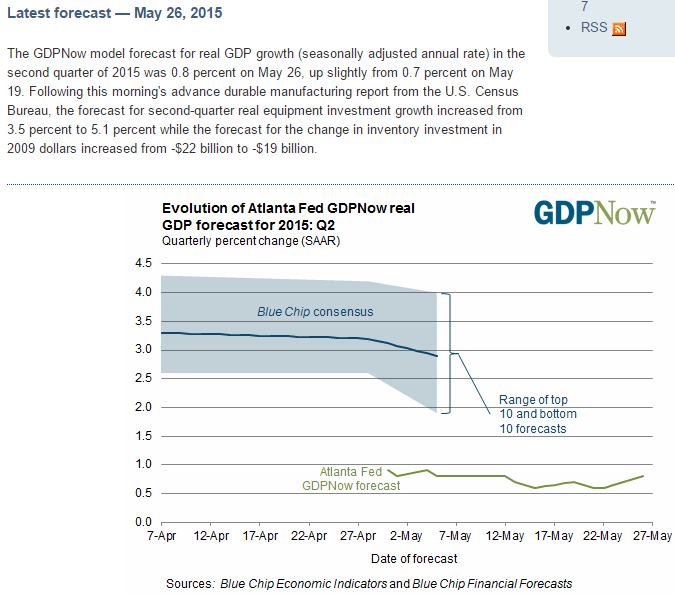
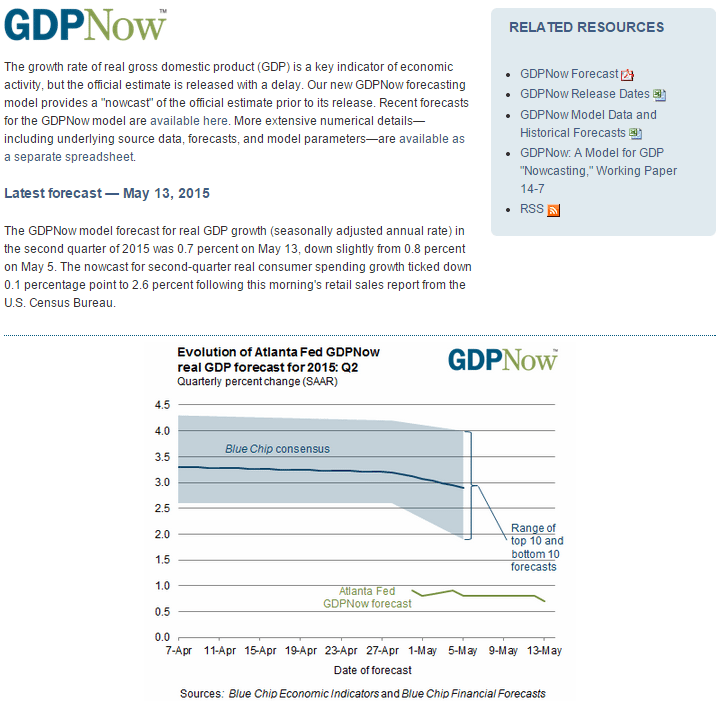
Still not showing much of a rebound from Q1, with their Q2 GDP forecast now at only .8% annualized:
er-5-27-1
Continues to disappoint and still looking worse than it was in Q1:

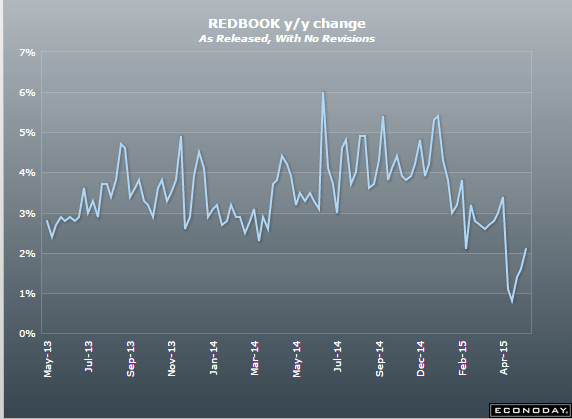
Redbook Retail Sales
er-5-27-2

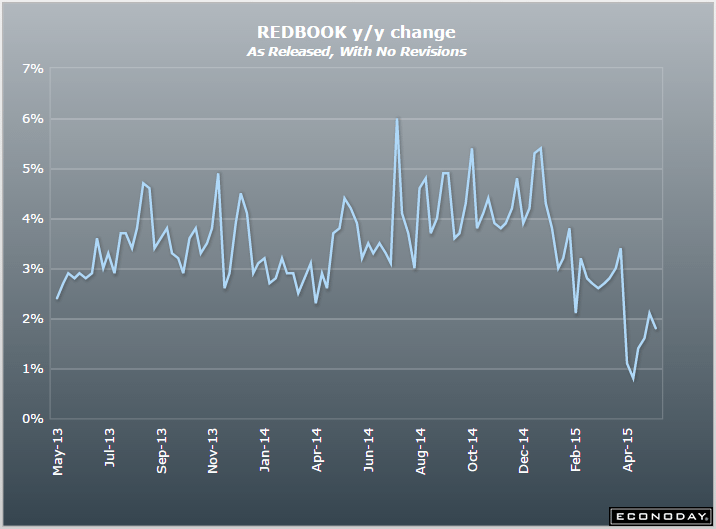
Up 1% after being down 4% last week:

United States : MBA Mortgage Applications
er-5-27-3
Highlights
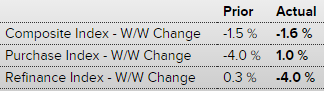
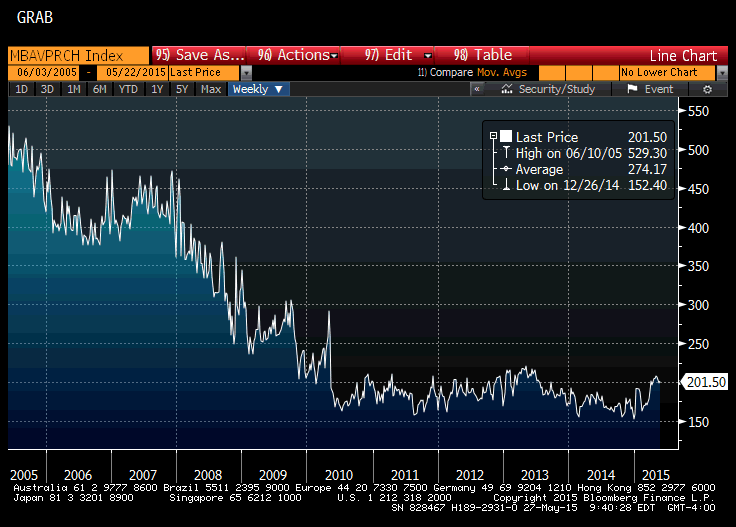
Mortgage rates are moving higher and squeezing out what had been gains in purchase applications. Purchase applications did rise in the May 22 week but only 1.0 percent. Year-on-year, applications are still up a healthy 14.0 percent. Demand for refinancing continues to shrink, down 4.0 percent in the latest week. The average 30-year fixed mortgage for conforming loan balances ($417,000 or less) rose 3 basis points to 4.07 percent.

Purchase Mortgage level:

sg2015052734828

Atlanta Fed, LA port traffic, EU trade surplus, German ZEW, housing starts, redbook retail sales

No positive change here yet:
er-5-19-1

This was supposed to rebound:

LA area Port Traffic Decreased in April

By Bill McBride

May 18 (Calculated Risk) — Note: LA area ports were impacted by labor negotiations that were settled on February 21st. Port traffic surged in March as the waiting ships were unloaded (the trade deficit increased in March too), and port traffic declined in April.

Container traffic gives us an idea about the volume of goods being exported and imported – and usually some hints about the trade report since LA area ports handle about 40% of the nation’s container port traffic.

The following graphs are for inbound and outbound traffic at the ports of Los Angeles and Long Beach in TEUs (TEUs: 20-foot equivalent units or 20-foot-long cargo container).

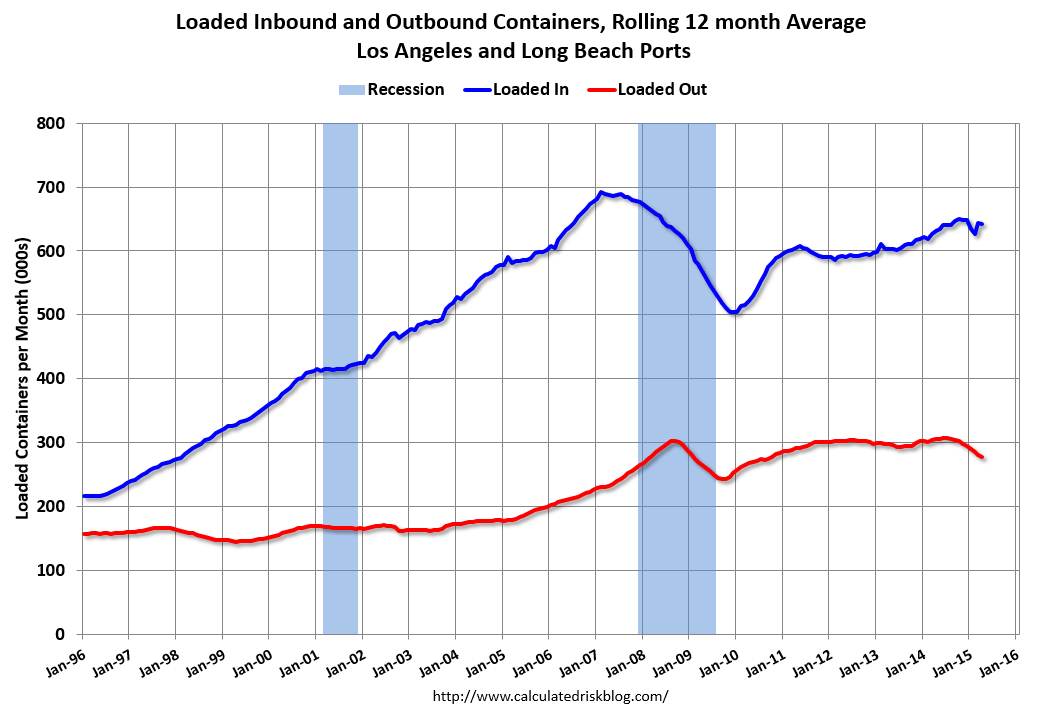
To remove the strong seasonal component for inbound traffic, the first graph shows the rolling 12 month average.

On a rolling 12 month basis, inbound traffic was down 0.2% compared to the rolling 12 months ending in March. Outbound traffic was down 1.1% compared to 12 months ending in March.

Inbound traffic had been increasing, and outbound traffic had been moving down recently. The recent downturn in exports might be due to the strong dollar and weakness in China.

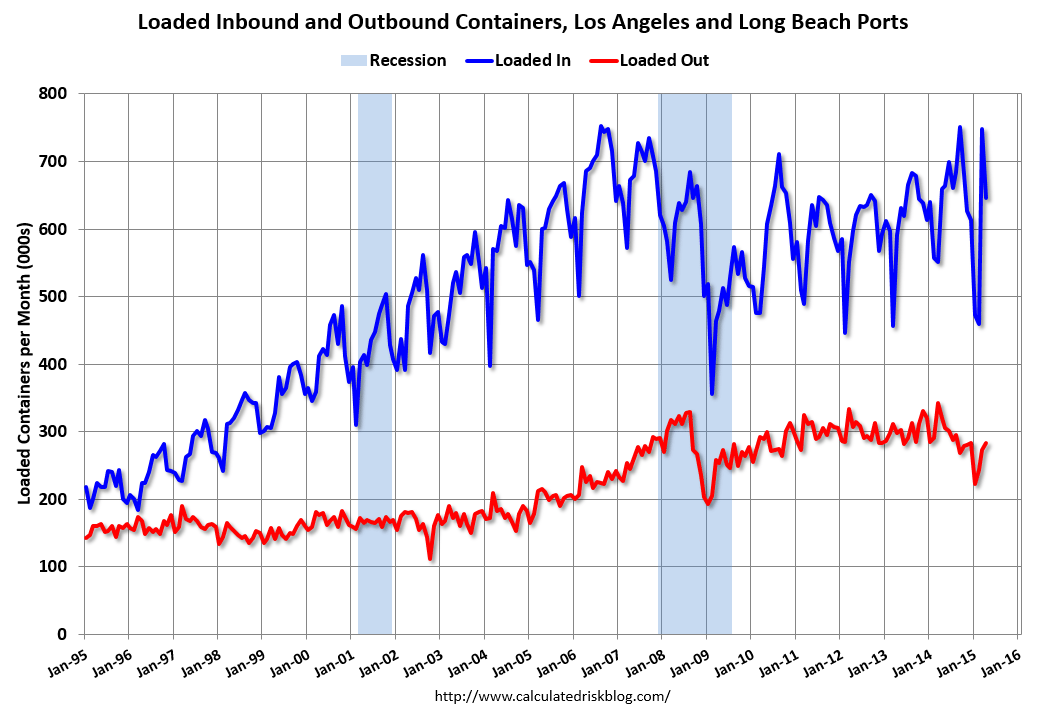
The 2nd graph is the monthly data (with a strong seasonal pattern for imports).

LA Area Port TrafficUsually imports peak in the July to October period as retailers import goods for the Christmas holiday, and then decline sharply and bottom in February or March (depending on the timing of the Chinese New Year).

Imports were down 2% year-over-year in April; exports were down 11% year-over-year.

The labor issues are now resolved – the ships have disappeared from the outer harbor – and the distortions from the labor issues are behind us. This data suggests a smaller trade deficit in April.
er-5-19-2
er-5-19-3

Strong number.

Currencies with trade surplus don’t ordinarily go down…
;)

European Union : Merchandise Trade
er-5-19-4

A bit on the weak side, to say the least, and even with negative rates and QE…
;)

Germany : ZEW Survey
er-5-19-5

Solid improvement here. First good number in quite a while.
The 5 month average is almost back to where it was in November…

United States : Housing Starts
er-5-19-6
Highlights
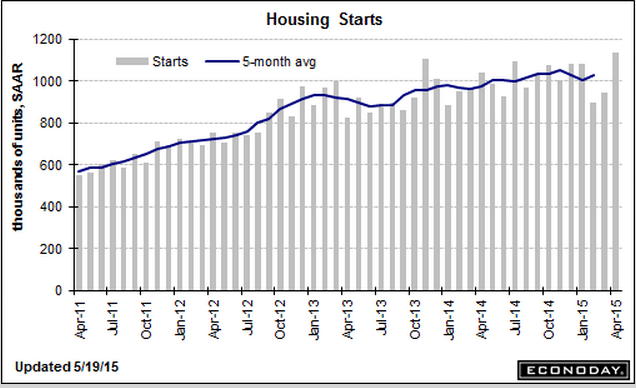
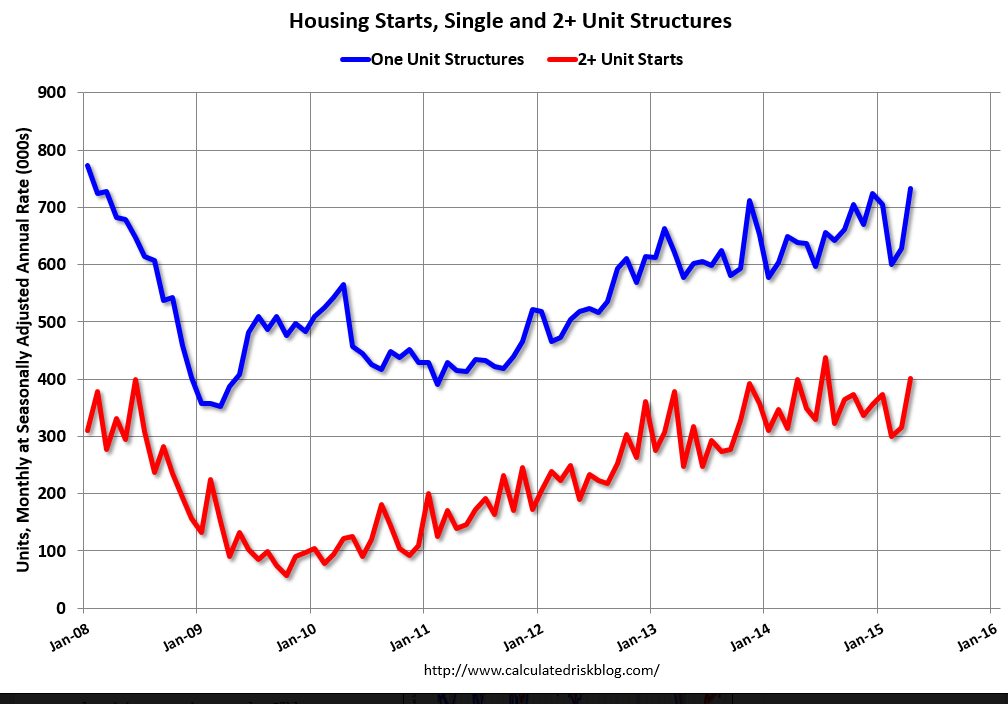
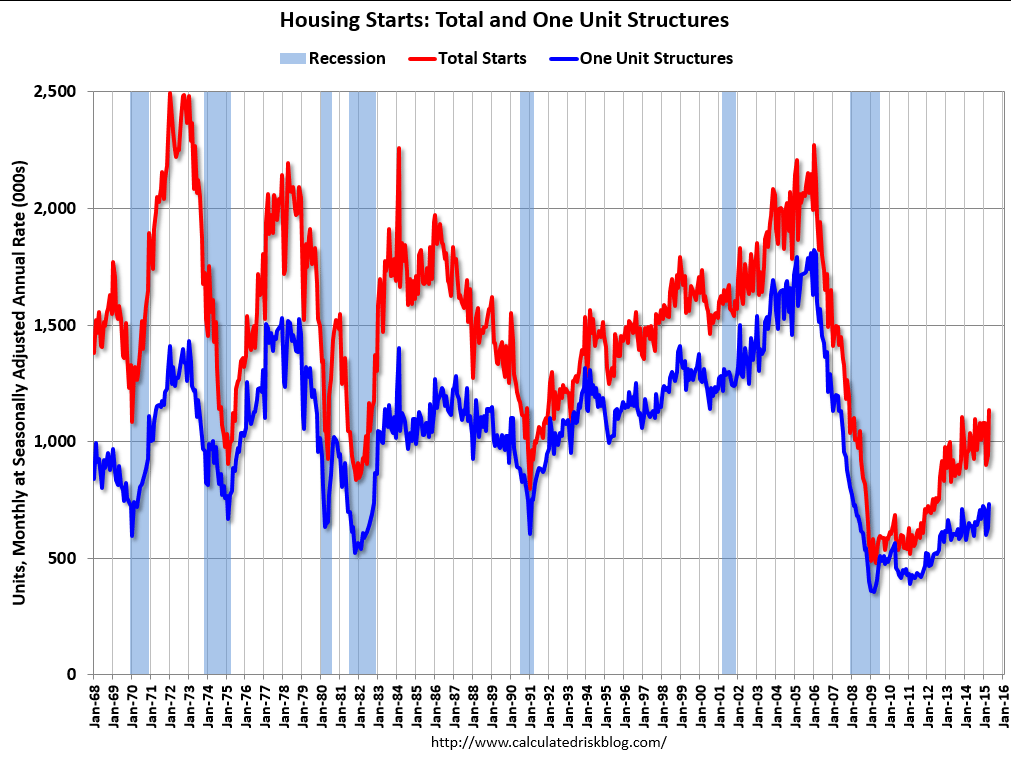
There were hardly any indications before today, but the spring housing surge is here. Today’s housing starts & permits report is one of the very strongest on record with starts soaring 20.2 percent in April to a much higher-than-expected annual rate of 1.135 million with permits up 10.1 percent to a much higher-than-expected 1.143 million. Both readings easily top the Econoday high-end forecast of 1.120 million for each. The gain for starts is the best in 7-1/2 years with the gain in permits the best in 7 years. Today’s report is an eye-opener and will re-establish expectations for building strength in housing, a sector held down badly in the first quarter by severe weather.
er-5-19-7
er-5-19-8
er-5-19-9

Half way through May and this one isn’t bouncing back:

United States : Redbook
er-5-19-10
er-5-19-11

Railcar traffic, Draghi statement, NY manufacturing survey, Industrial production, Consumer confidence

Rail Week Ending 09 May 2015: Data Still Not Pretty. Rail Softness Continues.

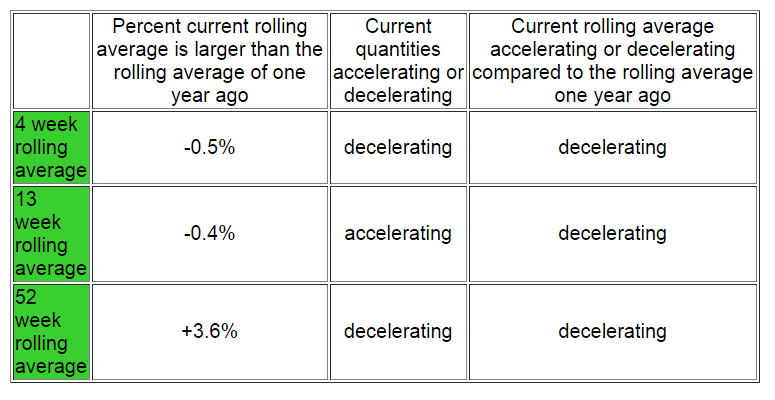
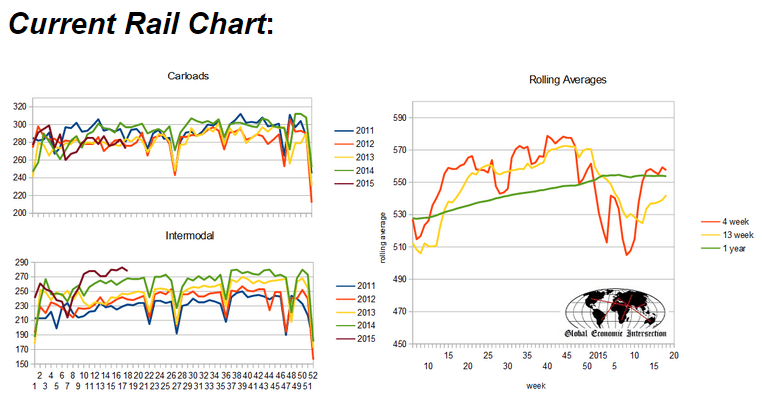
(Econintersect) — Week 18 of 2015 shows same week total rail traffic (from same week one year ago) declined according to the Association of American Railroads (AAR) traffic data. Intermodal traffic improved, which accounts for half of movements – but weekly railcar counts goes deeper into contraction.

This analysis is looking for clues in the rail data to show the direction of economic activity – and is not necessarily looking for clues of profitability of the railroads. The weekly data is fairly noisy, and the best way to view it is to look at the rolling averages which generally are in a weak growth cycle.
er-5-15-1
er-5-15-2
A summary of the data from the AAR:

The Association of American Railroads (AAR) today reported U.S. rail traffic for the week ending May 9, 2015.

For this week, total U.S. weekly rail traffic was 551,034 carloads and intermodal units, down 2.3 percent compared with the same week last year.

Total carloads for the week ending May 9, 2015 were 273,433 carloads, down 7.9 percent compared with the same week in 2014, while U.S. weekly intermodal volume was 277,601 containers and trailers, up 3.8 percent compared to 2014.

Four of the 10 carload commodity groups posted increases compared with the same week in 2014. They include: motor vehicles and parts, up 8.9 percent to 18,997 carloads; petroleum and petroleum products, up 6.1 percent to 15,464 carloads; and miscellaneous carloads, up 3.6 percent to 9,220 carloads. Commodity groups that saw decreases during this one week included: coal, down 16.1 percent to 93,691 carloads; metallic ores and metals, down 12.1 percent to 23,572 carloads; and grain, down 11.2 percent to 17,959 carloads.

For the first 18 weeks of 2015, U.S. railroads reported cumulative volume of 5,043,559 carloads, down 1.8 percent from the same point last year; and 4,679,513 intermodal units, up 1.7 percent from last year. Total combined U.S. traffic for the first 18 weeks of 2015 was 9,723,072 carloads and intermodal units, a decrease of 0.1 percent compared to last year.

North American rail volume for the week ending May 9, 2015 on 13 reporting U.S., Canadian and Mexican railroads totaled 368,931 carloads, down 7.5 percent compared with the same week last year, and 350,845 intermodal units, up 3.2 percent compared with last year. Total combined weekly rail traffic in North America was 719,776 carloads and intermodal units, down 2.6 percent. North American rail volume for the first 18 weeks of 2015 was 12,681,610 carloads and intermodal units, up 1 percent compared with 2014.

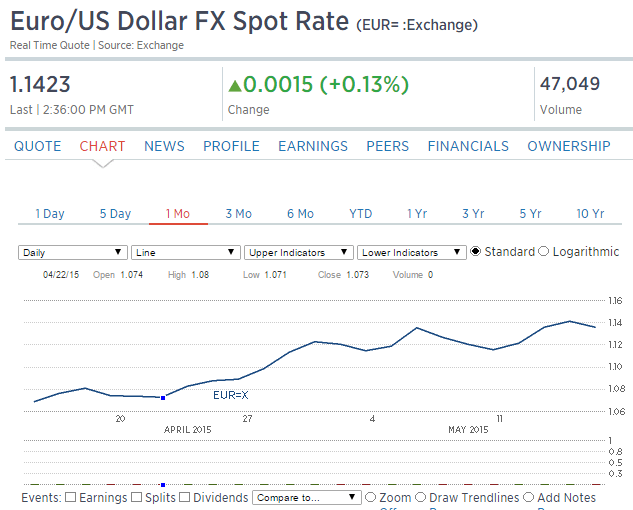
Here we go. This kind of thing previously had caused the euro to fall vs the dollar. If it doesn’t happen this time there’s a serious problem brewing. And right now the euro is up on the day…

Draghi helps stocks

Aside from individual stocks, sentiment received a boost from the ECB on Friday. Draghi said Thursday that the central bank will “implement in full” its bond-buying program and it will stay in place “as long as needed.”

“While we have already seen a substantial effect of our measures on asset prices and economic confidence, what ultimately matters is that we see an equivalent effect on investment, consumption and inflation,” Draghi said, according to the text of a speech delivered in Washington.

“To that effect, we will implement in full our purchase program as announced and, in any case, until we see a sustained adjustment in the path of inflation.”
er-5-15-3
Empire State Mfg Survey
er-5-15-4
Highlights
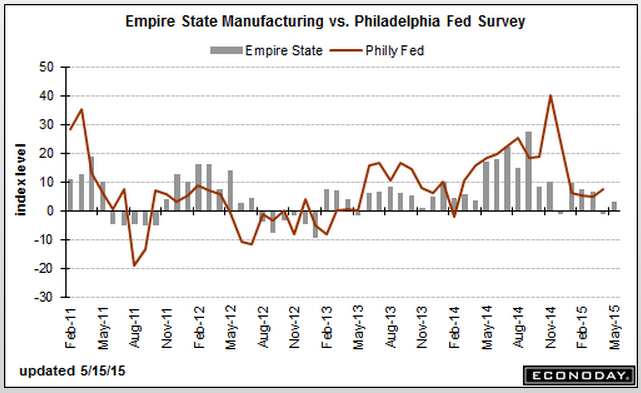
The first indication on May conditions in the manufacturing sector is soft, as indications have been all year. The Empire State index came in at 3.09, below what were already weak Econoday expectations for 5.00. Shipments look respectable at 14.94 but are way ahead of new orders, at only 3.85, and even further ahead of backlog orders which are in deep contraction at minus 11.46. Employment growth is down as is the 6-month outlook, both pointing to a lack of optimism.

Price readings in this report stand out, pointing to even less pressure than in April with input cost inflation very subdued, down nearly 10 points to 9.38, and with virtually no price traction at all for finished goods, at only 1.04.

The manufacturing sector, hurt in part by weak exports, looks to be more and more of a drag at a time when economic growth is supposed to be on a springtime rebound. Next indication on the May manufacturing sector will be next Thursday with the Philly Fed report. Later this morning the industrial production report will offer the first definitive data on the April manufacturing sector.
er-5-15-5

This is bad too:

Industrial Production

er-5-15-6
Highlights
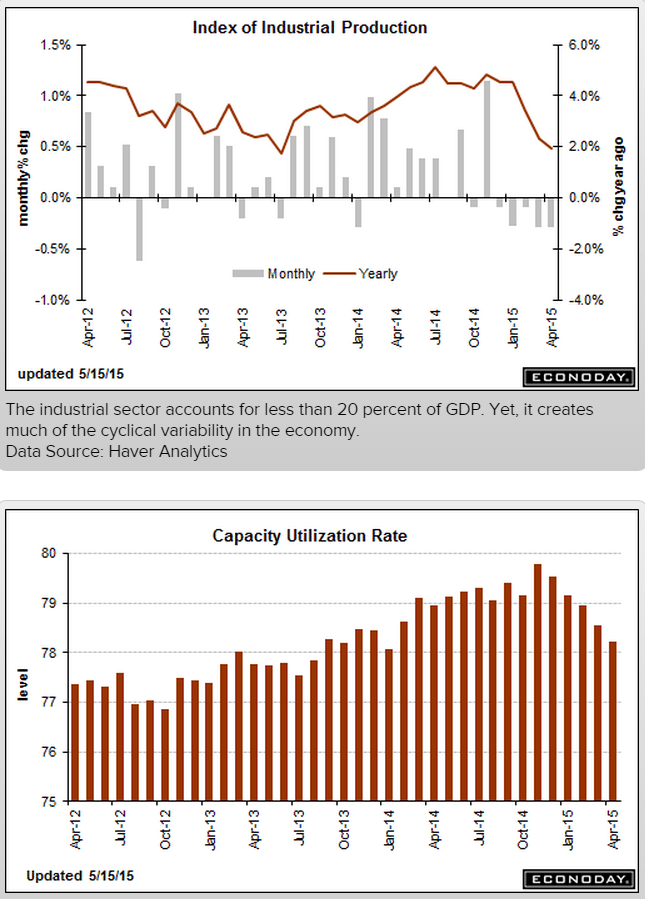
Industrial production is stalling, down 0.3 percent in April for a 5th straight monthly contraction. Factories are cutting back with capacity utilization down 4 tenths to 78.2 percent. And the manufacturing component, which has been flat to negative all year, is unchanged. All these readings are at or near the Econoday low-side forecasts.

Among manufacturing subcomponents, consumer goods output fell 0.3 percent with business goods down 0.4 percent. Construction supplies rose only fractionally but at 0.1 percent the reading is the best all year (this a reminder of how weak construction and housing has been). A positive is a second strong month for auto output, up 1.3 percent on top of March’s 4.3 percent surge, but whether output increases further will depend on auto sales which, in yesterday’s retail sales report, turned lower in April.

The two other main components in today’s report show even greater weakness with mining, hurt by oil & gas, at minus 0.8 percent for the 6th contraction in 7 months and utilities at minus 1.3 percent for a 2nd straight decline.

The industrial economy remains flat and is holding down what is supposed to be the economy’s springtime bounce. The news from the factory sector, including this morning’s Empire State report, won’t be pulling forward expectations for the Fed’s first rate hike.
er-5-15-7

Even this has suddenly broken:

Consumer Sentiment

er-5-15-8
Highlights
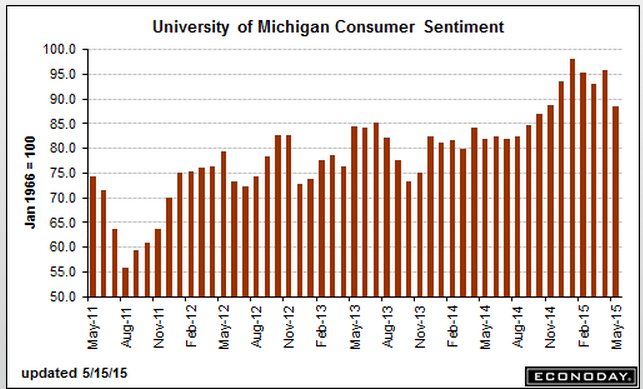
Consumer confidence had been holding, as the FOMC assured us just a couple of weeks ago, at high levels, but perhaps less so now with the consumer sentiment index at 88.6 which is nearly 5 points below Econoday’s low-side forecast. Both components show weakness with current conditions down 7.2 points to 99.8 and expectations down 7.3 points to 81.5. These are the lowest readings since October and November of last year.

At the same time that confidence is going down, inflation expectations, reflecting rising gasoline prices, are going up. Expectations 1-year out are up 3 tenths to 2.9 percent while expectations 5-years out are up 2 tenths to 2.8 percent. Despite the turn higher, however, these are still low levels.

The drop in current conditions hints at softness in this month’s jobs market while the drop in expectations is a downgrade for the outlook on jobs. The hawks at the Fed have been anticipating, perhaps over anticipating, that strong consumer confidence levels would eventually translate to gains for retail sales. Retail sales have been flat along and now consumer confidence, based at least on today’s consumer sentiment report, is moving backwards.
er-5-15-9
Of the nearly 1.6 million loan originations in Q1, 471,822 were purchase loan originations, down 25% from the prior quarter and up less than 1% from a year ago. There were 1,080,043 refinance originations in Q1, an increase of 6% from the prior quarter and 27% from a year ago.

Business inventories, retail sales charts, Atlanta Fed

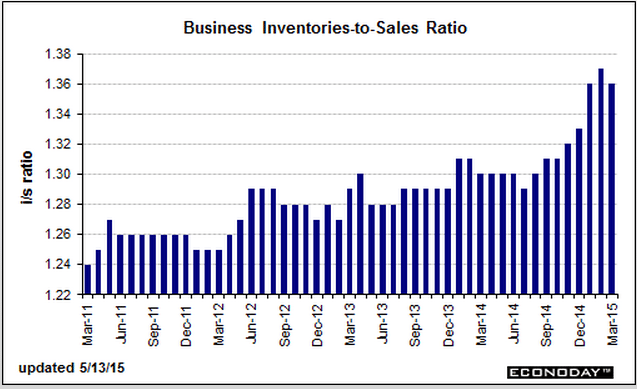
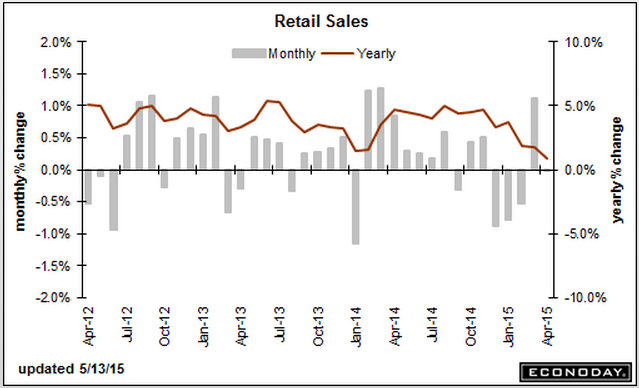
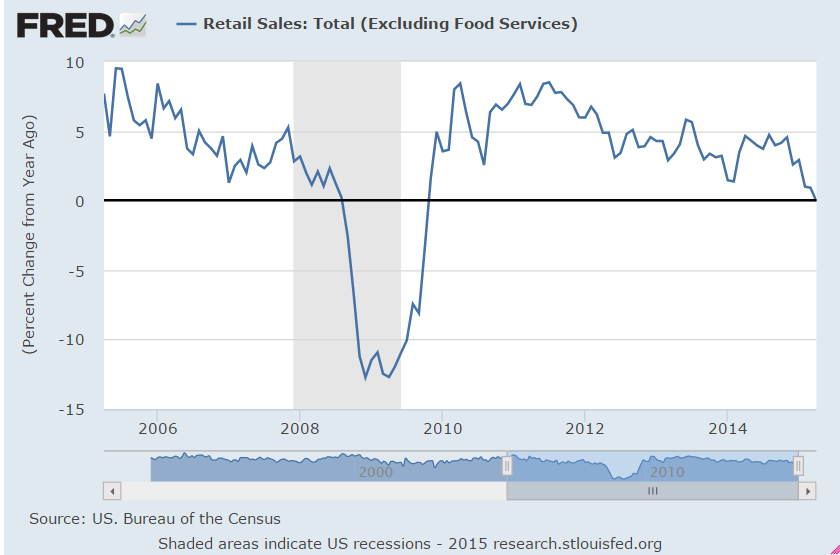
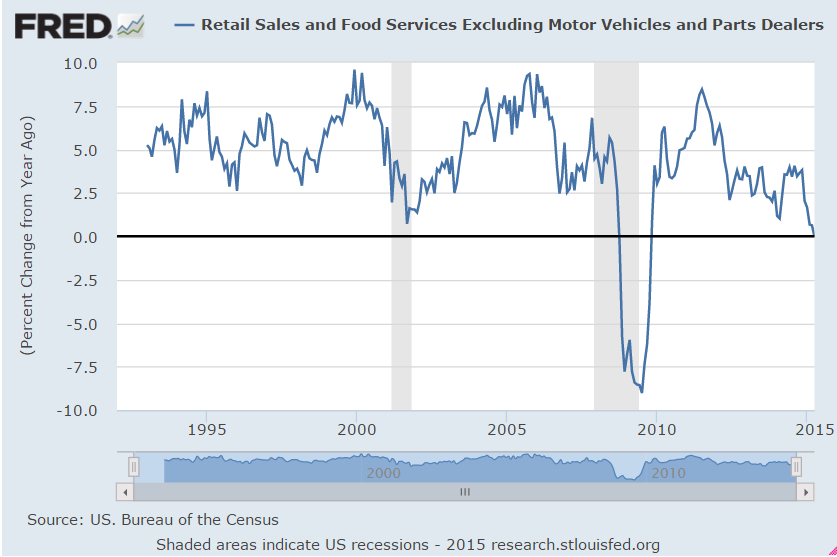
Still way high, especially with today’s retail sales growth at 0

United States : Business Inventories
er-5-13-1
Highlights
Business inventories don’t look quite as bloated after a small 0.1 percent gain in March that is under the 0.4 percent gain in business sales, taking the stock-to-sales ratio down to 1.36 from February’s recovery high of 1.37.

The improvement in March is centered, however, in the retail sector where, thanks to that month’s surge in sales, the stock-to-sales ratio slipped to 1.46 from 1.47. Whether further improvement can be expected in April is uncertain given this morning’s disappointing retail sales report.

The stock-to-sales ratios for the report’s two other components were unchanged, at 1.35 for manufacturers and at 1.30 for wholesalers.

Inventory overhang, built up during the slow first quarter, is widely seen as a risk for second-quarter growth, though this report suggests that the inventory headwind may not be that severe. Today’s data follow yesterday’s small business optimism report where inventory readings were surprisingly low.
er-5-13-2
er-5-13-3
er-5-13-4
er-5-13-5
er-5-13-6

Q2 forecast down to .7% as nothing yet stepping up to replace the lost oil and gas capex spending:
er-5-13-7

EU GDP, Mtg apps, retail sales

European Union : GDP Flash

er-5-13-8

Highlights
Eurozone economic activity extended its recovery into last quarter with a provisional and slightly smaller than expected 0.4 percent increase in real GDP versus the previous period. The fourth quarter rise was unrevised at 0.3 percent and annual growth edged a tick firmer to 1.0 percent. In line with normal procedure, Eurostat provided no details of the latest GDP expenditure components.

Growth was hindered by a sharp slowdown in Germany where total output expanded a quarterly 0.3 percent following a 0.7 percent rise at the end of last year. However, France (0.6 percent after 0.0 percent) was surprisingly robust and Spain (0.9 percent after 0.7 percent) posted its strongest performance in more than seven years. Italy (0.3 percent after 0.0 percent) saw its first positive print since the third quarter of 2013. Amongst the smaller countries Cyprus (1.6 percent after minus 0.4 percent) finally pulled out of recession but Finland (minus 0.1 percent after minus 0.2 percent) saw a second successive quarter of falling output.

Early signals on the current quarter have pointed to little change in Eurozone economic momentum which will probably be seen as disappointing by policymakers and investors alike. Still, the ECB’s QE programme was only launched in March so much of its potential benefit has yet to be realised. That said, with the region’s inflation currently running at just a provisional 0.0 percent annual rate, Eurozone governments and the ECB will be hoping for a significantly stronger growth profile over the second half of the year.

Q2 not getting any help here…

United States : MBA Mortgage Applications
er-5-13-9

Still not spending that gas savings…
Q2 still not showing signs of life

Retail Sales
er-5-13-10

Redbook retail sales, Small business confidence, JOLTS, Japan budget

So now they don’t have Easter to kick around anymore and they’re still weak:

Redbook
er-5-12-1
Retail sales picked up slightly in the May 9 week as Easter-effects finally fade, but at a year-on-year plus 2.1 percent sales remain soft. Redbook reports an as-expected Mother’s Day holiday in the week and reports early buying for graduation. Tomorrow the government will post its April retail sales report which is expected to show a solid rate excluding autos.
er-5-12-2

About the only things showing hope are some of the surveys, just like last quarter (which is now looking to be revised into negative territory):

NFIB Small Business Optimism Index
er-5-12-3

And you have to read pretty far into this story before you realize the numbers were down vs the prior month:

BLS: Jobs Openings at 5.0 million in March, Up 19% Year-over-year

From the BLS:

There were 5.0 million job openings on the last business day of March, little changed from 5.1 million in February, the U.S. Bureau of Labor Statistics reported today. Hires were little changed at 5.1 million in March and separations were little changed at 5.0 million….

Quits are generally voluntary separations initiated by the employee. Therefore, the quits rate can serve as a measure of workers’ willingness or ability to leave jobs. … There were 2.8 million quits in March, little changed from February.

JOLTS
er-5-12-4
Highlights
Yesterday’s labor market conditions index was very soft as is today’s JOLTS report where job openings fell 2.9 percent to 4.994 million in March from a revised 5.144 million in February. This is well below the Econoday consensus for 5.158 million.

Despite the March fall-off, workers appear to be confident in the labor market judging by their willingness to quit. The quits rate rose 1 tenth in the month to 2.0 percent. The hiring rate in the month held steady at 3.6 percent.

Last week’s employment report for April proved much better than March but was still soft, a description underscored by today’s report. Not soft, however, have been weekly jobless claims which will be posted on Thursday.

They still don’t get it:

Japan seen targeting 1% primary deficit in fiscal 2018

May 12 (Nikkei) — Japan will likely aim to cut its primary deficit to about 1% of gross domestic product by fiscal 2018 through spending cuts and other measures, with an eye toward its goal of achieving a surplus by fiscal 2020. Japan’s potential growth rate currently falls short of 1%, and its primary deficit is expected to total 3.3% of GDP this fiscal year at 16.4 trillion yen ($135 billion). According to conservative calculations by the Cabinet Office, which assume real economic growth of 1% or so and nominal growth of over 1%, Japan would face a primary deficit of 15.7 trillion yen in fiscal 2018 — equivalent to 3% of GDP.

Car sales

Big letdown here. More Q2 downgrades on the way.
Still waiting for the burst of consumer spending from the drop in oil prices…

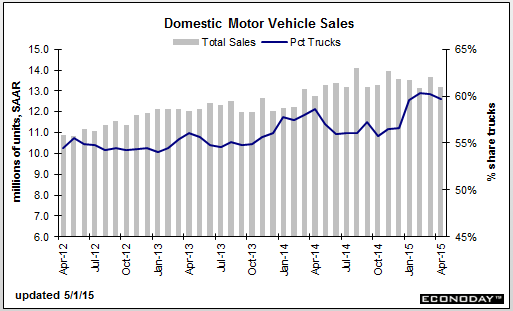
United States : Motor Vehicle Sales
er-5-1-16
Highlights
The early indications from April have mostly been weak including the first hard consumer data on the month which are vehicle sales. Vehicle sales fell 4.1 percent to a 16.5 million annual rate. This is a very solid rate but the comparison with March points unfortunately to a downtick for the motor vehicle component of the retail sales report. This is a key component of the report which has been bouncing up and down in recent months, unable to find traction as have retail sales in general.
er-5-1-17

global glympse

Germany : Retail Sales
gg-1
Highlights
Retail sales followed a smaller revised 0.1 percent dip in February with a surprisingly hefty 2.3 percent monthly slump in March. The drop was the steepest since December 2013 but friendly base effects were enough to ensure that the first back-to-back decline since April/May 2014 still boosted unadjusted annual growth from 2.5 percent to 3.2 percent. Nonetheless, the level of sales at quarter-end was the weakest since last October.

March’s setback means that first quarter purchases were up only 0.5 percent versus the fourth quarter when they rose a solid 1.2 percent. This looks odd in the context of a raft of strong consumer surveys. In particular, at 53.0 the retail sector PMI last month posted its highest reading since last June.

France : Consumer Mfgd Goods Consumption
gg-2
Japan : Industrial Production
gg-3
Highlights
March industrial production dropped a much less than anticipated 0.3 percent on the month – analysts were expecting a drop of 2.2 percent. It was the second consecutive decline. On the year, output was down 2.9 percent. The monthly reading showed great fluctuations, but Thursday’s reading means it has been in negative territory for seven of the previous twelve months.

gg-4

Exactly as I’ve discussed. Q1 was positive only because of the inventory build, which is likely normalize in Q2:

WSJ’s Hilsenrath says the sharp slowdown in Q1 growth has clouded the timing for rate liftoff. The piece argues the dollar’s strength, cautious consumer spending and a downturn in oil-related investment may limit the extent of a rebound in growth.

Highlighting a pattern of weak Q1 growth, the article notes that since 2010 first-quarter GDP growth has averaged 0.6%, compared to average growth of 2.9% in other quarters. It adds that the uneven nature of growth could mean the Fed takes a longer time to assess whether the economy is on track before raising rates.

The paper cites analysts who now anticipate liftoff in September or later. In offering a more guarded economic outlook, the article notes the job market hasn’t improved since the last Fed meeting and that after providing a 74 bp tailwind to Q1 growth, an inventory run down in Q2 could act as a new drag on growth.

Redbook retail sales, consumer confidence, Richmond Fed

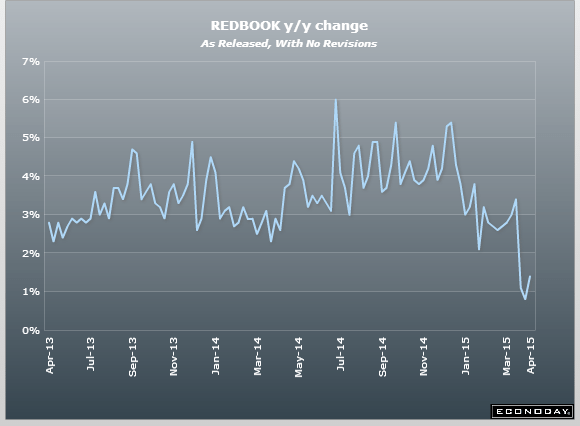
Not good again.
Looks like more than a ‘soft spot’ as so far no improvement for Q2:

Redbook
er-4-28-7
Highlights
It’s hard to make heads or tails of weekly retail sales data surrounding Easter and its shifting comparisons. Redbook’s same-store year-on-year sales tally came in at a very weak plus 1.4 percent in the April 25 week which however is up from plus 0.8 percent in the prior week but well down from the plus 3.0 to 3.5 percent underlying trend. This trend, or somewhere close to it, is likely to re-emerge in next week’s report when Easter calendar distortions are no longer in play. Behind the distortions, however, Redbook does note that the overall performance is below plan though warmer weather did help seasonal sales in the latest week.
er-4-28-8

United States : Consumer Confidence
er-4-28-9
Highlights
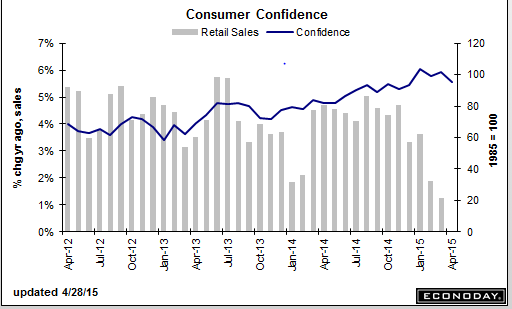
Consumer confidence has fallen back noticeably this month, down more than 6 points to a much lower-than-expected 95.2. This compares very poorly with the Econoday consensus for 103.0 and is even far below the Econoday low estimate of 100.5. The weakness, ominously, is the result of falling assessments of the jobs market, both the current jobs market and expectations for the future jobs market. The second quarter, which is expected to be much stronger than the weather-depressed first quarter, isn’t likely to get off to a fast start, at least as far as this report goes.
er-4-28-10

Richmond Fed Manufacturing Index
er-4-28-11

Recent History Of This Indicator
The Richmond Fed manufacturing index in March fell into contraction, to minus 8 vs zero in February. Order readings, both for new orders and backlogs, were down substantially as were shipments and the workweek. Hiring, however, remained respectable, at least for now. Price readings showed only the most marginal pressure.

Japan retail sales, UK GDP, small business lending, Steven Hansen May forecast, Dallas Fed

In case anyone thinks currency depreciation and tax hikes were the path to domestic bliss:

Japan : Retail Sales
er-4-28-1
Highlights
Retail sales plummeted a greater than expected 9.7 percent from a year ago. This was the third consecutive month sales declined. March’s result marks a fresh historic low in the data. The data do not bode well for first quarter consumer spending, a major portion of GDP. For the fiscal year, sales retreated 1.2 percent after rising 2.9 percent in fiscal year 2013.
All the subcategories were lower on the year. Auto sales dropped for a sixth consecutive month, this time by 4.1 percent on the year after sliding 2.6 percent the month before. Fuel sales sank 20 percent after 17.9 percent, no doubt partially attributable to the decline in crude oil. Retail machinery sales dropped for a twelfth month, this time by 27.9 percent after sliding 9.6 percent the month before. Apparel sales were down 6.2 percent after increasing 2.0 percent in February.

Japanese consumers have cut back spending since April 2014 when the country’s sales tax was raised from 5 to 8 percent.

So the weakness is pretty much global now:

UK GDP disappoints, below forecasts

By Holly Ellyatt

April 28 (CNBC) — UK gross domestic product (GDP) grew slower than expected in the first quarter at 0.3 percent, in the last major economic indicator before the country’s general election in nine days’ time.

A first estimate from the Office of National Statistics (ONS), showed GDP had grown 0.3 percent quarter on quarter, below a forecast of 0.5 percent according to a poll of analysts by Reuters.

The data will not be welcomed by U.K. Prime Minister David Cameron, who has made the strength of the economy a key part of his campaign ahead of a general election on May 7. Sterling fell to $1.5185 after the data.
er-4-28-2

This isn’t going anywhere either:
er-4-28-3
Economists are now seeing weakness but no chance of recession:

May 2015 Economic Forecast: Slower Growth Continues With Confirming Evidence of Economic Weakness

By Steven Hansen

April 28 — Econintersect’s Economic Index is indicating growth will continue to be soft in May. The tracked sectors of the economy are relatively soft with most expanding but some contracting. The effects of the recently solved West Coast Port slowdown (a labor dispute which had been going on for months) and weather related issues are no longer evident in the raw data. Therefore, the economic slowdown forecast last month is cyclic and not resulting from transient causes.

There is NO evidence of recessionary dynamics in the data – just moderate weakness throughout most data sets. Our employment six month forecast discussed below continues to forecast relatively strong employment growth (even after last month’s rather poor jobs report) but economic pressures are now indicating a weakening of employment growth beginning in June.

United States : Dallas Fed Mfg Survey
er-4-28-4
Highlights
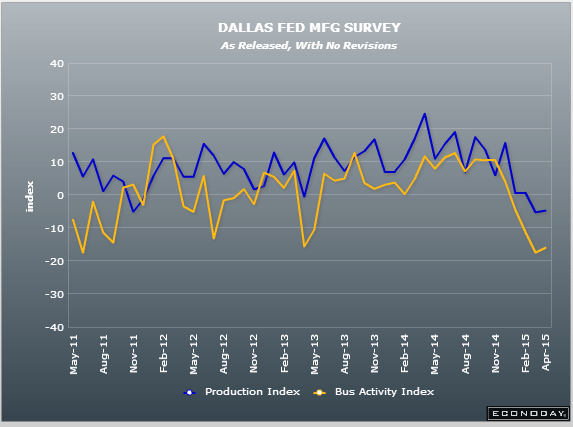
There have been two key factors holding down US manufacturing this year: weak export demand and weakness in the oil & gas sector. The latter is a special focus of the Dallas Fed manufacturing survey where readings have been severely depressed including today’s minus 16.0 reading for business activity and minus 4.7 reading on production.

New orders, arguably the most important reading of all, are at minus 14.0 with the related growth rate at minus 15.5 for its 6th straight negative reading. Companies in the sample are not upbeat about the outlook with this score coming in at a nearly 2-1/2 year low of minus 7.8. The workweek is down and capacity utilization is at a 6-year low of minus 10.4.

Looking at commentary, a few stand out: “Our oil & gas customers have come to a complete stop,” “Lower energy prices have adversely impacted our business in the energy sector,” and “It is going to be a tough summer.”

Yet, despite all the order and production weakness, employment moved from minus 1.8 in March to plus 1.8 in April, which is far from sizzling but is surprisingly in positive ground.
er-4-28-5

Lots of cheerleading in this commentary for a release that was below expectations:

PMI Services Flash
er-4-28-6
Highlights
The service sector is a key driver for the US economy right now given the export-related struggles facing the factory sector. And the latest news is good with the PMI services flash coming in at a very strong 57.8. This indicates faster-than-average monthly growth vs the long-term average for this reading of 55.9. Growth in new orders remains strong and job hiring is described as robust, the latter offering a positive indication for April’s employment report.

Another very positive indication is how upbeat the survey sample is about the business outlook in what is a further indication that general economic weakness early in the year was only temporary. Cost pressures remain subdued though prices have ticked higher this month due likely to the increase underway for fuel costs which however remain low.

The domestic economy right now is healthy, a factor that should boost the housing market this spring and hopefully the jobs sector as well.