2008-09-26 EU News Highlights


[Skip to the end]

France and the eurozone are looking pretty grim.

Exports are weak as demand from the US for imports slows.

Rising prices from energy prices that have driven up ‘inflation’ are in the hands of the Saudis and Russians.

Rising budget deficits are both necessary to sustain growth and threatening national solvency.

The eurozone has used a chronic shortfall of domestic demand to drive exports and sustain growth. When they had their own currencies, they used to buy USD to keep their currencies down and real wages low.
(This culture of exports keeps the standard of living down but it does keep people working.)

With the new single currency, the ECB can’t (ideologically) buy USD to keep their real wages low. So now they are losing their export channel and need to sustain domestic demand to sustain employment. Lower interest rates don’t do that. ECB rate cuts won’t matter.

Just like Fed, rate cuts didn’t sustain US demand, and zero rates didn’t sustain demand in Japan. And fiscal balance in the eurozone is strictly at the national level, where deficits risk solvency. And their banks are at risk of insolvency as well, with deposit insurance also at the national level.

This is true systemic risk. Things can deteriorate very quickly, and the entire payments system shut down, if external demand is too low to sustain growth and employment.

Operationally the ‘solution’ is quite simple; the ECB or the Euro Parliament can write any size check they want (in euros) to support any size fiscal response they want. But legally (and ideologically) this can’t happen without a change in the treaty.

And add to this the fact that the ECB has been increasingly borrowing USD from the Fed to support its banking system that somehow has been caught short USD, probably due to making USD loans that they funded in USD. While this is relatively small (maybe $120 billion), it could snowball, and ultimately, at the macro level, it may wind down with euro agents selling euros to buy and repay the USD and trigger a currency collapse.

Right now it’s all going the wrong way in the eurozone.


Highlights

FRENCH ECONOMY SHRANK IN SECOND QUARTER AS ECONOMIC CRISIS
SocGen, Barclays Say ECB to Cut Rates to 3.5%
German Import Price Inflation Holds at Fastest Pace Since 2000
European Central Banks Offer More Dollars From Fed
Consumer Prices Decline in Two German States, Increase in Hesse
French Consumer Confidence Rises on Oil Price Decline
ECB’s Gonzalez-Paramo Says Markets Still `in Middle’ of Crisis
One-Month Euro Borrowing Rate Climbs to 8-Year High, EBF Says
Sarkozy Pushes Back Deficit Reduction as Growth Slows
French Budget Deficit Wider Than Estimated, Woerth Says
Spanish Mortgage Lending Falls 29 Percent, 12th Monthly Decline
ECB’s Ordonez Says Spain Wage-Indexation Toxic
Euro-Area Economy Is at Standstill, Bank of Italy Index Shows
European Government Bonds Rise as U.S. Bank-Rescue Plan Stalls


Articles

FRENCH ECONOMY SHRANK IN SECOND QUARTER AS ECONOMIC CRISIS

(dpa) – The French economy contracted by 0.3 per cent in the second quarter of the year, the first quarter of negative GDP growth since 2002, the government’s statistical office INSEE announced on Friday.

The announcement could be the first of a series of bad news for France’s economy. French radio reported Friday that the unemployment figures to be made public on Monday will be the worst in 10 years, with up to 40,000 adults added to the jobless rolls in August.

On Thursday, in a speech on the current economic crisis, French President Nicolas Sarkozy said that the turmoil in the American finance sector would affect French economic growth, joblessness and purchasing power.

He also suggested that the country could be heading for a recession, which is defined as two consecutive quarters of negative economic growth.

According to INSEE, the economic contraction in the second quarter was due in part to the second consecutive decline in household spending and a 1.7 per cent fall in exports. dpa sm sc

[list of articles][end]

SocGen, Barclays Say ECB to Cut Rates to 3.5%

(Bloomberg) The European Central Bank will cut its benchmark interest rate to 3.5 percent next year as the financial market crisis deepens the economic slowdown and slows inflation, economists at Societe Generale SA and Barclay’s Capital said, revising earlier calls.

“A deeper corporate sector correction is now under way in Europe that will only be exacerbated by the financial turmoil,”

James Nixon, an economist at Societe Generale in London wrote in a note to clients. “Weaker growth and falling inflation will now finally open the door to a series of gradual interest-rate cuts.”

Business confidence in the euro area’s three largest economies fell this month more than economists forecast as financial turmoil in the U.S. imperiled growth around the world.

The ECB has so far said slowing growth isn’t enough to overcome concern that the fastest inflation in 16 years will become entrenched through a wage-price spiral.

Nixon forecasts three quarter-percent cuts in March, June and September, bringing the ECB key rate to 3.5 percent from 4.25 percent. He previously predicted rates would remain unchanged throughout 2009.

Barclays Capital’s chief European economist, Julian Callow, expects the bank to start cutting rates in December and then lower borrowing costs again in March and June.

Callow conceded that the first cut may be delayed as ECB policy makers await the outcome of Germany’s IG Metall wage round, raising the “risk of a 50 basis-points cut in March.”

[list of articles][end]

German Import Price Inflation Holds at Fastest Pace Since 2000

(Bloomberg) Import-price inflation in Germany, Europe’s largest economy, held at the fastest pace in almost eight years in August led by higher energy costs.

Prices rose 9.3 percent from a year earlier, the Federal Statistics Office in Wiesbaden said today, unchanged from July and the highest level since November 2000. Economists expected an increase of 9.1 percent, the median of 21 forecasts in a Bloomberg News survey showed. In the month, prices fell 0.8 percent, less than economists expected.

While the price of oil has retreated about a third from its July record, easing pressure on consumer and company purses, a barrel of crude is still over 30 percent more expensive than a year ago. The European Central Bank expects past oil price gains to result in pipeline pressures that could unleash an inflationary wage-price spiral. Policy makers say preventing these so-called second round-effects overrides any anxiety over faltering economic growth and the financial market crisis.

“While the price of oil may have dropped significantly from July, it’s still high and other commodities are slower to follow,” said Alexander Koch, an economist at UniCredit Markets and Investment in Munich. “There are still pipeline pressures that will keep the ECB on inflation alert until the end of the year.”

ECB Vice President Lucas Papademos said in an interview with Italy’s Il Sole 24 Ore published today that there are “clear indications” of faster wage increases and that the bank “cannot exclude renewed increases in oil and commodity prices.”

Rising Prices
German inflation probably slowed to 2.9 percent in August from 3.3 percent in the previous month, when measured using a harmonized European Union method, a Bloomberg survey shows. That’s still well above the ECB’s 2 percent limit. The Federal Statistics Office in Wiesbaden may publish September inflation data today.

Prices for gas rose 55.4 percent in the year and oil was 50.3 percent more expensive, today’s report showed. The cost of coal increased 84.3 percent from August 2007. Excluding energy, import prices rose 4.1 percent in the year.

Business confidence in the euro area’s three largest economies fell more this month than economists forecast as financial turmoil in the U.S. imperiled growth around the world, industry surveys showed yesterday. The economy of the 15 nations sharing the euro is already struggling to recover from a second- quarter contraction.

In the past two weeks, Lehman Brothers Holdings Inc. collapsed and the U.S. government took over American International Group Inc. The world’s biggest financial companies have posted more than $520 billion in writedowns and credit losses since the start of last year after record defaults on housing loans to consumers with poor credit histories, pushing up borrowing costs as banks became reluctant to lend to each other.

The ECB raised its key rate to a seven year-high of 4.25 percent in July after record oil prices pushed the inflation rate to the highest in 16 years. Annual price gains have decelerated, even if, at 3.8 percent, they are still almost twice the ECB’s 2 percent limit.

[list of articles][end]

European Central Banks Offer More Dollars From Fed

(Bloomberg) European central banks will for the first time let banks borrow dollars from them for a week in an effort to ease drum-tight money markets at the end of the quarter.

With the cost of borrowing dollars over three months yesterday jumping by the most since 1999, the European Central Bank, Bank of England and Swiss National Bank said today they will auction a total of $74 billion in one-week funding. The Federal Reserve assisted by providing the ECB and SNB with access to $13 billion more of its currency, boosting the amount of dollars it makes available to counterparts to $290 billion.

“These operations are designed to address funding pressures over quarter end,” the central banks said in statements.

“Central banks continue to work together closely and are prepared to take further steps as needed to address the ongoing pressure in funding markets.”

The central banks are tweaking the timeframes over which they auction dollars as banks remain reluctant to lend to each other even after the Fed more than quadrupled the amount of dollars that can be sold around the world. Concern a U.S. rescue plan to ease the worsening financial crisis won’t be implemented fast enough may strain markets again today.

“The money markets will remain tense until the U.S. package is agreed and starts to be implemented,” said Holger Schmieding, chief European economist at Bank of America Corp. in London.

Switch to Weekly
Having sold dollars for a day for the first time last week, the ECB will today offer $35 billion in funds for a week. It will reduce its sale of overnight dollars by $10 billion to $30 billion. The Swiss National Bank will auction $9 billion over seven days, while paring the amount it offers overnight to $7 billion from $10 billion.

The Bank of England, which has held six overnight dollar auctions for $40 billion, will now sell $30 billion for a week and $10 billion in overnight auctions. The U.K. bank will also hold weekly auctions for pounds against extended collateral including mortgage securities.

Central bankers are stepping in as a source of dollars as $522 billion in writedowns and losses tied to the U.S. mortgage market and questions about the credit-worth of counterparties prompt bankers to hoard cash to meet their own funding needs.

Banks in the euro region deposited more than 1 billion euros with the ECB for a sixth day running yesterday, the longest such stretch since the introduction of the euro in 1999.

Swap Lines
The Fed is providing counterparts with dollars through so- called swap lines, enabling them to auction the U.S. currency in their own markets in return for collateral. It last week extended links established in December with the ECB and Swiss National Bank by $70 billion, and created $110 billion in new facilities with central banks in Japan, the U.K. and Canada. Yesterday, it agreed to channel $30 billion to Norway, Sweden, Denmark and Australia.

The financial crisis, which deepened this month after Lehman Brothers Holdings Inc. filed for bankruptcy and the U.S. government took over American International Group Inc., is entering a new stage as lawmakers squabble over a $700 billion rescue of the U.S. banking system. Negotiations stalled yesterday after Republicans in the U.S. House of Representatives undercut the Bush administration and left it to congressional leaders to hammer out a compromise.

Concern the plan may be diluted yesterday spurred money- market rates around the world. The three-month London interbank offered rate, or Libor, that most banks charge each other for dollar loans rose 29 basis points to 3.77 percent.

[list of articles][end]

Consumer Prices Decline in Two German States, Increase in Hesse

(Bloomberg) Consumer prices in two German states eased in September as the cost of food and package vacations declined. Prices rose in the state of Hesse.

Prices in Brandenburg and Saxony fell 0.1 percent from August, the state statistics offices in Kamenz and Potsdam said today. In the year, prices gained 2.8 percent in Brandenburg and 3 percent in Saxony. In Hesse, consumer prices rose 0.1 percent from August and 3.3 percent in the year.

While the cost of oil has fallen from a July record it’s still 30 percent higher than a year ago. The European Central Bank expects past gains in food and commodity prices could still unleash an inflationary wage-price spiral. ECB President Jean- Claude Trichet said on Sept. 11 that inflation is the main worry of European citizens.

“Energy prices still drive inflation in Germany,” said Matthias Rubisch, an economist at Commerzbank AG in Frankfurt.

“The ECB will remain concerned as inflation will recede only slightly in the coming months.”

Economists expect German inflation to slow to 2.9 percent in September from 3.3 percent using a harmonized European Union method, the median of 15 forecasts in a Bloomberg News survey shows. The Federal Statistics Office in Wiesbaden is scheduled to report pan-German inflation figures later today.

Energy prices in Brandenburg rose 0.6 percent from the previous month while prices for package vacations fell 7 percent and costs for holiday accommodation decreased 27.4 percent.

Seasonal food prices dropped 2.5 percent. In Hesse, food prices fell 0.3 percent from August while household energy costs rose 1.4 percent in the month and 13.3 percent in the year.

Import Price Pressure
Import-price inflation in Germany, Europe’s largest economy, held at the fastest pace in almost eight years in August led by higher energy costs, the Federal Statistics Office in Wiesbaden said today. Excluding energy, import prices rose 4.1 percent in the year.

ECB Vice President Lucas Papademos said in an interview with Italy’s Il Sole 24 Ore published today that there are “clear indications” of faster wage increases and that the bank “cannot exclude renewed increases” in oil and commodity prices. “The outlook for inflation over the medium term will fundamentally depend on future unit labor cost growth.”

Germany’s IG Metall labor union, representing 3.2 million workers, is seeking the biggest pay increase in 16 years for staff at companies such as ThyssenKrupp AG and Siemens AG. The union, Germany’s biggest, wants wages to rise 8 percent next year, Chairman Berthold Huber said this week.

[list of articles][end]

French Consumer Confidence Rises on Oil Price Decline

(Bloomberg) French consumer confidence unexpectedly rose for the first time in more than a year in September after falling fuel prices left people with more to spend on food and clothing.

A gauge of consumer sentiment rose to minus 44 from a revised record-low minus 47 in July, the last month reported, the Paris- based national statistics office, Insee, said in a statement today. Economists expected a reading of minus 47, according to the median of 20 forecasts in a Bloomberg News survey.

The price of oil has fallen by almost a third from its record in July. Still, crude remains at more than $100 a barrel and is 33 percent higher than a year ago. At the same time, a deepening crisis in global financial markets may dim consumers’ willingness to spend in coming months.

“Whether it’s consumption, investment or exports, all the engines of French growth are stopped, or even in reverse,” said Marc Touati, chief economist at Global Equities in Paris, before the report.

Earlier this month, Finance Minister Christine Lagarde pared her prediction for 2008 economic growth to around 1 percent from a previous forecast of at least 1.7 percent. Those forecasts may prove optimistic as the worst U.S. housing slump since the Great Depression has pushed up the cost of credit globally and roiled financial markets, threatening to further pare global growth.

Growth Declines
The French economy shrank 0.3 percent in the second quarter, the first contractions in more than five years, a separate report confirmed today. Household spending fell 0.1 percent, while exports declined 1.7 percent, from an increase of 2.6 percent in the first three months. The European Commission predicted Sept. 10 that the economy will stall in the third quarter, barely skirting a recession.

“It’s possible France’s GDP will shrink in the third quarter; even zero growth would be good,” Frederik Ducrozet, an economist at Credit Agricole SA in Paris, said on Bloomberg Television.

The gain in French confidence mirrored advances in Germany and Italy as the lower oil prices fueled optimism that record inflation rates would ease. Confidence among consumers in Germany, Europe’s biggest economy, unexpectedly rose for the first time in five months, a report showed yesterday. Italian confidence advanced from a 15-year low in August.

Manufacturers were less optimistic. Confidence among French producers dropped to a five-year low in September, Insee said on Sept. 24, suggesting that the turmoil in markets fueled by the collapse of Lehman Brothers Holdings Inc. has overshadowed declines in oil and the dollar. Crude has fallen 27 percent decline since a July 11 record of $147.27 and the euro also declined from a peak against the dollar the same month.

French President Nicolas Sarkozy said in a speech on the economy yesterday that the turmoil in financial markets will be lasting and the fallout will hurt growth, employment and spending.

[list of articles][end]

ECB’s Gonzalez-Paramo Says Markets Still `in Middle’ of Crisis

(Bloomberg) European Central Bank Executive Board member Jose Manuel Gonzalez-Paramo comments on the global financial market turmoil. He spoke today at a conference in Chicago.

“I would have much preferred to be here under somewhat different circumstances. The international financial system has reached a crossroad. Large financial institutions have failed or have to be taken over by others. Major bank models have been put into question. Important markets exhibit high volatility and low liquidity. Together with other economic developments, the financial turmoil has significantly increased the uncertainty surrounding the outlook for growth and inflation in the short- and medium-term both in the euro area and in the U.S.”

“We still seem to be in the middle of” the financial turmoil.

[list of articles][end]

One-Month Euro Borrowing Rate Climbs to 8-Year High, EBF Says

(Bloomberg) The cost of borrowing in euros for one month rose to the highest level since December 2000, according to the European Banking Federation.

The euro interbank offered rate, or Euribor, climbed 3 basis points to 5.01 percent, EBF figures show today. It was at 4.63 percent a week ago. The three-month rate increased 2 basis points to 5.14 percent, the highest level since the introduction of the euro in 1999.

[list of articles][end]

Sarkozy Pushes Back Deficit Reduction as Growth Slows

(Bloomberg) French President Nicolas Sarkozy, facing the slowest economic expansion in at least five years, shelved deficit-reduction plans in his second budget released today.

The budget is based on a growth forecast for this year and next of 1 percent, less than half the 2007 pace, which will leave the government with less revenue and higher welfare costs. To keep the shortfall under the European Union limit, France may cap spending, not replace half of retiring civil servants, and raise taxes to fund incentives for the unemployed to return to work.

“It’s easy to explain: tax receipts are shrinking,” Budget Minister Eric Woerth said today on RTL radio. “Less growth means less fiscal revenue.” He cited the higher cost of debt and high inflation as other factors pushing up the deficit.

Sarkozy’s 8 billion euros ($11.7 billion) of tax cuts this year were not enough to buoy growth as surging commodities prices fanned inflation and global demand cooled amid a year-long credit crisis. The euro region’s second-largest economy contracted and shed jobs in the second quarter, sending consumer confidence to a record low and curbing spending.

Deficit Widening
The new budget plan forecasts the deficit will hold at last year’s level of 2.7 percent of gross domestic product this year and next, remaining below the EU threshold of 3 percent. The government initially planned to narrow the shortfall to 2.5 percent this year and 2 percent next year.

“If there’s one European country in a problematic situation regarding the 3 percent, it’s France,” said Natacha Valla, an economist at Goldman Sachs Group Inc. in Paris.

The higher deficit and slower growth will force an increase in borrowing. The government plans to sell $135 billion euros of bonds and notes next year, up from $116.5 billion euros worth this year. Total debt will rise to 66 percent of GDP from 65.3 percent this year.

The budget plan is based on the assumption that the cost of oil will average $100 a barrel in 2009 and the euro will be worth on average $1.45. Crude oil reached a peak of $147.27 in July and the euro hit a record $1.6038 in the same month.

Sarkozy, who’s been in office since May 2007, has faced growing popular discontent as gasoline and food prices rose.

Sixty-two percent of those surveyed by BVA polling company this month found his economic policy “bad” or “very bad.”

Public Support
“The reason why Sarkozy was elected president is that he’d promised to deliver on economic and social issues at a time of pessimism,” said Gael Sliman, deputy director at BVA. Now “the bad economic news condemn him to be unpopular during all the difficult period of 2008 and part of 2009.”

Sarkozy yesterday said he wouldn’t impose austerity policies as the turmoil in financial markets hurts economic growth, job creation and household purchasing power.

“If activity were to strongly and lastingly recede, I wouldn’t hesitate to take necessary steps to underpin it,” the French president said in a speech in Toulon, France. “Telling the truth to the French is saying that the crisis isn’t over, its consequences will be lasting.”

Sarkozy’s political opposition, said he was using the world economic crisis to divert attention from his policy failures.

`Using’ the Crisis
“The president is using the crisis as an excuse to justify the acceleration of an austerity policy towards the middle class” and the least well off, Michel Sapin a former Socialist Finance Minister, said in a statement.

The government has little leeway to act, especially with France holding the rotating EU presidency. Two weeks ago, Finance Minister Christine Lagarde and her European counterparts pledged to pursue financial discipline. European Central Bank President Jean-Claude Trichet called for them to deliver on their promise.

Woerth said today that government has reined in spending.

“It’s going to be a status-quo budget,” said Laurence Boone, an economist at Barclays Capital in Paris. “They have no room for maneuver if they want to stay within the EU limits” of a deficit of less than 3 percent of gross domestic product.

The tax cuts announced by Sarkozy last year, including a mortgage-interest deduction, the elimination of most inheritance levies and a wealth-tax rebate for people investing in small companies will extend into next year. They also include the elimination of most taxes on overtime hours, which may not be as effective because of the slowdown, Barclays’ Boone said.

Legislative Victories
Sarkozy won a string of legislative victories before the summer recess. Lawmakers in recent past months passed measures proposed by the government to boost retail competition, toughen jobseekers’ benefit rules and increase work hours.

“Structural reforms have been launched,” Goldman’s Valla said. “What the economy needs are very precise and fast spending measures, but France doesn’t have the means to do it.”

The president has promised to eliminate a tax on companies’ sales. At the same time, he is planning new levies on private health and retirement insurers and on corporate profits distributed to employees as part of a plan to erase the health- care system deficit by 2011.

He also said last month he will impose a new capital-gains tax to fund incentives for the unemployed to go back to work, a measure backed by 65 percent of French people, the BVA poll showed.

According to Medef, France’s biggest business lobby, overall levies on companies are going to rise “slightly” in 2008 and “strongly” next year.

[list of articles][end]

French Budget Deficit Wider Than Estimated, Woerth Says

(Bloomberg) France’s budget gap this year will be wider than estimated, Budget Minister Eric Woerth said, adding that he sees the deficit in 2009 at 2.7 percent of gross domestic product.

Woerth said the deficit will rise to about 49 billion euros ($72 billion) this year, up from a 41.4 billion-euro initial forecast. He said 2009’s deficit will widen to 52 billion euros.

“It’s easy to explain,” he said. “Tax receipts are shrinking. Less growth means less fiscal revenue.”

He cited the higher cost of debt and rising inflation among other reasons for the widening French deficit.

Woerth said France will not drop the government goal of balancing its budget in 2012.

“It is not out of reach,” he said.

[list of articles][end]

Spanish Mortgage Lending Falls 29 Percent, 12th Monthly Decline

(Bloomberg) Mortgage lending in Spain fell for the 12th month in July as the collapse of a decade-long housing boom pushed the Spanish economy toward recession.

Mortgage lending, in terms of the amount of money disbursed, fell 29 percent from a year earlier, and the number of mortgages issued for homes declined 29 percent, the Madrid-based National Statistics Institute said in an e-mailed statement today. In June mortgage lending fell 37 percent from a year earlier.

The housing boom helped Spain grow faster than the euro- region for more than a decade. The global credit crunch has increased borrowing costs and contributed to pushing construction and real estate companies into bankruptcy, and Spain is now expected to follow Ireland into a recession, according to the European Commission.

Housing transactions fell 26 percent from a year earlier, the institute said.

[list of articles][end]

ECB’s Ordonez Says Spain Wage-Indexation Toxic

(Bloomberg) European Central Bank Governing Council member Miguel Angel Fernandez Ordonez comments on Spanish wage-indexation and the ECB’s inflation-fighting policy. He spoke in Seville, Spain, today.

On Spanish wage-indexation:
“Clauses linking pay settlements to inflation in collective- bargaining agreements are especially toxic when inflation has increased due to external shocks.

“It’s not surprising that the unemployment rate has increased in the past year.

“It’s much more important than in the past to activate all mechanisms that can allow agents to limit cost increases and improve productivity gains.

“Until now, employment has been the main variable that adjusts at times of crisis.

“Unemployment has seen an intense increase.

“The most important thing is not to give in to the temptation of adopting policies that try to avoid the adjustment.”

“The damage of unemployment is much worse” than a salary decline.

On Spanish inflation:
“Inflation will probably be much closer to the euro-region average in 2009 and 2010.”

On the ECB’s inflation-fighting credentials:
“It’s essential that the European Central Bank is fully focused on the objective it been set to maintain inflation at a very moderate pace and in this respect I think the ECB is fully fulfilling its mission.

“There is full confidence that the ECB will return inflation to its objective, and that is helping to mitigate somewhat the current uncertainties regarding the financial system, economic growth and other variables.”

On money-market interest rates:
“It’s difficult to predict if this tightening will keep increasing, though clearly interest rates in money markets, the fundamental reference for Spanish mortgages, already include a substantial risk premium over the ECB’s official interest rates.”

On the global economy:
“Unlike a few months ago, no one is defending the possibility of decoupling now.”

The effects of the crisis “have touched everyone.”

On U.S. rescue plan:
“We should be grateful that with the money of U.S. taxpayers they improve the international financial situation.”

On how the European banking sector compares to U.S.:
“So far, the situation in the European banking system isn’t the same, except one country outside the euro region that is facing considerable problems.”

On Spanish real estate:
“We have a problem in real estate, but it is far from what is being seen in the U.S.”

“U.S. subprime has 16 percent default rates. We haven’t seen that in the worst moments of crisis.”

On Spanish banks:
“If construction is going to be reduced then the Spanish financial system has to adjust to the new situation.”

“What they have in front of them is a complicated task.”

[list of articles][end]

Euro-Area Economy Is at Standstill, Bank of Italy Index Shows

(Bloomberg) The European economy has stalled, an index co-produced by the Bank of Italy showed.

The EuroCoin index measuring economic expansion fell this month to a record low of 0.04 from 0.17 in August, the London- based Center for Economic Policy Research said in a report today.

“The most recent figure was negatively affected by the sharp fall of firms’ confidence and the recent financial markets retreat,” the report said.

The economy of the 15 nations that share the euro contracted in the second quarter for the first time since the single currency was introduced in 1999.

[list of articles][end]

European Government Bonds Rise as U.S. Bank-Rescue Plan Stalls

(Bloomberg) European government bonds rose, with yields on two-year notes headed for the biggest weekly decline in eight months, as investors sought the safest assets after negotiations on a U.S. financial-rescue plan stalled.

Investors piled into short-dated debt as lawmakers in the U.S. prepared to meet for a second day after talks yesterday ended without an agreement. A group of House Republicans led by Eric Cantor of Virginia said they wouldn’t back a plan based on the approach outlined by Treasury Secretary Henry Paulson and supported by President George W. Bush and Democratic leaders.

Washington Mutual Inc. was taken over by JPMorgan Chase & Co., in the biggest U.S. bank failure in history.

“The market is reminded once again that this is not a simple piece of legislation,” Luca Jellinek, a London-based strategist at Royal Bank of Scotland Group Plc, wrote in a note today. “The news is uniformly friendly” to the bond market.

The yield on the two-year note dropped 9 basis points to 3.75 percent as of 10:25 a.m. in London. The 4 percent note due September 2010 rose 0.17, or 1.7 euros per 1,000-euro ($1,458) face amount, to 100.46. Were the note to close at that level, it would be the biggest weekly decline in the yield since the five days ended Feb. 8.

The yield on the 10-year German bund, the euro region’s benchmark government-debt security, fell 3 basis points to 4.20 percent. Yields move inversely to bond prices.

The gains pushed the difference in yield, or spread, between two- and 10-year notes to the widest in five months as investors raised bets the financial crisis in the U.S. will crimp economic growth in Europe.

Outperform Treasuries
European bonds have outperformed U.S. Treasuries this quarter as the bailout plan fuelled speculation that it will add to the U.S. government’s fiscal burden. Bonds in the euro region handed investors a 2.97 percent return since the end of June, compared with 1.91 percent from their U.S. counterparts, according to Merrill Lynch & Co.’s EMU Direct and Treasury Master indexes.

Demand for government bonds was also boosted as stocks declined and the cost of protecting European corporate bonds from default rose. The Dow Jones Stoxx 600 Index fell 1.3 percent. Contracts on the Markit iTraxx Crossover Index of 50 companies with mostly high-risk, high-yield credit ratings increased 15 basis points to 590, according to JPMorgan Chase & Co., indicating a deterioration in the perception of credit quality.

The European Central Bank, Swiss National Bank and Bank of England said today they will auction a combined $74 billion in one-week funding to counter the seizure in money markets. The Federal Reserve assisted by providing the ECB and SNB with access to $13 billion more of its currency, boosting the amount of dollars it makes available to counterparts to $290 billion.

Money-market interest rates around the world soared yesterday on concern that Paulson’s plan will be diluted as it makes its way through Congress, causing banks to hoard cash. The three-month London interbank offered rate, or Libor, that banks charge each other for dollar loans jumped by the most since 1999 and the euro rate rose to the highest level since November 2000.


[top]
Bloomberg: Euro refineries to shut for repairs


[Skip to the end]

This happens when margins get too low: cheaper to shut for repairs than to operate at a loss.

Saudi output should fall a bid due to lack of demand, but crude prices should hold at their levels.

Gasoline prices should increase vs crude prices (crack spreads widen).

Shell, BP to Shut Refineries for Repair, Cut Europe Fuel Supply

by Nidaa Bakhsh

Sept. 25 (Bloomberg) Royal Dutch Shell Plc, BP Plc and Total SA are leading oil companies that will shut at least 6 percent of Europe’s refining for repairs next month, reducing inventories already diminished by U.S. demand after Hurricane Ike.

The outages from Rotterdam to Italy will idle at least 952,000 barrels of crude oil distillation a day in October, double the September figure, according to data compiled by Bloomberg. The total includes plants owned by Shell and BP in the Netherlands, representing a combined 400,000 barrels a day.

Refinery profits in western Europe fell to their lowest level since at least 2004 this year as record prices cut fuel demand. Gasoline inventories fell 18 percent to 612,000 metric tons in the Amsterdam-Rotterdam-Antwerp region last week, according to Dutch consultant PJK International BV, because of rising exports to the U.S. after Hurricane Ike shut Gulf Coast refineries.


[top]

2008-08-07 US Economic Releases


[Skip to the end]


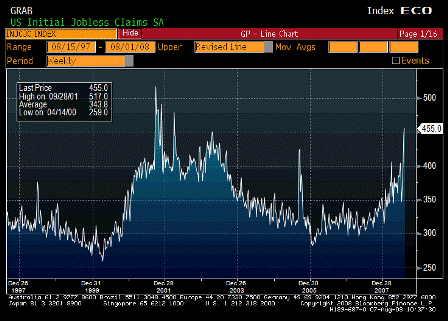
Initial Jobless Claims (Aug 2)

Survey 425K
Actual 455K
Prior 448K
Revised n/a

Karim writes:

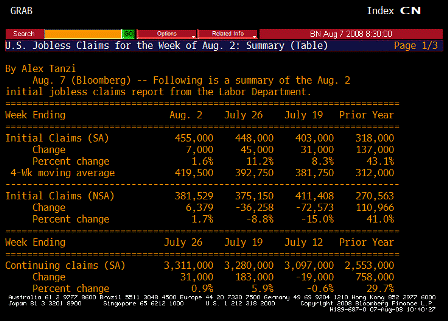
  • Initial claims rise 7k to new cycle high of 455k with 4wk moving avg up from 393k to 420k

[top][end]

Continuing Jobless Claims (Jul 26)

Survey 3255K
Actual 3311K
Prior 3282K
Revised 3280K

Karim writes:

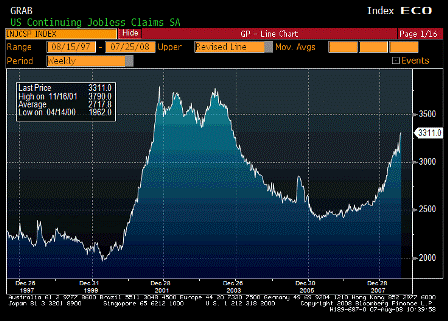
  • Continuing claims rise from 3280k to 3311k and 4wk moving avg up from 3174k to 3201k

[top][end]

Jobless Claims TABLE 1 (Jul 26)

[top][end]

Jobless Claims TABLE 2 (Jul 26)

Cesar writes:

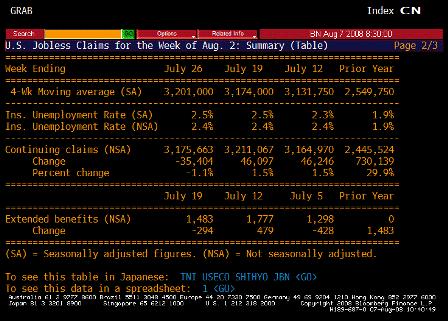
A year ago we were at 4.7% unemployment rate (7,137 unemployed/ 153,182 labor force)

We are currently at 5.7% unemployment rate (8,784 unemployed/ 154,603 labor force)

Seems nearly the entire jump in unemployment is due to labor force increases.

Total employed is about flat.

In that case, GDP growth is about equal to productivity growth.

Karim writes:

  • Initial claims somewhat distorted by new program to extend benefits where those filing extensions are considered first time filers (double counted); this should have an effect for the first 2-3 weeks of the program before initial claims fall back to trend level (same happened back in 2001). Last week was first week of program, so numbers for next 2 weeks should reflect underlying trend (last number before extension program was 403k). Of concern would be if numbers don’t fall back much.
  • This program does not effect continuing claims, which reflects ability to find a job once laid off. This is at a new cycle high.

[top][end]


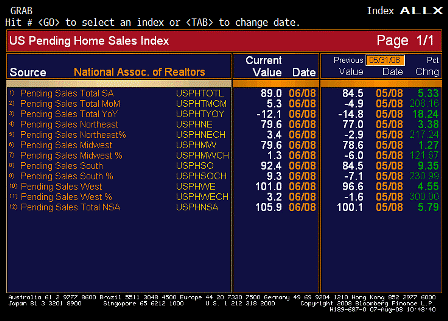
Pending Home Sales MoM (Jun)

Survey -1.0%
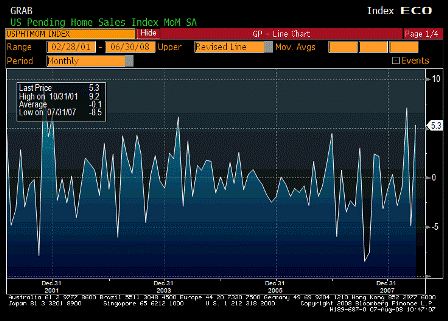
Actual 5.3%
Prior -4.7%
Revised -4.9%

Karim writes:

  • Rise 5.3% m/m, continuing recent see-saw pattern (-4.9%, +7.1% prior 2mths).

Q2 GDP for Japan and Germany are out next week. A German newspaper yesterday leaked German GDP growth likely to be -1 to -1.5%. Much of this is a giveback for a strong Q1 of +1.5% but definitely weaker than expected. Of concern to the ECB is that Spain (industrial production now down 10% y/y) and Italy already written off, so much depends on Germany. Moreover, German PMIs have gotten off to a very weak start for Q3. I imagine that was at the root of Trichet’s more dovish tone today.

Estimates for Japanese Q2 GDP are in the -1% to -3.5% range. The July Tankan and the foreign orders component of last night’s machinery orders data also don’t bode too well for Q3.

[top][end]

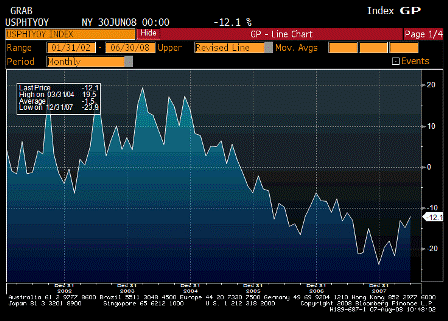
Pending Home Sales YoY (Jun)

Survey n/a
Actual -12.1%
Prior -14.8%
Revised n/a

Looks like it has bottomed and moving up as prices have adjusted and GDP has improved.

Housing my no longer be subtracting from GDP.

[top][end]

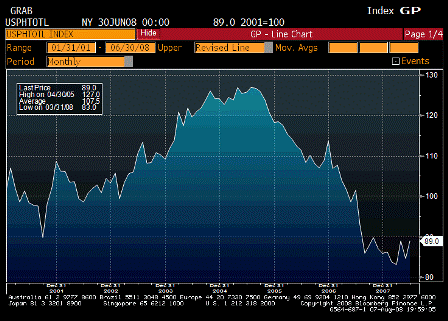
Pending Home Sales Total SA (Jun)

Survey n/a
Actual 89.0
Prior 84.5
Revised n/a

Looks to have found support and probably bottomed albeit at very low levels.

[top][end]

Pending Home Sales ALLX (Jun)

[top][end]


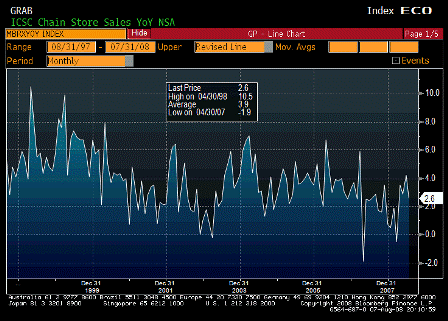
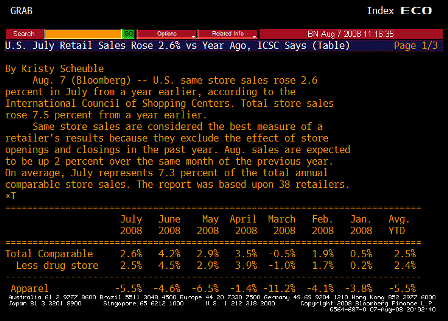
ICSC Chain Store Sales YoY (Jul)

Survey 3.4%
Actual 2.6%
Prior 4.3%
Revised 4.2%

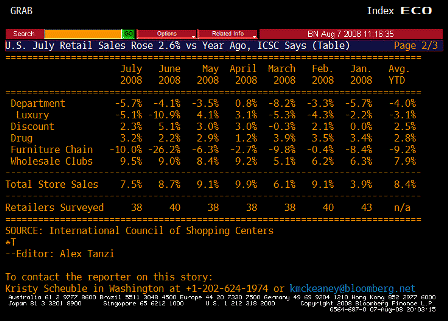
Less then expected but not bad.

[top][end]

ICSC TABLE 1 (Jul)

[top][end]

ICSC TABLE 2 (Jul)

[top][end]


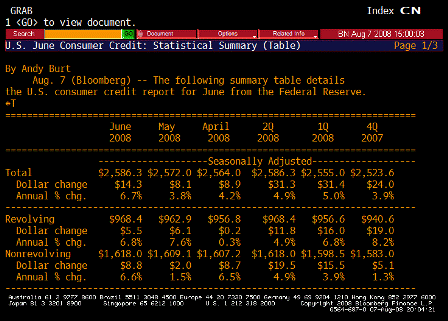
Consumer Credit (Jun)

Survey $6.3B
Actual $14.3B
Prior $7.8B
Revised $8.1B

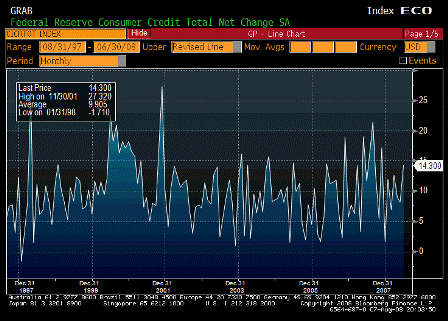
Volatile series. Moving up some to support higher levels of spending.

[top][end]

Consumer Credit TABLE 1 (Jun)

[top][end]

Consumer Credit TABLE 2 (Jun)

Note from the graph the improving position of the domestic sector as the government deficit and net exports rise and support domestic ‘savings’ and spending. The US budget deficit is expected to exceed 3% this year and exports should remain firm even with slowing foreign economies. In fact, that’s one of the primary reasons those economies are slowing.

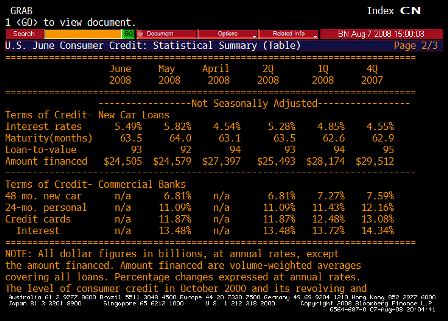
U.S. June Consumer Credit Up $14.3 Billion, More Than Forecast

by Shobhana Chandra

(Bloomberg) U.S. consumers borrowed more than twice as much as economists forecast in June as the slump in real-estate prices prevented American homeowners from tapping into home-equity lines of credit.

Consumer credit rose by $14.3 billion, the most since November, to $2.59 trillion, the Federal Reserve said today in Washington. In May, credit rose by $8.1 billion, previously reported as an increase of $7.8 billion. The Fed’s report doesn’t cover borrowing secured by real estate.

Consumers are using credit cards and loans to cover expenses as falling home values cause banks to restrict access to home- equity lines. The Bush administration sent out tax rebate checks in the past three months to help support spending, which accounts for more than two-thirds of the economy.

“Consumers are stressed, and some who are short of cash are relying more on credit cards,” Joseph Brusuelas, chief economist at Merk Investments LLC in Palo Alto, California, said before the report.


[top]

Re: Sov CDS: ny open 15Jul08


[Skip to the end]

(an email exchange)

>    On Tue, Jul 15, 2008 at 11:03 AM, Mike wrote:
>
>    Should we be looking at selling protection on USTs for 20bps?
>

makes sense

And makes even more sense for the Fed to be selling it:

  1. free money (really sort of a tax for those who want to pay it, but whatever)
  2. assists market functioning


>
>
>    Sov CDS: ny open 15Jul08
>
>    Credit 5yr 10yrket Credit 5yr 10yr
>    Austria 12.5/15.5 17.0/18.5 Ireland 27.5/30.5 37.0/39.0
>    Belgium 19.0/22.0 26.5/29.0 Italy 41.0/43.0 51.5/53.5
>    Denmark 10.0/12.5 15.0/17.5 Nether 10.5/12.5 15.0/17.0
>    Finland 10.0/12.5 15.0/17.5 Portug 38.0/40.0 48.0/50.0
>    France 11.0/13.0 15.0/17.5 Spain 38.0/40.0 47.5/49.5
>    Germany 6.0/8.0 9.75/10.75 Sweden 10.5/12.5 15.0/17.0
>    Greece 51.0/53.0 61.5/63.5 UK 14.5/17.5 21.0/24.0
>    Iceland 250/290 240/300 US 14.5/18.5 19.0/25.0
>
>


[top]

2008-06-11 EU Highlights


[Skip to the end]

Highlights

French Inflation Accelerates to 12-Year High of 3.7%
Spain’s Core Inflation Accelerated in May as Food Costs Surged
Germany’s Weise Says Unemployment May Fall More Than Expected
Stark Says ECB Not Talking About Series of Increases

Doesn’t mean they won’t do it.

ECB’s Liikanen Sees Inflation Expectations Rising

If inflation expectations remain elevated.

Spain, Portugal, Italy Worry About Rate Increases, WSJ Says


[top]

2008-05-30 EU News Highlights


[Skip to the end]

Highlights

European Inflation Accelerates More Than Forecast as Oil Surges

Note the concern over inflation expectations in the text below.
That’s what has turned the Fed as well.

German Retail Sales Unexpectedly Dropped on Inflation
Weber Rules Out Changing ECB’s Current Inflation Goal

While the US economic memory from the depression is unemployment lines, the German memory is wheelbarrows full of money.

Eurozone unemployment is down to about 7% which frightens the inflation hawks, as per the below reports.

Trichet Says Pushing Down Inflation Is ECB’s Biggest Challenge

[top][end]


Articles

European Inflation Accelerates More Than Forecast as Oil Surges

(Bloomberg) European inflation accelerated faster than economists forecast this month as oil prices jumped to a record, adding to what European Central Bank President Jean-Claude Trichet has called policy makers’ “biggest challenge.”

The inflation rate in the euro area rose to 3.6 percent, matching a 16-year high, from 3.3 percent in April, the European Union statistics office in Luxembourg said in a statement today.

Economists had forecast a 3.5 percent rate, according to the median of 36 estimates in a Bloomberg survey.

The ECB, which aims to keep consumer-price growth below 2 percent, said yesterday there are signs inflation expectations “have been trending up recently” and it’s imperative that they remain contained. The Frankfurt-based bank celebrates its 10th anniversary this weekend, having failed to meet its target for the last eight years.

“There has been a sharp deterioration in the inflation picture,” said Simon Barry, an economist at Ulster Bank in Dublin. “Our base case is the ECB is on hold for now, but the inflation risk has increased and there’s no room for complacency.”

Separate figures published by the statistics office today show that unemployment in the euro area remained at a record low 7.1 percent in April.

Crude Oil
Crude oil prices have doubled in the last 12 months and reached a record $135.09 May 22. Food commodities have also surged in the last year, boosting how much consumers are paying for staples such as bread and milk. Wheat has gained 45 percent in the past year and corn has surged 51 percent.

Soaring prices have led to protests in Europe and companies and consumers expect prices to continue to rise. A European Commission index of manufacturers’ selling price expectations increased this month, while consumers’ outlook for their personal finances deteriorated. Greencore Group Plc, the world’s biggest maker of prepared sandwiches, this week said it’s been passing on cost increases to customers by raising its prices.

In France, fishermen have blockaded ports in the past week to protest against the increase in oil prices, while a group representing bus companies in Ireland said it may have to stop school runs because of the cost of gasoline.

Key Rate
The ECB has kept its key rate at a six-year high of 4 percent to counter inflation even as the economy of the 15 euro nations cools. The central bank is concerned that wages will increase to compensate for the higher cost of living, threatening a wage-price spiral.

“We’re looking at below trend growth” in the euro area, said Barry, the Ulster Bank economist. “But for the ECB to consider cutting, that would require a pretty sharp weakening in the economy and nothing so far is heading that way.”

(snip)

Some companies are raising salaries. German wages increased the most in 12 years in January, the statistics office said last month. Germany’s Ver.di union in March negotiated a settlement for as many as 2.1 million public-sector staff that is worth 8.9 percent over two years.

[top][end]

Weber Rules Out Changing ECB’s Current Inflation Goal

(Bloomberg) European Central Bank council member Axel Weber said revising the ECB’s definition of price stability would jeopardize the bank’s credibility at a time when fighting inflation is “of the essence.”

“I see no compelling reason why a temporary, albeit protracted, rise in energy and food prices should give rise to a discretionary change in the eurosystem’s stability norm,” Weber said at a conference in Frankfurt today. “It would risk unanchoring inflation expectations at a point in time where their solid anchoring is of the essence.”

The ECB defines price stability as keeping inflation just below 2 percent “over the medium term” and has struggled to meet that goal since taking charge of monetary policy in 1999. While economists including Joachim Fels of Morgan Stanley say the ECB should be open to changing its target, President Jean-Claude Trichet said May 8 he won’t consider it “for one second.”

“The present price hikes are a timely reminder that, when it comes to inflation, complacency is out of place,” said Weber, who is also head of Germany’s Bundesbank. “We cannot rest on our laurels where credibility is concerned.”

`Prepared to Act’
The ECB’s 21-member governing council is scheduled to hold its next assessment on interest rates on June 5.

“Over the past decade, the Eurosystem has shown that — if necessary — it is prepared to act in a firm and timely manner,” Weber said. “We will continue to do so over the next decades in order to maintain price stability.”

Surging energy costs pushed inflation to 3.6 percent in May, the most since 1992, from 3.3 percent in the previous month, the European Union’s statistics office in Luxembourg said today.

Economists forecast a 3.5 percent rate, according to the median of 36 estimates in a Bloomberg survey.

Surging food and oil prices “represent the latest, and arguably the most worrying, disturbance in a series of substantial upside price shocks,” Weber said.

Inflation expectations, as measured by French inflation-indexed bonds, rose to an all-time high of 2.46 percent on May 28 from around 2.1 percent two months ago.

A surge in inflation expectations close to 3 percent for this year “is hardly surprising,” Weber said. “Market participants and the general public are likely to readjust their short-term inflation expectations as soon as they observe inflation returning to a lower level.”

[top][end]

Trichet Says Pushing Down Inflation Is ECB’s Biggest Challenge

(Bloomberg) European Central Bank President Jean-Claude Trichet said the central bank’s “biggest challenge” is to push inflation just below 2 percent in the medium term, according to an interview with Bild newspaper.

“We have to be careful that current price shocks of food and oil don’t translate into price increases of other goods and exaggerated wage agreements, thus triggering a general inflation and wage wave,” Trichet told the newspaper in the interview published today. Bild translated his remarks into German.

Price stability “is and will always be the most important aim of the ECB,” Trichet told the newspaper. Regarding the global financial turbulence, the ECB continues to be “very alert and ready to act” if needed, he said.

[top][end]

Germany is the only large member of the euro zone where the measure of economic sentiment remains above its long-term average of 100.0. It rose slightly to 103.0 in May from 102.8 in April.

French economic sentiment in May fell below the 100.0 long-term average for the first time in more than a year, declining to 99.8 from 103.1 a month earlier. Sentiment remains well below average in Italy, Spain and Greece.


[top]

Fed minutes – longish version


[Skip to the end]

I cut quite a bit, but still a lot worth a quick read:

In view of continuing strains in interbank and other financial markets, the Committee took up proposals to expand several of the liquidity arrangements that had been put in place in recent months. Chairman Bernanke indicated his intention to increase the overall size of the Term Auction Facility under delegated authority from the Board of Governors, and he proposed increases in the swap lines with the European Central Bank and Swiss National Bank to help address pressures in short-term dollar funding markets.

Still problems with USD funding in the eurozone.

By unanimous votes, the Committee approved the following three resolutions:

The Federal Open Market Committee directs the Federal Reserve Bank of New York to increase the amount available from the System Open Market Account under the existing reciprocal currency arrangement (“swap” arrangement) with the European Central Bank to an amount not to exceed $50 billion. Within that aggregate limit, draws of up to $25 billion are hereby authorized. The current swap arrangement shall be extended until January 30, 2009, unless further extended by the Federal Open Market Committee.

The Federal Open Market Committee directs the Federal Reserve Bank of New York to increase the amount available from the System Open Market Account under the existing reciprocal currency arrangement (“swap” arrangement) with the Swiss National Bank to an amount not to exceed $12 billion. Within that aggregate limit, draws of up to $6 billion are hereby authorized. The current swap arrangement shall be extended until January 30, 2009, unless further extended by the Federal Open Market Committee.

The information reviewed at the April meeting, which included the advance data on the national income and product accounts for the first quarter, indicated that economic growth had remained weak so far this year. Labor market conditions had deteriorated further, and manufacturing activity was soft. Housing activity had continued its sharp descent, and business spending on both structures and equipment had turned down. Consumer spending had grown very slowly, and household sentiment had tumbled further. Core consumer price inflation had slowed in recent months, but overall inflation remained elevated.

The stronger than expected April numbers hadn’t been released yet, including the drop in the unemployment rate to 5.0%.

Although industrial production rose in March, production over the first quarter as a whole was soft, having declined, on average, in January and February. Gains in manufacturing output of consumer and high-tech goods in March were partially offset by a sharp drop in production of motor vehicles and parts and by ongoing weakness in the output of construction-related industries. The output of utilities rebounded in March following a weather-related drop in February, and mining output moved up after exhibiting weakness earlier in the year. The factory utilization rate edged up in March but stayed well below its recent high in the third quarter of 2007.

Real consumer spending expanded slowly in the first quarter. Real outlays on durable goods, including automobiles, were estimated to have declined in March, but expenditures on nondurable goods were thought to have edged up, boosted by a sizable increase in real outlays for gasoline. For the quarter as a whole, however, real expenditures on both durable and nondurable goods declined. Real disposable personal income also grew slowly in the first quarter, restrained by rapidly rising prices for energy and food. The ratio of household wealth to disposable income appeared to have moved down again in the first quarter, damped by the appreciable net decline in broad equity prices over that period and by further reductions in house prices. Measures of consumer sentiment fell sharply in March and April; the April reading of consumer sentiment published in the Reuters/University of Michigan Survey of Consumers was near the low levels posted in the early 1990s.

That’s how it goes in an export driven economy. They haven’t recognized that yet:

Residential construction continued its rapid contraction in the first quarter. Single-family housing starts maintained their steep downward trajectory in March, and starts of multifamily homes declined to the lower portion of their recent range. Sales of new single-family homes declined in February to a very low rate and dropped further in March. Even though production cuts by homebuilders helped to reduce the level of inventories at the end of February, the slow pace of sales caused the ratio of unsold new homes to sales to increase further. Sales of existing homes remained weak, on average, in February and March, and the index of pending sales agreements in February suggested continued sluggish activity in coming months. The recent softening in residential housing demand was consistent with reports of tighter credit conditions for both prime and nonprime borrowers.

Recent signs of housing stabilizing haven’t materialized yet.

The U.S. international trade deficit widened in February. Imports rose sharply, more than offsetting continued robust growth of exports. Most major categories of non-oil imports increased in February, and imports of natural gas, automobiles, and consumer goods surged. Imports of services continued to rise at a robust pace. By contrast, oil imports moved down. Increases in exports in February were concentrated in agricultural goods, automobiles, and industrial supplies, particularly fuels. Exports of capital goods declined for the second consecutive month, with weakness evident across a wide range of products.

The March numbers weren’t out yet, and they bounced back strongly, resulting in upward revisions to Q1 GDP.

Real economic growth in the major advanced foreign economies was estimated to have slowed further in the first quarter and consumer and business sentiment was generally down. In Japan, business sentiment fell significantly and indicators of investment remained weak. In the euro area, growth was estimated to have remained subdued in the first quarter, with Germany and France faring better than Italy and Spain. Growth in the United Kingdom slowed in the first quarter, as credit conditions tightened. Available data for Canada indicated a continued substantial drag from exports in the first quarter, although domestic demand appeared relatively robust. In emerging market economies, economic growth slowed some in the fourth quarter and was estimated to have held about steady in the first quarter. In emerging Asia, real economic growth was estimated to have picked up in the first quarter from a robust pace in the fourth quarter, led by brisk expansions in China and Singapore. Growth in other emerging Asian economies generally remained subdued. The pace of expansion in Latin America likely declined some in the first quarter, largely because the Mexican economy slowed in the wake of softer growth in the United States.

Headline inflation in the United States was elevated in March. Although the increase in food prices slowed in March relative to earlier in the year, energy prices rose sharply. Excluding these categories, core inflation rose at a relatively subdued rate again in March. The core personal consumption expenditures (PCE) price index increased at a somewhat more moderate rate in the first quarter than in the fourth quarter of 2007. Survey measures of households’ expectations for year-ahead inflation rose further in early April, but survey measures of longer-term inflation expectations moved relatively little. Average hourly earnings increased in March at a somewhat slower pace than in January and February. This wage measure rose significantly less over the 12 months that ended in March than in the previous 12 months. The employment cost index for hourly compensation continued to rise at a moderate rate in the first quarter.

Food and energy have since gone up further than forecast at the meeting.

At its March 18 meeting, the Federal Open Market Committee (FOMC) lowered its target for the federal funds rate 75 basis points, to 2-1/4 percent. In addition, the Board of Governors approved a decrease of 75 basis points in the discount rate, to 2-1/2 percent. The Committee’s statement noted that recent information indicated that the outlook for economic activity had weakened further; growth in consumer spending had slowed, and labor markets had softened. It also indicated that financial markets remained under considerable stress, and that the tightening of credit conditions and the deepening of the housing contraction were likely to weigh on economic growth over the next few quarters. Inflation had been elevated, and some indicators of inflation expectations had risen, but the Committee expected inflation to moderate in coming quarters, reflecting a projected leveling-out of energy and other commodity prices and an easing of pressures on resource utilization.

Which didn’t happen.

Still, the Committee noted that uncertainty about the inflation outlook had increased, and that it would be necessary to continue to monitor inflation developments carefully. The Committee said that its action, combined with those taken earlier, including measures to foster market liquidity, should help to promote moderate growth over time and to mitigate the risks to economic activity. The Committee noted, however, that downside risks to growth remained, and indicated that it would act in a timely manner as needed to promote sustainable economic growth and price stability.

Conditions in U.S. financial markets improved somewhat, on balance, over the intermeeting period, but strains in some short-term funding markets increased. Pressures on bank balance sheets and capital positions appeared to mount further, reflecting additional losses on asset-backed securities and on business and household loans. Against this backdrop, term spreads in interbank funding markets and spreads on commercial paper issued by financial institutions widened significantly. Financial institutions continued to tap the Federal Reserve’s credit programs. Primary credit borrowing picked up noticeably after March 16, when the Federal Reserve reduced the spread between the primary credit rate and the target federal funds rate to 25 basis points. Demand for funds from the Term Auction Facility stayed high over the period. In addition, the Primary Dealer Credit Facility drew substantial demand through late March, although the amount outstanding subsequently declined somewhat. Early in the period, historically low interest rates on Treasury bills and on general-collateral Treasury repurchase agreements indicated a considerable demand for safe-haven assets. However, Federal Reserve actions that increased the availability of Treasury securities to the public apparently helped to improve conditions in those markets. In five weekly auctions beginning on March 27, the Term Securities Lending Facility provided a substantial volume of Treasury securities in exchange for less-liquid assets. Yields on short-term Treasury securities and Treasury repurchase agreements moved higher, on balance, following these auctions; nonetheless, “haircuts” applied by lenders on non-Treasury collateral remained elevated, and in some cases increased somewhat, toward the end of the period.

In longer-term credit markets, yields on investment-grade corporate bonds rose, but their spreads relative to Treasury securities decreased a bit from recent multiyear highs. In contrast, yields on speculative-grade issues dropped, and their spreads relative to Treasury yields narrowed significantly. Gross bond issuance by nonfinancial firms was robust in March and the first half of April and included a small amount of issuance by speculative-grade firms. Supported by increases in business and residential real estate loans, commercial bank credit expanded briskly in March despite the report of tighter lending conditions in the Senior Loan Officer Opinion Survey on Bank Lending Practices conducted in April. Part of the strength in commercial and industrial loans was apparently due to increased utilization of existing credit lines, the pricing of which reflects changes in lending policies only with a lag.

Also, though standards were ‘tightened’, that doesn’t mean most borrowers can’t meet those standards.

Some banks surveyed in April reported that they had started to take actions to limit their exposure to home equity lines of credit, draws on which had grown rapidly in recent months. After having tightened considerably in March, conditions in the conforming segment of the residential mortgage market recovered somewhat. Spreads of rates on conforming residential mortgages over those on comparable-maturity Treasury securities decreased, and credit default swap premiums for the government-sponsored enterprises declined substantially. Broad stock price indexes increased markedly over the intermeeting period, mainly in response to earnings reports and announcements of recapitalizations from major financial institutions that evidently lessened investors’ concerns about the possibility of severe difficulties materializing at those firms.

Conditions in the money markets of major foreign economies remained strained, particularly in the United Kingdom and the euro area. Term interbank funding spreads rose in these areas, despite steps taken by their central banks to help ease liquidity pressures. Yields on sovereign debt in the advanced foreign economies moved up in a range that was about in line with the increases in comparable Treasury yields in the United States. The trade-weighted foreign exchange value of the dollar against major currencies rose.

The dollar is back down now.

M2 expanded briskly again in March, as households continued to seek the relative liquidity and safety of liquid deposits and retail money market mutual funds. The increases in these components were also supported by declines in opportunity costs stemming from monetary policy easing.

Over the intermeeting period, the expected path of monetary policy over the next year as measured by money market futures rates moved up significantly on net, apparently because economic data releases and announcements by large financial firms imparted greater confidence among investors about the prospects for the economy’s performance in coming quarters. Futures rates also moved up in response to both the Committee’s decision to lower the target for the federal funds rate by 75 basis points at the March 18 meeting, which was a somewhat smaller reduction than market participants had expected, and the Committee’s accompanying statement, which reportedly conveyed more concern about inflation than had been anticipated.

Yes.

The subsequent release of the minutes of the March FOMC meeting elicited limited reaction. Consistent with the higher expected path for policy and easing of safe-haven demands, yields on nominal Treasury coupon securities rose substantially over the period, and the Treasury yield curve flattened. Measures of inflation compensation for the next five years derived from yields on inflation-indexed Treasury securities were quite volatile around the time of the March FOMC meeting and on balance increased somewhat over the intermeeting period, although they remained in the lower portion of their range over the past several months. Measures of longer-term inflation compensation declined, returning to around the middle of their recent elevated range.

They seem to continue to give these quite a bit of weight.

In the forecast prepared for this meeting, the staff made little change to its projection for the growth of real gross domestic product (GDP) in 2008 and 2009. The available indicators of recent economic activity had come in close to the staff’s expectations and had continued to suggest that a substantial softening in economic activity was under way. The staff projection pointed to a contraction of real GDP in the first half of 2008 followed by a modest rise in the second half of this year, aided in part by the fiscal stimulus package.

Doesn’t look like there will be a contraction; so, GDP is likely to be higher than staff forecasts.
The forecast showed real GDP expanding at a rate somewhat above its potential in 2009, reflecting the impetus from cumulative monetary policy easing, continued strength in net exports, a gradual lessening in financial market strains, and the waning drag from past increases in energy prices. Despite this pickup in the pace of activity, the trajectory of resource utilization anticipated through 2009 implied noticeable slack. The projection for core PCE price inflation in 2008 as a whole was unchanged; it was reduced a bit over the first half of the year to reflect the somewhat lower-than-expected readings of recent core PCE inflation and raised a bit over the second half of the year to incorporate the spillover from larger-than-anticipated increases in prices of crude oil and non-oil imports since the previous FOMC meeting.
Here’s where the subsequent talk of headline measures passing into core was discussed.

The forecast of headline PCE inflation in 2008 was revised up in light of the further run-up in energy prices and somewhat higher food price inflation; headline PCE inflation was expected to exceed core PCE price inflation by a considerable margin this year. In view of the projected slack in resource utilization in 2009 and flattening out of oil and other commodity prices, both core and headline PCE price inflation were projected to drop back from their 2008 levels, in line with the staff’s previous forecasts.

They are relying on slack in 2009 to bring down this year’s inflation.

In conjunction with the FOMC meeting in April, all meeting participants (Federal Reserve Board members and Reserve Bank presidents) provided annual projections for economic growth, the unemployment rate, and inflation for the period 2008 through 2010. The projections are described in the Summary of Economic Projections, which is attached as an addendum to these minutes.

These were all before subsequent ‘better than expected’ releases, higher crude prices, and a falling USD.

In their discussion of the economic situation and outlook, FOMC participants noted that the data received since the March FOMC meeting, while pointing to continued weakness in economic activity, had been broadly consistent with their expectations. Conditions across a number of financial markets were judged to have improved over the intermeeting period, but financial markets remained fragile and strains in some markets had intensified. Although participants anticipated that further improvement in market conditions would occur only slowly and that some backsliding was possible, the generally better state of financial markets had caused participants to mark down the odds that economic activity could be severely disrupted by a further substantial deterioration in the financial environment.

Their concern of systematic tail risk has gone down substantially.

Economic activity was anticipated to be weakest over the next few months, with many participants judging that real GDP was likely to contract slightly in the first half of 2008. GDP growth was expected to begin to recover in the second half of this year, supported by accommodative monetary policy and fiscal stimulus, and to increase further in 2009 and 2010. Views varied about the likely pace and vigor of the recovery through 2009, although all participants projected GDP growth to be at or above trend in 2010. Incoming information on the inflation outlook since the March FOMC meeting had been mixed. Readings on core inflation had improved somewhat, but some of this improvement was thought likely to reflect transitory factors, and energy and other commodity prices had increased further since March. Total PCE inflation was projected to moderate from its current elevated level to between 1-1/2 percent and 2 percent in 2010, although participants stressed that this expected moderation was dependent on food and energy prices flattening out and critically on inflation expectations remaining reasonably well anchored.

As per Kohn’s latest speech, they have seen these inflation expectations begin to elevate.

Conditions across a number of financial markets had improved since the previous FOMC meeting. Equity prices and yields on Treasury securities had increased, volatility in both equity and debt markets had ebbed somewhat, and a range of credit risk premiums had moved down. Participants noted that the better tone of financial markets had been helped by the apparent willingness and ability of financial institutions to raise new capital. Investors’ confidence had probably also been buoyed by corporate earnings reports for the first quarter, which suggested that profit growth outside of the financial sector remained solid,

Yes, they have noted that outside the financial sector and housing the economy looks pretty good.

and also by the resolution of the difficulties of a major broker-dealer in mid-March.

Probably Bear Stearns.

NOTE: They didn’t refer to it by name.

Moreover, the various liquidity facilities introduced by the Federal Reserve in recent months were thought to have bolstered market liquidity and aided a return to more orderly market functioning. But participants emphasized that financial markets remained under considerable stress, noted that the functioning of many markets remained impaired, and expressed concern that some of the recent recovery in markets could prove fragile. Strains in short-term funding markets had intensified over the intermeeting period, in part reflecting continuing pressures on the liquidity positions of financial institutions. Despite a narrowing of spreads on corporate bonds, credit conditions were seen as remaining tight. The Senior Loan Officer Opinion Survey on Bank Lending Practices conducted in April indicated that banks had tightened lending standards and pricing terms on loans to both businesses and households. Participants stressed that it could take some time for the financial system to return to a more normal footing, and a number of participants were of the view that financial headwinds would probably continue to restrain economic activity through much of next year. Even so, the likelihood that the functioning of the financial system would deteriorate substantially further with significant adverse implications for the economic outlook was judged by participants to have receded somewhat since the March FOMC meeting.
The housing market had continued to weaken since the previous meeting, and participants saw little indication of a bottoming out in either housing activity or prices. Housing starts and the demand for new homes had declined further, house prices in many parts of the country were falling faster than they had towards the end of 2007, and inventories of unsold homes remained quite elevated. A small number of participants reported tentative signs that housing activity in a few areas of the country might be beginning to pick up, and a narrowing of credit risk spreads on AAA indexes of sub-prime mortgages in recent weeks was also noted. Nonetheless, the outlook for the housing market remained bleak, with housing demand likely to be affected by restrictive conditions in mortgage markets, fears that house prices would fall further, and weakening labor markets. The possibility that house prices could decline by more than anticipated, and that the effects of such a decline could be amplified through their impact on financial institutions and financial markets, remained a key source of downside risk to participants’ projections for economic growth.

There have been subsequent glimmers of hope that housing has stabilized and may be turning.

Growth in consumer spending appeared to have slowed to a crawl in recent months and consumer sentiment had fallen sharply. The pressure on households’ real incomes from higher energy prices and the erosion of wealth resulting from continuing declines in house prices likely contributed to the deceleration in consumer outlays. Reports from contacts in the banking and financial services sectors indicated that the availability of both consumer credit and home equity lines had tightened considerably further in recent months and that delinquency rates on household credit had continued to drift upwards. Consumer sentiment and spending had also been held down by the softening in labor markets–nonfarm payroll employment had fallen for the third consecutive month in March and the unemployment rate had moved up. The restraint on spending emanating from weakness in labor markets was expected to increase over coming quarters, with participants projecting the unemployment rate to pick up further this year and to remain elevated in 2009.

Subsequently, the unemployment rate fell.

Consumption spending was likely to be supported in the near term by the fiscal stimulus package, which was expected to boost spending temporarily in the middle of this year. Some participants suggested that the weak economic environment could increase the propensity of households to use their tax rebates to pay down existing debt and so might diminish the impact of the package. However, it was also noted that the tightening in credit availability might mean a significant number of households may be credit constrained and this might increase the proportion of the rebates that is spent. The timing and magnitude of the impact of the stimulus package on GDP was also seen as depending on the extent to which the boost to consumption spending is absorbed by a temporary run-down in firms’ inventories or by an increase in imports rather than by an expansion in domestic output.

The jurry is still out on this. My guess is the rebates will add more to GDP than forecasted.

The outlook for business spending remained decidedly downbeat. Indicators of business sentiment were low, and reports from business contacts suggested that firms were scaling back their capital spending plans. Several participants reported that uncertainty about the economic outlook was leading firms to defer spending projects until prospects for economic activity became clearer. The tightening in the supply of business credit was also seen as holding back investment, with some firms apparently reluctant to reduce their liquidity positions in the current environment. Spending on nonresidential construction projects continued to slow, although the extent of that slowing varied across the country. A few participants reported that the commercial real estate market in some areas remained relatively firm, supported by low vacancy rates.

Yes.

The strength of U.S. exports remained a notable bright spot. Growth in exports, which had been supported by solid advances in foreign economies and by declines in the foreign exchange value of the dollar, had partially insulated the output and profits of U.S. companies, especially those in the manufacturing sector, from the effects of weakening domestic demand. Several participants voiced concern, however, that the pace of activity in the rest of the world could slow in coming quarters, suggesting that the impetus provided from net exports might well diminish.

The March numbers subsequently released showed further acceleration of exports.

The information received on the inflation outlook since the March FOMC meeting had been mixed. Recent readings on core inflation had improved somewhat, although participants noted that some of that improvement probably reflected transitory factors. Moreover, the increase in crude oil prices to record levels, together with rapid increases in food and import prices in recent months, was likely to put upward pressure on inflation over the next few quarters. Prices embedded in futures contracts continued to point to a leveling-off of energy and commodity prices.

Still misreading the info implied from futures prices:

Although these futures contracts probably remained the best basis for projecting movements in commodity prices, participants emphasized the considerable uncertainty attending the likely path of commodity prices and cautioned that commodity prices in recent years had often advanced more quickly than had been implied by futures contracts. Several participants reported that business contacts had expressed growing concerns about the increase in their input costs and that there were signs that an increasing number of firms were seeking to pass on these higher costs to their customers in the form of higher prices. Other participants noted, however, that the extent of the pass-through of higher energy and food prices to core retail prices appeared relatively limited to date, and that profit margins in the nonfinancial sector remained reasonably high, suggesting that there was some scope for firms to absorb cost increases without raising prices. Available data and anecdotal reports indicated that gains in labor compensation remained moderate, and some participants suggested that wage growth was unlikely to pick up sharply in coming quarters if, as anticipated, labor markets remained relatively soft. However, several participants were of the view that wage inflation tended to lag increases in prices and so may not provide a useful guide to emerging price pressures.

Agreed!

On balance, participants expected the recent increases in oil and food prices to continue to boost overall consumer price inflation in the near term; thereafter, total inflation was projected to moderate, with all participants expecting total PCE inflation of between 1-1/2 percent and 2 percent by 2010. Participants stressed that the expected moderation in inflation was dependent on the continued stability of inflation expectations.

One can’t overstate the weight they all put on inflation expections, which are now seen as elevating.

A number of participants voiced concern that long-term inflation expectations could drift upwards if headline inflation remained elevated for a protracted period or if the recent substantial policy easing was misinterpreted by the public as suggesting that Committee members had a greater tolerance for inflation than previously thought.

This was again expressed recently by Vice Chair Kohn in his speech.

The possibility that inflation expectations could increase was viewed as a key upside risk to the inflation outlook. However, participants emphasized that appropriate monetary policy, combined with effective communication of the Committee’s commitment to price stability, would mitigate this risk.

‘Appropriate monetary policy’ opens the door for rate hikes.

Participants stressed the difficulty of gauging the appropriate stance of policy in current circumstances. Some participants noted that the level of the federal funds target, especially when compared with the current rate of inflation, was relatively low by historical standards. Even taking account of current financial headwinds, such a low rate could suggest that policy was reasonably accommodative. However, other participants observed that the pronounced strains in banking and financial markets imparted much greater uncertainty to such assessments and meant that measures of the stance of policy based on the real federal funds rate were not likely to provide a reliable guide in the current environment. Several participants expressed the view that the easing in monetary policy since last fall had not as yet led to a loosening in overall financial conditions, but rather had prevented financial conditions from tightening as much as they otherwise would have in response to escalating strains in financial markets. This view suggested that the stimulus from past monetary policy easing would be felt mainly as conditions in financial markets improved.

Seems there are three ‘camps’ on this point.

In the Committee’s discussion of monetary policy for the intermeeeting period, most members judged that policy should be eased by 25 basis points at this meeting. Although prospects for economic activity had not deteriorated significantly since the March meeting, the outlook for growth and employment remained weak and slack in resource utilization was likely to increase. An additional easing in policy would help to foster moderate growth over time without impeding a moderation in inflation.

There hasn’t been any forward looking sign of moderation since that meeting.

Moreover, although the likelihood that economic activity would be severely disrupted by a sharp deterioration in financial markets had apparently receded, most members thought that the risks to economic growth were still skewed to the downside. A reduction in interest rates would help to mitigate those risks. However, most members viewed the decision to reduce interest rates at this meeting as a close call.

Interesting statement!

The substantial easing of monetary policy since last September, the ongoing steps taken by the Federal Reserve to provide liquidity and support market functioning, and the imminent fiscal stimulus would help to support economic activity. Moreover, although downside risks to growth remained, members were also concerned about the upside risks to the inflation outlook, given the continued increases in oil and commodity prices and the fact that some indicators suggested that inflation expectations had risen in recent months. Nonetheless, most members agreed that a further, modest easing in the stance of policy was appropriate to balance better the risks to achieving the Committee’s dual objectives of maximum employment and price stability over the medium run.
The Committee agreed that that the statement to be released after the meeting should take note of the substantial policy easing to date and the ongoing measures to foster market liquidity. In light of these significant policy actions, the risks to growth were now thought to be more closely balanced by the risks to inflation. Accordingly, the Committee felt that it was no longer appropriate for the statement to emphasize the downside risks to growth. Given these circumstances, future policy adjustments would depend on the extent to which economic and financial developments affected the medium-term outlook for growth and inflation. In that regard, several members noted that it was unlikely to be appropriate to ease policy in response to information suggesting that the economy was slowing further or even contracting slightly in the near term, unless economic and financial developments indicated a significant weakening of the economic outlook.

In other words, no thought of more rate cuts without that change in outlook.

Votes for this action: Messrs. Bernanke, Geithner, Kohn, Kroszner, and Mishkin, Ms. Pianalto, Messrs. Stern and Warsh.

Votes against this action: Messrs. Fisher and Plosser.

Messrs. Fisher and Plosser dissented because they preferred no change in the target federal funds rate at this meeting. Although the economy had been weak, it had evolved roughly as expected since the previous meeting. Stresses in financial markets also had continued, but the Federal Reserve’s liquidity facilities were helpful in that regard and the more worrisome development in their view was the outlook for inflation. Rising prices for food, energy, and other commodities; signs of higher inflation expectations; and a negative real federal funds rate raised substantial concerns about the prospects for inflation. Mr. Plosser cited the recent rapid growth of monetary aggregates as additional evidence that the economy had ample liquidity after the aggressive easing of policy to date. Mr. Fisher was concerned that an adverse feedback loop was developing by which lowering the funds rate had been pushing down the exchange value of the dollar, contributing to higher commodity and import prices, cutting real spending by businesses and households, and therefore ultimately impairing economic activity. To help prevent inflation expectations from becoming unhinged, both Messrs. Fisher and Plosser felt the Committee should put additional emphasis on its price stability goal at this point, and they believed that another reduction in the funds rate at this meeting could prove costly over the longer run.

By notation vote completed on April 7, 2008, the Committee unanimously approved the minutes of the FOMC meeting held on March 18, 2008.


[top]

Bloomberg: Budget deficit to rise in Italy

Countercyclical budget deficit growth could bring on a national credit crisis in the Eurozone that makes the current US situation look like child’s play.

This is their vulnerability that came with the Maastricht Treaty and has yet to be tested.

Italy Halves Growth Forecast, Sees Deficit Rising

by Flavia Krause-Jackson

(Bloomberg) The Italian government cut its 2008 economic growth forecast by more than half, as slumping confidence and rising prices threaten to brake expansion to the slowest among the 15 nations that share the euro.

The $2.2 trillion economy, Europe’s fourth-biggest, will grow 0.6 percent this year, the Rome-based Finance Ministry said today in a statement. That’s down from a forecast of 1.5 percent in December and would be the weakest rate of growth since 2005.

Italy may be the first and only country in the euro region to enter a recession this year and may have contracted in the fourth quarter, according to Morgan Stanley economist Vladimir Pillonca. Growth is slowing just as rising food and energy prices are fueling inflation and sapping consumer and business confidence.

“If you add to the mix an international situation that is now weaker than expected, this creates a real mess in a country where productivity was already declining,” said Luigi Speranza, an economist at NP Paribas SA in London.

Italy’s budget deficit will rise to 2.4 percent of gross domestic product, more than the 2.2 percent formerly predicted though still under the European Union ceiling of 3 percent. The shortfall narrowed last year to 1.9 percent of gross domestic product, the least since 2000, the Rome-based national statistics office said Feb. 29. That’s about half the 2006 deficit of 3.4 percent.

Re: Italy BOT auction has to be cut back to clear

>
>     On Tue, Mar 11, 2008 at 7:52 AM, Dave Vealey wrote:
>
>     1 yr bill auction in Italy looks to have failed to get enough bids for
>     paper. Avg yield was 3.80% and high yield was 4.50%….
>
>     DV
>

Not good! This is where the real systemic risk lies, as previously discussed.

2008-01-16 EU Highlights

Overall, inflation and weakness continues:

European Inflation Holds Above 3% as Food Prices Soar
German 2007 Inflation Fastest Since Records Began
France: Inflation up to 2.3% in Q4 sunk real wages, spending
ECB’s Weber Says Shouldn’t `Over-Dramatize’ Inflation Jump
Europe’s Economies Face `Stagflation’ Risk This Year
Weber Says ECB Won’t Tolerate Excessive Pay Increases
European Car Sales Rose in 2007 on New Fiat, BMW Models
German First-Quarter Growth to Slow to 0.3 Percent
Bank of Italy Cuts 2008 Growth Forecast Due to Euro, Inflation
Bank of France Cuts Fourth-Quarter Growth Forecast to 0.4%
French Populace Grows to 63.8 Million, Second-Highest in Europe
Iceland delays banks’ plans to adopt the euro

Good choice.


♥