
TimesOnline: Latest on BoE rate setting

The mainstream view remains the cost of a near term recession in order to bring prices under control now is far less than the cost of a recession later if you support growth now and let prices continue higher.

Bank of England holds interest rate at 5%

by Gary Duncan, Grainne Gilmore

The Bank of England rebuffed mounting concerns over the rapidly weakening economy today and held interest rates at 5 per cent as it pursued its drive to quell soaring inflation.

The tough verdict from the Bank’s rate-setting Monetary Policy Committee (MPC) brushed aside pleas from business leaders and trade unions for a cut in base rates to shore up Britain’s growth, amid growing fears that the country is on the brink of recession.

The Bank’s decision came after headline consumer price inflation leapt to a 10-year high of 3.8 per cent in June, well above the Bank’s 2 per cent target, and amid expectations that it could hit 5 per cent over the summer, following swingeing increases in household gas and electricity bills imposed by utility companies.

The MPC had been widely expected to spurn pressure for a rate cut today in a bid to make clear its determination to bring inflation back to the target set by the Chancellor. The committee will almost certainly have discussed raising rates this morning, as it did last month, when Professor Tim Besley, voted for an immediate increase. He is expected to have done so again today, and may have been joined by other hawkish MPC members.

The Bank will set out its thinking more clearly next week when it publishes its latest forecasts for the economy in its quarterly Inflation Report. That is expected to emphasise the dilemma that the MPC confronts, with inflation set to soar far above target in the next few months, even as the economy slides towards a severe downturn.

The quandary facing the Bank was underlined yesterday as the International Monetary Fund sharply cut its forecasts for Britain’s growth this year and next, while issuing a warning that it saw “little scope” for interest rates to fall, although it also saw no need for an immediate rate rise.

Today’s no-change verdict by the MPC came despite bleak economic news in recent days, which have produced danger signs of recession.

Concern that Britain’s growth had ground to a virtual halt last month, and could even be in the grip of recession, were inflamed this week after bleak figures revealed growing frailty in the most critical parts of the economy.

These included shrinking activity in the services sector, the economy’s engine room that account for three quarters of the UK’s output, as well as in manufacturing.

The services sector, spanning businesses from cafes and leisure centres to accountancy and law firms, shrank for a third month in succession last month, according to the latest purchasing managers’ survey, regarded by the Bank as a key gauge of economic conditions.

Although services activity edged up from a seven-year low that was plumbed in June, the survey pointed to an even sharper slowdown ahead, with levels of outstanding business for the sector’s companies falling for a tenth month in a row, and inflows of new business dropping to a record low.

At the same time, it emerged that manufacturing is suffering its first sustained run of decline since 2001, after its output fell in June for a fourth month in a row, dropping by 0.5 per cent.

The figures were among the latest data confirming the dire plight of the economy, and came after official confirmation that the pace of Britain’s overall growth slowed to just 0.2 per cent in the second quarter, its weakest rate of expansion for three years.

The falling housing market remains a key source of economic anxiety, with the Nationwide Building Society reporting that house prices tumbled by a further 1.7 per cent last month, leaving them down 8.1 per cent on last year – their sharpest annual pace of decline since 1991.

The high street is also being badly hit by the downturn, with official figures showing that retail sales plunged by 3.9 per cent in June – their biggest monthly drop for 22 years.

Yesterday, the International Monetary Fund added to the mood of pessimism as it cut its forecast for Britain’s growth this year and next to only 1.4 per cent, and 1.1 per cent, respectively. The prediction of the UK’s worst performance since the end of the last recession raised the spectre of two years of economic misery.

In May, Mervyn King, Governor of the Bank, was forced to write an explanatory letter to the Chancellor, required by law, explaining why inflation had risen more than 1 point above its 2 per cent target, after it climbed to its then-high of 3.3 per cent. Mr King has admitted that he expects to write more such letters this year.

The Bank’s inflation headache has been further aggravated by signs of further severe price pressures in the pipeline to the consumer, Manufacturers’ costs rose at a record 30 per cent annual rate in June, and prices for goods leaving factories rose by a record 10 per cent. Inflation is being stoked by a sharp slide in the pound, by about 12 per cent over the past year, which lifts Britain’s bills for imported products.

However, there has been some let up in international food and energy costs, with oil prices tumbling by 13 per cent in a month, and prices for food products are also on the slide.
Re: UK economy


[Skip to the end]

(an email exchange)

>   
>   
>   On Wed, Aug 6, 2008 at 12:25 AM, Prof. P. Arestis wrote:
>   
>   Dear Warren,
>   
>   Just received the piece below. The situation over here is getting
>   worse but pretty much as expected.
>   
>   Recession signalled by key indicators of British economy
>   
>   
>   Best wishes, Philip
>   

Dear Philip,

Yes, seems tight fiscal has finally taken its toll and is now reversing the ugly way – falling revenues and rising transfer payments.

Without support from government deficit spending, consumer debt increases sufficient to support modest growth are unsustainable.

And with a foreign monopolist setting crude oil prices ‘inflation’ will persist until there is a large enough supply response,

It’s the BoE’s choice which to respond to, though ironically changing interest rates is for the most part ceremonial.

All the best,
Warren


[top]

AMEX/CAT


[Skip to the end]

Karim writes:

AMEX notes consumer spending slowed in latter part of quarter, suggesting effect of fiscal impulse waning. CAT driven by emerging market strength, states U.S. and Europe are two weakest regions, and expects rate cuts by Fed and ECB by year-end.

AMEX

  • Consumer spending slowed during the latter part of the quarter and credit indicators deteriorated beyond our expectations,” Mr Chenault said. The economic fallout was evident even among American Express’s prime customers.

CAT

  • CATERPILLAR SEES ECB CUTTING RATES AT LEAST 25BP BEFORE YR END
  • CATERPILLAR SEES NO SIGN OF RECOVERY IN NORTH AMERICAN HOUSING
  • CATERPILLAR ASSUMES AT LEAST ONE MORE RATE CUT LATER THIS YR
  • CATERPILLAR SEES ‘DIFFICULT’ FOR ECONOMY TO AVOID A RECESSION
  • CATERPILLAR SEES OIL PRICE AVG ABOUT 16% HIGHER IN LAST HALF
  • CATERPILLAR SAYS 2Q SALES/REVENUE UP 30% OUTSIDE NORTH AMERICA
  • Caterpillar Net Rises 34% as Asia, Mideast Building Lift Sales
  • Caterpillar Reports All-Time Record Quarter Driven by Strong Growth Outside North America
  • Right, weak domestic demand for sure. But note the last few lines that represent the booming exports even though domestic economies around the world are slowing.

    That’s what happens when they spend their accumulated hoard of USD here and spend less at home as they try to get rid of their USD hoards. This doesn’t stop until their holdings of USD fall to desired levels.

    I still see continued domestic weakness with GDP muddling through due to exports and government spending.

    And ever higher prices pouring in through the import/export channel.


    [top]

2008-06-25 EU News Highlights


[Skip to the end]

Weakness and inflation= rate hikes in the eurozone.

Fed response to same conditions later today.

Trichet Says Price-Stability Risks Have Intensified


Spanish Producer-Price Inflation Accelerates to 23-Year High


European Bonds Drop Before German Price Reports, as Stocks Gain


ECB’s Noyer Backs Inflation Vigilance, Flexible Exchange Rates


ECB’s Tumpel-Gugerell Says ECB Ready to Raise Rates If Needed


Wellink Says Inflation Accelerating, ECB on `Heightened Alert’


ECB Confirms August Press Conference, Scraps Summer Holiday


Inflation Tops Unemployment as Main Concern in EU, Survey Shows


German Consumer Optimism Nears 3-Year Low, Stern Poll Shows


Spain Recession Risk Climbs as Rates Move Higher, Survey Shows


Europe Heavy-Truck Sales Fall on Eastern Region Drop


[top]

Bloomberg: Mainstream criticism of FOMC


[Skip to the end]

As mainstream economists, the Fed knows it took a very large risk when it cut aggressively, hoping its forecasts for ‘moderating inflation’ would play out, and knowing the following would happen if ‘inflation’ accelerated.

Bernanke May Regret Interest-Rate Cuts, Lawson Says

by Kim-Mai Cutler

(Bloomberg) Former U.K. Chancellor of the Exchequer Nigel Lawson said Federal Reserve Chairman Ben S. Bernanke may be “regretting” the fastest pace of U.S. interest-rate cuts since 1984 as global inflation accelerates.

The Fed reduced its benchmark rate by 3.25 percentage points to 2 percent between September and April 30 to stave off a recession following the collapse of the U.S. subprime-mortgage market. The Bank of England, also facing a slowdown, cut its key rate by 0.75 percentage point to 5 percent. The European Central Bank left rates unchanged at 4 percent for a year and signaled this month it may raise them in July.

“The Bank of England has been very cautious and careful and it has been much closer to the views of the European Central Bank,” Lawson, 76, who was finance minister from 1983 to 1989 under former Prime Minister Margaret Thatcher, said in a telephone interview. “It has not gone conspicuously the way of the Fed, where I suspect that Mr. Bernanke’s now regretting it.”

U.S. consumer prices rose 0.6 percent in May, the most since November, the Labor Department said June 13. Inflation in the euro area accelerated last month to a 3.7 percent annual rate, the fastest since June 1992, the European Union reported June 16.

Inflation caused by rising commodity prices is the biggest threat to the world economy, eclipsing concern about the seizure in the credit markets, finance ministers from the Group of Eight nations said June 14. The World Bank said on June 10 that global economic growth will probably slow to 2.7 percent this year from 3.7 percent in 2007.

Oil ‘Bubble’
Rising food prices and a “speculative bubble” in oil markets will prompt central banks to lift rates, leading to a “growth recession” where the rate of expansion is lower than historical trends, Lawson said in the interview.

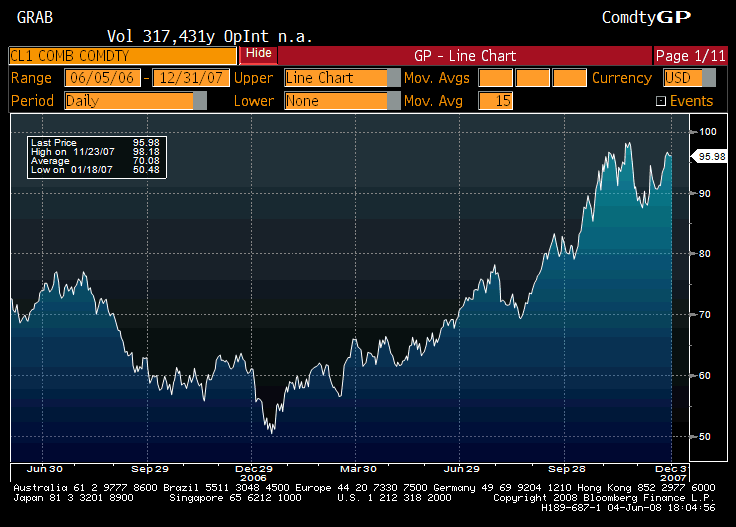
Crude oil rose 95 percent from a year ago and traded at an all-time high of $139.89 a barrel in New York June 16. Corn for December delivery also traded at a record $7.915 in Chicago.

“Most of the central banks are very, very clear on just how dangerous it is to let inflationary expectations get out of hand,” he said.

Traders see a 48 percent chance the Fed will raise its target rate for overnight bank loans from 2 percent as early as August, up from 4.1 percent odds a month ago, futures contracts on the Chicago Board of Trade show. The chances of an increase in October are 99 percent, the contracts show.

Michelle Smith, a Fed spokeswoman in Washington, declined to comment on Lawson’s remarks.

‘Shallow’ Recession
The slowdown in the U.K. is going to last “longer than most people expect,” while remaining “shallow,” Lawson said. The economy, the second-largest in Europe, grew 0.4 percent in the first quarter, its weakest pace since 2005, as higher credit costs hurt construction and business services slowed, according to the Office for National Statistics.

“This is the hangover after the binge,” Lawson said. “It’s going to be very, very difficult for the next two to three years for the global economy.”

The U.K. won’t adopt the euro in place of the pound as a global slowdown heightens tensions between members of the 27- nation European Union, Lawson said. Ireland vetoed the bloc’s new government treaty June 13, sinking an agreement that needed ratification by all EU countries.

“There are going to be considerable strains within the euro area,” Lawson said. “There are going to be a number of countries that found the single currency satisfactory during the benign period, that are now going to hurt much more under these difficult conditions.”


[top]

Central banks trying to limit backup


[Skip to the end]

Karim writes:

ECB-Board Member Bini Smaghi was 4th board member since last week’s press conference to say that one 25bp hike was enough to return inflation back to the 2% target in 2yrs time (Trichet, Stark, Orphanides before him). Whether true or not, market reaction since last Thursday clearly in excess of that expected or desired. This French economist’s website probably works against him but you never know; www.stroptrichet.com

BOE-‘The framework is based on the recognition that the actual inflation rate will on occasions depart from its target as a result of shocks and disturbances.
Attempts to keep inflation at the inflation target in these circumstances may cause undesirable volatility in output”. The Committee believes that, if Bank Rate were set to bring inflation back to the target within the next 12 months, the result would be unnecessary volatility in output and employment.

    ÃƒÆ’ Classic Philips curve trade-off being described here as well as amount of time given to bring inflation back to target

FRB-5 stories since Sunday trying to dampen rate hike expectations seems like a coordinated plant: Page 1 of WSJ today, FT article today citing ‘senior officials’, Market News piece from Beckner from yesterday, Washington Post article yesterday from Novak, and Blinder editorial in New York times on Sunday. Also Lacker was unusually tame yesterday in his remarks on inflation expectations.

Yes, agreed.

In fact, it can be said that this entire cycle has witnessed subdued inflation responses from top CBs. There is probably no precedent for the Fed cutting aggressively into the food/fuel negative supply shocks.

‘SOME’ have suggested this is a baby boomer phenomena – short sighted aversion to ‘pain’ by a bunch of spoiled kids more than willing to eat their seed corn seems to crop up everywhere. Nothing gets addressed until it gets bad enough to be a major crisis. Energy, biofuels, environment, Iran, weak levies, etc. etc. and now inflation.

It does seem to explain a lot.


[top]

Bernanke comments


[Skip to the end]

The FOMC can’t possibly believe that a 2% Fed Funds rate is the ‘right’ rate given current CPI of about 4%, core at about 2.5%, GPD moving back up towards 2%, unemployment ‘only’ about 5%, and inflation expectations showing signs of elevating.

The 2% Fed Funds rate is only appropriate if their forecasts show as sufficiently high probability of economic deterioration and increased ‘slack’.

As Fisher and other have put it, they all believe low and stable inflation is a necessary condition for optimal growth and employment.

The Lehman issue will pass with a lot less drama than the Bear Stearns issue.

Q2 GDP forecasts are being revised up as most numbers are coming in better than expected.

Inflation continues to move higher.

The ‘Mike Masters sell-off’ in commodities will run its course, with commodities subject to competitive markets underperforming, and crude moving higher (when the smoke clears – they try not to make their position too obvious as with the Goldman sell off of August 2006) as Saudis continue as price setter.

2008-06-04 Crude Sell Off in 2006

2006 Crude Sell Off

I expect the sell off to be less than the approximate three month sell off from the Goldman index change in 2006.

Obama is looking strong, but it has been historically problematic to propose tax hikes and win the election.


News reports of Bernanke’s speech:

“Some indicators of longer-term inflation expectations have risen in recent months, which is a significant concern for the Federal Reserve,” Bernanke said in a speech to graduating students at Harvard University.

Yes. To the point. They are concerned their own actions might indicate a higher tolerance for inflation and thereby elevate inflation expectations.

“We will need to monitor that situation closely,” he said, but added there was little sign a “1970s-style wage-price spiral, in which wages and prices chased each other ever upward,” might be starting.

The 1970s were all about oil prices working through the cost side of the economy, just as they are today. And there are still many nations with weak domestic demand, weak currencies, and continuously high levels of inflation.

He said the impact of soaring oil prices has been “relatively muted” because the amount of energy used to produce a given amount of output — a gauge known as energy intensity — has fallen markedly since the 1970s.

This only extends the delay between food/energy prices and core CPI.

He also said policy-makers learned a lesson in the 1970s, in particular that they must keep long-term inflation expectations anchored to achieve low and stable inflation.

Yes, the FOMC and the mainstream truly believes this. In fact, it’s all they have regarding ‘inflation’ vs. relative value changes in their models.

“If people expect an increase in inflation to be temporary and do not build it into their long-term plans for setting wages and prices, then the inflation created by a shock to oil prices will tend to fade relatively quickly,” he said.

Again, they all do truly believe this. They see inflation as a ‘monetary phenomena’, where somehow ‘too much money chases too few goods’. That makes ‘inflation’ a demand-side issue. Price pressures on the supply-side are only ‘relative value stories’ until ‘inflation expectations’ shape ‘long-term plans for setting wages and prices’.


[top]

Re: Alt A downgrades


[Skip to the end]

(An email exchange)

On Wed, Jun 4, 2008 at 12:57 AM, Eric wrote:
>     I guess you have seen this article.
>
>      Primes going down too.
>
>
>      More generally look at the attached graphs, they suggest that IOs and other
>      exotic mortgage are clearly a major cause of the problems, independently of
>      the quality of the loans. I think there is here a pretty good argument to make
>      that non-fixed mortgages, and more especially exotic mortgage have structural
>      characteristics that make them prone to speculative and ponzi structure. The
>      borrowers expect to be able to refinance at one point once interest rate reset or
>      the principal become due. Warren you were saying that proof of ability to pay
>     “libor plus 3 or whatever” was necessary to qualify. This margin of safety
>      (expected ability to pay libor +3 even though now borrower pay only teaser rate)
>      may have been destroyed in several ways.
>
>      – the interest rate may have reset at a higher rate than libor + 3, so that people
>      cannot afford the mortgage anymore.
>
>      – ARMs reinforce the probability of the previous effect, especially when libor when
>      up sky high after the crisis
>
>     – Income of borrowers felt short of expectations, expecially with the economic
>     slowdown (here fiscal policy is clearly a big player)
>
>     – The margin of safety thinned. Maybe previously they had to prove libor + 5 but
>     progressively borrower only had to prove libor + 4 then libor + 3. This would qualify
>      more borrowers and make the deal more sensitive to shock in product and financial
>      markets
>
>      In all this case the affordability of the mortgage is questioned Þ need to refinance Þ
>      if not available then sell the house (short sale or foreclosure). Fixed-rate mortgage
>      eliminate three of the previous reason (only income expectations is a problem).
>
>      Éric

agreed with all.

add to that food and energy prices taking income from home mtg payments, which could be the larger short term effect.

the fed has been taking some heat for this under the theory that the low rates have hurt the $ and thereby hurt the financial sector via the above channel, rather than helped the financial sector via lower rates ‘easing’ conditions via the lower payments channel.

the fed has argued this isn’t the case, insisting the lower rates have helped more than hurt.

also, the fiscal package could soften some of the delinquency increases for a few months.


[top]

Statement from Meltzer


[Skip to the end]

I like this not so much for his suggestion as for his assessment of the Fed.

This both expresses the market view of the Fed and the Fed’s own expressed concern that their previous actions could contribute to elevated inflation expectations.

“I think they should put interest rates up and worry about inflation. What do I think they’ll do? I think they’ll delay,” says Allan Meltzer, a professor of political economy at Carnegie Mellon and noted Fed watcher. “The Fed is spineless in response to pressures from Congress and pressures from Wall Street.”

In contrast, my best guess is the Fed is ready to act quickly to restore a ‘real rate’ ASAP as ‘market functioning’ risk subsides, no matter how weak the economy my get.

IMHO, it was blind fear of 1907/1930/gold standard deflationary tail risk that caused the Fed to cut rates into a triple negative supply shock, not a lack of resolve vs. inflation that pushed their ‘balance of risks’ towards ’emergency’ cuts with much talk of being ‘nimble’ regarding ‘taking them back’.

The immediate deflation risk was seen to be coming from the housing collapse.

While housing remains weak, it is no longer perceived to pose the same broad-based deflationary risk. Instead, it is showing signs of leveling off, and with GDP and personal income muddling through, housing looks to be muddling through at current levels as well.

NOTE: In August, the Fed didn’t cut because inflation was deemed too high, and it’s a lot higher now.

I don’t expect ‘ordinary’ recession risks to keep them from moving to put a brake on what they see as elevating inflation expectations.

Even Yellen the Dove is ready to hike. They all believe low inflation is a necessary condition for optimal long-term growth and employment, and inflation is now by far the greatest risk to long-term growth and employment.

And they all agree the cost of slow growth now to reign in inflation is far less then the cost of bringing down inflation later should it continue to get worse. In the ‘balance of risks’, inflation is a risk because it is perceived as a crucial risk to long-term growth.

They also agree that their dual mandate is, therefore, met by keeping inflation low, which automatically optimizes long-term growth and employment.

The remaining dove position is that inflation isn’t a problem, as evidenced by low core reports and well-anchored wage demands, and that the current output gap is sufficient to keep inflation expectations from elevating and bring inflation down to desired levels over the next few years.

That position is quickly losing support as evidenced by two actual dissenting votes and a growing movement to the hawk side as perceived deflationary tail risk subsides, inflation expectations show signs of elevating and food/crude/import prices remain firm as they are further supported by the fiscal package.


[top]