Chicago Fed, EU CPI

Who would have thought?

Chicago Fed National Activity Index
chi-fed-mar
Highlights
March was not a good month for the economy, an assessment confirmed by the national activity index which fell steeply to minus 0.42 vs an already weak and downwardly revised minus 0.18 in February. And the first quarter as a whole was also weak, reflected in the 3-month average which came in at minus 0.09.

The production component, at minus 0.27, pulled down the index the most in March followed by personal consumption & housing at minus 0.13. Employment also pulled down the index, at minus 0.3 for a big swing downward vs February’s plus 0.11. The only component in positive ground in March, and only barely, was sales/orders/inventories at only plus 0.01.

Imagine what inflation would be without the years of 0 rates, the QE, and the weak euro!

;)

European Union Consumer Prices Fall for Fourth Month

April 17 (WSJ) — Eurostat on Friday said consumer prices in the 28-nation bloc fell 0.1% in March from a year earlier, and confirmed data that showed prices in the eurozone were also 0.1% lower. In February, prices fell 0.3% in the EU as a whole, a figure that was revised from an earlier estimate of 0.2%. Twelve EU members experienced an annual decline in consumer prices in March, down from 20 in February. The decline in prices in the 12 months to March was largely due to a drop in energy costs, although that eased markedly. In the eurozone, energy prices rose 1.7% from February.

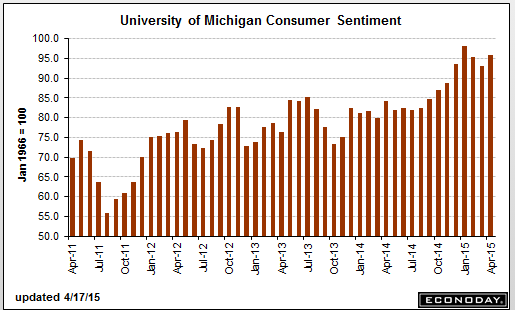
Michigan Consumer sentiment, CPI, Texas employment, rail traffic, apartment market

Again, this is one man one vote, not one dollar one vote:

er-4-17-1
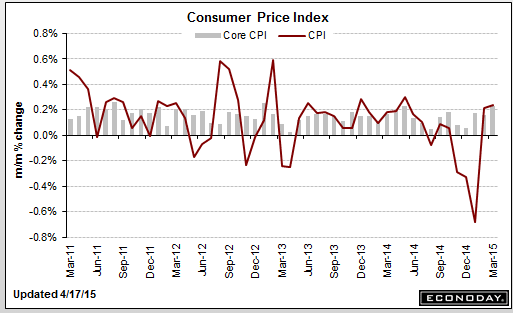
Consumer Price Index
er-4-17-2
Highlights
Higher energy prices coming up from low levels boosted the CPI. But the trend is still soft. Overall consumer price inflation rose 0.2 percent after rebounding 0.2 percent in February. The March figure equaled analysts’ forecast for a 0.2 percent gain. Energy increased 1.1 percent after gaining 1.0 percent in February. Gasoline prices increased 3.9 percent after rebounding 2.4 percent in February after plummeting 18.7 percent in January, Food slipped 0.2 percent after rising 0.2 percent in February. Excluding food and energy, consumer price inflation posted at a 0.2 percent increase, following a 0.2 percent rise for February. Analysts forecast a 0.1 percent gain.

Within the core, along with the shelter index, a broad array of indexes rose in March, including medical care, used cars and trucks, apparel, new vehicles, household furnishings and operations, and recreation. The index for airline fares, in contrast, declined for the fourth time in the last 5 months.

On a seasonally adjusted basis, the headline CPI was essentially unchanged after being down 0.1 percent in February on a year-ago basis. Excluding food and energy, the year-ago rate was 1.8 percent versus 1.7 percent February. Essentially, the trend in inflation is still sluggish and will allow the Fed to not hurry rate increases.
er-4-17-3

The Texas Workforce Commission reported that non-farm payroll employment in the Lone Star State declined by 25,400 (or -0.22%) on a seasonally adjust basis in March, the first monthly decline since September 2009 and the largest monthly decline since August 2009. Declines were broad-based from an industry perspective, with mining and logging, construction, manufacturing, and the service-producing sectors all experiencing a monthly dip in employment.

Rail Week Ending 11 April 2015: Continued Weakness In Rail Data

(Econintersect) — Week 14 of 2015 shows same week total rail traffic (from same week one year ago) again declined according to the Association of American Railroads (AAR) traffic data. Intermodal traffic, which accounts for half of movements, is growing year-over-year – but weekly railcar counts remain in contraction. Rail traffic remains surprisingly weak.

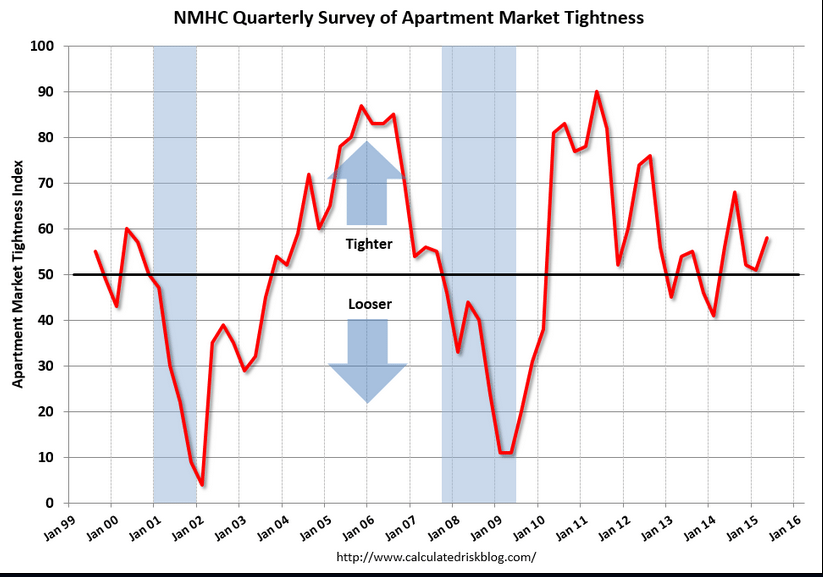
This still looks reasonably loose to me:
er-4-17-4

US macro update, FX update

US macro update:

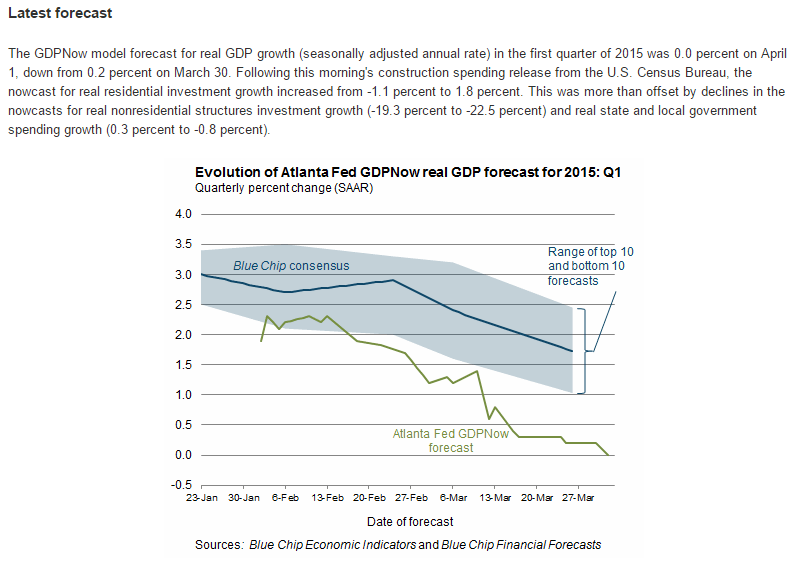
So looks to me like it’s all gone bad since the oil price crash, exactly as feared, and the Atlanta Fed most recently lowered it’s Q1 GDP estimate to 0.

First, a quick review of the accounting.
GDP = spending = sales = income.
An increase in spending = an increase in sales = an increase in income.

And, on a look back, as a point of logic, is this critical, fundamental understanding:

For every agent that spent less than his income (aka demand leakages) another must have spent more than his income (aka deficit spending/spending from savings) or that much output would not have been sold.

And this also means that to sustain last year’s rate of GDP growth, all the sectors on average need to grow at least at the same rate as last year, and higher if GDP growth is to increase.

Next, in that context, a quick look back at the last few years.

When stocks fell after the 2012 Obama reelection I called it a buying opportunity, as I saw sufficient total deficit spending along with sufficient income growth for additional private sector deficit spending that I thought would support maybe 4% GDP growth.

But that changed when we were allowed to at least partially go over what was called ‘the fiscal cliff’ with the expiration of my (another story) FICA tax cut and some of the Bush tax cuts amounting to what was then estimated to be a $180 billion tax hike- the largest in US history. And the sequesters about 4 months later cut about 70 billion in spending. That all lowered my GDP estimate by that much and more, and I began referring to a macro constraint that would keep an ever declining lid on GDP.

The fundamental problem was that govt, the agent that was spending more than its income to offset the demand leakages, had suddenly removed that support, and I didn’t see any other agent stepping up to the plate or even capable of stepping up to the plate to increase his deficit spending to replace it. Historically it would be housing and cars, but with the income cuts from the decrease in govt net spending I didn’t see those sectors sufficiently increasing private sector deficit spending.

So GDP growth was lower than expected in 2013, and even what we had towards the end of the year looked bogus to me, including the mainstream claiming the rise in inventories this time was a good thing, not to be followed by reduced production, as it meant there were high sales forecasts and it all would be self sustaining. I thought otherwise and wrote about heading to negative growth by year end.

And in fact Q1 2014, originally forecast to grow at about 2%, was first released as positive before being subsequently revised down to less than -2%, with maybe 1% of that drop due to cold weather. At that point I continued to not see any source of deficit spending to offset the demand leakages that were dragging down the economy.

However, what I completely missed in early 2014 was the increase in deficit spending underway in the energy sector as new investment chased $90 crude prices. I knew crude production was expanding, and likely to grow by maybe a million barrels/day or so, but I didn’t realize the magnitude of the rate of growth of that capital expenditure until after prices collapsed several months ago and economists started estimating how much capex might be lost with lower prices.

It was then I realized that the energy sector had been the mystery source of the growth of deficit spending that had been offsetting the drop in govt deficit spending, and thereby supporting the positive GDP prints that otherwise might have gone negative much sooner, and that the end of that support was also the end of positive GDP growth.

So here we are, with Q1 GDP forecasts all being revised down after Q4 was also revised down, as all the charts are pointing south, and all are in denial that it is anything more than a random blip down as happened last year in Q1, along with the pictures of houses and cars covered in snow, as forecasts for Q2 and beyond remain well north of 2%.

But without some agent stepping up to the plate to replace the lost growth in energy CAPEX that replaced the lost govt deficit spending, all I can see is the automatic fiscal stabilizers- falling tax revenues and rising unemployment comp- as the next source of deficit spending that eventually reverses the decline.
nowcast-3-30

FX:

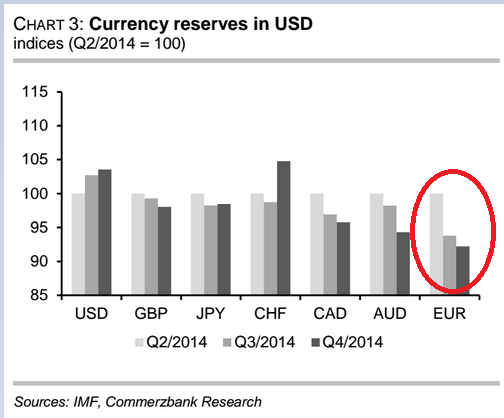
The euro short/underweight looks to me to be the largest short of any kind in the history of the world. The latest reports confirmed large scale global central bank portfolio shifting out of euro both through historically massive active selling, as well as passively as valuations changed relative weightings. And at the same time, the speculation and portfolio shifting that drove the euro down resulted in the real global economy selling local currencies to buy euro to use to purchase real goods and services from the EU. In other words, the falling euro has supported a growing EU current account surplus that’s removing net euro financial assets from the global economy.

The portfolio shifting has been driven by fundamental misconceptions that include the belief that
1. The old belief that lower rates from the ECB are an inflationary bias and therefore euro unfriendly
2. The old belief that QE is an inflationary bias and therefore euro unfriendly
3. The belief that Greek default is euro unfriendly
4. The new belief that the EU current account surplus creates a domestic savings glut that is euro unfriendly.

The operational facts are the opposite:

1. Lower rates paid by govt reduce net euro financial assets in the economy while net govt spending is not allowed to increase, the net of which functionally is a tax on the economy and euro friendly.
2. QE merely shifts the composition of euro deposits at the ECB while (modestly) reducing interest income earned by the economy and increasing ECB profits that get returned to members to contribute to deficit reduction efforts and not get spent, the net of which is functionally a tax on the economy and euro friendly.
3. Greek bonds are euro deposits at the ECB that are reduced by default, thereby acting as a tax on the economy and euro friendly.
4. The EU current account surplus is driving by non residents buying real goods and services from the EU which entails selling their their currencies and buying euro used to make their purchases, which is euro friendly.

So it now looks to me like the portfolio shifting has run its course as the EU current account surplus continues to remove euro from the global economy now caught short. This means the euro is likely to appreciate to the point where the current account surplus reverses, and since the current account surplus is not entirely a function of the level of the euro, that could be a very long way off. Not to mention that as EU exports soften additional measures will likely be taken domestically to lower costs to enhance competitiveness, which will only drive the euro that much higher.
eu-reserves

personal income and outlays, pending home sales, Dallas Fed

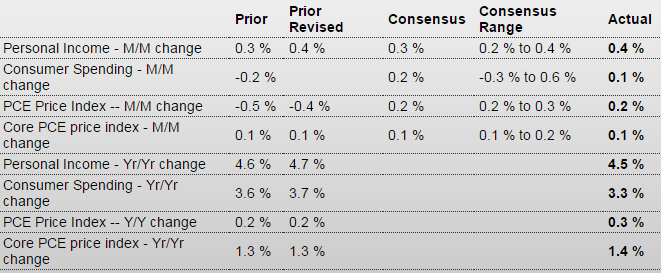
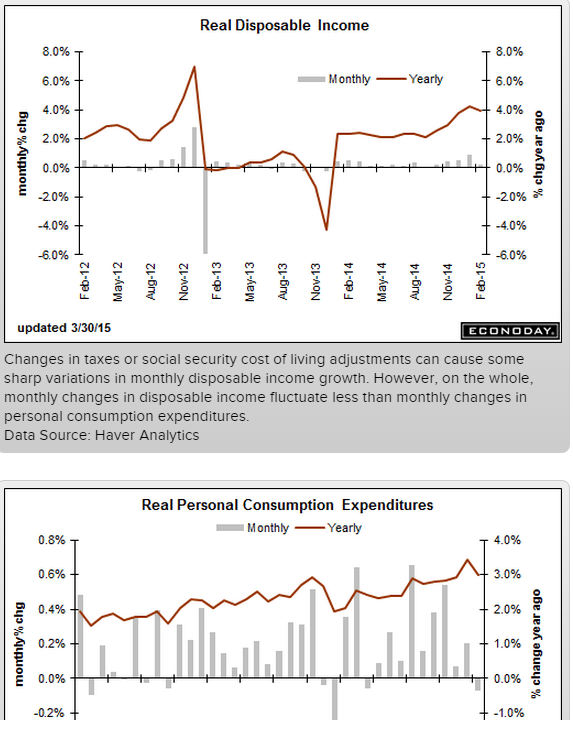
Personal income as reported up .4 with spending only up .1 = increased savings. However, while that counts most of the income gained by those who gained from the oil price decline, I suspect it does not include quite a bit of the income lost by those who got hurt by the decline in oil prices, as that lost ‘income’ is often outside the definition of ‘income’ included in this report. And much of that lost income that is included is likely estimated, as much of it goes unreported on a monthly or even quarterly basis. If so, both income and savings are being over reported by what I’m thinking is about .2 on the income side, which pushes the savings down below ‘normal’ and is also consistent with declining personal consumption expenditures.

Personal Income and Outlays
personal-income-feb-table
Highlights
In February, personal income growth remained healthy but spending and inflation were soft. Personal income advanced 0.4 percent after posting an equal gain of 0.4 percent in January. February topped expectations for a 0.3 percent gain. The wages & salaries component increased 0.3 percent, but followed a robust 0.6 percent the prior month.

Personal spending made a partial rebound of 0.1 percent after declining 0.2 percent in January. Analysts forecast a 0.2 percent rise. Durables fell 1.0 percent, following a 0.4 percent rise in January. Nondurables made a 0.4 percent comeback after plunging 2.5 percent in January. Services advanced 0.2 percent after a 0.4 percent boost in January.

Prices at the headline level rebounded a moderate 0.2 percent, following three declines including 0.4 percent for January. Market expectations were for 0.2 percent. The core PCE price index rose 0.1 percent, matching the pace in January and expectations.

Income growth was moderately strong in February. But spending has been softening in recent months due to adverse weather and lower energy prices. But the consumer sector has fuel for spending. Inflation continues to be low and well below the Fed’s target of 2 percent year-ago inflation, meaning the Fed likely will stick with no rate hike before mid-year.
personal-income-feb-graph

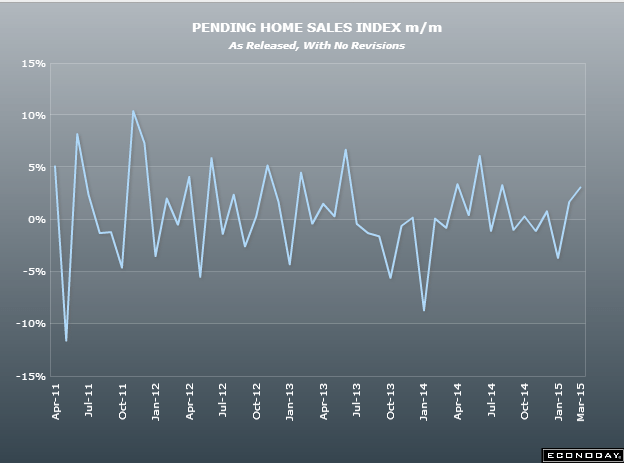
Better than expected but it remains at depressed levels with easy comparisons with last year’s extra cold winter compared with this year’s colder than average winter, which some how resulted in a 35,000 home jump- a 157% increase- in new home sales in the northeast to cause that report to spike some.

Pending Home Sales Index
pending-home-sales-feb-table
Highlights
Pending home sales picked up steam in February, up a much stronger-than-expected 3.1 percent on top of a 1.2 percent revised gain in January. This is the first back-to-back gain since April and May last year. Today’s report is a second shot in the arm for the ever-lagging housing sector, following last week’s big surge in new homes sales.

By region, the Midwest shows a strong February gain for pending sales as does the West, a region where sales of existing homes have been flat. The South, by far the largest housing region, and the Northeast, by far the smallest, show small monthly declines.

Year-on-year, pending home sales, which are defined as contract signings for existing homes, are up a robust-looking 12.0 percent which is a 6th straight increase. But this is misleading as many deals fall through. Final sales of existing homes, in data posted last week, are up only 4.7 percent year-on-year.
pending-home-sales-feb-graph

Unambiguous big fat whopping negative, therefore largely unreported:

Dallas Fed Mfg Survey
dallas-fed-march
Highlights
Texas factory activity declined in March. The production index, a key measure of state manufacturing conditions, fell to minus 5.2, posting its first negative reading in nearly two years.

Other measures of current manufacturing activity also reflected contraction in March. The new orders index pushed further into negative territory, coming in at minus 16.1, and the growth rate of orders index remained negative for a fifth consecutive month but edged up to minus 15.3 in March. The shipments and capacity utilization indexes slipped to more negative readings, minus 8.7 and minus 6.4, respectively.

Perceptions of broader business conditions were rather pessimistic for a third month in a row. The general business activity index declined 6 points to minus 17.4 in March, while the company outlook index was largely unchanged at minus 4.

Labor market indicators reflected slight employment declines and shorter workweeks. The March employment index dipped to minus 1.8, its first negative reading since May 2013. Thirteen percent of firms reported net hiring, compared with 14 percent reporting net layoffs. The hours worked index has been gradually declining for six months and came in at minus 5.3 in March, down from minus 1.6 in February.

Prices declined in March, and upward pressure on wages continued to ease slightly. The raw materials prices index fell to minus 9.4, its lowest reading since May 2009. The finished goods prices index pushed further negative to -9.8, also reaching a low not seen since 2009. The wages and benefits index came in at 15.6, down from 16.8 in February.

Expectations regarding future business conditions remained fairly weak in March. The index of future general business activity edged down to 3, while the index of future company outlook inched up to 12.8. Both indexes remain well below the levels seen throughout 2014. Indexes for future manufacturing activity, however, improved markedly in March. The indexes of future production, capacity utilization and growth rate of orders posted double-digit gains from their February readings.

According to the Dallas Fed report, both manufacturing and prices are soft-leaving the Fed in a likely dovish mode. Texas has the second largest manufacturing sector, following California. So far, regional manufacturing surveys point to sluggish manufacturing activity in March.

new from Bernanke

In case there was any doubt…

>   
>   (email exchange)
>   
>   On Mon, Mar 30, 2015 at 11:28 AM, Scott wrote:
>   

New from Bernanke:

Why are interest rates so low?

Bad:
what matters most for the economy is the real, or inflation-adjusted, interest rate (the market, or nominal, interest rate minus the inflation rate). The real interest rate is most relevant for capital investment decisions, for example.

The equilibrium interest rate is the real interest rate consistent with full employment of labor and capital resources, perhaps after some period of adjustment.

Large deficits will tend to increase the equilibrium real rate (again, all else equal), because government borrowing diverts savings away from private investment.

Good:
Contrary to what sometimes seems to be alleged, the Fed cannot somehow withdraw and leave interest rates to be determined by “the markets.”

[the Fed] has no choice but to set the short-term interest rate somewhere.

QE, the dollar, and the euro, jobless claims, US trade deficit, Philadelphia Fed survey

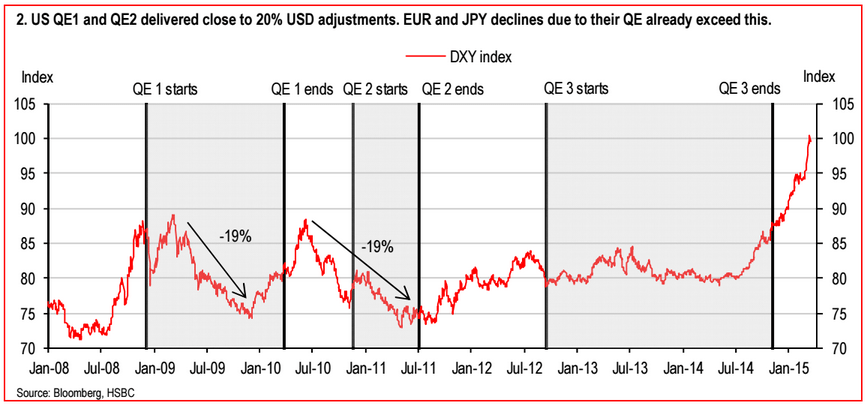
So my story is that traders and portfolio managers worried about inflation and currency depreciation from QE caused the depreciation during those periods, covering shorts and restoring dollar weightings after QE ended, returning the dollar to where it was. And now the latest spike is largely from the ECB’s QE announcement which caused strong desires to shift out of euro and into dollars. And this too should reverse at some point as, like everywhere else it’s been tried, QE will not reverse their deflationary forces or add to aggregate demand, and the euro shorts and underweight portfolios will be scrambling to get their euro back, while at the same time the current account surplus that resulted from the weak euro works to make those needed euro that much harder to get.
dxy
claims-3-12

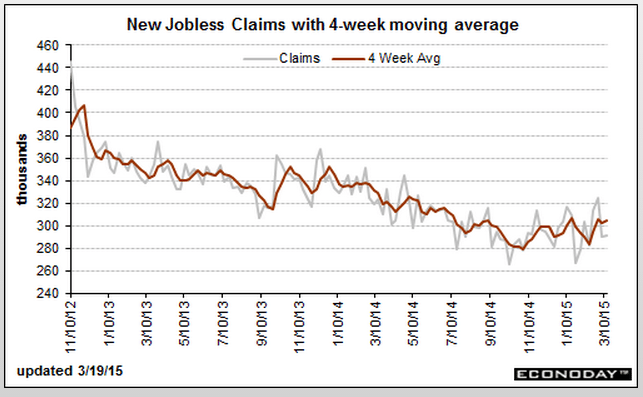
This should take q4 GDP down a bit more for the next published revision.
And it’s also consistent with my oil price narrative as well:

Current Account
ca-q4
Highlights
The nation’s current account gap widened sharply in the fourth quarter, to $113.5 billion vs a slightly revised $98.9 billion in the third quarter and driving the gap, relative to GDP, up 4 tenths to 2.6 percent. The gap on income is the main culprit, up $11.4 billion in the quarter and reflecting declining equity in foreign affiliates as well as transfers for fines and penalties. On trade, the goods gap rose $4.1 billion but was offset in part by a $1.0 billion increase in the services surplus.

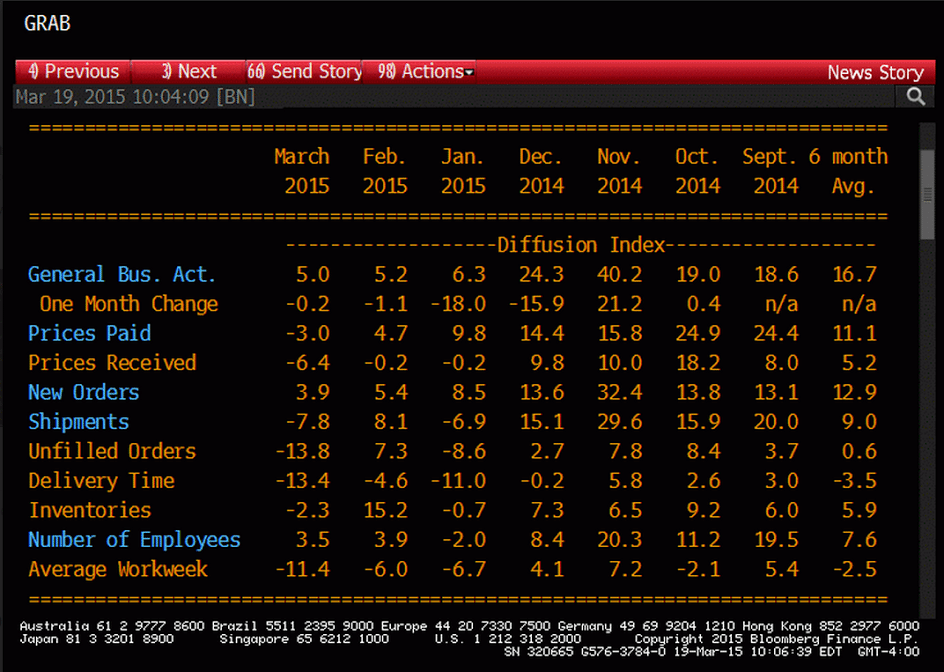
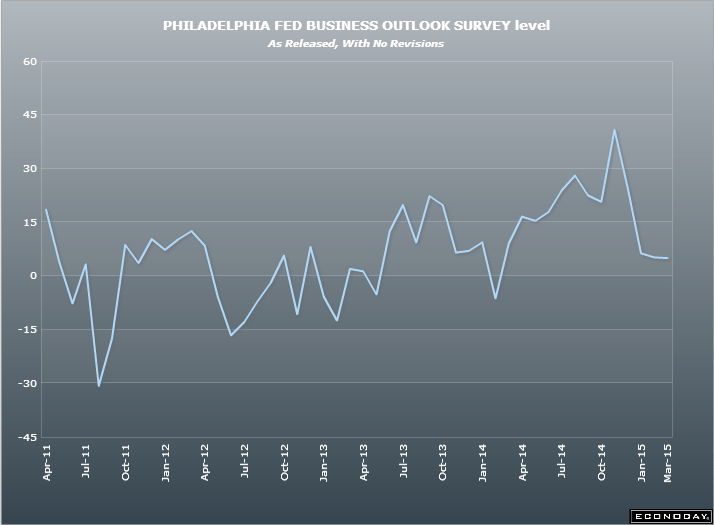
Down from last month and a bit worse than expected:

Philadelphia Fed Business Outlook Survey
philly-fed-mar-table
philly-fed-mar-detail
philly-fed-mar-graph

Atlanta Fed, Producer prices, Consumer Sentiment

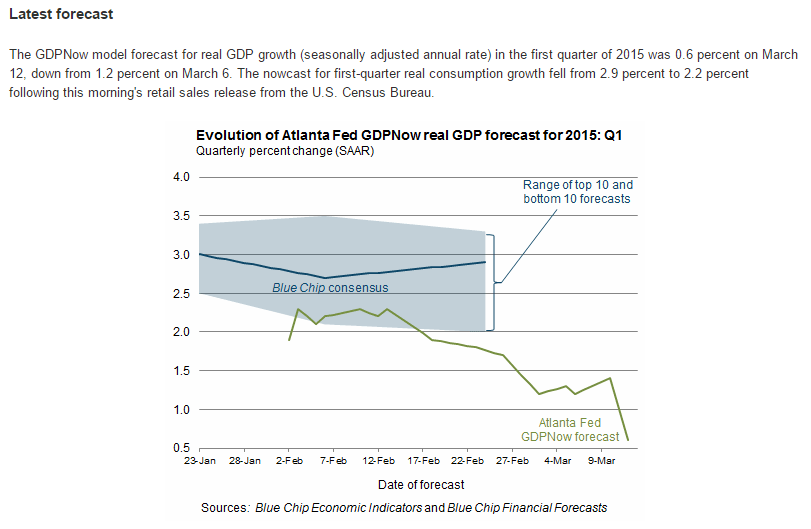
First, the economic releases have continued to lower the Atlanta Fed’s Q1 GDP estimate now down to only .6%:

My narrative seems to be holding- the drop in oil prices has lowered total spending below ‘stall speed’, after energy related spending chasing $90 oil was what kept it positive for the last couple of years:
atl-nowcast
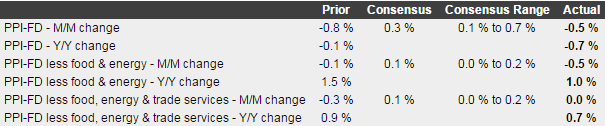
Prices down and it’s not just energy:

PPI-FD
ppi-feb
Highlights
The PPI for total final demand fell 0.5 percent in February after decreasing 0.8 percent in January. Expectations were for a 0.3 percent rebound. Energy was flat, following a 10.3 percent drop while foods decreased 1.6 percent, following a 1.1 percent dip in January. Excluding food and energy, producer price inflation posted a minus monthly 0.5 percent after slipping 0.1 percent the month before. Analysts called for a 0.1 percent gain. Total excluding food, energy and trade services were unchanged after dipping 0.3 percent in January. Expectations were for a 0.1 percent rise in February.

The index for final demand goods decreased 0.4 percent after falling 2.1 percent in January. Leading the decrease, margins for final demand trade services dropped 1.5 percent. (Trade indexes measure changes in margins received by wholesalers and retailers.)
The index for final demand services fell 0.5 percent after easing 0.2 percent the month before.

On a seasonally adjusted year-ago basis, PPI final demand was down 0.7 percent, compared to down 0.1 percent in January. Excluding food & energy, the PPI final demand was up 1.0 percent versus 1.7 percent the month before. Excluding food, energy, and trade services PPI inflation slowed to 0.7 percent on a year-ago basis, compared to 0.9 percent in January.

Consumer Sentiment
cs-mar
Highlights
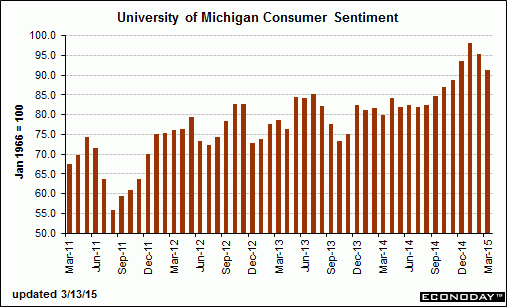
There appears to have been a bubble in consumer spirits late into last year and early into this one, that is a brief surge that came and went and never materialized into a rise for consumer spending. The first read on consumer sentiment this month fell very sharply to 91.2, down 4.2 points from final February for the lowest reading since November. Sentiment peaked at 98.2 in mid-month January which was the highest reading in 8 years.

The two components of the headline index both show weakness, at 103.0 for a 3.9 point decline for current conditions and at 83.7 for a 4.3 point decline for expectations. The decline in current conditions points to weakness for consumer spending this month relative to February while the decline in expectations points to a falling off in confidence for the jobs outlook.

Gasoline prices, though low, have been edging up in recent weeks and are now lifting inflation expectations which are up 2 tenths for the 1-year outlook to 3.0 percent and up 1 tenth for the 5-year outlook to 2.8 percent.
cs-march-graph

JPM, MS Q1 revision, Fed labor market conditions index, German exports fall, Japan GDP

From JPM:

In light of the data we’ve received this week – January reports for real consumer spending, construction spending, and net exports that varied from disappointing to downright weak, as well as a softer February print for car sales –– we are marking down our tracking for annualized real GDP growth in Q1 from 2.5% to 2.0%. Even after this revision risks are more skewed to the downside than upside. By way of comparison, the Atlanta Fed’s tracking estimate of Q1 recently came down to 1.2%.

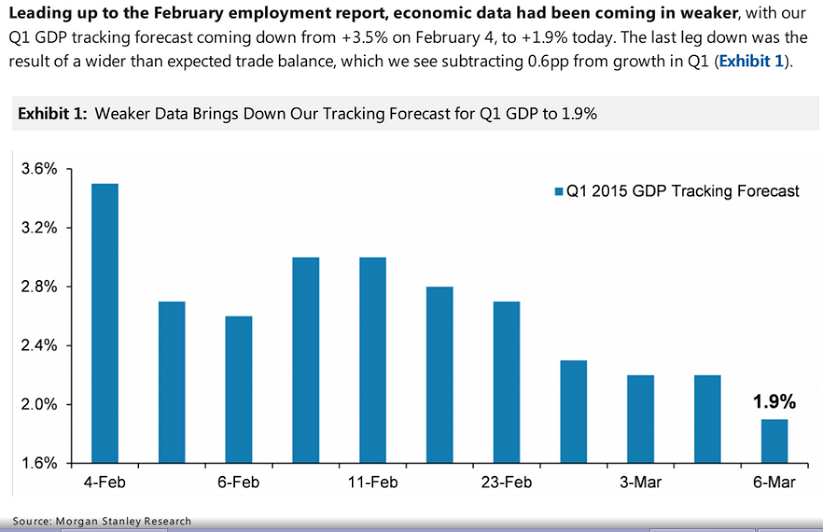
From MS:

weaker-q1

Labor Market Conditions Index
lmci-feb
Highlights
The Fed’s Labor Market Conditions Index remained positive in February but decelerated to 4 in February from 4.8 in January. This was despite stronger-than expected payroll gains this past Friday. One area of weakness likely was soft wage growth. The Fed’s Research Department does not give details on this unofficial report. While the employment situation’s payroll numbers have some analysts suggesting a June rate hike by the Fed, today’s LMCI indicates that there may be considerable debate within the Fed on “liftoff” timing-especially since inflation is very sluggish.

German exports post biggest drop in five months in January

Mar 9 (Reuters) — Seasonally-adjusted exports decreased by 2.1 percent in January after a sharp rise in December. The data for December was revised down to a 2.8 percent gain from a previously reported 3.4 percent increase. An unadjusted breakdown showed shipments to the euro zone dropped by 2.8 percent in January compared with a year ago while Germany sent 0.5 percent fewer goods to countries outside of the European Union. Exports to countries within the EU that do not use the euro were the only ones to post a gain.

Japan’s 4th-qtr GDP downgraded as business investment falls

Mar 9 (Kyodo) — Gross domestic product for October-December grew an annualized real 1.5 percent, downgraded from 2.2 percent. The figure translated into a 0.4 percent increase from the previous quarter, against 0.6 percent growth in a preliminary report released Feb. 16 by the Cabinet Office. Business investment dropped 0.1 percent, against an earlier-reported 0.1 percent growth, for the third straight quarter of decline. Private consumption was upgraded to a 0.5 percent rise from a 0.3 percent increase. Exports grew 2.8 percent, revised upward from a 2.7 percent increase.

mtg purchase apps, Fed’s Evans, ADP, ISM non manufacturing

Still no sign of a surge in spending here, as apps remain below even last years winter depressed numbers:

MBA Purchase Applications
mba-2-27
Highlights
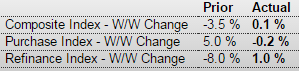
A dip in mortgage rates failed to give much lift to the purchase index which slipped 0.2 percent in the February 27 week for a year-on-year rate that is also at minus 0.2 percent. The refinance index did rise but not by much, up 1.0 percent. The average rate for 30-year fixed-rate mortgages with conforming loan balances ($417,000 or less) decreased to 3.96 percent from 3.99 percent.

The lonely dove:

Fed’s Evans, citing low inflation, wants no rate hikes until 2016

March 4 (Reuters) — The Federal Reserve should wait until the first half of 2016 before raising interest rates, a top U.S. central banker said on Wednesday, or risk undermining the very recovery it has helped engineer.

“Given uncomfortably low inflation and an uncertain global environment, there are few benefits and significant risks to increasing interest rates prematurely,” Chicago Federal Reserve Bank President Charles Evans said in remarks prepared for delivery to the Lake Forest-Lake Bluff Rotary Club. “I think we should be patient in raising interest rates.”

Even if the Fed keeps rates at their near-zero level until next year, he said, inflation probably won’t reach the Fed’s 2-percent goal until the end of 2018. And if his forecast proves wrong and the economy begins to run too hot too fast, he said, the Fed would have “ample time” to raise rates moderately to head off excessively high inflation.

Evans, a voting member this year on the Fed’s policy-setting panel, stands nearly alone at the central bank in calling for rates to stay near zero for another year or so. Many of his colleagues have said they are open to, if not eager for, rate hikes to begin as soon as June.

For his part, Evans expects the U.S. economy to grow at a 3-percent pace over the next couple of years, generating job gains of over 200,000 a month for some time.

But that is not enough to justify raising rates, he said. Unemployment, at 5.7 percent, is still above the 5 percent he now believes is sustainable for the economy in the longer run.

More importantly, the Fed’s core gauge of inflation is at just 1.3 percent, and inflation expectations based on prices in Treasury markets have fallen dramatically.

Before raising rates, he said, he would like to see not only a rise in core inflation and in market-based inflation expectations, but also a rise in wages, now averaging around 2 percent a year, to between 3 and 4 percent.

Anyone mention that, like car sales, this is the 3rd consecutive monthly decline?

ADP Employment Report
adp-feb
Highlights
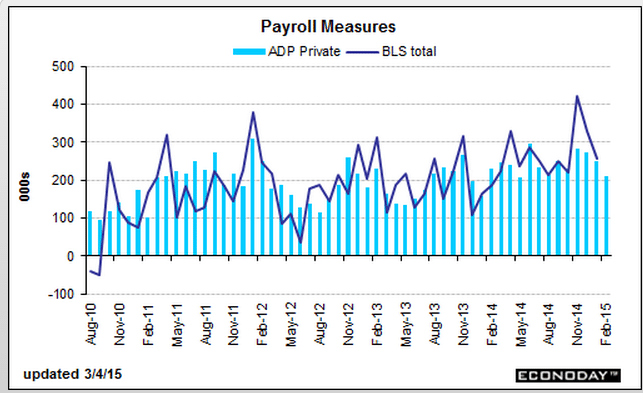
ADP sees slowing for Friday’s February payrolls, estimating that private payrolls rose 212,000 which is 8,000 below consensus for the ADP report. But ADP’s data also includes a big upward revision for January, to 250,000 vs an initially reported 213,000. The results aren’t likely to shift expectations for Friday’s government data where the corresponding Econoday consensus is 225,000 vs January’s 267,000.

Breaking down ADP’s estimate, service-providing industries are up 181,000 in February vs 206,000 in January with goods-producing industries up 31,000 vs 45,000. Further detail shows professional services up 34,000 vs January’s 49,000 with construction up 31,000 vs 45,000. Growth in trade & transport is 31,000, down from 50,0000. Financial activities are up 20,000 vs 15,000 with manufacturing up only 3,000 vs a gain of 15,000 in January.
adp-feb-graph

This survey remains firm:

ISM Non-Mfg Index
ism-non-man-feb-employ

Highlights
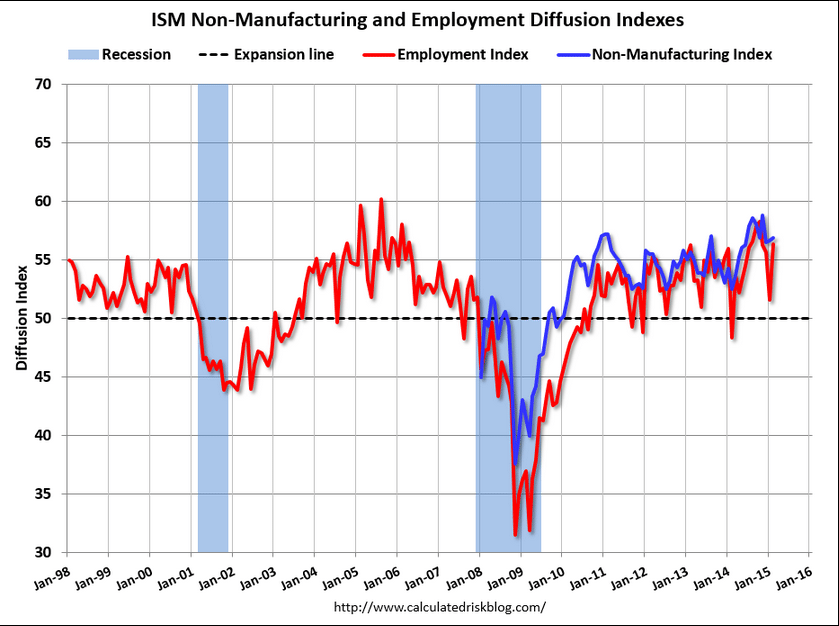
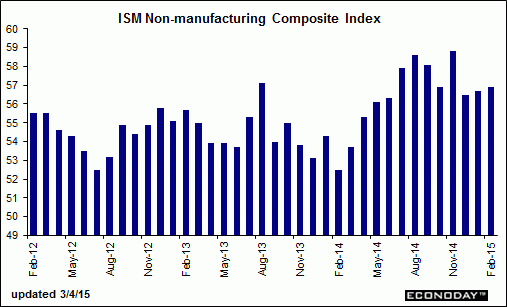
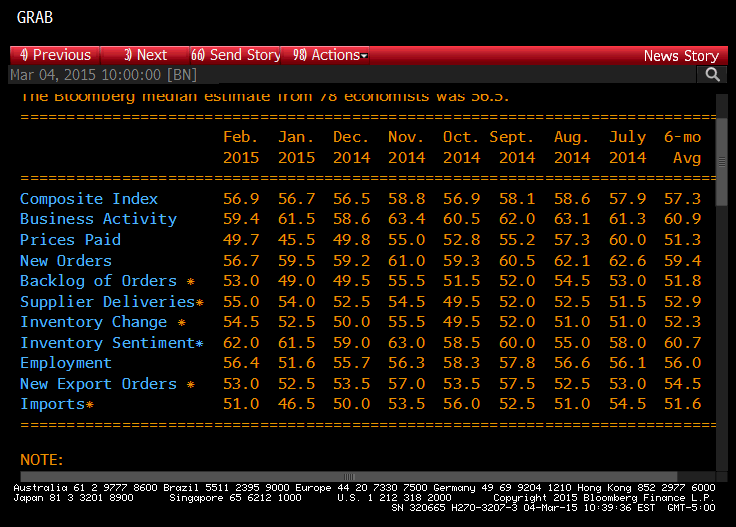
Growth remains very solid in ISM’s non-manufacturing sample where the composite index is up 2 tenths to 56.9 in the February report. Employment is a stand-out positive, jumping nearly 5 points to a 4-month high of 56.4.

Not so strong are new orders where growth is down nearly 3 points to 56.7 for the lowest reading since March last year. Nevertheless, this is still a very healthy and sustainable rate of growth.

Supplier deliveries slowed further in February which added to the composite for the month. But the slowing is likely tied, not to demand factors, but to the port slowdown on the West Coast, a slowdown which has since been resolved. The slowing in deliveries is the likely reason behind a rise in inventories and a build in backlog orders. Cost pressures, as they are in most reports, are flat, the result of course of low fuel costs.

A big plus in today’s report is wide breadth of strength with 14 of 18 industries reporting growth in the month led once again by accommodation & food services which are likely getting a boost from discretionary consumer spending, itself the result of the strong jobs market and low gasoline prices. In the contraction column are both construction and mining, two sectors that remain weak.
ism-non-man-feb-graph

ism-non-man-feb-table

Interesting what’s up and what’s down:
ism-table

eur/usd

Warren, euro continue to go down vs usd. Do you think draghi goal is to reach eur/usd 1:1 ?

Good question!

No one thinks the ECB is buying dollars so if that’s the case the world is getting short euros directly and indirectly in very large size, as per the EU trade surplus, which is a consequence of the overall increases in ‘competitiveness’ as wages are depressed by fiscal policy. It’s all part of the ‘purchasing power parity’ shift with the EU becoming the low cost producer. And these forces all work to make the euro very strong once the ‘portfolio shifting’ has run its course, which it hasn’t yet.

What’s happened with the euro is the same thing that happened with the USD- markets feared QE would be inflationary and cause currency depreciation, so they discounted that in advance of QE, depressing the dollar. And when it didn’t happen and QE ended, the dollar reversed as those caught short and those who had become underweight in dollars had to restore their dollar exposures.

So while portfolios with dollar liabilities that had reduced dollar exposure were returning to dollars, at the same time the ECB was moving towards negative rates and QE, causing portfolios to reduce euro exposures, driving the euro lower. And events surrounding Greece and Ukraine only added to euro fears, further driving portfolio managers to shift exposure away from euro.

What I can’t tell you is when the tide will turn, but looks to me that when it does, the euro goes up until the trade surplus reverses, and since the link between the rising euro and the trade balance is ‘loose’ the euro could easily get very high vs the dollar- say, over 1.5- before that happens.

To answer your question, what Draghi is doing- negative rates and QE, fundamentally makes the euro stronger, but he believes, as do market participants, that it makes the euro weaker. Same with the Fed, of course, as market participants believe higher rates are dollar friendly when in fact fundamentally they weaken it. So while Draghi may be targeting 1:1 as you suggest, and taking measures he believes and markets believe will get him there, in fact he and markets are ‘pushing on a spring’ as fundamentally net euro are being drained rather than added to the global economy.

What this also suggests is the next EU crisis could be that of the strong euro as it appreciates and starts hurting EU export industries, and the ECB just keeps doing more and more QE and cuts rate further which only makes it all worse.