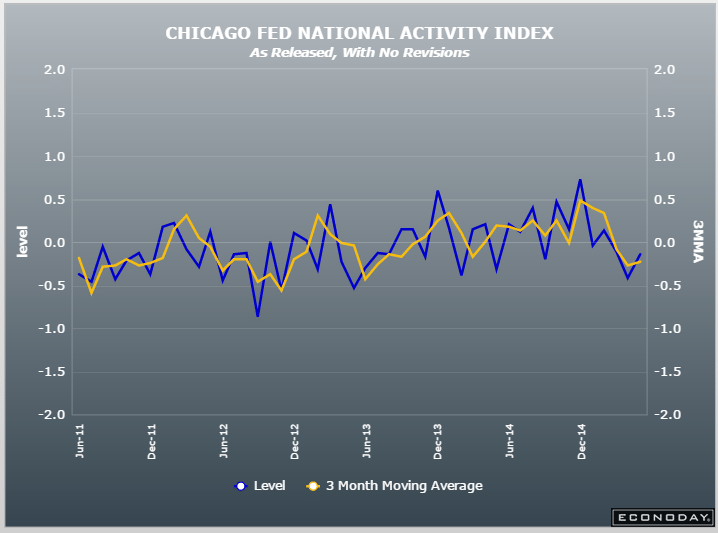
seasonal adjustments, export reports, Atlanta Fed, Chicago Fed, PMI manufacturing, Philadelphia Fed Survey, Existing home sales, KC Fed

Note that if/when the adjustments are changed it looks like they make Q4 and Q1 a bit higher and Q2 and Q3 a bit lower. The net adjustments are 0 for the year.

Nicole Mayerhauser, chief of BEA’s national income and wealth division, which oversees the GDP report, said in the statement that the agency has identified several sources of trouble in the data, including federal defense service spending. Mayerhauser said initial research has shown this category of spending to be generally lower in the first and the fourth quarters. The BEA will also be adjusting “certain inventory investment series” that have not previously been seasonally adjusted. In addition, the agency will provide more intensive seasonal adjustment quarterly service spending data.

My narrative goes something like this: The CB euro selling drives the price down to the point where the euro zone net exports increase sufficiently to absorb the cb selling, at which point the euro reverses as the trade flows overwhelm the selling from those portfolios and the euro then continues to rise until the current account surplus goes away:

Job creation at four-year high despite slower pace of economic growth

May 21 (Markit) — Eurozone PMI Composite Output Index at 53.4 (53.9 in April), Services PMI Activity Index at 53.3 (54.1 in April), Manufacturing PMI at 52.3 (52.0 in April), and Manufacturing PMI Output Index at 53.5 (53.4 in April). Faster growth in manufacturing was offset by a slowdown in services, though the pace in the latter merely eased slightly further from March’s eight-month high to suggest a broad-based upturn remains in place. Weaker order book growth was centred on the service sector, with manufacturing reporting the strongest inflows of new orders for just over a year, linked to improved export performance.


PMI data signals further slowing of private sector output growth

May 21 (Markit) — PMI data signals further slowing of private sector output growth () Germany Composite Output Index at 52.8 (54.1 in April), Services Activity Index at 52.9 (54.0 in April), Manufacturing PMI at 51.4 (52.1 in April), and Manufacturing Output Index at 52.7 (54.3 in April). Mirroring the trend for output, German private sector companies also signalled a weaker rise in new business. While a pick-up in construction activity and rising domestic demand were reasons behind the overall increase, some survey participants linked the slowing in the rate of growth to economic uncertainties. Meanwhile, manufacturers reported a fourth successive monthly rise in new export orders.

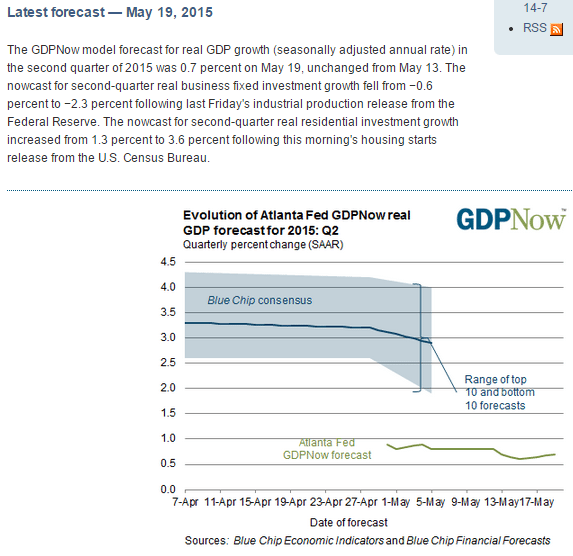
Recent data leaves their forecast unchanged:
er-5-22-1
Negative and looking weak:
er-5-22-3
Weaker here too:

PMI Manufacturing Index Flash
er-5-22-4

Highlights
Markit’s US manufacturing sample had been far stronger than other readings on the sputtering sector but is a little less so with the May report where the index slipped slightly to a 16-month low of 53.8, 8 tenths below the Econoday consensus.

Slowing growth in new orders, including weakness in export orders tied directly to strength in the dollar, held down the May index. Another area of weakness remains the energy sector where business spending is down. Shipment growth slowed to its slowest rate so far this year.

Strength in the report is centered in employment, but this won’t last if orders continue to slow. Deliveries continue to be delayed in part by persistent bottlenecks tied to the long since resolved port strike. Costs are up but inflation remains marginal.

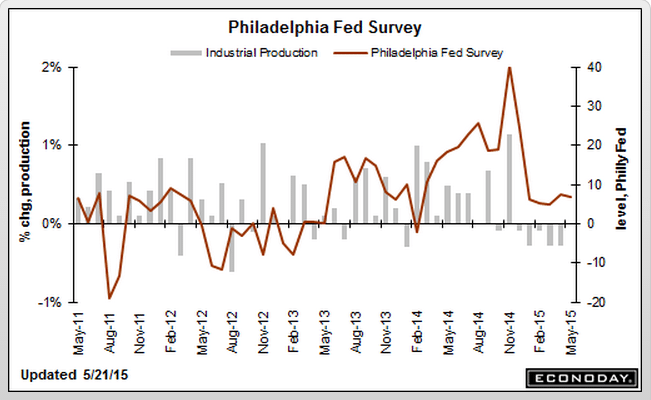
The manufacturing sector is having a tough spring following six prior months of slowing. Watch for the Philly Fed report coming up this morning at 10:00 a.m. ET.

Less than expected and weak:
er-5-22-5
Less than expected and weak:

Existing Home Sales
er-5-22-6

Highlights
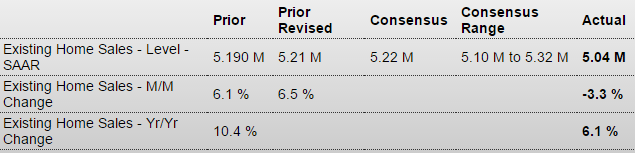
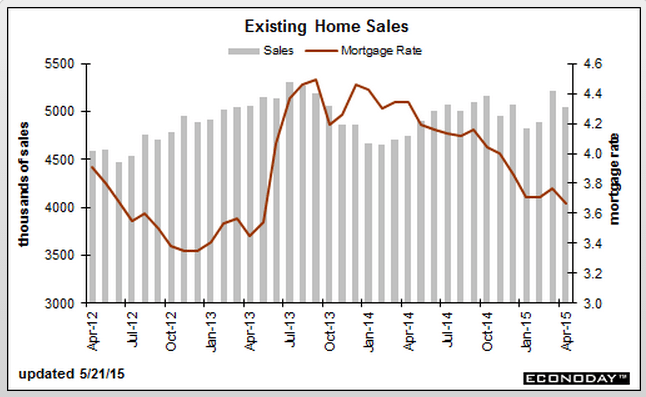
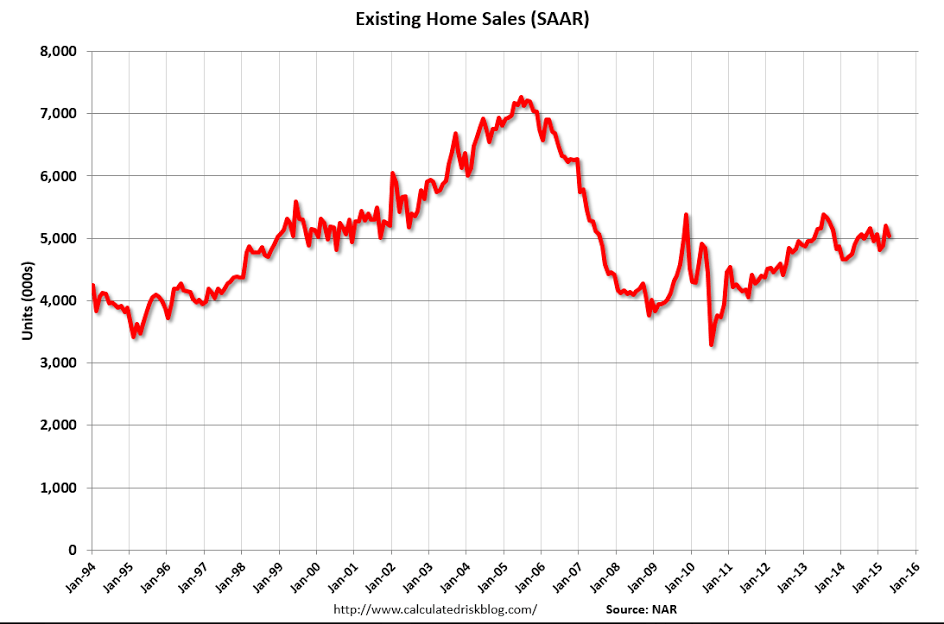
Existing homes sales are not living up to springtime expectations, down 3.3 percent in April to a 5.04 million annual rate which is just below the low-end Econoday forecast. Three of 4 regions show contraction in April with the sharpest decline, minus 6.8 percent, in the South, which is by far the largest housing region. Year-on-year, total sales are still up a respectable 6.1 percent.

Another positive is a rise in supply with 2.21 million used homes on the market vs 2.01 million in March. This rise, together with the drop in sales, raises supply relative to sales to 5.3 months from 4.6 months. And another positive is a 4.1 percent rise in the median price to $219,400 which is up 8.9 percent year-on-year.

But this report in sum is a disappointment, failing to point to any building momentum. Strength in the housing sector may be switching, from existing home sales to new home sales at least based on this report compared to the historic surge earlier this week in housing starts & permits. But housing data month-to-month are always volatile and, on net, it’s too soon to decipher how strong the spring housing season is right now.
er-5-22-7
er-5-22-8

And one last negative for today:

Kansas City Fed Manufacturing Index
er-5-22-111
Highlights
The early indications on May’s manufacturing activity have been slightly positive, that is until the Kansas City Fed report where the composite index is in deeply negative ground at minus 13. This is the weakest of the recovery for this reading and follows an already weak minus 7 in April.

New orders this month are deeply negative, at minus 19, as are backlog orders at minus 21. These readings, reflecting contraction for export orders and trouble in the energy sector, point to significant trouble for the region’s manufacturing activity in the months ahead.

Shipments are already in contraction, at minus 9, as is employment, at a deeply negative minus 17 that contrasts with mostly positive employment indications in other reports.

Railcar traffic, Draghi statement, NY manufacturing survey, Industrial production, Consumer confidence

Rail Week Ending 09 May 2015: Data Still Not Pretty. Rail Softness Continues.

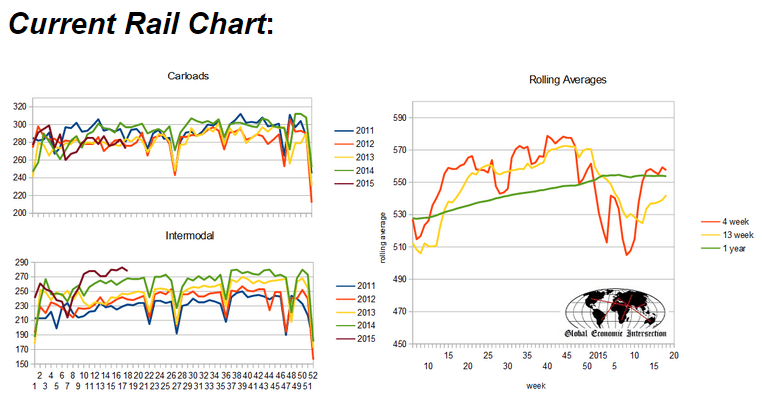
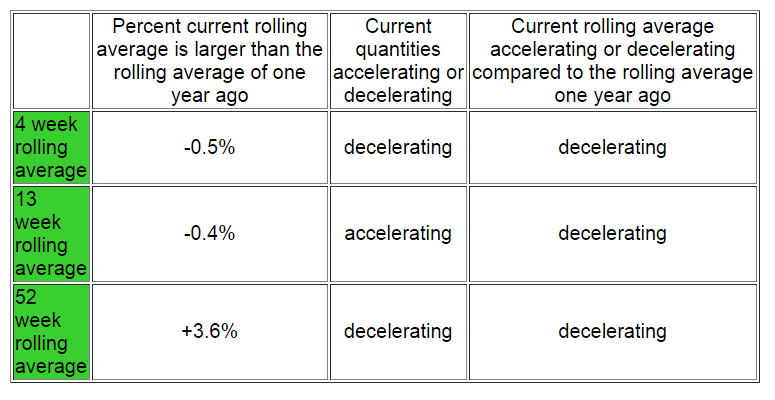
(Econintersect) — Week 18 of 2015 shows same week total rail traffic (from same week one year ago) declined according to the Association of American Railroads (AAR) traffic data. Intermodal traffic improved, which accounts for half of movements – but weekly railcar counts goes deeper into contraction.

This analysis is looking for clues in the rail data to show the direction of economic activity – and is not necessarily looking for clues of profitability of the railroads. The weekly data is fairly noisy, and the best way to view it is to look at the rolling averages which generally are in a weak growth cycle.

er-5-15-1
er-5-15-2
A summary of the data from the AAR:

The Association of American Railroads (AAR) today reported U.S. rail traffic for the week ending May 9, 2015.

For this week, total U.S. weekly rail traffic was 551,034 carloads and intermodal units, down 2.3 percent compared with the same week last year.

Total carloads for the week ending May 9, 2015 were 273,433 carloads, down 7.9 percent compared with the same week in 2014, while U.S. weekly intermodal volume was 277,601 containers and trailers, up 3.8 percent compared to 2014.

Four of the 10 carload commodity groups posted increases compared with the same week in 2014. They include: motor vehicles and parts, up 8.9 percent to 18,997 carloads; petroleum and petroleum products, up 6.1 percent to 15,464 carloads; and miscellaneous carloads, up 3.6 percent to 9,220 carloads. Commodity groups that saw decreases during this one week included: coal, down 16.1 percent to 93,691 carloads; metallic ores and metals, down 12.1 percent to 23,572 carloads; and grain, down 11.2 percent to 17,959 carloads.

For the first 18 weeks of 2015, U.S. railroads reported cumulative volume of 5,043,559 carloads, down 1.8 percent from the same point last year; and 4,679,513 intermodal units, up 1.7 percent from last year. Total combined U.S. traffic for the first 18 weeks of 2015 was 9,723,072 carloads and intermodal units, a decrease of 0.1 percent compared to last year.

North American rail volume for the week ending May 9, 2015 on 13 reporting U.S., Canadian and Mexican railroads totaled 368,931 carloads, down 7.5 percent compared with the same week last year, and 350,845 intermodal units, up 3.2 percent compared with last year. Total combined weekly rail traffic in North America was 719,776 carloads and intermodal units, down 2.6 percent. North American rail volume for the first 18 weeks of 2015 was 12,681,610 carloads and intermodal units, up 1 percent compared with 2014.

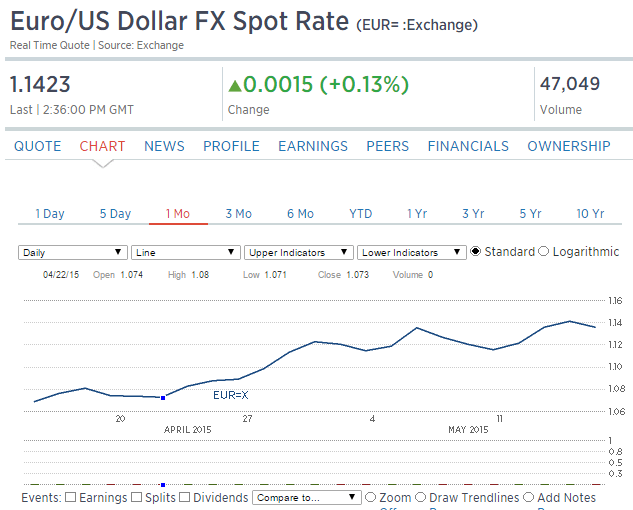
Here we go. This kind of thing previously had caused the euro to fall vs the dollar. If it doesn’t happen this time there’s a serious problem brewing. And right now the euro is up on the day…

Draghi helps stocks

Aside from individual stocks, sentiment received a boost from the ECB on Friday. Draghi said Thursday that the central bank will “implement in full” its bond-buying program and it will stay in place “as long as needed.”

“While we have already seen a substantial effect of our measures on asset prices and economic confidence, what ultimately matters is that we see an equivalent effect on investment, consumption and inflation,” Draghi said, according to the text of a speech delivered in Washington.

“To that effect, we will implement in full our purchase program as announced and, in any case, until we see a sustained adjustment in the path of inflation.”
er-5-15-3
Empire State Mfg Survey
er-5-15-4
Highlights
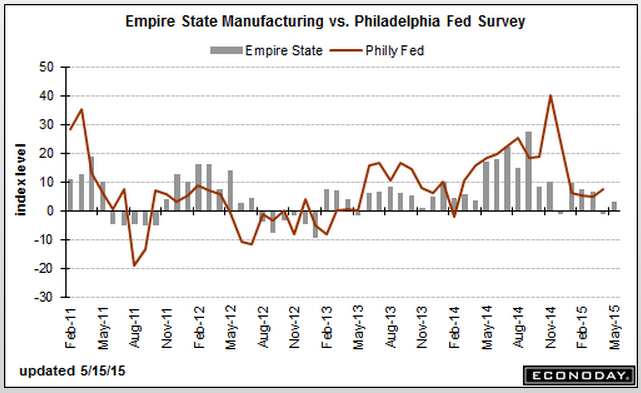
The first indication on May conditions in the manufacturing sector is soft, as indications have been all year. The Empire State index came in at 3.09, below what were already weak Econoday expectations for 5.00. Shipments look respectable at 14.94 but are way ahead of new orders, at only 3.85, and even further ahead of backlog orders which are in deep contraction at minus 11.46. Employment growth is down as is the 6-month outlook, both pointing to a lack of optimism.

Price readings in this report stand out, pointing to even less pressure than in April with input cost inflation very subdued, down nearly 10 points to 9.38, and with virtually no price traction at all for finished goods, at only 1.04.

The manufacturing sector, hurt in part by weak exports, looks to be more and more of a drag at a time when economic growth is supposed to be on a springtime rebound. Next indication on the May manufacturing sector will be next Thursday with the Philly Fed report. Later this morning the industrial production report will offer the first definitive data on the April manufacturing sector.

er-5-15-5

This is bad too:

Industrial Production
er-5-15-6
Highlights
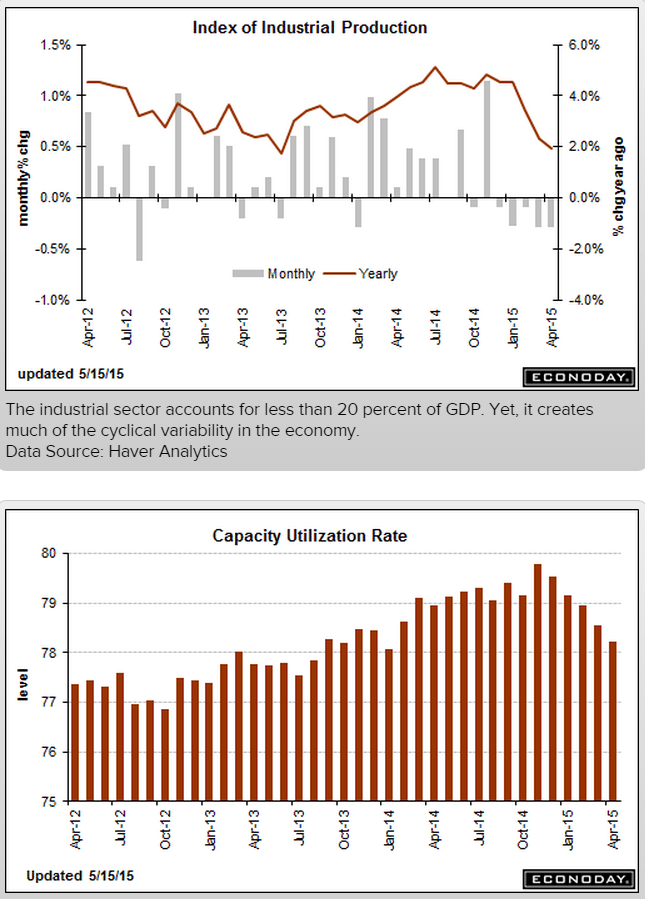
Industrial production is stalling, down 0.3 percent in April for a 5th straight monthly contraction. Factories are cutting back with capacity utilization down 4 tenths to 78.2 percent. And the manufacturing component, which has been flat to negative all year, is unchanged. All these readings are at or near the Econoday low-side forecasts.

Among manufacturing subcomponents, consumer goods output fell 0.3 percent with business goods down 0.4 percent. Construction supplies rose only fractionally but at 0.1 percent the reading is the best all year (this a reminder of how weak construction and housing has been). A positive is a second strong month for auto output, up 1.3 percent on top of March’s 4.3 percent surge, but whether output increases further will depend on auto sales which, in yesterday’s retail sales report, turned lower in April.

The two other main components in today’s report show even greater weakness with mining, hurt by oil & gas, at minus 0.8 percent for the 6th contraction in 7 months and utilities at minus 1.3 percent for a 2nd straight decline.

The industrial economy remains flat and is holding down what is supposed to be the economy’s springtime bounce. The news from the factory sector, including this morning’s Empire State report, won’t be pulling forward expectations for the Fed’s first rate hike.
er-5-15-7

Even this has suddenly broken:

Consumer Sentiment
er-5-15-8
Highlights
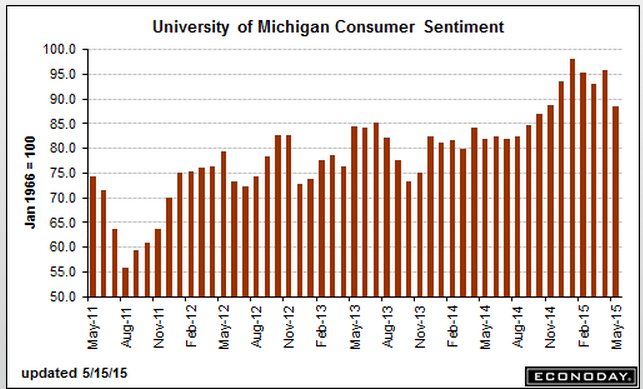
Consumer confidence had been holding, as the FOMC assured us just a couple of weeks ago, at high levels, but perhaps less so now with the consumer sentiment index at 88.6 which is nearly 5 points below Econoday’s low-side forecast. Both components show weakness with current conditions down 7.2 points to 99.8 and expectations down 7.3 points to 81.5. These are the lowest readings since October and November of last year.

At the same time that confidence is going down, inflation expectations, reflecting rising gasoline prices, are going up. Expectations 1-year out are up 3 tenths to 2.9 percent while expectations 5-years out are up 2 tenths to 2.8 percent. Despite the turn higher, however, these are still low levels.

The drop in current conditions hints at softness in this month’s jobs market while the drop in expectations is a downgrade for the outlook on jobs. The hawks at the Fed have been anticipating, perhaps over anticipating, that strong consumer confidence levels would eventually translate to gains for retail sales. Retail sales have been flat along and now consumer confidence, based at least on today’s consumer sentiment report, is moving backwards.
er-5-15-9
Of the nearly 1.6 million loan originations in Q1, 471,822 were purchase loan originations, down 25% from the prior quarter and up less than 1% from a year ago. There were 1,080,043 refinance originations in Q1, an increase of 6% from the prior quarter and 27% from a year ago.

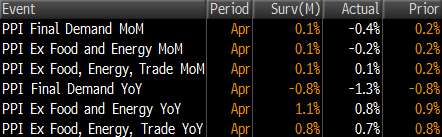
claims, producer prices, euro comments, public sector jobs

Just a reminder, claims measure those losing jobs who file for benefits, not new hires:

Jobless Claims
er-5-14-1
er-5-14-2

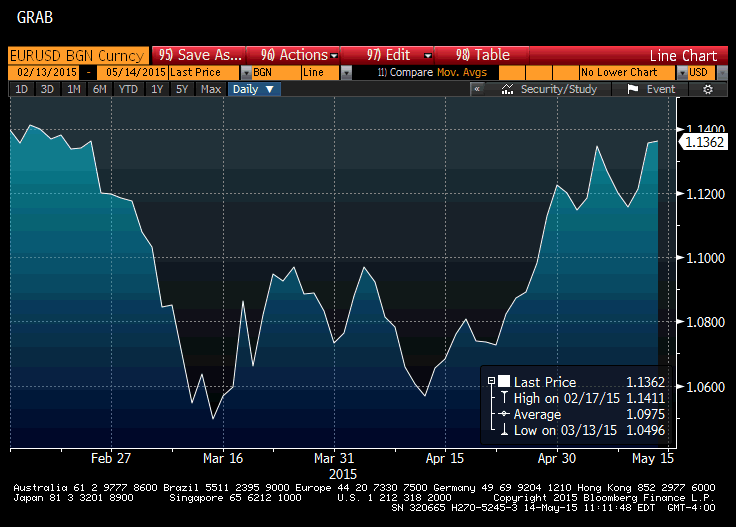
The euro has been moving higher vs the dollar, as CB selling winds down as they reach the lower limits of their reserve targets along with fundamental support from a large and growing EU current account surplus that’s drained those euro sold by those CB’s and other sellers from global markets. This may have left the short sellers and others needing to recover euro allocations subject to a dramatic short squeeze for as long as the current account surplus continues. And this poses an extreme risk to the EU. Growth forecasts have been largely based on ‘weak euro’ and as it moves higher that growth never materializes, and instead the economy deteriorates/unemployment goes higher, etc. etc. and, making matters worse, the ECB is left ideologically bankrupt, having seen negative rates and QE do nothing more than exacerbate the deflation they were trying to reverse. All they can do is try more of the same, which will be a very depressing environment for those who have been suffering under the failed policies. All of which has the potential to accelerate the already growing support for the various anti euro forces.
sg2015051440308

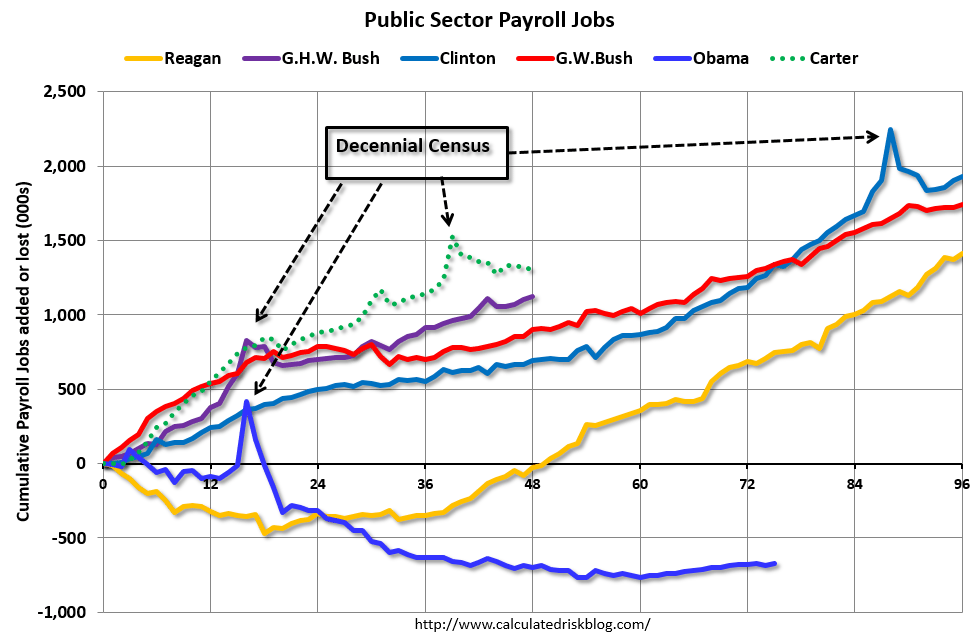
Yes, President Obama wins the Tea Party trophy for downsizing government:
er-5-14-3

EU GDP, Mtg apps, retail sales

European Union : GDP Flash

er-5-13-8

Highlights
Eurozone economic activity extended its recovery into last quarter with a provisional and slightly smaller than expected 0.4 percent increase in real GDP versus the previous period. The fourth quarter rise was unrevised at 0.3 percent and annual growth edged a tick firmer to 1.0 percent. In line with normal procedure, Eurostat provided no details of the latest GDP expenditure components.

Growth was hindered by a sharp slowdown in Germany where total output expanded a quarterly 0.3 percent following a 0.7 percent rise at the end of last year. However, France (0.6 percent after 0.0 percent) was surprisingly robust and Spain (0.9 percent after 0.7 percent) posted its strongest performance in more than seven years. Italy (0.3 percent after 0.0 percent) saw its first positive print since the third quarter of 2013. Amongst the smaller countries Cyprus (1.6 percent after minus 0.4 percent) finally pulled out of recession but Finland (minus 0.1 percent after minus 0.2 percent) saw a second successive quarter of falling output.

Early signals on the current quarter have pointed to little change in Eurozone economic momentum which will probably be seen as disappointing by policymakers and investors alike. Still, the ECB’s QE programme was only launched in March so much of its potential benefit has yet to be realised. That said, with the region’s inflation currently running at just a provisional 0.0 percent annual rate, Eurozone governments and the ECB will be hoping for a significantly stronger growth profile over the second half of the year.

Q2 not getting any help here…

United States : MBA Mortgage Applications
er-5-13-9

Still not spending that gas savings…
Q2 still not showing signs of life

Retail Sales
er-5-13-10

ISM, PMI, Consumer Sentiment, Construction Spending

Slow start for April Manufacturing:

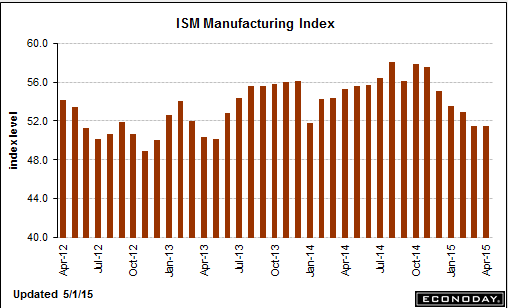
ISM Mfg Index
er-5-1-5
Highlights
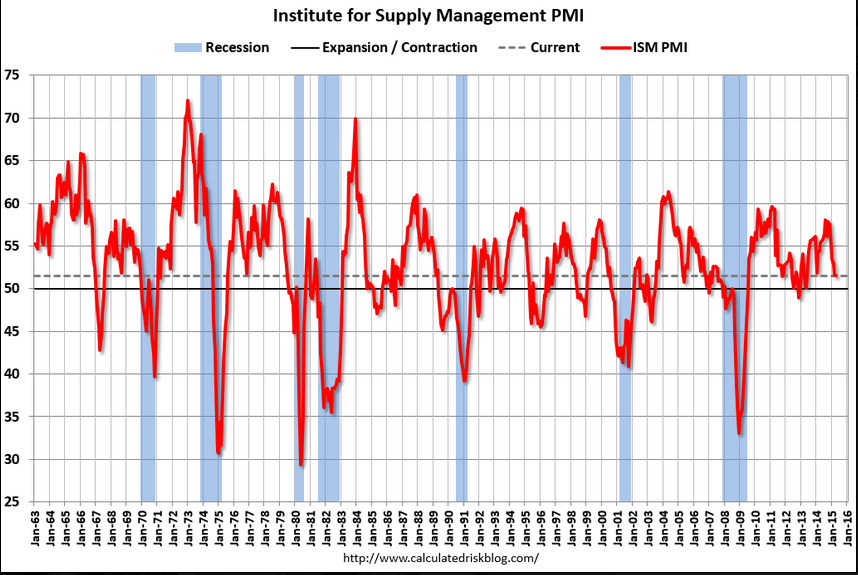
There’s a new unwanted wrinkle in the ISM report and that’s weakness in employment, holding down the headline index to 51.5 in April, unchanged from March. Employment has been holding strong in other reports — but not in the ISM report where the index is down nearly 2 points to a sub-50 level of 48.3 to indicate month-to-month contraction. This is the first time this reading is in contraction since May 2013 and it’s the lowest reading since all the way back in September 2009.

Other indications, however, are positive. New orders actually rose in the month, up 1.7 points to 53.5, and export orders are above 50 for the first time this year, at 51.5 for a 4.0 point gain. Production, at 56.0, is especially strong as are import orders at 54.0 for a 1.5 point gain. Prices, as in other reports, remain in contraction, little changed at 40.5.

And there’s solid breadth in the report with 15 of 18 industries showing composite growth in the month with strength in the auto industry specifically cited. This report is mixed though the decline in employment won’t be raising expectations for next week’s employment report for April.
er-5-1-6
er-5-1-7

Goldman Analyst’s index:
er-5-1-8

PMI Manufacturing Index
er-5-1-9

Highlights
Markit’s sample has been reporting some of the strongest activity of any manufacturing sample, making its otherwise respectable showing at 54.1 in April, down from 55.7 in March, yet another indication of weakness in the sector. Weakness, as in other samples, is centered in exports where orders, for the first time since November, are in outright contraction, the result of the strong dollar’s depressing impact on foreign demand.

Production is the softest it’s been all year, and that of course includes the winter months which, in most data, were hit hard by heavy weather. Deliveries continue to be delayed, the result not of strong demand but, interestingly, of continued issues tied to the long resolved port slowdown on the West Coast.

This is one man one vote, not one dollar one vote, which squares this series with soft consumer spending reports:

Consumer Sentiment
er-5-1-10

Highlights
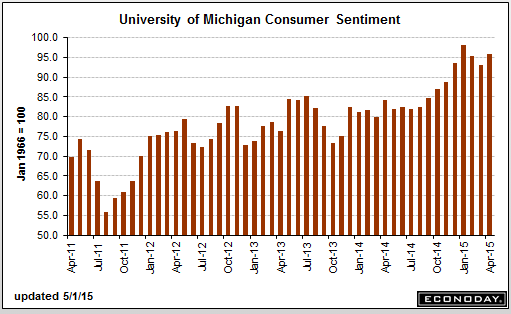
The Federal Reserve in Wednesday’s FOMC statement described consumer confidence as strong, confirmed by today’s consumer sentiment index which came in at 95.9 for final April, unchanged from mid-month April and noticeably higher from 93.0 in final March.

The headline’s two components both show gains with current conditions at 107.0, up 2.0 points from March, and with expectations at 88.8, up 3.5 points. The former points to month-to-month strength for consumer activity while the latter points to confidence in the income outlook, specifically the jobs market.

Inflation readings are very weak in this report, reflecting no doubt the low level of gas prices which however have been on the rise in recent weeks. The 1-year outlook is at 2.6 percent, down from 3.0 percent in March, with the 5-year outlook also at 2.6 percent, down from 2.8 percent.

Fed policy makers are keeping a close eye on inflation expectations and today’s report won’t offer anything to the hawks who want to begin raising rates. And despite the strength in the overall reading, strength in sentiment has yet to translate to strength in spending.
er-5-1-14

This is just plain bad and a downward reduction to Q1 GDP. And weaker GDP=weaker sales and incomes=that much less spending power going into Q2:

Construction Spending
er-5-1-12
Highlights
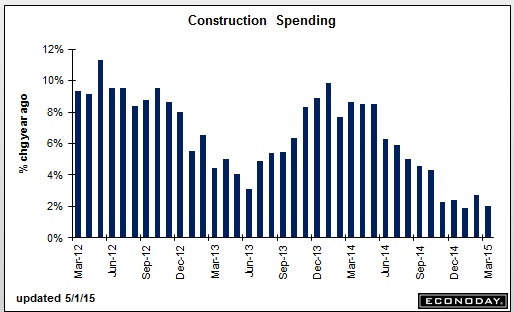
Construction spending once again defied expectations. March construction spending dropped 0.6 percent against expectations of an increase of 0.4 percent. On the year, construction spending was up 2.0 percent, down from February’s annual increase of 2.7 percent. Both residential and public building declined. While weather can still be blamed for some of the decline, a basic weakness in the building sector was apparent.

Private residential spending dropped 1.6 percent on the month with both single family and multi-family homes declined. In addition, residential construction excluding new homes, which captures home remodeling, also declined after gains in the previous two months. Nonresidential private construction provided a ray of sunshine — it advanced 1.0 percent on gains in the office, manufacturing, and health care sectors.

Public construction was down for a third straight month to its lowest level since February 2014. State and local government spending, the much larger portion of public construction, dropped in both February and March while Federal Government construction retreated after an 8.6 percent surge in the previous month.
er-5-1-13

Atlanta Fed, Japan and China, rail car traffic, Saudi output

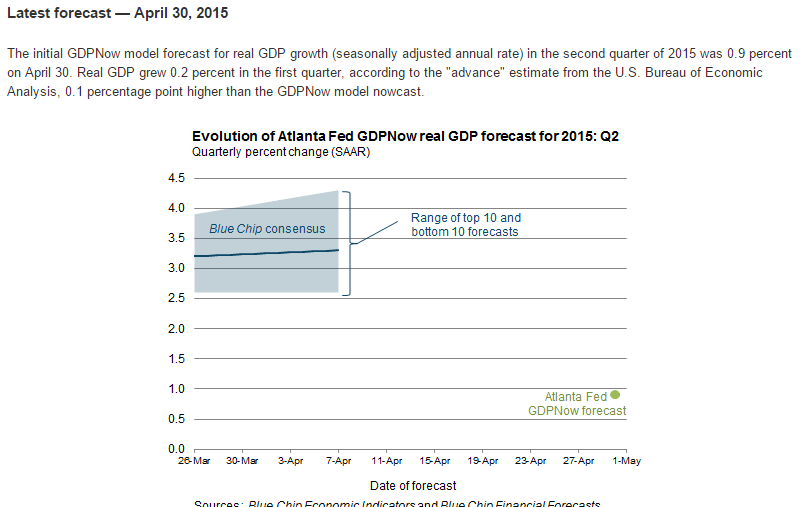
Currently a .9 forecast for Q2, well below other estimates again:
er-5-1-1
More global deceleration:

Japan : Household Spending
er-5-1-2
Highlights
Household spending declined for a twelfth straight month in March. On the year, spending was down 10.6 percent after sliding 2.9 percent in January. Consumption has been weak since last April when Japan raised its consumption tax by 3 percentage points to 8 percent. Spending in the most of the subcategories declined. The biggest drops were in furniture & household utensils (down 39.6 percent) and transportation (down 16.1 percent). Only education advanced, this time by 3.1 percent on the year.

Japan : PMI Manufacturing Index
er-5-1-3
Highlights
April final manufacturing PMI slipped the below the breakeven 50 level with a reading of 49.9. The data indicated worsening operating conditions in the Japanese manufacturing sector. Manufacturing production contracted for the first time since July 2014 in April. This was underpinned by a further decline in new orders, with the rate of decline the fastest since when the higher sales tax increase was implemented in April last year. Panelists reported a fall in demand from both domestic and international clients and challenging economic conditions as the main factors behind the decline in new work.

Production contracted for the first time since July 2014, underpinned by a further decline in new orders. Meanwhile, growth in new export orders slowed to the weakest in the current 10-month sequence of expansion. On the price front, input price inflation eased to the slowest in over two years.

At 49.9 in April, the headline PMI signaled a fractional deterioration in operating conditions in the Japanese manufacturing sector for the first time in almost a year. Furthermore, the headline PMI has only posted below the 50.0 no-change mark three times in the past two years.

China : CFLP Manufacturing PMI
er-5-1-4
Highlights
April CFLP manufacturing PMI inched up to a reading of 50.1 — barely over the 50-point level that separates growth from contraction. The result was better than expectations, with economists predicting that the reading would be a breakeven 50. The March reading was also 50.1.

Four of ten sectors recorded readings over the 50 breakeven level. They were production (52.6), new orders (50.2), supplier delivery times (50.4) and business expectations (59.5). However, new export orders, finished goods inventories, imports, input prices, raw materials inventories and employment continued to contract.

China’s economy, which has enjoyed some of the fastest growth rates in the world in the past two decades, is now slowing and policymakers recently said it will target economic growth of “around 7 percent” this year, the slowest expansion in a quarter century.

Rail Week Ending 25 April 2015: Another Bad Data Week

Econintersect: Week 16 of 2015 shows same week total rail traffic (from same week one year ago) declined according to the Association of American Railroads (AAR) traffic data. Intermodal traffic improved, which accounts for half of movements – but weekly railcar counts remain in contraction.

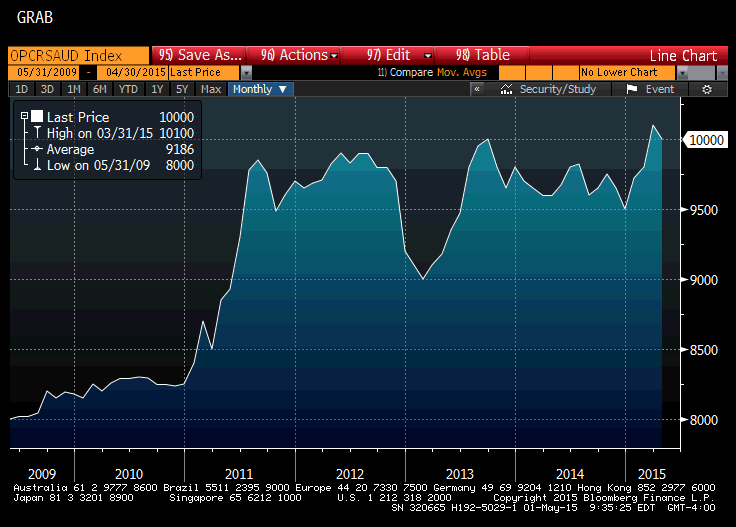
Saudi output remained reasonably steady indicating little change in net demand at their posted prices:
sg2015050134525

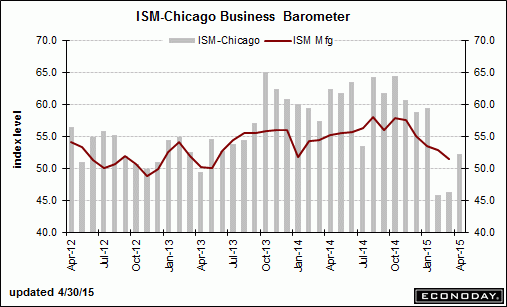
GDP detail, EU unemployment, personal income, ECI, Jobless Claims, chicago pmi, Bloomberg consumer comfort

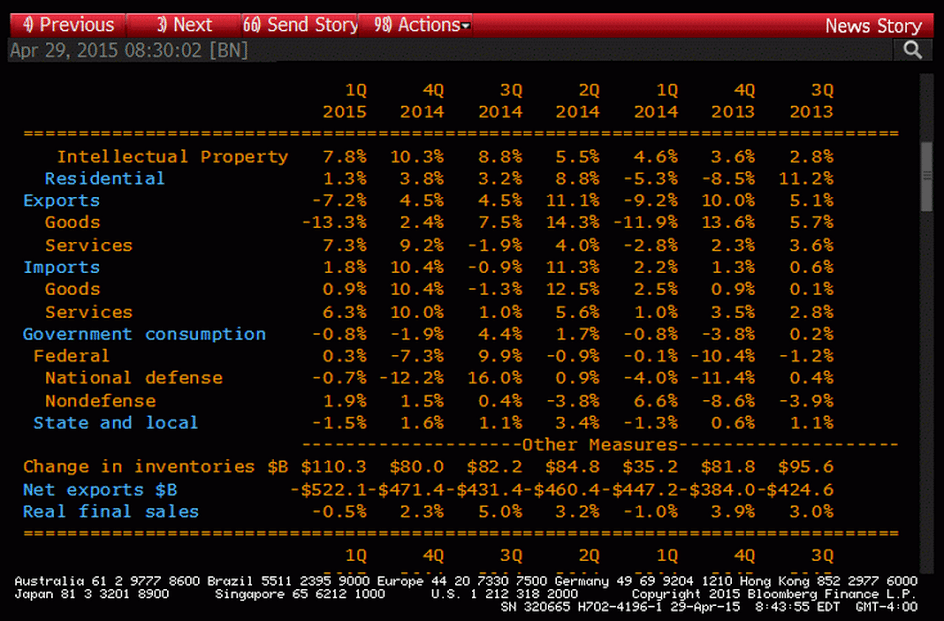
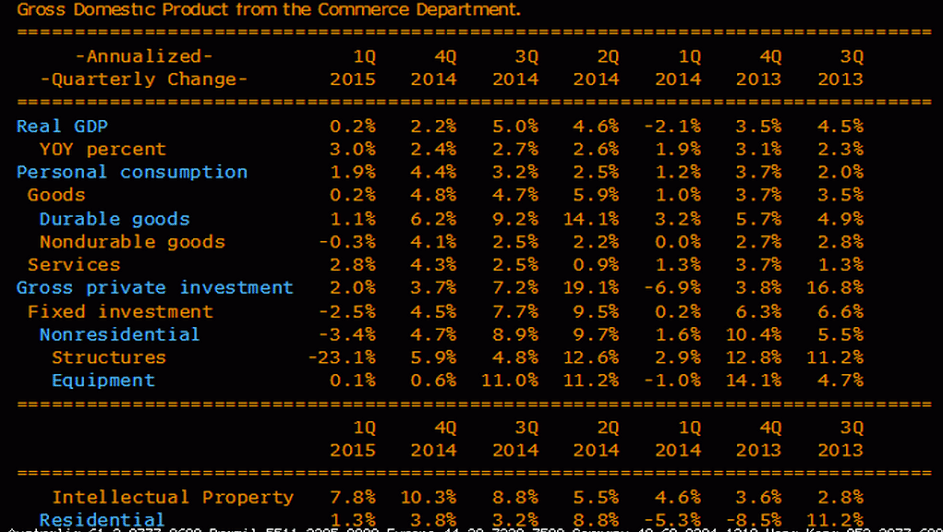
Note the inventory build:
er-4-30-1
er-4-30-2
Note the ‘bending of the curve’ for nominal spending that almost never happens:
er-4-30-3
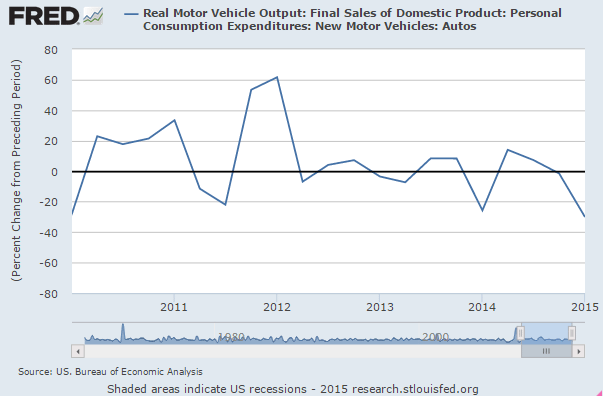
A bit of a disconnect between headline car sales and car sales’ contribution to GDP?
er-4-30-4
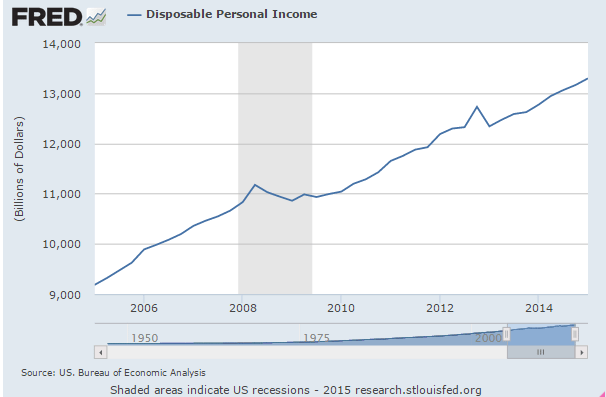
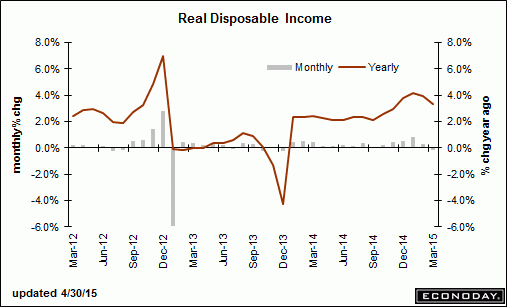
Disposable income has ratched down twice recently- once from the recession and jump in unemployment, and again with the tax hikes:
er-4-30-5

European Union : Unemployment Rate
er-4-30-6
Highlights
The Eurozone labour market made limited progress in March. Joblessness fell a further 36,000 to 18.105 million but the unemployment rate held steady at 11.3 percent, a tick above market expectations.

Amongst the larger member states the national jobless rate was unchanged in France (10.6 percent) and Germany (4.7 percent) and declined another tick to 23.0 percent in Spain. However, Italy saw its rate jump 0.3 percentage points to 13.0 percent, just a couple of ticks short of last November’s record high. Top of the pile was again Greece (25.7 percent in January) while Germany remained at the bottom.

Youth unemployment was also unchanged at 22.7 percent following a downward revision to the February rate.

The income lost due to falling oil revenues might be starting to show and the growth rate remains near stall speed:

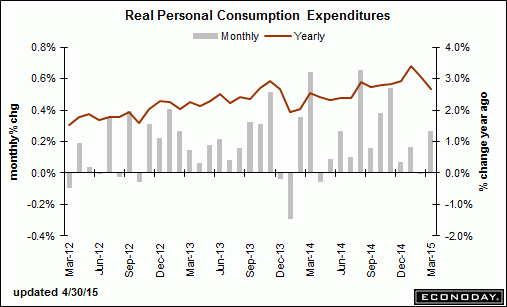
Personal Income and Outlays
er-4-30-7
Highlights
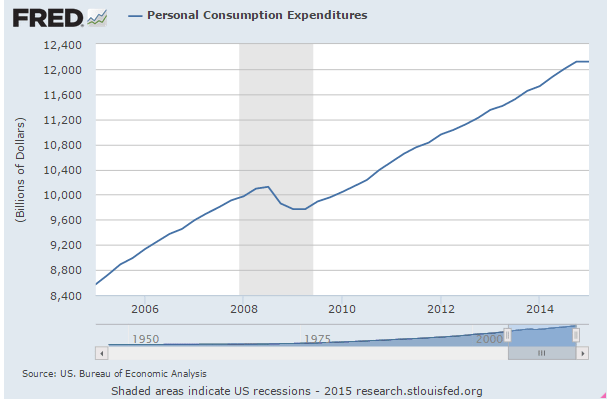
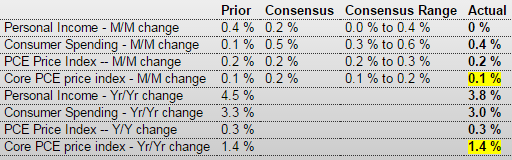
March consumer spending rebounded 0.4 percent (and was up 3.0 percent from a year ago) from a revised increase of 0.2 percent in February. But the data suggest that people remain somewhat cautious in their spending despite months of cheaper gasoline and rising confidence. Consumer spending generates more than two thirds of GDP and is a key driver of growth. Spending on services increased 0.2 percent from the prior month. Spending on goods added 1.0 percent after three consecutive monthly declines, including a 1.8 percent increase in purchases of durable goods like trucks and washing machines that are designed to last at least three years.

Personal income was flat on the month the weakest reading since December 2013. On the year, income was up 3.8 percent.

The Federal Reserve acknowledged that the economy slowed during the winter months, but they blamed the weakness on “transitory factors.” Officials said in a statement they “continue to expect that, with appropriate policy accommodation, economic activity will expand at a moderate pace.”

Personal consumption expenditures price index undershot the Fed’s 2 percent target increasing 0.3 percent in March from a year earlier, the same increase as the previous month. Excluding the volatile food and energy categories, prices climbed 1.3 percent in March from a year earlier for the fourth consecutive month.
er-4-30-8
er-4-30-9

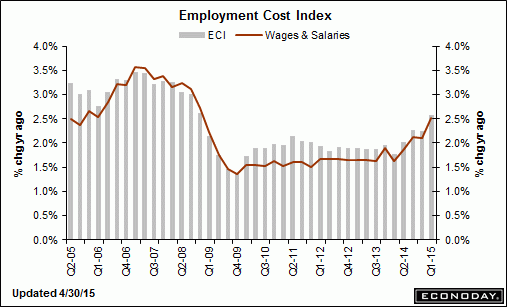
A bit higher than expected but I attribute this to hiring getting ahead of itself as reported employment gains have been outrunning growth of output:

Employment Cost Index
er-4-30-10
er-4-30-11
In the 12 months through March, labor costs jumped 2.6 percent, the largest rise since the fourth quarter of 2008. That is still below the 3 percent threshold that economists say is needed to bring inflation closer to the Fed’s 2 percent target.

Lower than expected and the Fed knows it shows separations and not new hires, though it has correlated to hiring historically:

Jobless Claims
er-4-30-12
Highlights
The Fed is ready now to pull the trigger at anytime and today’s jobless claims data may have their finger a little itchy. Initial claims, not skewed by special factors, plunged 34,000 in the April 25 week to 262,000 which is the lowest level since all the way back to April 2000. The 4-week average is down 1,250 to a 283,750 level which is just below a month-ago and is also a 15-year low.
er-4-30-13
Bloomberg Consumer Comfort Index
er-4-30-14
Highlights
Bloomberg’s consumer confidence index declined for a third consecutive week to a six-week low of 44.7 as Americans took a less favorable view of their finances and the slowdowns at factories and oilfields soured attitudes among men. Sentiment among men showed one of the biggest decreases in the past four years, while confidence in the Midwest slumped by the most in more than a decade. While the Bloomberg comfort gauge cooled from an almost eight-year high reached earlier this month, it remains well above last year’s average of 36.7, which was the best since 2007.

wage growth and business investment

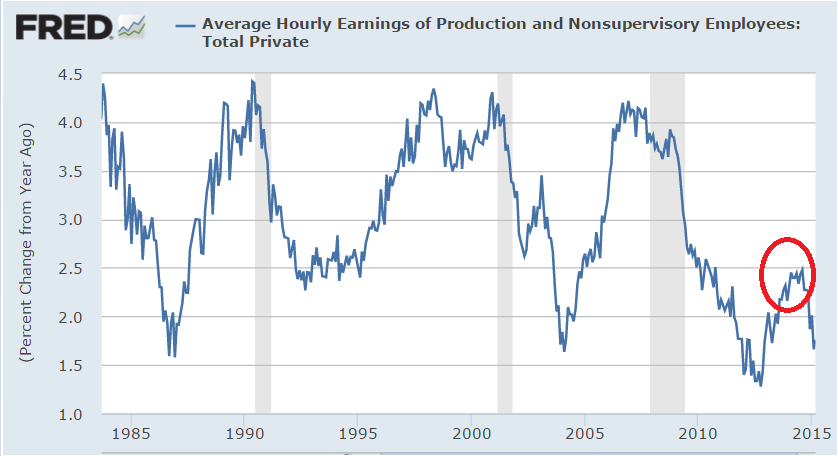
Interesting how these two reports relate to each other.

And the circled section is the last time the street was screaming about ‘wage inflation’ saying that every time in the past it went up as it had to that point it kept going up for the next 4 years. But it does track somewhat with investment, below:
ahe

Wage Growth Is Poised to Accelerate

By Gene Epstein

April 24 (Barrons) — Jason Benderly of Applied Global Macro Research has built an explanatory model that accounts for fluctuations in labor compensation with a far closer fit than a single-variable model that consists solely of the change in the unemployment rate. These four key variables (the change in the jobless rate, the jobless rate, the change in labor productivity, and after-tax profit margins), along with two other, minor ones relating to prices, explain real hourly compensation, which includes all benefits, going back to 1960. With no trouble explaining the recent period, the model predicts an acceleration in wage growth.

Weak U.S. business spending data hints at sluggish growth rebound

By Lucia Mutikani

April 24 (Reuters) — U.S. business investment spending plans fell for a seventh straight month in March. Non-defense capital goods orders excluding aircraft declined 0.5 percent last month after a revised 2.2 percent drop in February, which was the biggest decline since July 2013. In March, shipments of core capital goods fell 0.4 percent after a downwardly revised 0.1 percent gain in February.Shipments in February were previously reported to have risen 0.3 percent. That downward revision together with March’s weak reading could see economists trim their first-quarter GDP growth estimates.

Looks like this is coincident to recession, unless rescued by another fracking boom…
capex
Sure looks to me like there’s a high probability this cycle is over. And could have been over last year if not rescued by the fracking boom.

Fracksional reserve banking???
:( sorry!!!

sea container counts, state labor force stats, mtg purchase apps, existing home sales, FHA home prices, Japan headline

March 2015 Sea Container Counts Are Not Strong Even Though the Labor Troubles Are Over

By Steve Hansen

The West Coast Ports labor dispute is over, and appears the backlog has been eliminated causing a spike in exports. However, not only is year-to-date volumes contracting for both imports and exports – but March exports are contracting month-over-month and year-over-year. This is indicating weak economic conditions domestically and globally.
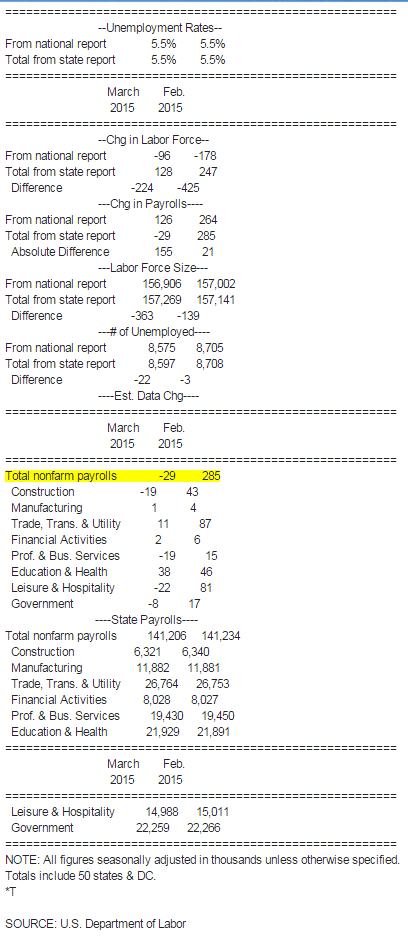
U.S. March Labor Force Comparison Statistics (Table)

By Chris Middleton

April 21 (Bloomberg) — Following is a comparison of U.S. labor force figures as reported in the national employment situation release and the monthly regional and state employment report. Total state figures are calculated by Bloomberg News.

Each state series is subject to larger sampling and nonsampling errors than the national series. Summing them compounds the state level errors and can cause significant distortions at the aggregate level. Due to these statistical limitations, the Bureau of Labor Statistics does not compile a “sum-of-states” employment series and cautions users that such a series is subject to a relatively large and volatile error structure.
er-4-22-1

Oil States See Slumping Employment as Texas Loses 25,000 Jobs in March

April 21 (WSJ) — While the U.S. economy continued to add jobs last month, states that rely heavily on the oil industry experienced significant cuts. Job losses hit particularly hard in Texas (down 25,400 jobs) and Oklahoma (down 12,900), leading the nation in losses. North Dakota lost 3,000 jobs, a significant cut in such a small state. All told, 31 states and Washington, D.C., saw a drop in employment in March, and only 18 states saw employment rising. The broad deterioration was a reversal from February, a month in which only 13 states saw decreases and 36 states and D.C. saw an increase.

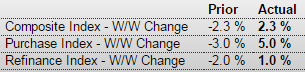
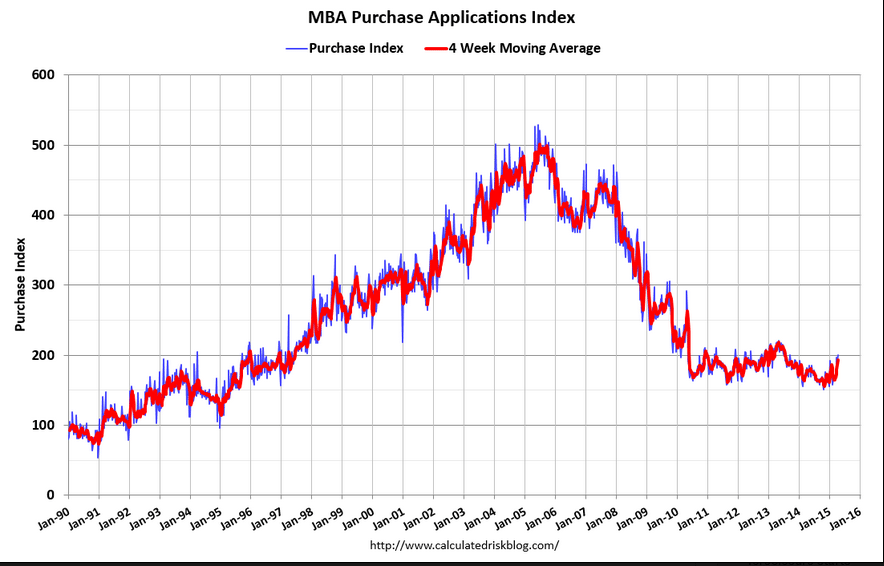
Purchase apps up some from still very depressed levels, but cash sales have been falling so total sales not necessarily higher.

And year over year up but last year’s sales were even more depressed by the exceptionally cold winter.

MBA Mortgage Applications
er-4-22-2
Highlights
Mortgage applications for home purchases have definitely been showing life this spring, up 5.0 percent in the April 17 week. This is the 4th increase in 5 weeks. Helping purchase demand are low rates, down 4 basis points in the week to an average 3.83 percent for conforming loan balances ($417,000 or less). Low rates, however, aren’t doing much to stimulate refinancing demand with this index up only 1.0 percent in the week. Watch for existing home sales later this morning at 10:00 a.m. ET.
er-4-22-3

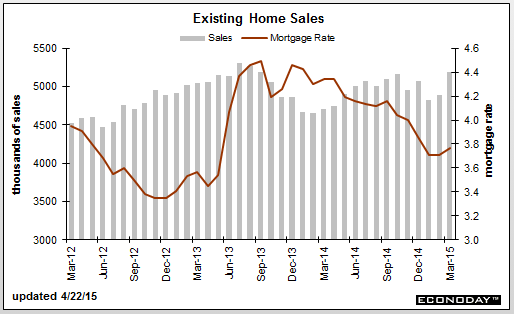
Up a bit more than expected, but still depressed as well. And few distressed sales raise the median price so a ‘quality adjusted’ price would be more informative. And with the last slowdown coincident with a rate spike maybe the Fed isn’t ready to risk that again?

Existing Home Sales
er-4-22-4
Highlights
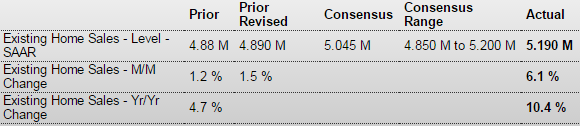
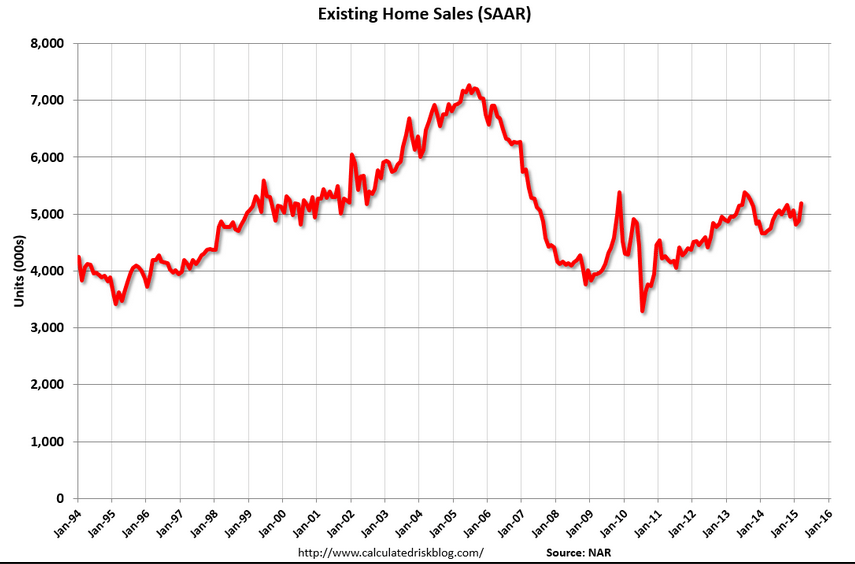
This winter’s heavy weather may very well have held down the housing market which appears to be heading into the spring with new momentum. Existing home sales surged 6.1 percent in March to a 5.190 million annual rate. This is near high-end expectations and the best rate since September 2013. In percentage terms, the 6.1 percent gain is the strongest since December 2010 and among the very highest in the 16-year history of the series.

Sales of single-family homes jumped 5.5 percent in the month to a 4.590 million rate while condos really jumped, up 11.1 percent to a 600,000 rate. All regions show solid gains in total sales led by the Midwest at 10.1 percent with the South at the rear, though still up a solid 3.8 percent.

Price data all show strength with the median price up a very strong 5.1 percent to $212,100. Year-on-year, the median is up 7.8 percent for the best reading since February last year. This is a bit below the year-on-year sales rate of 10.4 percent which hints at further pricing power ahead.
er-4-22-5
er-4-22-6

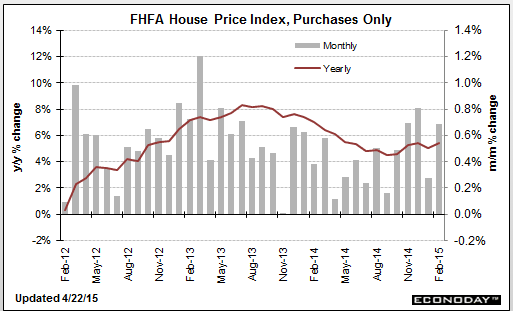
Again, I’d like to see what this looks like excluding distressed sales:

er-4-22-7

Bank of Japan to cut fiscal 2015 inflation forecast

April 1 (Nikkei) — The Bank of Japan is considering lowering its 1% inflation forecast for fiscal 2015 amid the continued slump in oil prices and a slow recovery in domestic consumption.

So Cal home sales, Carter and the inflation of the 70’s

Up a bit vs March last year so no boom yet:

CoreLogic (formerly DataQuick data): SoCal sales up 5.0% Year-over-year

By Bill McBride

April 20 (Calculated Risk) — CoreLogic released the Southern California report today for March (CoreLogic acquired DataQuick).

The data shows 18,156 new and resale houses and condos sold in Los Angeles, Riverside, San Diego, Ventura, San Bernardino and Orange counties in March.

That was up 35.6% from 13,650 sales in February, and up 5.0% from 17,638 sales in March last year.

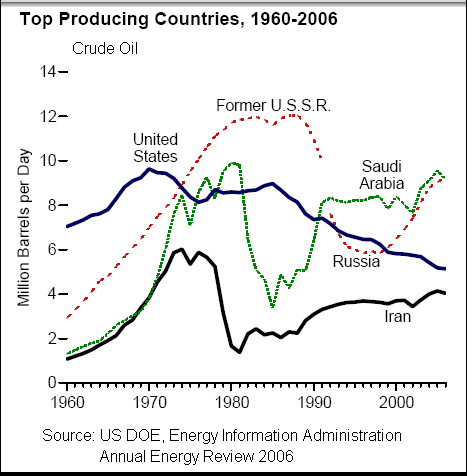
A narrative about how Carter’s deregulation of natural gas in 1978 (not ‘monetary policy’)is what broke the ‘great inflation’ that was likewise caused by the prior rise in the price of oil. The report may be ‘over friendly’ to Carter, but it was the substitution of natural gas for oil in public utilities and other businesses that dislodged OPEC’s pricing power. Note the supply cuts as Saudia Arabia and Iran, shown here, attempted to set hold prices at over $30 as substitution reduced demand:
oil-production

Miller Center – Jimmy Carter

Energy Policy Success

Carter’s main achievement involved energy policy, though he would receive little credit for it during his term. Despite the lip service paid by American presidents to reducing energy dependence, U.S. oil imports had shot up 65 percent annually since 1973. In 1976 the nation was consuming one-quarter of all Organization of Petroleum Exporting Countries (OPEC) production. The U.S. remained wasteful in energy use, with consumption per capita 2.3 times the average for nations in the European Economic Community and 2.6 times Japan’s. Carter set out to reduce this dependence.

The president got Congress to pass the Emergency Natural Gas Act, which would authorize the national government to allocate interstate natural gas. He created a Department of Energy to regulate existing energy suppliers and fund research on new sources of energy, particularly sustainable (wind and solar power) and ecologically sound sources. His Energy Security Act created the U.S. Synthetic Fuels Corporation, which would provide $20 billion in joint ventures with private industry. Carter signed his first energy package into law on November 9, 1978. The deregulation of oil and natural gas prices that resulted would lead to a vast increase in the supply of energy in the 1980s, and consequently a lowering of prices.

During Carter’s term, however, the actions of the OPEC oil cartel (foreign oil producers) resulted in an increase in oil prices, from $13 a barrel to over $34. With America so dependent on oil, this huge price increase resulted in a run-up in inflation. Carter asked Congress to accelerate stockpiling 500 million barrels of crude oil in a national security reserve, setting target date by end of 1980 instead of 1982 (the deadline set by the Ford administration). The administration also developed new conservation measures that would sharply reduce industry’s use of fuels, as well as automobile mileage standards. Strip mining would now be regulated by the Surface Mining Control and Reclamation Act, a victory for environmentalists.

Carter had other successes in energy policy, particularly in nuclear energy policy, in which he was an expert. He got Congress to abolish the powerful Joint Committee on Atomic Energy, a step that would make it easier to block breeder reactors and move toward light-water reactors of the kind favored by the administration. Carter won his route for a soon to be constructed oil pipeline in Alaska. He killed funding for the Clinch River Breeder Reactor, because the plutonium reactor technology would increase the risk of nuclear proliferation if adopted elsewhere in the world. Instead, Congress authorized and funded a shutdown of the reactor.

By April 1980, he had gotten much of his second energy package through, including a Crude Oil Windfall Profits Tax (with revenues designated for the general Treasury but not for specific energy projects), which would expire in 1993 or before, if the full amount of $227 billion had been collected. But there were two major defeats: Congress overrode a presidential veto of a bill that Congress had passed repealing a $4.62 per barrel oil import fee—the first time in twenty-eight years that a Congress had overridden a veto by a president from the majority party. It also defeated the Energy Mobilization Board that Carter had proposed to cut through “red tape” in developing new sources of energy.

While Americans had to endure long gas lines during the summer of 1979 and higher prices at the pump—effects of the Iranian revolution of that same year— Carter’s program by and large worked. Consumption of foreign oil did go down, from 48 percent when Carter took office to 40 percent in 1980, with a reduction of 1.8 million barrels a day. When Carter left office there were high inventories of oil and a surplus of natural gas, delivered by a more rational distribution system. There was greater oil exploration than before, leading eventually to an oil glut and a drop in prices-which Carter’s Department of Energy had not predicted. Between 1980 and 1985, domestic production would increased by almost 1 million barrels a day, while imports of crude oil and petroleum products declined from 8.2 to 4.5 million barrels a day. His goal of reducing U.S. dependency on foreign sources succeeded, at least temporarily.