The Fed’s next move

If I were a mainstream economist and on the FOMC (I’m not either, they are both), and world equity markets were firm going into the meeting next week with the monoline issue put to bed, I’d opt for no cut.

That would be expected to rally the $, take down gold and most other commodities, and be taken as a strong move to ‘keep expectations well anchored’ before they had a chance to elevate.

Equities might sell off initially, but be encouraged with the knowledge the Fed was keeping inflation under control, and therefore not get involved into a prolonged, rate hiking fight against inflation down the road.

Also, confidence in the economy would be conveyed, as the no cut decision would be taken as a statement from the Fed that the economy didn’t need further rate cuts.


Jan 23 late update

Monoline problem addressed, stocks suddenly oversold as that risk fades.

Most earning look strong. Guidance may be soft but that’s at least partially a function of the expectation of a recession as per the media reporting and will get ignored as those fears continue to fade.

If initial claims tomorrow are around 325,000 as expected, and continuing claims are reasonably stable, it will indicate the labor markets may not have deteriorated from Q4 as feared.

Existing home sales are still winter numbers, but could surprise on the upside as anecdotal reports indicate aggressive selling of excess inventories.

The Fed and the stock market share the same fears. As the market’s fears fade so will the Fed’s, and the markets and the Fed could start to take away a the cut now priced in for the meeting next week.

This leaves FF futures and ED futures maybe 100 bp over priced, as the improving outlook will price in the possibility that fewer future cuts will be appropriate.

And the fiscal package is growing. This is the first time I’ve ever seen the Fed encouraging adding to the deficit, and in an election year it’s hard to imagine Congress and the President not taking advantage of that opening and in the spirit of bipartisan cooperation expanding the package so all get their favorite tax cut and spending initiative. $250-300 billion wouldn’t surprise me. And they need to do it quick before it’s discovered there is no recession problem, but instead an inflation problem.

Also note WTI and Brent crude have converged quite a bit in the sell off, which probably means WTI was sold off by speculators, and a bounce back to the Saudi’s target price (whatever that is) can be expected.

Exports are also likely to be underestimated in next week’s GDP preview, so there’s a good chance it will be revised up when December trade numbers are announced in February.

And without a rise in unemployment and a meaningful drop in personal income housing can come back very quickly from a very low base. Affordability is up nicely, and the production of new homes is down by maybe a million vs last year.


Re: Will the cure be worse than the disease?

(an interoffice email)

> the only problem i have with Meltzer is that is the consensus view now,
> that inflation is a foregone conclusion-i think long term that may be
> right (long term paper currency devaluation) but you could easily
> correct commodity and energy prices if you have a reduction of
> speculator and investor demand (ie see 1970s chart of gold and crude
> oil-there years in which the price of those commodities corrected
> viciously in a long term up trend). Specs of today in a mark to market
> world i dont believe are immune from short term negative commodity
> marks…

Agreed.

Two things (as Reagan would say):

  1. Crude probably stays high as Saudis are selling 9 million bpd at current prices. no reason to cut price unless demand fall off and forces them to hit bids rather than getting offers lifted. And world inventories are relatively low so it would be hard to get a sell off from physical inventory liquidation. More likely for other commodities to underperform crude in a spec sell off. Might even be happening now. (And biofuels like crude and food costs.)
  1. Even if crude/food/import and export prices level off or even go down some, they are so far ahead of core CPI increases that core can continue to go up for several quarters to close the gap. And the Fed thinks that can dislodge expectations so can’t afford to let it happen.
  1. world employment/income seems to be holding up, so actual nominal demand for consumption of resources shouldn’t collapse without some major positive supplied side shock.

Meltzer is wrong as IMHO not much is a function of interest rates; so, he’s ‘blaming’ the wrong entity for ‘inflation’. But his story is the mainstream story; so, i expect a lot more of same.


♥

Will the cure be worse than the disease?

Will the cure be worse than the disease?

Right, the financial press will chop the Fed to ribbons if inflation continues higher, as I expect it will.

But Bernanke is setting the stage for an even bigger recession down the road. Just as the ultra-low rates of the early 2000s created many of the problems we’re experiencing today, pumping money into the system would probably stoke inflation, forcing the Fed to hike rates sharply in the near future. “It’s better to take a small recession and kill inflation immediately instead of facing high inflation and a really big recession later,” says Carnegie Mellon economist Allan Meltzer.

That’s the orthodox mainstream view. They are already starting to turn on Bernanke and his reinvention of monetary policy.

Meltzer, who is finishing the second volume of his history of the Federal Reserve, warns that Bernanke is risking a disastrous replay of the 1970s, when high oil prices fueled double-digit inflation. Every time the Fed started to tighten and unemployment jumped, chairmen G. William Miller and Arthur Burns lost their nerve. They lowered rates to boost job growth, and inflation inevitably revived, causing a vicious price spiral. The Fed let the disease rage for so long that it took draconian action by chairman Paul Volcker in the early 1980s to finally defeat inflation. The price was a deep recession, with unemployment hitting 11% in 1982. “The mentality is the same as in the 1970s,” says Meltzer. “‘As soon as we get rid of the risk of recession, we’ll do something about inflation.’ But that comes too late.”

Yes, that’s the mainstream story (not mine, of course) and likely to get a lot louder, and if inflation picks up, it could cost Bernanke his job.

Indeed, while the economy is sending mixed messages about growth, the signs of increasing inflation are flashing bright red. For 2007 the consumer price index rose 4.1%, the biggest annual increase in 17 years. Gold, historically a reliable harbinger of inflation, set an all-time high of more than $900 an ounce. The dollar is languishing at a record low against the euro and a weighted basket of international currencies. “Flooding the market with liquidity is a disaster for the purchasing power of the dollar,” says David Gitlitz, chief economist for Trend Macrolytics.

And the Fed knows this. And they know they are ‘way out of bounds’ of mainstream theory with current policy, including encouraging a fiscal package.

The Fed’s supporters tend to downplay those dangers. They contend that the inflation surge is being driven largely by energy costs. Since oil isn’t likely to rise from its near-$100 level, inflation is likely to tail off in 2008. “That argument is wrong,” says Brian Wesbury, chief economist with First Trust Portfolios, an asset-management firm. “As people spend less to drive to the golf course, they will spend the extra money on golf clubs or other products. The Fed wants to reflate the economy, so the money that went into higher oil prices will drive up the prices of other goods.”

That’s the mainstream story, and it’s lose/lose for the Fed.

Fed supporters also point out that the yield on ten-year Treasury bonds stands at just 3.8%, a figure that implies that investors expect inflation to be around 2% in future years. So if inflation is really expected to rage, why aren’t interest rates far higher? The explanation is twofold. First, government bonds are hardly a foolproof forecaster. For example, five years ago Treasury yields were predicting 2% inflation over the next five years, and the actual figure was 3%, or 50% higher.

Another point the mainstream will make: Fed foolishly relied on its forecasting models and ignored the obvious signs of inflation.

Second, investors are so skittish about most stocks and corporate bonds that they’re paying a huge premium for safe investments, chiefly U.S. Treasuries. “It’s all about a flight to safety,” says Meltzer. Stand by for a major rise in yields as the reality of looming inflation sinks in.

So what is the right course for the Fed? Bernanke should hold the Fed funds rate exactly where it is now, at 4.25%. Standing pat might well push the economy into a recession. But the Fed’s newfound vigilance on inflation would boost the dollar, effectively lowering the prices of oil and other imports. America would suffer a short downturn and restore price stability, paving the way to a strong recovery in 2010 or 2011.

Sadly, the Fed has already chosen sides. It’s likely to lower rates every time growth slows or joblessness rises. As a result, it will never tame inflation until it becomes a clawing, bellowing threat. Then we’ll have to suffer a real recession, the kind we suffered in the aftermath of a time we should study and shouldn’t forget – the 1970s.

Says it all.

Hard to say why the Fed hasn’t played it that way, but they haven’t and will pay the price if inflation keeps rising.


♥

Fed comments

The Fed is aware rate cuts don’t do much for near term financial disruptions. For example, the FF/LIBOR spread was first addressed with FF cuts, but little or nothing changed until the TAF was introduced to address and normalize that spread.

Along the same lines, Bernanke has recently met with the President and Congress to coordinate a fiscal package, and today’s cuts were preceded by Paulson talking about what Treasury is doing for the financial crisis.

The Fed knows they pay an inflation price for each cut, but also believe they need to get the current financial crisis behind them first, and then address any residual inflation issue. Nor does Congress want to go into the election with a weak economy.

The incentives are in place for a credible fiscal package.

And with core inflation indicators now moving up, the Fed would very much like this rate cut, along with the pending fiscal package, to ‘work’ and be the last one needed.


♥

2008-01-22 US Economic Releases

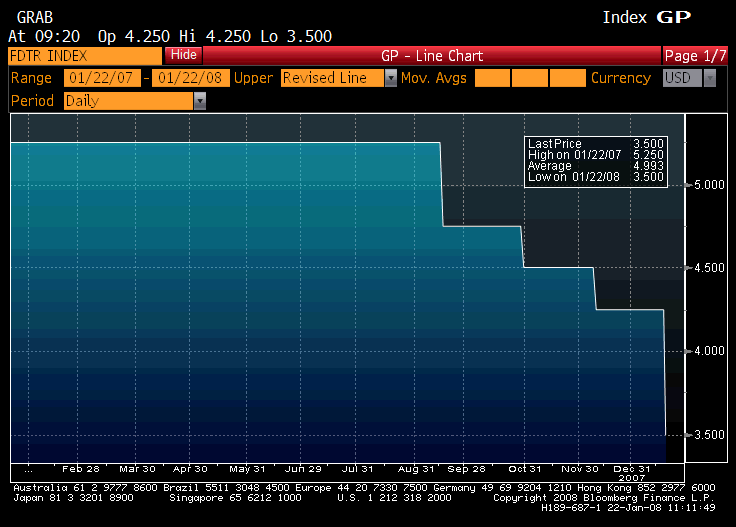
2008-01-22 FOMC Inter-meeting Rate Cut

FOMC Inter-meeting Rate Cut (Jan 22)

Survey n/a
Actual 3.50%
Prior 4.25%
Revised n/a

The cut was fully priced in for next week, with a lesser probability for doing it today.

The Fed is worried about ‘financial conditions’ and hopes to prevent them from spilling over into the real economy by doing, what the mainstream would call, ‘stepping on the inflation pedal.’


2008-01-22 Richmond Fed Manufact. Index

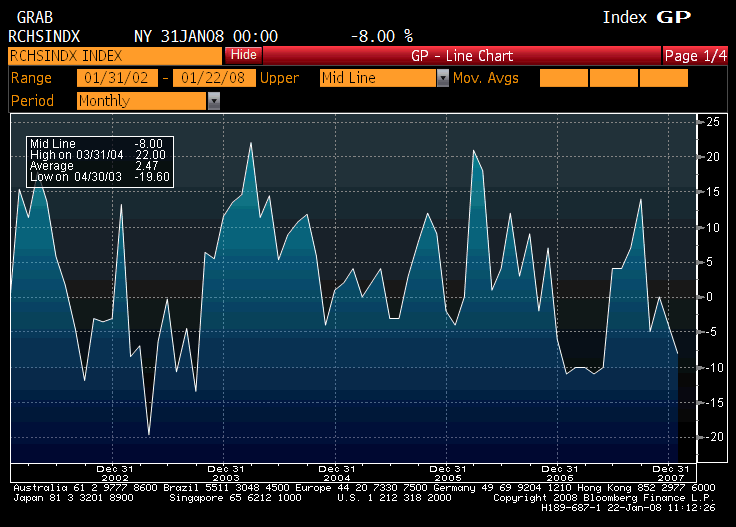
Richmond Fed Manufacturing Index (Jan)

Survey -5
Actual -8
Prior -4
Revised n/a

2008-01-22 Richmond Fed Manufact. Index TABLE

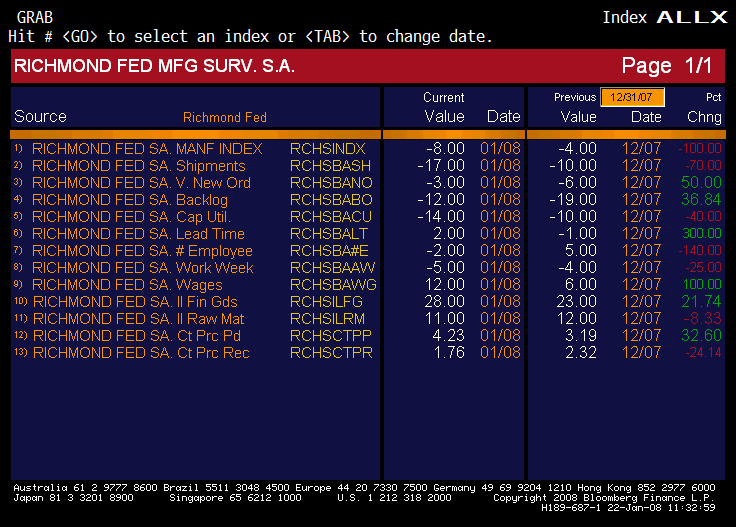
Richmond Fed Manufacturing Index TABLE

Down, but was lower last year about this time.

Also, the details of the table say more than the headline number. Shipments, cap utilization, and number of employees were the larger declines. Lead time, wages, and new orders and backlogs were up the highest percent. Prices remained moderately positive.


2008-01-22 ABC Consumer Confidence

ABC Consumer Confidence

Survey n/a
Actual -23
Prior -24
Revised n/a

Bumping along the bottom – still watching CNBC.


♥

I’ve been wrong on the Fed

> Hi
>
> You’ve been looking for this kind of financial trouble for a bit over in Europe. Good call Warren.
>
> Bobby.
>

Thanks, yes, I called it from mid 2006 – weakness due to deficit too small to support the credit structure, but inflation racing up as food/fuel rise due to Saudis acting the swing producer and biofuels burning up our food supply.

My error was in thinking the inflation would keep the fed from cutting. Been totally wrong on that!

Never would have thought a CB would act this way in the face of a triple negative supply shock – food/fuel/importand export prices all ratcheting up.

And looks like another 50 cut or maybe even 75 or 100 on Jan 30 even as core inflation goes through their ‘comfort zone,’ and Bernanke’s pushing Congress to hike the deficit! Never imagined the Fed would be keen to send a strong ‘we don’t care about inflation’ message, regardless of GDP in the short run. Goes against every aspect of mainstream monetary theory. But they sure are doing it!

And still no major weakness in the real economy, apart from some possible weakness late December if exports fell off. That won’t be out for a while.

All I can come with are three things:

  1. They’ve been misusing futures prices for oil and food to predict inflation will fall.
  2. They are afraid of fixed exchange rate/gold standard types of monetary collapses, even though we have a floating exchange rate policy, where that doesn’t happen and for all practical purposes can’t happen with floating fx.
  3. They are relying on their forecasts for weakness to bring down inflation when it’s coming from a combination of producer price
    setting, biofuels, and Paulson’s weak $ policy chasing foreign central banks away from $US financial assets.

And yes, watch out for a system wide failure of the payments system in the Eurozone if deposit insurance gets tested by a major bank failure.

Also, the $US remains fundamentally strong, but Paulson and to some degree the Fed are scaring investors away from $US financial assets, including US and other pension funds, which keeps the $ cheap enough to drive increasing US exports.

warren


♥

2008-01-21 Update

Major themes intact:

  • weak economy
  • higher prices

Weakness:

US demand soft but supported by exports.

US export strength resulting from non resident ‘desires’ to reduce the rate of accumulation of $US net financial assets. This driving force is ideologically entrenched and not likely to reverse in the next several months.

In previous posts, I suggested the world is ‘leveraged’ to the US demand for $700 billion per year in net imports, as determined by the non resident desire to accumulate 700 billion in $US net financial assets.

US net imports were something over 2% of rest of world GDP, and the investment to support that demand as it grew was probably worth another 1% or more of world GDP.

The shift from an increasing to decreasing US trade deficit is a negative demand shock to rest of world economies.

This comes at a time when most nations have decreasing government budget deficits as a percent of their GDP, also reducing demand.

The shift away from the rest of world accumulation of $US financial assets should continue. Much of it came from foreign CB’s. And now, with Tsy Sec Paulson threatening to call any CB that buys $US a ‘currency manipulator’, it is unlikely the desire to accumulate $US financial assets will reverse sufficiently to stop the increase in US exports. I’m sure, for example, Japan would already have bought $US in substantial size if not for the US ‘weak dollar’ policy.

All else equal, increasing exports is a decrease in the standard of living (exports are a real cost, imports a benefit), so Americans will be continuing to work but consuming less, as higher prices slow incomes, and output goes to non residents.

I also expect a quick fiscal package that will add about 1% to US GDP for a few quarters, further supporting a ‘muddling through’ of US GDP.

Additional fiscal proposals will be coming forward and likely to be passed by Congress. It’s an election year and Congress doesn’t connect fiscal policy with inflation, and the Fed probably doesn’t either, as they consider it strictly a monetary phenomena as a point of rhetoric.

Higher Prices:

Higher prices world wide are coming from both increased competition for resources and imperfect competition in the production and distribution of crude oil. In particular, the Saudis, and maybe the Russians as well, are acting as swing producer. They simply set price and let output adjust to demand conditions.

So the question is how high they will set price. President Bush recently visited the Saudis asking for lower prices, and perhaps the recent drop in prices can be attributed to those meetings. But the current dip in prices may also be speculators reducing positions, which creates short term dips in price, which the Saudis slowly follow down with their posted prices to disguise the fact they are price setters, before resuming their price hikes.

At current prices, Saudi production has actually been slowly increasing, indicating demand is firm at current prices and the Saudis are free to continue raising them as long as desired.

The current US fiscal proposals are designed to help people pay the higher energy prices, further supporting demand for Saudi oil.

They may also be realizing that if they spend their increased income on US goods and services, US GDP is sustained and real terms of trade shift towards the oil producers.

Conclusion:

  • The real economy muddling through
  • Inflation pressures continuing

A word on the financial sector’s continuing interruptions:

With floating exchange rates and countercyclical tax structures we won’t see the old fixed exchange rate types of real sector collapses.

The Eurozone banking sector is the exception, and remains vulnerable to systemic failure, as they don’t have credible deposit insurance in place, and, in fact, the one institution that can readily ‘write the check’ (the ECB) is specifically prohibited by treaty from doing so.

Today, in most major economies, fiscal balances move to substantial, demand supporting deficits with an increase in unemployment of only a few percentage points. Note the US is already proactively adding 1% to the budget deficit with unemployment rising only 0.3% at the last initial observation in December. In fact, fiscal relaxation is being undertaken to relieve financial sector stress, and not stress in the real economy.

Food and energy have had near triple digit increases over the last year or so. Even if they level off, or fall modestly, the cost pressures will continue to move through the economy for several quarters, and can keep core inflation prices above Fed comfort zones for a considerable period of time.

Fiscal measures to support GDP will add to the perception of inflationary pressures.

The popular press is starting to discuss how inflation is hurting working people. For example, I just saw Glen Beck note that with inflation at 4.1% for 07 real wages fell for the first time in a long time, and he proclaimed inflation the bigger fundamental threat than the weakening economy.

I also discussed the mortgage market with a small but national mortgage banker. He’s down 50% year over year, but said the absolute declines leveled off in October, including California. He also pointed out one of my old trade ideas is back – when discounts on pools become excessive to current market rates, buy discounted pools of mortgages and then pay mortgage bankers enough of that discount to be able refinance the individual loans at below market rates.


♥

Big think: Q and A’s

Response to questions from big think.

Is fiscal responsibility essential to creating a stronger, more prosperous nation, or is the matter overhyped?

Worse, the matter is totally confused. By identity, government budget deficits = ‘non-government’ accumulation of financial assets denominated in that currency.

That means net savings desires of the non-government sectors can only be accommodated by the government’s fiscal balance. (Deficit to add financial assets; surplus to reduce financial assets.)

Therefore, if government deficit spending is insufficient to satisfy the total net savings desires of the non-government sectors, the evidence is unemployment and excess capacity in general, which is also known as a lack of aggregate demand.


There are a plethora of reasons for Americans to work later in life today. It is difficult to live off of Social Security benefits alone, we are living longer and 401(k) plans are far less reliable than traditional retirement plans. So do older members of our society get a fair shot when it comes to employment? What about younger workers? Does youth and inexperience repel employers?

Employers attempt to maximize their profits. That means ‘hiring off the top.’ In other words, they try to hire the best first, and the seemingly less attractive workers get hired last.


What is the most exciting thing going on in business today?

The combination of weak demand, due to world budget deficits being too small, and rising prices of food and fuel, due to the Saudis acting as the swing producer (they are a monopoly supplier at the margin), is creating a highly disruptive ‘stagflation’ condition much like the 70’s.


Where is capitalism failing today?

Capitalism is functioning within the given institutional structure, which includes tax laws, labor laws, govt. spending decisions, contract law, etc.

What needs to change in the system?

The system changes continually with changes in the application of the institutional structure and with the advancement of knowledge on how to use any given structure.

Currently, we have a floating exchange rate system in place, which is capable of sustaining full employment and price stability. This is a major advancement over the previous gold standard, which necessarily resulted in periodic recessions and depressions and allocated real resources to the production and accumulation of gold.

However, we continue to fail to recognize how to sustain sufficient demand for full employment and we fail to utilize techniques of government spending that will promote price stability; so, the promise of floating exchange rates has yet to be realized.


Everyone deserves a fair price for their work,

As a matter of ‘game theory’ if a person has to work to eat and survive, but business only has to hire if it determines it can sufficiently profit by adding employees, it is an ‘unfair game’ biased against workers, and we should expect real wages to stagnate over time.

And this is exactly what we observe.

but should there be caps on CEO salaries?

The corporate structure is part of the general institutional structure, which is producing the seemingly higher than necessary CEO salaries. Simple caps would have other consequences.

More fundamental changes to the institutional structure are needed to put incentives in place for alternative distributions of incomes.

Is it fair to lay off workers when your own salary is worth tens of millions of dollars.

At the macro level, with sufficient aggregate demand to ensure full employment, efficiency increases total output. Therefore layoffs without production cuts potentially benefit the entire population.

However to get that outcome, the current institutional structure has to be adjusted to include the necessary incentives.

Or, does the market require high salaries to retain the highest quality leaders and the lifestyle they must lead in their high risk jobs?

No. The reason for the high CEO salaries is a function of the corporate structure that includes the legal arrangements between shareholders, board of directors, and management. It is the resulting interaction that will continue to push up CEO salaries.


Is war the biggest growth economy? It pours unknown amounts of wealth from around the world into technology, man power and manufacturing as well as using up, or destroying a great deal of natural resources.

Again, this is the result of institutional structure which is currently providing the incentives that give us the observed results.

And the situation is actually much worse than described above.

Current tax and other elements of fiscal policy are supporting biofuels. The result is that we are directly and indirectly burning up our food supply for fuel. This is already creating food shortages which have the potential to kill more people than were killed in World War II over the next few years.

How many people have an income either directly or indirectly derived from armed conflict? Since the industries that profit from the various aspects of war have become so vast and dependent on world wide struggles, will they ever let the world create peace?

First, biofuels will kill tens of millions over the next few years if nothing is done to stop that process. That is far higher than any of the current wars.

Second, the lack of understanding of the application of fiscal policy to ensure full employment and price stability is contributing to
regional conflicts.

Third, profiting from war is an example of how institutional structure functions channel economic resources. The outcomes are a function of the structure.


Are you worried about America’s economy?

Yes, I see weaker demand, supported by rising exports that diminish demand in the rest of the world, while inflation accelerates due to imperfect competition in the production of crude oil.


♥

ECB reiterates rate hike warning

ECB reiterates rate hike warning

FRANKFURT(AFP): The European Central Bank (ECB) reiterated Thursday a strong warning about eurozone inflation, calling for price and wage moderation and suggesting it would raise interest rates if necessary.

A monthly ECB bulletin said it was “absolutely essential” that long-term inflation be avoided, underscoring that the bank “remains prepared to act pre-emptively so that second-round effects” do not materialise. Such effects include further consumer price increases and excessive pay increases. The ECB said inflation pressure “has been fully confirmed” after eurozone consumer prices rose by 3.1 percent in December, the biggest increase in six-and-a-half years.

The report was released a day after Yves Mersch, Luxembourg central bank chief and a member of the ECB board, spoke in an interview of “factors that mitigate inflation risks” and suggested the ECB should “be cautious” amid widespread economic uncertainty. That was taken to mean the bank could lower its main lending rate, currently at 4.0 percent, causing the euro to fall below $1.46 on foreign exchange markets.

Like ECB president Jean-Claude Trichet on Wednesday, the bulletin confirmed the bank’s economic outlook: “That of real GDP (gross domestic product) growth broadly in line with trend potential” of around two percent. But it acknowledged that this projection was subject to high uncertainty owing to the US housing crisis and its unknown final effect on the global economy.

Wording of the bulletin matched that of a press conference by Trichet on January 10, when the bank left its key interest rate unchanged. Among other threats to the economy, the ECB pointed Thursday to persistently high prices for oil and other commodities. While acknowledging growth risks, the bank has stressed concern about rising prices and said that keeping inflation expectations under control was its “highest priority,” suggesting it was more inclined to raise interest rates than to lower them.

Many economists have cast doubt on such a possibility however since the US Federal Reserve and Bank of England have begun a cycle of interest rate cuts.

Faced with such scepticism, Trichet raised his tone last week, saying the bank would not tolerate an upward spiral in consumer prices and wages, a message in part to trade unions gearing up for pay talks.

Faced with drops in purchasing power, labour representatives have become particularly militant in Germany, the biggest eurozone economy. The ECB has raised its rates eight times since an increase cycle began in December 2005, with the benchmark lending rate rising from two to four percent.

An additional hike was expected in September but rates remained on hold owing to the US subprime mortgage market crisis.


♥