Excerpt from Kohn’s speech

My expectations for moderating inflation and limited spillover effects from commodity price increases depend critically on the continued stability of inflation expectations.

The FOMC has never wavered on this all important aspect of monetary policy – they firmly believe inflation expectations are what causes a relative value story to turn into an inflation story.

In that regard, year-ahead inflation expectations of households have increased this year in response to the jump in headline inflation. Of greater concern, some measures of longer-term inflation expectations appear to have edged up. If longer-term inflation expectations were to become unmoored–whether because of a protracted period of elevated headline inflation or because the public misinterpreted the recent substantial policy easing as suggesting that monetary policy makers had a greater tolerance for inflation than previously thought–then I believe that we would be facing a more serious situation.

If inflation expectations come unmoored for any reason, inflation is thought to follow.

And here he expresses concern that inflation expectations may be rising due to a public perception that the Fed easings mean the Fed has a greater inflation tolerance.

Governor Kohn is clearly concerned that the Fed’s actions since August may be causing inflation expectations to elevate, and his statement further implies that it will take actual ‘action’ on the part of the Fed to dispel the notion that they are more tolerant of inflation.

Markets will not believe the Fed will take action on inflation until after they actually do it, but that the Fed will respond to weakness regardless of inflation. This was expressed by today’s price action. With crude hitting $129 EDs a year out are 8 bps lower in yield.
2008-05-20 US Economic Releases


[Skip to the end]


Whether the ‘definitions’ call the food and energy price hikes ‘inflation’ or not, they are still problematic.

There are two choices for government: try to sustain aggregate demand or try to reduce aggregate demand.

Currently, the policy is to say ‘inflation’ is not a problem and try to sustain aggregate demand, as evidenced by the tax rebates and Fed rate cuts.
(NOTE: I don’t think rate cuts add to demand, but the Fed does.)

And as oil climbs in price, markets discount lower rates from the Fed (markets also think lower rates add to demand).

And, for another fiscal example, Obama speaks of tax cuts for the middle class so people can pay for their food and energy. Adding to demand like that will drive prices up further.

Supply responses aren’t particularly price sensitive in the short run; so, crude could go up a lot more before something like pluggable hybrids in sufficient quantities cut demand for gasoline by the 5-10 million bpd necessary to break the rise in crude prices.

And by that time the pass throughs to the rest of the economy (yes, including housing and wages) will be well entrenched.

The other choice for government is to cut aggregate demand. This means tax hikes or spending cuts, and a deep, ugly recession to hopefully cut demand for gasoline that way. Looks even more painful and less promising, if that’s possible.

I have suggested cutting demand for gasoline with a ‘non-price’ policy of setting the national speed limit at 30 mph for private transportation. This is a conceptual extension of policies mandating mpg, etc. It will cut gasoline demand by perhaps 5 million bpd and if adopted world wide more than that, but has yet to even enter the national debate.

So it will be a debate between adding to aggregate demand and cutting aggregate demand – like choosing whether you want to get shot with a revolver or an automatic.

The days are numbered for current bias to add to demand – the limits of ‘inflation’ tolerance aren’t far away. We are only now probably seeing the pass through from $60 crude. There is much more to come, and for several years. And in hindsight, the current policy of adding to demand will at best be considered an error of judgment.


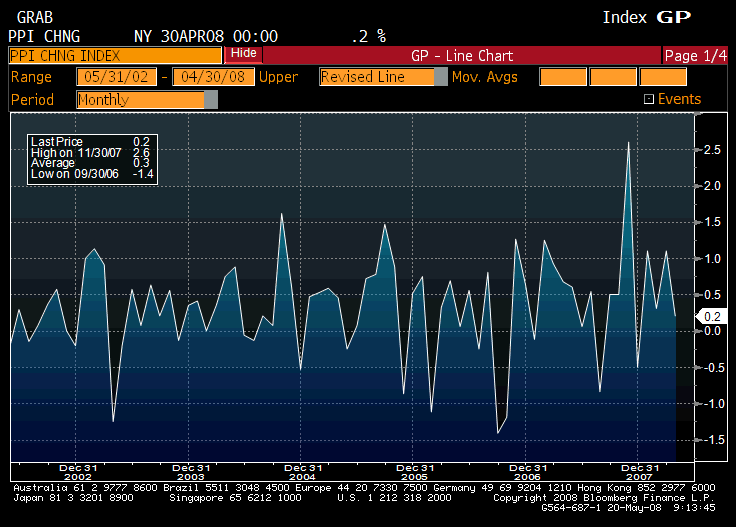
2008-05-20 Producer Price Index MoM

Producer Price Index MoM (Apr)

Survey 0.4%
Actual 0.2%
Prior 1.1%
Revised n/a

[top][end]


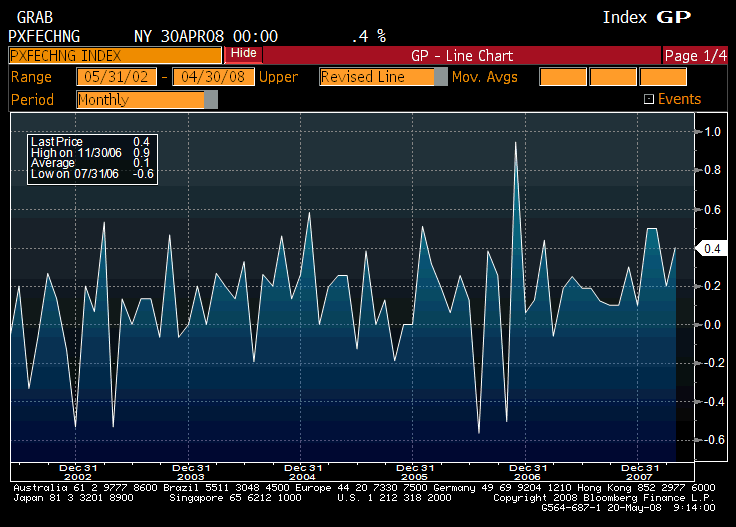
2008-05-20 PPI Ex Food & Energy MoM

PPI Ex Food & Energy MoM (Apr)

Survey 0.2%
Actual 0.4%
Prior 0.2%
Revised n/a

[top][end]


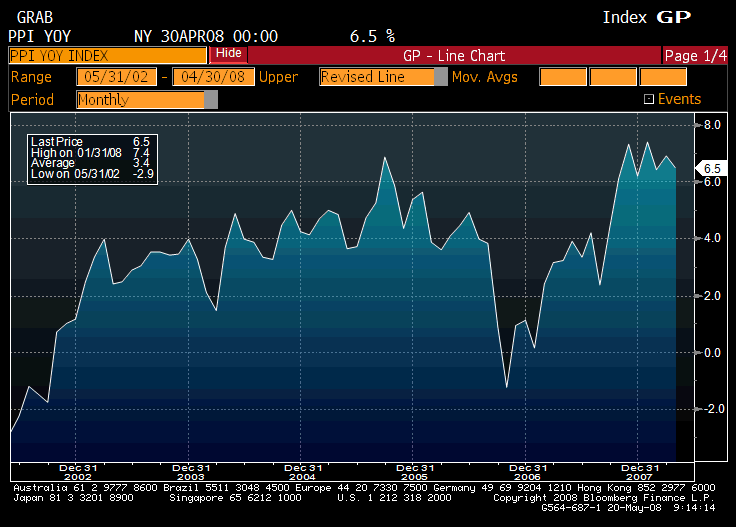
2008-05-20 Producer Price Index YoY

Producer Price Index YoY (Apr)

Survey 6.7%
Actual 6.5%
Prior 6.9%
Revised n/a

This all either gets passed through to all other prices (inflation) or real terms of trade deteriorate further – both unpleasant at best.

[top][end]


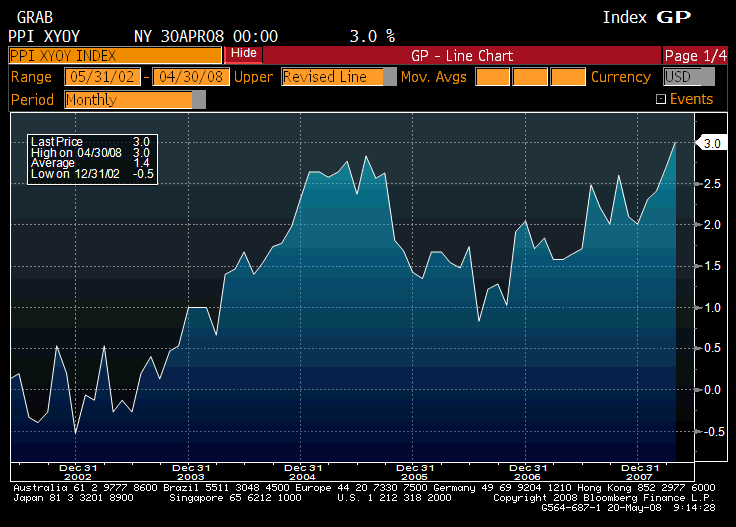
2008-05-20 PPI Ex Food & Energy YoY

PPI Ex Food & Energy YoY (Apr)

Survey 2.9%
Actual 3.0%
Prior 2.7%
Revised n/a

The pass through has started and has long way to go just based on current energy prices.

[top][end]


IBD/TIPP Economic Optimism (May)

Survey 37.8
Actual 40.3
Prior 39.2
Revised

Add one more to the ‘better than expected’ list.

[top][end]


ABC Consumer Confidence (May 18)

Survey
Actual
Prior 2.9%
Revised

[comments]


[top]

Q&A for Warren B


[Skip to the end]

Hi Warren,

Do you think there is any chance that the Fed ever puts us into a steeply inverted curve, say something like 10% short rates with 6% long rates? Hard to imagine that happening with the housing market weak, but what do you think?

Very high probability – I’d say 85% chance if, as I expect, crude stays here or goes higher. maybe a lot higher.

Hiking causes inflation to accelerate via the cost structure of business, so when they start hiking, inflation accelerates. Guaranteed!

Only a major supply response will break the inflation. Like pluggable hybrids in 5-10 years or cutting the national speed limit to 30mph, which is highly doubtful.


[top]

Re: State payrolls suggest a downward revision to April


[Skip to the end]

(an email exchange)

>
> the sum of state payrolls just came out for April showing -151k jobs, vs
> the actual prelim rleease earlier this mth of -20k. hints at a potentially
> large downward revision to April payrolls when the May data is released.
>

Thanks!

Plenty of export driven banana republics out there with high unemployment, low wages, falling currencies, high inflation, and high interest rates. Looking like we’re next…


[top]

2008-05-16 EU Highlights


[Skip to the end]

Only the rising euro has kept the ecb from hiking, so far.

Highlights

ECB’s Trichet Sees ‘Less Flattering’ Growth in Second Quarter
ECB concern over liquidity scheme
Trichet Says No Room to Relax in Inflation Fight
ECB’s Mersch Says Current Rates Will Help Curb Inflation
French First-Quarter Payrolls Grow at Slowest Pace Since 2006
Germany’s DIW Raises Second-Quarter Growth Forecast
ECB’s Constancio Sees Slowing European Growth in Second Quarter
Volkswagen, BMW Lead 9.6% Advance in European April Car Sales
Almunia Says `External Shocks’ Put `Upside’ Pressure on Prices
European Notes Head for Weekly Decline on Outlook for ECB Rates


[top]

FT: Germany leans towards tax cut


[Skip to the end]

Germany leans towards tax cut

by Bertrand Benoit

(FT) Michael Glos said the government’s budget pledge “should not stand in isolation above all other [goals]”. The minister said he “fully supported” a plan by his Christian Social Union to cut income tax by €28bn ($43bn, £22bn) until 2012 without an equivalent cut in spending. The government last week slashed its tax revenue estimate by more than €5bn for this year and next, yet advocates of fiscal rectitude are becoming a minority as the CSU, the CDU – its sister party headed by Chancellor Angela Merkel – and the Social Democratic party, its partner in the ruling alliance, seek to please voters ahead of next year’s election.

While this would increase employment and output, it would also add nominal aggregate demand as well as add to the ‘funding pressure’ of the national government. In the current environment, this would add support to nominal prices as well as undermine the credit quality of the government.

What’s happening is much of the mainstream believes inflation is a function of monetary policy and not fiscal policy, so they see this as a way to support the economy without inflation.

Same happened in the US with Bernanke pushing Congress for the fiscal package that’s now kicking in and adding to price pressures. In general, the FOMC holds the mainstream belief that ‘true inflation’ is a function of only monetary policy.


[top]

Fed Speak: Yellen the Dove


[Skip to the end]

There have been a lot of Fed speakers; so, I’ve selected a few comments on Yellen’s speech, as she has been deemed the most dovish Fed bank president.

Note the shift in rhetoric from ‘market functioning’ to inflation.

Of course, the FOMC’s idea of getting tough and fighting inflation has been to only cut 25 basis points.

Data dependent, this seems to be changing.

It could be the signs of passthrough from headline to core CPI or signs inflation expectations are elevating (as per their recent comments).

They also seem to have lost confidence in their inflation forecasts and may not be giving their future inflation indicators the same weight as in the past 6 months.

Fed’s Yellen: Funds rate been cut enough for now

by Ros Krasny

(Reuters) – San Francisco Federal Reserve Bank President Janet Yellen said on Wednesday that the federal funds rate has been lowered far enough for now after months of aggressive central bank rate cuts.

The Fed’s key monetary policy tool ‘has come way down,’ Yellen said while critiquing presentations on the economy at a symposium for college students organized by the San Francisco Fed and the Pacific Northwest Regional Economic Conference.

Yellen said the Fed continues to grapple with difficult policy choices but restated that high inflation was a worry. ‘The 1970s were a horrible period. If there’s one thing that has to be very high priority, we don’t want to go back to a period that is anything like that,’ she said.


[top]

US – State Tax Reveues Stuggling


[Skip to the end]

Preliminary data for Jan – Mar quarter shows sales tax at -0.1% YY, first decline since 2002 Q1. 21 states out of 36 reporting so far saw declines. Inflation adjusted sales tax declined in at least 27 states. Income tax was +4.7% YY thus no notable deterioration yet.

Here are the sales tax data from largest states:

Califonia -0.9
Texas +6.7
NY +4.2
Florida -6.0
Illinois +0.1
Penn -1.0
Ohio +0.5
Michigan -0.7
Georgia -3.0
North Carolina -7.6

Separately, Tennessee says sales tax dropped 5.5% in April.

The key to aggregate demand is net state spending.

If taxes fall but spending is sustained, that’s a demand add, for example.

Gross spending/taxing also has a multiplier greater than 1.

This includes states ‘borrowing to spend’ for ‘investment’ accounts.

GDP tables showed that states have cut back, reducing the size of their add to aggregate demand.

But Federal government has more than made up for it.


[top]

UBS: China’s energy imports soar by the back door!!!!


[Skip to the end]

Report by Andrew at UBS LIMITED

China – You will have seen in the FT that China plans to encourage its agricultural industry to start buying up land in Africa and Latin America to grow crops on for the Chinese market.

Last year the Chinese National Development & Reform Commission said that China will import the equivalent of 6% of the U.S. corn harvest by 2010. That works out at 38% of U.S. exports or 25% of world exports. A week or two back the Chinese Academy of Social Sciences said that China now has a shortfall of agricultural land equivalent to 17% of what it needs to support its population. Yesterday the Ministry of Agriculture said it is becoming increasingly difficult to sustain self-sufficiency.

This is why global grain prices are soaring, and are going to continue soaring. It is due to top soil mining and water depletion in China, and they are now clearly starting to call on the rest of the world to do the same.

Putting aside the strain this will have on the rest of the world’s land, it also does two other things. Grains have 2 real inputs. Energy (fertilizers) and water. So by importing grains, it is importing embedded energy and embedded water, and on a HUGE scale.

China is running out of water and is going through peak coal production, but rather than buying the energy on the open market and then desalinating the water it needs – (it would require 3% of world oil production to desalinate the scale of water needed just to stand still) – it is going to buy this in an embedded form. It does make some sense in that China has depleted its land so aggressively – (it has lost about 75% of its top soil in the last 30 years, and is consuming way beyond sustainable levels of water) that it will take less energy to produce grains in other parts of the world than in China, BUT that means paying world prices for the energy rather than with Chinese subsidized fertilizer and water prices. Food prices are going to soar. The terms of trade are going to continue to move against China.

You will have seen today that Thailand is warning that its rice yield could fall by 75% by year end. To meet global needs, it is doing a 3 crop harvest this year. That means the land is getting no respite, and the paddy fields are exhausting its water resources. The head of the government’s rice department has warned that this could seriously damage yields for many years, losing it the position as the world’s largest rice exporter. Rice is a very nitrogen dependent crop. That is why it is grown in paddy fields as the water stops nitrogen loss from the soil, and nitrogen rich algae grow on the stagnant water to form a living fertilizer. With the water depleting, Thailand is having to turn to buying nitrogen based fertilizers (natural gas is the cheapest way of making this), adding to the global call on energy.

Quite frankly, food and energy prices are only going one way until Chinese demand is priced out of the market. The problem is that China’s lands and water are so destroyed now, that it is going to become increasingly impossible for it to maintain existing production. Talk of bringing more land in the old Soviet Union or Africa under production seems wishful thinking. If you recall the Soviet Union destroyed its own land in the 1960’s under the various 5 year plans which caused it to import 25% of the U.S. grain harvest in the 1970’s causing the food price rises then. African land quality is also generally poor – (Northern African soils destroyed by the Roman Empire’s over exploitation, and then in recent years the use of fertilizers managed to lift agricultural yields heavily, but the land has deteriorated at the same time), and Africa, like Eastern Europe (and in fact every continent other than North America is a net grain importer. Food and energy price inflation is not a temporary issue, prices are going higher.

Dave from AVM comments on the article:

Good piece, highlights a few more things we have been talking about for a few months:

  1. Farming inputs ARE energy and water, energy for fertilizer (NG) and also diesel/kero for farm equipment (together something like 50+% of US farmer’s COGS)
  2. Diesel also a call on NG, as “cleaning” fuel (lowering sulfur content) requires hydrogen which is usually a byproduct of active gasoline refining (not this year, yet). In the absence of an increase in refinery utilization rates, hydrogen will be increasingly cracked with natural gas (which is still cheap fuel versus petroleum on a molecular basis)
  3. China also importing more LNG on long term contract basis, putting pressure on domestic US natural gas prices (we have to compete for LNG cargos (spot) when there are domestic NG shortages [we have a 300bcf deficit today to last year’s levels, before summer cooling demand begins in earnest])
  4. Coal issues mentioned are true, but coal still difficult to trade effectively. Better expressed in regional power markets.
  5. Abandoning ethanol mandates now (as opposed to Nov EPA vote) to have little impact on ethanol/implied corn demand with crude 120+

We think grains and natural gas prices to rise jointly over next 6 months by 20%+. Power to follow but with extremely high volatility in the summer months, and large positive skew in the shoulders (june and sep).

If food’s as tight as indicated below, world tensions will get a lot worse than anyone currently imagines, including large regional wars.

Eliminating biofuels could buy a few years, cutting national speed limits a few more and perhaps even stabilize things for the next 25 years.


[top]