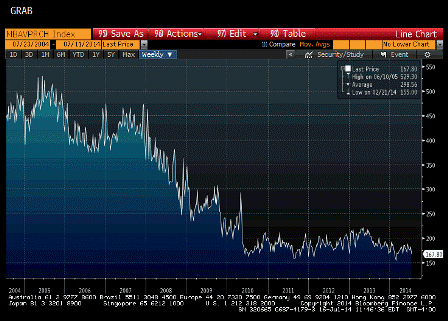
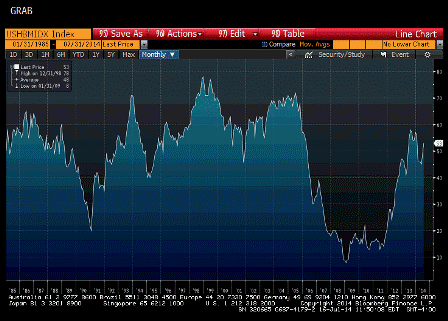
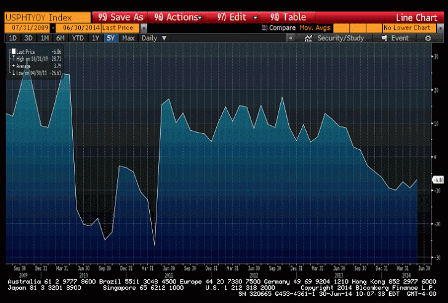
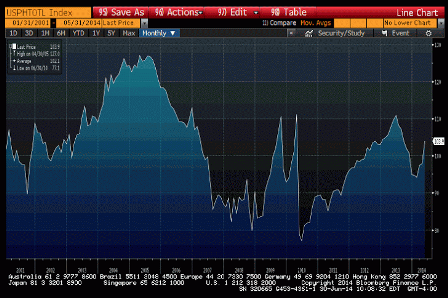
Housing market index

Above expectations on a bounce from ‘cold winter’ lows that still leaves it relatively low, and lower than this time last year.

And note that mortgage finance has flattened out as well.

The regional breakdown is led by the Midwest which surged 13 points to 65 followed by the West which dipped 1 point to 57. Continuing to lag way back is the Northeast, a region already fully developed, with the South, which is by far the largest region for new home sales, down 2 points to a soft 51 which doesn’t point to much strength for the new home sales report. Watch for housing starts tomorrow and the new home sales report next Monday. The Dow is moving to opening highs following today’s report.

retail sales, mtg purchase apps, global highlights

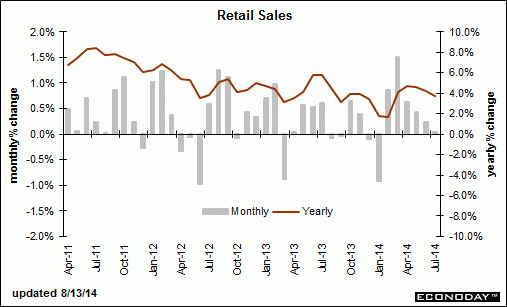
Growth decelerating for 3 consecutive months:


Highlights
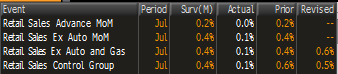
Retail sales disappointed for a second month in a row. Retail sales were flat in July, following a 0.2 percent gain the month before (originally up 0.2 percent). Analysts forecast for a 0.2 percent rise in July.

Motor vehicles slipped 0.2 percent, following a decrease of 0.3 percent in June. Excluding motor vehicles, sales edged up 0.1 percent, following an increase of 0.4 percent in June. Forecasts were for 0.4 percent. Excluding motor vehicles and gasoline, sales nudged up 0.1 percent in July after jumping 0.6 percent the prior month. The median market forecast for July was for 0.3 percent.

While consumer spending was healthy in the second quarter, that does not appear to be the case for the third quarter based on July data.


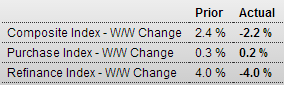
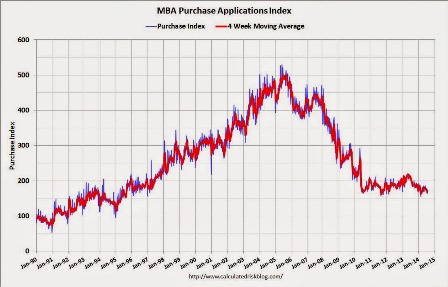
Mtg purchase apps down for the week and down 10% year over year:

MBA Purchase Applications


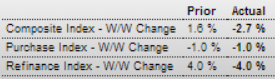
Demand for purchase applications remained flat in the August 8 week, down 1.0 percent for the second straight week. Year-on-year, purchase applications are down 10.0 percent. Demand for refinancing is also weak, down 4.0 percent in the week. The declines come despite a dip in mortgage rates where the average 30-year mortgage rate for conforming loans ($417,500 or higher) fell 2 basis points to 4.24 percent.

Home Price Growth Slowdown a Mixed Trend for Economy (WSJ) Single-family housing prices rose 4.4% in the year that ended in the second quarter, the slowest annual pace since 2012, according to a report released Tuesday by National Association of Realtors. The association found that median prices for existing single-family homes grew year-over-year in 122 of 173 metropolitan areas it tracked, while prices declined in 47 metro areas. Only 19 areas showed double-digit year-over-year price increases, a substantial drop from the 37 cities that showed such increases in the first quarter.While the median existing single-family home price between the second quarters of 2013 and 2014 rose 7.3% in the West to $297,400, home prices in the Northeast fell 0.9% to $255,500, the report said.

Japan GDP shrinks sharper than after 1997 tax hike (Nikkei) The Cabinet Office said in a preliminary report Wednesday that real gross domestic product for April-June contracted at an annualized rate of 6.8% from the previous quarter. The decline was steeper than in the same quarter of 1997, after sales tax was raised from 3% to 5%. At that time, the economy shrank 3.5%. Economic and Fiscal Policy Minister Akira Amari was unfazed by the big contraction. “The backlash will ease down the road,” he said at a news conference after the GDP results were announced. He said the economy will return to a mild recovery path after summer. “Production shifts to overseas are well underway,” said Amari, indicating that the export decline this time is a long-term structural trend.

China July property investment slows, sales drop sharply (Reuters) Property investment grew 13.7 percent in the first seven months from a year ago, down from an annual rise of 14.1 percent in the first half. Newly started property construction dropped 12.8 percent in the January to July period from the same time a year ago, though the decline easing from an annual drop of 16.4 percent in the first six months. Meanwhile, property sales dropped 16.3 percent in July in terms of floor space, according to Reuters calculations based on official data. That compared with a 0.2 annual drop in June. The NBS data showed mortgage loans fell 3.7 percent in the first seven months of 2014, unchanged from the first half.


Surprisingly weak China July money data cast doubts on recovery’s durability (Reuters) China’s total social financing (TSF) aggregate fell to 273.1 billion yuan ($44.34 billion) in July, about one seventh of that in June. The People’s Bank of China took the unusual step of issuing a statement immediately after the data, reassuring markets that credit and financing growth was still reasonable and that it had not changed its monetary policy. Non-performing loans have now risen for 11 straight quarters, the central bank’s statement said. Chinese banks made 385.2 billion yuan ($62.53 billion) worth of new yuan loans in July, down sharply from 1.08 trillion yuan in June and well below expectations of 727.5 billion yuan, central bank data showed on Wednesday.–

Overly tight fiscal globally continues to put the squeeze on output and employment.

This email is going to pmc donors in advance of being posted on my website.
If you wish to be removed from this list just let me know thanks!

Recent charts

If you haven’t donated to the PMC yet you can do so here.

I just finished the 2 day ride. :)

100% of all donations go to Dana Farber in Boston, THE premier cancer research center.

And I’m in the process of narrowing this mailing list to those who donate.

;)

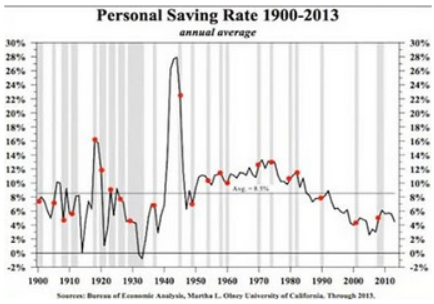
Notice that the govt deficit and savings rate more pretty much together?

Car sales off of last months pace, but forecasts for this year are for a slower rate of growth than last year:


Full size image

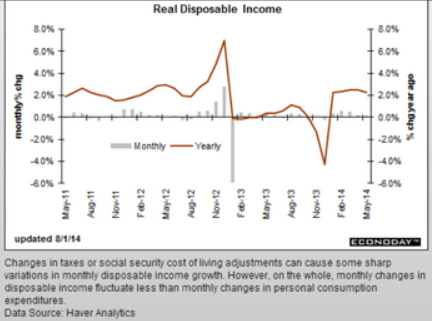
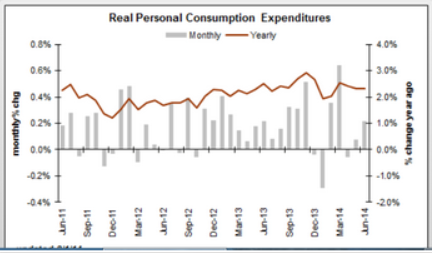
No sign of ‘consumer acceleration’ here?


Full size image

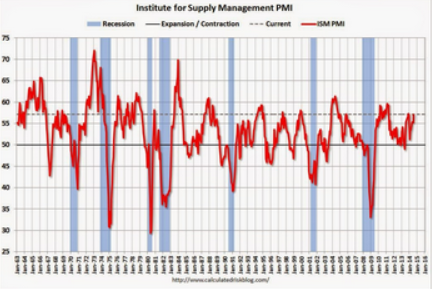
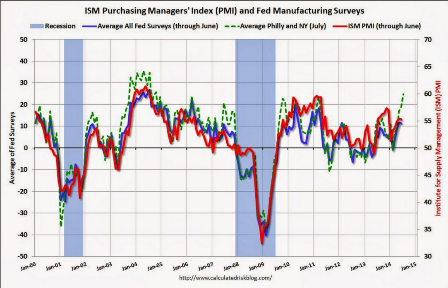
Manufacturing continues chugging along at it’s usual 4% rate of growth:

PMI Manufacturing Index:


Full size image

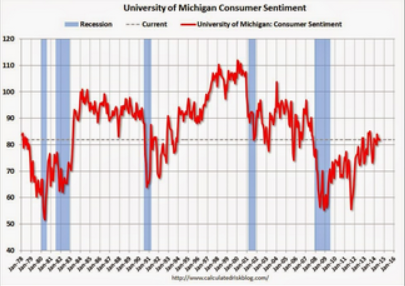
And Consumer Sentiment continues to bob around at levels that were the pretty much the lows of prior cycles:


Full size image

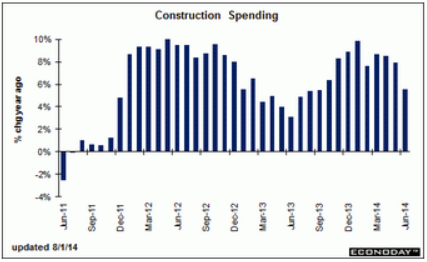
Slipping a bit after the year end surge to beat expiring tax credits?

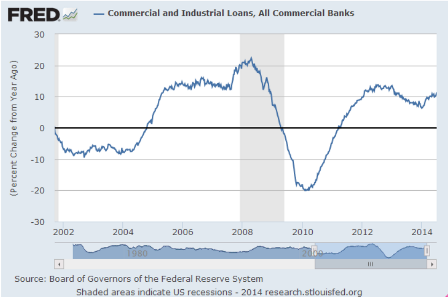
Bank lending flattening some after growing to fund unsold Q2 inventories?

Q2 could be revised to anything over the next couple of months, seems, as was Q1.

But at least for now the chart is what it is:


Highlights
The second quarter rebounded more than expected from the adverse weather impacted first quarter. While there were a number of strong components, the rebound was led by inventory growth.

Mtg purchase apps, Case Shiller

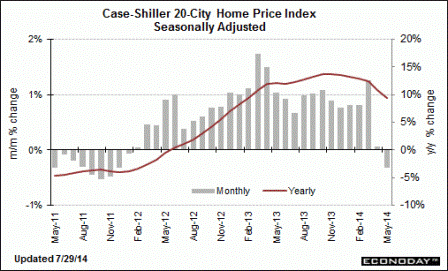
Seems both apps and price growth both peaked around the same time?

MBA Purchase Applications

Highlights
The housing market is flat, evident in the purchase index which is little changed for a second week at plus 0.2 percent in the July 25 week. Year-on-year, the index is down 12.0 percent. Refinancing is also flat, down 4.0 percent in the week. Rates have been very steady, unchanged for the third straight week at 4.33 percent for 30-year conforming mortgages ($417,000 or less).


Full size image

S&P Case-Shiller HPI


Highlights
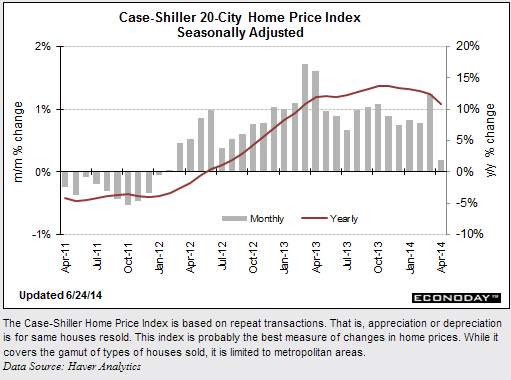
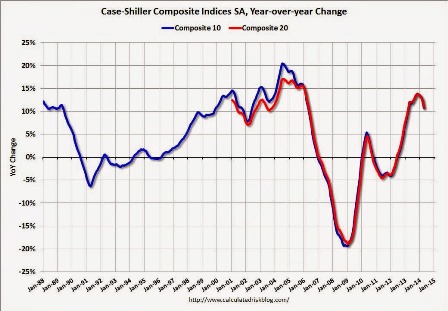
Home-price appreciation is slowing rapidly, actually going into reverse in May at a seasonally adjusted minus 0.3 percent for Case-Shiller’s 20-city index. This is the first negative reading since January 2012.

Year-on-year, both adjusted and unadjusted, home prices are at plus 9.3 percent, down substantially from 10.8 percent and 12.4 percent in the two prior months.

The weakness is very apparent in the 20-city breakdown with 14 cities in the negative column for the month. Atlanta shows the steepest monthly decline, at minus 0.9 percent, followed closely by Chicago and San Francisco.

Pending home sales and why housing matters

NAR: Pending Home Sales Index decreased 1.1% in June, down 7.3% year-over-year

By Bill McBride

From the NAR: Pending Home Sales Slip in June

The Pending Home Sales Index, a forward-looking indicator based on contract signings, declined 1.1 percent to 102.7 in June from 103.8 in May, and is 7.3 percent below June 2013 (110.8). Despite June’s decrease, the index is above 100 – considered an average level of contract activity – for the second consecutive month after failing to reach the mark since November 2013 (100.7).

The PHSI in the Northeast fell 2.9 percent to 83.8 in June, and is 3.2 percent below a year ago. In the Midwest the index rose 1.1 percent to 106.6, but remains 5.5 percent below June 2013.

Pending home sales in the South dipped 2.4 percent to an index of 113.8 in June, and is 4.3 percent below a year ago. The index in the West inched 0.2 percent in June to 95.7, but remains 16.7 percent below June 2013.

Note: Contract signings usually lead sales by about 45 to 60 days, so this would usually be for closed sales in July and August.

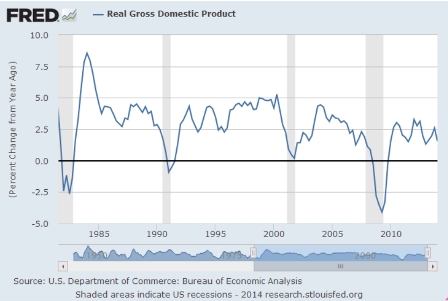
So manufacturing is chugging along at it’s usual 4% rate of growth, jobs are chugging along at a 1.9% rate of growth, and for the most part all the surveys are looking pretty good.

Yet GDP year over year looks to be trending down, with the consensus 2014 forecast now down less then 2%.

Full size image

So why does housing matter?
Can’t spending simply go elsewhere?

The problem is the oldest of all macro constraints-

If any agent spends less than his income, another must spend more than his income for all of the output to get sold.

It’s also been expressed as ‘the paradox of thrift’- decisions to not spend income and to instead ‘save’ cause sales and income to fall with no increase in net savings.

And it shows up in this discussion- ‘if the banks charge interest, where does the economy get the money to pay it?’ With the response ‘the banks spend the interest income’.

And if the banks don’t spend their income it’s the same unspent income problem as with any unspent income.

Unspent income is also known as a demand leakage.

And in the normal course of business, the US has all kinds of demand leakages going on, many due to tax advantages, including pension contributions (and pension fund earnings), additions to IRA’s, insurance reserves, bank reserves, foreign central bank dollar reserves,
etc. etc. etc.

This means that much output won’t get sold unless other agents spend more than their incomes. This includes the US govt spending more than its income (the dreaded deficit), as well as corporations spending more than their earnings, and consumers borrowing to spend more than their incomes.

Which is where housing comes in. Historically it’s been the engine of ‘borrowing to spend’ to offset the demand leakages, driving the economy even as the automatic fiscal stabilizers work to bring down the govt’s deficit spending. This includes the borrowing to spend that turned into the sub prime fiasco, the Clinton housing boom that combined with the .com and y2k borrowing to spend, and the $1 trillion+ S and L financing/fraud that drove the Reagan years back when that was a lot of money.

Yes, the business sector can materially borrow to spend to close the output gap. It falls under ‘investment’, including construction, and many would argue it’s the preferred way to go. And this would include new equity issues as well as borrowings ‘further up the credit stack’, as long as it’s ‘borrowing to spend’ on real goods and services- the output- GDP. So yes, there’s some of that going on, which is encouraging, but not nearly enough to overcome the demand leakages they way it did in the late 90’s.

So again, historically, it’s been new housing that has been the prime channel for private sector agents to spend more than their incomes.
Yes, they can spend on other things, but it’s highly problematic for that spending to result in anything near the mortgage debt of prior cycles.

That is, instead of a 200,000 mortgage on a house, the same family would have to borrow 200,000 to spend elsewhere to similarly support the economy/accommodate the savings desires of those wishing to spend less then their incomes. Buying a car does some of that, and maybe a few appliances, or a student loan.

But overall, seems to me that kind of thing can’t ever be enough to ‘close the output gap.’

And with the politicians measuring success by their deficit reduction efforts, the macro constraint of unspent income only gets worse.

So housing matters a lot as it looks to be the only available avenue for the economy to spend more than its income in sufficient quantities to overcome the demand leakages.


Housing and Philly Fed

Note the Nov/Dec mini spike to capture year end tax credits (my story) followed by familiar down for the winter, then up, then back down some pattern.

Yes, you can have a low output gap without housing, and yes, manufacturing is chugging along nicely. But overall the charts show declining monthly growth rates of retail sales, industrial production, and housing starts, as what’s looking more and more like the macro constraint of the relentless demand leakages continue to take their toll.

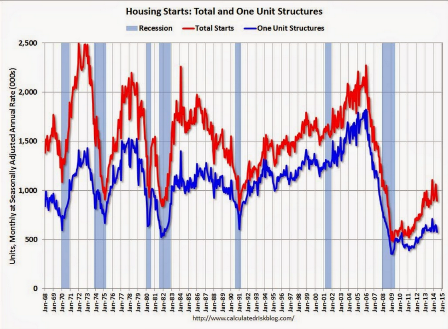
Housing Starts


Highlights
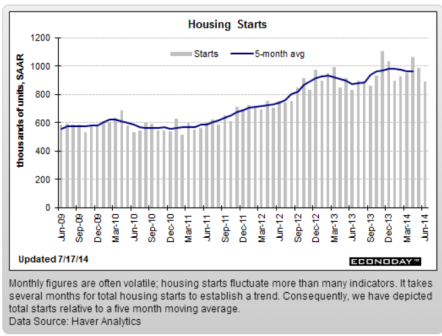
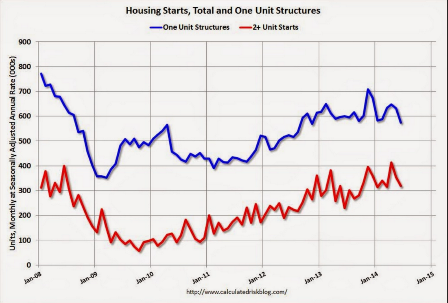
Fed Chair Janet Yellen was right to worry about the housing sector during Congressional testimony this week. Starts in June disappointed sharply, declining another monthly 9.3 percent after decreasing 7.3 percent in May. June starts came in at 0.893 million units annualized, up 7.5 percent on a year-ago basis. Expectations were for 1.026 million units.

The fall in the latest month was led by the multifamily component but closely followed by the single-family component. Multifamily family starts dropped 9.9 percent after falling 14.7 percent in May. The single-family component declined 9.0 percent in June, following a 2.6 percent dip the prior month.

Building permits also lost ground. Permits declined 4.2 percent after decreasing 5.1 percent in May. June’s 0.963 million units annualized was up 2.7 percent on a year-ago basis. Analysts forecast 1.038 million units for June.

The housing sector still needs propping up by the Fed. This sector is losing steam instead of improving. Recent NAHB HMI have pointed to start weakness with weak numbers on traffic.


Full size image


Full size image


Full size image


Full size image

Industrial production, mtg purchase apps charts, homebuilder’s index

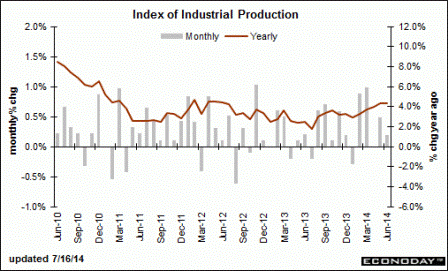
Slowed in Q1, rebound in Q2, H1 about the same old 4% rate IP usually grows at as previously discussed:

Industrial Production


Highlights
As suggested by production worker hours, industrial production was soft in June. Industrial production slowed to a rise of 0.2 percent, following a jump of 0.5 percent in May. Expectations were for a 0.4 percent boost. The manufacturing component decelerated to a modest 0.1 percent gain after jumping 0.4 percent the prior month. The median market forecast was for 0.4 percent. Mining was healthy with a 0.8 percent increase, following a 1.1 percent surge in May. Utilities declined 0.3 percent, following a drop of 0.4 percent in May.

Manufacturing excluding motor vehicles increased 0.2 percent in June after a 0.3 percent rise in May.

Within manufacturing, the production of durable goods increased 0.4 percent in June and rose at an annual rate of 8.8 percent in the second quarter. In June, the gains were broad based among durable manufacturing industries, with increases of 1.0 percent or more in the indexes for nonmetallic mineral products, for primary metals, for fabricated metal products, for aerospace and miscellaneous transportation equipment, and for furniture and related products. The production of nondurable goods moved down 0.3 percent in June. In June, the output of petroleum and coal products fell 2.7 percent, in part because of a disruption at a major refinery; the production of apparel and leather declined 1.3 percent, and the index for food, beverage, and tobacco products moved down 0.6 percent.

The overall capacity utilization rate in June held steady at 79.1 percent. The latest number came in slightly lower than the consensus projection for 79.2 percent.

For the second quarter as a whole, manufacturing production rose at an annual rate of 6.7 percent after increasing 1.4 percent in the first quarter, suggesting that second quarter GDP will rebound nicely from the first quarter freeze shock.

We are seeing some volatility in manufacturing numbers recently. But on average, growth is healthy.

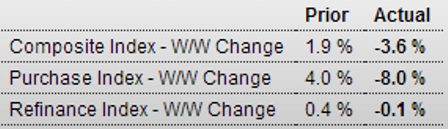
Mortgage purchase apps still way soft:

MBA Purchase Applications

Highlights
The purchase index fell 8.0 percent in the July 11 week, more than reversing a 4.0 percent gain in the prior week. The refinance index was little changed, down 0.1 percent in the week. Rates were little changed in the week with the average 30-year rate for conforming loans ($417,500 or less) up 1 tenth to 4.33 percent. Watch for the housing market index later this morning at 10:00 a.m. ET.

MBA purchase applications:


Full size image

National Association of Home Builders index up:


Full size image


Full size image

May business borrowing and confidence drops, and other charts from recent releases

U.S. business borrowing for equipment falls 8 percent in May: ELFA

By Abinaya Vijayaraghavan

June 23 (Reuters) — U.S. companies’ borrowing to spend on capital investment fell in May, the Equipment Leasing and Finance Association (ELFA) said.

Companies signed up for $6.9 billion in new loans, leases and lines of credit last month, down 8 percent from a year earlier. Their borrowing fell 14 percent from April.

“The small decline in new business volume makes the case for a slow recovery in certain sectors of the economy in which equipment financing plays an important role,” ELFA Chief Executive William Sutton said in a statement.

Washington-based ELFA, a trade association that reports economic activity for the $827 billion equipment finance sector, said credit approvals totaled 76.1 percent in May, down from 77.4 percent in April.

ELFA’s leasing and finance index measures the volume of commercial equipment financed in the United States. It is designed to complement the U.S. Commerce Department’s durable goods orders report, which it typically precedes by a day.
ELFA’s index is based on a survey of 25 members that include Bank of America Corp(BAC.N), BB&T Corp (BBT.N), CIT Group Inc (CIT.N) and the financing affiliates or subsidiaries of Caterpillar Inc (CAT.N), Deere & Co (DE.N), Verizon Communications Inc(VZ.N), Siemens AG (SIEGn.DE), Canon Inc (7751.T) and Volvo AB (VOLVb.ST).

The Equipment Leasing & Finance Foundation, ELFA’s non-profit affiliate, said its confidence index fell to 61.4 in June from 65.4 in May.

A reading of above 50 indicates a positive outlook.

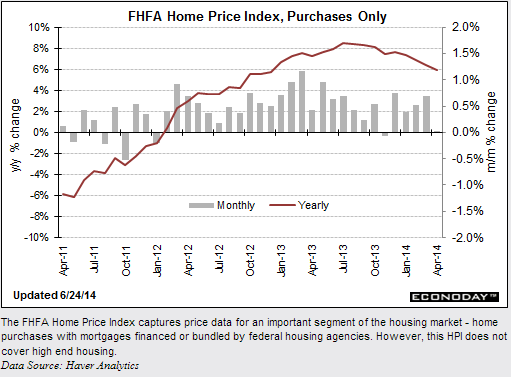
More evidence home price increases have slowed, as ‘liquidation supply shock’ that began in 2009 winds down:


Full size image

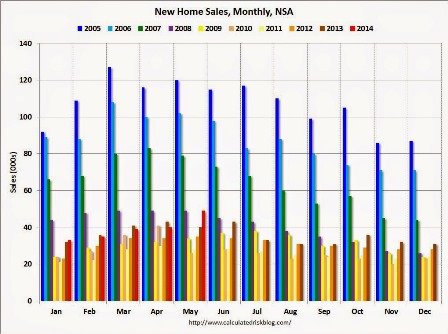
Also this morning the Census Bureau reported that new home sales were at a seasonally adjusted annual rate (SAAR) of 504 thousand in May. That is the highest level since May 2008. As usual, I don’t read too much into any one report. In fact, through May this year, sales were 196,000, Not seasonally adjusted (NSA) – only up 2% compared to the same period in 2013 – not much of an increase.

Richmond Fed Manufacturing Index

Highlights
Activity may be slowing this month in the Richmond Fed’s manufacturing district but not new orders. The headline index slowed 4 points to a reading of 3 with shipments and employment both slowing significantly. But the pace of new orders actually improved slightly, up 1 point to 4. The Richmond Fed has been showing less of a post-winter bounce than other regional reports, especially Empire State and Philly Fed.

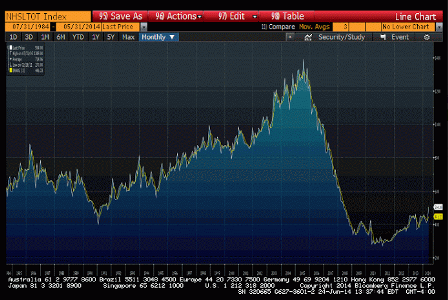
New home sales up more than expected, but the 3 month average looks tame and in any case if they continue to drift higher at this the pace of the last couple of years it will only take another 15 or 20 years or so to get back to prior cycle levels. When we had a lot fewer people. And, like last month, revised down, it will be revised next month:


Full size image


Full size image

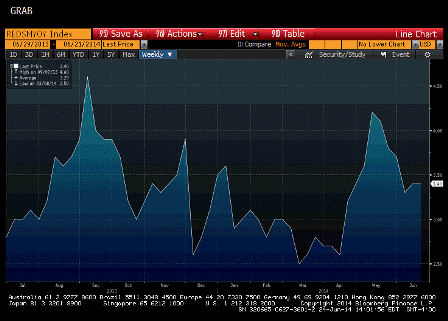
Redbook Sales monthly Y/Y:


Full size image

housing starts and other charts

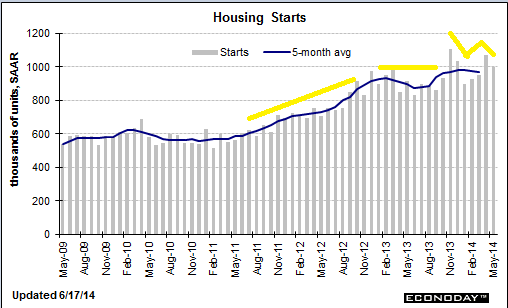
Same pattern- down some for the winter, up some, then backing off some.

If this is in fact what’s happening, Q2 GDP could be up less than 3%, and 2014 sub 2%, or even sub 0, if the demand leakages are allowed to keep the upper hand and a fiscal adjustment isn’t made.

“The Business Roundtable survey showed chief executives forecast GDP growth of 2.3 percent in 2014, down from last quarter’s estimate of 2.4 percent for the year.”

“Federal Reserve Chair Janet Yellen said last month there was a risk a protracted housing slowdown could undermine the economy.”

Housing Starts

Highlights
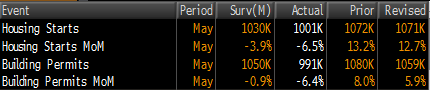
Housing took a step back in May. Starts fell a monthly 6.5 percent but followed a strong 12.7 percent spike in April. The 1.001 million unit pace was up 9.4 percent on a year-ago basis and fell short of expected 1.036 million units.

Single-family starts dropped 5.9 percent after a 4.6 percent rise. Multifamily starts declined 7.6 percent, following a 29.2 percent spike in April.

Building permits followed a similar pattern, suggesting some moderation in construction. Permits fell 6.4 percent after a 5.9 percent rise in April. Permits posted at 0.991 million units and were down 1.9 percent on a year-ago basis. Analysts forecast 1.062 million units.

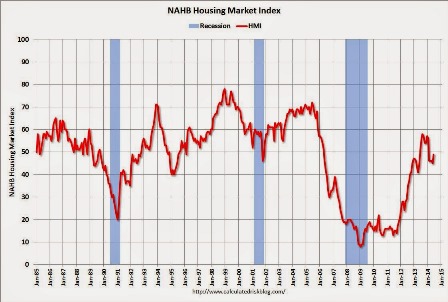
Builder was up some, but has remained below 50 for 5 months, and by historical standards remains dismal:


Full size image

Industrial production/manufacturing was up some yesterday, but it’s a relatively small part of the economy and seems to chug along at 3-4% annual growth rates.

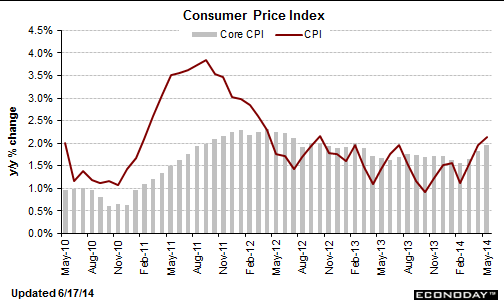
“The core CPI was lifted by a 0.3 percent rise in rent. There were also increases in medical care costs, apparel, new cars prices and airline fares.”

This doesn’t read to me like an ‘excessive demand problem’ that higher rates would reverse. But that’s just me. I agree the Fed may think otherwise!