
Early Holiday Cheer…

As discussed last week, the latest euro package just announced is unravelling quickly as markets again realize there is no actual substance, and no operational path with regards to carrying any of it out. So things will deteriorate as described until markets again force further ‘action.’

At the same time, the austerity continues to weaken the euro economies, with Q4 potentially going negative, driving deficits that much higher in the process.

The ‘answer’ remains the ECB writing the check, which they’ve sort of seemed to recognize, but they remain (errantly) concerned that reliance on the ECB is inherently inflationary, and thereby violates the ECB’s mandate for price stability. So it won’t happen until things again get bad enough to force it to happen.

The catastrophic risk remains a failure, when push comes to shove, to allow the ECB to write the check as they have been doing to allow it all to muddle through.

The range of outcomes couldn’t be wider. Write the check and not much happens, don’t write the check and there is unthinkable collapse.

Meanwhile, the 1% running the US looks to be trying to take the lead in the global austerity race to the bottom as the Democrats in the super committee on deficit reduction have led off by proposing a $4 trillion deficit reduction package.

Toss in West Texas crude prices heading to Brent levels of about $110/barrel as the strategic petroleum reserve release winds down over the next three weeks and the looks to me like the US consumer crawls back into his foxhole just in time for the holiday season.

Not to mention Japan now darning the torpedoes and buying dollars to take back a bit of the export market they lost by kowtowing to former tsy sec paulson’s demands to not be a ‘currency manipulator’ in the context of still weakening global demand in general.

The number one threat to world order remains a failure to sustain demand. The good news is sustaining aggregate demand is a simple matter once the monetary system is understood. The bad news is there seems to be no one of authority who doesn’t have it all backwards.

GS US Views: OK for Now, But Slowdown Ahead (Hatzius)

As previously discussed, no double dip, but instead continued sequential quarter to quarter gdp growth with q4 possible better than q3 as well, helped by lower gasoline prices.

The 8.5% federal budget deficit continues to provide fundamental nominal support for GDP and the domestic credit sectors are still too weak to subtract much if they do pull back.

And it still seems to me that the chances of a euro area event reducing aggregate demand in the US are reasonably low.

US Views : OK for Now, But Slowdown Ahead

By Jan Hatzius
October 9 (Goldman Sachs)

1. After the sharp slowdown earlier in the year, the US economy seems to have grown at roughly a trend pace over the summer. Our GDP “bean count” now stands at 2½% for the third quarter, the ISM indexes are broadly stable in the low 50s, payroll employment is growing at a pace of around 100k per month, and the unemployment rate has been flat for the past three months.

2. Although the recent US growth news has generally beaten low expectations, we expect a renewed deceleration to just a ½%-1% growth pace in the next two quarters and see the risk of renewed recession at about 40%. The main reason is the turmoil in the euro area, where we switched to a recession forecast last Monday. To be sure, there is more talk in Europe about the types of action that we think would help, including a larger financial safety net for sovereign issuers (perhaps achieved by “leveraging” the EFSF), proactive bank recapitalization, and monetary easing. But policy continues to move very slowly relative to the building risks in the financial system and the deterioration in the real economy. A true turnaround in the financial situation does not yet appear to be in sight, let alone a bottoming in the real economy.

3. There are several channels through which the European crisis is likely to weigh on US growth. The impact via reduced exports is the most obvious, but it is unlikely to be very large. Exports to the Euro area account for about 2% of US GDP, so an impact of much more than 0.1-0.2 percentage point would probably require a much deeper European recession than we are forecasting. The bigger issue is the significant tightening in financial conditions and the availability of credit. Since early summer, our financial conditions index has tightened by more than 50bp, a move that might shave ½ percentage point from growth over the next year. In addition, there are some early indications of tightening credit availability including an increase in the percentage of small firms reporting in the NFIB survey that “credit was harder to get” last time they tried to borrow (the next update is due on Tuesday). Tighter credit could easily shave another ½ point or more, for a total impact from Europe on US growth of 1-1½ percentage points. Should the European recession deepen, the risk of further dislocations in the financial system and greater spillovers into the US would grow (for more on this, see Andrew Tilton’s US weekly dated September 16 at US Economics Analyst: 11/37 – Will the European Storm Cross the Atlantic?).

4. One key question is whether the European crisis—and the unsettled fiscal policy environment more generally—has caused a sufficiently large increase in uncertainty to lead companies to postpone hiring and capex decisions in a self-reinforcing manner. There is some evidence that corporate behavior may be changing, as online job ads have dropped off and the percentage of firms increasing employment in the nonmanufacturing ISM survey has declined at the most rapid pace on record over the past two months (data go back to 1997). No such deterioration was visible in Friday’s payroll numbers, but online job ads lead by a month or two and most of the ISM responses probably came after the payroll survey week, so the jury is still out.

5. The other key drag on US growth is the tightening of fiscal policy. Our baseline assumption remains extension of the employee-side payroll tax cut and passage of a small business hiring incentive; we do not assume extension of emergency unemployment benefits (although this is a close call), a further expansion of the payroll tax cut as proposed by the President, additional infrastructure spending or aid to state governments, or another foreign repatriation tax break. We also expect the Congressional “supercommittee” to agree on spending cuts and revenue increases that cover part of the mandated $1.2 trillion in savings over 10 years; the remainder will likely come via automatic cuts that take place from 2013. Overall, we view the risks around our assumption of just under 1 percentage point of fiscal drag (excluding multiplier effects) in 2012 as roughly balanced at present.

6. Even in the baseline case of no recession, we expect additional monetary easing as the Federal Reserve supplements “Operation Twist” with yet more purchases of long-term securities financed by creation of excess bank reserves (that is, additional QE). We believe that this could still boost growth a bit by further reducing the term premium in the Treasury yield curve and thereby ease financial conditions. But policymakers are clearly running into diminishing returns. If they want a bigger impact, they will probably need to supplement additional QE with changes to the Fed’s monetary policy framework. A relatively incremental version of this is the proposal by Chicago Fed President Evans to promise no monetary tightening until the unemployment rate falls back to 7%-7½% and/or inflation rises to 3%. A more radical version would be a temporary increase in the Fed’s inflation target or a move to price level or nominal GDP level targeting as discussed by Jari Stehn a couple of weeks ago (see US Economics Analyst: 11/38 – The Fed’s “Unconventional” Unconventional Options).

7. While additional easing is likely eventually, we currently do not expect a big move at the November 1-2 FOMC meeting. This is based partly on the somewhat better data and partly on Fed Chairman Bernanke’s remark in his congressional testimony that Fed officials had “no immediate plans” to ease further. Of course, since Bernanke also said that he saw the economy as “close to faltering,” it probably would not take a huge amount of new information to change his mind, but for now our best guess is that the next statement will be less eventful than its two predecessors.

DGO


Karim writes:

Hard to believe we are still getting August data, but durables came in better than expected:

  • Headline -0.1%, but core +1.1% and prior month revised from -1.5% to -0.2%
  • Core shipments up 2.8%
  • Shipments number likely reflects some impact from global supply chain resumption early in Q3
  • Q3 still looks about 2% growth

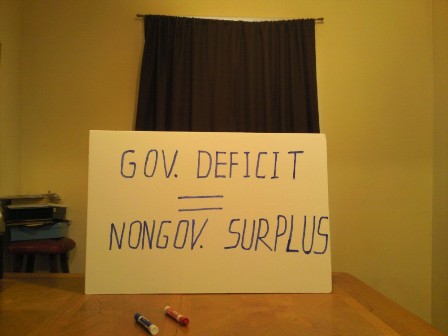
Yes, seems again this year markets fail to recognize the support for aggregate demand that comes from an 8.5% US federal deficit.

Q3 earnings should also be strong, as GDP has been increasing sequentially all year as well.

And with lower gasoline prices, Q4 could be up from Q3, though as Karim suggested, Q3 may have started higher and ended on a weak note.

Posted in GDP

Deflation rearing its ugly head and the euro is up

Interesting day so far.
Stocks down, interest rates down, commodities down, including gold (seems the found Hugo’s gold?) but the euro is up some, after falling some last week.

With federal deficits too low most everywhere, it’s like a general crop failure, with the question being which crops will go up the most vs each other.

Not easy to say, but the euro has to be a bit of a favorite given the sincerity and intensity of their commitment to austerity/deficit reduction? And their new good buddies, the Swiss, now helping out by buying euro as others buy their currency with their new cap in place.

However lower crude and product prices do help the US more than the rest, so that’s a factor that gives the dollar an edge. And the portfolio shifting/speculation/trend following in illiquid markets can overpower the underlying fundamentals as well medium term.

And the dollar and the euro are seeing bids from China and Japan now and then as those nations work to protect their softening export markets.

My least favorite currency longer term may be the yuan, with its inflation issue and ongoing deficit spending, both direct and via state bank lending, though they too seem to be cutting back some. But until FDI (foreign direct investment) lets up, those ‘flows’ continue to support the yuan.

And commodity currencies are in a class of their own, weakening with weakening commodity prices.

It’s also noteworthy that the deflation is coming at a time when central banks, for all practical purposes, can’t be much more inflationary by (errant) mainstream standards of measurement. Unfortunately, however, it’s not that they are out of bullets, it’s that the presumed lethal live ammo has turned out to be blanks, with mounting evidence that the gun was pointed backwards as well.

The obvious answer is a simple fiscal adjustment- just a few keystrokes on the govt’s computers can immediately restore aggregate demand/employment/output- but they’ve all talked themselves out of that one.

However it’s not total doom and gloom.
For example, the US deficit is large enough to muddle through with decent corporate earnings and a bit of minor ‘job creation’ as well.

And sequentially, GDP is slowly improving: .5 q1, 1.0 q2, and maybe 1-2% for q3.
Good for stocks, not so good for people, but the bar is now set so low and the understanding so skewed that ‘blood in the streets’ isn’t yet even a passing thought, so don’t expect much to change any time soon.

And standby for the ECB writing the next check, no matter how large, to keep that all muddling through as well.

Claims/Trade/ECB/Fed/swiss/euro

Seems several reasons Fed unlikely to ‘ease’ further:

GDP continues to move up sequentially since year end

Fed forecasts showing continuing modest growth

Core CPI remains firm

Employment still at least modestly growing (ex Verizon, household sector, etc)

Financial burdens ratios way down indicating the potential for a credit expansion is there.

China and much of the FOMC doesn’t seem to like QE or anything even vaguely related, including long term rate commitments.

Also, with the Swiss ‘peg’ vs the euro, as long as the Swiss remain relatively strong buying the franc, it translates into buying of euro. So this new buyer of euro offers further euro support/deflation to an already highly deflationary environment.


Karim writes:

  • Claims rise 9k to 414k; 400-425k range now holding for about 2mths; not a lot of firing, not a lot of hiring
  • Large drop in trade deficit in July, both nominal and real.
  • Exports rose 3.6% while imports fell 0.2%; supply chain coming back on stream helped industrial exports, while lower oil prices dampened imports
  • Q3 GDP still looking like 2%; forward looking survey measures mixed, with consumer surveys much weaker than business surveys.
  • ECB shifts from ‘inflation risks to upside and policy is accommodative’ to…
  • Inflation risks are ‘balanced’, ‘downside risks’ to growth forecasts (which were reduced), and while policy is still accommodative, financial conditions have tightened
  • While LTROs and SMP help with the transmission of policy, if financial conditions still tighten further, the changed forecasts and biases leave the door open for rate cuts
  • Staff forecasts for inflation were left unchanged at 2.6% for 2011 and 1.7% for 2012; Growth forecasts were cut from 1.9% to 1.6% for 2011, and 1.7% to 1.3% for 2012

China Services PMI Falls To Record Low On Weak New Order Inflows

This report leaves open the hard landing possibility, as defined by GDP growth under 6%:

China Services PMI Falls To Record Low On Weak New Order Inflows

September 5 (RTTNews) — An indicator of the health of China’s service sector fell to a record low in August, on the back of weak intake of new orders, latest data from Markit Economics showed Monday.

The seasonally adjusted business activity index fell to 50.6 in August from 53.5 in July, pointing to near stagnation in service sector. An index reading above 50 indicates expansion of the sector, while a reading below 50 suggests contraction.

Slowing new business inflows drove the HSBC China Services PMI reading to the lowest level since the series began in November 2005, HSBC chief economist Hongbin Qu said. This reflects the effect of property and credit tightening measures, the economist added.

“That said, the property market is unlikely to collapse not least because of Chinese households’ low leverage ratio and the fact that credit tightening is likely approaching an end. This, plus resilient consumer spending, suggests China’s service sector is likely to see a moderation in growth, and not a meltdown,” Hongbin said.

The composite output index, that measures activity across both manufacturing and service sectors, recorded a score of 50.4, unchanged from July’s 28-month low. The reading pointed to another marginal expansion in Chinese private sector activity.

On the prices front, average cost burdens faced by service providers continued to rise markedly in August, primarily reflecting pressure from higher salary payments. Despite marked cost rises, service sector firms increased their output prices only marginally in August, as strong competitive pressures restricted their pricing power.

According to data from the China Federation of Logistics and Purchasing, or CFLP, Saturday, China’s non-manufacturing sector growth eased in August, largely driven by a slowdown in railway investment. The CFLP Purchasing Managers’ Index for the non-manufacturing sector fell to 57.6 from 59.6 in July. The PMI survey for the manufacturing sector indicated the activity improved slightly in August, signaling a gradual stabilization of the domestic economic situation.

Despite a slight improvement in overall factory sector performance, exports orders declined, reflecting lackluster growth among overseas economies.

China’s economic growth cooled to 9.5 percent year-on-year in the second quarter from 9.7 percent in the first quarter, according to government data.