Warren Mosler speaks in Quincy, Part I
Warren Mosler speaks in Quincy, Part II
[top]

>
> (email exchange)
>
> On Tue, Sep 29, 2009 at 11:20 AM, Joshua Davis wrote:
>
> moving in the right direction for sure, but for partly
> the wrong reason…he still misses the point that we’re
> not on a gold standard…
>
Yes, very much so. Does not seem like it would take much to set him straight.
If anyone on this list knows him, please email him a copy of ‘the 7 deadly frauds’ thanks!
The true fiscal cost of stimulus
By Paul Krugman
Sept. 29 (NYT Blog) — As I get ready for the CAP and EPI events, I’ve been thinking more about the issue of crowding in. (See also Mark Thoma.) And I’m coming more and more to the conclusion that the public debate over fiscal stimulus, which views it as an agonizing tradeoff between possible benefits now and certain costs later, is wildly off base.
Just to be clear, we’re talking about fiscal stimulus in a liquidity trap — that is, under conditions in which conventional monetary policy has lost traction, in which the Fed would set interest rates much lower if it could. Under more normal conditions the conventional view of stimulus is more or less right. But we’re in liquidity-trap conditions now, and will be for a long time if official projections are at all right. So what does that imply?
First of all, as I and others have pointed out, fiscal expansion does not crowd out private investment — on the contrary, there’s crowding in, because a stronger economy leads to more investment. So fiscal expansion increases future potential, rather than reducing it.
And yes, there’s some evidence to that effect beyond the procyclical behavior of investment. The new IMF analysis of medium-term effects of financial crisis finds that
the evidence suggests that economies that apply countercyclical
fiscal and monetary stimulus in the short run to cushion the
downturn after a crisis tend to have smaller output losses over
the medium run.
So fiscal expansion is good for future growth. Still, it does burden the government with higher debt, requiring higher taxes or some other sacrifice in the future. Or does it? Well, probably — but not nearly as much as generally assumed.
Here’s why: first, in the short run fiscal expansion leads to higher GDP, which leads to higher revenues, which offset a significant fraction of the initial outlay. A billion dollars in stimulus probably leads to only $600 million or a bit more in additional debt.
But that’s not the whole story. Crowding in raises future GDP — which raises future tax revenues. And the rise in revenues relative to what they would have been otherwise offsets at least some of the burden of debt service.
I’m not proposing a fiscal-stimulus Laffer curve here: it’s probably not true that spending money actually improves the government’s long-run fiscal position (although that’s certainly within the range of possibilities.) What I am suggesting is that fiscal stimulus under current conditions, where theFed funds rate “ought†to be around -5 percent, does much, much less to hurt that long-run position than the headline number would suggest.
And that, in turn, means that penny-pinching on stimulus is deeply, destructively foolish.
[top]
No comment
US May Face ‘Armageddon’ If China, Japan Don’t Buy Debt
By: JeeYeon Park
Spetember 24 (News Associate) – The US is too dependent on Japan and China buying up the country’s debt and could face severe economic problems if that stops, Tiger Management founder and chairman Julian Robertson told CNBC.
“It’s almost Armageddon if the Japanese and Chinese don’t buy our debt,†Robertson said in an interview. “I don’t know where we could get the money. I think we’ve let ourselves get in a terrible situation and I think we ought to try and get out of it.”
[top]
Market functioning has finally returned, helped by the Fed slowly getting around to where it should have been even before all this started- lending unsecured to its banks, setting its target rate and letting quantity adjust to demand. It’s not technically lending unsecured, but instead went through a process of accepting more and varied collateral from the banks until the result was much the same as lending unsecured.
A couple of years back (has it been that long?) when CPI and inflation expectations were rising, the Fed said it was going to restore market function first, and then work on inflation. It’s taken them this long to restore market functioning (eventually implementing in some form the proposals I put forth back then regarding market functioning) and with the inflation threat subdued by the wide output gap it looks like they are on hold for a while, though they would probably like to move to a ‘more normal’ stance when it feels safe to do so. That would mean a smaller portfolio (not that it actually matters) and a modest ‘real rate of interest’ as a fed funds target is also based on their notion of how things work.
It is more obvious now that the automatic fiscal stabilizers did turn the tide around year end, as the great Mike Masters inventory liquidation came to an end, and the Obamaboom began. The ‘stimulus package’ wasn’t much, and wasn’t optimal for public purpose, but it wasn’t ‘nothing,’ and has been helping aggregate demand some as well, and will continue to do so. It has restored non govt incomes and savings of financial assets to at least ‘muddle through’ levels of modest GDP growth, and we are now also in the early stages of a housing recovery, but not enough to keep productivity gains from continuing to keep unemployment and excess capacity at elevated levels.
This also happens to be a good equity environment- enough demand for some top line growth, bottom line growth helped by downward pressures on compensation, and interest rates helping valuations as well. There will probably be ups and downs from here, but not the downs of last year.
There also doesn’t seem to be much public outrage over the unemployment rate, with GDP heading into positive territory. Expectations of what government can do are apparently low enough such that jobs being lost at a slower rate has been sufficient to increase public support of government policies.
The largest macro risk remains a government that doesn’t understand the monetary system and is therefore unlikely to make the appropriate fiscal adjustments should aggregate demand suddenly head south for any reason.
And here’s a new one, just when I thought I’d heard it all:
‘Black Swan’ Author Taleb Wants His Vote for Barack Obama Back
By Joe Schneider
Sept. 16 (Bloomberg)— U.S. PresidentBarack Obama has failed to appoint advisers and regulators who understand the complexity of financial systems,Nassim Taleb, author of “The Black Swan,†told a group of business people in Toronto.
“I want my vote back,†Taleb, who said he voted for Obama, told the group.
The U.S. has three times the debt, relative to the country’s economic output, or gross domestic product, as it had in the 1980s, Taleb said. He blamed rising overconfidence around the world. U.S. Federal Reserve Chairman Ben Bernanke, who was appointed to a second term last month by Obama, contributed to that misperception, Taleb said.
“Bernanke thought the system was getting stable,†Taleb said, when it was on the verge of collapse last year.
Debt is a direct measure of overconfidence, he said. The national debt, according to the U.S. Debt Clock Web site, is at $11.8 trillion.
The nation must reduce its debt level and avoid “the moral sin†of converting private debt to public debt, he said.
“This is what I’m worried about,†Taleb said. “But no one has the guts to say let’s bite the bullet.â€
As the founder of New York-based Empirica LLC, a hedge-fund firm he ran for six years before closing it in 2004, Taleb built a strategy based on options trading to protect investors from market declines while profiting from rallies. He now advises Universa Investments LP, a $6 billion fund that bets on extreme market moves.
[top]
>
> (email exchange)
>
> On Mon, Sep 14, Michael wrote:
>
Tea Party speakers rally Quincy crowd with call to ‘take back your country’
Warren Mosler, an economist who came to Quincy from St. Croix, said the Tea Party movement is gaining momentum as the situation in Washington deteriorates. Unless politicians take notice, he expects the campaign to keep growing.
Made some good progress with some now former deficit terrorists, thanks.
Some I spoke to the night before at dinner told me they altered their presentations accordingly.
Thanks for sending this link to the
[top]
Yes, consumer installment debt tends to fall with rising federal deficits.
The income and savings added by the higher deficits helps sustain consumption without as much consumer debt as would otherwise be necessary.
[top]
This comes down to the questions of:
What are banks?
What is the role of bank capital?
What are the dynamics of capital ratios?
1. What are banks?
Banks are public private partnerships presumably established and maintained for public purpose.
The presumed public purpose is to maintain and service a payments system and to make loans that further public purpose.
With most nations having learned the ugly way that the liability side of banking is not the place for market discipline,
they use a variety of methods to sustain credible deposit insurance.
With, for all practical purposes, unlimited govt. insured funding available, regulation falls on bank assets and capital.
Regulation determines what assets are ‘legal’ and presumably in line with public purpose. Regulators monitor all bank assets for compliance and assurance that bank assets are ‘worthy’ of the government deposit insurance.
2. What is the role of bank capital?
Banks can be government owned or privately owned.
When banks are 100% public institutions, government determines the price of risk, as expressed by the risk premium charged for specific loans.
As public private institutions, private capital is in a first loss position and risk is priced by private sector agents.
The US and most nations have presumably determined public purpose is served by having the private sector price loans.
Hence banks are public private partnerships with private owners investing prescribed quantities of capital.
3. What are the dynamics of capital ratios?
The capital ratios determine the minimum legal percentage of private funds at risk for the legal bank assets.
For example, a 10% capital ration would mean that private capital is providing 10% of the value of the assets as a first loss piece.
Higher capital ratios reduce both the risk and the returns on the private invested capital.
This also alters the banking system’s cost of raising capital, and thereby also alters interest rates charged by banks.
Conclusion
This understanding is not evident at the level of public policy formation, and the results are not encouraging.
The question of public purpose of capital ratios seems for the most part to be limited to the possibility of 100% of the private capital being lost, and the risk to ‘tax payer money.’
I don’t see any discussion of the larger issues of public purpose for which private bank ownership is presumably established.
And I see no need for international cooperation.
As with fiscal policy, the public purpose of each nation is better served dealing with its own insured banks unilaterally.
From GS this morning:
- Renewed focus on bank Capital ratios – in light of G20 and the statement from Basel committee yesterday. Waiting for a more formal piece from our analysts on this – but essential conclusion from the number of press pieces around today and the Basel statement is that banks, globally, will need to improve the quality and extent of capital ratios. Nothing new in that message – but the momentum towards formalisation of this process gathering pace. Looks likely that we will get a proposal on ‘Basel 3’ by end of year – impact assement early next year and implementation by the end of 2010. Legislation that will a ) force banks to increase capital ratios b ) replace some of the hybrid capital they have raised previously in form of preference shares or subdebt with common equtiy and c ) limit share dividends in good times to increase captial buffers in downturns. Would like to get some details from our equtiy analysts here – for the moment a very mixed set of views on the implications. FT disputes recent positive price action in bank stocks given the size of equtiy issuance that is likely to be needed in medium term as these proposals take shape. Others suggest that the Basel statement has a notable skew towards banks being able to build capital ratios organically over time by limiting dividends and retaining earnings – purposefully ensuring that there is no snap requirement for capital raising once legislation is proposed. Despite this we suspect that two sectors are still vulnerable here a ) banks with high leverage ratios ( i.e european banks with large non retail operations – particularly given IFRS doesn’t net derivative exposures ) b ) those banks with high proportion of hybrid capital ( i.e particuarly those banks with large gvt investment via preference shares )
[top]
Agreed.
Hence the need for a full payroll tax holiday and per capita distributions to the States
Those simple pen strokes/data entry on the government’s computer will reverse the lost aggregate demand in short order.
The homicide rate is going up as well.
The deficit myths have all but completely taken over.
Employment Report: 216K Jobs Lost, 9.7% Unemployment Rate
By CalculatedRisk
Nonfarm payroll employment continued to decline in August (-216,000), and the unemployment rate rose to 9.7 percent, the U.S. Bureau of Labor Statistics reported today. Although job losses continued in many of the major industry sectors in August, the declines have moderated in recent months.
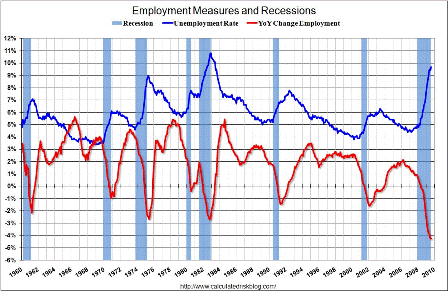
This graph shows the unemployment rate and the year over year change in employment vs. recessions.
Nonfarm payrolls decreased by 216,000 in August. The economy has lost almost 5.83 million jobs over the last year, and 6.93 million jobs during the 20 consecutive months of job losses.
The unemployment rate increased to 9.7 percent. This is the highest unemployment rate in 26 years.
Year over year employment is strongly negative.
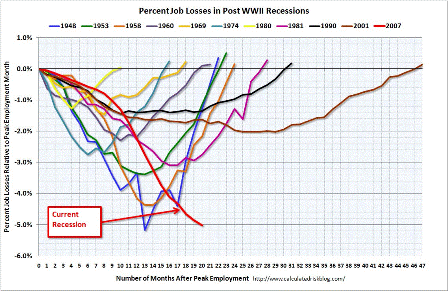
The second graph shows the job losses from the start of the employment recession, in percentage terms (as opposed to the number of jobs lost).
For the current recession, employment peaked in December 2007, and this recession was a slow starter (in terms of job losses and declines in GDP).
However job losses have really picked up over the last year, and the current recession is now the 2nd worst recession since WWII in percentage terms (and the 1948 recession recovered very quickly) – and also in terms of the unemployment rate (only early ’80s recession was worse).
The economy is still losing jobs at about a 2.6 million annual rate, and the unemployment rate will probably be above 10% soon. This is still a weak employment report – just not as bad as earlier this year. Much more to come …
[top]
A glimmer of hope in the last sentence but fails to state that any policy that reduces spending needs to be ‘matched’ with a tax cut to sustain output and employment.
If this is implemented without a tax cut, score one more move to reduce demand and suppress output and employment.
Obama expands workers’ retirement savings options
Obama: Government will make it easier for workers to save for retirement
By Charles Babington
September 5 (AP) — The government is trying to make it easier for Americans to save for retirement, President Barack Obama said Saturday, as he noted the toll the recession has taken on extra income and savings accounts.
Actually, saving has of course gone up as the federal deficit has gone up
One initiative will allow people to have their federal tax refunds sent as savings bonds. Others are meant to require workers to take action to stay out of an employer-run savings program rather than having to take action to join it.
“We know that automatic enrollment has made a big difference in participation rates by making it simpler for workers to save,” Obama said in his weekly radio and Internet address. “That’s why we’re going to expand it to more people.”
The new federal steps, which do not require congressional action, include:
— Making it easier for small companies to set up 401(k) retirement savings plans in which all workers are automatically enrolled unless they ask to be omitted. Employers can set default amounts of each worker’s pay — perhaps 3 percent — to automatically be deposited into the accounts without being taxed. Workers can raise or lower the contribution levels, and they choose how to invest the money. They will pay taxes on the money only when they withdraw it as retirees, when their tax rates are likely to be lower than when they are working full-time. A similar process would apply to savings plans called SIMPLE-IRAs.
— Allowing such plans to automatically increase the amount that workers save over time unless the workers object.
— Allowing people to check a box on their federal tax returns asking that any refund be sent as a savings bond. More than 100 million U.S. households receive refund checks each year, and many are promptly cashed and spent.
— Allowing workers, when leaving a job, to direct unused vacation pay to a retirement savings account rather than taking it in cash.
The administration earlier asked Congress to make it easier to set up retirement accounts for people whose workplaces do not offer them. No legislation has moved thus far.
“Tens of millions of families have been, for a variety of reasons, unable to put away enough money for a secure retirement,” Obama said. “Half of America’s work force doesn’t have access to a retirement plan at work. And fewer than 10 percent of those without workplace retirement plans have one of their own.”
While saving for retirement is universally seen as a good idea, any increase in savings rates could somewhat slow the nation’s rebound from the economic recession.
[top]
