China raises bank reserve to curb lending

While this doesn’t actually work to curb lending, it does indicate that China continues to see inflation as a severe enough of a political problem to risk a serious slowdown. And while it’s not impossible, I’ve yet to see any nation succeed in cutting what they call inflation short of increasing their output gap- and most often with a dramatic slowdown.

So while the 9% of GDP US budget deficit continues to support modest GDP growth and only very modestly increasing employment, a combination that’s a pretty good environment for stocks, the risks outlined at year end continue to increase.

China continues to fight inflation which can soften thing sufficiently for a commodities retreat. The euro zone continues its austerity and is already showing sings of weakening domestic demand from levels that weren’t all that high. The US Congress continues to press for deficit reduction well before private sector credit growth is ready to take the hand off, and with all sides agreeing there’s a long term deficit problem there doesn’t seem to be much resistance.

It’s all deflationary, and I continue to watch for a strong dollar as a timing/cue to the potential global slowdown.
So far world crude prices hovering at just over $100/barrel are keeping the dollar in check, but doing so by bleeding off some US domestic demand.

China raises bank reserve to curb lending

February 18 (CNBC) — China ordered its banks Friday to hold back more money as reserves in a new move to curb lending and cool a spike in inflation.

The order raising reserves by 0.5 percent of deposits was the second such move this year by the central bank and followed six reserve increases in 2010. Reserves vary by institution but are about 20 percent for China’s biggest state-owned lenders.

Beijing is using a series of repeated, gradual hikes in interest rates and reserve levels to stanch a flood of lending that helped China rebound quickly from the global crisis but now is fueling pressure for prices to rise.

Inflation is politically dangerous for China’s communist leaders because it erodes economic gains on which they base their claim to power. Poor families are hit hardest in a society where some spend up to half their incomes on food and millions have seen little benefit from three decades of economic reform.

March 30 2009 post

Here’s what I said back a couple of years ago.

Unfortunately, not much has changed (including my suggestion at the time in an earlier post that it was all a pretty good environment for stocks which could easily double).

Review of the recession and how to end it

March 30th, 2009

  1. The problem is suboptimal output and employment which is evidence of a lack of aggregate demand.
     
  2. Less important what caused the drop in aggregate demand
    • The end of the subprime expansion in 2006 reduced the demand for housing
       
    • The wind down of the one time Q2 2008 fiscal adjustment (Q2 2008 GDP was up 2.8%)
       
    • The Mike Masters inventory liquidation that began in July 2008 added supply from inventories, reducing output and employment
       
    • A shift in the propensity to spend due to the pro cyclical nature of credit worthiness


  3. My proposals for restoring aggregate demand:
    • A full payroll tax holiday – This tax is taking $1 trillion per year from workers and businesses struggling to make ends meet $1,000 per capita in revenue sharing for the States (approx. $300 billion total).
       
    • Federal funding for a $8 per hour full time job for anyone willing and able to work that includes federal health care.
       
    • Caveat – Unless our demand for motor fuel is cut in half, restoring aggregate demand will also empower the Saudis to set ever higher prices for crude oil which will cause our real terms of trade and standard of living to deteriorate.
       
    • Political options for reducing imported fuel consumption:
       

      • Regressive – utilizing allocation by price (Carbon tax, fuel taxes)
         
      • Closer to neutral – mandating higher fuel economy requirements for new vehicles, offering incentives to trade up to more fuel efficient vehicles
         
      • Progressive – substantially reducing speed limits to discourage driving and advantage public transportation


  4. Redirect banking to serve public purpose
    • Ban banks from all secondary markets.
       
    • Allow bank lending only to serve public purpose.
       
    • Do not use the liability side of banking for market discipline.


  5. Analysis of current situation
    • Our leaders believe they must first ‘get credit flowing again’ to restore output and employment.
       
    • Unfortunately the reverse is the case; restoration of output and employment will restore the flow of credit.
       
    • Government is removing about $1 trillion per year in payroll taxes from employees and employers who can’t meet their mortgage payments and wondering what is causing the financial crisis.
       
    • All moves to date by the Treasury and Federal Reserve have only served to shift financial assets between the public and private sectors. Nothing has directly added to aggregate demand.
       
    • Therefore the economy has continued to deteriorate, with only the ‘automatic stabilizers’ slowly adding financial assets and income to the private sector, as the counter-cyclical deficit rises.
       
    • The rate of federal deficit spending (not counting TARP and other shifting of financial assets that does not directly alter demand, as above) now exceeds 5% of GDP and seems to have begun moving the economy sideways.
       
    • The new fiscal package starts taking effect in April. While modest in size, it isn’t ‘nothing’ and will further support GDP.
       
    • Employment will not grow until real output of goods and services exceeds productivity growth.
       
    • Fuel prices are already moving higher.


  6. Conclusion
    • Leadership that doesn’t understand how the monetary system works has needlessly prolonged the recession and delayed the recovery.
       
    • They have put a premium on ‘confidence’ as the President spends countless hours in front of the TV cameras, when in fact loss of ‘confidence’ means only that federal taxes can be lower for a given level of federal spending:

      lower confidence = less private sector spending = less aggregate demand = lower taxes or higher federal spending to sustain output and employment

    • The headline USD trillions they have directed towards the financial sector has accomplished little or nothing beyond burning up expensive political capital and credibility.
       
    • They are in this way over their heads, and it’s costing us dearly.
       

MMT on MarketWatch

MMT breaking through???

Deficit hysteria grips Washington

By Darrell Delamaide

February 16 (MarketWatch) — Deficit hysteria is rising to fever pitch in Washington as the political jockeying over the budget begins in earnest.

“Fiscal nightmare,” “buried under a mountain of debt,” “awash in red ink” – these are some of the colorful phrases being bandied about by politicians, pundits and even journalists ostensibly reporting facts. Most of them are winging it on a single undergraduate course in economics, if that, but they know they’re right because everybody agrees.

Yet, if you look out the window, you don’t see any red ink or mountains of debt. The only nightmare is unemployment continuing near 10% and ongoing waves of foreclosures – neither of which is attributable to the federal deficit and neither of which will be fixed by budget cuts.

There is no visible harm from current deficits. Yields on U.S. Treasurys are up a tick but still near historic lows. Core inflation in the U.S. is still so far below the 2% annual rate deemed desirable by the Federal Reserve that deflation continues to be more worrying. There is no crowding out of private borrowers in the debt markets.

Just you wait, cry the deficit hawks, it will be a nightmare by 2016 or 2020 or 2050. Well, let’s wait and see. If we put those 15 million people back to work and get the economy growing at a steady clip, tax revenues will rise and cheat all those bloodthirsty hawks of their fiscal Armageddon.

Worried? Confused? Alarmed at the slow-motion train wreck in Washington?

There is cause for alarm. There is the possibility that the government, held under the sway of misguided and obsolete economic theories and driven by a not-so-hidden corporate agenda, will make genuinely harmful cuts in both discretionary spending and entitlement programs – cuts that will cause real and needless misery to millions.

The overwrought hysteria of the deficit hawks – one economist calls them deficit terrorists – has already sabotaged government stimulus that could have rebooted the economy much more quickly and alleviated unemployment to a greater extent.

It’s certainly useful to comb through the budget and reexamine programs for possible cuts. Military spending can certainly be cut back. Some recalibration of entitlements is also necessary.

But the helter-skelter axing of programs to meet a target pulled out of thin air – what’s so magic about $100 billion in spending cuts this year? – risks causing much unnecessary harm.

Before you succumb to the deficit hysteria, think about the disconnect between the dire language and the observable facts. Be careful about false comparisons – such as the U.S. going the way of Greece.

The U.S. is not Greece. The U.S. has full monetary sovereignty – that is, it has complete control over its own currency. Greece, as a member of the euro, does not, which is why it has constraints on its borrowing.

When the U.S. was bound by the gold standard, it also faced constraints. Most of the thinking and language about budgets and deficits actually goes back to this time, when the U.S. genuinely had to “finance” its deficit.

Since abandonment of the gold standard and the de facto adoption of a fiat currency, however, these constraints no longer apply. The U.S. is free to print as much money as it likes; the U.S. government is free to spend money without financing it.

How crazy, you say. What about inflation? Inflation occurs when there is more demand than supply and this simply isn’t going to happen when there is 8-10% unemployment. Treasury and the Fed have ample tools – selling debt securities and raising interest rates – to deal with inflation when it does threaten.

Modern monetary theory – which is espoused by a growing number of economists and investment managers because it explains the observable facts better than the obsolete theories driving most of the public discussion – deals with the world as it is without a gold standard.

A better comparison for the U.S. than Greece is Japan, which also enjoys full monetary sovereignty. Japan has a public debt approaching 200% of GDP. This compares to the U.S. at 60% in 2010 and on its way up.

Deficit terrorists have decided arbitrarily that 60% is the maximum limit. They have been predicting the imminent collapse of Japan – for the past 20 years. And yet Japan continues to finance its deficit with rock-bottom interest rates.

The federal government is also not comparable to a household. It does not have a checkbook to balance or a credit card to max out, even though our folksy politicians like to use these metaphors. It does not have to “live within its means” like a family or individual. Our grandchildren will never have to repay all that debt. No one will, ever. It will continue to grow as our economy grows.

All this flies in the face of all the groupthink going on in Congress, in the press and on cable TV. So if you want to reject modern monetary theory as hogwash and cling to theories that worked a century ago, you’re in good company. But think about it, look around you, and decide for yourself what best describes the world you live in.

U.K. Retail Sales Advance at Fastest Pace in 10 Months, BRC Says

The deficit is still plenty large enough for a decent expansion, so the year end weather setbacks could be reversed and then some before sufficient austerity sets in and works to reverse it all.

Hard to figure the timing for the cross currents.

Also, opening the borders to wealthy foreigners, as they recently announced they were doing, is a clever move to firm the currency and support the economy and asset prices.

UK Headlines

U.K. Retail Sales Advance at Fastest Pace in 10 Months, BRC Says
U.K. Housing-Price Gauge Increased in January on Supply Shortage
Osborne Says U.K. Bank Levy Increase to Raise 800 Million Pounds

Fiscal panel co-chair blasts critics as “jerks”

History will not be kind to either Simpson or the equally out of paradigm headline critics who are equally responsible for losing this battle.

Fiscal panel co-chair blasts critics as “jerks”

February 6 (Reuters) — Any fiscal plan that fails to tackle military spending, Medicare, Medicaid and Social Security is “a sparrow’s belch in the midst of a typhoon,” a chairman of a presidential deficit-reduction commission said in an interview aired on Sunday.

Former Senator Alan Simpson, Republican co-chair of the National Commission on Fiscal Responsibility and Reform, also trashed certain critics as “jerks” and compared the United States to “a milk cow with 300 million teats.”

“If you have a career politician get up and say, ‘I know we can get this done; we’re going to get rid of all earmarks, all waste, fraud, and abuse, all foreign aid, Air Force one, all congressional pensions,’ that’s a sparrow’s belch in the midst of a typhoon,” Simpson told CNN’s “State of the Union.”

President Barack Obama created the bipartisan, 18-member commission to address fiscal challenges centered around a deficit of more than $1.3 trillion, the highest since World War Two, and a record federal debt now topping $14 trillion.

A bold budget-balancing plan floated by Simpson — long noted for earthy, sometimes off-color remarks — and his fellow co-chairman, Erskine Bowles, fell short in December of the support needed from panel members to trigger congressional action.

“So I’m waiting for the politician to get up and say, there’s only one way to do this, you dig into the big four: Medicare, Medicaid, Social Security, and defense,” Simpson said. “And anybody giving you anything different than that, you want to walk out the door, stick your finger down your throat and give them the green weenie.”

Simpson and Bowles recommended Social Security benefit cuts via a higher retirement age, lower annual cost-of-living adjustments and a change in the way benefits are calculated.

“We’re not talking about privatization,” he said on CNN. “These jerks who keep dragging that up are lying. We never suggested that.”

Simpson served from 1979 to 1997 as a Senator from Wyoming. He had apologized in August for comparing Social Security to “a milk cow with 310 million teats.”

But in the interview he said he had merely misspoken.

“I meant to say that America was a milk cow with 300 million teats, and not just Social Security.”

Excellent post on the MMT controversy

Straw Men (And Women)

By Peter Cooper

This post is for all the MMT foot soldiers out there in cyberspace, including myself and most readers (prominent MMT economists who are kind enough to drop in from time to time excepted, of course).

Come on, we know who we are. Battling it out in diverse message forums, matching wits with fellow participants who, judging from their arguments, mostly appear to read our posts with their eyes shut and their fingers in their ears to block out the sounds of our linked video presentations. This navel-gazing exercise may seem self-indulgent to the crustier MMT old-timers among us, but, hey, rationalize it, we deserve it!

The post is also for readers who have not yet made up their minds about MMT. Think of this as a small taste of the kind of self-congratulatory back slapping you too will be able to enjoy at heteconomist if you decide to join the ranks of the foot soldiers. Enjoy! You also deserve it!

Straw Men in Cyberspace

On a private message forum I often visit, a regular participant – who is very bright, and a good contributor on many topics – recently posted a criticism of the MMT position on budget deficits that went something like this:

Budget deficits increase demand in some areas and decrease it in others. To illustrate the point I will show an extreme example. Say Honest Annie has $10,000 in savings. Mr Lucky is given $100,000,000 to stimulate the economy. Oh look, now Annie can produce more goods because Mr Lucky can afford to buy them. Of course, look at poor Annie’s real disposition. This new demand comes with the devaluation of her hard-earned savings. What is changing is that now she has to produce more to be able to afford more goods. The government has tricked her into having to work more because her savings have been devalued due to inflation. Sure, Mr Lucky is happy because Annie is producing more goods for him, but there are two sides to the coin.

Clearly the government should not adopt such a ridiculous policy in which it randomly gives one person $100 million in an economy where a typical person has savings of $10,000. But even in terms of the ludicrous example, the poster’s logic is lacking.

If Mr Lucky spent some of the money to buy stuff from Honest Annie, and she had the available time and resources to respond to the additional demand at current prices, she would receive some of Mr Lucky’s money in payment and also have increased spending power to purchase output from Mr Lucky or somebody else. The deficit expenditure can increase demand in some areas without reducing it in others provided the economy is operating below full capacity.

The question is whether there are idle resources that people would willingly put to use if there was demand for the resulting output, and whether this additional output could be supplied in a non-inflationary manner.

No one in the MMT camp is suggesting the government should net spend more than is necessary to enable the purchase of potential output at current prices.

The author of the example is influenced by the Austrian school, so some of his reasoning is defensible within that framework. In particular, as I discussed here and here, the Austrian definition of inflation is different from the one used by other economists. For everyone but the Austrians, inflation means a persistent rise in the general price level (the weighted average of all prices of final goods and services), not an expansion of broader money per se.

This can lead to differences between Austrians and non-Austrians in their assessments of whether inflation is occurring. If there is a rise in general prices, there will typically be an expansion of broader money to accommodate it unless real potential output shrinks due to a supply shock. In this case, both Austrians and non-Austrians alike will observe inflation. But it is possible for the broader money supply to expand (inflation for Austrians) without general prices rising (no inflation for other economists) whenever the economy is operating below full capacity. This means that from the Austrian perspective, it makes sense to suggest deficit expenditure will reduce the value of money even if, for other economists, there is no inflation.

Differences such as this can be discussed as part of a healthy debate. What is more annoying is the practice of creating straw-man arguments, such as the suggestion that MMT economists are advocating mindless spending out of all proportion to the actual demand deficiency or without any thought to the allocation of that net spending. The tactic often appears to be deliberate, in that there is a wilful misinterpretation of the argument to make it easier to ridicule or criticize. No matter how many times the point is clarified, the wilful (and convenient) misinterpretation will be repeated as if nothing has changed. The result is a discussion that fails to advance beyond irrelevant mischaracterizations and attempts to set (reset) the record straight.

As a practical matter for foot soldiers, we need to balance the need to deal with such mischaracterizations with the desire to develop the argument further for those not thrown by the mischaracterizations or to present the same argument elsewhere. At some point, it is probably best to assume that intelligent readers have been provided with enough clarification to make up their own minds about the merits of the straw-man argument, and just get on with advancing the discussion, or if the point has been made, move on to other forums. There is no need to convince every person in every forum.

MMT – and heterodox approaches, in general – seem more susceptible to this kind of straw-man treatment because its proponents have to make the running. In debates with critics or skeptics, the aim of the MMT proponent is usually to explain why the current dominant understanding of the economy is lacking, and why an alternative may offer an improvement in understanding.

A skeptic who is only interested in a better understanding of the economy has no motive to mischaracterize MMT arguments. The motive for engaging in discussion for such a person would be to understand the approach to enable an informed assessment of it. But when a skeptic or critic is more interested in defending a preconceived view of the world – possibly for psychological, political, or careerist reasons – their motive may not be to understand but to obfuscate, sidetrack, or otherwise hold up the discussion in ways that at least muddies the waters enough to make it difficult for others, who may be trying to understand without prejudging positions, to separate nonsense from valid argument, especially if they do not have a training in economics.

Consider journalists who write on economic matters, for example. In a way, it is hard to blame them for erring on the side of the orthodoxy when in doubt if they don’t have sufficient confidence in their own understanding of the subject. When in doubt, it is surely safer to go with the view of a Nobel Prize recipient or Professor from an Ivy League university over the views of a heterodox economist, even if the heterodox position seems to make more sense.

Opponents of the heterodox position can take advantage of this, knowing that they do not have to win arguments, or even engage in them in many cases, provided there is sufficient doubt over the heterodox position, whether because of perception, status, obfuscation or deliberately disruptive tactics, which on the internet can of course be done anonymously.

Straw Men in Academia

Straw-man argumentation is not limited to the orthodoxy or the internet. Heterodox schools use this tactic in disputes among themselves. For example, Marx’s theory of value was widely claimed to be “internally inconsistent” for eighty years on the basis of a straw man (the dominant dual-system, simultaneist interpretation of his theory) before a group of economists were finally able to demonstrate that Marx’s work could be interpreted in a way that not only gave it internal coherence but reproduced all of his results on value, including the long-run tendency of the rate of profit to fall, which had supposedly been “disproved” by Okishio’s theorem.

It wasn’t until the 1980s that papers began to be published by economists adhering to the so-called “temporal single-system interpretation” of Marx, demonstrating the theoretical coherence – validity, not necessarily correctness – of his theory of value when interpreted in a temporal and “single-system” way. It took another twenty-five years of persistence by these economists before Sraffians (who were the most prominent antagonists) and other critics grudgingly stopped dismissing Marx’s theory in pat phrases repeated over and over again without any authority other than the insinuation of authority.

One of the leading protagonists in this debate, Andrew Kliman, has written an accessible book for the generalist reader documenting the history of the debate and summarizing the major findings. For anyone interested in the debate over Marx’s theory of value, it is well worth reading, and eye-opening in bringing to light the extent of intellectual dishonesty in academia, including within the heterodoxy.

The straw-man tactic of the Sraffians served to discredit Marx and help to create a justification for alternative theories (e.g. Sraffianism) to replace or “correct” Marx’s theory. The tactic was also employed by developers of an array of alternative, though short-lived, value theories, such as the New Interpretation, Simultaneous Single-System Interpretation, Value Form theory, etc. A certain career benefit and “respectability” no doubt also comes from distancing oneself from Marx’s theory of value in a capitalist society.

The straw-man attack on Marx’s theory was effective partly because Marxism is outside the orthodoxy and Marxists have little to no presence in academic economics, let alone clout. Another reason for its effectiveness may be that Marxist thought is critical of the capitalist system itself. It is not merely reformist. This is not exactly the most career-savvy research program for an up-and-coming academic.

None of this is to suggest that Sraffianism or any of the other alternative theories are not valid approaches in their own right. It is simply to insist that the developers of these theories were not entitled to assert the invalidity of Marx’s theory almost like a religious mantra when the argument relied on a straw man.

The unjustified but highly successful eighty-year banishment of Marx’s theory can be contrasted with the lack of impact the Cambridge Capital Controversy has had on the dominance of neoclassical economics. This time the position of the Sraffians in theoretical terms was very strong, and their central points were conceded by Paul Samuelson and other leading neoclassical participants in the debate, yet the victory has so far had little impact on the status quo in academic economics.

The strategically effective response of the neoclassical orthodoxy to heterodox critiques drawing on the results of the Cambridge Capital Controversy has been simply not to respond through debate but rather ignore the implications, stop publishing heterodox work in the top journals, and cease hiring heterodox economists in the most prestigious universities or leading policymaking institutions (see Nobel-nomics for a polemical take on the aftermath of the Capital Debates).

When aimed at the orthodoxy, even legitimate criticism struggles to make a dent. For the heterodoxy, the very strongest arguments take a long time to break through.

Eventually, though, as MMT commentator rvm often reminds me, truth will out. Advances in understanding in many areas of human endeavor have faced the same kind of opposition throughout history. Even now, some heterodox advances in economics eventually slip in through the back door of neoclassical economics.

For example, there appears to be an increasing recognition among monetary researchers that some traditional concepts are untenable. Recent notable examples apply to the money-multiplier theory and money endogeneity. Understanding of these points has been well established in Post Keynesian economics for a long time. Now, slowly, some of the ideas are creeping in to mainstream analysis (usually without appropriate credit being given to earlier heterodox work).

All this is a longwinded way of saying that the road is uphill, but the only option is to keep plugging away. Some of the leading proponents of MMT have been grinding away for thirty years now. As internet foot soldiers, we can follow their lead. Sooner or later, perhaps long after we’re all dead, society will wake up to reality, strengthen conceptual understanding, and implement sensible policies.

Ancient historians of twentieth and twenty-first century economic thought will look back and realize that much of the truth was worked out by Kalecki, Keynes, Lerner, CofFEE, UMKC, TCOTU, etc. From their vantage point of 5000 AED (five thousand years After Environmental Destruction), orthodox historians will wonder how the clear and cogent answers of MMT could possibly have been ignored by so many experts of the era, who seemed inexplicably fond of straw men. These orthodox thinkers of the future will know with utter certainty that they could never be so close-minded!

A Comment on MMT Internet Discussions

There is one particular straw man that is repeatedly erected by critics of MMT. I’m sure most foot soldiers reading this will have noticed it. It is one that I find especially grating. The best (i.e. most irritating) phrase I’ve seen to encapsulate the nuances of this particular straw man is the refrain:

MMT claims we can print prosperity.

The phrase “print prosperity” is shorthand for the common message board accusation that MMT ignores real resources and gets bamboozled by money as if it is magic. The accusation is very common. The term “print prosperity” was coined, to the best of my knowledge, by a Math Professor, no less, who happens to be keen on the kind of “fiscal conservatism” advocated by the Concord Coalition.

I consider it a perverse injustice that, in online discussions, MMT sympathizers are frequently reproached for imagining that “we can print prosperity” when in fact it is us who constantly stress as a fundamental point that the only true constraints are resource based, not financial or monetary in nature. We are the ones insisting that if we have the resources, we can put them to use. It is the neoclassical orthodoxy and others who try to make out that we can’t use resources, even if they are available, because of some magical, mysterious monetary or financial constraint. Just who is it that believes in magic here?

MMT shows clearly that if we have the resources, money is no obstacle to a government that issues its own flexible exchange-rate fiat currency. It is not saying that creating money magically creates goods and services. It is saying that it is nonsense – superstitious nonsense – to think affordability for such a government could be about money rather than resources.

Obviously, anyone is entitled to disagree with the MMT position. But they are not entitled purposefully to misrepresent MMT as suggesting that it is oblivious to real resource constraints when it is alternative theories that attempt to obfuscate matters by conjuring up fictitious “financial constraints” (e.g. the neoclassical “government budget constraint” framework).

Take the debate over how to address the aging population for example. It should be obvious – and is obvious in MMT – that the only way to address this issue is to increase future productive capacity. This involves the application of real resources now to research, infrastructure development, education (including in areas relevant to servicing an aging population), etc.

Clearly, MMT is not, as many internet critics claim, saying that creating money solves the problem. It is really the MMT critics who are falling into the trap of thinking money rather than the application of real resources is the solution, despite their frequent protestations to the contrary. They are the ones who think that if the government “saves” money now, this will somehow help to address the needs of the aging population in, let’s say, twenty years time.

Yet, these same people also stress that you can’t “print prosperity”. Well, if you can’t “print prosperity” – and we all agree on that – what good is that money the government supposedly should stash away going to be twenty years from now? It won’t help to provide the infrastructure and technological knowledge that was not developed in the preceding twenty years because governments preferred to “save” money for the future rather than apply resources to the real task of raising productive capacity.

Oh well. We shrug and move on. Such are the trials and tribulations of an internet foot soldier.

Bernanke text

Just when you think he’s making progress:

>   
>   (email exchange)
>   
>   On Thu, Feb 3, 2011 at 1:41 PM, Cullen wrote:
>   
>   After a glimpse of hope from some of Bernanke’s speeches late last year
>   he appears to have suffered some sort of memory loss as he is once again
>   talking about the dangers of the govt debt:
>   

Bernanke:

By definition, the unsustainable trajectories of deficits and debt that the CBO outlines cannot actually happen, because creditors would never be willing to lend to a government with debt, relative to national income, that is rising without limit.

Link to text

Comments on Non-Mfg ISM

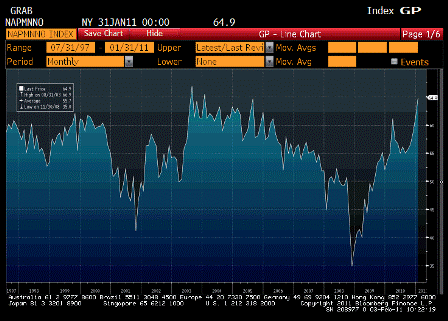
Looks from the chart we’re getting close to the post Bush tax cut, coming out of that recession highs, so we’re on track for our 3-5% read gdp growth guestimates.

And the high productivity reported today reinforces our thoughts on unemployment coming down only slowly as well.

Last time around the expansion phase of what became the sub prime crisis was a substantial contributor to private sector credit growth. Without that kind of contribution from somewhere else, this recovery could be more modest than the last.

For exports to be sustained, the govt would have to keep the dollar down with fx purchases and reserve building, which in my humble opinion isn’t going to happen. That means the adjustment takes place via a climbing US dollar that continues until it dampens exports. Much like what the euro zone has experienced for the last decade or so.


Karim writes:

Multi-year highs for overall index, new orders (3rd highest on record-chart attached), and employment.
Anecdotes also very positive.

  • “New initiatives creating increase in spending.” (Finance & Insurance)
  • “Indications are that business is picking up and that 2011 could see positive growth across many industries. We are seeing an increase in orders at the beginning of the year.” (Professional, Scientific & Technical Services)
  • “Starting to see higher prices in many areas. Low inventory levels are leading to longer delivery time frames.” (Public Administration)
  • “Business uncertainty seems to be subsiding.” (Management of Companies & Support Services)
  • “Business activity is picking up. The challenges in the textile market (cotton/polyester) are significantly impacting price along with the inability to secure pricing for a period longer than two months.” (Accommodation & Food Services)
  • “2011 looking better than 2010.” (Information)


Jan Dec
Composite 59.4 57.1
Business activity 64.6 62.9
Prices Paid 72.1 69.5
New Orders 64.9 61.4
Backlog of Orders 50.5 48.5
Supplier Deliveries 53.5 51.5
Inventory Change 49.0 52.5
Inventory Sentiment 60.0 61.5
Employment 54.5 52.6
Export orders 53.5 56.0
Imports 53.5 51.0