Juncker on the euro crisis

Juncker has to know better than this, he can’t be that sheltered?

From Mike Norman’s blog

“The debt level of the USA is disastrous,” Mr. Juncker said. “The real problem is that no one can explain well why the euro zone is in the epicenter of a global financial challenge at a moment, at which the fundamental indicators of the euro zone are substantially better than those of the U.S. or Japanese economy.”

WSJ on China buying Tsy secs

A bit of support in the Wall Street Journal for my suspicions about an understanding being reached between China and the Fed, and Fed Chairman Bernanke’s timing on his strong dollar speeches:

“A report this week showed foreigners were net buyers of long-term U.S. financial assets in April. China bought U.S. Treasuries after five straight months of net selling, and remained the top holder of those government securities.”

thoughts on the euro

So my story has been that while most thought QE was a bumper crop for the dollar- Fed printing money and flooding the system with liquidity and all that-

It was in fact a crop failure for the dollar, as evidenced by the Fed turning over $79 billion in QE profits (that would have otherwise gone to the economy) to the Tsy.

And because everyone thought it was a bumper crop, they all sold the heck out of dollars in all kinds of theaters and iterations, from outright selling of dollars, to buying of commodities and stocks and in general making all kinds of dollar ‘inflation bets.’

And then a few weeks ago Chairman Bernanke comes on tv and starts talking about how his policies are strong dollar policies, just as the dollar index hit its lows and within a day or so headed north.

At the time it seemed strange to me that he’d suddenly, out of nowhere, break silence on the dollar and make those kinds of strong dollar statements previously left to Treasury. Unless he had a pretty good idea the dollar would start going up.

And only a few days ago he again spoke about how his policies were strong dollar policies, and the dollar traded around a bit, but remained above the lows and then headed back up. Especially vs the euro.

And shortly after that we find out China had let maybe $200 billion in T bills run off since QE2 started, and while their dollar holdings didn’t fall, their reserve growth was allocated elsewhere, and, from market action, there were substantial allocations to the euro. This hunch was further supported by their earlier announcement that they would be buying Spanish bonds to ‘help them out’ as a Trojan horse to buy euro to support their exports to the euro zone.

So my story is maybe the T bill runoff thing was a shot across the Fed’s bow? China was in the news objecting to QE and demanding what they considered ‘sound money’ policy. So it would make sense, to let the Fed know they were serious, to do something like let their T bills run off and alter fx allocation ratios away from the dollar and toward the euro, all of which caused the dollar to sell off for several months. And with the implication, and maybe also in private conversation, that any more QE would mean outright selling of dollar reserves. And the Fed Chairman taking this to heart and with other FOMC members also objecting to more QE, and maybe even knowing that QE doesn’t do anything anyway apart from scaring global portfolio managers, including those in China and Russia, etc. out of dollars, maybe somehow reached an understanding with China, where China would return to ‘normal’ fx allocations and there would be no QE3? And the subsequent strong dollar speeches that followed had the knowledge behind them that China had returned to dollar financial asset accumulation, which would likely end the dollar slide and reverse it?

This also means the euro has lost this ‘extra’ support it’s ‘enjoyed’ for the prior several months, which means it’s all a lot worse for the euro than it is good for the dollar, as they have bigger fish to get deep fried than just the level of the currency. Seems the last thing they need now is for a major buyer of euro denominated debt to switch allocations to dollars.

And it also could be that this ‘extra’ euro debt buying has been delaying the euro crisis for the last several months as well. This means it’s all been propped up while getting worse down deep, which means if that support has now been pulled, it falls that much harder.

A lower euro also works to ‘inflate away’ euro zone national govt debt ratios, and currency depreciation in general as a market induced path to debt relief is a well known phenomena, though one the ECB is likely to fight to comply with its low inflation mandate. And fighting inflation means hiking interest rates, which, while initially helping some, actually work to increase national govt deficits and hurt their credit ratings, as well as further depress the euro.

Fed Chairman Ben S. Bernanke on Fiscal Sustainability

This is from the same Ben S. Bernanke that stated the Fed spends by using their computer to mark up numbers in bank accounts.

Now, by extension, he’d propose basketball stadiums have a reserve of points for their scoreboards to make sure the teams could get their scores when they put the ball through the hoop.

If he was a state Governor this would be a pretty good speech. But he’s not.

Comments below:

Bernanke Speech

At the Annual Conference of the Committee for a Responsible Federal Budget, Washington, D.C.
June 14, 2011
Fiscal Sustainability

I am pleased to speak to a group that has such a distinguished record of identifying crucial issues related to the federal budget and working toward bipartisan solutions to our nation’s fiscal problems.

Yes, we now have bipartisan support for deficit reduction. Good luck to us.

Today I will briefly discuss the fiscal challenges the nation faces and the importance of meeting those challenges for our collective economic future. I will then conclude with some thoughts on the way forward.

Fiscal Policy Challenges
At about 9 percent of gross domestic product (GDP), the federal budget deficit has widened appreciably since the onset of the recent recession in December 2007. The exceptional increase in the deficit has mostly reflected the automatic cyclical response of revenues and spending to a weak economy as well as the fiscal actions taken to ease the recession and aid the recovery. As the economy continues to expand and stimulus policies are phased out, the budget deficit should narrow over the next few years.

Both the Congressional Budget Office and the Committee for a Responsible Federal Budget project that the budget deficit will be almost 5 percent of GDP in fiscal year 2015, assuming that current budget policies are extended and the economy is then close to full employment.1 Of even greater concern is that longer-run projections that extrapolate current policies and make plausible assumptions about the future evolution of the economy show the structural budget gap increasing significantly further over time. For example, under the alternative fiscal scenario developed by the Congressional Budget Office, which assumes most current policies are extended, the deficit is projected to be about 6-1/2 percent of GDP in 2020 and almost 13 percent of GDP in 2030. The ratio of outstanding federal debt to GDP, expected to be about 69 percent at the end of this fiscal year, would under that scenario rise to 87 percent in 2020 and 146 percent in 2030.2 One reason the debt is projected to increase so quickly is that the larger the debt outstanding, the greater the budgetary cost of making the required interest payments. This dynamic is clearly unsustainable.

Unfortunately, even after economic conditions have returned to normal, the nation faces a sizable structural budget gap.

The nation’s long-term fiscal imbalances did not emerge overnight. To a significant extent, they are the result of an aging population and fast-rising health-care costs, both of which have been predicted for decades. The Congressional Budget Office projects that net federal outlays for health-care entitlements–which were 5 percent of GDP in 2010–could rise to more than 8 percent of GDP by 2030. Even though projected fiscal imbalances associated with the Social Security system are smaller than those for federal health programs, they are still significant. Although we have been warned about such developments for many years, the difference is that today those projections are becoming reality.

Up to hear he’s discussed the size of the debt with words like ‘unfortunate’ and ‘imbalances’ and finally we here why he believes this is all a bad thing:

A large and increasing level of government debt relative to national income risks serious economic consequences. Over the longer term, rising federal debt crowds out private capital formation and thus reduces productivity growth.

What? Yes, public acquisition of real goods and services removes those goods and services from the private sector. But this is nothing about that. This is about deficits reducing the ability of firms to raise financial capital to invest in real investment goods and services to keep up productivity.

The type of crowding out the chairman is warning about is part of loanable funds theory, which is applicable to fixed exchange rate regimes, not floating fx regimes. This is a very serious error.

To the extent that increasing debt is financed by borrowing from abroad, a growing share of our future income would be devoted to interest payments on foreign-held federal debt.

Yes, if the interest payments set by the Fed are high enough, that will happen. However it isn’t necessarily a problem, particularly with the foreign sector’s near 0% propensity to spend their interest income on real goods and services. Japan, for example, as yet to spend a dime of it’s over $1 trillion in dollar holdings accumulated over the last six decades, and china’s holdings only seem to grow as well. In fact, the only way paying interest on the debt could be a problem is if that interest income is subsequently spent in a way we don’t approve of, and it’s easy enough to cross that bridge when we come to it.

High levels of debt also impair the ability of policymakers to respond effectively to future economic shocks and other adverse events.

There is no actual, operational impairment to spend whatever they want whenever they want. Federal spending is not constrained by revenues, as a simple fact of monetary operations. The only nominal constraints on spending are political, and the only constraints on what can be bought are what is offered for sale.

Even the prospect of unsustainable deficits has costs, including an increased possibility of a sudden fiscal crisis.

Where does this come from??? Surely he’s not comparing the US govt, the issuer of the dollar, where he spends by using his computer to mark up numbers in bank accounts, to Greece, a user of the euro, that doesn’t ‘clear its own checks’ like the ECB and the Fed do?

As we have seen in a number of countries recently, interest rates can soar quickly if investors lose confidence in the ability of a government to manage its fiscal policy.

He is looking at Greece!

Although historical experience and economic theory do not show the exact threshold at which the perceived risks associated with the U.S. public debt would increase markedly, we can be sure that, without corrective action, our fiscal trajectory is moving the nation ever closer to that point.

‘That point’ applies to users of a currency, like Greece, the other euro members, US states, businesses, households, etc.

But it does not apply to issuers of their own currency, like the US, Japan, UK, etc.

Is it possible the Fed chairman does not know this???

Perhaps the most important thing for people to understand about the federal budget is that maintaining the status quo is not an option. Creditors will not lend to a government whose debt, relative to national income, is rising without limit; so, one way or the other, fiscal adjustments sufficient to stabilize the federal budget must occur at some point.

Again with the ‘some point’ thing. There is no ‘some point’ for issuers of their own currency, like Japan, who’s debt to GDP is maybe 200% and 10 year JGB’s are trading at 1.15%.

These adjustments could take place through a careful and deliberative process that weighs priorities and gives individuals and firms adequate time to adjust to changes in government programs and tax policies. Or the needed fiscal adjustments could come as a rapid and much more painful response to a looming or actual fiscal crisis in an environment of rising interest rates, collapsing confidence and asset values, and a slowing economy. The choice is ours to make.

Right, the sky is falling.

Achieving Fiscal Sustainability

As if we didn’t already and automatically have it as the issuer of the currency.

The primary long-term goal for federal budget policy must be achieving fiscal sustainability.

What happened to his dual mandates of low inflation and full employment? That’s just for the Fed, but not for budget policy?

Well, if you believe the sky is falling no telling what your priority would be.

A straightforward way to define fiscal sustainability is as a situation in which the ratio of federal debt to national income is stable or moving down over the longer term.

And what does ‘straightforward’ mean? The math is easy? Is that how to set goals for the nation?

This goal can be attained by bringing spending, excluding interest payments, roughly in line with revenues, or in other words, by approximately balancing the primary budget. Given the sharp run-up in debt over the past few years, it would be reasonable to plan for a period of primary budget surpluses, which would serve eventually to bring the ratio of debt to national income back toward pre-recession levels.

All arbitrary measures not tied down to real world consequences apart from being a defensive move to keep the sky from falling.

Fiscal sustainability is a long-run concept. Achieving fiscal sustainability, therefore, requires a long-run plan, one that reduces deficits over an extended period and that, to the fullest extent possible, is credible, practical, and enforceable. In current circumstances, an advantage of taking a longer-term perspective in forming concrete plans for fiscal consolidation is that policymakers can avoid a sudden fiscal contraction that might put the still-fragile recovery at risk.

A glimmer of hope here where he seems to recognize how fiscal adjustments alter the real economy. Unfortunately, with the sky about to fall, he has more important fish to fry.

At the same time, acting now to put in place a credible plan for reducing future deficits would not only enhance economic performance in the long run,

Right, so govt doesn’t crowd out private capital formation with a floating fx regime…

but could also yield near-term benefits by leading to lower long-term interest rates and increased consumer and business confidence.

Yes, long term rates would likely be lower, because markets, which anticipate Fed rate settings, would believe the economy would be weak for a very long time, and therefore the odds of rate hikes would be lower.

While it is crucial to have a federal budget that is sustainable,

Don’t want to crowd out that private capital that gets borrowed from banks where the causation runs from loans to deposits (there’s no such thing as banks running out of money to lend).

our fiscal policies should also reflect the nation’s priorities by providing the conditions to support ongoing gains in living standards and by striving to be fair both to current and future generations.

Living standards are best supported by full employment policy, which happens to be a Fed mandate, in case he’s forgotten.

Interesting question, does the Fed’s mandate extend to influencing policy through speeches as to what others should do, or is it just a mandate for monetary policy decisions?

In addressing our long-term fiscal challenges, we should reform the government’s tax policies and spending priorities so that they not only reduce the deficit, but also enhance the long-term growth potential of our economy–for example, by increasing incentives to work and to save, by encouraging investment in the skills of our workforce, by stimulating private capital formation, by promoting research and development, and by providing necessary public infrastructure.

Big fat fallacy of composition there. Especially from a Princeton professor who should know better.

We cannot reasonably expect to grow our way out of our fiscal imbalances, but a more productive economy will ease the tradeoffs that we face.

Making Fiscal Plans
It is easy to call for sustainable fiscal policies but much harder to deliver them. The issues are not simply technical; they are also closely tied to our values and priorities as a nation. It is little wonder that the debates have been so intense and progress so difficult to achieve.

Recently, negotiations over our long-run fiscal policies have become tied to the issue of raising the statutory limit for federal debt. I fully understand the desire to use the debt limit deadline to force some necessary and difficult fiscal policy adjustments, but the debt limit is the wrong tool for that important job. Failing to raise the debt ceiling in a timely way would be self-defeating

Maybe, but he’s just guessing.

if the objective is to chart a course toward a better fiscal situation for our nation.

The current level of the debt and near-term borrowing needs reflect spending and revenue choices that have already been approved by the current and previous Congresses and Administrations of both political parties. Failing to raise the debt limit would require the federal government to delay or renege on payments for obligations already entered into. In particular, even a short suspension of payments on principal or interest on the Treasury’s debt obligations could cause severe disruptions in financial markets and the payments system, induce ratings downgrades of U.S. government debt, create fundamental doubts about the creditworthiness of the United States, and damage the special role of the dollar and Treasury securities in global markets in the longer term.

All of which has happened to Japan, with no adverse consequences on the currency or interest rates, as is necessarily the case for the issuer of a non-convertible currency and floating exchange rate.

Interest rates would likely rise, slowing the recovery and, perversely, worsening the deficit problem by increasing required interest payments on the debt for what might well be a protracted period.3

Some have suggested that payments by the Treasury could be prioritized to meet principal and interest payments on debt outstanding, thus avoiding a technical default on federal debt. However, even if that were the case, given the current size of the deficit and the uneven time pattern of government receipts and payments, the Treasury would soon find it necessary to prioritize among and withhold critical disbursements, such as Social Security and Medicare payments and funds for the military.

Yes, as congress is well aware, to the point that it’s no longer about a debt default, but about a partial shutdown of the rest of the govt.

This has been yesterday’s speech. Congress has moved on from the risk of debt default to the risk of partial govt shutdown.

Moreover, while debt-related payments might be met in this scenario, the fact that many other government payments would be delayed could still create serious concerns about the safety of Treasury securities among financial market participants.

That doesn’t follow?

The Hippocratic oath holds that, first, we should do no harm. In debating critical fiscal issues, we should avoid unnecessary actions or threats that risk shaking the confidence of investors in the ability and willingness of the U.S. government to pay its bills.

Our reps take a different oath

In raising this concern, I am by no means recommending delay or inaction in addressing the nation’s long-term fiscal challenges–quite the opposite. I urge the Congress and the Administration to work in good faith to quickly develop and implement a credible plan to achieve long-term sustainability. I hope, though, that such a plan can be achieved in the near term without resorting to brinksmanship or actions that would cast doubt on the creditworthiness of the United States.

What would such a plan look like? Clear metrics are important, together with triggers or other mechanisms to establish the credibility of the plan. For example, policymakers could commit to enacting in the near term a clear and specific plan for stabilizing the ratio of debt to GDP within the next few years and then subsequently setting that ratio on a downward path.

Again, the falling sky trumps concerns over output and employment.

Indeed, such a trajectory for the ratio of debt to GDP is comparable to the one proposed by the National Commission on Fiscal Responsibility and Reform.4To make the framework more explicit, the President and congressional leadership could agree on a definite timetable for reaching decisions about both shorter-term budget adjustments and longer-term changes. Fiscal policymakers could look now to find substantial savings in the 10-year budget window, enforced by well-designed budget rules, while simultaneously undertaking additional reforms to address the long-term sustainability of entitlement programs.

In other words, cuts in the social security and Medicare budgets. This at a time of record excess capacity.

If only the sky wasn’t falling…

Such a framework could include a commitment to make a down payment on fiscal consolidation by enacting legislation to reduce the structural deficit over the next several years.

Conclusion
The task of developing and implementing sustainable fiscal policies is daunting, and it will involve many agonizing decisions and difficult tradeoffs. But meeting this challenge in a timely manner is crucial for our nation. History makes clear that failure to put our fiscal house in order will erode the vitality of our economy, reduce the standard of living in the United States, and increase the risk of economic and financial instability.

And what history might that be? There’s no such thing as a currency issuer ever not being able to make timely payment.

Madison sq garden will not run out of points to post on the scoreboard.

And check out the references. He relies on the information from the group he’s addressing:

References
Committee for a Responsible Federal Budget (2010). The CRFB Medium and Long-Term Baselines. Washington: CRFB, August.

Congressional Budget Office (2010). The Long-Term Budget Outlook. Washington: Congressional Budget Office, June (revised August).

National Commission on Fiscal Responsibility and Reform (2010). The Moment of Truth: Report of the National Commission on Fiscal Responsibility and Reform. Washington: NCFRR, December.

Zivney, Terry L., and Richard D. Marcus (1989). “The Day the United States Defaulted on Treasury Bills,” Financial Review, vol. 24 (August), pp. 475-89.

Bernanke Admits Economy Slowing; No Hint of New Stimulus

In fact, no one on the FOMC has called for QE3, so it’s highly unlikely with anything short of actual negative growth.

So the question is, why the unamimous consensus?

I’d say it varies from member to member, with each concerned for his own reason, for better or for worse.

And I do think the odds of their being an understanding with China are high, particularly with China having let their T bill portfolio run off, while directing additions to reserves to currencies other than the $US, as well as evidence of a multitude of other portfolio managers doing much the same thing. This includes buying gold and other commodities, all in response to (misguided notions of) QE2 and monetary and fiscal policy in general. So the Fed may be hoping to reverse the (mistaken) notion that they are ‘printing money and creating inflation’ by making it clear that there are no plans for further QE.

Hence the ‘new’ strong dollar rhetoric: no more ‘monetary stimulus’ and lots of talk about keeping the dollar strong fundamentally via low inflation and pro growth policy. And the tough talk about the long term deficit plays to this theme as well, even as the Chairman recognizes the downside risks to immediate budget cuts, as he continues to see the risks as asymetric. The Fed believes it can deal with inflation, should that happen, but that it’s come to the end of the tool box, for all practical purposes, in their fight against deflation, even as they fail to meet either of their dual mandates of full employment and price stability to their satisfaction.

They also see downside risk to US GDP from China, Japan, and Europe for all the well publicized reasons.

And, with regard to statements warning against immediate budget cuts, I have some reason to believe at least one Fed official has read my book and is aware of MMT in general.

Bernanke Admits Economy Slowing; No Hint of New Stimulus

June 7 (Reuters) — Federal Reserve Chairman Ben Bernanke Tuesday acknowledged a slowdown in the U.S. economy but offered no suggestion the central bank is considering any further monetary stimulus to support growth.

He also issued a stern warning to lawmakers in Washington who are considering aggressive budget cuts, saying they have the potential to derail the economic recovery if cuts in government spending take hold too soon.

A recent spate of weak economic data, capped by a report Friday showing U.S. employers expanded payrolls by a meager 54,000 workers last month, has renewed investor speculation the economy could need more help from the Fed.

“U.S. economic growth so far this year looks to have been somewhat slower than expected,” Bernanke told a banking conference. “A number of indicators also suggest some loss in momentum in labor markets in recent weeks.”

He said the recovery was still weak enough to warrant keeping in place the Fed’s strong monetary support, saying the economy was still growing well below its full potential.

At the same time, Bernanke argued that the latest bout of weakness would likely not last very long, and should give way to stronger growth in the second half of the year. He said a recent spike in U.S. inflation, while worrisome, should be similarly transitory. Weak growth in wages and stable inflation expectations suggest few lasting inflation pressures, Bernanke said.

On the budget, Bernanke repeated his call for a long-term plan for a sustainable fiscal path, but warned politicians against massive short-term reductions in spending.

“A sharp fiscal consolidation focused on the very near term could be self-defeating if it were to undercut the still-fragile recovery,” Bernanke said.

“By taking decisions today that lead to fiscal consolidation over a longer horizon, policymakers can avoid a sudden fiscal contraction that could put the recovery at risk,” he said.

All Tapped Out?

The central bank has already slashed overnight interest rates to zero and purchased more than $2 trillion in government bonds in an effort to pull the economy from a deep recession and spur a stronger recovery.

With the central bank’s balance sheet already bloated, officials have made clear the bar is high for any further easing of monetary policy. The Fed’s current $600 billion round of government bond buying, known as QE2, runs its course later this month.

Sharp criticism in the wake of QE2 is one factor likely to make policymakers reluctant to push the limits of unconventional policy. They also may have concerns that more stimulus would face diminishing economic returns, while potentially complicating their effort to return policy to a more normal footing.

But a further worsening of economic conditions, particularly one that is accompanied by a reversal of recent upward pressure on inflation, could change that outlook.

The government’s jobs report Friday was almost uniformly bleak. The pace of hiring was just over a third of what economists had expected and the unemployment rate rose to 9.1 percent, defying predictions for a slight drop.

In a Reuters poll of U.S. primary dealer banks conducted after the employment data, analysts saw only a 10 percent chance for another round of government bond purchases by the central bank over the next two years. Dealers also pushed back the timing of an eventual rate hike further into 2012.

The weakening in the U.S. recovery comes against a backdrop of uncertainty over the course of fiscal policy and bickering over the U.S. debt limit in Congress, with Republicans pushing hard for deep budget cuts.

Fragility is Global

Hurdles to better economic health have emerged from overseas as well. Europe is struggling with a debt crisis, while Japan is still reeling from the effects of a traumatic earthquake and tsunami.

In emerging markets, China is trying to rein in its red-hot growth to prevent inflation.

Fed policymakers have admitted to being surprised by how weak the economy appears, but none have yet called for more stimulus.

In an interview with the Wall Street Journal, Chicago Federal Reserve Bank President Charles Evans, a noted policy dove, said he was not yet ready to support a third round of so-called quantitative easing. His counterpart in Atlanta, Dennis Lockhart, also said the economy was not weak enough to warrant further support.

While Boston Fed President Eric Rosengren told CNBC Monday the economy’s weakness might delay the timing of an eventual monetary tightening, the head of the Dallas Federal Reserve Bank, Richard Fisher, said the Fed may have already done too much.

Evans and Fisher have a policy vote on the Fed this year while Rosengren and Lockhart do not.

Weekly Credit Graph Packet – 06/06/11

Recognizing that ‘it’s all one piece’
The rest of the credit stack seems to be moving up in yield roughly in line with equities.

The slowdown seems to be getting serious.

Hopefully the euro zone and UK haven’t yet reached the tipping point where austerity shifts from reducing deficits to adding to them (due to induced economic weakness).

And hopefully Japan decides to go with an all out reconstruction plan without increasing taxes or otherwise ‘paying for it.’

And hopefully China’s second half weakness doesn’t get out of hand.

And hopefully the US Congress doesn’t accomplish any serious near term deficit reduction.

And hopefully the Fed informs us all that QE and 0 rates reduce interest income for the economy, as indicated in Bernanke’s 2004 published paper. And therefore, as he indicated, a fiscal adjustment is called for to sustain aggregate demand at congressionally mandated levels.

Credit Graph Packet

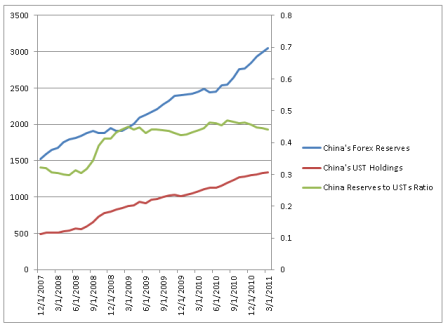
China Has Divested 97 Percent of Its Holdings in U.S. Treasury Bills

So it looks like QE2 indeed managed to scare China out of the dollar. This is the portfolio shifting previously discussed that’s been dragging down the dollar even though, fundamentally sound, as Fed Chairman Bernanke correctly stated.

And when China (and Japan) offered to buy Spanish and other euro zone national govt debt to ‘help out’, the euro zone fell for that one, watching their currency rise against their better judgement with regards to their euro wide exports.

And maybe Fed Chairman Bernanke is aware of this, and has assured China he does favor a strong dollar as per his latest public statements, and let them know that QE3 is unlikely, and has ‘won them back’? No way to tell except by watching the market prices.

And with most everyone out of paradigm with regards to monetary operations, there’s no telling what they all might actually do next.

What is known is that world fiscal balance is tight enough to be slowing things down, and looking to keep getting tighter.
And QE/lower overall term structure of rates removes interest income from the economy, and shifts income from savers to bank net interest margins.
And if China’s growth is going to slow dramatically, its most likely to happen the second half as they tend to front load their state lending and deficit spending each year.

And all the while our own pension funds continue to allocate to passive commodity strategies, distorting those markets and sending out price signals that continue to bring out increasing levels of supply that are filling up already overflowing storage bins.

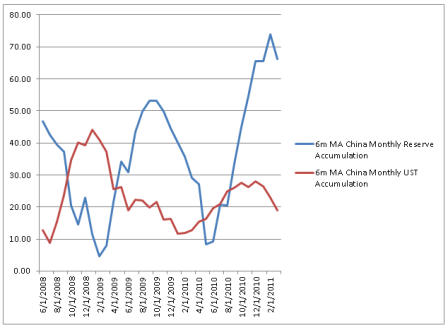
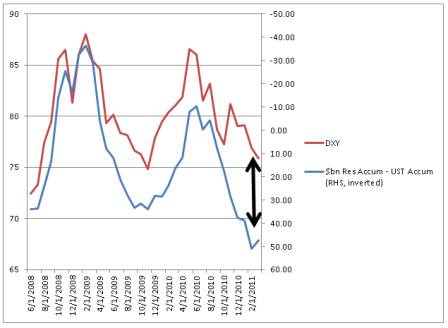
Note in particular that reserve accumulation has been high and rising recently, though UST accumulation has been moderate.

China Has Divested 97 Percent of Its Holdings in U.S. Treasury Bills

By Terence P. Jeffrey

Jun 4 (CNSNews.com) — China has dropped 97 percent of its holdings in U.S. Treasury bills, decreasing its ownership of the short-term U.S. government securities from a peak of $210.4 billion in May 2009 to $5.69 billion in March 2011, the most recent month reported by the U.S. Treasury.
Treasury bills are securities that mature in one year or less that are sold by the U.S. Treasury Department to fund the nation’s debt.

Mainland Chinese holdings of U.S. Treasury bills are reported in column 9 of the Treasury report linked here.

Until October, the Chinese were generally making up for their decreasing holdings in Treasury bills by increasing their holdings of longer-term U.S. Treasury securities. Thus, until October, China’s overall holdings of U.S. debt continued to increase.

Since October, however, China has also started to divest from longer-term U.S. Treasury securities. Thus, as reported by the Treasury Department, China’s ownership of the U.S. national debt has decreased in each of the last five months on record, including November, December, January, February and March.

Prior to the fall of 2008, acccording to Treasury Department data, Chinese ownership of short-term Treasury bills was modest, standing at only $19.8 billion in August of that year. But when President George W. Bush signed legislation to authorize a $700-billion bailout of the U.S. financial industry in October 2008 and President Barack Obama signed a $787-billion economic stimulus law in February 2009, Chinese ownership of short-term U.S. Treasury bills skyrocketed.

By December 2008, China owned $165.2 billion in U.S. Treasury bills, according to the Treasury Department. By March 2009, Chinese Treasury bill holdings were at $191.1 billion. By May 2009, Chinese holdings of Treasury bills were peaking at $210.4 billion.

However, China’s overall appetite for U.S. debt increased over a longer span than did its appetite for short-term U.S. Treasury bills.
In August 2008, before the bank bailout and the stimulus law, overall Chinese holdings of U.S. debt stood at $573.7 billion. That number continued to escalate past May 2009– when China started to reduce its holdings in short-term Treasury bills–and ultimately peaked at $1.1753 trillion last October.

As of March 2011, overall Chinese holdings of U.S. debt had decreased to 1.1449 trillion.

Most of the U.S. national debt is made up of publicly marketable securities sold by the Treasury Department and I.O.U.s called “intragovernmental” bonds that the Treasury has given to so-called government trust funds—such as the Social Security trust funds—when it has spent the trust funds’ money on other government expenses.

The publicly marketable segment of the national debt includes Treasury bills, which (as defined by the Treasury) mature in terms of one-year or less; Treasury notes, which mature in terms of 2 to 10 years; Treasury Inflation-Protected Securities (TIPS), which mature in terms of 5, 10 and 30 years; and Treasury bonds, which mature in terms of 30 years.

At the end of August 2008, before the financial bailout and the stimulus, the publicly marketable segment of the U.S. national debt was 4.88 trillion. Of that, $2.56 trillion was in the intermediate-term Treasury notes, $1.22 trillion was in short-term Treasury bills, $582.8 billion was in long-term Treasury bonds, and $521.3 billion was in TIPS.

At the end of March 2011, by which time the Chinese had dropped their Treasury bill holdings 97 percent from their peak, the publicly marketable segment of the U.S. national debt had almost doubled from August 2008, hitting $9.11 trillion. Of that $9.11 trillion, $5.8 trillion was in intermediate-term Treasury notes, $1.7 trillion was in short-term Treasury bills; $931.5 billion was in long-term Treasury bonds, and $640.7 billion was in TIPS.

Before the end of March 2012, the Treasury must redeem all of the $1.7 trillion in Treasury bills that were extant as of March 2011 and find new or old buyers who will continue to invest in U.S. debt. But, for now, the Chinese at least do not appear to be bullish customers of short-term U.S. debt.

Treasury bills carry lower interest rates than longer-term Treasury notes and bonds, but the longer term notes and bonds are exposed to a greater risk of losing their value to inflation. To the degree that the $1.7 trillion in short-term U.S. Treasury bills extant as of March must be converted into longer-term U.S. Treasury securities, the U.S. government will be forced to pay a higher annual interest rate on the national debt.

As of the close of business on Thursday, the total U.S. debt was $14.34 trillion, according to the Daily Treasury Statement. Of that, approximately $9.74 trillion was debt held by the public and approximately $4.61 trillion was “intragovernmental” debt.

Hoenig Urges Fed to Raise Interest Rates

This from the Fed’s longest serving policy maker, who remains hopelessly out of paradigm.

(The ‘encourage individuals to save’ bit is particularly telling.)


Hoenig Urges Fed to Raise Interest Rates

May 28 (CNBC) —Federal Reserve Bank of Kansas City President Thomas Hoenig, the central bank’s longest-serving policy maker, said the U.S. needs to raise interest rates to encourage individuals to save and avoid future asset bubbles.

Posted in Fed