the Fed and the dollar

Imagine being on the FOMC and in the mainstream paradigm

In 2008 you moved quickly to make sure the US would not become the next Japan

You cut rates to 0, even faster than Japan did.

You provided unlimited liquidity to the dollar money markets,
both home and abroad.

You did trillions of QE, sooner than Japan did.

You announced you expected rates to stay down for two years.

etc. etc. etc.

And what do you have to show for it, 3 years later?

GDP marginally positive, much like Japan
Inflation working its way lower to Japan-like levels, especially housing and wages.
Employment stagnant a la Japan.

And now, after 3 years of 0 rates, and trillions of QE, the dollar is going up, much like the yen did.
After the Fed has done all it could think of to reinflate, and then some.

And all just like MMT suspected.
And for what should be obvious reasons.

quick look at the 489 billion euro LTRO

When it comes to CB liquidity operations, as previously discussed, it’s about price- interest rates- and not quantities of funds. In other words, the LTRO is an ECB tool that assists in setting the term structure of euro interest rates. It helps the ECB set the term cost of funds for its banking system, with that cost being passed through to the economy on a risk adjusted basis, with the banking system continuing to price risk.

So what does locking in their funds via LTRO do for most banks? Not much. Helps keep interest rate risk off the table, but they’ve always had other ways of doing that. It takes away some liquidity risk, but not much, as the banks haven’t been euro liquidity constrained. And banks still have the same constraints due to capital and associated risks.

To it’s credit, the ECB has been pretty good on the liquidity front all along. I’d give it an A grade for liquidity vs the Fed where I’d give a D grade for liquidity. Back in 2008 the ECB was quick to provide unlimited euro liquidity to its member banks, while the Fed dragged its feet for months before expanding its programs sufficiently to ensure its member banks dollar liquidity. And the FDIC did the unthinkable, closing WAMU for liquidity rather than for capital and asset reasons.

But while liquidity is a necessary condition for banking and the economy under current institutional arrangements, and while aggregate demand would further retreat if the CB failed to support bank liquidity, liquidity provision per se doesn’t add to aggregate demand.

What’s needed to restore output and employment is an increase in net spending, either public or private. And that choice is more political than economic.

Public sector spending can be increased by simply budgeting and spending. Private sector spending can be supported by cutting taxes to enhance income and/or somehow providing for the expansion of private sector debt.

Unfortunately current euro zone institutional structure is working against both of these channels to increased aggregate demand, as previously discussed.

And even in the US, where both channels are, operationally, wide open, it looks like FICA taxes are going to be allowed to rise at year end and work against aggregate demand, when the ‘right’ answer is to suspend it entirely.

CB announcements

Just looks like the Fed lowered the rate on its swap lines to keep libor down, which had been moving up to its prior swap line rate.

No big deal, apart from the fact the Fed shouldn’t be allowed to lend on an unsecured basis like this without explicit approval of congress.

Lending unsecured on an unlimited basis has the potential to be highly inflationary.

With the currency a public monopoly, the price level is necessarily a function of prices paid at the point of govt spending and or collateral demanded when govt lends.

Allowing unlimited unsecured lending has the potential to vaporize the currency. And while in this case that kind of abuse isn’t likely, the potential is there.

Fed Chairman Eccles 1933 statement

“Individuals, corporations, cities, and States can not, of themselves, do anything except play according to the rules of the present money system and make their outgo balance their income, or ultimately “go broke.” Most of them are unable, much as they may desire, to give consideration to helping the general situation except as they may influence the action of the Federal Government, which is in an entirely different category, it being able to make and change therules of the game…A State, of course, is in the same financial category as corporations and individuals in that they do not have the power of issuing money or credit. The Federal Government is entirely in a different category because it controls the money system.” ~ Marriner Eccles (February 13 – 23, 1933 Senate Hearing Committe – prior to becoming Fed Chairman)

Signs of Disinflation (Hatzius)

And this Fed fears deflation a lot more than inflation:

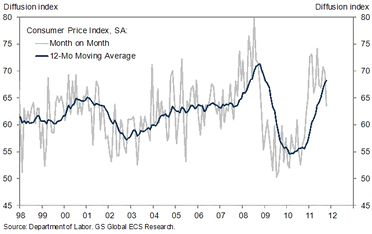
  • We see signs that the upside inflation surprises of 2011 have ended. Our new statistical summary of the price components of business surveys such as the ISM, Philly Fed, and NFIB points to decelerating inflation. In addition, our unweighted CPI diffusion index, which measures the breadth of price changes across 178 detailed price categories, fell to its lowest level since late 2010.

Inflation has been above our expectations in 2011, but we expect a substantial part of this surprise to reverse and see core inflation clearly below the Fed’s “mandate-consistent” level of 2% or a bit less by the end of 2012. The reasons are straightforward. There is still a large amount of slack in the US economy; nominal wage inflation remains very low; and much of the inflation pickup of 2011 can be traced to temporary factors such as short-term commodity price pass-through and upward pressure on motor vehicle prices in the wake of the Japanese earthquake. (We do not expect a full reversal of the core inflation pickup because the increase in rent inflation is likely to be more persistent.)

The recent inflation data have started to look more consistent with our view of moderating core inflation. The consumer price index (CPI) excluding food and energy has risen at an annualized rate of just 1.2% over the past two months, the lowest rate since December 2010 Statistically based measures of core inflation such as the Cleveland Fed’s weighted-median and 16% trimmed-mean CPI send a similar message.

Our unweighted CPI diffusion index is also starting to look a bit more benign again. It is constructed by seasonally adjusting all 178 individual CPI categories for which we have sufficient data, calculating the month-to-month change, and then reporting the percentage of categories showing price increases plus half the percentage showing no change. That is, values above 50 indicate that more categories are seeing price increases than decreases; the higher above 50, the greater the breadth of price increases relative to price decreases. (We perform our own seasonal adjustment because the Labor Department only provides seasonally adjusted CPI data for a subset of product categories.) Exhibit 1 below shows our diffusion index. While it is still clearly above the levels of 2009 and 2010, the October 2011 reading was the lowest since November 2010.

Exhibit 1: CPI Diffusion Index Has Started to Slow

chart


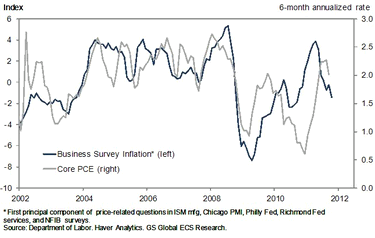
To gain more insight into future inflation trends, we have constructed a new measure that summarizes the inflation signal from various business surveys. Specifically, we calculated the first principal components of the price-related questions in the monthly ISM, Chicago PMI, Philly Fed, NFIB, Kansas City Fed, and Richmond Fed business surveys. These questions refer to prices paid, prices received, or wages and salaries and are generally reported as the difference between the percentage of respondents saying that prices rose in the survey month and the percentage saying that prices fell. (Focusing only on prices paid or prices received indexes does not make a significant difference to the results.)

The results are shown in Exhibit 2 below. In general, our business survey indicator of inflation tracks the ups and downs of the core PCE index–the Fed’s favorite measure of underlying inflation–reasonably well. After a significant acceleration in early 2011, the indicator has declined notably in recent months and is now consistent with a deceleration in core PCE inflation from the recent 2%+ level to somewhere closer to 1.5%. This is also consistent with our forecast that inflation will slow over the next year.

Exhibit 2: Business Survey Inflation Shows Recent Deceleration
chart

Retail Sales/Empire/PPI/Evans- GDP remains firm

As previously discussed, GDP looks to be growing sequentially, and should do fine next year if fiscal policy doesn’t tighten.

But still not so good for people working for a living, pretty good for corporate earnings.

And risks remain- Europe, China, Super Committee, etc. etc.

And look for a relief rally if Europe all agrees the ECB writes the check,
followed by a sell off due to the austerity that accompanies it.


Karim writes:

Data confirms Q4 GDP growth tracking 3.25%.; slight boost to Q1 estimate; more like 2.75% vs 2.5% previously.

RETAIL SALES

  • Up 0.5% headline and 0.6% control group
  • Iphone 4s definitely helped as electronics sales rise 3.7% for the month, largest gain since 11/09

EMPIRE

  • Rises to 6mth high of 0.6 from -8.48 in October; but 0.6 still weak historically.
  • Also, new orders and employment component both soften in the month.

PPI

  • Pipeline pressures receding as -0.3% headline, -0.4% on consumer goods, -1.1% intermediate stage, and -2.5% crude stage

EVANS AND BULLARD

  • Evans advocating 3% inflation target and linking policy guidance to unemployment/inflation objective
  • Also acknowledges he is ‘sufficiently outside’ consensus at the Fed
  • Bullard rejects linking policy to numerical objectives and states would need to see evidence of deterioration in U.S. economy to support additional easing