Fed seems to know QE doesn’t work to help the economy

Seems the A students know it’s just a tax.

That leaves the Fed in a very bad place. They are utilizing a tool, QE, that only works to bring down rates if markets believe it doesn’t actually work to help the economy.

That is, if markets believe QE is good for the economy, they will price in Fed rate hikes that much sooner, keeping mortgage rates high.

And if they think QE is bad for the economy, they will price in lower rates down the road, which brings mortgage rates lower.

So if the Fed wants lower rates, they know that more QE will only bring rates down if markets think it doesn’t help the economy.

Fed’s Bernanke focused on whether bond-buying works, Fisher says

By Ann Saphir

October 4 (Reuters) — The Federal Reserve’s powerful chairman and architect of the U.S. central bank’s massive bond-buying program is serious about questioning its effectiveness, a Fed policymaker known for his opposition to the program said on Thursday.

“The difference I have with my colleagues is the question of efficacy,” Richard Fisher, president of the Dallas Federal Reserve Bank, told a group of CEOs in Little Rock, Arkansas. “To his great credit, Chairman Bernanke has made this the driving point of every discussion: Is this working or is it not working?”

Fisher, repeating comments he made just hours earlier in his hometown of Dallas, said he believes it is not.

The Fed, he said, has done enough, and it is up to Congress to create tax and regulatory certainty so that businesses feel comfortable hiring again.

“I am not alone” at the Fed in doubting the program’s effectiveness, he said.

Posted in Fed

Fed–Williams uber dovish

Looks to me like there’s been more push back on rates due to risks to housing, perceived to be the most rate sensitive ‘engine of growth’. I don’t think this Fed wants its legacy to be ‘just when things got going after 5 years of hard work the let rates go up and it all went bad again.’

The problem is that if markets believe these Fed tools do work to support higher rates of growth than otherwise, that means Fed rate hikes will actually be sooner/faster etc. which works to keep rates higher. So seems it’s a bit of a conundrum. The policy designed to keep term rates down can instead work to keep them higher.

And should the stock market ‘crater’, the Fed will likely look to ‘do more’ which could be anything from ‘more of same’- more QE, guidance, tolerances, etc- to outright rate caps, which are the only ‘reliable’ way to set lower term rates.

*FED’S WILLIAMS: AFTER FIRST RATE HIKE, ONLY GRADUAL INCREASES

*WILLIAMS SAYS UNEMPLOYMENT IS TOO HIGH, INFLATION TOO LOW

*FED’S WILLIAMS SEES UNCONVENTIONAL STIMULUS FOR NEXT FEW YEARS

*FED’S WILLIAMS: AFTER FIRST RATE HIKE, ONLY GRADUAL INCREASES

*WILLIAMS HAS SUPPORTED RECORD MONETARY POLICY STIMULUS

*WILLIAMS DOESN’T VOTE ON MONETARY POLICY THIS YEAR

*SAN FRANCISCO FED PRESIDENT JOHN WILLIAMS SPEAKS IN SAN DIEGO

*WILLIAMS SAYS UNEMPLOYMENT IS TOO HIGH, INFLATION TOO LOW

*FED’S WILLIAMS SEES UNCONVENTIONAL STIMULUS FOR NEXT FEW YEARS

Comments on Volcker article

Here’s my take on the Volcker article

My comments in below:

The Fed & Big Banking at the Crossroads

By Paul Volcker

I have been struck by parallels between the challenges facing the Federal Reserve today and those when I first entered the Federal Reserve System as a neophyte economist in 1949.

Most striking then, as now, was the commitment of the Federal Reserve, which was and is a formally independent body, to maintaining a pattern of very low interest rates, ranging from near zero to 2.5 percent or less for Treasury bonds. If you feel a bit impatient about the prevailing rates, quite understandably so, recall that the earlier episode lasted fifteen years.

The initial steps taken in the midst of the depression of the 1930s to support the economy by keeping interest rates low were made at the Fed’s initiative. The pattern was held through World War II in explicit agreement with the Treasury. Then it persisted right in the face of double-digit inflation after the war, increasingly under Treasury and presidential pressure to keep rates low.

Yes, and this was done after conversion to gold was suspended which made it possible. And they fixed long rates as well/

The growing restiveness of the Federal Reserve was reflected in testimony by Marriner Eccles in 1948:

Under the circumstances that now exist the Federal Reserve System is the greatest potential agent of inflation that man could possibly contrive.
This was pretty strong language by a sitting Fed governor and a long-serving board chairman. But it was then a fact that there were many doubts about whether the formality of the independent legal status of the central bank—guaranteed since it was created in 1913—could or should be sustained against Treasury and presidential importuning. At the time, the influential Hoover Commission on government reorganization itself expressed strong doubts about the Fed’s independence. In these years calls for freeing the market and letting the Fed’s interest rates rise met strong resistance from the government.

Not freeing the ‘market’ but letting the Fed chair have his way. Rates would be set ‘politically’ either way. Just a matter of who.

Treasury debt had enormously increased during World War II, exceeding 100 percent of the GDP, so there was concern about an intolerable impact on the budget if interest rates rose strongly. Moreover, if the Fed permitted higher interest rates this might lead to panicky and speculative reactions. Declines in bond prices, which would fall as interest rates rose, would drain bank capital. Main-line economists, and the Fed itself, worried that a sudden rise in interest rates could put the economy back in recession.

All of those concerns are in play today, some sixty years later, even if few now take the extreme view of the first report of the then new Council of Economic Advisers in 1948: “low interest rates at all times and under all conditions, even during inflation,” it said, would be desirable to promote investment and economic progress. Not exactly a robust defense of the Federal Reserve and independent monetary policy.

But in my humble opinion a true statement!

Eventually, the Federal Reserve did get restless, and finally in 1951 it rejected overt presidential pressure to maintain a ceiling on long-term Treasury rates. In the event, the ending of that ceiling, called the “peg,” was not dramatic. Interest rates did rise over time, but with markets habituated for years to a low interest rate, the price of long-term bonds remained at moderate levels. Monetary policy, free to act against incipient inflationary tendencies, contributed to fifteen years of stability in prices, accompanied by strong economic growth and high employment. The recessions were short and mild.

I agreed with John Kenneth Galbraith in that inflation was not a function of rates, at least not in the direction they believed, due to interest income channels. However, the rate caps on bank deposits, etc. Did mean that rate hikes had the potential to disrupt those financial institutions and cut into lending, until those caps were removed.

In general, however, the ‘business cycle’ issues are better traced to fiscal balance.

No doubt, the challenge today of orderly withdrawal from the Fed’s broader regime of “quantitative easing”—a regime aimed at stimulating the economy by large-scale buying of government and other securities on the market—is far more complicated. The still-growing size and composition of the Fed’s balance sheet imply the need for, at the least, an extended period of “disengagement,” i.e., less active purchasing of bonds so as to keep interest rates artificially low.

Artificially? vs what ‘market signals’? Rates are ‘naturally’ market determined with fixed fx policies, not today’s floating fx.

In fact, without govt ‘interference’ such as interest on reserves and tsy secs, the ‘natural’ rate is 0 as long as there are net reserve balances from deficit spending.

Nor is there any technical or operational reason for unwinding QE. Functionally, the Fed buying securities is identical to the tsy not issuing them and instead letting its net spending remain as reserve balances. Either way deficit spending results in balances in reserve accounts rather than balances in securities accounts. And in any case both are just dollar balances in Fed accounts.

Moreover, the extraordinary commitment of Federal Reserve resources,

‘Resources’? What does that mean? Crediting an account on its own books is somehow ‘using up a resource’? It’s just accounting information!

alongside other instruments of government intervention, is now dominating the largest sector of our capital markets, that for residential mortgages. Indeed, it is not an exaggeration to note that the Federal Reserve, with assets of $3.5 trillion and growing, is, in effect, acting as the world’s largest financial intermediator. It is acquiring long-term obligations in the form of bonds and financing those purchases by short-term deposits. It is aided and abetted in doing so by its unique privilege to create its own liabilities.

The Fed creates govt liabilities, aka making payments. That’s its function. And, for example, the treasury securities are the initial intervention. They are paid for by the Fed debiting reserve accounts and crediting securities accounts. All QE does is reverse that as the Fed debits the securities accounts and ‘recredits’ the reserve accounts. So it can be said that all QE does is neutralize prior govt intervention.

The beneficial effects of the actual and potential monetizing of public and private debt, which is the essence of the quantitative easing program, appear limited and diminishing over time. The old “pushing on a string” analogy is relevant. The risks of encouraging speculative distortions and the inflationary potential of the current approach plainly deserve attention.

Right, with the primary fundamental effect being the removal of interest income from the economy. The Fed turned over some $100billion to the tsy that the economy would have otherwise earned. QE is a tax on the economy.

All of this has given rise to debate within the Federal Reserve itself. In that debate, I trust that sight is not lost of the merits—economic and political—of an ultimate return to a more orthodox central banking approach. Concerning possible changes in Fed policy, it is worth quoting from Fed Chairman Ben Bernanke’s remarks on June 19:

Going forward, the economic outcomes that the Committee sees as most likely involve continuing gains in labor markets, supported by moderate growth that picks up over the next several quarters as the near-term restraint from fiscal policy and other headwinds diminishes. We also see inflation moving back toward our 2 percent objective over time.

If the incoming data are broadly consistent with this forecast, the Committee currently anticipates that it would be appropriate to moderate the monthly pace of [asset] purchases later this year. And if the subsequent data remain broadly aligned with our current expectations for the economy, we would continue to reduce the pace of purchases in measured steps through the first half of next year, ending purchases around midyear.

In this scenario, when asset purchases ultimately come to an end, the unemployment rate would likely be in the vicinity of 7 percent, with solid economic growth supporting further job gains, a substantial improvement from the 8.1 percent unemployment rate that prevailed when the Committee announced this program.

I would like to emphasize once more the point that our policy is in no way predetermined and will depend on the incoming data and the evolution of the outlook as well as on the cumulative progress toward our objectives. If conditions improve faster than expected, the pace of asset purchases could be reduced somewhat more quickly. If the outlook becomes less favorable, on the other hand, or if financial conditions are judged to be inconsistent with further progress in the labor markets, reductions in the pace of purchases could be delayed.

Indeed, should it be needed, the Committee would be prepared to employ all of its tools, including an increase in the pace of purchases for a time, to promote a return to maximum employment in a context of price stability.

Implying QE works to do that.

I do not doubt the ability and understanding of Chairman Bernanke and his colleagues. They have a considerable range of instruments available to them to manage the transition, including the novel approach of paying interest on banks’ excess reserves, potentially sterilizing their monetary impact.

Reserves can be thought of as ‘one day treasury securities’ and the idea that paying interest sterilizing anything is a throwback to fixed fx policy, not applicable to floating fx.

What is at issue—what is always at issue—is a matter of good judgment, leadership, and institutional backbone. A willingness to act with conviction in the face of predictable political opposition and substantive debate is, as always, a requisite part of a central bank’s DNA.

A good working knowledge of monetary operations would be a refreshing change as well!

Those are not qualities that can be learned from textbooks. Abstract economic modeling and the endless regression analyses of econometricians will be of little help. The new approach of “behavioral” economics itself is recognition of the limitations of mathematical approaches, but that new “science” is in its infancy.

Monetary operations can be learned from money and banking texts.

A reading of history may be more relevant. Here and elsewhere, the temptation has been strong to wait and see before acting to remove stimulus and then moving toward restraint. Too often, the result is to be too late, to fail to appreciate growing imbalances and inflationary pressures before they are well ingrained.

Those who know monetary operations read history very differently from those who have it wrong.

There is something else that is at stake beyond the necessary mechanics and timely action. The credibility of the Federal Reserve, its commitment to maintaining price stability, and its ability to stand up against partisan political pressures are critical. Independence can’t just be a slogan. Nor does the language of the Federal Reserve Act itself assure protection, as was demonstrated in the period after World War II. Then, the law and its protections seemed clear, but it was the Treasury that for a long time called the tune.

And didn’t do a worse job.

In the last analysis, independence rests on perceptions of high competence, of unquestioned integrity, of broad experience, of nonconflicted judgment and the will to act. Clear lines of accountability to Congress and the public will need to be honored.

And a good working knowledge of monetary operations.

Moreover, maintenance of independence in a democratic society ultimately depends on something beyond those institutional qualities. The Federal Reserve—any central bank—should not be asked to do too much, to undertake responsibilities that it cannot reasonably meet with the appropriately limited powers provided.

I know that it is fashionable to talk about a “dual mandate”—the claim that the Fed’s policy should be directed toward the two objectives of price stability and full employment. Fashionable or not, I find that mandate both operationally confusing and ultimately illusory. It is operationally confusing in breeding incessant debate in the Fed and the markets about which way policy should lean month-to-month or quarter-to-quarter with minute inspection of every passing statistic. It is illusory in the sense that it implies a trade-off between economic growth and price stability, a concept that I thought had long ago been refuted not just by Nobel Prize winners but by experience.

The Federal Reserve, after all, has only one basic instrument so far as economic management is concerned—managing the supply of money and liquidity.

Completely wrong. With floating fx, it can only set rates. It’s always about price, not quantity.

Asked to do too much—for example, to accommodate misguided fiscal policies, to deal with structural imbalances, or to square continuously the hypothetical circles of stability, growth, and full employment—it will inevitably fall short. If in the process of trying it loses sight of its basic responsibility for price stability, a matter that is within its range of influence, then those other goals will be beyond reach.

Back in the 1950s, after the Federal Reserve finally regained its operational independence, it also decided to confine its open market operations almost entirely to the short-term money markets—the so-called “Bills Only Doctrine.” A period of remarkable economic success ensued, with fiscal and monetary policies reasonably in sync, contributing to a combination of relatively low interest rates, strong growth, and price stability.

Yes, and the price of oil was fixed by the Texas railroad commission at about $3 where it remained until the excess capacity in the US was gone and the Saudis took over that price setting role in the early 70’s.

That success faded as the Vietnam War intensified, and as monetary and fiscal restraints were imposed too late and too little. The absence of enough monetary discipline in the face of the overt inflationary pressures of the war left us with a distasteful combination of both price and economic instability right through the 1970s—a combination not inconsequentially complicated further by recurrent weakness in the dollar.

No mention of a foreign ‘monopolist’ hiking crude prices from 3 to 40?

Or of Carter’s deregulation of nat gas in 78 causing OPEC to drown in excess capacity in the early 80’s?

Or the non sensical targeting of borrowed reserves that worked only to shift rate control from the FOMC to the NY fed desk, and prolonged the inflation even as oil prices collapsed?

We cannot “go home again,” not to the simpler days of the 1950s and 1960s. Markets and institutions are much larger, far more complex. They have also proved to be more fragile, potentially subject to large destabilizing swings in behavior. There is the rise of “shadow banking”—the nonbank intermediaries such as investment banks, hedge funds, and other institutions overlapping commercial banking activities.

Not to mention restaurants letting people eat before they pay for their meals. This completely misses the mark.

Partly as a result, there is the relative decline of regulated commercial banks, and the rapid innovation of new instruments such as derivatives. All these have challenged both central banks and other regulatory authorities around the developed world. But the simple logic remains; and it is, in fact, reinforced by these developments. The basic responsibility of a central bank is to maintain reasonable price stability—and by extension to concern itself with the stability of financial markets generally.

In my judgment, those functions are complementary and should be doable.

They are, but it all requires an understanding of the underlying monetary operations.

I happen to believe it is neither necessary nor desirable to try to pin down the objective of price stability by setting out a single highly specific target or target zone for a particular measure of prices. After all, some fluctuations in prices, even as reflected in broad indices, are part of a well-functioning market economy. The point is that no single index can fully capture reality, and the natural process of recurrent growth and slowdowns in the economy will usually be reflected in price movements.

With or without a numerical target, broad responsibility for price stability over time does not imply an inability to conduct ordinary countercyclical policies. Indeed, in my judgment, confidence in the ability and commitment of the Federal Reserve (or any central bank) to maintain price stability over time is precisely what makes it possible to act aggressively in supplying liquidity in recessions or when the economy is in a prolonged period of growth but well below its potential.

With floating fx bank liquidity is always infinite. That’s what deposit insurance is all about.
Again, this makes central banking about price and not quantity.

Feel free to distribute.

Fed up date

So we know QE is about signaling.

And the Fed knew that tapering was a signal they were ok with the higher rates, including the already higher mortgage rates.

And they decided they didn’t want to send that signal, so they delayed the taper. They also revised down their growth forecasts, which meant the economy was performing at less than expected levels, which further pushed back against the higher rates.

And they expressed risk of continued ‘fiscal drag’ as well. It’s all about signaling their current reaction function to control the term structure of rates. And in fact the rates in question have subsequently come down, indicating tactical success. And, at least for now, the dollar is down a touch as well.

A few interesting things are not part of the discussion:

The Fed can directly set the term structure of their risk free rates by simply making a locked market on any part of the curve.

The Fed buying tsy secs is functionally the same as the tsy not issuing them in the first place.

The consequences of QE/tapering are largely the same as the issuance/non issuance of tsy secs.

Interest rate tools, operationally, also include the tsy issuing only at pre determined rates and maturities, as well as buy backs and maturity swaps.

And why is the paradox of thrift, a mainstream standard for maybe 200 years, never discussed?

By identity, if govt cuts back on its net spending, that output only gets sold if some other agent increases its net spending.

Meanwhile, the demand leakages continue to grow relentlessly. It’s all implicit in every mainstream model, but none the less left out of every public discussion.

And there’s another issue that’s internally conflicted. The Fed believes inflation is about monetary policy and the Fed, and not fiscal policy and the treasury. Hike rates until the ‘real rate’ is high enough and inflation goes down, because it makes borrowing expensive and slows the economy as well.

And lower the real rate enough and inflation goes up, though unfortunately that pesky 0 bound limits that tool, resulting in a hand off to QE and forward guidance and expanding the types of assets the Fed buys and the like.

Not to mention the key is the inflation expectations channel, which rules all, of course.

Let me conclude that today most mainstream elites have recognized there is no solvency risk for the US govt. Simplistically, ‘they can always print the money’ which is good enough for the point at hand. So with no solvency risk, the risk of too high deficits comes down to inflation, and there are no credible long term inflation forecasts flashing red.

Additionally, the Fed believes inflation is a monetary and not fiscal phenomenon. So the Fed can’t even argue against deficits on inflationary grounds, leaving it with, for all practical purposes, no argument for deficit reduction.

So as we enter the fray over deficit reduction and the risk of catastrophic systemic failure, there is no intellectual leadership coming from the Fed, and an intellectually dishonest silence from the mainstream academic and media elite.

Good luck to us!

(feel free to distribute)

Fed guys talking

Not tapering and all that goes with that can be called their push back vs higher mtg rates, in that tapering would have signaled they were ok with the higher rates.

A close ally of Fed Chairman Ben Bernanke, Dudley highlighted the drags from the sharp recent rise in longer-term interest rates, higher taxes and lower public spending adopted earlier this year, and questions over the U.S. debt limit and government funding as Congress meets this autumn.

Dudley also said the Fed could “wait a long time” to raise interest rates once the unemployment rate hits a 6.5 percent threshold.

Atlanta Fed boss Dennis Lockhart said the labor market still needed a spark to continue its recovery, Dow Jones reported.

“We see a picture in which fewer firms are expanding employment, and each expanding firm is adding fewer new jobs on average than in the past,” Lockhart said, according to a report, adding that the “employment dynamics of the U.S. economy are slower.”

Posted in Fed

Whither QE?

Mtg rates are up by over a full 1%, because the Fed may scale back on QE. But it hasn’t scaled back yet. But rates are way higher anyway.

So the question is, does QE per se keep down rates?
Or does it just about signals?

So when this last round of QE began, why did rates go down? It couldn’t have been just because the Fed was going to buy, which would then drive rates down, because it’s now already bought, and will continue to buy, yet rates are suddenly far higher.

Nor did rates fall with QE because market participants though it would make the economy worse?

It’s about rates falling on the belief that Fed buying per se would bring them down, and now rates are higher on the belief that the Fed not buying as much means rates go higher. Even though it’s been demonstrated that the amount or pace of Fed buying per say doesn’t do that.

There is no way to make any sense out of it.
It’s just knee jerk reactions in a sea of ignorance.

NFP/Fed Chair Nomination Timing

Karim writes:

NFP Key Takeaways

  • Several sub-texts, mainly that the softer news was in prior months and that the better news was in the most recent month (August).

Yes, though August is subject to revision, and the underlying ‘private payroll’ growth, which lags fiscal adjustments, is now looking like it’s been hurt by the year end tax hikes and subsequent sequesters.

  • Net payroll revisions of -74k definitely the soft side of this report; with a 169k gain for August close to expectations.


Yes

  • The Income proxy at +0.7% for August (jobs x hours x wages) definitely the strong side of this report.


Yes, though Friday’s +.1 for personal income is more ‘macro’

  • The rise in the diffusion index from 55 to 59 also good news as job gains are more broad based.

Ok, fewer jobs but more spread out.

  • The U6 measure fell from 14% to 13.7%, and most other measures of underemployment also fell.
  • The Unemployment rate fell from 7.4% to 7.3% as the 312k drop in the labor force offset the 115k drop in the household survey
  • The Part rate is now at its lowest since 1978-which will most certainly fuel the structural vs cyclical debate

Yes, as it looks like un and under employed are transitioning to ‘out of the labor force’, and participation rates are falling for younger people as well and if you say half the drop in participation is cyclical you can add about 4% to the un and under employment rates.

  • This outcome shouldn’t effect tapering at the September FOMC meeting and if anything, may accelerate the pace of tapering given how close we are to the 7% unemployment rate level that Bernanke identified in June as being consistent with the end of QE.

Agreed. The Fed is heck bent on tapering. They don’t like QE as a tool. And Jackson Hole had presentations showing it doesn’t work with regards to output, employment, CPI, etc.

  • Its highly doubtful the part rate will influence the tapering decision as Bernanke knew full well in June that the part rate was on a long-term decline when he set the 7% level (the same as when the Fed set the 6.5% threshold last December). I expect a more nuanced discussion of the part rate in speeches and the minutes.
  • Recall, payrolls were averaging 90k/mth when the Fed set out on QE3.

And the term structure of rates was lower, questioning what QE actually accomplishes in that regard, as it’s still going full force at the moment.

  • Any decision not to taper or to draw out the taper next year would be more due to the signaling qualities of QE (they wont be hiking as long as they are buying).

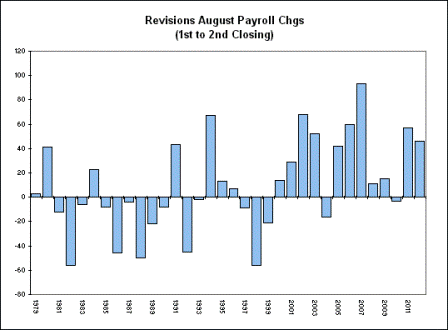
A few observers have also pointed out that August payrolls have had upward revisions in 11 of the past 13 years. This is possibly due to the earlier start of the school year over time, which may also have had an impact on the labor force dynamics. Chart below from SMR.


Full size image


New Fed Chair

  • Its increasingly expected that the nomination of the new Fed Chair will take place between the Sep 18 FOMC meeting and the Annual IMF/WB Meeting in DC on October 11-12.
  • I’d put the odds on Summers around 75%.


Confirmation is another story, of course. But seems his odds of confirmation should be better than, say, Jamie Dimon… ;)

Comments on research report

From DB,
Comments below:

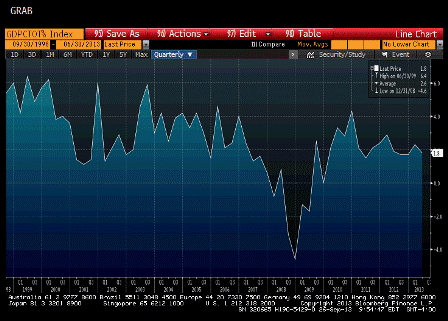
Commentary for friday: the second print on Q2 GDP growth showed a significant upward revision to +2.5% from +1.7% as previously reported. Recall that growth was only +1.1% in Q1.

After the 3rd downward revision

Given that the deflator was revised a tenth higher (0.8% vs. 0.7% as previously reported), the magnitude of the overall revision is even more impressive. Personal consumption was unrevised at +1.8% in Q2,

Down from 2.3% in Q1 if I recall correctly

While business fixed investment was only modestly softer (+4.4% vs. +4.6%). Residential investment was also reduced slightly (+12.9% vs. +13.4%). The big changes to Q2 growth were in inventories and international trade. Inventory accumulation was lifted to $62.6b from $56.7b as first reported, thereby adding 0.6 ppt to growth compared to 0.4 ppt previously.

The question is voluntary to restock from a Q1 dip or sales growth forecast, or involuntary due to lower than expected sales.

In terms of trade, firmer exports and softer imports drove net exports to improve; as a result, the original -0.8 ppt drag from trade was revised up to zero.

Question is whether exports can be sustained through Q3 as the dollar spike vs Japan and then the EM’s hurts ‘competitiveness’

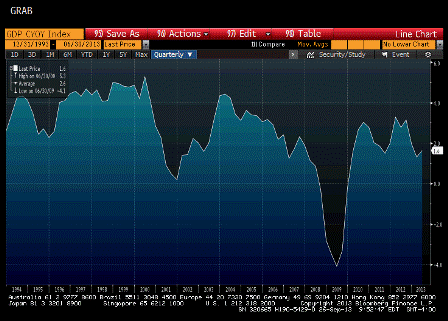
The government drag on Q2 was revised to become slightly larger (-0.2 ppt vs. -0.1 ppt as first reported). Nonetheless, the federal government drag on economic activity has diminished significantly compared to the impact in Q1 (-0.7 ppt) and Q4 2012 (-1.2 ppt). A diminished drag from the public sector should enable overall GDP growth, which was +1.6% year-on-year in Q2, to close the gap with private sector growth, which was +2.5% over the same period.

I see it this way- the govt deficit spending is a net add of spending/income. So with the deficit dropping from 7% of GDP last year to maybe 3% currently, with maybe 2% of the drop from proactive fiscal initiatives, some other agent has to be spending more than his income to sustain sales/incomes etc. If not, output goes unsold/rising inventories and then unproduced. The needed spending to ‘fill the spending gap’ left by govt cutbacks can come from either domestic credit expansion or increased net exports (no resident credit expansion/savings reductions. I don’t detect the domestic credit expansion and net export growth/trade deficit reduction seems likely given the dollar spike and oil price spike?

If we achieve +3.0% growth in the current quarter and +3.5% in Q4, this will push the year-on-year rate to +1.7% in Q3 and +2.5% by yearend. (this is in line with the Fed’s central tendency forecasts, which are due to be updated at the september FOMC meeting.)

In order for our growth forecast to come to fruition, we will need to see a pickup in consumer spending,

Hard to fathom, as personal consumption has been slipping from 2.3 in Q1 to 1.8 in Q2, and walmart and the like sure aren’t seeing any material uptick in sales? Car sales are ok, but further gains from the June high rate seems doubtful as July has already posted a slower annual rate.

homebuilding and business investment relative to first half performance. The first two series are likely to be boosted by sturdier employment gains, and hence faster household income growth.

Seems early Q3 reports show falling mtg purchase applications, home sales falling month to month, and lots of anecdotals showing the spike in mtg rates has slowed things down. So growth from Q2 seems unlikely at this point?

We are confident that the pace of hiring will pick up in the relatively near term, because jobless claims continue to hold near cyclical lows.

New jobs dropped to 160,000 in july, and claims measure people losing their jobs, not new hires. Also, top line growth, the ultimate driver of employment, remains low, so assuming actual productivity hasn’t gone negative a spike in jobs is unlikely?

Given the usefulness of jobless claims as a payroll forecasting tool, it should come as little surprise that they are also significantly correlated with wage and salary growth. In fact, over the past 25 years, the current level of jobless claims has typically coincided with private wage and salary growth above 6% compared to 3.8% in Q2.

As above, claims may have correlated with all that in the past, but the causation isn’t there. Looks to me like claims are more associated with ‘time from the bottom’ as with time after the economy bottoms firings tend to slow, regardless of hiring?

Meanwhile, the third growth driver noted above—business investment—will largely depend on the corporate profit trend. Yesterday’s second print on GDP provided the first look at economy-wide corporate profits, which rose +3.9% in Q2 vs. -1.3% in Q1. Many analysts fretted the decline in profits in Q1, because they tend to drive business investment and hiring plans. We dismissed the Q1 weakness as a temporary development which occurred in lagged response to the growth slowdown in Q4 2012 and Q1 2013. The fact that profits are reaccelerating (+5.0% year-on-year versus +2.1% in Q1) is an encouraging development in this regard.

Profits also are a function of sales, which are a function of ‘deficit spending’ from either govt or other sectors, as previously discussed. And, again, i see no signs of ‘leaping ahead’ in any of those sectors.

Faster GDP growth through yearend should result in even stronger corporate profit growth.

Agreed! But didn’t he just say that the GDP growth would come from business investment that’s a function of profits (and in turn a function of sales/GDP)?

To be sure, the additional growth momentum now evident in the Q2 GDP results makes our 3% target for current quarter growth more easily attainable. –CR

I don’t see how inventory growth is ‘momentum’ and seems there are severe headwinds to Q3 net exports as drivers of growth?

And govt is there with a deficit of only 3% of GDP to help offset the relentless ‘unspent income’/demand leakages inherent in the global institutional structure.