May business borrowing and confidence drops, and other charts from recent releases

U.S. business borrowing for equipment falls 8 percent in May: ELFA

By Abinaya Vijayaraghavan

June 23 (Reuters) — U.S. companies’ borrowing to spend on capital investment fell in May, the Equipment Leasing and Finance Association (ELFA) said.

Companies signed up for $6.9 billion in new loans, leases and lines of credit last month, down 8 percent from a year earlier. Their borrowing fell 14 percent from April.

“The small decline in new business volume makes the case for a slow recovery in certain sectors of the economy in which equipment financing plays an important role,” ELFA Chief Executive William Sutton said in a statement.

Washington-based ELFA, a trade association that reports economic activity for the $827 billion equipment finance sector, said credit approvals totaled 76.1 percent in May, down from 77.4 percent in April.

ELFA’s leasing and finance index measures the volume of commercial equipment financed in the United States. It is designed to complement the U.S. Commerce Department’s durable goods orders report, which it typically precedes by a day.

ELFA’s index is based on a survey of 25 members that include Bank of America Corp(BAC.N), BB&T Corp (BBT.N), CIT Group Inc (CIT.N) and the financing affiliates or subsidiaries of Caterpillar Inc (CAT.N), Deere & Co (DE.N), Verizon Communications Inc(VZ.N), Siemens AG (SIEGn.DE), Canon Inc (7751.T) and Volvo AB (VOLVb.ST).

The Equipment Leasing & Finance Foundation, ELFA’s non-profit affiliate, said its confidence index fell to 61.4 in June from 65.4 in May.

A reading of above 50 indicates a positive outlook.

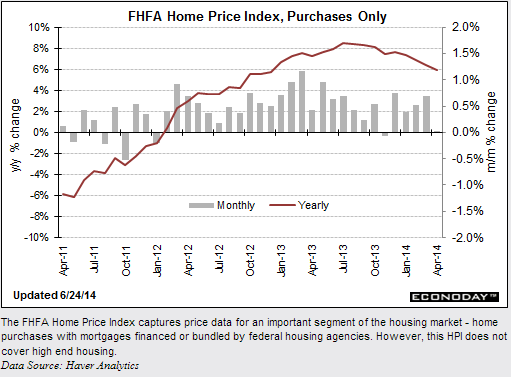
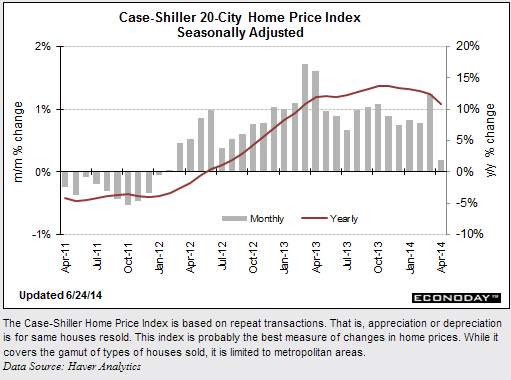
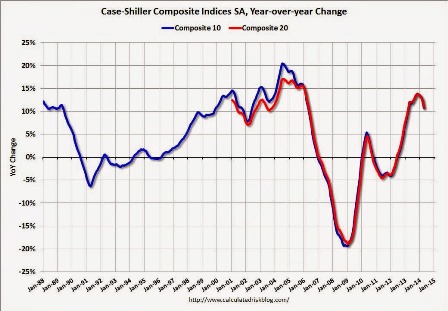
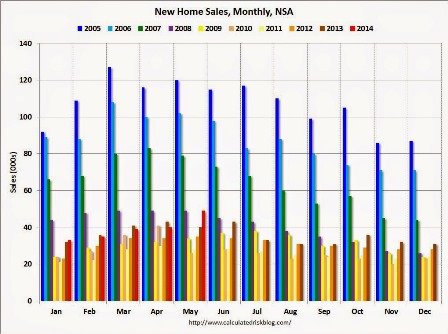
More evidence home price increases have slowed, as ‘liquidation supply shock’ that began in 2009 winds down:


Full size image

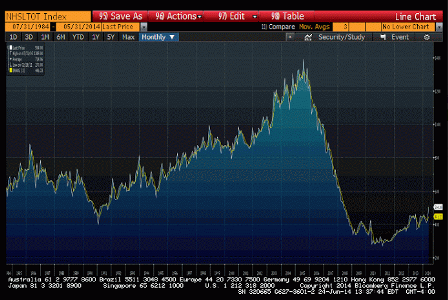
Also this morning the Census Bureau reported that new home sales were at a seasonally adjusted annual rate (SAAR) of 504 thousand in May. That is the highest level since May 2008. As usual, I don’t read too much into any one report. In fact, through May this year, sales were 196,000, Not seasonally adjusted (NSA) – only up 2% compared to the same period in 2013 – not much of an increase.

Richmond Fed Manufacturing Index

Highlights
Activity may be slowing this month in the Richmond Fed’s manufacturing district but not new orders. The headline index slowed 4 points to a reading of 3 with shipments and employment both slowing significantly. But the pace of new orders actually improved slightly, up 1 point to 4. The Richmond Fed has been showing less of a post-winter bounce than other regional reports, especially Empire State and Philly Fed.

New home sales up more than expected, but the 3 month average looks tame and in any case if they continue to drift higher at this the pace of the last couple of years it will only take another 15 or 20 years or so to get back to prior cycle levels. When we had a lot fewer people. And, like last month, revised down, it will be revised next month:


Full size image


Full size image

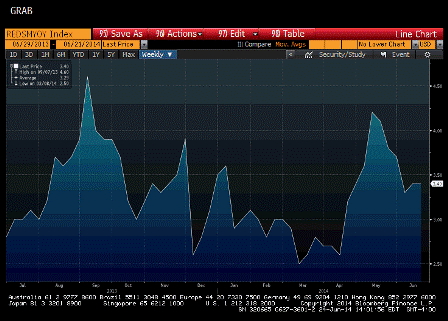
Redbook Sales monthly Y/Y:


Full size image

QE is a Tax

QE is a Tax

By Chris Mayer

May 2 — QE is a tax.

That’s an odd thing to say about the Fed’s bond-buying stimulus program, known as quantitative easing, or QE. But the reality of QE is different than what most people think…

To talk about this, I sought out Warren Mosler, a former hedge fund manager and now trailblazing economist. (I first introduced Mosler to you in your February letter, No. 120. See “How Fiat Money Works.”) So on one Sunday afternoon, with Mosler in Italy and me in Gaithersburg, Md., we chatted on Skype about the Fed and its doings.

Mosler was also a successful banker, and he talks about this stuff with the ease that comes from deep familiarity with the plumbing of the system. The U.S. system, importantly, is one of floating exchange rates and a nonconvertible currency. Meaning the government does not fix the price of the dollar against anything (contra what is done in Hong Kong, where they peg their currency to the dollar). And it is not convertible into anything except itself. (You can’t present your dollars to the Fed and demand gold, for instance.)

With those parameters, we started with a simple question: What would the natural rate of interest be if the government didn’t try to interfere in the interest rate market? (“Natural rate” in this context means the risk-free, nominal rate of interest.)

“In some sense, QE is undoing what the Treasury has done.”

Well, before we can answer that, think about the ways the government interferes in the interest rate market. There are two ways, Mosler points out. The first is that the government pays interest on bank reserves, which are essentially checking accounts held at the Fed. Currently, that rate is 25 basis points, or 0.25%.

The second is to offer “alternative accounts at the Fed called Treasury securities.” These are essentially savings accounts and pay higher interest than the checking accounts (or reserve accounts).

“If we eliminated these things, there would no interest paid on reserves, and there would be no securities,” Mosler says. “So the natural rate of interest would be zero.” Like in Japan for 20 years.

Note this doesn’t mean there would be no interest rates. It means absent these interventions, the market would determine interest rates based on credit risk, etc. But there would be no floor — no risk-free rate, no natural rate — put in place by the government.

“Not that you should do it that way,” Mosler says, “but that’s the way to look at it. The base case is zero. Then the Treasury comes in and offers $17 trillion in securities. And that’s a distortion, to some degree. If the Fed did QE and bought them all back, it would put you back to where you started. In some sense, QE is undoing what the Treasury has done.” When the Fed buys securities, it is as if the Treasury never issued them in the first place.

Or as Mosler puts it in a tidy, eight-page paper (more on that in a bit):

It can be argued that asset pricing under a zero interest rate policy is the “base case” and that any move away from a zero interest rate policy constitutes a (politically implemented) shift from this “base case.”

In other words, the government doesn’t have to pay 3% on a 10-year note, as it does today. It doesn’t have to issue bonds at all. It creates dollar deposits (money) in member bank reserve accounts when it spends. By issuing securities/offering alternative interest-bearing accounts, the government pays a lot of interest to the economy.

“So in that sense,” Mosler says, “issuing securities means paying higher rates than the overnight rate. It is a spending increase and has an inflationary bias by adding net financial assets to the system.”

The mainstream view says that when the government sells Treasury securities, it is taking money out of the system, that it’s a deflationary thing to do and it offsets the inflationary effect of deficit spending. “Not true at all,” Mosler says. “Selling Treasuries does not take money out.” What’s happening is akin to a shuffle between checking accounts and savings accounts.

Let’s turn back to the case of QE, where the Fed buys securities. In this case, the economy loses the interest income from those securities.

“QE takes money out of the economy,” Mosler says, “which is what a tax does.” Hence, as noted above, QE is a tax.

“The whole point of QE is to bring rates down,” Mosler says. “If it does bring rates down, that means the rest of the securities the Treasury sells pay less interest too. So it lowers government interest expense even more. Because the government is a net payer of interest, lower rates mean it pays less interest.”

But does it help the economy? Hard to see how it does. Mosler has an interesting take here. I’ll paraphrase as best I can.

Let’s say people ask why the Fed is buying securities. Well, to help the economy. So now people have to think about whether that policy will work or not. If it’s going to work, that means the Fed’s going to be raising rates, because the economy will be getting stronger. The only time QE will bring rates down is if investors think the policy won’t work. It’s a policy that works through expectations, and it works only if investors think it won’t work.

“It’s a disgrace,” he says.

“On top of that, most investors don’t understand it,” Mosler says. “You’ve got the Chinese reading about how the Fed is printing money. And they go and buy gold. There are knock-on effects all over the world, and portfolios are shifting based on perceptions.”

QE, then, because it costs the private sector interest income and doesn’t add money to the economy, is not inflationary. “The evidence is that it is not inflationary,” Mosler says.

Let’s look at it another way. The bank of Japan has been trying to create inflation for 20 years. The Fed’s been trying to create inflation as hard as it can. The European Central Bank too. “It is not so easy for a central bank to create inflation,” he says, “or you’d think one of these guys would’ve succeeded.

“People act like you have to be careful because one false move on inflation expectations and, bang, you have hyperinflation,” Mosler chuckles. “If you know what that false move is, tell Janet Yellen [the current Fed chief], because she’s trying to find it.”

Though he no longer runs a hedge fund, Mosler is still involved in financial markets. He has a portfolio he runs for himself and for other people. I asked him if he fears interest rates going up.

“It could happen,” he says. “It’s a political decision where rates go.”

And that’s a good place to leave it. Because it brings us back to the beginning. Without the government wading into the interest rate market, the base rate would be zero. And everybody would be working off that. But instead, we have the Fed trying to find monetary nirvana.

As Mosler says, it’s a disgrace.

These are challenging ideas, I know. If you want to read more, look up “The Natural Rate of Interest is Zero,” a tightly reasoned, accessible eight-page paper by Mathew Forstater and Warren Mosler. You can find it free online.

Comments on Martin Wolf’s banking article

Strip private banks of their power to create money

By: Martin Wolf
The giant hole at the heart of our market economies needs to be plugged

Printing counterfeit banknotes is illegal, but creating private money is not. The interdependence between the state and the businesses that can do this is the source of much of the instability of our economies. It could – and should – be terminated.

It is perfectly legal to create private liabilities. He has not yet defined ‘money’ for purposes of this analysis

I explained how this works two weeks ago. Banks create deposits as a byproduct of their lending.

Yes, the loan is the bank’s asset and the deposit the bank’s liability.

In the UK, such deposits make up about 97 per cent of the money supply.

Yes, with ‘money supply’ specifically defined largely as said bank deposits.

Some people object that deposits are not money but only transferable private debts.

Why does it matter how they are labeled? They remain bank deposits in any case.

Yet the public views the banks’ imitation money as electronic cash: a safe source of purchasing power.

OK, so?

Banking is therefore not a normal market activity, because it provides two linked public goods: money and the payments network.

This is highly confused. ‘Public goods’ in any case aren’t ‘normal market activity’. Nor is a ‘payments network’ per se ‘normal market activity’ unless it’s a matter of competing payments networks, etc. And all assets can and do ‘provide’ liabilities.

On one side of banks’ balance sheets lie risky assets; on the other lie liabilities the public thinks safe.

Largely because of federal deposit insurance in the case of the us, for example. Uninsured liabilities of all types carry ‘risk premiums’.

This is why central banks act as lenders of last resort and governments provide deposit insurance and equity injections.

All that matters for public safety of deposits is the deposit insurance. ‘Equity injections’ are for regulatory compliance, and ‘lender of last resort’ is an accounting matter.

It is also why banking is heavily regulated.

With deposit insurance the liability side of banking is not a source of ‘market discipline’ which compels regulation and supervision as a simple point of logic.

Yet credit cycles are still hugely destabilising.

Hugely destabilizing to the real economy only when the govt fails to adjust fiscal policy to sustain aggregate demand.

What is to be done?

How about aggressive fiscal adjustments to sustain aggregate demand as needed?

A minimum response would leave this industry largely as it is but both tighten regulation and insist that a bigger proportion of the balance sheet be financed with equity or credibly loss-absorbing debt. I discussed this approach last week. Higher capital is the recommendation made by Anat Admati of Stanford and Martin Hellwig of the Max Planck Institute in The Bankers’ New Clothes.

Yes, a 100% capital requirement, for example, would effectively limit lending. But, given the rest of today’s institutional structure, that would also dramatically reduce aggregate demand -spending/sales/output/employment, etc.- which is already far too low to sustain anywhere near full employment levels of output.

A maximum response would be to give the state a monopoly on money creation.

Again, ‘money’ as defined by implication above, I’ll presume. The state is already the single supplier/monopolist of that which it demands for payment of taxes.

One of the most important such proposals was in the Chicago Plan, advanced in the 1930s by, among others, a great economist, Irving Fisher.

Yes, a fixed fx/gold standard proposal.

Its core was the requirement for 100 per cent reserves against deposits.

Reserves back then were ‘real’ gold certificates.

The floating fx equiv would be 100% capital requirement.

Fisher argued that this would greatly reduce business cycles,

And greatly reduce aggregate demand with the idea of driving net exports to increase gold/fx reserves, or, alternatively, run larger fiscal deficit which, on the gold standard, put the nation’s gold supply at risk

end bank runs

Yes, banks would only be lending their equity, so there is nothing to ‘run’

and drastically reduce public debt.

If you wanted a vicious deflationary spiral to lower ‘real wages’ and drive net exports

A 2012 study by International Monetary Fund staff suggests this plan could work well.

No comment…

Similar ideas have come from Laurence Kotlikoff of Boston University in Jimmy Stewart is Dead, and Andrew Jackson and Ben Dyson in Modernising Money.

None of which have any kind of grasp on actual monetary operations.

Here is the outline of the latter system.

First, the state, not banks, would create all transactions money, just as it creates cash today.

Today, state spending is a matter of the CB crediting a member bank reserve account, generally for further credit to the person getting the corresponding bank deposit. The member bank has an asset, the funds credited by the CB in its reserve account, and a liability, the deposit of the person who ultimately got the funds.

If the bank depositor wants cash, his bank gets the cash from the CB, and the CB debits the bank’s reserve account. So the person who got paid holds the cash and his bank has no deposit at the CB and the person has no bank deposit.

So in this case the entire ‘money supply’ would consist of dollars spent by the govt. But not yet taxed. That’s called the deficit/national debt. That is, the govt’s deficit would = the (net) ‘money supply’ of the economy, which is exactly the way it is today.

Customers would own the money in transaction accounts,

They already do

and would pay the banks a fee for managing them.

:(

Second, banks could offer investment accounts, which would provide loans. But they could only loan money actually invested by customers.

So anyone who got paid by govt (directly or indirectly) could invest in an account so those same funds could be lent to someone else. Again, by design, this is to limit lending. And with ‘loanable funds’ limited in this way, the interest rate would reflect supply and demand for borrowing those funds, much like and fixed exchange rate regime.

So imagine a car company with a dip in sales and a bit of extra unsold inventory, that has to borrow to finance that inventory. It has to compete with the rest of the economy to borrow a limited amount of available funds (limited by the ‘national debt’). In a general slowdown it means rates will skyrocket to the point where companies are indifferent between paying the going interest rate and/or immediately liquidating inventory. This is called a fixed fx deflationary collapse.

They would be stopped from creating such accounts out of thin air and so would become the intermediaries that many wrongly believe they now are. Holdings in such accounts could not be reassigned as a means of payment. Holders of investment accounts would be vulnerable to losses. Regulators might impose equity requirements and other prudential rules against such accounts.

As above.

Third, the central bank would create new money as needed to promote non-inflationary growth. Decisions on money creation would, as now, be taken by a committee independent of government.

What does ‘create new money’ mean in this context? If they spend it, that’s fiscal. If they lend it, how would that work? In a deflationary collapse there are no ‘credit worthy borrowers’ as they system is in technical default due to ‘unspent income’ issues. Would they somehow simply lend to support a target rate of interest? Which brings us back to what we have today, apart from deciding who to lend to at that rate, the way today’s banks decide who to lend to? And it becomes a matter of ‘public bank’ vs ‘private bank’, but otherwise the same?

Finally, the new money would be injected into the economy in four possible ways: to finance government spending,

That’s deficit spending, as above, and no distinction regards to current policy

in place of taxes or borrowing;

Same as above. For all practical purposes, all govt spending is via crediting a member bank account.

to make direct payments to citizens;

Same thing- net fiscal expenditure

to redeem outstanding debts, public or private;

Same

or to make new loans through banks or other intermediaries.

As above, that’s just a shift from private banking to public banking, and nothing more.

All such mechanisms could (and should) be made as transparent as one might wish.

The transition to a system in which money creation is separated from financial intermediation would be feasible, albeit complex.

No, it’s quite simple actually, as above.

But it would bring huge advantages. It would be possible to increase the money supply without encouraging people to borrow to the hilt.

Deficit spending does that.

It would end “too big to fail” in banking.

That’s just a matter of shareholders losing when things go bad which is already the case.

It would also transfer seignorage – the benefits from creating money – to the public.

That’s just a bunch of inapplicable empty rhetoric with today’s floating fx regimes.

In 2013, for example, sterling M1 (transactions money) was 80 per cent of gross domestic product. If the central bank decided this could grow at 5 per cent a year, the government could run a fiscal deficit of 4 per cent of GDP without borrowing or taxing.

In any case spending in excess of taxing adds to bank reserve accounts, and if govt doesn’t pay interest on those accounts or offer interest bearing alternatives, generally called securities accounts, the consequence is a 0% rate policy. So seems this is a proposal for a permanent zero rate policy, which I support!!! But that doesn’t require any of the above institutional change, just an announcement by the cb that zero rates are permanent.

The right might decide to cut taxes, the left to raise spending. The choice would be political, as it should be.

And exactly as it is today in any case

Opponents will argue that the economy would die for lack of credit.

Not if the deficit spending is allowed to ‘shift’ from private to public.

I was once sympathetic to that argument. But only about 10 per cent of UK bank lending has financed business investment in sectors other than commercial property. We could find other ways of funding this.

Govt deficit spending or net exports are the only two alternatives.

Our financial system is so unstable because the state first allowed it to create almost all the money in the economy

The process is already strictly limited by regulation and supervision

and was then forced to insure it when performing that function.

The liability side of banking isn’t the place for market discipline, hence deposit insurance.

This is a giant hole at the heart of our market economies. It could be closed by separating the provision of money, rightly a function of the state, from the provision of finance, a function of the private sector.

The funds to pay taxes already come only from the state.

The problem is that leadership doesn’t understand monetary operations.

This will not happen now. But remember the possibility. When the next crisis comes – and it surely will – we need to be ready.

Agreed!!!!!

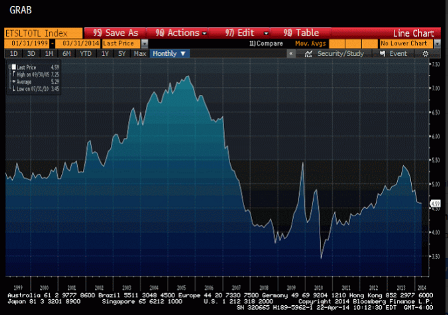
Existing home sales

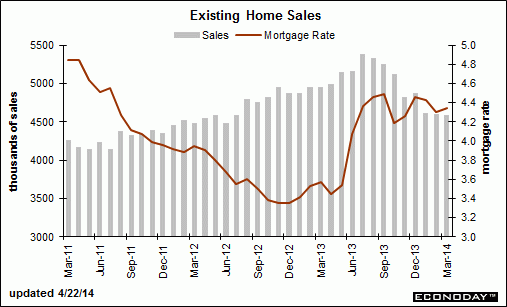
Recalls my suspicion of the Bernanke legacy- “just as the recovery was gaining traction he let mtg rates rise and cratered the housing market, etc.”


Full size image

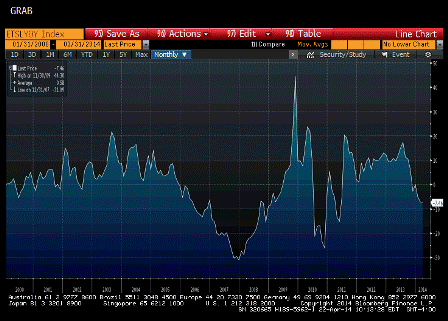
Y/Y:

Full size image

Existing Home Sales


Highlights
Sales of existing homes have yet to recover from the Federal Reserve’s decision, way back last year, to begin withdrawing stimulus. For the seventh time in eight month, sales of existing homes contracted, at minus -0.2 percent in March to a slightly lower-than-expected annual rate of 4.59 million. Year-on-year, sales are down 7.5 percent which is the steepest rate of contraction since May 2011.

Unattractive mortgage rates are only one reason for the sales weakness. Another is high prices which, in stark contrast to the contraction in sales, are up, not down, 7.9 percent year-on-year. The median price soared in March, up 5.4 percent to $198,000.

Low supply is another reason for the sales trouble, though the weakness in sales during March did lift supply relative to sales slightly, at 5.2 months vs 5.0 months in February.

Regional data show March weakness in the South and West and monthly strength in the Northeast and Midwest. Year-on-year, all four regions show declines.

The housing sector remains the weak link in the economy and the weather isn’t to blame, at least not in March. The Dow is showing little initial reaction to today’s results.

Empire State Manufacturing Survey

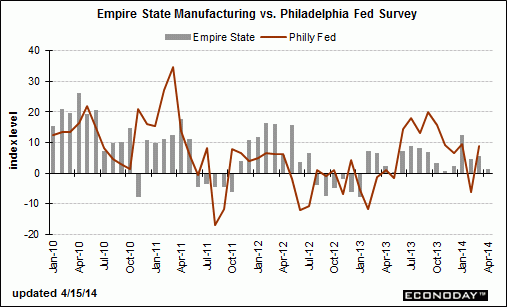
Another non bounce, this time an April survey:

Empire State Mfg Survey

Highlights
The first look at the manufacturing sector this month is flat with the Empire State index barely over zero, at 1.29 vs 5.61 in March and 4.48 in February. New orders, the most important of all readings, is in the negative column at minus 2.77. Shipments show some growth, at plus 3.15, while employment shows better growth, at 8.16 vs March’s 5.88. On the negative side are unfilled orders, at minus 13.27. Inventories show a draw while price data do show some upward pressure. A positive is a more than 5 point uptick in the 6-month outlook to a very solid 38.23. This report, held back by the dip in new orders, is no better than mixed suggesting that the beginning of the spring, at least in the New York manufacturing economy, didn’t make for much of a bounce.


Full size image

Yellen on wages

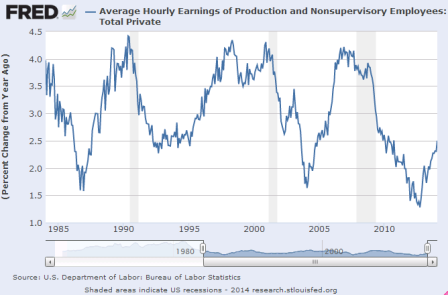
When asked about the growth in hourly wages:

Most measures of wage increases are running at very low levels. Wage inflation closer to 3% or 4% would be expected given some measures, such as productivity growth. But right now it is certainly not flashing. An increase in it might signal some tightening or meaningful increase over time. I would say were not seeing that.

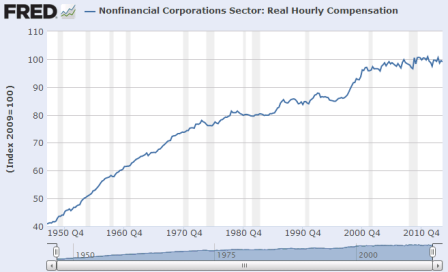
It’s well publicized that real wages have been lagging for maybe 40 years, as profits hit an all time high of about 11% of GDP. So as a point of logic the only way wages can stop the slide is if they grow faster than GDP grows, which leads to the ‘where the productivity growth has been going’ discussion, etc. Furthermore, in today’s economy the distribution is largely and necessarily a result of an impossibly ‘complex’, global, institutional structure rather than ‘free market forces’.

Add to that the Fed only has ‘one lever’ which is interest rates, and they all believe that lowering rates is ‘easing’, and that GDP growth promotes wage grow. So it could be that hourly wage growth of 2% that looks like it’s heading to prior highs of around 4% per se might not be all that strong a factor for quite a while in their reaction function?


Full size image


Full size image

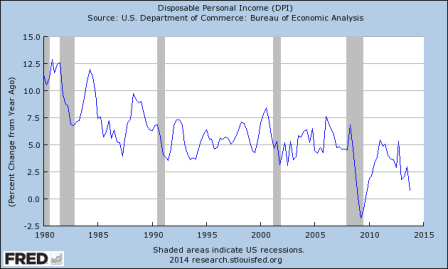
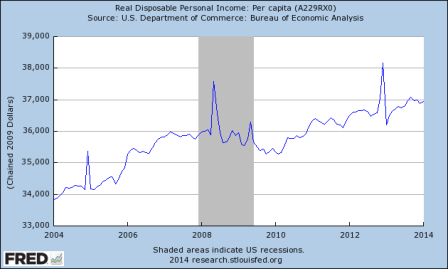
proactive fiscal tightening damages income growth


Full size image


Full size image

Mind the gap:


Full size image

This is below prior recession levels!


Full size image

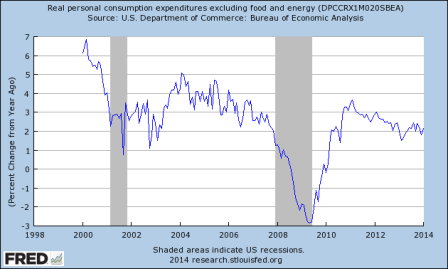
This is year over year growth in consumption of domestic product, which is GDP less capex less exports.

It shows how much ‘the consumer’ is spending on domestically produced goods and services:


Full size image

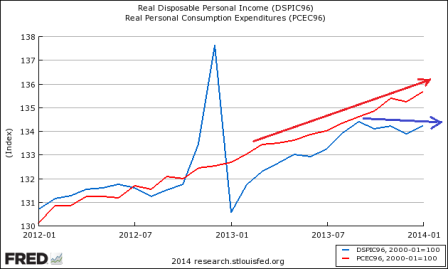
The underlying narrative is that proactive austerity damages income growth and thereafter requires a ‘jump’ in ‘borrowing to spend’/reduction in savings’ to sustain the prior levels of growth.

When growth itself brings the govt deficit down via the auto fiscal stabilizers, the needed credit growth/savings drop to replace the lost govt deficit spending is ‘already there proactively’ as it’s what drove the growth in the first place. So while the credit expansion/savings reduction needs to continue to grow to support GDP growth, the credit expansion/savings reduction doesn’t need to ‘spike up’ proactively as it does when the fiscal tightening is proactive.

So note that q3’s higher GDP growth included over 1% from additions to inventories. That represents a reduction in corporate savings from what it would have been if they had not net added to inventories. That is, consumers didn’t ‘jump the gap’ created by the ongoing increase in FICA vs the prior year, and the sequester cuts, that together proactively reduced govt deficit spending by over 1.5% of GDP (with the FICA hike adding to the automatic stabilizers as well). And Q4’s consumer spending on domestic product grew at a lower rate even as capex was higher. Also note that while capex growth for 2014 is forecast at about the same 5% as 2013, even with the high levels of energy investments, ultimately it’s largely a function of top line sales.

The reduction in net imports is a reduction in the growth of foreign savings of $ denominated financial assets, which does ‘make up’ for the reduction in govt deficit spending, depending on foreign demand. But it’s been ongoing and doesn’t look to be ‘jumping the spending gap.’

And note too that the running US deficit of about 3% of GDP is about the same as the euro zone’s and the Maastricht limit. So for me the question is whether this will make our economies converge as US income growth continues to decline?

And, as previously discussed, the 0 rate policy has worked to directly bring down personal income. Also note that personal income growth has slowed coincidentally with the approx 200,000/mo additions to total employment.

So seems that the income added by that much new employment isn’t enough to keep overall (after tax) personal income growth positive.

Fed Adopts Foreign-Bank Capital Rules as World Finance Fragments

Beats me why the Fed should care if foreign banks have any capital if the Fed isn’t insuring their deposits or other liabilities?

Seems if they want to lend their money to people who can’t pay it back it’s their problem???
;)

Fed Adopts Foreign-Bank Rule as World Finance Fragments

By Yalman Onaran

November 1 (Bloomberg) — The Federal Reserve approved new standards for foreign banks that will require the biggest to hold more capital in the U.S., joining other countries in erecting walls around domestic financial systems.

Banks with $50 billion of assets in the U.S. will have to meet the standard under a revised rule approved yesterday, which raised the threshold from $10 billion proposed in 2012. The central bank left out two controversial elements of the original proposal, saying those were still being developed.

Walling off U.S. units of foreign banks, designed to protect taxpayers from having to bail them out in a crisis, may increase borrowing costs for those companies and hurt their profitability. The firms say it will also raise borrowing rates for governments and consumers.