
Spanish Law Aims To Rein in Budget

Institutionalizing death by 1000 cuts:

Spanish Law Aims To Rein in Budget

(FT) Spain’s plan to toughen the central government’s control of regional finances passed its first legislative hurdle in a parliamentary vote Thursday. “This is a law that will serve as the foundation for policies to make Spain’s budget deficit disappear, so that Spain goes back to being a reliable European Union partner,” Budget Minister Cristóbal Montoro said after the bill passed the lower house of Parliament. The law will now go to the Senate, where it also is expected to pass. The new law will require that all levels of Spanish government have balanced budgets by 2020 and that the government lower its debt-to-GDP ratio to 60% by that year as well. The government has forecast its debt-to-GDP ratio will rise to around 80% this year.
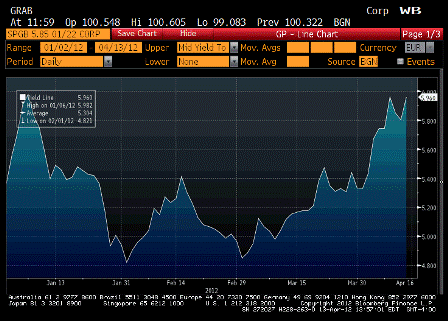
Spanish Banks Face Bond Losses in LTRO Aftermath: David Powell

Looks like it was at least the Spanish banks that got the nod to buy their govt’s bonds when the LTRO was announced.

Problem is they can only buy them to the extent their capital allows, and as raising more capital isn’t happening, it was probably a one time buying binge.

That’s why subsequent LTRO’s won’t do much for banks whose capital is already fully extended.

And losses serve to weaken their capital positions.

Spanish Banks Face Bond Losses in LTRO Aftermath: David Powell

By David Powell

April 11 (Bloomberg) — The European Central Bank may have pushed the Spanish banking system closer to collapse through its three-year longer-term refinancing operations.

Banks in Spain have been saddled with losses of about 1.6 billion euros as a result of the liquidity operation conducted in December, according to Bloomberg Brief estimates. Spanish lenders purchased 45.7 billion euros of government bonds during the months of December, January and February, according to monthly data from the ECB, and the average of the current prices of two-, six- and 10-year government bonds of Spain is 3.5 percent below the average of the average of those prices from Dec. 22 to March 1. [Note: The prices for six-year bonds are used instead of those for five-year bonds because the price history for the current five-year generic government bond of Italy starts only in January.]

International assistance will probably be needed to break the cycle. Spanish sovereign yields surged last year as investors worried about the solvency of the state given unrecognized losses in the banking system linked to the real estate bubble. Interest rates later declined after Spanish lenders purchased government debt during those three months, probably with the proceeds of the first three-year longer-term refinancing operation. Those purchases are now creating additional losses for the banking system.

The losses stemming from those bonds were essentially transferred to the domestic banking system from private bondholders with the assistance of the central bank.

The damage may be mitigated by low levels of margin calls from the ECB. Deposits related to margin calls at the central bank totaled only 0.3 billion in the week ended April 4, according to the Eurosystem’s weekly financial statement.

That suggests commercial lenders posted assets as collateral that have maintained their values. Those probably consisted primarily of the “residential mortgages and loans to small and medium-sized enterprises (SMEs)”, which the central bank said were eligible for use in its Dec. 8 statement. Those illiquid assets may be unaffected by the mark-to-market process because there are no developed markets for them. The deposits related to margin calls probably would have risen if banks had posted government bonds as collateral.

The situation for financial institutions in Italy is less dire than for those in Spain. Italian government bond prices on average are 2.1 percent above the distressed levels at which they traded from Dec. 22 to March 1. That suggests Italian banks may be sitting on profits of about 425 million euros after they purchased 20.3 billion euros of government bonds during that period.

Losses for both banking systems would probably have been created if they purchased government bonds with the proceeds of the second three-year longerterm refinancing operation. The funds from the second auction are excluded from this analysis because it settled on March 1 and the latest data from the ECB on government bond purchases of euro-area banks runs through the end of February. The data for March will be released on April 30.

As Ronald Reagan quipped, “The nine most terrifying words in the English language are: ‘I’m from the government and I’m here to help.'”

EU Daily | Monti under fire as crisis deepens

It’s now not over until the ECB writes the check, the whole check, and nothing but the check.

Monti under fire as crisis deepens

(FT) — “We are not standing down,” said Susanna Camusso, leader of the leftwing CGIL. Workers are to down tools next Friday over pension reforms passed in December and will strike again when parliament debates Mario Monti’s controversial labour reform legislation. Rather than feeling mollified by concessions made by Mr Monti over changes to rules on the firing of workers for economic reasons, Ms Camusso made it clear the union felt emboldened by its mobilisation. “The text is very bad,” Emma Marcegaglia, head of Confindustria, told the Financial Times, saying it would be better to scrap the entire labour reform legislation if it were not amended in parliament. A senate committee will start examining the bill on Wednesday.

Shaken Spain seeks to restore confidence

(FT) — Luis de Guindos, the economy minister, has said in interviews with local and foreign media that Spain does not need a bailout of the kind provided to Greece, Ireland and Portugal by the European Union and the International Monetary Fund. Mr de Guindos told Germany’s Frankfurter Allgemeine Zeitung that the government’s next step would be a reform of the health and education systems “that is, a rationalisation of spending in the autonomous regions”. Spain needs to cut more than 3 percentage points of gross domestic product from its public sector deficit, reducing it from 8.5 per cent of GDP in 2011 to 5.3 per cent this year in line with EU targets. In 2013, the deficit is supposed to fall further to 3 per cent of GDP.

Spain Economy to Start Growing From 2013, de Guindos Tells Ser

(Bloomberg) — Spain’s economy will start growing next year, Economy Minister Luis de Guindos says in interview with Cadena Ser radio station today.

Labor situation to stabilize from final quarter of this year, de Guindos says.

Italy Fights Spain for Investors as ECB Boost Fades: Euro Credit

(Bloomberg) — Competition between Italy and Spain for international investors’ funds will heat up this quarter as domestic buying stoked by the European Central Bank fades.

Italian and Spanish bonds slumped last week after demand dropped at a Spanish bond sale and Prime Minister Mariano Rajoy said his country is in “extreme difficulty.” The decline reversed a first-quarter rally sparked by more than 1 trillion euros ($1.3 trillion) of ECB loans to the region’s banks via its longer-term refinancing operation. Spain’s 10-year yield spread to German bunds widened to the most in four months, while Italy’s reached a six-week high.

“Spain and Italy are coming back down to earth after an incredible first quarter,” said Luca Jellinek, head of European interest-rate strategy at Credit Agricole SA in London. “The LTRO bought some time, but not a massive amount of time. Now the second quarter will be harder than the first unless policy moves convince foreign investors to come back in.”

Italian 10-year bonds fell for a fourth week, with the yield advancing 40 basis points to 5.51 percent. The yield difference over bunds widened to 378 basis points, compared with an average of 381 basis points in the first quarter. Spain’s 10- year yield spread to Germany reached 410 basis points last week after averaging 333 basis points in the first three months.

eu credit growth slows

So much for the LTRO “bazooka”:

EMU Growth Watch: Credit Growth Slows

Frankfurt, Germany (AP) — The European Central Bank says the flow of credit available to businesses slowed down in February — a sign that the bank’s massive series of cheap loans to the financial system has yet to kickstart a lagging eurozone economy. Figures Wednesday showed loans to nonfinancial corporations — a key credit indicator — grew by only 0.4 percent on an annual basis, down from 0.7 percent in January. The ECB made two massive rounds of cheap loans to banks Dec. 21 and Feb. 29, adding about €500 billion ($666 billion) in net new credit to the financial system. The loans were introduced in the hope that the money would eventually find its way to businesses and consumers as loans and, in turn, promote growth. The loans are credited with easing the eurozone debt crisis by removing fears that one or more of Europe’s shaky banks might fail, and by making it easier for heavily indebted governments such as Italy to borrow on bond markets.

Our Take: LTRO’s do not mean banks will be lending.

EUR PMIs-Big GDP Implications

And not only no change in fiscal policy, but more of same. As the carpenter said about his piece of wood, ‘no matter how much I cut off it’s still too short.’

Fertile ground for the ‘bond tax’ (PSI) for the next round of austerity, to reduce the need to further cut public services and raise domestic taxes.


Karim writes:

As mentioned before, PMI surveys in Europe are the most timely and important economic data point for the ECB; they have the greatest weight in the ECB’s model of estimating current quarter and quarter ahead growth.

Today’s data was weaker across the board, with Germany surprisingly weak in particular.

  • Euro composite PMI fell for the second month in a row, from 49.3 to 48.7
  • Weakness was led by manufacturing, down from 49 to 47.7
  • German manufacturing was especially weak, falling from 50.2 to 48.1
  • French PMI slipped back below 50, from 50.2 to 49

The impact on GDP according to NowCasting (which uses a similar framework as the ECB) was a downward revision to Q2 real GDP growth from +0.6% (annualized) to -0.6% (annualized) for the EuroZone, and from 0.1% (annualized) to -1.2% (annualized) for Germany.

This data should certainly push up the probability of an ECB policy rate cut in May or June.

Hints of Portugal PSI?

From Morgan Stanley
Note the talk of a PSI (bond tax):

5. Portugal: Portugal’s five-year bonds are trading at ~16%, right around the level where Greek bonds traded last April when Eurozone officials began to turn their attention to forcing losses on private sector creditors. The key area of concern in the market is a €9.7B bond maturing in September 2013 that is not covered by the country’s €78B bailout. Portugal needs ~€25B-€30B to fund itself through 2015. Portuguese officials hope that a pickup in market confidence will allow it to return to the bond market in time to refinance the 2013 bond. The Portuguese funding concerns have been widely discussed in the press. While there has been speculation that the country could be next in line for a debt restructuring, this outcome has been disputed by both Portuguese and troika officials.