The Influence of the Sub Prime Fiasco on the Last Business Cycle

I recently sent this with regard to the question of how high the deficit might need to be for full employment, as per my earlier post showing we may be needing ever lower taxes for a given size govt (a higher deficit) for full employment:

The federal surplus years of the late 90’s were supported by the private sector willing and able to borrow to both fund consumption and fund impossible and often fraudulent .com business plans. Private sector debt was growing at about 7% of gdp into y2k, with 2% of gdp being eaten up by the federal surplus, and the other 5% and more by other demand leakages/net savings of financial assets- trade deficit, pension fund contributions and asset appreciation, etc.

This unsustainable process bled us dry and shortly after y2k it all went bad. Near 0 rates and a small ‘stimulus’ did nothing to close the output gap. Finally, in 2003, Bush came through with a then massive fiscal adjustment that got the deficit up to about 8% of gdp (annualized) for q3 03 which was enough to turn things around, and the economy improved enough to not cost him the election.

But it was pretty modest growth, like today, until it picked up to a respectable pace with the agg demand created by what was later to be recognized as the housing fraud. The borrowing to buy housing binge was the consumer debt expansion that drove gdp growth for the year or so before it was discovered.

After the frauds were discovered, maybe in mid 06 or so, the new borrowing to buy housing fell off. With that support from aggregate demand pulled, there was no longer enough demand to sustain employment and home prices, which leveled off and began to fall, undermining the asset side of the banking system. The 170 billion stimulus in the first half of 08 worked to support demand, allow people to make mtg payments, etc. and gdp returned to about +2.5% in q2 08.

However, the fall in real estate values took down Bear and Lehman, and the fed failed to adequately support the liability side of its banking system (that is, provide continuous liquidity regardless, and do the deed on the asset side- wiping out shareholders and other capital including bond holders to absorb losses, liquidate insolvent firms no one wants to buy, put people in jail, etc. etc. but NEVER allow even the implication of a liquidity crisis. This was done during the s and l crisis which prevented that from spilling over to the real economy the way this one did.) Around July/aug 2008, in fact, is when I began calling for a full payroll tax holiday as the right response to a financial crisis like the one we were in. The real economy needed the people who were working for a living armed with enough income to make their payments (if the wanted to) and do their normal shopping from income rather than credit which the banking system was failing to provide. That simple keystroke could have prevented the entire real sector collapse, and the financial sector could have been left to more or less fend for itself and hopefully come through in a greatly reduced fashion.

So my point is, the mtg fraud first accelerated the economy, and then when that support was pulled the economy collapsed when govt was not forthcoming with a fiscal adjustment to replace the lost aggregate demand.

That is, the sub prime fiasco first added support to gdp that would not have been there, and then that support was removed when the frauds were discovered.

I see the real lesson to be learned as the govt always has the means and even responsibility to make immediate fiscal adjustments to support demand. In other words, make sure there are enough consumer spending dollars for business to compete for.

And, at the same time, to not support moral hazard by letting companies (particularly financial institutions) fail and investors take all the losses first during organized insolvency proceedings.

If govt. had done this in mid 08- provide the continuous liquidity to the banking system and suspend all FICA contributions- it all would have been much different. The fall in housing prices and new construction would not have been nearly as severe, delinquencies and foreclosures would have been much lower, far fewer banks would have failed, car sales would not have fallen nearly as far and the car companies would not have needed bailouts, and so on down the line. Note that even the crash of 1987 did not take out the real economy, even though it followed the then staggering losses from the s and l crisis, as bank liquidity was never allowed to be in question.

Karim on Jobless Claims Data and Year End Comments

Agreed with Karim, the relatively modest recovery remains on track.

Left alone, I see GDP in the 3.5%-5.5% range for next year, and possibly more.

Though they didn’t add much, the latest tax adjustments did take away the down side risk of taxes going up at year end.

I do, however, see several negatives with maybe up to 25% possibilities each, meaning collectively the odds of any one of them happening are a lot higher than that.

The new Congress is serious about deficit reduction. The risk is they will be successful, and it seems they even have the votes to get a balanced budget amendment passed.

China could get it wrong in their fight against inflation and cause a pretty severe slump. In fact, I can’t recall any nation that didn’t cause a widening of their output gap in their various fights against inflation.

The ECB’s imposed austerity in return for funding at some point reverses the current modest growth of that region. Not to mention the small but real risk the ECB decides to not buy any more member nation debt in the secondary markets.

While a less important economy for the world, the UK austerity looks ill timed as well.

The Saudis could continue to hike their posted prices which could reduce US demand for domestic output. The spike to the 150 level in 08 was a significant contributor to the severity of the financial collapse that followed.

There are also several lesser factors I’ve been listing the last few weeks that could cause aggregate demand to disappoint.

On the positive side is always the possibility of a private sector credit expansion taking hold.

Traditionally that would be borrowing to spend on housing and cars.

Federal deficit spending has done its job of restoring incomes and monetary savings, and will continue to do so.

Financial burdens ratios are down, car sales are showing some modest growth, and housing looks to have at least bottomed. And both are at low enough levels where there could be a lot of growth and they’d still be very low, especially housing.

I don’t see inflation as a risk (unless crude spikes a lot higher), nor deflation (unless one of the above shocks kicks in).

And I do see the ‘because we think we could be the next Greece we’re turning ourselves into the next Japan’ theme continuing, as it seems highly unlikely to me we will get back to, say, the 4% unemployment level for a very long time, if ever, until there’s a paradigm change regarding fiscal policy.

The full employment budget deficit might be up to 4% of GDP or higher, and our current tax structure probably still delivers a cycle ending surplus at full employment.

In other words, with our current tax structure and size of govt, full employment remains unsustainable.

Lastly, my feel is that there’s about a better than even chance of an equity and commodity sell off. Stocks as well as commodities look like they are pretty much pricing in all the good economic news, some of which is bogus, like QE being inflationary, as previously discussed. There could also be dollar strength which would contribute to equity and commodity weakness. And the stock and commodity weakness would also work to bring the term structure of rates lower as well, particularly as rates seem to have gone higher recently more due to supply factors during a holiday week and maybe year end selling than anything else. The forwards ED forwards don’t look to me to be at all low with respect to mainstream expectations of future fed rate settings. And it also looks like the annual portfolio rebalancing will be that of selling stocks which went up last year and buying bonds which went down, to get all the portfolio ratios back in line with marching orders from higher ups.

HNY!!!

Karim Basta wrote:
· Another major milestone in the recovery story.
· Initial claims fall below 400k for the first time since summer 2008;dropping 34k for the week to 388k.
· Labor department states ‘no special factors’ in the data.
 

I recall a senior Fed official once telling me if he were stranded on a desert island and could only receive 1 data point to keep up with the direction of the U.S. economy that it would be initial claims. So forecasts likely being revised higher as I write this.

post boat ride recap and a reader’s questions answered

After my brief recap is my response to a very good and typical inquiry I thought I’d pass along.

Meanwhile, the tax cuts were extended, and perhaps a bit of restriction removed, eliminating that source of risk of a sharp contraction that could have happened otherwise.

With the 2%, 1 year reduction in FICA taxes for individuals, arguably traceable to my efforts, there was some consideration of declaring victory and moving on, but I’m feeling more the opposite.

First, it’s tiny and at the macro level the propensity to spend of the recipients is trivial.

And it probably doesn’t even offset the drag from prices for imported crude and products.

And it may just be an interim step in letting the next Congress ‘pay for it’ with Social Security cuts.

The large increase in ‘spending cutters’ are about to take their seats in Washington, with many pledged to kick things off with a $250 billion spending cut, and then balance the Federal budget, along with what could be a majority ready to pass the doomsday bill for a balanced budget amendment to the US constitution.

And a President who seems to think that’s all a good idea as well.

And my nagging feeling that a 0 interest rate policy is highly deflationary, meaning that for a given size govt we need even lower taxes than otherwise, remains.

Lastly, for this post, China has been a first half/second half story, with much of their economic year front loaded into the first half, and they have apparently capped state sponsored lending, which could mean a relatively weak first half, or worse.

The euro zone is forecasting lower growth for next year as austerity bites and the ECB’s job becomes more problematic, as slower growth will slow the ‘fiscal improvement.’

And the recent extreme absurdity of the ECB raising more capital serves to highlight the risk of having incompetents in control.

Reader’s Questions:

I continue to review your book. A question or thought I come back to a lot lately is what is the long term implication of national debt.


– Should the federal deficit and associated payments be taken completely out of the budget discussion?

Yes, especially in conjunction with a permanent 0 interest rate policy and the tsy selling nothing longer than 3 mo bills.

That seems to be what is implied on page 32, when you state that “Nor is the financing of deficit spending of any consequence”. I take that whole section to mean that in any year the ability to consume output is not impacted by prior consumption and spending rather it is impacted by the current economic environment and ability to pay, and that payment on the national debt is not an issue (just moving money from one account to another).

Right. And potential consumption is always what goods and services we are physically capable of producing.

I understand that, but does value (rather than money) get added to the economic system when the transfers are made?

Yes, what’s called ‘nominal value’ is added- net financial assets such as tsy bonds, reserves at the fed, and cash are equal to the deficit spending.

Does it have any impact on inflation or taxation?

Not the deficit per se. Govt spending can drive up/support prices if the spending is on a ‘quantity basis’ vs a price constrained basis.

For example, if the govt offers a job to anyone willing and able to work that pays $8/hour and leave the wage at that level it won’t drive up wages.

But if it decides to hire, say, 5 million people and pay what it takes to get them to work it can drive up wages.

The first example is spending on a ‘price rule’ that says $8 max

The second is spending on a quantity rule that says we pay what it takes to get 5 million workers.

I guess the simple question is if we ran deficits every year forever would pricing or wages be impacted and if so how?

The spending and taxing will have the impact. The deficit is the difference between the two and equal to new savings of financial assets added to the economy. If the deficit spending matches ‘savings desires’ that means the spending and taxing are ‘in balance’ with regards to over all pricing pressures.

Is there a national security concern by having foreign governments having huge deposits in our currency? What if China, or whoever, just started selling their positions in dollars purposely to drive down the dollar’s value, accepting the risk that it would have on its own economy?

There is the risk that China might do that.

But also note that we are currently trying to force China to adjust its currency upward, which is a downward adjustment of the dollar. So at the current time driving the dollar down is actually a national policy objective, albeit one I don’t agree with.

Also, the level of one’s currency doesn’t alter the real wealth of the nation. With imports always real benefits and exports always real costs, the challenge is to optimize ‘real terms of trade’ which means get the most imports for any given level of exports. Here, again, we are going the wrong way as a nation, attempting to increase exports to proactively get our trade gap lower.

I guess what I am trying to reconcile is that if everything has a consequence, I don’t understand what consequence deficit spending has on the long term.

It allows available savings to be added to the economy.

For a given size of govt, there is a level of taxes which keeps the real economy in balance.

Over taxing is evidenced by unemployment/excess capacity, and under taxing is evidenced by excess spending that’s causing inflation.

My assumption, based on history is that there is no consequence. My hunch is that the deficit spending is what pushes the economy along

Yes, though I like to say it’s about removing the restriction of over taxation that allows the economy to move on it’s ‘natural’ course of some sort, of course massively influenced by the rest of our institutional structure.

and supports increases in pricing, which translates into inflation. Even at 2% per year after 100 years prices would be whatever 2% compounded annually over 100 years amounts to. And, in essence that is of no consequence.

Right, while ‘a’ dollar buys less than it used, all ‘the’ dollars are buying a lot more that’s being consumed. That is, real GDP is far higher than 100 years ago.

Non-Mfg ISM


Karim writes:

Details firm-especially new orders and employment (highest level since Oct 2007)


Nov Oct
Composite 55.0 54.3
Prices Paid 63.2 68.3
New Orders 57.7 56.7
Employment 52.7 50.9
Export orders 59.5 55.5
Imports 54.5 54.0
  • “Business remains steady; outlook for fourth quarter is good.” (Information)
  • “Trending favorable — see more activity toward additional staff and capital expenditures for 2011.” (Finance & Insurance)
  • “Business is stable. Customers are exerting a lot of pressure to lower prices.” (Agriculture, Forestry, Fishing & Hunting)
  • “Slight uptick in orders, but nothing to indicate sustainability.” (Professional, Scientific & Technical Services)
  • “This business cycle is cause for continued caution for the foreseeable future. We would like to see some settling of unemployment, retail and home sales — none of which appear to be either forthcoming or predictable. We anticipate continued uncertainty and retrenchment.” (Retail Trade)

FMOC Minutes

New Forecasts (central tendency and range of forecasts) in Table 1 below: Long-Run inflation forecast of 1.6-2.0% is basically their target; 2011 and 2012 unemployment forecasts revised up by 0.6-0.7%. Note that low-end of GDP forecast for 2011 is 2.5%. This is above many other forecasters.


Interesting Observations from FRB Staff; Outlook revised up, basically on assumption of improved financial conditions; and in turn inflation higher due to less slack and weaker $

The staff revised up its forecast for economic activity in 2011 and 2012. In light of asset market developments over the intermeeting period, which in large part appeared to reflect heightened expectations among investors that the Federal Reserve would undertake additional purchases of longer-term securities, the November forecast was conditioned on lower long-term interest rates, higher stock prices,
and a lower foreign exchange value of the dollar than was the staff’s previous forecast.

The downward pressure on inflation from slack in resource utilization was expected to be slightly less than previously projected, and prices of imported goods were anticipated to rise somewhat faster.

FOMC Members-Recap of debate of pros/cons of LSAPs; sizing LSAPs; and setting an inflation target, and setting a long-term interest rate target

Although participants considered it quite unlikely that the economy would slide back into recession, some noted that continued slow growth and high levels of resource slack could leave the economic expansion vulnerable to negative shocks. In the absence of such shocks, and assuming appropriate monetary policy

They do assume what they do has quite a bit of influence over the outcomes.

participants’ economic projections generally showed growth picking up to a moderate pace and the unemployment rate declining somewhat next year. Participants generally expected growth to strengthen further and unemployment to decline somewhat more rapidly in 2012 and 2013.

Several noted that the recent rate of output growth, if continued, would more likely be associated with an increase than a decrease in the unemployment rate.

While underlying inflation remained subdued, meeting participants generally saw only small odds of deflation, given the stability of longer-term inflation expectations

They remain steeped in inflation expectations theory as previously discussed.

and the anticipated recovery in economic activity.

Most saw the risks to growth as broadly balanced, but many saw the risks as tilted to the downside. Similarly, a majority saw the risks to inflation as balanced; some, however, saw downside risks predominating while a couple saw inflation risks as tilted to the upside.

Participants also differed in their assessments of the likely benefits and costs associated with a program of purchasing additional longer-term securities in an effort to provide additional monetary stimulus, though most saw the benefits as exceeding the costs in current circumstances. Most participants judged that a program of purchasing additional longer-term securities would put downward pressure on longer-term interest rates and boost asset prices; some observed that it could also lead to a reduction in the foreign exchange value of the dollar. Most expected these changes in financial conditions to help promote a somewhat stronger recovery in output and employment while also helping return inflation, over time, to levels consistent with the Committee’s mandate. In addition, several participants argued that the stimulus provided by additional securities purchases would help protect against further disinflation and the small probability that the U.S. economy could fall into persistent deflation–an outcome that they thought would be very costly. Some participants, however, anticipated that additional purchases of longer-term securities would have only a limited effect on the pace of the recovery; they judged that the economy’s slow growth largely reflected the effects of factors that were not likely to respond to additional monetary policy stimulus and thought that additional action would be warranted only if the outlook worsened and the odds of deflation increased materially. Some participants noted concerns that additional expansion of the Federal Reserve’s balance sheet could put unwanted downward pressure on the dollar’s value in foreign exchange markets. Several participants saw a risk that a further increase in the size of the Federal Reserve’s asset portfolio, with an accompanying increase in the supply of excess reserves and in the monetary base, could cause an undesirably large increase in inflation.

This flies in the face of any understanding of banking and actual monetary operations, as well as recent Fed research.

However, it was noted that the Committee had in place tools that would enable it to remove policy accommodation quickly if necessary to avoid an undesirable increase in inflation.


Participants expressed a range of views about the potential costs and benefits of quantifying the Committee’s interpretation of its statutory mandate to promote price stability by adopting a numerical inflation objective or a target path for the price level. In the end, participants noted that the longer-run projections contained in the Summary of Economic Projections, which is released once per quarter in conjunction with the minutes of four of the Committee’s meetings, convey considerable information about participants’ assessments of their statutory objectives. Participants discussed whether it might be useful for the Chairman to hold occasional press briefings to provide more detailed information to the public regarding the Committee’s assessment of the outlook and its policy decision making than is included in Committee’s short post-meeting statements.


In their discussion of the relative merits of smaller and more frequent adjustments versus larger and less frequent adjustments in the Federal Reserve’s intended securities holdings, participants generally agreed that large adjustments had been appropriate when economic activity was declining sharply in response to the financial crisis. In current circumstances, however, most saw advantages to a more incremental approach that would involve smaller changes in the Committee’s holdings of securities calibrated to incoming data.


Finally, participants discussed the potential benefits and costs of setting a target for a term interest rate. Some noted that targeting the yield on a term security could be an effective way to reduce longer-term interest rates and thus provide additional stimulus to the economy. But participants also noted potentially large risks, including the risk that the Federal Reserve might find itself buying undesirably large amounts of the relevant security in order to keep its yield close to the target level.

No mention at all of the interest income channels, which act to reduce interest income in the economy as rates fall.

European Debt/GDP ratios – the core issue

Review:

Financially, the euro zone member nations have put themselves in the position of the US States.

Their spending is revenue constrained. They must tax or borrow to fund their spending.

The ECB is in the position of the Fed. They are not revenue constrained. Operationally, they spend by changing numbers on their own spread sheet.

Applicable history:

The US economy’s annual federal deficits of over 8% of gdp, Japan’s somewhere near there, and the euro zone is right up there as well.

And they are still far too restrictive as evidenced by the unemployment rates and excess capacity in general.

So why does the world require high levels of deficit spending to achieve fiscal neutrality?

It’s the deadly innocent fraud, ‘We need savings to have money for investment’ as outlined in non technical language in my book.

The problem is that no one of political consequence understands that monetary savings is nothing more than the accounting record of investment.

And, therefore, it’s investment that ’causes’ savings.

Not only don’t we need savings to fund investment, there is no such thing.

But all believe we do. And they also believe we need more investment to drive the economy (another misconception of causations, but that’s another story for another post).

So the US, Japan, and the euro zone has set up extensive savings incentives, which, for all practical purposes, function as taxes, serving to remove aggregate demand (spending power). These include tax advantaged pension funds, insurance and other corporate reserves, etc.

This means someone has to spend more than their income or the output doesn’t get sold, and it’s business that goes into debt funding unsold inventory. Unsold inventory kicks in a downward spiral, with business cutting back, jobs and incomes lost, lower sales, etc. until there is sufficient spending in excess of incomes to stabilize things.

This spending more than income has inevitably comes from automatic fiscal stabilizers- falling revenues and increased transfer payments due to the slowdown- that automatically cause govt to spend more than its income.

And so here we are:

The stabilization at the current output gap has largely come from the govt deficit going up due to the automatic stabilizers, though with a bit of help from proactive govt fiscal adjustments.

Note that low interest rates, both near 0 short term rates and lower long rates helped down a bit by QE, have not done much to cause consumers and businesses to spend more than their incomes- borrow to spend- and support GDP through the credit expansion channel.

I’ve always explained why that always happened by pointing to the interest income channels. Lower rates shift income from savers to borrowers, and the economy is a net saver. So, overall, lower rates reduce interest income for the economy. The lower rates also tend to shift interest income from savers to banks, as net interest margins for lenders seem to widen as rates fall. Think of the economy as going to the bank for a loan. Interest rates are a bit lower which helps, but the economy’s income is down. Which is more important? All the bankers I’ve ever met will tell you the lower income is the more powerful influence.

Additionally, banks and other lenders are necessarily pro cyclical. During a slowdown with falling collateral values and falling incomes it’s only prudent to be more cautious. Banks do strive to make loans only to those who can pay them back, and investors do strive to make investments that will provide positive returns.

The only sector that can act counter cyclically without regard to its own ability to fund expenditures is the govt that issues the currency.

So what’s been happening over the last few decades?

The need for govt to tax less than it spends (spend more than its income) has been growing as income going to the likes of pension funds and corporate reserves has been growing beyond the ability of the private sector to expand its credit driven spending.

And most recently it’s taken extraordinary circumstances to drive private credit expansion sufficiently for full employment conditions.

For example, In the late 90’s it took the dot com boom with the funding of impossible business plans to bring unemployment briefly below 4%, until that credit expansion became unsustainable and collapsed, with a major assist from the automatic fiscal stabilizers acting to increase govt revenues and cut spending to the point of a large, financial equity draining budget surplus.

And then, after rate cuts did nothing, and the slowdown had caused the automatic fiscal stabilizers had driven the federal budget into deficit, the large Bush proactive fiscal adjustment in 2003 further increased the federal deficit and the economy began to modestly improve. Again, this got a big assist from an ill fated private sector credit expansion- the sub prime fraud- which again resulted in sufficient spending beyond incomes to bring unemployment down to more acceptable levels, though again all to briefly.

My point is that the ‘demand leakages’ from tax advantaged savings incentives have grown to the point where taxes need to be lot lower relative to govt spending than anyone seems to understand.

And so the only way we get anywhere near a good economy is with a dot com boom or a sub prime fraud boom.

Never with sound, proactive policy.

Especially now.

For the US and Japan, the door is open for taxes to be that much lower for a given size govt. Unfortunately, however, the politicians and mainstream economists believe otherwise.

They believe the federal deficits are too large, posing risks they can’t specifically articulate when pressed, though they are rarely pressed by the media who believe same.

The euro zone, however has that and much larger issues as well.

The problem is the deficits from the automatic stabilizers are at the member nation level, and therefore they do result in member nation insolvency.

In other words, the demand leakages (pension fund contributions, etc.) require offsetting deficit spending that’s beyond the capabilities of the national govts to deficit spend.

The only possible answer (as I’ve discussed in previous writings, and gotten ridiculed for on CNBC) is for the ECB to directly or indirectly ‘write the check’ as has been happening with the ECB buying of member nation debt in the secondary markets.

But this is done only ‘kicking and screaming’ and not as a matter of understanding that this is a matter of sound fiscal policy.

So while the ECB’s buying is ongoing, so are the noises to somehow ‘exit’ this policy.

I don’t think there is an exit to this policy without replacing it with some other avenue for the required ECB check writing, including my continuing alternative proposals for ECB distributions, etc.

The other, non ECB funding proposals could buy some time but ultimately don’t work. Bringing in the IMF is particularly curious, as the IMF’s euros come from the euro members themselves, as do the euro from the other funding schemes. All that the core member nations funding the periphery does is amplify the solvency issues of the core, which are just as much in ponzi (dependent on further borrowing to pay off debt) as all the rest.

So what we are seeing in the euro zone is a continued muddling through with banks and govts in trouble, deposit insurance and member govts kept credible only by the ECB continuing to support funding of both banks and the national govts, and a highly deflationary policy of ECB imposed ‘fiscal responsibility’ that’s keeping a lid on real economic growth.

The system will not collapse as long as the ECB keeps supporting it, and as they have taken control of national govt finances with their imposed ‘terms and conditions’ they are also responsible for the outcomes.

This means the ECB is unlikely to pull support because doing so would be punishing itself for the outcomes of its own imposed policies.

Is the euro going up or down?

Many cross currents, as is often the case. My conviction is low at the moment, but that could change with events.

The euro policies continue to be deflationary, as ECB purchases are not yet funding expanded member nation spending. But this will happen when the austerity measures cause deficits to rise rather than fall. But for now the ECB imposed terms and conditions are keeping a lid on national govt spending.

The US is going through its own deflationary process, as fiscal is tightening slowly with the modest GDP growth. Also the mistaken presumption that QE is somehow inflationary and weakens the currency has resulted in selling of the dollar for the wrong reasons, which seems to be reversing.

China is dealing with its internal inflation which can reverse capital flows and result in a reduction of buying both dollars and euro. It can also lead to lower demand for commodities and lower prices, which probably helps the dollar more than the euro. And a slowing China can mean reduced imports from Germany which would hurt the euro some.

Japan is the only nation looking at fiscal expansion, however modest. It’s also sold yen to buy dollars, which helps the dollar more than the euro.

The UK seems to be tightening fiscal more rapidly than even the euro zone or the US, helping sterling to over perform medium term.

All considered, looks to me like dollar strength vs most currencies, perhaps less so vs the euro than vs the yen or commodity currencies. But again, not much conviction at the moment, beyond liking short UK cds vs long Germany cds….

Happy turkey!

(Next year in Istanbul, to see where it all started…)

Beyond risk off

So it was buy the rumor, buy the news, then watch it all fall apart a few days later.

QE was a major international event, with the word being that the ‘money printing’ would not only take down the dollar, but also spread ‘liquidity’ to the rest of the world through the US banking system, via some kind of ‘carry trades’ and who knows what else, or needed to know. It was just obvious…

So the entire world was front running QE in every currency, commodity, and equity market.

And the Fed announcement only brought in more international players, with money printing headlines screaming globally.

Then the ‘risk off’ unwinding phase started, reversing what had been driven by maybe three themes:

1. There were those who knew all along QE probably did not do anything of consequence, but went along for the ‘risk on’ ride believing others believed QE worked and would drive prices accordingly.

2. A group that thought originally QE might do something and piled in, but began having second thoughts about how effective QE might actually be after learning more about it, and decided to get out.

3. A third group who continue to believe QE does work, who got cold feed when they started doubting whether the Fed would actually follow through with enough QE, also for two reasons.
   a. the FOMC itself made it clear opinion was highly polarized, often for contradictory reasons
   b. the economy showed signs of modest growth that cast doubts on whether the Fed might
   think something as ‘powerful and risky’ as QE was still needed.

Reminds me some of the old quip- the food was terrible and the portions were small-
(QE is questionable policy and they aren’t going to do enough of it.)

So risk off continues in what have become fundamentally illiquid markets until some time after the speculative longs have been sold and the shorts covered.

Next question, what about after the smoke clears?

A. The dollar could remain strong even after the initial short covering ends- the modest GDP growth is slowly tightening fiscal, and crude oil prices are falling, both of which make dollars ‘harder to get’

It’s starting a kind of virtuous cycle where the stronger dollar moves crude lower which strengthens the dollar.
Also, the J curve works in reverse with other imports as well. As imports get cheaper, initially
the rest of world gets fewer dollars from exports to the US, until/unless volumes pick up.

The euro zone is again struggling with the idea of the ECB supporting the weaker members with secondary market bond purchases, as ECB imposed austerity measures are showing signs of decreasing revenues of the more troubled members. Seems taxpayers of the core members are resisting allowing the ECB to support the weaker members, and the core leaders are groping for something that works politically and financially. All this adds risk to holding euro financial assets, as even a small threat of a breakup jeopardizes the very existence of the euro.

Japan is on the way to fiscal easing while the US, UK, and euro zone are attempting to tighten fiscal.

Falling commodity prices hurt the commodity currencies.

B. Interest rates are moving higher as spec longs who bought the QE rumor and news are getting out.
But it looks to me like term rates could again move back down after this sell off has run its course.
The Fed still failing on both mandates- real growth is still modest at best, and the 0 rate policy is deflationary/contractionary enough for even a 9% budget deficit not to do much more than support gdp at muddling through levels, with a far too high output gap/unemployment rate.
And falling commodities, weak stocks, and a strong dollar give the Fed that much more reason not to hike.

C. A mixed bag for stocks.
Equity values have fallen after running up on the QE rumor/news, further supported by the dollar weakness that came with the QE rumor news, with the equity sell off now exacerbated by the dollar rally which hurts earnings translations and export prospects.

But a 9% federal deficit is still chugging away, adding to incomes and savings of financial assets, and providing for modest top line growth and ok earnings via cost cutting as well.

Fiscal risks include letting the tax cuts expire and proactive spending cuts by the new Congress which seems committed to austerity type measures.

Low interest rates help valuations but reduce the economy’s interest income.

China acting more like the inflation problem is serious. Hearing talk of price controls, as they struggle to sustain employment and keep a lid on prices, in a nation where inflation or unemployment have meant regime change. Looks to me like a slowdown can’t be avoided with the western educated kids now mostly in charge.

>   
>   (email exchange)
>   
>   On Wed, Nov 17, 2010 at 1:05 AM, Paul wrote:
>   
>   Very interesting — but I have a question:
>   
>   What if the deficit causes “saving” increase in financial assets held by
>   foreigners (via the trade imbalance) rather than US domestic households?
>   

Hi Paul!

That would mean we would get the additional benefit of enjoying a larger trade deficit, which means for a given size govt taxes can be that much lower.

Or, if we get sufficient domestic private sector deficit spending, govt deficit spending can remain the same and we benefit by the enhanced real terms of trade supported by the increased foreign savings desires.

Except of course policy makers don’t get it and squander the benefit of a larger trade deficit/better real terms of trade with a too low federal deficit (taxes too high for the given level of govt) that sadly results in domestic unemployment- currently a real cost beyond imagination.

Fundamentally, exports are real costs and imports real benefits, and net imports are a function of foreign savings desires.

So the higher the foreign savings desires the better the real terms of trade.

Also, with floating exchange rates, the way I see it, it’s always ‘in balance’ as the trade deficit = foreign savings desires.

Best!
Warren

from John Mauldin

>   
>   (email exchange)
>   
>   On Sat, Nov 6, 2010 at 7:10 AM, wrote:
>   
>   The yield spreads on Irish and Spanish bonds are blowing out even as we speak, as
>   well as those on the rest of the periphery. While all eyes are on the Fed, the real action
>   may be in Europe.
>   

Agreed! The question remains, is the ECB still there to backstop short term funding. So far seems yes.
It’s entirely a political decision. Think of the euro zone as an under water city, with the ECB controlling the air supply.

Also, I like the next chart. A 9% federal budget deficit is so far been enough to muddle through with very modest GDP growth and stabilize employment, albeit at very low levels. With a proactive fiscal adjustment, it doesn’t get much better until consumer credit expansion kicks in, which could be quite a while.

It also looks to me like a dollar rally that will revive deflation fears might still be in the cards, as it’s been sold mainly based on a misunderstanding of QE.

A Few Thoughts on the Employment Numbers

By Dr. Lacy Hunt, Hoisington Investment Mgt. Co.

The October employment situation was dramatically weaker than the headline 159k increase in the payroll employment measure. The broader household employment fell 330k. The only reason that the unemployment rate held steady is that 254k dropped out of the labor force. The civilian labor force participation rate fell to a new low of 64.5%, indicating that people do not believe that jobs are available, but this serves to hold the unemployment rate down. In addition, the employment-to-population ratio fell to 58.3%, the lowest level in nearly 30 years.

While not actually knowing what happened to the net job change in the non-surveyed small business sector, the Labor Department assumed that 61k jobs were created in that sector. This assumption is not supported by such important private surveys as those from the National Federation of Independent Business or by ADP. Just a month ago the Labor Department had to revise downward the job totals due to a serious overcount of their statistical artifact known as the Birth/Death Model.


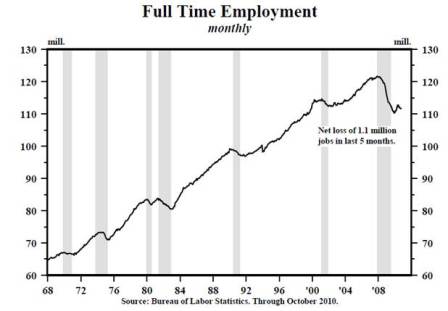
The most distressing aspect of this report is that the US economy lost another 124K full-time jobs, thus bringing the five-month loss to 1.1 million in this most critical of all employment categories. In an even more significant sign, the level of full-time employment in October was at the same level that was reached originally in December 1999, almost 11 years ago (see attached chart). An economy cannot generate income growth by continuing to substitute part-time work for full-time employment. This loss of full-time jobs goes a long way to explain why real personal income less transfer payments has been unchanged since May.

The weakness in real income is probably lost in an environment in which the Fed is touting the gain in stock prices and consumer wealth resulting from the latest quantitative easing (QE), but QE has unintended negative consequences for real household income. Due to higher prices of energy and food commodities, QE may result in less funds for discretionary spending for consumers whose incomes are stagnant. Also, with five-year yields falling below 1%, rates on CDs and other types of short-term bank deposits will decline, also cutting into household income. At the end of the day these effects will be more powerful than any stock-price boost in consumer spending, which, as always, will be very small and slow to materialize.

To have a broad-based recovery, the manufacturing sector must participate. Contrary to the ISM survey, manufacturing jobs fell 7k, the third consecutive drop, resulting in a net loss over the past three months of 35k.

In summary, the latest economic developments indicate a slight worsening of underlying fundamental conditions.

Payrolls


Karim writes:
Very solid number in many respects

  • NFP +151k plus Net revisions +110k
  • Private sector job gwth +159k
  • Average hourly earnings +0.2% and index of aggregate hours +0.4% will combine with the jobs increase to produce a very strong personal income number for October
  • Hours data will also show up in stronger industrial production, cap u, etc.
  • Unemployment rate unch at 9.6% but that is well understood to be the last labor market indicator to turn
  • Some industry highlights in terms of net job changes: Construction +13k; Retail +16k; Temp +11k; Leisure and Hospitality -24k
  • Diffusion index roughly unch at 55 (from 55.6)
  • Median duration of unemployment at 21.2 from 20.4; U6 measure at 17% from 17.1%

The income gains generated from this number plus recent equity gains put consumer balance sheets in much better shape; the mix between spending, savings and debt reduction remains to be seen, but the outlook for spending is certainly better than it appeared before today.

So it looks like a 9% budget deficit is sufficient to overcome the drag from the 0 interest rate policy and the size of the Fed’s portfolio to support GDP at modest levels of growth, perhaps just above levels of productivity increases, which means a very modestly improving employment outlook.

But not enough for a meaningful reduction in the output gap, which probably requires a fiscal adjustment like a payroll tax suspension, or a jump in private sector credit expansion via houses and cars.

QE2 will add a bit more drag, but probably not enough to make much difference.

Extending the tax cuts is a positive for demand versus letting them expire.
But that would not be a tax cut, just not a tax hike.

And there’s a chance it would get ‘paid for’ with a spending cut elsewhere, maybe social security or medicare after the sustainability committee reports Dec 1 and scares them all.

Still looks like fear that we might be the next Greece is turning us into the next Japan.

claims


Karim writes:

Initial claims fell 21k to a 3mth low of 434k, but the Labor Dept attributed this to a missed seasonal adjustment factor due to the Columbus Day holiday

Unadjusted claims rose by 3%, or 11k; the seasonal adjustment factor was looking for a 7.8% rise. Thus, the seasonally adjusted number fell by 21k.

The spike to 475k the week before the holiday likely reflects the flipside of this.

After also adjusting for the spike that followed benefit extension in late July, claims have really been very stable in the 440-460k range for the past 6mths.