Barro and Redlick on ‘stimulus’


[Skip to the end]

Thanks, at least he’s off most of his prior ‘Ricardian equivalence’ nonsense:

Stimulus Spending Doesn’t Work

The bottom line is this: The available empirical evidence does not support the idea that spending multipliers typically exceed one, and thus spending stimulus programs will likely raise GDP by less than the increase in government spending.

That’s a good thing. It means we can have taxes be that much lower for a given level of spending.

That’s a ‘good thing’ in my book!

Defense-spending multipliers exceeding one likely apply only at very high unemployment rates, and nondefense multipliers are probably smaller. However, there is empirical support for the proposition that tax rate reductions will increase real GDP.

Not to mention a payroll tax holiday. And federal revenue sharing. And funding an $8/hr job for anyone willing and able to work.

Mr. Barro is a professor of economics at Harvard and a senior fellow at Stanford University’s Hoover Institution. Mr. Redlick is a recent Harvard graduate. This op-ed is based on a working paper issued by the National Bureau of Economic Research in September.

Please forward this to Mr. Barro and Mr. Redlick, thanks!


[top]

EU Officials Say Stimulus Exit Unlikely Before 2011


[Skip to the end]

They are worried raising rates will further support the euro.

And they all seek a quick return to ‘fiscal responsibility’

This all should insure the Eurozone remains characterized by high unemployment and elevated systemic risk


EU Officials Say Stimulus Exit Unlikely Before 2011

By Svenja O’Donnell and Chris Burns

Oct. 1 (Bloomberg) — European Union finance chiefs said the pace of recovery means they probably won’t withdraw stimulus measures before 2011 as they grapple with rising unemployment and the effects of the euro’s gains.

“We look with concern to the exchange-rate developments and the impact of our ability to export,” Portuguese Finance Minister Fernando Teixeira dos Santos said today in an interview with Bloomberg Television at a meeting of European finance chiefs in Gothenburg, Sweden. “But we should expect markets to react appropriately to the fundamentals of our economy.”

The finance officials are discussing the form and timing of exit strategies after spending billions of euros in emergency measures to drag the economy out of its worst recession in 60 years. While there are signs the recovery is under way, it may not be sustained enough to permit a withdrawal of these measures before 2011, ministers said.

“We have to prepare exit strategies, of course, and we shall see if these strategies can be implemented then in 2011,” Luxembourg’s Jean-Claude Juncker said after leading a meeting of euro-area finance chiefs today. “We shall see whether this situation becomes more stable by then.”

The euro, which has gained 13 percent in the past seven months against the dollar, traded at $1.4544 at 2:10 p.m. in London today, down from $1.4640 in New York yesterday.

Euro’s Advance

The ministers discussed the euro’s advance in preparation for a Group of Seven meeting in Istanbul this weekend, European Central Bank President Jean-Claude Trichet told a press conference.

“We had a discussion as usual preparing for the meetings in Istanbul,” Trichet said. “There is very strong sentiment that we have a shared interest in a strong and stable international financial system and excess volatility and disorderly movements in exchange rates have adverse implications for economic and financial stability.”

Trichet also said exit plans should be implemented once the recovery is under way, “in our own view the latest in 2011,” he said.

The euro-area economy may expand 0.2 percent in the current quarter and 0.1 percent in the three months through December, the commission said on Sept. 14. In the second quarter, the economy contracted just 0.1 percent as Germany and France returned to growth.

Jobless Rate

Europe’s unemployment rate rose to a 10-year high of 9.6 percent in August, data showed today, as companies continued to cut jobs even as the recession eased. The European Commission forecasts the euro-area jobless rate will reach 11.5 percent next year.

“It’s clear we have to keep economic policy very expansionary in the coming period to really be sure of establishing a recovery,” Swedish Finance Minister Anders Borg said today. “At the same time, this is the time to start designing and communicating exit strategies,” he said, adding that it’s “clear that fiscal policy in Europe is not sustainable.”

France’s budget deficit will widen next year to a record, the government projected yesterday, as President Nicolas Sarkozy cuts business taxes and spending on jobless benefits climbs. Spain this week posted the largest budget shortfall in at least nine years.

This afternoon the euro-area officials were joined by finance ministers from the rest of the European Union as well as central bankers from the 27 EU nations. Included on their agenda is the banking industry and financial- supervision proposals. The Committee of European Banking Supervisors is due to present the results of stress tests carried out on the banking industry.

Reducing Deficits

Officials should focus on reducing deficits over raising interest rates, Jean Pisani-Ferry, director of Bruegel, a Brussels-based study group, said in a presentation to ministers in Gothenburg today.

“In view of the public finance costs of large deficits, budgetary consolidation should be given priority over monetary tightening,” Pisani-Ferry said in the report, co-written with Juergen von Hagen and Jakob von Weizsaecker. “For this to succeed, governments need to start fiscal consolidation swiftly in 2011 with the withdrawal of the stimuli.”

This afternoon the euro-area officials were joined by finance ministers from the rest of the European Union as well as central bankers from the 27 EU nations. Included on their agenda is the banking industry and financial-supervision proposals. The Committee of European Banking Supervisors is due to present the results of stress tests carried out on the banking industry.


[top]

Krugman in NYT Blog


[Skip to the end]

>   
>   (email exchange)
>   
>   On Tue, Sep 29, 2009 at 11:20 AM, Joshua Davis wrote:
>   
>   moving in the right direction for sure, but for partly
>   the wrong reason…he still misses the point that we’re
>   not on a gold standard…
>   

Yes, very much so. Does not seem like it would take much to set him straight.

If anyone on this list knows him, please email him a copy of ‘the 7 deadly frauds’ thanks!

The true fiscal cost of stimulus

By Paul Krugman

Sept. 29 (NYT Blog) — As I get ready for the CAP and EPI events, I’ve been thinking more about the issue of crowding in. (See also Mark Thoma.) And I’m coming more and more to the conclusion that the public debate over fiscal stimulus, which views it as an agonizing tradeoff between possible benefits now and certain costs later, is wildly off base.

Just to be clear, we’re talking about fiscal stimulus in a liquidity trap — that is, under conditions in which conventional monetary policy has lost traction, in which the Fed would set interest rates much lower if it could. Under more normal conditions the conventional view of stimulus is more or less right. But we’re in liquidity-trap conditions now, and will be for a long time if official projections are at all right. So what does that imply?

First of all, as I and others have pointed out, fiscal expansion does not crowd out private investment — on the contrary, there’s crowding in, because a stronger economy leads to more investment. So fiscal expansion increases future potential, rather than reducing it.

And yes, there’s some evidence to that effect beyond the procyclical behavior of investment. The new IMF analysis of medium-term effects of financial crisis finds that

    the evidence suggests that economies that apply countercyclical
    fiscal and monetary stimulus in the short run to cushion the
    downturn after a crisis tend to have smaller output losses over
    the medium run.

So fiscal expansion is good for future growth. Still, it does burden the government with higher debt, requiring higher taxes or some other sacrifice in the future. Or does it? Well, probably — but not nearly as much as generally assumed.

Here’s why: first, in the short run fiscal expansion leads to higher GDP, which leads to higher revenues, which offset a significant fraction of the initial outlay. A billion dollars in stimulus probably leads to only $600 million or a bit more in additional debt.

But that’s not the whole story. Crowding in raises future GDP — which raises future tax revenues. And the rise in revenues relative to what they would have been otherwise offsets at least some of the burden of debt service.

I’m not proposing a fiscal-stimulus Laffer curve here: it’s probably not true that spending money actually improves the government’s long-run fiscal position (although that’s certainly within the range of possibilities.) What I am suggesting is that fiscal stimulus under current conditions, where theFed funds rate “ought” to be around -5 percent, does much, much less to hurt that long-run position than the headline number would suggest.

And that, in turn, means that penny-pinching on stimulus is deeply, destructively foolish.


[top]

Julian Robertson chimes in


[Skip to the end]

No comment

US May Face ‘Armageddon’ If China, Japan Don’t Buy Debt

By: JeeYeon Park

Spetember 24 (News Associate) – The US is too dependent on Japan and China buying up the country’s debt and could face severe economic problems if that stops, Tiger Management founder and chairman Julian Robertson told CNBC.

“It’s almost Armageddon if the Japanese and Chinese don’t buy our debt,” Robertson said in an interview. “I don’t know where we could get the money. I think we’ve let ourselves get in a terrible situation and I think we ought to try and get out of it.”


[top]

quick macro update


[Skip to the end]

Market functioning has finally returned, helped by the Fed slowly getting around to where it should have been even before all this started- lending unsecured to its banks, setting its target rate and letting quantity adjust to demand. It’s not technically lending unsecured, but instead went through a process of accepting more and varied collateral from the banks until the result was much the same as lending unsecured.

A couple of years back (has it been that long?) when CPI and inflation expectations were rising, the Fed said it was going to restore market function first, and then work on inflation. It’s taken them this long to restore market functioning (eventually implementing in some form the proposals I put forth back then regarding market functioning) and with the inflation threat subdued by the wide output gap it looks like they are on hold for a while, though they would probably like to move to a ‘more normal’ stance when it feels safe to do so. That would mean a smaller portfolio (not that it actually matters) and a modest ‘real rate of interest’ as a fed funds target is also based on their notion of how things work.

It is more obvious now that the automatic fiscal stabilizers did turn the tide around year end, as the great Mike Masters inventory liquidation came to an end, and the Obamaboom began. The ‘stimulus package’ wasn’t much, and wasn’t optimal for public purpose, but it wasn’t ‘nothing,’ and has been helping aggregate demand some as well, and will continue to do so. It has restored non govt incomes and savings of financial assets to at least ‘muddle through’ levels of modest GDP growth, and we are now also in the early stages of a housing recovery, but not enough to keep productivity gains from continuing to keep unemployment and excess capacity at elevated levels.

This also happens to be a good equity environment- enough demand for some top line growth, bottom line growth helped by downward pressures on compensation, and interest rates helping valuations as well. There will probably be ups and downs from here, but not the downs of last year.

There also doesn’t seem to be much public outrage over the unemployment rate, with GDP heading into positive territory. Expectations of what government can do are apparently low enough such that jobs being lost at a slower rate has been sufficient to increase public support of government policies.

The largest macro risk remains a government that doesn’t understand the monetary system and is therefore unlikely to make the appropriate fiscal adjustments should aggregate demand suddenly head south for any reason.

And here’s a new one, just when I thought I’d heard it all:

‘Black Swan’ Author Taleb Wants His Vote for Barack Obama Back

By Joe Schneider

Sept. 16 (Bloomberg)— U.S. PresidentBarack Obama has failed to appoint advisers and regulators who understand the complexity of financial systems,Nassim Taleb, author of “The Black Swan,” told a group of business people in Toronto.

“I want my vote back,” Taleb, who said he voted for Obama, told the group.

The U.S. has three times the debt, relative to the country’s economic output, or gross domestic product, as it had in the 1980s, Taleb said. He blamed rising overconfidence around the world. U.S. Federal Reserve Chairman Ben Bernanke, who was appointed to a second term last month by Obama, contributed to that misperception, Taleb said.

“Bernanke thought the system was getting stable,” Taleb said, when it was on the verge of collapse last year.

Debt is a direct measure of overconfidence, he said. The national debt, according to the U.S. Debt Clock Web site, is at $11.8 trillion.

The nation must reduce its debt level and avoid “the moral sin” of converting private debt to public debt, he said.

“This is what I’m worried about,” Taleb said. “But no one has the guts to say let’s bite the bullet.”

As the founder of New York-based Empirica LLC, a hedge-fund firm he ran for six years before closing it in 2004, Taleb built a strategy based on options trading to protect investors from market declines while profiting from rallies. He now advises Universa Investments LP, a $6 billion fund that bets on extreme market moves.


[top]

Unemployment


[Skip to the end]

Agreed.

Hence the need for a full payroll tax holiday and per capita distributions to the States

Those simple pen strokes/data entry on the government’s computer will reverse the lost aggregate demand in short order.

The homicide rate is going up as well.

The deficit myths have all but completely taken over.

Employment Report: 216K Jobs Lost, 9.7% Unemployment Rate

By CalculatedRisk

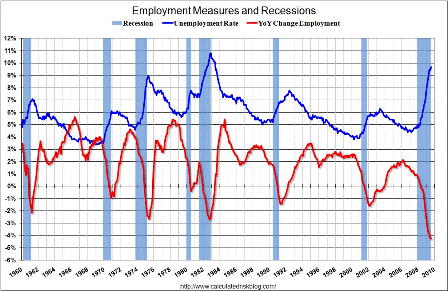
Nonfarm payroll employment continued to decline in August (-216,000), and the unemployment rate rose to 9.7 percent, the U.S. Bureau of Labor Statistics reported today. Although job losses continued in many of the major industry sectors in August, the declines have moderated in recent months.

This graph shows the unemployment rate and the year over year change in employment vs. recessions.

Nonfarm payrolls decreased by 216,000 in August. The economy has lost almost 5.83 million jobs over the last year, and 6.93 million jobs during the 20 consecutive months of job losses.

The unemployment rate increased to 9.7 percent. This is the highest unemployment rate in 26 years.

Year over year employment is strongly negative.

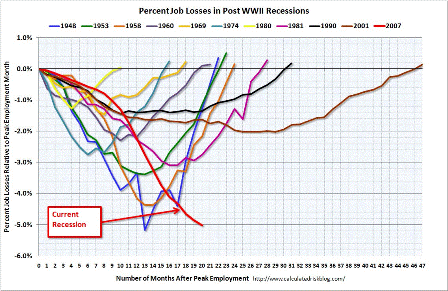
The second graph shows the job losses from the start of the employment recession, in percentage terms (as opposed to the number of jobs lost).

For the current recession, employment peaked in December 2007, and this recession was a slow starter (in terms of job losses and declines in GDP).

However job losses have really picked up over the last year, and the current recession is now the 2nd worst recession since WWII in percentage terms (and the 1948 recession recovered very quickly) – and also in terms of the unemployment rate (only early ’80s recession was worse).

The economy is still losing jobs at about a 2.6 million annual rate, and the unemployment rate will probably be above 10% soon. This is still a weak employment report – just not as bad as earlier this year. Much more to come …


[top]

Obama: Government will make it easier for workers to save for retirement


[Skip to the end]

A glimmer of hope in the last sentence but fails to state that any policy that reduces spending needs to be ‘matched’ with a tax cut to sustain output and employment.

If this is implemented without a tax cut, score one more move to reduce demand and suppress output and employment.

Obama expands workers’ retirement savings options

Obama: Government will make it easier for workers to save for retirement

By Charles Babington

September 5 (AP) — The government is trying to make it easier for Americans to save for retirement, President Barack Obama said Saturday, as he noted the toll the recession has taken on extra income and savings accounts.

Actually, saving has of course gone up as the federal deficit has gone up

One initiative will allow people to have their federal tax refunds sent as savings bonds. Others are meant to require workers to take action to stay out of an employer-run savings program rather than having to take action to join it.

“We know that automatic enrollment has made a big difference in participation rates by making it simpler for workers to save,” Obama said in his weekly radio and Internet address. “That’s why we’re going to expand it to more people.”

The new federal steps, which do not require congressional action, include:

— Making it easier for small companies to set up 401(k) retirement savings plans in which all workers are automatically enrolled unless they ask to be omitted. Employers can set default amounts of each worker’s pay — perhaps 3 percent — to automatically be deposited into the accounts without being taxed. Workers can raise or lower the contribution levels, and they choose how to invest the money. They will pay taxes on the money only when they withdraw it as retirees, when their tax rates are likely to be lower than when they are working full-time. A similar process would apply to savings plans called SIMPLE-IRAs.

— Allowing such plans to automatically increase the amount that workers save over time unless the workers object.

— Allowing people to check a box on their federal tax returns asking that any refund be sent as a savings bond. More than 100 million U.S. households receive refund checks each year, and many are promptly cashed and spent.

— Allowing workers, when leaving a job, to direct unused vacation pay to a retirement savings account rather than taking it in cash.

The administration earlier asked Congress to make it easier to set up retirement accounts for people whose workplaces do not offer them. No legislation has moved thus far.

“Tens of millions of families have been, for a variety of reasons, unable to put away enough money for a secure retirement,” Obama said. “Half of America’s work force doesn’t have access to a retirement plan at work. And fewer than 10 percent of those without workplace retirement plans have one of their own.”

While saving for retirement is universally seen as a good idea, any increase in savings rates could somewhat slow the nation’s rebound from the economic recession.


[top]

Assessing the Fed under Chairman Bernanke


[Skip to the end]

“Worldly wisdom teaches that it is better for reputation to fail conventionally than to succeed unconventionally.”
Keynes, Chapter 12, The General Theory of Employment, Interest, and Money

The Fed has failed, but failed conventionally, and is therefore being praised for what it has done.

The Fed has a stated goal of “maximum employment, stable prices, and moderate long term interest rates” (Both the Federal Act 1913 and as amended in 1977).

It has not sustained full employment. And up until the recent collapse of aggregate demand, the Fed assumed it had the tools to sustain the demand necessary for full employment. In fact, longer term Federal Reserve economic forecasts have always assumed unemployment would be low and inflation low two years in the future, as those forecasts also assumed ‘appropriate monetary policy’ would be applied.

The Fed has applied all the conventional tools, including aggressive interest rate cuts, aggressive lending to its member banks, and extended aggressive lending to other financial markets. Only after these actions failed to show the desired recovery in aggregate demand did the Fed continue with ‘uncoventional’ but well known monetary policies. These included expanding the securities member banks could use for collateral, expanding its portfolio by purchasing securities in the marketplace, and lending unsecured to foreign central banks through its swap arrangements.

While these measures, and a few others, largely restored ‘market functioning’ early in 2009, unemployment has continued to increase, while inflation continues to press on the low end of the Fed’s tolerance range. Indeed, with rates at 0% and their portfolio seemingly too large for comfort, they consider the risks of deflation much more severe than the risks of an inflation that they have to date been unable to achieve.

The Fed has been applauded for staving off what might have been a depression by taking these aggressive conventional actions, and for their further aggressiveness in then going beyond that to do everything they could to reverse a dangerously widening output gap.

The alternative was to succeed unconventionally with the proposals I have been putting forth for well over a year. These include:

1. The Fed should have always been lending to its member banks in the fed funds market (unsecured interbank lending) in unlimited quantities at its target fed funds rate. This is unconventional in the US, but not in many other nations that have ‘collars’ where the Central Bank simply announces a rate at which it will borrow, and a slightly higher rate at which it will lend.

Instead of lending unsecured, the Fed demands collateral from its member banks. When the interbank markets ceased to function, the Fed only gradually began to expand the collateral it would accept from its banks. Eventually the list of collateral expanded sufficiently so that Fed lending was, functionally, roughly similar to where it would have been if it were lending unsecured, and market functioning returned.

What the Fed and the administration failed to appreciate was that demanding collateral from loans to member banks was redundant. The FDIC was already examining banks continuously to make sure all of their assets were deemed ‘legal’ and ‘appropriate’ and properly risk weighted and well capitalized. It is also obligated to take over any bank not in compliance. The FDIC must do this because it insures the bank deposits that potentially fund the entire banking system. Lending to member banks by the Fed in no way changes the asset structure of the banks, and so in no way increases the risk to government as a whole. If anything, unsecured lending by the Fed alleviates risk, as unsecured Fed lending eliminates the possibility of a liquidity crisis.

2. The Fed has assumed and continued to assume lower interest rates add to aggregate demand. There are, however, reasons to believe this is currently not the case.

First, in a 2004 Fed paper by Bernanke, Sacks, and Reinhart, the authors state that lower interest rates reduce income to the non government sectors through what they call the ‘fiscal channel.’ As the Fed cuts rates, the Treasury pays less interest, thereby reducing the income and savings of financial assets of the non government sectors. They add that a tax cut or Federal spending increase can offset this effect. Yet it was never spelled out to Congress that a fiscal adjustment was potentially in order to offset this loss of aggregate demand from interest rate cuts.

Second, while lowering the fed funds rate immediately cut interest rates for savers, it was also clear rates for borrowers were coming down far less, if at all. And, in many cases, borrowing rates rose due to credit issues. This resulted in expanded net interest margins for banks, which are now approaching an unheard of 5%. Funds taken away from savers due to lower interest rates reduces aggregate demand, borrowers aren’t gaining and may be losing as well, and the additional interest earned by lenders is going to restore lost capital and is not contributing to aggregate demand. So this shift of income from savers to banks (leveraged lenders) is reducing aggregate demand as it reduces personal income and shifts those funds to banks who don’t spend any of it.

3. The Fed is perpetuating the myth that its monetary policy will work with a lag to support aggregate demand, when it has no specific channels it can point to, or any empirical evidence that this is the case. This is particularly true of what’s called ‘quantitative easing.’ Recent surveys show market participants and politicians believe the Fed is engaged in ‘money printing,’ and they expect the size of the Fed’s portfolio and the resulting excess reserve positions of the banks to somehow, with an unknown lag, translate into a dramatic ‘monetary expansion’ and inflation. Therefore, during this severe recession where unemployment has continued to be far higher than desired, market participants and politicians are focused instead on what the Fed’s ‘exit strategy’ might be. The the fear of that presumed event has clearly taken precedence over the current economic and social disaster. A second ‘fiscal stimulus’ is not even a consideration, unless the economy gets substantially worse. Published papers from the NY Fed, however, clearly show how ‘quantitative easing’ should not be expected to have any effect on inflation. The reports state that in no case is the banking system reserve constrained when lending, so the quantity of reserves has no effect on lending or the economy.

4. The Fed is perpetuating the myth that the Federal Government has ‘run out of money,’ to use the words of President Obama. In May, testifying before Congress, when asked where the money the Fed gives the banks comes from, Chairman Bernanke gave the correct answer- the banks have accounts at the Fed much like the rest of us have bank accounts, and the Fed gives them money simply by changing numbers in their bank accounts. What the Chairman explained was there is no such thing as the government ‘running out of money.’ But the government’s personal banker, the Federal Reserve, as decided not publicly correct the misunderstanding that the government is running out of money, and thereby reduced the likelihood of a fiscal response to end the current recession.

There are also additional measures the Fed should immediately enact, such banning member banks from using LIBOR in any of their contracts. LIBOR is controlled by a foreign entity and it is counter productive to allow that to continue. In fact, it was the use of LIBOR that prompted the Fed to advance the unlimited dollar swap lines to the world’s foreign central banks- a highly risky and questionable maneuver- and there is no reason US banks can’t index their rates to the fed funds rate which is under Fed control.
There is also no reason I can determine, when the criteria is public purpose, to let banks transact in any secondary markets. As a point of logic, all legal bank assets can be held in portfolio to maturity in the normal course of business, and all funding, both short term and long term can be obtained through insured deposits, supplemented by loans from the Fed on an as needed basis. This would greatly simply the banking model, and go a long way to ease regulatory burdens. Excessive regulatory needs are a major reason for regulatory failures. Banking can be easily restructured in many ways for more compliance with less regulation.

There are more, but I believe the point has been made. I conclude by giving the Fed and Chairman Bernanke a grade of A for quickly and aggressively applying conventional actions such as interest rate cuts, numerous programs for accepting additional collateral, enacting swap lines to offset the negative effects of LIBOR dependent domestic interest rates, and creative support of secondary markets. I give them a C- for failure to educate the markets, politicians, and the media on monetary operations. And I give them an F for failure to recognize the currently unconventional actions they could have taken to avoid the liquidity crisis, and for failure inform Congress as to the necessity of sustaining aggregate demand through fiscal adjustments.


[top]