
Category Archives: Deficit
Fiscal panel co-chair blasts critics as “jerks”
History will not be kind to either Simpson or the equally out of paradigm headline critics who are equally responsible for losing this battle.
Fiscal panel co-chair blasts critics as “jerks”
February 6 (Reuters) — Any fiscal plan that fails to tackle military spending, Medicare, Medicaid and Social Security is “a sparrow’s belch in the midst of a typhoon,” a chairman of a presidential deficit-reduction commission said in an interview aired on Sunday.
Former Senator Alan Simpson, Republican co-chair of the National Commission on Fiscal Responsibility and Reform, also trashed certain critics as “jerks” and compared the United States to “a milk cow with 300 million teats.”
“If you have a career politician get up and say, ‘I know we can get this done; we’re going to get rid of all earmarks, all waste, fraud, and abuse, all foreign aid, Air Force one, all congressional pensions,’ that’s a sparrow’s belch in the midst of a typhoon,” Simpson told CNN’s “State of the Union.”
President Barack Obama created the bipartisan, 18-member commission to address fiscal challenges centered around a deficit of more than $1.3 trillion, the highest since World War Two, and a record federal debt now topping $14 trillion.
A bold budget-balancing plan floated by Simpson — long noted for earthy, sometimes off-color remarks — and his fellow co-chairman, Erskine Bowles, fell short in December of the support needed from panel members to trigger congressional action.
“So I’m waiting for the politician to get up and say, there’s only one way to do this, you dig into the big four: Medicare, Medicaid, Social Security, and defense,” Simpson said. “And anybody giving you anything different than that, you want to walk out the door, stick your finger down your throat and give them the green weenie.”
Simpson and Bowles recommended Social Security benefit cuts via a higher retirement age, lower annual cost-of-living adjustments and a change in the way benefits are calculated.
“We’re not talking about privatization,” he said on CNN. “These jerks who keep dragging that up are lying. We never suggested that.”
Simpson served from 1979 to 1997 as a Senator from Wyoming. He had apologized in August for comparing Social Security to “a milk cow with 310 million teats.”
But in the interview he said he had merely misspoken.
“I meant to say that America was a milk cow with 300 million teats, and not just Social Security.”
Excellent post on the MMT controversy
Straw Men (And Women)
By Peter Cooper
This post is for all the MMT foot soldiers out there in cyberspace, including myself and most readers (prominent MMT economists who are kind enough to drop in from time to time excepted, of course).
Come on, we know who we are. Battling it out in diverse message forums, matching wits with fellow participants who, judging from their arguments, mostly appear to read our posts with their eyes shut and their fingers in their ears to block out the sounds of our linked video presentations. This navel-gazing exercise may seem self-indulgent to the crustier MMT old-timers among us, but, hey, rationalize it, we deserve it!The post is also for readers who have not yet made up their minds about MMT. Think of this as a small taste of the kind of self-congratulatory back slapping you too will be able to enjoy at heteconomist if you decide to join the ranks of the foot soldiers. Enjoy! You also deserve it!
Straw Men in Cyberspace
On a private message forum I often visit, a regular participant – who is very bright, and a good contributor on many topics – recently posted a criticism of the MMT position on budget deficits that went something like this:Budget deficits increase demand in some areas and decrease it in others. To illustrate the point I will show an extreme example. Say Honest Annie has $10,000 in savings. Mr Lucky is given $100,000,000 to stimulate the economy. Oh look, now Annie can produce more goods because Mr Lucky can afford to buy them. Of course, look at poor Annie’s real disposition. This new demand comes with the devaluation of her hard-earned savings. What is changing is that now she has to produce more to be able to afford more goods. The government has tricked her into having to work more because her savings have been devalued due to inflation. Sure, Mr Lucky is happy because Annie is producing more goods for him, but there are two sides to the coin.
Clearly the government should not adopt such a ridiculous policy in which it randomly gives one person $100 million in an economy where a typical person has savings of $10,000. But even in terms of the ludicrous example, the poster’s logic is lacking.
If Mr Lucky spent some of the money to buy stuff from Honest Annie, and she had the available time and resources to respond to the additional demand at current prices, she would receive some of Mr Lucky’s money in payment and also have increased spending power to purchase output from Mr Lucky or somebody else. The deficit expenditure can increase demand in some areas without reducing it in others provided the economy is operating below full capacity.
The question is whether there are idle resources that people would willingly put to use if there was demand for the resulting output, and whether this additional output could be supplied in a non-inflationary manner.
No one in the MMT camp is suggesting the government should net spend more than is necessary to enable the purchase of potential output at current prices.
The author of the example is influenced by the Austrian school, so some of his reasoning is defensible within that framework. In particular, as I discussed here and here, the Austrian definition of inflation is different from the one used by other economists. For everyone but the Austrians, inflation means a persistent rise in the general price level (the weighted average of all prices of final goods and services), not an expansion of broader money per se.
This can lead to differences between Austrians and non-Austrians in their assessments of whether inflation is occurring. If there is a rise in general prices, there will typically be an expansion of broader money to accommodate it unless real potential output shrinks due to a supply shock. In this case, both Austrians and non-Austrians alike will observe inflation. But it is possible for the broader money supply to expand (inflation for Austrians) without general prices rising (no inflation for other economists) whenever the economy is operating below full capacity. This means that from the Austrian perspective, it makes sense to suggest deficit expenditure will reduce the value of money even if, for other economists, there is no inflation.
Differences such as this can be discussed as part of a healthy debate. What is more annoying is the practice of creating straw-man arguments, such as the suggestion that MMT economists are advocating mindless spending out of all proportion to the actual demand deficiency or without any thought to the allocation of that net spending. The tactic often appears to be deliberate, in that there is a wilful misinterpretation of the argument to make it easier to ridicule or criticize. No matter how many times the point is clarified, the wilful (and convenient) misinterpretation will be repeated as if nothing has changed. The result is a discussion that fails to advance beyond irrelevant mischaracterizations and attempts to set (reset) the record straight.
As a practical matter for foot soldiers, we need to balance the need to deal with such mischaracterizations with the desire to develop the argument further for those not thrown by the mischaracterizations or to present the same argument elsewhere. At some point, it is probably best to assume that intelligent readers have been provided with enough clarification to make up their own minds about the merits of the straw-man argument, and just get on with advancing the discussion, or if the point has been made, move on to other forums. There is no need to convince every person in every forum.
MMT – and heterodox approaches, in general – seem more susceptible to this kind of straw-man treatment because its proponents have to make the running. In debates with critics or skeptics, the aim of the MMT proponent is usually to explain why the current dominant understanding of the economy is lacking, and why an alternative may offer an improvement in understanding.
A skeptic who is only interested in a better understanding of the economy has no motive to mischaracterize MMT arguments. The motive for engaging in discussion for such a person would be to understand the approach to enable an informed assessment of it. But when a skeptic or critic is more interested in defending a preconceived view of the world – possibly for psychological, political, or careerist reasons – their motive may not be to understand but to obfuscate, sidetrack, or otherwise hold up the discussion in ways that at least muddies the waters enough to make it difficult for others, who may be trying to understand without prejudging positions, to separate nonsense from valid argument, especially if they do not have a training in economics.
Consider journalists who write on economic matters, for example. In a way, it is hard to blame them for erring on the side of the orthodoxy when in doubt if they don’t have sufficient confidence in their own understanding of the subject. When in doubt, it is surely safer to go with the view of a Nobel Prize recipient or Professor from an Ivy League university over the views of a heterodox economist, even if the heterodox position seems to make more sense.
Opponents of the heterodox position can take advantage of this, knowing that they do not have to win arguments, or even engage in them in many cases, provided there is sufficient doubt over the heterodox position, whether because of perception, status, obfuscation or deliberately disruptive tactics, which on the internet can of course be done anonymously.
Straw Men in Academia
Straw-man argumentation is not limited to the orthodoxy or the internet. Heterodox schools use this tactic in disputes among themselves. For example, Marx’s theory of value was widely claimed to be “internally inconsistent” for eighty years on the basis of a straw man (the dominant dual-system, simultaneist interpretation of his theory) before a group of economists were finally able to demonstrate that Marx’s work could be interpreted in a way that not only gave it internal coherence but reproduced all of his results on value, including the long-run tendency of the rate of profit to fall, which had supposedly been “disproved” by Okishio’s theorem.
It wasn’t until the 1980s that papers began to be published by economists adhering to the so-called “temporal single-system interpretation” of Marx, demonstrating the theoretical coherence – validity, not necessarily correctness – of his theory of value when interpreted in a temporal and “single-system” way. It took another twenty-five years of persistence by these economists before Sraffians (who were the most prominent antagonists) and other critics grudgingly stopped dismissing Marx’s theory in pat phrases repeated over and over again without any authority other than the insinuation of authority.
One of the leading protagonists in this debate, Andrew Kliman, has written an accessible book for the generalist reader documenting the history of the debate and summarizing the major findings. For anyone interested in the debate over Marx’s theory of value, it is well worth reading, and eye-opening in bringing to light the extent of intellectual dishonesty in academia, including within the heterodoxy.
The straw-man tactic of the Sraffians served to discredit Marx and help to create a justification for alternative theories (e.g. Sraffianism) to replace or “correct” Marx’s theory. The tactic was also employed by developers of an array of alternative, though short-lived, value theories, such as the New Interpretation, Simultaneous Single-System Interpretation, Value Form theory, etc. A certain career benefit and “respectability” no doubt also comes from distancing oneself from Marx’s theory of value in a capitalist society.
The straw-man attack on Marx’s theory was effective partly because Marxism is outside the orthodoxy and Marxists have little to no presence in academic economics, let alone clout. Another reason for its effectiveness may be that Marxist thought is critical of the capitalist system itself. It is not merely reformist. This is not exactly the most career-savvy research program for an up-and-coming academic.
None of this is to suggest that Sraffianism or any of the other alternative theories are not valid approaches in their own right. It is simply to insist that the developers of these theories were not entitled to assert the invalidity of Marx’s theory almost like a religious mantra when the argument relied on a straw man.
The unjustified but highly successful eighty-year banishment of Marx’s theory can be contrasted with the lack of impact the Cambridge Capital Controversy has had on the dominance of neoclassical economics. This time the position of the Sraffians in theoretical terms was very strong, and their central points were conceded by Paul Samuelson and other leading neoclassical participants in the debate, yet the victory has so far had little impact on the status quo in academic economics.
The strategically effective response of the neoclassical orthodoxy to heterodox critiques drawing on the results of the Cambridge Capital Controversy has been simply not to respond through debate but rather ignore the implications, stop publishing heterodox work in the top journals, and cease hiring heterodox economists in the most prestigious universities or leading policymaking institutions (see Nobel-nomics for a polemical take on the aftermath of the Capital Debates).
When aimed at the orthodoxy, even legitimate criticism struggles to make a dent. For the heterodoxy, the very strongest arguments take a long time to break through.
Eventually, though, as MMT commentator rvm often reminds me, truth will out. Advances in understanding in many areas of human endeavor have faced the same kind of opposition throughout history. Even now, some heterodox advances in economics eventually slip in through the back door of neoclassical economics.
For example, there appears to be an increasing recognition among monetary researchers that some traditional concepts are untenable. Recent notable examples apply to the money-multiplier theory and money endogeneity. Understanding of these points has been well established in Post Keynesian economics for a long time. Now, slowly, some of the ideas are creeping in to mainstream analysis (usually without appropriate credit being given to earlier heterodox work).
All this is a longwinded way of saying that the road is uphill, but the only option is to keep plugging away. Some of the leading proponents of MMT have been grinding away for thirty years now. As internet foot soldiers, we can follow their lead. Sooner or later, perhaps long after we’re all dead, society will wake up to reality, strengthen conceptual understanding, and implement sensible policies.
Ancient historians of twentieth and twenty-first century economic thought will look back and realize that much of the truth was worked out by Kalecki, Keynes, Lerner, CofFEE, UMKC, TCOTU, etc. From their vantage point of 5000 AED (five thousand years After Environmental Destruction), orthodox historians will wonder how the clear and cogent answers of MMT could possibly have been ignored by so many experts of the era, who seemed inexplicably fond of straw men. These orthodox thinkers of the future will know with utter certainty that they could never be so close-minded!
A Comment on MMT Internet Discussions
There is one particular straw man that is repeatedly erected by critics of MMT. I’m sure most foot soldiers reading this will have noticed it. It is one that I find especially grating. The best (i.e. most irritating) phrase I’ve seen to encapsulate the nuances of this particular straw man is the refrain:MMT claims we can print prosperity.
The phrase “print prosperity” is shorthand for the common message board accusation that MMT ignores real resources and gets bamboozled by money as if it is magic. The accusation is very common. The term “print prosperity” was coined, to the best of my knowledge, by a Math Professor, no less, who happens to be keen on the kind of “fiscal conservatism” advocated by the Concord Coalition.
I consider it a perverse injustice that, in online discussions, MMT sympathizers are frequently reproached for imagining that “we can print prosperity” when in fact it is us who constantly stress as a fundamental point that the only true constraints are resource based, not financial or monetary in nature. We are the ones insisting that if we have the resources, we can put them to use. It is the neoclassical orthodoxy and others who try to make out that we can’t use resources, even if they are available, because of some magical, mysterious monetary or financial constraint. Just who is it that believes in magic here?
MMT shows clearly that if we have the resources, money is no obstacle to a government that issues its own flexible exchange-rate fiat currency. It is not saying that creating money magically creates goods and services. It is saying that it is nonsense – superstitious nonsense – to think affordability for such a government could be about money rather than resources.
Obviously, anyone is entitled to disagree with the MMT position. But they are not entitled purposefully to misrepresent MMT as suggesting that it is oblivious to real resource constraints when it is alternative theories that attempt to obfuscate matters by conjuring up fictitious “financial constraints” (e.g. the neoclassical “government budget constraint” framework).
Take the debate over how to address the aging population for example. It should be obvious – and is obvious in MMT – that the only way to address this issue is to increase future productive capacity. This involves the application of real resources now to research, infrastructure development, education (including in areas relevant to servicing an aging population), etc.
Clearly, MMT is not, as many internet critics claim, saying that creating money solves the problem. It is really the MMT critics who are falling into the trap of thinking money rather than the application of real resources is the solution, despite their frequent protestations to the contrary. They are the ones who think that if the government “saves” money now, this will somehow help to address the needs of the aging population in, let’s say, twenty years time.
Yet, these same people also stress that you can’t “print prosperity”. Well, if you can’t “print prosperity” – and we all agree on that – what good is that money the government supposedly should stash away going to be twenty years from now? It won’t help to provide the infrastructure and technological knowledge that was not developed in the preceding twenty years because governments preferred to “save” money for the future rather than apply resources to the real task of raising productive capacity.
Oh well. We shrug and move on. Such are the trials and tribulations of an internet foot soldier.
Bernanke text
Just when you think he’s making progress:
>
> (email exchange)
>
> On Thu, Feb 3, 2011 at 1:41 PM, Cullen wrote:
>
> After a glimpse of hope from some of Bernanke’s speeches late last year
> he appears to have suffered some sort of memory loss as he is once again
> talking about the dangers of the govt debt:
>
Bernanke:
By definition, the unsustainable trajectories of deficits and debt that the CBO outlines cannot actually happen, because creditors would never be willing to lend to a government with debt, relative to national income, that is rising without limit.
Link to text
Comments on Non-Mfg ISM
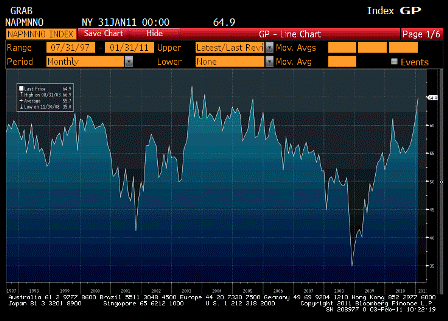
Looks from the chart we’re getting close to the post Bush tax cut, coming out of that recession highs, so we’re on track for our 3-5% read gdp growth guestimates.
And the high productivity reported today reinforces our thoughts on unemployment coming down only slowly as well.
Last time around the expansion phase of what became the sub prime crisis was a substantial contributor to private sector credit growth. Without that kind of contribution from somewhere else, this recovery could be more modest than the last.
For exports to be sustained, the govt would have to keep the dollar down with fx purchases and reserve building, which in my humble opinion isn’t going to happen. That means the adjustment takes place via a climbing US dollar that continues until it dampens exports. Much like what the euro zone has experienced for the last decade or so.
Karim writes:
Multi-year highs for overall index, new orders (3rd highest on record-chart attached), and employment.
Anecdotes also very positive.
- “New initiatives creating increase in spending.” (Finance & Insurance)
- “Indications are that business is picking up and that 2011 could see positive growth across many industries. We are seeing an increase in orders at the beginning of the year.” (Professional, Scientific & Technical Services)
- “Starting to see higher prices in many areas. Low inventory levels are leading to longer delivery time frames.” (Public Administration)
- “Business uncertainty seems to be subsiding.” (Management of Companies & Support Services)
- “Business activity is picking up. The challenges in the textile market (cotton/polyester) are significantly impacting price along with the inability to secure pricing for a period longer than two months.” (Accommodation & Food Services)
- “2011 looking better than 2010.” (Information)
| Jan | Dec | |
| Composite | 59.4 | 57.1 |
| Business activity | 64.6 | 62.9 |
| Prices Paid | 72.1 | 69.5 |
| New Orders | 64.9 | 61.4 |
| Backlog of Orders | 50.5 | 48.5 |
| Supplier Deliveries | 53.5 | 51.5 |
| Inventory Change | 49.0 | 52.5 |
| Inventory Sentiment | 60.0 | 61.5 |
| Employment | 54.5 | 52.6 |
| Export orders | 53.5 | 56.0 |
| Imports | 53.5 | 51.0 |

Gross misrepresentations
My comments following Bill Gross’s comments:
I don’t know if the U.S. has reached a desperate point, but it is employing instruments and vehicles and policies that smack of desperation.
He fails to see the function of federal taxes is to regulate aggregate demand, and not to raise revenue per se.
We are not looking at a default here, but at years of accelerating inflation, which basically robs investors and labor of their real wages and earnings.
Apart from the possibility that he’s wrong, and that there will be no accelerating deflation, inflation per se does not make a nation poorer, and does not necessarily reduce real wages and earnings. In fact, real wages could very well be made to increase during an inflationary period. It’s all about policy responses and institutional structure. And as for investors, some will do well and some will do poorly, which most don’t consider an injustice.
We are looking at a currency that almost certainly will depreciate relative to other, stronger currencies in developing countries that have lower levels of debt and higher growth potential.
Maybe and maybe not on both scores.
The dollar may not depreciate.
And lower levels of public debt and higher growth potential do not necessarily mean a currency will appreciate.
For example, Japan has had perhaps the least growth potential and one of the strongest currencies for quite a while, and China has had a policy of keeping its currency weak which has been credited with fostering high growth, etc.
And, on the short end of the yield curve, we are looking at creditors receiving negative real interest rates for a long, long time. That, in effect, is a default.
No, it’s a policy option.
A default is a promise broken.
And there is no national promise by any nation to provide a real return to savers at the short end of the curve.
Ultimately creditors and investors are at the behest of a central bank and policymakers that will rob them of their money.
That’s a serious and groundless accusation of motivation of the Fed.
Robbing implies dishonesty and involuntary confiscation.
However no one is forced by the Fed or anyone else to hold dollars in money market accounts, investors buy securities with known nominal interest rates, and for all practical purposes investors know much the same information regarding inflation as the Fed does.
So when William Gross uses the word ‘rob’ he’s implying the Fed is deliberately publishing false inflation forecasts to trick investors into buying US govt securities at rates lower than if they knew the Fed’s actual inflation forecasts.
I suggest an immediate apology is in order for this groundless, inappropriate, and insulting remark.
Tea Party ‘fiscal responsibility’ rhetoric risking depression
The Tea Party leadership needs to read ‘The 7 Deadly Innocent Frauds of Economic Policy’ and go public on the need for a higher debt ceiling and a larger federal deficit, before they do even more damage to the US economy:
Public strongly opposes debt level increase: Reuters/Ipsos poll
By Andy Sullivan and Richard Cowan
December 25 (Reuters) — The U.S. public overwhelmingly opposes raising the country’s debt limit even though failure to do so could hurt America’s international standing and push up borrowing costs, according to a Reuters/Ipsos poll released on Wednesday.
Some 71 percent of those surveyed oppose increasing the borrowing authority, the focus of a brewing political battle over federal spending. Only 18 percent support an increase.
The poll underscores the tough task ahead for U.S. lawmakers as the debt nears its current ceiling of $14.3 trillion. Treasury Secretary Timothy Geithner last week warned that a failure to raise the borrowing limit in the coming months could lead to “catastrophic economic consequences.”
Brian Riedl, the lead budget analyst at the conservative Heritage Foundation, said the poll findings put “a lot more pressure on those who want to raise the debt limit to make a convincing argument to a very skeptical public.”
Republicans, who won control of the House of Representatives in November on a promise to scale back government, hope to pair any debt-ceiling hike with a commitment from President Barack Obama to reduce long-term spending.
Republicans have vowed to slash $60 billion from the budget as soon as March, but many of those cuts are not likely to be popular with the public.
The United States posted an $80 billion budget deficit in December. The government has now posted a budget deficit for 27 straight months, the longest streak on record.
A deal to extend tax cuts this year that was approved by Congress in December is expected to put a hole of more than $800 billion in the deficit over the next decade.
Obama wants broader tax reforms although it will be hard to get them through a divided Congress in the next two years. His administration is exploring ways to boost tax incentives for corporate investments, Geithner said.
WHAT TO CUT?
While the public apparently does not want Washington to keep borrowing more and more, it appears to lack a clear idea of how to cut spending.
“You get nervous,” Riedl said. “There is some contradiction: Historically the public wants a balanced budget but doesn’t show a lot of enthusiasm toward the policies to get us there.”
Only 24 percent say the country can afford to cut back on education spending, a likely Republican target, and 21 percent support cuts to law enforcement.
With the United States fighting wars in Afghanistan and Iraq, 51 percent supported cutbacks to military spending.
Less than half, 45 percent, support an expected Republican effort to pare enforcement of environmental laws.
Some 53 percent support cutting the budgets of financial regulators like the Securities and Exchange Commission, in spite of the widespread consensus that a lax regulatory atmosphere contributed to the financial crisis of 2007-2009.
And 47 percent support cutbacks to national parks, which were shuttered for several weeks during the budget battles of 1995 and 1996.
Expensive benefit programs that account for nearly half of all federal spending enjoy widespread support, the poll found. Only 20 percent supported paring Social Security retirement benefits while a mere 23 supported cutbacks to the Medicare health-insurance program.
Some Democrats say that tax increases, especially on the wealthy, have to be part of any serious effort to control deficits, coupled with better enforcement of tax laws or streamlining those laws.
Some 73 percent support scaling back foreign aid and 65 percent support cutting back on tax collection — two very small lines in the massive federal budget ledger.
The poll of 1,021 U.S. adults was conducted between Friday and Monday. It has a margin of error of plus or minus 3.1 percentage points.
Italian deficit narrows in third quarter
Now that Japan has an open door to buy euro to ‘help out’ the region’s finances, and the ECB’s funding terms and conditions forcing deflationary austerity measures that continue to bring euro zone deficits down, I’m itching to buy the euro vs the yen.
At some point, however, and maybe as soon as q3 this year, or even sometime in q2, the austerity in the euro zone will fail to reduce deficits and instead the tightening measures will cause growth to go into reverse and deficits to increase, causing fundamental euro weakness.
But until then, the euro remains fundamentally strong, with technicals/one time portfolio shifts causing the sell offs.
Headlines:
Portugal Finance Minister says no need for bailout
Euro May Decline to 2010 Low Against Yen: Technical Analysis
ECB intervenes as debt crisis deepens
Portugal faces growing tensions
Tensions Rise Before Portugal Auction
Germany May Soften Objections to Euro Fund Increase
German 2011 Construction Sales May Drop, HDB Building Lobby Says
German Trade With China Rose to a Record in 2010
French Business Confidence Rose in December for Fourth Month
Italian deficit narrows in third quarter
Italian deficit narrows in third quarter
(FT) Italy’s public budget deficit narrowed in the third quarter of last year, putting the economy on track to hit government austerity targets of about 5 per cent of gross domestic product in 2010. As a result of austerity measures passed in December, Italy is targeting a public budget deficit of 3.9 per cent in 2011 and 2.7 per cent in 2012. Debt is expected to peak at about 120 per cent of gross domestic product this year, giving the economy ministry little room to manoeuvre. In the third quarter, the public deficit narrowed to 3.2 per cent of GDP compared with 3.9 per cent in the period a year earlier, according to data from the national statistics office. It narrowed to 5.1 per cent of GDP in the first nine months, down from 5.5 per cent a year earlier.
Fed Turns Over Record $78.4 Billion Profit to Treasury
And not even a hint they removed even more than that much interest income from the private sector.
(the $78.4 billion is after expenses)
Fed Turns Over Record $78.4 Billion Profit to Treasury
By: Reuters
The Federal Reserve reported Monday its earnings jumped by more than 50 percent in 2010 to a record $80.9 billion on its massive holdings of securities, and it is turning the bulk of it over to the U.S. Treasury Department.
The $78.4 billion that the Fed is remitting to Treasury is also a record and is $31 billion more than a year earlier. In 2009 the Fed had net income of $53.4 billion.
The Fed’s portfolio has ballooned to $2.16 trillion, roughly triple its size before the financial crisis, as it purchased securities including U.S. government debt and mortgage-linked bonds in a move to drive down borrowing costs and stimulate the economy.
“The increase was due primarily to increased interest income earned on securities holdings during 2010,” the U.S. central bank said in releasing preliminary unaudited results.
Audited results will be issued in the spring and may show some changes, Fed officials indicated.
After driving overnight interest rates close to zero percent in December 2008, the Fed bought $1.7 trillion of longer-term Treasury and mortgage-related bonds as a supplement to its pledge to keep overnight rates near zero for a long time.
It followed that up late last year with a new $600 billion bond-buying program — again intended to spur growth by pumping liquidity into the economy. That program ends at mid-year.
The Fed turns over profits to the Treasury annually and has never posted a loss. But the central bank took a number of extraordinary actions during and after the 2007-2009 financial crisis that critics say may have left it with some poor-quality holdings.
Doubts on All Sides
Critics fault the Fed on several scores, with some claiming its actions have sown the seeds for a potential flare-up in inflation and others saying it has put the central bank at risk of destabilizing losses when it sells down its holdings.
If credit losses were to pile up, those criticisms could mount.
In addition, some foreign governments have charged that the Fed’s easy money policies could weaken the dollar and spark a round of competitive currency devaluations.
Fed officials who briefed reporters said asset sales would be part of a so-called “exit strategy” from loose monetary policy, but only once the economy was on a sound footing. That means sales of the securities may be some way down the road, they added.
A Fed official said that if the central bank had to make sales and take some losses, it could always scale back the amount it remits to the Treasury. But there is no mechanism in place for it to get past remittances returned by the Treasury.
In testimony to Congress on Friday, Fed Chairman Ben Bernanke gave no sign the Fed was ready start scaling back its bond purchase program.
Nor did the Fed chief give any hints about further buying beyond the June deadline for the $600 billion program.
The Fed said its 2010 income included $76.2 billion in income on securities bought through open market operations, including Treasury and mortgage-linked debt, $7.1 billion from limited liability companies created in response to the financial crisis, $2.1 billion in interest income from credit extended to American International Group and $1.3 billion of dividends on preferred interests in AIA Aurora and ALICO Holdings.
Bernanke testimony
The Economic Outlook and Monetary and Fiscal Policy
Chairman Ben S. Bernanke
Before the Committee on the Budget, U.S. Senate, Washington, D.C.
January 7, 2011
Chairman Conrad, Senator Sessions, and other members of the Committee, thank you for this opportunity to offer my views on current economic conditions, recent monetary policy actions, and issues related to the federal budget.
The Economic Outlook
The economic recovery that began a year and a half ago is continuing, although, to date, at a pace that has been insufficient to reduce the rate of unemployment significantly.1 The initial stages of the recovery, in the second half of 2009 and in early 2010, were largely attributable to the stabilization of the financial system, expansionary monetary and fiscal policies, and a powerful inventory cycle. Growth slowed somewhat this past spring as the impetus from fiscal policy and inventory building waned and as European sovereign debt problems led to increased volatility in financial markets.
More recently, however, we have seen increased evidence that a self-sustaining recovery in consumer and business spending may be taking hold. In particular, real consumer spending rose at an annual rate of 2-1/2 percent in the third quarter of 2010, and the available indicators suggest that it likely expanded at a somewhat faster pace in the fourth quarter. Business investment in new equipment and software has grown robustly in recent quarters, albeit from a fairly low level, as firms replaced aging equipment and made investments that had been delayed during the downturn. However, the housing sector remains depressed, as the overhang of vacant houses continues to weigh heavily on both home prices and construction, and nonresidential construction is also quite weak. Overall, the pace of economic recovery seems likely to be moderately stronger in 2011 than it was in 2010.
Although recent indicators of spending and production have generally been encouraging, conditions in the labor market have improved only modestly at best. After the loss of nearly 8-1/2 million jobs in 2008 and 2009, private payrolls expanded at an average of only about 100,000 per month in 2010–a pace barely enough to accommodate the normal increase in the labor force and, therefore, insufficient to materially reduce the unemployment rate.2 On a more positive note, a number of indicators of job openings and hiring plans have looked stronger in recent months, and initial claims for unemployment insurance declined through November and December. Notwithstanding these hopeful signs, with output growth likely to be moderate in the next few quarters and employers reportedly still reluctant to add to payrolls, considerable time likely will be required before the unemployment rate has returned to a more normal level. Persistently high unemployment, by damping household income and confidence, could threaten the strength and sustainability of the recovery. Moreover, roughly 40 percent of the unemployed have been out of work for six months or more. Long-term unemployment not only imposes exceptional hardships on the jobless and their families, but it also erodes the skills of those workers and may inflict lasting damage on their employment and earnings prospects.
A very ‘dovish’ assessment of this leg of the dual mandate, indicating the low rate policy will continue.
Recent data show consumer price inflation continuing to trend downward. For the 12 months ending in November, prices for personal consumption expenditures rose 1.0 percent, and inflation excluding the relatively volatile food and energy components–which tends to be a better gauge of underlying inflation trends–was only 0.8 percent, down from 1.7 percent a year earlier and from about 2-1/2 percent in 2007, the year before the recession began. The downward trend in inflation over the past few years is no surprise, given the low rates of resource utilization that have prevailed over that time. Indeed, as a result of the weak job market, wage growth has slowed along with inflation; over the 12 months ending in November, average hourly earnings have risen only 1.6 percent. Despite the decline in inflation, long-run inflation expectations have remained stable; for example, the rate of inflation that households expect over the next 5 to 10 years, as measured by the Thompson Reuters/University of Michigan Surveys of Consumers, has remained in a narrow range over the past few years. With inflation expectations stable, and with levels of resource utilization expected to remain low, inflation is likely to be subdued for some time.
A very dovish assessment of the inflation mandate as well, which he links to the output gap and inflation expectations.
Monetary Policy
Although it is likely that economic growth will pick up this year and that the unemployment rate will decline somewhat, progress toward the Federal Reserve’s statutory objectives of maximum employment and stable prices is expected to remain slow. The projections submitted by Federal Open Market Committee (FOMC) participants in November showed that, notwithstanding forecasts of increased growth in 2011 and 2012, most participants expected the unemployment rate to be close to 8 percent two years from now. At this rate of improvement, it could take four to five more years for the job market to normalize fully.
FOMC participants also projected inflation to be at historically low levels for some time. Very low rates of inflation raise several concerns: First, very low inflation increases the risk that new adverse shocks could push the economy into deflation, that is, a situation involving ongoing declines in prices. Experience shows that deflation induced by economic slack can lead to extended periods of poor economic performance; indeed, even a significant perceived risk of deflation may lead firms to be more cautious about investment and hiring. Second, with short-term nominal interest rates already close to zero, declines in actual and expected inflation increase, respectively, both the real cost of servicing existing debt and the expected real cost of new borrowing. By raising effective debt burdens and by inhibiting new household spending and business investment, higher real borrowing costs create a further drag on growth. Finally, it is important to recognize that periods of very low inflation generally involve very slow growth in nominal wages and incomes as well as in prices. (I have already alluded to the recent deceleration in average hourly earnings.) Thus, in circumstances like those we face now, very low inflation or deflation does not necessarily imply any increase in household purchasing power. Rather, because of the associated deterioration in economic performance, very low inflation or deflation arising from economic slack is generally linked with reductions rather than gains in living standards.
It doesn’t get any more dovish than that.
In a situation in which unemployment is high and expected to remain so and inflation is unusually low, the FOMC would normally respond by reducing its target for the federal funds rate. However, the Federal Reserve’s target for the federal funds rate has been close to zero since December 2008, leaving essentially no scope for further reductions. Consequently, for the past two years the FOMC has been using alternative tools to provide additional monetary accommodation. Notably, between December 2008 and March 2010, the FOMC purchased about $1.7 trillion in longer-term Treasury and agency-backed securities in the open market. The proceeds of these purchases ultimately find their way into the banking system, with the result that depository institutions now hold a high level of reserve balances with the Federal Reserve.
Although longer-term securities purchases are a different tool for conducting monetary policy than the more familiar approach of managing the overnight interest rate, the goals and transmission mechanisms of the two approaches are similar. Conventional monetary policy works by changing market expectations for the future path of short-term interest rates, which, in turn, influences the current level of longer-term interest rates and other financial conditions. These changes in financial conditions then affect household and business spending. By contrast, securities purchases by the Federal Reserve put downward pressure directly on longer-term interest rates by reducing the stock of longer-term securities held by private investors.3 These actions affect private-sector spending through the same channels as conventional monetary policy. In particular, the Federal Reserve’s earlier program of asset purchases appeared to be successful in influencing longer-term interest rates, raising the prices of equities and other assets, and improving credit conditions more broadly, thereby helping stabilize the economy and support the recovery.
Reads like he’s finally got it right, and that it’s about price not quantity.
In light of this experience, and with the economic outlook still unsatisfactory, late last summer the FOMC began to signal to financial markets that it was considering providing additional monetary policy accommodation by conducting further asset purchases. At its meeting in early November, the FOMC formally announced its intention to purchase an additional $600 billion in Treasury securities by the end of the second quarter of 2011, about one-third of the value of securities purchased in its earlier programs. The FOMC also maintained its policy, adopted at its August meeting, of reinvesting principal received on the Federal Reserve’s holdings of securities.
The FOMC stated that it will review its asset purchase program regularly in light of incoming information and will adjust the program as needed to meet its objectives. Importantly, the Committee remains unwaveringly committed to price stability and, in particular, to maintaining inflation at a level consistent with the Federal Reserve’s mandate from the Congress.4 In that regard, it bears emphasizing that the Federal Reserve has all the tools it needs to ensure that it will be able to smoothly and effectively exit from this program at the appropriate time. Importantly, the Federal Reserve’s ability to pay interest on reserve balances held at the Federal Reserve Banks will allow it to put upward pressure on short-term market interest rates and thus to tighten monetary policy when needed, even if bank reserves remain high. Moreover, the Fed has invested considerable effort in developing methods to drain or immobilize bank reserves as needed to facilitate the smooth withdrawal of policy accommodation when conditions warrant. If necessary, the Committee could also tighten policy by redeeming or selling securities on the open market.
More evidence he’s finally got it right.
As I am appearing before the Budget Committee, it is worth emphasizing that the Fed’s purchases of longer-term securities are not comparable to ordinary government spending. In executing these transactions, the Federal Reserve acquires financial assets, not goods and services.
And he’s taken to heart some good coaching from his Monetary Affairs executives on this as well.
Ultimately, at the appropriate time, the Federal Reserve will normalize its balance sheet by selling these assets back into the market or by allowing them to mature. In the interim, the interest that the Federal Reserve earns from its securities holdings adds to the Fed’s remittances to the Treasury; in 2009 and 2010, those remittances totaled about $120 billion.
No mention that functions much like a tax, removing that much income from the non govt. sectors.
Fiscal Policy
Fiscal policymakers also face a challenging policy environment. Our nation’s fiscal position has deteriorated appreciably since the onset of the financial crisis and the recession. To a significant extent, this deterioration is the result of the effects of the weak economy on revenues and outlays, along with the actions that were taken to ease the recession and steady financial markets. In their planning for the near term, fiscal policymakers will need to continue to take into account the low level of economic activity and the still-fragile nature of the economic recovery.
Substitute ‘adjusted’ for deteriorated and it’s something I perhaps could have said. And the last sentence opens the door for further fiscal adjustment. But then it all goes bad:
However, an important part of the federal budget deficit appears to be structural rather than cyclical; that is, the deficit is expected to remain unsustainably elevated even after economic conditions have returned to normal. For example, under the Congressional Budget Office’s (CBO) so-called alternative fiscal scenario, which assumes that most of the tax cuts enacted in 2001 and 2003 are made permanent and that discretionary spending rises at the same rate as the gross domestic product (GDP), the deficit is projected to fall from its current level of about 9 percent of GDP to 5 percent of GDP by 2015, but then to rise to about 6-1/2 percent of GDP by the end of the decade. In subsequent years, the budget outlook is projected to deteriorate even more rapidly, as the aging of the population and continued growth in health spending boost federal outlays on entitlement programs. Under this scenario, federal debt held by the public is projected to reach 185 percent of the GDP by 2035, up from about 60 percent at the end of fiscal year 2010.
The CBO projections, by design, ignore the adverse effects that such high debt and deficits would likely have on our economy. But if government debt and deficits were actually to grow at the pace envisioned in this scenario, the economic and financial effects would be severe. Diminishing confidence on the part of investors that deficits will be brought under control would likely lead to sharply rising interest rates on government debt and, potentially, to broader financial turmoil. Moreover, high rates of government borrowing would both drain funds away from private capital formation and increase our foreign indebtedness, with adverse long-run effects on U.S. output, incomes, and standards of living.
It is widely understood that the federal government is on an unsustainable fiscal path. Yet, as a nation, we have done little to address this critical threat to our economy. Doing nothing will not be an option indefinitely; the longer we wait to act, the greater the risks and the more wrenching the inevitable changes to the budget will be. By contrast, the prompt adoption of a credible program to reduce future deficits would not only enhance economic growth and stability in the long run, but could also yield substantial near-term benefits in terms of lower long-term interest rates and increased consumer and business confidence. Plans recently put forward by the President’s National Commission on Fiscal Responsibility and Reform and other prominent groups provide useful starting points for a much-needed national conversation about our medium- and long-term fiscal situation. Although these various proposals differ on many details, each gives a sobering perspective on the size of the problem and offers some potential solutions.
This is absolute garbage from the good Princeton professor.
With this testimony he continues to share the blame for the enlarged output gap.
Because he fears we could be the next Greece, he remains part of the process that is turning us into the next Japan.
Of course, economic growth is affected not only by the levels of taxes and spending, but also by their composition and structure. I hope that, in addressing our long-term fiscal challenges, the Congress will seek reforms to the government’s tax policies and spending priorities that serve not only to reduce the deficit but also to enhance the long-term growth potential of our economy–for example, by encouraging investment in physical and human capital, by promoting research and development, by providing necessary public infrastructure, and by reducing disincentives to work and to save. We cannot grow out of our fiscal imbalances, but a more productive economy would ease the tradeoffs that we face.